
Install the app
How to install the app on iOS
Follow along with the video below to see how to install our site as a web app on your home screen.
Note: This feature may not be available in some browsers.
You are using an out of date browser. It may not display this or other websites correctly.
You should upgrade or use an alternative browser.
You should upgrade or use an alternative browser.
Haitian Aid - Please Consider Giving
- Thread starter QueEx
- Start date



<font size="5"><center>
Organizations accepting donations to help Haiti</font size></center>
By The Associated Press
The Associated Press
Wednesday, January 13, 2010
<font size="3">-- Want to help victims of the earthquake in Haiti? Aid organizations need your assistance but warn that well-intentioned efforts like collecting bottled water and clothing on your own may not be the most helpful thing for a disaster-ravaged country that does not have the infrastructure to distribute them.
Some tips from InterAction, a coalition of U.S.-based international non-governmental organizations: </font size>
---
<font size="3">Here is a list of organizations accepting donations: </font size>
http://www.washingtonpost.com/wp-dyn/content/article/2010/01/13/AR2010011302658.html
Organizations accepting donations to help Haiti</font size></center>
By The Associated Press
The Associated Press
Wednesday, January 13, 2010
<font size="3">-- Want to help victims of the earthquake in Haiti? Aid organizations need your assistance but warn that well-intentioned efforts like collecting bottled water and clothing on your own may not be the most helpful thing for a disaster-ravaged country that does not have the infrastructure to distribute them.
Some tips from InterAction, a coalition of U.S.-based international non-governmental organizations: </font size>
- CASH. Donating cash to established relief organizations is the best way to help because it allows professionals to get exactly what they need and does not use up scarce resources such as transportation, staff time or warehouse space.
- SUPPLIES. If you decide to donate supplies and not cash, contact an established relief organization before you collect anything. If you have already collected items, donate them to a relief organization within your community or sell them at a yard sale or charity auction and donate the proceeds.
- VOLUNTEERS. People who want to volunteer should have previous disaster or international experience or technical skills and should work through a relief organization. More information is available from the Center for International Disaster Information, http://www.cidi.org
---
<font size="3">Here is a list of organizations accepting donations: </font size>
- INTER-ACTION. InterAction has a list of agencies responding and how to donate to them. Find it here: http://www.interaction.org/crisis-list/earthquake-haiti
- RED CROSS. To donate $10 to the American Red Cross, text Haiti to 90999. The amount will be added to your next phone bill. The organization is also accepting donations through its International Response Fund, http://www.redcross.org
- WYCLEF JEAN. To donate $5 to Wyclef Jean's Haitian Yele charity, text 501501. The money will be added to your next phone bill.
- INTERNATIONAL RESUCE COMMITTEE. To find out how to help the International Rescue Committee, visit: http://www.theIRC.org or call toll free, 1-877-REFUGEE.
- OXFAM'S. To donate through Oxfam's emergency appeal, visit: http://www.oxfam.org.uk
http://www.washingtonpost.com/wp-dyn/content/article/2010/01/13/AR2010011302658.html
why should I donate again?, Last I heard they didn't give a shit about our help?
why should I donate again?, Last I heard they didn't give a shit about our help?
Who are the "they" that said that ? ? ?
QueEx
<font size="5"><center>
Mobile giving to help Haiti exceeds $9 million</font size><font size="4">
Cell phone users send donations via text messages to charitable groups</font size></center>
MSNBC

By Suzanne Choney
Updated 5:55 p.m. CT, Fri., Jan. 15, 2010
Americans are turning to their cell phones to donate money via text message for Haitian relief efforts, pledging more than $9 million so far to the American Red Cross alone as of Friday.
On Thursday, the Mobile Giving Foundation noted that "In 36 hours, donations made via mobile phones for Haiti earthquake relief have surpassed $7 million" to several relief organizations. The Bellevue, Wash.-based nonprofit group has worked with the country's four major wireless carriers to arrange for the text-message donation program.
Jeffrey Nelson, Verizon Wireless spokesman, called the campaign "the largest outpouring of charitable support by texting in history — by far."
"In all of 2009, all mobile giving (via texting) to all charities totaled just under $4 million for the year," he said.
The American Red Cross is the largest benefactor of the effort so far. Other organizations receiving $5 and $10 donations include the Yele Haiti foundation, started by Wyclef Jean, a native of Haiti and member of the now-defunct Fugees musical group; the International Rescue Committee; the International Medical Corps; and the Clinton Foundation Haiti Relief Fund.
In a matter of days, the mobile giving campaign has become a popular and easy way to donate to relief efforts, with all four major carriers — Verizon Wireless, AT&T, Sprint and T-Mobile —backing the text-messaging donation campaign, saying customers will not be charged for text-messaging mobile donations. Smaller carriers around teh country are also involved in the program.
As of Friday, AT&T said its customers have pledged $4.2 million to the Red Cross, and Verizon Wireless customers have given nearly $3 million to the agency. Sprint customers have contributed more than $1.2 million in mobile-giving donations, a spokeswoman said.
Previous donating-via-text message efforts raised $400,000 after Hurricane Katrina in 2005, and $200,000 after the 2004 Indian Ocean tsunami by all wireless customers in the U.S., said Nelson of Verizon Wireless.
The mobile giving effort is organized by the Mobile Giving Foundation in concert with the mGive Foundation. In the Red Cross' case, phone users can text the word "HAITI" to 90999 to donate $10," and when prompted, hit "YES" to confirm the donation.
The donation is added to the cell user's bill, and receipts are available.
Other text-message codes for donations include:
The mobile donation campaign, mentioned on the White House's blog has also lent a boost to the activity.
Twitter co-founder Biz Stone also suggested the mobile donation route to the Red Cross and to Yele on Twitter's blog, saying it is among "a few simple but effective ways to help (that) have emerged."
Meanwhile, T-Mobile said Thursday its current customers trying to connect with "loved ones in Haiti during the aftermath" of the earthquake can make calls to Haiti without being charged for international long distance calls through Jan. 31. The free calls are retroactive to Jan. 12, the date of the quake, T-Mobile said.
Also, T-Mobile customers "who may already be in Haiti will be able to roam on T-Mobile’s partner networks in Haiti (operated locally in Haiti under the names Voila and Digicel) free-of-charge through the end of the month. In both cases, T-Mobile will remove these charges from customer bills accordingly."
]http://today.msnbc.msn.com/id/34850532/ns/technology_and_science-wireless/
Mobile giving to help Haiti exceeds $9 million</font size><font size="4">
Cell phone users send donations via text messages to charitable groups</font size></center>
MSNBC
By Suzanne Choney
Updated 5:55 p.m. CT, Fri., Jan. 15, 2010
Americans are turning to their cell phones to donate money via text message for Haitian relief efforts, pledging more than $9 million so far to the American Red Cross alone as of Friday.
On Thursday, the Mobile Giving Foundation noted that "In 36 hours, donations made via mobile phones for Haiti earthquake relief have surpassed $7 million" to several relief organizations. The Bellevue, Wash.-based nonprofit group has worked with the country's four major wireless carriers to arrange for the text-message donation program.
Jeffrey Nelson, Verizon Wireless spokesman, called the campaign "the largest outpouring of charitable support by texting in history — by far."
"In all of 2009, all mobile giving (via texting) to all charities totaled just under $4 million for the year," he said.
The American Red Cross is the largest benefactor of the effort so far. Other organizations receiving $5 and $10 donations include the Yele Haiti foundation, started by Wyclef Jean, a native of Haiti and member of the now-defunct Fugees musical group; the International Rescue Committee; the International Medical Corps; and the Clinton Foundation Haiti Relief Fund.
In a matter of days, the mobile giving campaign has become a popular and easy way to donate to relief efforts, with all four major carriers — Verizon Wireless, AT&T, Sprint and T-Mobile —backing the text-messaging donation campaign, saying customers will not be charged for text-messaging mobile donations. Smaller carriers around teh country are also involved in the program.
As of Friday, AT&T said its customers have pledged $4.2 million to the Red Cross, and Verizon Wireless customers have given nearly $3 million to the agency. Sprint customers have contributed more than $1.2 million in mobile-giving donations, a spokeswoman said.
Previous donating-via-text message efforts raised $400,000 after Hurricane Katrina in 2005, and $200,000 after the 2004 Indian Ocean tsunami by all wireless customers in the U.S., said Nelson of Verizon Wireless.
The mobile giving effort is organized by the Mobile Giving Foundation in concert with the mGive Foundation. In the Red Cross' case, phone users can text the word "HAITI" to 90999 to donate $10," and when prompted, hit "YES" to confirm the donation.
The donation is added to the cell user's bill, and receipts are available.
Other text-message codes for donations include:
- Text the word "YELE" to 501501 to donate $5 to the Yele Haiti foundation.
- Text the word "HAITI" to 20222 to donate $10 to the Clinton Foundation Haiti Relief Fund.
- Text "HAITI" to 25383 to donate $5 to the International Rescue Committee.
- Text "HAITI" to 85944 to donate $10 to the International Medical Corps.
The mobile donation campaign, mentioned on the White House's blog has also lent a boost to the activity.
Twitter co-founder Biz Stone also suggested the mobile donation route to the Red Cross and to Yele on Twitter's blog, saying it is among "a few simple but effective ways to help (that) have emerged."
Meanwhile, T-Mobile said Thursday its current customers trying to connect with "loved ones in Haiti during the aftermath" of the earthquake can make calls to Haiti without being charged for international long distance calls through Jan. 31. The free calls are retroactive to Jan. 12, the date of the quake, T-Mobile said.
Also, T-Mobile customers "who may already be in Haiti will be able to roam on T-Mobile’s partner networks in Haiti (operated locally in Haiti under the names Voila and Digicel) free-of-charge through the end of the month. In both cases, T-Mobile will remove these charges from customer bills accordingly."
]http://today.msnbc.msn.com/id/34850532/ns/technology_and_science-wireless/

why should I donate again?, Last I heard they didn't give a shit about our help?
Don't let some bureaucrat's words stop you from giving to people who's lives literally depends on quick response of others. CNN showed this little girl who's leg was stuck under rubble and all the relief workers were able to do was give her water and hold her head until they got the building off of her. Unfortunately, the help wasn't enough and she died later at the hospital. Now think of that situation 1000X more and ask yourself that question. What would you want done if that was your daughter/sister/cousin?

<font size="3">
For Immediate Release</font size>
January 13, 2010
Washington D.C.
FBI National Press Office
(202) 324-3691
<font size="3"><center>Haitian Earthquake Relief Fraud Alert </font size></center>
The FBI today reminds Internet users who receive appeals to donate money in the aftermath of Tuesday’s earthquake in Haiti to apply a critical eye and do their due diligence before responding to those requests. Past tragedies and natural disasters have prompted individuals with criminal intent to solicit contributions purportedly for a charitable organization and/or a good cause.
Therefore, before making a donation of any kind, consumers should adhere to certain guidelines, to include the following:
Anyone who has received an e-mail referencing the above information or anyone who may have been a victim of this or a similar incident should notify the IC3 via www.ic3.gov.
http://www.fbi.gov/pressrel/pressrel10/earthquake011310.htm
For Immediate Release</font size>
January 13, 2010
Washington D.C.
FBI National Press Office
(202) 324-3691
<font size="3"><center>Haitian Earthquake Relief Fraud Alert </font size></center>
The FBI today reminds Internet users who receive appeals to donate money in the aftermath of Tuesday’s earthquake in Haiti to apply a critical eye and do their due diligence before responding to those requests. Past tragedies and natural disasters have prompted individuals with criminal intent to solicit contributions purportedly for a charitable organization and/or a good cause.
Therefore, before making a donation of any kind, consumers should adhere to certain guidelines, to include the following:
- Do not respond to any unsolicited (spam) incoming e-mails, including clicking links contained within those messages.
- Be skeptical of individuals representing themselves as surviving victims or officials asking for donations via e-mail or social networking sites.
- Verify the legitimacy of nonprofit organizations by utilizing various Internet-based resources that may assist in confirming the group’s existence and its nonprofit status rather than following a purported link to the site.
- Be cautious of e-mails that claim to show pictures of the disaster areas in attached files because the files may contain viruses. Only open attachments from known senders.
- Make contributions directly to known organizations rather than relying on others to make the donation on your behalf to ensure contributions are received and used for intended purposes.
- Do not give your personal or financial information to anyone who solicits contributions: Providing such information may compromise your identity and make you vulnerable to identity theft.
Anyone who has received an e-mail referencing the above information or anyone who may have been a victim of this or a similar incident should notify the IC3 via www.ic3.gov.
http://www.fbi.gov/pressrel/pressrel10/earthquake011310.htm
Don't let some bureaucrat's words stop you from giving to people who's lives literally depends on quick response of others. CNN showed this little girl who's leg was stuck under rubble and all the relief workers were able to do was give her water and hold her head until they got the building off of her. Unfortunately, the help wasn't enough and she died later at the hospital. Now think of that situation 1000X more and ask yourself that question. What would you want done if that was your daughter/sister/cousin?
^ ^ ^ ^ ^

Best way to give is through grassroots organizations already working in Haiti prior to this disaster. I don't trust the red cross and would advise finding other organization to send donations to. You'll recall red cross is the org that collects blood then sells it. 
 during the early AIDS crisis they continued selling tainted blood after being advised not to do so. relatively small percentage of what you give them ever gets to the people in need. how and why does a government funded agency need donations to begin with???
during the early AIDS crisis they continued selling tainted blood after being advised not to do so. relatively small percentage of what you give them ever gets to the people in need. how and why does a government funded agency need donations to begin with???
IMF Offers Haiti Loan With Stipulation Of Freezing Public Wages
Capitalism at its best!
source: The Nation
IMF to Haiti: Freeze Public Wages
Since a devastating earthquake rocked Haiti on Tuesday--killing tens of thousands of people--there's been a lot of well-intentioned chatter and twitter about how to help Haiti. Folks have been donating millions of dollars to Wyclef Jean's Yele Haiti (by texting "YELE" to 501501) or to the Red Cross (by texting "HAITI" to 90999) or to Paul Farmer's extraordinary Partners in Health, among other organizations. I hope these donations continue to pour in, along with more money, food, water, medicine, equipment and doctors and nurses from nations around the world. The Obama administration has pledged at least $100 million in aid and has already sent thousands of soldiers and relief workers. That's a decent start.
But it's also time to stop having a conversation about charity and start having a conversation about justice--about recovery, responsibility and fairness. What the world should be pondering instead is: What is Haiti owed?
Haiti's vulnerability to natural disasters, its food shortages, poverty, deforestation and lack of infrastructure, are not accidental. To say that it is the poorest nation in the Western hemisphere is to miss the point; Haiti was made poor--by France, the United States, Great Britain, other Western powers and by the IMF and the World Bank.
Now, in its attempts to help Haiti, the IMF is pursuing the same kinds of policies that made Haiti a geography of precariousness even before the quake. To great fanfare, the IMF announced a new $100 million loan to Haiti on Thursday. In one crucial way, the loan is a good thing; Haiti is in dire straits and needs a massive cash infusion. But the new loan was made through the IMF's extended credit facility, to which Haiti already has $165 million in debt. Debt relief activists tell me that these loans came with conditions, including raising prices for electricity, refusing pay increases to all public employees except those making minimum wage and keeping inflation low. They say that the new loans would impose these same conditions. In other words, in the face of this latest tragedy, the IMF is still using crisis and debt as leverage to compel neoliberal reforms.
<SPAN style="BACKGROUND-COLOR: #ffff00">For Haiti, this is history repeated. As historians have documented, the impoverishment of Haiti began in the earliest decades of its independence, when Haiti's slaves and free gens de couleur rallied to liberate the country from the French in 1804. But by 1825, Haiti was living under a new kind of bondage--external debt. In order to keep the French and other Western powers from enforcing an embargo, it agreed to pay 150 million francs in reparations to French slave owners (yes, that's right, freed slaves were forced to compensate their former masters for their liberty). In order to do that, they borrowed millions from French banks and then from the US and Germany. As Alex von Tunzelmann pointed out, "by 1900, it [Haiti] was spending 80 percent of its national budget on repayments."
It took Haiti 122 years, but in 1947 the nation paid off about 60 percent, or 90 million francs, of this debt (it was able to negotiate a reduction in 1838). In 2003, then-President Aristide called on France to pay restitution for this sum--valued in 2003 dollars at over $21 billion. A few months later, he was ousted in a coup d'etat; he claims he left the country under armed pressure from the US.</SPAN>
Then of course there are the structural adjustment policies imposed by the IMF and World Bank in the 1990s. In 1995, for example, the IMF forced Haiti to cut its rice tariff from 35 percent to 3 percent, leading to a massive increase in rice-dumping, the vast majority of which came from the United States. As a 2008 Jubilee USA report notes, although the country had once been a net exporter of rice, "by 2005, three out of every four plates of rice eaten in Haiti came from the US." During this period, USAID invested heavily in Haiti, but this "charity" came not in the form of grants to develop Haiti's agricultural infrastructure, but in direct food aid, furthering Haiti's dependence on foreign assistance while also funneling money back to US agribusiness.
A 2008 report from the Center for International Policy points out that in 2003, Haiti spent $57.4 million to service its debt, while total foreign assistance for education, health care and other services was a mere $39.21 million. In other words, under a system of putative benevolence, Haiti paid back more than it received. As Paul Farmer noted in our pages after hurricanes whipped the country in 2008, Haiti is "a veritable graveyard of development projects."
So what can activists do in addition to donating to a charity? One long-term objective is to get the IMF to forgive all $265 million of Haiti's debt (that's the $165 million outstanding, plus the $100 million issued this week). In the short term, Haiti's IMF loans could be restructured to come from the IMF's rapid credit facility, which doesn't impose conditions like keeping wages and inflation down.
Indeed, debt relief is essential to Haiti's future. It recently had about $1.2 billion in debt canceled, but it still owes about $891 million, all of which was lent to the country from 2004 onward. $429 million of that debt is held by the Inter-American Development Bank (IDB), to whom Haiti is scheduled to make $10 million in payments next year. Obviously, that's money better spent on saving Haitian lives and rebuilding the country in the months ahead; the cancellation of the entire sum would free up precious capital. The US controls about 30 percent of the bank's shares; Latin American and Caribbean countries hold just over 50 percent. Notably, the IDB's loans come from its fund for special operations (i.e. the IDB's donor nations and funds from loans that have been paid back), not from IDB's bonds. Hence, the total amount could be forgiven without impacting the IDB's triple-A credit rating.
Finally, although the Obama administration temporarily halted deportations to Haiti, it hasn't granted Haitians temporary protected status (TPS), which would save them from being deported back to the scene of a disaster for as long as 18 months, allow them to work in the US and, crucially, send money back to relatives in Haiti. In the past, TPS has been given to countries like Honduras and Nicaragua in 1998 after Hurrican Mitch, but it has never been extended to Haitians, even after the 2008 storms, presumably because immigrations officials fear a mass exodus from Haiti.
But decency, as well as fairness, should trump those fears now. As Sunita Patel, an attorney with CCR, told me, "We have granted TPS to El Salavador, Honduras, Nicaragua, Somalia and Sudan following natural disasters. To apply different rules here would fly in the face of the administration's efforts to build good will abroad."
(UPDATE: It has just been announced that the Obama administration has granted Temporary Protected Status to Haiti. This is a great relief to Haitians in the US and a victory for those who pressured the administration to do so.)
Capitalism at its best!
source: The Nation
IMF to Haiti: Freeze Public Wages
Since a devastating earthquake rocked Haiti on Tuesday--killing tens of thousands of people--there's been a lot of well-intentioned chatter and twitter about how to help Haiti. Folks have been donating millions of dollars to Wyclef Jean's Yele Haiti (by texting "YELE" to 501501) or to the Red Cross (by texting "HAITI" to 90999) or to Paul Farmer's extraordinary Partners in Health, among other organizations. I hope these donations continue to pour in, along with more money, food, water, medicine, equipment and doctors and nurses from nations around the world. The Obama administration has pledged at least $100 million in aid and has already sent thousands of soldiers and relief workers. That's a decent start.
But it's also time to stop having a conversation about charity and start having a conversation about justice--about recovery, responsibility and fairness. What the world should be pondering instead is: What is Haiti owed?
Haiti's vulnerability to natural disasters, its food shortages, poverty, deforestation and lack of infrastructure, are not accidental. To say that it is the poorest nation in the Western hemisphere is to miss the point; Haiti was made poor--by France, the United States, Great Britain, other Western powers and by the IMF and the World Bank.
Now, in its attempts to help Haiti, the IMF is pursuing the same kinds of policies that made Haiti a geography of precariousness even before the quake. To great fanfare, the IMF announced a new $100 million loan to Haiti on Thursday. In one crucial way, the loan is a good thing; Haiti is in dire straits and needs a massive cash infusion. But the new loan was made through the IMF's extended credit facility, to which Haiti already has $165 million in debt. Debt relief activists tell me that these loans came with conditions, including raising prices for electricity, refusing pay increases to all public employees except those making minimum wage and keeping inflation low. They say that the new loans would impose these same conditions. In other words, in the face of this latest tragedy, the IMF is still using crisis and debt as leverage to compel neoliberal reforms.
<SPAN style="BACKGROUND-COLOR: #ffff00">For Haiti, this is history repeated. As historians have documented, the impoverishment of Haiti began in the earliest decades of its independence, when Haiti's slaves and free gens de couleur rallied to liberate the country from the French in 1804. But by 1825, Haiti was living under a new kind of bondage--external debt. In order to keep the French and other Western powers from enforcing an embargo, it agreed to pay 150 million francs in reparations to French slave owners (yes, that's right, freed slaves were forced to compensate their former masters for their liberty). In order to do that, they borrowed millions from French banks and then from the US and Germany. As Alex von Tunzelmann pointed out, "by 1900, it [Haiti] was spending 80 percent of its national budget on repayments."
It took Haiti 122 years, but in 1947 the nation paid off about 60 percent, or 90 million francs, of this debt (it was able to negotiate a reduction in 1838). In 2003, then-President Aristide called on France to pay restitution for this sum--valued in 2003 dollars at over $21 billion. A few months later, he was ousted in a coup d'etat; he claims he left the country under armed pressure from the US.</SPAN>
Then of course there are the structural adjustment policies imposed by the IMF and World Bank in the 1990s. In 1995, for example, the IMF forced Haiti to cut its rice tariff from 35 percent to 3 percent, leading to a massive increase in rice-dumping, the vast majority of which came from the United States. As a 2008 Jubilee USA report notes, although the country had once been a net exporter of rice, "by 2005, three out of every four plates of rice eaten in Haiti came from the US." During this period, USAID invested heavily in Haiti, but this "charity" came not in the form of grants to develop Haiti's agricultural infrastructure, but in direct food aid, furthering Haiti's dependence on foreign assistance while also funneling money back to US agribusiness.
A 2008 report from the Center for International Policy points out that in 2003, Haiti spent $57.4 million to service its debt, while total foreign assistance for education, health care and other services was a mere $39.21 million. In other words, under a system of putative benevolence, Haiti paid back more than it received. As Paul Farmer noted in our pages after hurricanes whipped the country in 2008, Haiti is "a veritable graveyard of development projects."
So what can activists do in addition to donating to a charity? One long-term objective is to get the IMF to forgive all $265 million of Haiti's debt (that's the $165 million outstanding, plus the $100 million issued this week). In the short term, Haiti's IMF loans could be restructured to come from the IMF's rapid credit facility, which doesn't impose conditions like keeping wages and inflation down.
Indeed, debt relief is essential to Haiti's future. It recently had about $1.2 billion in debt canceled, but it still owes about $891 million, all of which was lent to the country from 2004 onward. $429 million of that debt is held by the Inter-American Development Bank (IDB), to whom Haiti is scheduled to make $10 million in payments next year. Obviously, that's money better spent on saving Haitian lives and rebuilding the country in the months ahead; the cancellation of the entire sum would free up precious capital. The US controls about 30 percent of the bank's shares; Latin American and Caribbean countries hold just over 50 percent. Notably, the IDB's loans come from its fund for special operations (i.e. the IDB's donor nations and funds from loans that have been paid back), not from IDB's bonds. Hence, the total amount could be forgiven without impacting the IDB's triple-A credit rating.
Finally, although the Obama administration temporarily halted deportations to Haiti, it hasn't granted Haitians temporary protected status (TPS), which would save them from being deported back to the scene of a disaster for as long as 18 months, allow them to work in the US and, crucially, send money back to relatives in Haiti. In the past, TPS has been given to countries like Honduras and Nicaragua in 1998 after Hurrican Mitch, but it has never been extended to Haitians, even after the 2008 storms, presumably because immigrations officials fear a mass exodus from Haiti.
But decency, as well as fairness, should trump those fears now. As Sunita Patel, an attorney with CCR, told me, "We have granted TPS to El Salavador, Honduras, Nicaragua, Somalia and Sudan following natural disasters. To apply different rules here would fly in the face of the administration's efforts to build good will abroad."
(UPDATE: It has just been announced that the Obama administration has granted Temporary Protected Status to Haiti. This is a great relief to Haitians in the US and a victory for those who pressured the administration to do so.)
Re: IMF Offers Haiti Loan With Stipulation Of Freezing Public Wages
John Boehner predicts 'end of Obama agenda'
John Boehner also spoke Monday about responding to the devastation in Haiti, saying that the United States should not grant amnesty to Haitian illegal immigrants currently residing in America.
"Our hearts go out to the people of Haiti, but we need to help them there," Boehner said of providing temporary protected status to Haitians. "I don't understand. That has nothing to do with trying to help the people of Haiti during this tragedy. It looked like a convenient way to be compassionate."
John Boehner predicts 'end of Obama agenda'
John Boehner also spoke Monday about responding to the devastation in Haiti, saying that the United States should not grant amnesty to Haitian illegal immigrants currently residing in America.
"Our hearts go out to the people of Haiti, but we need to help them there," Boehner said of providing temporary protected status to Haitians. "I don't understand. That has nothing to do with trying to help the people of Haiti during this tragedy. It looked like a convenient way to be compassionate."
Re: IMF Offers Haiti Loan With Stipulation Of Freezing Public Wages
It's all about choices!
They have a choice: the Haitians can accept the loan & live as slaves to the IMF OR, they can give the IMF the finger. The easiest way to enslave a population is to get them in debt! Haiti is on the world's stage right now, the right 'PR' person could truly expose the IMF for what they really are.
Capitalism at its best!
It's all about choices!
They have a choice: the Haitians can accept the loan & live as slaves to the IMF OR, they can give the IMF the finger. The easiest way to enslave a population is to get them in debt! Haiti is on the world's stage right now, the right 'PR' person could truly expose the IMF for what they really are.
Re: IMF Offers Haiti Loan With Stipulation Of Freezing Public Wages
Would I expect anything else from you?
It's all about choices!
They have a choice: the Haitians can accept the loan & live as slaves to the IMF OR, they can give the IMF the finger. The easiest way to enslave a population is to get them in debt! Haiti is on the world's stage right now, the right 'PR' person could truly expose the IMF for what they really are.
They have a choice
Would I expect anything else from you?
Re: IMF Offers Haiti Loan With Stipulation Of Freezing Public Wages
 I'm just sayin.......
fa real, the actions of the IMF are not an example of capitalism. Check out "Confessions of an Economic Hitman" and its typical 'fuckery' from the IMF. The way to beat these cats is to NOT get into debt with them. The actions are criminal and need to be exposed.
Would I expect anything else from you?
I'm just sayin.......fa real, the actions of the IMF are not an example of capitalism. Check out "Confessions of an Economic Hitman" and its typical 'fuckery' from the IMF. The way to beat these cats is to NOT get into debt with them. The actions are criminal and need to be exposed.
Re: IMF Offers Haiti Loan With Stipulation Of Freezing Public Wages
"Freeze wages"??? They make .68 cents a fuckin hour now! is that some kind of a sick joke? oh yea...capitalism what sicker joke is there?
John Boehner is being deliberately obtuse...of course he knows that people in the U.S. will send the money they earn back to their families in Haiti...all immigrant groups do this. "nothing to do with it"...
"Freeze wages"??? They make .68 cents a fuckin hour now! is that some kind of a sick joke? oh yea...capitalism what sicker joke is there?
John Boehner is being deliberately obtuse...of course he knows that people in the U.S. will send the money they earn back to their families in Haiti...all immigrant groups do this. "nothing to do with it"...

https://www.doctorswithoutborders.org/index.cfm
I donated via this organization.
Why?
because they were theyre helping out way before the Earthquake hit.
Look who created it....
guilty conscious?
I donated via this organization.
Why?
because they were theyre helping out way before the Earthquake hit.
Look who created it....
guilty conscious?
Best way to give is through grassroots organizations already working in Haiti prior to this disaster. I don't trust the red cross and would advise finding other organization to send donations to. You'll recall red cross is the org that collects blood then sells it.
First, it's not true that little of the donations actually get to people in need. They distribute 91 cents out of every dollar to relief.
Government funded doesn't mean they have unlimited funds for any and all situations.
The Red Cross is nationally known and is a reputable organization unlike some fly by night "grassroots" organization that hasn't done work of this scale before.
https://www.doctorswithoutborders.org/index.cfm
I donated via this organization.
Why?
because they were theyre helping out way before the Earthquake hit.
Look who created it....
guilty conscious?
Good organization.
They are asking for people to not send clothing. It's expensive to ship and cumbersome and often isn't used.

Another way...

http://richarddawkinsfoundation.org/
The extent of my knowledge on the organization as well as my perspective is posted here.
http://richarddawkinsfoundation.org/
The extent of my knowledge on the organization as well as my perspective is posted here.
Re: IMF Offers Haiti Loan With Stipulation Of Freezing Public Wages
<font size="5"><center>
U.S. Senate Approves Measure
Encouraging Relief of Haiti Debt</font size></center>
Business Week
By James Rowley
March 05, 2010
March 5 (Bloomberg) -- The U.S. Senate approved legislation to encourage canceling Haiti’s $1 billion debt to international organizations and creating a trust fund to reduce poverty in the earthquake-devastated nation.
The legislation directs the Obama administration to advocate for debt cancellation before such international agencies as the International Monetary Fund. The Senate passed the measure by unanimous consent.
It also directs that U.S. representatives advocate creation of an international trust fund to make grants to build roads, electricity grids, sanitation facilities and finance soil conservation and reforestation in what was already the poorest country in the Western Hemisphere before the Jan 12. earthquake.
“The people of Haiti face a long and difficult road ahead,” the measure’s sponsor, Democratic Senator Christopher Dodd of Connecticut, said in a statement. The legislation makes clear “they will not have to walk that road alone.”
“Dealing with Haiti’s crippling debt burden is an important initial step” to helping Haiti “develop greater stability,” Republican Senator Richard Lugar of Indiana, a co-sponsor of the measure, said in a statement.
The earthquake may have killed as many as 300,000 people and rebuilding the poorest country in the western hemisphere may cost as much as $13.9 billion, according to the Inter-American Development Bank.
According to the IMF Web site, the IDB was Haiti’s biggest creditor last year. The Washington-based IDB said Jan. 25 that it is owed $441 million by Haiti and is “considering a mechanism for the further alleviation” of the debt after providing $511 million in relief in 2009.
--With assistance from Sandrine Rastello in Washington. Editors: Ann Hughey, Mark Rohner.
To contact the reporter on this story: James Rowley in Washington at jarowley@bloomberg.net.
To contact the editor responsible for this story: Jim Kirk at jkirk12@bloomberg.net
http://www.businessweek.com/news/20...measure-encouraging-relief-of-haiti-debt.html
<font size="5"><center>
U.S. Senate Approves Measure
Encouraging Relief of Haiti Debt</font size></center>
Business Week
By James Rowley
March 05, 2010
March 5 (Bloomberg) -- The U.S. Senate approved legislation to encourage canceling Haiti’s $1 billion debt to international organizations and creating a trust fund to reduce poverty in the earthquake-devastated nation.
The legislation directs the Obama administration to advocate for debt cancellation before such international agencies as the International Monetary Fund. The Senate passed the measure by unanimous consent.
It also directs that U.S. representatives advocate creation of an international trust fund to make grants to build roads, electricity grids, sanitation facilities and finance soil conservation and reforestation in what was already the poorest country in the Western Hemisphere before the Jan 12. earthquake.
“The people of Haiti face a long and difficult road ahead,” the measure’s sponsor, Democratic Senator Christopher Dodd of Connecticut, said in a statement. The legislation makes clear “they will not have to walk that road alone.”
“Dealing with Haiti’s crippling debt burden is an important initial step” to helping Haiti “develop greater stability,” Republican Senator Richard Lugar of Indiana, a co-sponsor of the measure, said in a statement.
The earthquake may have killed as many as 300,000 people and rebuilding the poorest country in the western hemisphere may cost as much as $13.9 billion, according to the Inter-American Development Bank.
According to the IMF Web site, the IDB was Haiti’s biggest creditor last year. The Washington-based IDB said Jan. 25 that it is owed $441 million by Haiti and is “considering a mechanism for the further alleviation” of the debt after providing $511 million in relief in 2009.
--With assistance from Sandrine Rastello in Washington. Editors: Ann Hughey, Mark Rohner.
To contact the reporter on this story: James Rowley in Washington at jarowley@bloomberg.net.
To contact the editor responsible for this story: Jim Kirk at jkirk12@bloomberg.net
http://www.businessweek.com/news/20...measure-encouraging-relief-of-haiti-debt.html
<font size="5"><center>
U.S. donations to Haiti top $1 billion</font size></center>

NBC Augusta 26
Mar 5, 2010
NEW YORK (AP) - Experts who track charitable giving say donations from Americans for earthquake relief in Haiti have passed the $1 billion mark.
The Center on Philanthropy at Indiana University has been monitoring donations received by 91 charities engaged in Haiti relief since the quake on Jan. 12. The total surpassed $1 billion as of Friday. About one-third of it has gone to the American Red Cross.
The Chronicle of Philanthropy says other major recipients of Haiti donations include Catholic Relief Services, the U.S. Fund for UNICEF and the U.S. wing of Doctors Without Borders.
http://www.nbcaugusta.com/news/local/86673857.html
U.S. donations to Haiti top $1 billion</font size></center>
NBC Augusta 26
Mar 5, 2010
NEW YORK (AP) - Experts who track charitable giving say donations from Americans for earthquake relief in Haiti have passed the $1 billion mark.
The Center on Philanthropy at Indiana University has been monitoring donations received by 91 charities engaged in Haiti relief since the quake on Jan. 12. The total surpassed $1 billion as of Friday. About one-third of it has gone to the American Red Cross.
The Chronicle of Philanthropy says other major recipients of Haiti donations include Catholic Relief Services, the U.S. Fund for UNICEF and the U.S. wing of Doctors Without Borders.
http://www.nbcaugusta.com/news/local/86673857.html
<font size="5"><center>
Billions for Haiti,
a criticism for every dollar</font size></center>
Associated Press
By JONATHAN M. KATZ
March 6, 2010
PORT-AU-PRINCE, Haiti — The world's bill for the Haitian earthquake is large and growing — now $2.2 billion — and so is the criticism about how the money is being spent.
A half-million homeless received tarps and tents; far more are still waiting under soggy bed sheets in camps that reek of human waste. More than 4.3 million people got emergency food rations; few will be able to feed themselves anytime soon. Medical aid went to thousands, but long-term care isn't even on the horizon.
International aid groups and officials readily acknowledge they are overwhelmed by the scale of the disaster. Haitian leaders — frustrated that billions are bypassing them in favor of U.N. agencies and American and other non-governmental organizations — are whipping up sentiment against foreign aid groups they say have gone out of control.
In the past few days, someone scrawled graffiti declaring "Down with NGO thieves" along the cracked walls that line the road between Port-au-Prince's international airport, the temporary government headquarters, and a U.N. base.
Ahead of a crucial March 31 post-quake donors conference in New York, many are taking a hard look at the money that's flowed in so far.
First the good news: Assistance has indeed been pouring into Haiti, sometimes from unexpected places.
Donations from Americans for earthquake relief in Haiti have surpassed $1 billion, with about one-third going to the American Red Cross, the Center on Philanthropy at Indiana University said Friday. Other major recipients include Catholic Relief Services, the U.S. Fund for UNICEF and the U.S. wing of Doctors Without Borders, according to a separate report by the Chronicle for Philanthropy.
An analysis of U.N. data shows that private donations make up the bulk of the total, accounting for more than $980 million of what has already been delivered or that donors have promised.
The United States leads all countries with its commitments of $713 million — with Canada, France, Spain, the United Kingdom, Japan and the European Union among other top donors. Saudi Arabia poured $50 million of its oil wealth into the U.N. Emergency Response Relief Fund. Even countries with their own troubles rushed to Haiti's aid: Afghanistan provided $200,000.
A Nevada real estate developer agreed to send $5 million worth of circus tents formerly used by Cirque du Soleil. Leonardo DiCaprio and Coca-Cola are each sending $1 million. Dollar General is donating $100,000. Hanesbrands is shipping 2 million pairs of underwear.
But leaders including Prime Minister Jean-Max Bellerive are not happy with the way the aid money is being delivered.
"The NGOs don't tell us ... where the money's coming from or how they're spending it," he told The Associated Press. "Too many people are raising money without any controls, and don't explain what they're doing with it."
Haiti wanted aid organizations to register with the government long before the quake, a goal identified as a priority by former U.S. President Bill Clinton when he was named U.N. special envoy in 2009. But it was never completed.
U.N. and U.S. officials said there is close monitoring of NGOs who receive funds. The U.S. Agency for International Development requires recipient groups to file reports every two weeks on how their activities are lining up with their planned programs, said Julie Leonard, leader of the agency's Disaster Assistance Response Team.
Governments tend to give funds to agencies from their own countries.
USAID paid at least $160 million of its total Haiti-related expenditures to the Defense Department, the Federal Emergency Management Agency, two local U.S. search and rescue teams and, in at least two instances, itself.
Tens of millions more went to U.S.-based aid groups. While much of that bought food and other necessities for Haitians, it often did so from U.S. companies — including highly subsidized rice growers whose products are undercutting local producers, driving them out of business.
One cent of every dollar has gone to the Haitian government.
Saudi Arabia's donation is essentially a blank check for the U.N. fund to spend on Haiti relief as it sees fit. So is Afghanistan's. DiCaprio's million is going through the Clinton Bush Haiti Fund, while Coca-Cola and Dollar General's donations are headed for the American Red Cross. The underwear is going through the Atlanta, Georgia-based aid group CARE.
The circus tents are for the Haitian government.
In the days immediately after the quake, this is exactly what many Haitians said they wanted. Distrustful of leaders they said were corrupt, some went so far as to say they hoped the U.S. would annex the country.
But the top U.N. official in Haiti said the country's leaders are right: For half a century, the international community has kept Haiti's government weak and unable to deal with disaster by ignoring officials and working with outside organizations.
"We complain because the government is not able to (lead), but we are partly responsible for that," said U.N. Assistant Secretary-General of Peacekeeping Operations Edmond Mulet.
Worse, the patchwork of roughly 900 foreign and thousands more Haiti-based NGOs do not coordinate, take on too many roles and swarm well-known neighborhoods while leaving others untouched — doing what Mulet called "little things with little impact."
He said the individual organizations should identify specific roles, such as road construction, and stick to them to make it easier for the Haitian government to coordinate the overall response.
A French Foreign Ministry official said the solution is to take the Haitian government seriously.
"It's a bit the image of a child: If you believe he will never become an adult, he will never become an adult," said Pierre Duquesne, who oversees foreign aid.
Clinton has put out two statements in the past week noting that much has been left undone in the massive international relief effort. Refugees International published a report saying the "the humanitarian response has fallen short of meeting the Haitian people's immediate needs."
Deputy U.N. emergency relief coordinator Catherine Bragg said the group was being unreasonably pessimistic.
"The Haiti situation, as has been said many, many times since the first day, is the most complex humanitarian response we've ever had to deal with," she said.
The government estimates the quake killed 230,000 people — though without a civil registry or accurate means of counting, nobody really knows how many died. More than 1.2 million lost their homes, about half of those fleeing the capital to the even harder-to-track-and-reach countryside.
The Haitian government has gone through three prime ministers in two years, had a president overthrown in 2004 and was already helpless to rebuild from hurricanes and riots in 2008. It lost nearly all its major buildings and much of its staff in the quake.
Mulet said a strong plan at the New York donors' conference could help organize the response, strengthen the government and provide help for the Haitian people. But doing so will mean changing the way things have been done in Haiti for decades.
"If this shake-up was not enough to really change us nor them, then I don't know what will," he said.
___
Associated Press Writers Michelle Faul in Port-au-Prince, Edie Lederer at the United Nations in New York and Angela Charlton in Paris contributed to this report.
http://www.google.com/hostednews/ap/article/ALeqM5idZiVQhHcyG1gpBjzXaAmmk4_OtAD9E8PTRO0
Billions for Haiti,
a criticism for every dollar</font size></center>
Associated Press
By JONATHAN M. KATZ
March 6, 2010
PORT-AU-PRINCE, Haiti — The world's bill for the Haitian earthquake is large and growing — now $2.2 billion — and so is the criticism about how the money is being spent.
A half-million homeless received tarps and tents; far more are still waiting under soggy bed sheets in camps that reek of human waste. More than 4.3 million people got emergency food rations; few will be able to feed themselves anytime soon. Medical aid went to thousands, but long-term care isn't even on the horizon.
International aid groups and officials readily acknowledge they are overwhelmed by the scale of the disaster. Haitian leaders — frustrated that billions are bypassing them in favor of U.N. agencies and American and other non-governmental organizations — are whipping up sentiment against foreign aid groups they say have gone out of control.
In the past few days, someone scrawled graffiti declaring "Down with NGO thieves" along the cracked walls that line the road between Port-au-Prince's international airport, the temporary government headquarters, and a U.N. base.
Ahead of a crucial March 31 post-quake donors conference in New York, many are taking a hard look at the money that's flowed in so far.
First the good news: Assistance has indeed been pouring into Haiti, sometimes from unexpected places.
Donations from Americans for earthquake relief in Haiti have surpassed $1 billion, with about one-third going to the American Red Cross, the Center on Philanthropy at Indiana University said Friday. Other major recipients include Catholic Relief Services, the U.S. Fund for UNICEF and the U.S. wing of Doctors Without Borders, according to a separate report by the Chronicle for Philanthropy.
An analysis of U.N. data shows that private donations make up the bulk of the total, accounting for more than $980 million of what has already been delivered or that donors have promised.
The United States leads all countries with its commitments of $713 million — with Canada, France, Spain, the United Kingdom, Japan and the European Union among other top donors. Saudi Arabia poured $50 million of its oil wealth into the U.N. Emergency Response Relief Fund. Even countries with their own troubles rushed to Haiti's aid: Afghanistan provided $200,000.
A Nevada real estate developer agreed to send $5 million worth of circus tents formerly used by Cirque du Soleil. Leonardo DiCaprio and Coca-Cola are each sending $1 million. Dollar General is donating $100,000. Hanesbrands is shipping 2 million pairs of underwear.
But leaders including Prime Minister Jean-Max Bellerive are not happy with the way the aid money is being delivered.
"The NGOs don't tell us ... where the money's coming from or how they're spending it," he told The Associated Press. "Too many people are raising money without any controls, and don't explain what they're doing with it."
Haiti wanted aid organizations to register with the government long before the quake, a goal identified as a priority by former U.S. President Bill Clinton when he was named U.N. special envoy in 2009. But it was never completed.
U.N. and U.S. officials said there is close monitoring of NGOs who receive funds. The U.S. Agency for International Development requires recipient groups to file reports every two weeks on how their activities are lining up with their planned programs, said Julie Leonard, leader of the agency's Disaster Assistance Response Team.
Governments tend to give funds to agencies from their own countries.
USAID paid at least $160 million of its total Haiti-related expenditures to the Defense Department, the Federal Emergency Management Agency, two local U.S. search and rescue teams and, in at least two instances, itself.
Tens of millions more went to U.S.-based aid groups. While much of that bought food and other necessities for Haitians, it often did so from U.S. companies — including highly subsidized rice growers whose products are undercutting local producers, driving them out of business.
One cent of every dollar has gone to the Haitian government.
Saudi Arabia's donation is essentially a blank check for the U.N. fund to spend on Haiti relief as it sees fit. So is Afghanistan's. DiCaprio's million is going through the Clinton Bush Haiti Fund, while Coca-Cola and Dollar General's donations are headed for the American Red Cross. The underwear is going through the Atlanta, Georgia-based aid group CARE.
The circus tents are for the Haitian government.
In the days immediately after the quake, this is exactly what many Haitians said they wanted. Distrustful of leaders they said were corrupt, some went so far as to say they hoped the U.S. would annex the country.
But the top U.N. official in Haiti said the country's leaders are right: For half a century, the international community has kept Haiti's government weak and unable to deal with disaster by ignoring officials and working with outside organizations.
"We complain because the government is not able to (lead), but we are partly responsible for that," said U.N. Assistant Secretary-General of Peacekeeping Operations Edmond Mulet.
Worse, the patchwork of roughly 900 foreign and thousands more Haiti-based NGOs do not coordinate, take on too many roles and swarm well-known neighborhoods while leaving others untouched — doing what Mulet called "little things with little impact."
He said the individual organizations should identify specific roles, such as road construction, and stick to them to make it easier for the Haitian government to coordinate the overall response.
A French Foreign Ministry official said the solution is to take the Haitian government seriously.
"It's a bit the image of a child: If you believe he will never become an adult, he will never become an adult," said Pierre Duquesne, who oversees foreign aid.
Clinton has put out two statements in the past week noting that much has been left undone in the massive international relief effort. Refugees International published a report saying the "the humanitarian response has fallen short of meeting the Haitian people's immediate needs."
Deputy U.N. emergency relief coordinator Catherine Bragg said the group was being unreasonably pessimistic.
"The Haiti situation, as has been said many, many times since the first day, is the most complex humanitarian response we've ever had to deal with," she said.
The government estimates the quake killed 230,000 people — though without a civil registry or accurate means of counting, nobody really knows how many died. More than 1.2 million lost their homes, about half of those fleeing the capital to the even harder-to-track-and-reach countryside.
The Haitian government has gone through three prime ministers in two years, had a president overthrown in 2004 and was already helpless to rebuild from hurricanes and riots in 2008. It lost nearly all its major buildings and much of its staff in the quake.
Mulet said a strong plan at the New York donors' conference could help organize the response, strengthen the government and provide help for the Haitian people. But doing so will mean changing the way things have been done in Haiti for decades.
"If this shake-up was not enough to really change us nor them, then I don't know what will," he said.
___
Associated Press Writers Michelle Faul in Port-au-Prince, Edie Lederer at the United Nations in New York and Angela Charlton in Paris contributed to this report.
http://www.google.com/hostednews/ap/article/ALeqM5idZiVQhHcyG1gpBjzXaAmmk4_OtAD9E8PTRO0
<font size="5"><center>
Haiti gets nearly $10B in aid pledges</font size></center>
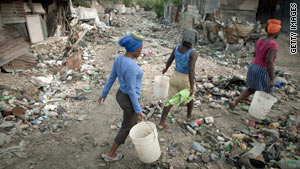
Women walk through a garbage-filled ravine in
quake-Petionville, Haiti, on Wednesday.
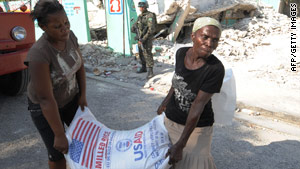
More than two months after a deadly earthquake,
many Haitians remain in dire need of basics such
as food.
c a b l e n e w s n e t w o r k
By the CNN Wire Staff
March 31, 2010
(CNN) -- A broad array of international donors pledged nearly $10 billion in long-term assistance to Haiti's earthquake recovery efforts during a daylong conference at United Nations headquarters.
U.N. Secretary-General Ban Ki-moon opened the conference, titled "Towards a New Future for Haiti," by urging the more than 100 donors in attendance to provide $11.5 billion over the next 10 years for the reconstruction of the island nation left devastated by a 7.0-magnitude quake in January.
"What we envision, today, is wholesale national renewal -- a sweeping exercise in nation-building on a scale and scope not seen in generations," Ban said, according to the United Nations.
The January 12 earthquake killed more than 200,000 people and severely affected the lives of 3 million more. Many are homeless and in dire need of food, clothing, shelter and health care.
More than $5 billion of the $9.9 billion pledged Wednesday will be used for immediate recovery efforts over the next 18 months and will be administered by an interim reconstruction commission co-chaired by former U.S. President Bill Clinton and Haitian Prime Minister Jean-Max Bellerive.
"The rainy season is fast approaching," Ban said in appealing for immediate funding, according to the U.N. "Some camps for displaced persons are at risk of flooding. Heath and sanitation issues are growing more serious."
U.S. Secretary of State Hillary Clinton, in her opening remarks to the conference, pledged $1.15 billion on behalf of the United States but warned the path toward recovery will be a long one that requires lasting commitments from fellow donor nations.
"We cannot just declare our intentions," she said. "We have to follow through and put them into practice. Therefore, this is not only a conference about what financially we pledge to Haiti. We also have to pledge our best efforts to do better ourselves -- to offer our support in a smarter way, a more effective way that produces real results for the people of Haiti."
The United States was one of more than three dozen nations to pledge their support, including Venezuela, Australia, Luxembourg, Canada, Chile, Denmark, Ecuador, Norway, Gambia, Slovenia, Oman and Japan.
Ban praised the fundraising effort in his closing remarks, saying, "This is the downpayment Haiti needs."
"Today, we have mobilized to give Haiti and its people what they need most: hope for a new future," he said. "We have made a good start, we need now to deliver."
Donations will be tracked via a public, Web-based system to ensure transparency and accountability, Ban said.
"We must make sure Haiti gets the money it needs when it needs it. And we must guarantee that it is well-coordinated and well-spent," he said.
Also Monday, Ban named Edmond Mulet as the U.N.'s special representative in Haiti, replacing Hedi Annabi, who died in the quake. Mulet has been the interim special representative since Annabi's death. He will also continue his work as the head of the U.N. Stabilization Mission in Haiti (MINUSTAH).
http://www.cnn.com/2010/WORLD/americas/03/31/haiti.donors/?hpt=T2
Haiti gets nearly $10B in aid pledges</font size></center>
Women walk through a garbage-filled ravine in
quake-Petionville, Haiti, on Wednesday.
More than two months after a deadly earthquake,
many Haitians remain in dire need of basics such
as food.
c a b l e n e w s n e t w o r k
By the CNN Wire Staff
March 31, 2010
(CNN) -- A broad array of international donors pledged nearly $10 billion in long-term assistance to Haiti's earthquake recovery efforts during a daylong conference at United Nations headquarters.
U.N. Secretary-General Ban Ki-moon opened the conference, titled "Towards a New Future for Haiti," by urging the more than 100 donors in attendance to provide $11.5 billion over the next 10 years for the reconstruction of the island nation left devastated by a 7.0-magnitude quake in January.
"What we envision, today, is wholesale national renewal -- a sweeping exercise in nation-building on a scale and scope not seen in generations," Ban said, according to the United Nations.
The January 12 earthquake killed more than 200,000 people and severely affected the lives of 3 million more. Many are homeless and in dire need of food, clothing, shelter and health care.
More than $5 billion of the $9.9 billion pledged Wednesday will be used for immediate recovery efforts over the next 18 months and will be administered by an interim reconstruction commission co-chaired by former U.S. President Bill Clinton and Haitian Prime Minister Jean-Max Bellerive.
"The rainy season is fast approaching," Ban said in appealing for immediate funding, according to the U.N. "Some camps for displaced persons are at risk of flooding. Heath and sanitation issues are growing more serious."
U.S. Secretary of State Hillary Clinton, in her opening remarks to the conference, pledged $1.15 billion on behalf of the United States but warned the path toward recovery will be a long one that requires lasting commitments from fellow donor nations.
"We cannot just declare our intentions," she said. "We have to follow through and put them into practice. Therefore, this is not only a conference about what financially we pledge to Haiti. We also have to pledge our best efforts to do better ourselves -- to offer our support in a smarter way, a more effective way that produces real results for the people of Haiti."
The United States was one of more than three dozen nations to pledge their support, including Venezuela, Australia, Luxembourg, Canada, Chile, Denmark, Ecuador, Norway, Gambia, Slovenia, Oman and Japan.
Ban praised the fundraising effort in his closing remarks, saying, "This is the downpayment Haiti needs."
"Today, we have mobilized to give Haiti and its people what they need most: hope for a new future," he said. "We have made a good start, we need now to deliver."
Donations will be tracked via a public, Web-based system to ensure transparency and accountability, Ban said.
"We must make sure Haiti gets the money it needs when it needs it. And we must guarantee that it is well-coordinated and well-spent," he said.
Also Monday, Ban named Edmond Mulet as the U.N.'s special representative in Haiti, replacing Hedi Annabi, who died in the quake. Mulet has been the interim special representative since Annabi's death. He will also continue his work as the head of the U.N. Stabilization Mission in Haiti (MINUSTAH).
http://www.cnn.com/2010/WORLD/americas/03/31/haiti.donors/?hpt=T2
Be careful when reading big $$$ signs given to Haiti for assistance.
Take the UN for example. More than 80% of annual $$$ spent on the Haiti stabilization mission is spent on UN staff salary, MWR vacation, contractor (middlemen), bonuses & gifts for top officials, etc.
Only about 5% actually made it to the people in whose name the work is being done!
$$$ can be given in many forms. One can give you $1 million worth of tomatoes that expires tomorrow - but it is still a million $$ given.
Take the UN for example. More than 80% of annual $$$ spent on the Haiti stabilization mission is spent on UN staff salary, MWR vacation, contractor (middlemen), bonuses & gifts for top officials, etc.
Only about 5% actually made it to the people in whose name the work is being done!
$$$ can be given in many forms. One can give you $1 million worth of tomatoes that expires tomorrow - but it is still a million $$ given.
<font size="4"><center>
UN aid official frustrated with Haiti progress</font size></center>
By KRISTEN GELINEAU (AP)
June 7, 2010
SYDNEY — The U.N.'s humanitarian chief acknowledged frustration Sunday with the slow progress in providing shelter to the 1.5 million Haitians still homeless because of the Jan. 12 earthquake, and said a large amount of work needs to be done as the hurricane season bears down on the struggling nation.
John Holmes told The Associated Press that the complex process of finding available land for transitional shelters, slow decision-making by the government and new waves of Haitians moving into homeless camps have made responding to the crisis particularly hard.
"We are a bit frustrated that it's taken so long," said Holmes, who is in Australia for a meeting of the U.N. Office for the Coordination of Humanitarian Affairs' donor support group. "We've not been able to build many of these transitional shelters so far."
The hurricane season began last week and forecasters are predicting it will be an active one, with as many as 23 named tropical storms. Deforestation and erosion has left Haiti particularly vulnerable to flooding and mudslides, and a big storm will create misery for those still living under tarps in flood zones five months after the quake.
"We have a lot of things to do and a lot of concerns and a lot of risks before we feel we're in a more comfortable situation," Holmes said.
Complicating matters further is the influx of Haitians moving into homeless camps, which have swelled in size to 1.5 million — almost twice as many as the number estimated soon after the quake.
Following the disaster, hundreds of thousands fled the devastated capital, Port-au-Prince, to outlying cities to stay with relatives. But conditions in those areas are not much better, and with nothing to do and no income, they've begun to head back to the capital and settle in the camps, Holmes said.
Others can no longer afford to pay their rent and feel they have no other alternative but to move to the camps, he said. And although some houses have been deemed safe for people to move back into, many residents are too scared to return, fearing another tremor.
Many Haitians also believe they will get more food and medical aid if they're in the camps than if they're not, Holmes said.
"People feel that somehow that if they're in the camps, then something will be provided in the end — and of course to some extent, it's true," Holmes said. "But I think they may have exaggerated expectations ... which we need to manage. But that's also the responsibility of the government."
Haiti's government has provided another challenge to the process of sheltering the homeless, Holmes said. Its infrastructure was shattered by the quake, and it is still not fully functioning, which means tough decisions take a long time to make, he said.
One major hurdle: getting government approval to build semi-permanent shelters made of wood with galvanized iron roofs. There is no land to build such housing in Port-au-Prince, and though areas have been identified outside the city, it has been hard to reach consensus between land owners, local authorities and the central government, Holmes said.
That's because officials know that transitional settlements are likely to end up becoming permanent settlements for some, which calls into question issues of what will happen to the houses and the people in the long term.
Holmes said he predicts it will be many more months before proper reconstruction can begin.
"It has been an uphill struggle the whole way to make progress," he said.
Copyright © 2010 The Associated Press. All rights reserved.
http://www.google.com/hostednews/ap/article/ALeqM5jGSSDFuvTO5aLCe-Jg4SFPcYQv3AD9G5KDU00
UN aid official frustrated with Haiti progress</font size></center>
By KRISTEN GELINEAU (AP)
June 7, 2010
SYDNEY — The U.N.'s humanitarian chief acknowledged frustration Sunday with the slow progress in providing shelter to the 1.5 million Haitians still homeless because of the Jan. 12 earthquake, and said a large amount of work needs to be done as the hurricane season bears down on the struggling nation.
John Holmes told The Associated Press that the complex process of finding available land for transitional shelters, slow decision-making by the government and new waves of Haitians moving into homeless camps have made responding to the crisis particularly hard.
"We are a bit frustrated that it's taken so long," said Holmes, who is in Australia for a meeting of the U.N. Office for the Coordination of Humanitarian Affairs' donor support group. "We've not been able to build many of these transitional shelters so far."
The hurricane season began last week and forecasters are predicting it will be an active one, with as many as 23 named tropical storms. Deforestation and erosion has left Haiti particularly vulnerable to flooding and mudslides, and a big storm will create misery for those still living under tarps in flood zones five months after the quake.
"We have a lot of things to do and a lot of concerns and a lot of risks before we feel we're in a more comfortable situation," Holmes said.
Complicating matters further is the influx of Haitians moving into homeless camps, which have swelled in size to 1.5 million — almost twice as many as the number estimated soon after the quake.
Following the disaster, hundreds of thousands fled the devastated capital, Port-au-Prince, to outlying cities to stay with relatives. But conditions in those areas are not much better, and with nothing to do and no income, they've begun to head back to the capital and settle in the camps, Holmes said.
Others can no longer afford to pay their rent and feel they have no other alternative but to move to the camps, he said. And although some houses have been deemed safe for people to move back into, many residents are too scared to return, fearing another tremor.
Many Haitians also believe they will get more food and medical aid if they're in the camps than if they're not, Holmes said.
"People feel that somehow that if they're in the camps, then something will be provided in the end — and of course to some extent, it's true," Holmes said. "But I think they may have exaggerated expectations ... which we need to manage. But that's also the responsibility of the government."
Haiti's government has provided another challenge to the process of sheltering the homeless, Holmes said. Its infrastructure was shattered by the quake, and it is still not fully functioning, which means tough decisions take a long time to make, he said.
One major hurdle: getting government approval to build semi-permanent shelters made of wood with galvanized iron roofs. There is no land to build such housing in Port-au-Prince, and though areas have been identified outside the city, it has been hard to reach consensus between land owners, local authorities and the central government, Holmes said.
That's because officials know that transitional settlements are likely to end up becoming permanent settlements for some, which calls into question issues of what will happen to the houses and the people in the long term.
Holmes said he predicts it will be many more months before proper reconstruction can begin.
"It has been an uphill struggle the whole way to make progress," he said.
Copyright © 2010 The Associated Press. All rights reserved.
http://www.google.com/hostednews/ap/article/ALeqM5jGSSDFuvTO5aLCe-Jg4SFPcYQv3AD9G5KDU00
<font size="5"><center>
A new kind of mobile aid for Haiti</font size><font size="4">
The Gates Foundation and the US Agency for International
Development (USAID) will award cash $10m to companies
that set up mobile banking services in Haiti yo help Haitians
use their own mobile phones to send, receive and store
money - services known as “mobile money” or “mobile banking”</font size></center>
Financial Times
June 9, 2010 9:09pm
by Shannon Bond
After Haiti’s devastating earthquake in January, people around the world whipped out their mobile phones to send millions of dollars in aid via text message to charities including the Red Cross. Now a new $10m fund aims to help Haitians use their own mobile phones to send, receive and store money - services known as “mobile money” or “mobile banking”.
The fund, a partnership between the Gates Foundation and the US Agency for International Development (USAID), will award cash to companies that set up mobile banking services in Haiti. More than a third of the island nation’s banks, ATMs, and money transfer locations were destroyed in the quake, according to the Gates Foundation - and few Haitians had access to traditional banking in the first place.
“Before the earthquake, fewer than 10 per cent of Haitians had ever used a commercial bank”, said Rajiv Shah, USAID administrator. “A mobile money system can restore and remake banking in Haiti and serve as an engine of inclusive growth.”
Such mobile money services are becoming increasingly popular across the developing world, particularly in Africa. As the FT’s Richard Lapper reports, “more and more banks are competing for the business of the 15m adult South Africans who had previously been excluded from the financial system” by offering insurance policies, micro loans - and mobile banking. And telecoms groups are offering services, such as Vodafone’s M-Pesa initiative in Kenya (which is soon expanding to South Africa).
<font size="4">How it Works</font size>
The practice “has grown out of the widespread custom of using prepaid calling credit as an informal currency”, The Economist explained last fall in a special report on emerging markets telecoms:
Advocates say these services make transferring money cheaper by lowering commissions and cutting transportation costs, encourage savings and increased access to credit.
“Making financial services widely available to the poorest families in the developing world can help break the cycle of poverty by giving them a safe place to save, guard against risks, build assets, and provide opportunities for the next generation”, said Mark Suzman, who heads the Gates Foundation’s Global Development Program.
http://blogs.ft.com/beyond-brics/2010/06/09/a-new-kind-of-mobile-aid-for-haiti/
A new kind of mobile aid for Haiti</font size><font size="4">
The Gates Foundation and the US Agency for International
Development (USAID) will award cash $10m to companies
that set up mobile banking services in Haiti yo help Haitians
use their own mobile phones to send, receive and store
money - services known as “mobile money” or “mobile banking”</font size></center>
Financial Times
June 9, 2010 9:09pm
by Shannon Bond
After Haiti’s devastating earthquake in January, people around the world whipped out their mobile phones to send millions of dollars in aid via text message to charities including the Red Cross. Now a new $10m fund aims to help Haitians use their own mobile phones to send, receive and store money - services known as “mobile money” or “mobile banking”.
The fund, a partnership between the Gates Foundation and the US Agency for International Development (USAID), will award cash to companies that set up mobile banking services in Haiti. More than a third of the island nation’s banks, ATMs, and money transfer locations were destroyed in the quake, according to the Gates Foundation - and few Haitians had access to traditional banking in the first place.
“Before the earthquake, fewer than 10 per cent of Haitians had ever used a commercial bank”, said Rajiv Shah, USAID administrator. “A mobile money system can restore and remake banking in Haiti and serve as an engine of inclusive growth.”
Such mobile money services are becoming increasingly popular across the developing world, particularly in Africa. As the FT’s Richard Lapper reports, “more and more banks are competing for the business of the 15m adult South Africans who had previously been excluded from the financial system” by offering insurance policies, micro loans - and mobile banking. And telecoms groups are offering services, such as Vodafone’s M-Pesa initiative in Kenya (which is soon expanding to South Africa).
<font size="4">How it Works</font size>
The practice “has grown out of the widespread custom of using prepaid calling credit as an informal currency”, The Economist explained last fall in a special report on emerging markets telecoms:
Once you have signed up, you pay money into the system by handing cash to an agent (usually a mobile operator’s airtime vendor), who credits the money to your mobile-money account. You can withdraw money by visiting another agent, who checks that you have sufficient funds before debiting your account and handing over the cash. You can also send money to other people, who will be sent a text message containing a special code that can be taken to an agent to withdraw cash. This allows cash to be sent from one place to another quickly and easily.
Advocates say these services make transferring money cheaper by lowering commissions and cutting transportation costs, encourage savings and increased access to credit.
“Making financial services widely available to the poorest families in the developing world can help break the cycle of poverty by giving them a safe place to save, guard against risks, build assets, and provide opportunities for the next generation”, said Mark Suzman, who heads the Gates Foundation’s Global Development Program.
http://blogs.ft.com/beyond-brics/2010/06/09/a-new-kind-of-mobile-aid-for-haiti/

`
The international community's responsibility to Haiti
<font size="3">IMF-mandated economic policies drove rural Haitians to Port-au-
Prince's slums, where they bore the full force of the earthquake
</font size>
Six months after the Haiti earthquake, what progress?
<font size="3">Six months after the 7.0 Haiti earthquake caused one of the worst
humanitarian disasters in modern times, the worse-case scenarios
have been avoided. Yet tens of thousands still live in camps.
</font size>

I just read about this today, they don't have the heavy equipment needed to clear rubble. To date 2% has been cleared since January...Sad
Haiti still waiting for pledged US aid

PORT-AU-PRINCE, Haiti – Nearly nine months after the earthquake, more than a million Haitians still live on the streets between piles of rubble. One reason: Not a cent of the $1.15 billion the U.S. promised for rebuilding has arrived.
The money was pledged by Secretary of State Hillary Clinton in March for use this year in rebuilding. The U.S. has already spent more than $1.1 billion on post-quake relief, but without long-term funds, the reconstruction of the wrecked capital cannot begin.
With just a week to go before fiscal 2010 ends, the money is still tied up in Washington. At fault: bureaucracy, disorganization and a lack of urgency, The Associated Press learned in interviews with officials in the State Department, the Senate Foreign Relations Committee, the White House and the U.N. Office of the Special Envoy. One senator has held up a key authorization bill because of a $5 million provision he says will be wasteful.
Meanwhile, deaths in Port-au-Prince are mounting, as quake survivors scramble to live without shelter or food.
"There are truly lives at stake, and the idea that folks are spending more time finger-pointing than getting this solved is almost unbelievable," said John Simon, a former U.S. ambassador to the African Union who is now with the Center for Global Development, a Washington think tank.
Nor is Haiti getting much from other donors. Some 50 other nations and organizations pledged a total of $8.75 billion for reconstruction, but just $686 million of that has reached Haiti so far — less than 15 percent of the total promised for 2010-11.
The lack of funds has all but halted reconstruction work by CHF International, the primary U.S.-funded group assigned to remove rubble and build temporary shelters. Just 2 percent of rubble has been cleared and 13,000 temporary shelters have been built — less than 10 percent of the number planned.
The Maryland-based agency is asking the U.S. government for $16.5 million to remove more than 21 million cubic feet of additional rubble and build 4,000 more temporary houses out of wood and metal.
"It's just a matter of one phone call and the trucks are out again. We have contractors ready to continue removing rubble. ... We have local suppliers and international suppliers ready to ship the amount of wood and construction materials we need," said CHF country director Alberto Wilde. "It's just a matter of money."
Last week the inaction bore tragic results. On Friday an isolated storm destroyed an estimated 8,000 tarps, tents and shacks in the capital and killed at least six people, including two children. And the threat of violence looms as landowners threaten entire camps with forced eviction.
In Washington there is confusion about the money. At a July hearing, Ravij Shah, director of the U.S. Agency for International Development, thanked members of Congress for approving the funds, saying, "The resources are flowing and are being spent in country."
It wasn't true then, and still hasn't happened.
When the earthquake hit, U.S. agencies sent troops, rescuers, aid workers and supplies to the devastated capital, Port-au-Prince. On March 24, President Barack Obama asked Congress for $2.8 billion in emergency aid to Haiti — about half to pay back money already spent by USAID, the Defense Department and others. An additional $212 million was to write off debt.
The heart of the request was $1.15 billion in new reconstruction funds.
A week later, Clinton touted that figure in front of representatives of 50 nations at the U.N. secretariat, the president of Haiti at her side.
"If the effort to rebuild is slow or insufficient, if it is marked by conflict, lack of coordination or lack of transparency, then the challenges that have plagued Haiti for years could erupt with regional and global consequences," Clinton said.
That was nearly six months ago. It took until May for the Senate to pass a supplemental request for the Haiti funds and until July for the House to do the same. The votes made $917 million available but did not dictate how or when to spend it. Without that final step, the money remains in the U.S. Treasury.
Then came summer recess, emergencies in Pakistan and elsewhere, and the distractions of election politics.
Now the authorization bill that would direct how the aid is delivered remains sidelined by a senator who anonymously pulled it for further study. Through calls to dozens of senators' offices, the AP learned it was Sen. Tom Coburn, a Republican from Oklahoma.
"He is holding the bill because it includes an unnecessary senior Haiti coordinator when we already have one" in U.S. Ambassador Kenneth Merten, Coburn spokeswoman Becky Bernhardt said.
The bill proposes a new coordinator in Washington who would not oversee U.S. aid but would work with the USAID administrator in Washington to develop a rebuilding strategy. The position would cost $1 million a year for five years, including salaries and expenses for a staff of up to seven people.
With the bill on hold, the State Department is trying to move the money along by avoiding Congress as much as possible. It sent lawmakers a "spending plan" on Sept. 20 and gave legislators 15 days to review it. If they fail to act on the plan, the money could be released as soon as specific projects get the OK.
"We need to make sure that the needs of the Haitian people are not sacrificed to procedural and bureaucratic impediments," Senate Foreign Relations Committee chairman John Kerry told the AP by e-mail. "As we approach nine months since the earthquake, further delays on any side are unacceptable."
Asked when the money will actually come, State Department spokesman Charles Luoma-Overstreet said the department expects to start spending in the coming weeks and months. He added that $275 million in "bridge" funds were released in March and have gone toward agriculture, work, health and shelter programs — not long-term reconstruction.
Haitian advocates say that is not enough.
Jean-Claude Bajeuax of the Ecumenical Center for Human Rights in Port-au-Prince said this phase was supposed to be about building semi-permanent houses.
"Where are they? We haven't seen them," he said. "There is not much money that is being used. There is not much work that has actually been done."
Of course there is no guarantee that the money would lead to the successful rebuilding of Haiti. Many past U.S. aid efforts have fallen short.
"I don't think (the money) will make any difference," said Haitian human rights advocate Pierre Esperance. "Haitian people are not really involved in this process."
But officials agree the funds could pay for new approaches to make Haiti more sustainable, and rebuilding projects could improve millions of lives.
The AP found that $874 million of the funds pledged by other countries at the donors conference was money already promised to Haiti for work or aid before the quake. An additional $1.13 million wasn't ever going to be sent; it was debt relief. And $184 million was in loans to Haiti's government, not aid.
The Office of the Special Envoy has been tracking the money delivered so far but does not know who got it. The envoy himself, former President Bill Clinton, told the AP in July and again in August that he was putting pressure on donors to meet their pledges.
On the streets of Haiti, many simply feel abandoned. Mishna Gregoire, 22, said she was happy when she heard about the donors conference. But six months later she is still in a tarp city with 5,000 other people, on a foul-smelling plaza in the Port-au-Prince suburb of Petionville.
"I thought it was something serious they were really going to do," Gregoire said, standing amid tarps torn apart by the sudden storm. "But nothing has been done. And I don't think anything will be done."
Tom Coburn Holding Up Millions Of Dollars In Aid For Haiti Earthquake Survivors
source: Think Progress
Coburn Holding Up Millions Of Dollars In Aid For Haiti Earthquake Survivors Over Obscure Objection
Last spring, the United States pledged nearly $1.2 billion in emergency aid to Haiti following its tragic earthquake that left hundreds of thousands of people dead and many more homeless.
Yet the Associated Press (AP) reports today that “not a cent of the $1.15 billion the U.S. promised for rebuilding has arrived” to Haitians who badly the need the aid. This summer, both the House and the Senate passed a bill that would make $917 million available for Haiti reconstruction aid. Yet Congress must also pass an authorization bill that directs exactly how the money will be spent, and thus far, the U.S. Senate has failed to do.
The AP conducted its own investigation of why the Senate has failed to pass the authorization bill, and it discovered that a single senator “pulled it for further study.” After calling dozens of senators’ offices, the AP discovered that the senator holding up the bill is Tom Coburn (R-OK). Coburn spokeswoman Becky Berhardt explained that the reason he is holding up the bill is because he objects to the creation of a senior Haiti coordinator — a position that would cost a paltry $5 million over five years — when the United States currently has an ambassador to the country:
<!-- post updates would go here in theory --><!-- end #entryContent -->
source: Think Progress
Coburn Holding Up Millions Of Dollars In Aid For Haiti Earthquake Survivors Over Obscure Objection
Last spring, the United States pledged nearly $1.2 billion in emergency aid to Haiti following its tragic earthquake that left hundreds of thousands of people dead and many more homeless.
Yet the Associated Press (AP) reports today that “not a cent of the $1.15 billion the U.S. promised for rebuilding has arrived” to Haitians who badly the need the aid. This summer, both the House and the Senate passed a bill that would make $917 million available for Haiti reconstruction aid. Yet Congress must also pass an authorization bill that directs exactly how the money will be spent, and thus far, the U.S. Senate has failed to do.
The AP conducted its own investigation of why the Senate has failed to pass the authorization bill, and it discovered that a single senator “pulled it for further study.” After calling dozens of senators’ offices, the AP discovered that the senator holding up the bill is Tom Coburn (R-OK). Coburn spokeswoman Becky Berhardt explained that the reason he is holding up the bill is because he objects to the creation of a senior Haiti coordinator — a position that would cost a paltry $5 million over five years — when the United States currently has an ambassador to the country:
Now the authorization bill that would direct how the aid is delivered remains sidelined by a senator who anonymously pulled it for further study. Through calls to dozens of senators’ offices, the AP learned it was Sen. Tom Coburn, a Republican from Oklahoma. “He is holding the bill because it includes an unnecessary senior Haiti coordinator when we already have one” in U.S. Ambassador Kenneth Merten, Coburn spokeswoman Becky Bernhardt said.
The bill proposes a new coordinator in Washington who would not oversee U.S. aid but would work with the USAID administrator in Washington to develop a rebuilding strategy. The position would cost $1 million a year for five years, including salaries and expenses for a staff of up to seven people.
While Coburn continues to hold up much-needed reconstruction aid over a relatively meaningless objection, “just 2 percent of [Haiti's earthquake] rubble has been cleared and 13,000 temporary shelters have been built – less than 10 percent of the number planned.” There are estimated to be 1.3 million Haitians still homeless as a result of the earthquake.The bill proposes a new coordinator in Washington who would not oversee U.S. aid but would work with the USAID administrator in Washington to develop a rebuilding strategy. The position would cost $1 million a year for five years, including salaries and expenses for a staff of up to seven people.
<!-- post updates would go here in theory --><!-- end #entryContent -->
Re: Haiti still waiting for pledged US aid
<font size="5"><center>
Palin to visit Haiti for humanitarian effort</font size></center>
Washington Post
By BECKY BOHRER
The Associated Press
December 9, 2010
JUNEAU, Alaska -- Former Alaska Gov. Sarah Palin plans to visit Haiti amid a period of political upheaval this weekend to aid humanitarian efforts in the Caribbean country.
A Palin staffer confirmed Thursday that Palin, the 2008 vice presidential nominee and a potential 2012 presidential contender, planned to travel to Haiti with the Rev. Franklin Graham as part of the outreach of his Samaritan's Purse relief organization.
A spokeswoman for the group confirmed Palin planned to visit relief sites this weekend.
A cholera outbreak has killed more than 2,000 people in Haiti, a country that is still recovering from a devastating earthquake earlier this year and is in the midst of a disputed presidential election.
Gunfire and barricades were reported Thursday in the capital city of Port-au-Prince, and the U.S. State Department reissued a travel warning to the country and recommended against nonessential travel.
Graham said he appreciates Palin's willingness to visit Haiti during such troubled times.
<SPAN style="BACKGROUND-COLOR: #ffff00">"I believe Gov. Palin will be a great encouragement to the people of Haiti</span> and to the organizations, both government and private, working so hard to provide desperately needed relief," he said in a statement.
Graham heads the Billy Graham Evangelistic Association, founded by his father, the Rev. Billy Graham. His Samaritan's Purse has maintained a presence in Haiti, treating thousands of people, building a cholera clinic and bringing in plane loads of medical aid, according to its website.
Palin staffer Rebecca Mansour said plans called for Palin to be joined by her husband, Todd, and, Mansour believed, daughter Bristol as well. She described the plans as fluid.
http://www.washingtonpost.com/wp-dyn/content/article/2010/12/09/AR2010120905633.html
<font size="5"><center>
Palin to visit Haiti for humanitarian effort</font size></center>
Washington Post
By BECKY BOHRER
The Associated Press
December 9, 2010
JUNEAU, Alaska -- Former Alaska Gov. Sarah Palin plans to visit Haiti amid a period of political upheaval this weekend to aid humanitarian efforts in the Caribbean country.
A Palin staffer confirmed Thursday that Palin, the 2008 vice presidential nominee and a potential 2012 presidential contender, planned to travel to Haiti with the Rev. Franklin Graham as part of the outreach of his Samaritan's Purse relief organization.
A spokeswoman for the group confirmed Palin planned to visit relief sites this weekend.
A cholera outbreak has killed more than 2,000 people in Haiti, a country that is still recovering from a devastating earthquake earlier this year and is in the midst of a disputed presidential election.
Gunfire and barricades were reported Thursday in the capital city of Port-au-Prince, and the U.S. State Department reissued a travel warning to the country and recommended against nonessential travel.
Graham said he appreciates Palin's willingness to visit Haiti during such troubled times.
<SPAN style="BACKGROUND-COLOR: #ffff00">"I believe Gov. Palin will be a great encouragement to the people of Haiti</span> and to the organizations, both government and private, working so hard to provide desperately needed relief," he said in a statement.
Graham heads the Billy Graham Evangelistic Association, founded by his father, the Rev. Billy Graham. His Samaritan's Purse has maintained a presence in Haiti, treating thousands of people, building a cholera clinic and bringing in plane loads of medical aid, according to its website.
Palin staffer Rebecca Mansour said plans called for Palin to be joined by her husband, Todd, and, Mansour believed, daughter Bristol as well. She described the plans as fluid.
http://www.washingtonpost.com/wp-dyn/content/article/2010/12/09/AR2010120905633.html
<font size="5"><center>
A year after earthquake,
Haiti's recovery remains gridlocked</font size></center>

Haitian people walk on a street in Port-au-Prince, Haiti. | Eliana Aponte/Miami
Herald/MCT)
McClatchy Newspapers
By Jim Wyss and J
acqueline Charles
Monday, January 10, 2011
PORT-AU-PRINCE, Haiti — Jenny-Carls Joseph dreams of going home. But home is a nightmare of broken concrete and twisted steel that, a year after Haiti's Jan. 12 earthquake, still holds his father's body.
Johnny Brandt would like to have his industrial park back, where he'd planned to build a factory. But more than 24,000 people —including Joseph — still live there in a sprawling settlement of tattered tarps and dusty tents.
Twelve months after the world rushed to Haiti's aid, the country is mired in reconstruction gridlock. Despite more than $10 billion in pledged aid and the good intentions of more than 10,000 aid organizations, its capital, Port-au-Prince, remains a sobering sight: More than 1 million people still live in more than 1,000 tent cities.
And then there's the rubble. After the 2004 tsunami in Indonesia, it took 2 1/2 years to remove 35 million cubic feet of debris, said Thomas Adams, the Haiti special coordinator for the U.S. Department of State. Haiti is suffocating under 20 times that much rubble.
"People cannot conceive of how many truckloads that is," Adams said. "The rubble will be around for a couple of years in the best of circumstances."
Only 5 percent of the rubble has been moved, with progress stymied in part because there's only one dump site to put it in. The Interim Haiti Recovery Commission, the agency responsible for quake relief that former President Bill Clinton and Haitian Prime Minister Jean-Max Bellerive co-chair, has been struggling to get donors to focus on the problem.
"Rubble removal is not sexy," Adams said. "There is no monument on a spot saying, 'The U.S. government moved 1 million cubic meters of rubble.' And other countries would like to put their money into health or education."
Meanwhile, companies have been clamoring for contracts.
"It has been clear for months and months that nothing is going to take place and there will be no recovery until the demolition takes place," said Randal Perkins, the CEO of AshBritt, a Florida company that won a controversial no-bid contract in partnership with a Haitian company to remove some of the debris. "It affects shelters. It affects everything. We have to get the place cleaned up, and right now money is the issue."
If debris is the most visible obstacle, others are equally daunting. Land disputes, arguments over strategy, disappointment in the Interim Haiti Recovery Commission and lack of hard cash — as opposed to just pledges — also have hampered the process.
"It is hard to be optimistic about progress," the British aid organization Oxfam said in a recent report about the recovery.
Government inaction and lack of money have hampered plans to build massive communities to lure people out of the tent cities. Eduardo Marques Almeida, the resident representative of the Inter-American Development Bank, said his organization had had to scuttle various housing projects because there was a lack of suitable land — and multiple ownership claims on some parcels.
"Whenever we decide to go to a specific land, someone calls me saying, 'This is my land, not the government's land,' " he said. "We have to solve this issue."
Two emergency relocation camps, Corail and Tabarre Issa, that were supposed to anchor new communities are struggling. Both are treeless, remote sites, far removed from the commerce and bustle of Port-au-Prince. Jobs are a problem, and the one-room homes are more humble than people expected.
"It's so small we cannot do anything inside," Melian Remis, 38, said outside her brand-new home in Tabarre Issa, where she lives with seven relatives. "At night, we sleep like fish, packed in together."
"Having the people in Corail, where most of the houses have been built, is not going to work. There is nothing there," Almeida said. "If they don't have jobs and access to education, it's not sustainable."
An undercurrent of competition and complaints that pit Haitian government officials against aid groups and international agencies is coloring the whole effort.
Jeff Kerzner, the Haiti country director of the Pan American Development Foundation, argues that aid money is being wasted on putting up temporary shelters. For the same amount of money, he says, work crews could repair homes so that residents could move back into them.
Kerzner said engineers already had assessed 382,000 buildings in Port-au-Prince and found that 54 percent were safe to move into and another 26 percent could be repaired.
At a price tag of about $1,300 per home, the costs are comparable to building a temporary shelter, Kerzner said. And the project skirts the issues of land titles and community displacement, he said.
But his view isn't universally accepted. Some wonder whether rebuilding without rethinking makes any sense. They note that the earthquake was so lethal partly because of the capital's densely packed, poorly planned neighborhoods.
"This place is a place that was built in a totally ad hoc fashion," said Nigel Fisher, the United Nations humanitarian coordinator in Haiti. "Do you rebuild that? It's an urban renewal question but it's also a social question."
What's clear is that homes alone aren't enough.
The tent cities offer potable water, sanitation and even free health care, basic services that more than 30 percent of the population lacked before the earthquake, Prime Minister Bellerive said.
"Even if (people) have a little home, they refuse to return to their homes," he said. "They are saying, 'I am going to stay there until you find a long-term solution. ... I am going to stay there until I see clearly my future.' "
Brandt, the owner of the industrial park where 24,000 people are living, said he'd lost faith in the aid groups and the government. He's met with both to find a way to regain control of the parcel, which is his guarantee on a line of credit for his company, European Motors, but they offer little hope.
"They have been there for a year and they are well taken care of," he said of his uninvited tenants, who get clean water, free health care and some food rations from aid groups. "Even if they had a place to go, they might not."
Joseph, whose father lies beneath the year-old rubble, agrees he's unlikely to leave.
"I won't leave this camp until everyone has a home to go to," he said, watching children jump rope on a thin slice of dirt between tents. "That's my dream. I'll be here until the end."
(Wyss and Charles report for The Miami Herald.)
http://www.mcclatchydc.com/2011/01/10/106558/a-year-after-earthquake-haitis.html
A year after earthquake,
Haiti's recovery remains gridlocked</font size></center>
Haitian people walk on a street in Port-au-Prince, Haiti. | Eliana Aponte/Miami
Herald/MCT)
McClatchy Newspapers
By Jim Wyss and J
acqueline Charles
Monday, January 10, 2011
PORT-AU-PRINCE, Haiti — Jenny-Carls Joseph dreams of going home. But home is a nightmare of broken concrete and twisted steel that, a year after Haiti's Jan. 12 earthquake, still holds his father's body.
Johnny Brandt would like to have his industrial park back, where he'd planned to build a factory. But more than 24,000 people —including Joseph — still live there in a sprawling settlement of tattered tarps and dusty tents.
Twelve months after the world rushed to Haiti's aid, the country is mired in reconstruction gridlock. Despite more than $10 billion in pledged aid and the good intentions of more than 10,000 aid organizations, its capital, Port-au-Prince, remains a sobering sight: More than 1 million people still live in more than 1,000 tent cities.
And then there's the rubble. After the 2004 tsunami in Indonesia, it took 2 1/2 years to remove 35 million cubic feet of debris, said Thomas Adams, the Haiti special coordinator for the U.S. Department of State. Haiti is suffocating under 20 times that much rubble.
"People cannot conceive of how many truckloads that is," Adams said. "The rubble will be around for a couple of years in the best of circumstances."
Only 5 percent of the rubble has been moved, with progress stymied in part because there's only one dump site to put it in. The Interim Haiti Recovery Commission, the agency responsible for quake relief that former President Bill Clinton and Haitian Prime Minister Jean-Max Bellerive co-chair, has been struggling to get donors to focus on the problem.
"Rubble removal is not sexy," Adams said. "There is no monument on a spot saying, 'The U.S. government moved 1 million cubic meters of rubble.' And other countries would like to put their money into health or education."
Meanwhile, companies have been clamoring for contracts.
"It has been clear for months and months that nothing is going to take place and there will be no recovery until the demolition takes place," said Randal Perkins, the CEO of AshBritt, a Florida company that won a controversial no-bid contract in partnership with a Haitian company to remove some of the debris. "It affects shelters. It affects everything. We have to get the place cleaned up, and right now money is the issue."
If debris is the most visible obstacle, others are equally daunting. Land disputes, arguments over strategy, disappointment in the Interim Haiti Recovery Commission and lack of hard cash — as opposed to just pledges — also have hampered the process.
"It is hard to be optimistic about progress," the British aid organization Oxfam said in a recent report about the recovery.
Government inaction and lack of money have hampered plans to build massive communities to lure people out of the tent cities. Eduardo Marques Almeida, the resident representative of the Inter-American Development Bank, said his organization had had to scuttle various housing projects because there was a lack of suitable land — and multiple ownership claims on some parcels.
"Whenever we decide to go to a specific land, someone calls me saying, 'This is my land, not the government's land,' " he said. "We have to solve this issue."
Two emergency relocation camps, Corail and Tabarre Issa, that were supposed to anchor new communities are struggling. Both are treeless, remote sites, far removed from the commerce and bustle of Port-au-Prince. Jobs are a problem, and the one-room homes are more humble than people expected.
"It's so small we cannot do anything inside," Melian Remis, 38, said outside her brand-new home in Tabarre Issa, where she lives with seven relatives. "At night, we sleep like fish, packed in together."
"Having the people in Corail, where most of the houses have been built, is not going to work. There is nothing there," Almeida said. "If they don't have jobs and access to education, it's not sustainable."
An undercurrent of competition and complaints that pit Haitian government officials against aid groups and international agencies is coloring the whole effort.
Jeff Kerzner, the Haiti country director of the Pan American Development Foundation, argues that aid money is being wasted on putting up temporary shelters. For the same amount of money, he says, work crews could repair homes so that residents could move back into them.
Kerzner said engineers already had assessed 382,000 buildings in Port-au-Prince and found that 54 percent were safe to move into and another 26 percent could be repaired.
At a price tag of about $1,300 per home, the costs are comparable to building a temporary shelter, Kerzner said. And the project skirts the issues of land titles and community displacement, he said.
But his view isn't universally accepted. Some wonder whether rebuilding without rethinking makes any sense. They note that the earthquake was so lethal partly because of the capital's densely packed, poorly planned neighborhoods.
"This place is a place that was built in a totally ad hoc fashion," said Nigel Fisher, the United Nations humanitarian coordinator in Haiti. "Do you rebuild that? It's an urban renewal question but it's also a social question."
What's clear is that homes alone aren't enough.
The tent cities offer potable water, sanitation and even free health care, basic services that more than 30 percent of the population lacked before the earthquake, Prime Minister Bellerive said.
"Even if (people) have a little home, they refuse to return to their homes," he said. "They are saying, 'I am going to stay there until you find a long-term solution. ... I am going to stay there until I see clearly my future.' "
Brandt, the owner of the industrial park where 24,000 people are living, said he'd lost faith in the aid groups and the government. He's met with both to find a way to regain control of the parcel, which is his guarantee on a line of credit for his company, European Motors, but they offer little hope.
"They have been there for a year and they are well taken care of," he said of his uninvited tenants, who get clean water, free health care and some food rations from aid groups. "Even if they had a place to go, they might not."
Joseph, whose father lies beneath the year-old rubble, agrees he's unlikely to leave.
"I won't leave this camp until everyone has a home to go to," he said, watching children jump rope on a thin slice of dirt between tents. "That's my dream. I'll be here until the end."
(Wyss and Charles report for The Miami Herald.)
http://www.mcclatchydc.com/2011/01/10/106558/a-year-after-earthquake-haitis.html

<font size="5"><center>
One Year Later
</font size></center>

Peterson Joseph, 24, lost his leg and home to the earthquake in Haiti in January 2010. He
checks on his belongings hidden in sheets that once substituted for a tent. (Carl Juste/
Miami Herald/MCT)

Sitting inside the destroyed National Catherdral in Port-au-Prince, Haiti, Robert Fritz, 23,
holds his daughter, Cristella Pierre Saint, as he waits for visitors to peddle for some loose
change. Cristella was born on the day of the earthquake just outside the cathedral.
She lost her mother just after birth. (Carl Juste/Miami Herald/MCT)

Haitian people walk at the market in Jacmel, Haiti. (Eliana Aponte/Miami Herald/MCT)

Melian Remis, who lives with seven family members in a shelter, said she's thankful to be out
of a tent and in a solid structure, but it's too small to be a permanent solution. "At night
we sleep like fish, packed in together" said Remis in Tabarre Issa, Haiti. (Jim Wyss/Miami
Herald/MCT)

A Haitian woman stands next to her new shelter at L'annexe de la Mairie refuge camp in
Port-au-Prince, Haiti. (Eliana Aponte/Miami Herald/MCT)
http://www.mcclatchydc.com/2011/01/10/106544_a106541/haiti-one-year-after-the-earthquake.html
One Year Later
</font size></center>
Peterson Joseph, 24, lost his leg and home to the earthquake in Haiti in January 2010. He
checks on his belongings hidden in sheets that once substituted for a tent. (Carl Juste/
Miami Herald/MCT)
Sitting inside the destroyed National Catherdral in Port-au-Prince, Haiti, Robert Fritz, 23,
holds his daughter, Cristella Pierre Saint, as he waits for visitors to peddle for some loose
change. Cristella was born on the day of the earthquake just outside the cathedral.
She lost her mother just after birth. (Carl Juste/Miami Herald/MCT)
Haitian people walk at the market in Jacmel, Haiti. (Eliana Aponte/Miami Herald/MCT)
Melian Remis, who lives with seven family members in a shelter, said she's thankful to be out
of a tent and in a solid structure, but it's too small to be a permanent solution. "At night
we sleep like fish, packed in together" said Remis in Tabarre Issa, Haiti. (Jim Wyss/Miami
Herald/MCT)
A Haitian woman stands next to her new shelter at L'annexe de la Mairie refuge camp in
Port-au-Prince, Haiti. (Eliana Aponte/Miami Herald/MCT)
http://www.mcclatchydc.com/2011/01/10/106544_a106541/haiti-one-year-after-the-earthquake.html
Similar threads


- Replies
- 5
- Views
- 231

- Replies
- 6
- Views
- 354

- Replies
- 3
- Views
- 213

