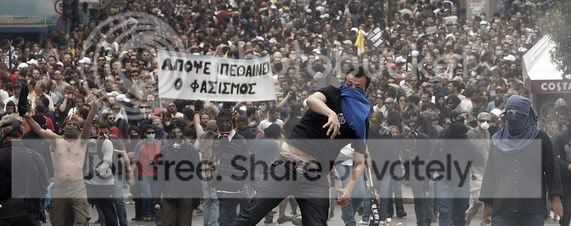
Greece erupts as men from IMF prepare to wield axe

Panameno718

Potential Star
Registered
http://www.timesonline.co.uk/tol/news/world/europe/article7113941.ece
MAY DAY protests in Greece turned violent yesterday as youths in gas masks and hoods set fire to vehicles, smashed shop fronts and threw molotov cocktails and rocks at police in an explosion of fury over austerity measures they claim will hurt only the poor.

Tourists were cut off from their hotels as thousands of communists, civil servants and private-sector workers converged on a main square in Athens to vent their rage at the European Union and the International Monetary Fund (IMF).

“No to the IMF’s junta,” they chanted as a youth in a black hood produced a hammer to try to smash windows of the luxury Grande Bretagne hotel.

Another painted anti-capitalist slogans on the facade, and demonstrators intervened to prevent him from spraying an Australian woman with paint as she tried to get back into the hotel. Japanese tourists stood taking photographs of the mayhem with mobile phones before being forced to retreat, coughing and sneezing, under a cloud of tear gas.

Related Links
Spain downgrade sparks European sell-off
Cost of covering Greek debt heads higher
The violence came as negotiations were concluding between the socialist government of George Papandreou, the IMF and the EU over a multi-billion-euro rescue package for Greece.

Anger has grown against the EU for insisting on tough austerity measures in return for a bailout worth an estimated €45 billion (£39 billion) this year alone, and up to €120 billion (£104 billion) over three years.

Some young Greeks prefer to blame their elders for the mountain of debt that has resulted in Greece, like a wayward child, being placed under the tutelage of the men from the IMF.

“I cannot help but blame my parents a little for what’s happened,” said Achilles Zacharoulis, a 36-year-old cardiologist. “They were here all that time,” he added, referring to the past three decades of mismanagement and fiscal insanity. “But what did they do to stop it?”

Vaggelis Gettos, 24, is just as alarmed at the burden being heaped on the young by austerity measures expected to be announced today, and has pledged to resist them in more protests this week against what he sees as a plot to impoverish Greece.

“We will live much worse than our parents,” he said. “Why should we be made to pay for their mistakes?”

The question of who was to blame and who should pay for the greatest crisis to afflict the single currency was a subject of heated debate, particularly after a leading credit rating agency put the cradle of civilisation in the same category as Azerbaijan by reducing its government bonds to “junk” status.

Economists regard the bloated civil service with its jobs for life and generous pensions as a cancer consuming the country’s resources. The older generation, the experts grimly concur, turned the state into a giant cash machine to be plundered at will.

Today the party is over, however, and that makes some experts optimistic: Greece now has no choice but to implement much-needed reforms that will bring swift results. “It’s like a dentist putting a child in braces,” said one observer. “It’s not nice, but necessary for growth in the right direction.”

Even before it was announced, the rescue package had provoked angry outbursts. On Thursday, Gettos and friends tried to break through a police cordon outside the finance ministry only to be forced back by tear gas.

They were in the thick of things again yesterday when police used tear gas to prevent protesters from marching on the American embassy.

Even greater social unrest is expected as resentment simmers among poorer families at being told to tighten their belts when wealthy Greeks can protect their fortunes by moving their money abroad, some of it into property bargains in London.

“It’s always the poor people who pay,” complained Katerina Ioannou, 20, in the cafeteria of the Athens University law faculty, a hotbed of student activism. “If I get a job as a trainee lawyer I’ll only earn €300 [£260] a month,” said Thanos Petrou, 21. “How can anyone survive on that?”

Some are already referring to a “lost generation” who will never find jobs or security, but the students, proud of their university’s reputation for being at the forefront of the uprising against the military dictatorship in 1973, are not the only ones planning resistance.

Mikis Theodorakis, the 84-year-old musician who composed the score for the film Zorba the Greek, calls for revolt against what he sees as an American plot to turn Greece into a “protectorate”. Bureaucrats will raise their fists at the barricades in a general strike and protests on Wednesday to protect their considerable perks from the IMF.

They and other public sector workers are virtually unsackable, can retire as early as 45 and get bonuses for using a computer, speaking a foreign language and arriving at work on time.

Some of them get as many as four extra months’ salary a year, compared with the 14 months that are paid to other Greek workers. One of the most generous bonuses is paid to unmarried daughters of dead employees in state-controlled banks: they can inherit their parents’ pensions.

Stefanos, 49, seems to embody the Greek good life. He retired as an army captain last year on a full pension and says he is quite happy planting his garden. He worries, though, about how to protect his savings from the crisis. “What about banks in Germany?” he asked friends around a dinner table in Athens.

“There’s an awful lot of fat to cut from the system,” says Yannis Stournaras, a former government financial adviser, in what sounded like understatement. He is considered one of the architects of Greece’s entry into the euro zone in 2001 but dismisses as “utter nonsense” allegations that Greece fudged its figures in order to be admitted.

Today the country’s budget deficit is 13.6% of GDP and the overall debt stands at €300 billion (£260 billion). Unemployment among 16- to 24-year-olds has risen to 30%, according to government figures. Crime, too, is increasing in Athens.

“I feel like a prisoner here,” says Ilias Iliopoulos, head of the powerful civil servants’ union, gesturing to new bars on his windows after two recent burglaries of his office.

“People are stealing so they can live, so they can eat,” he said. “And it will only get worse. These [IMF] measures will drag hundreds of thousands of Greek citizens into a life of poverty.”

Resentment among Greeks at being singled out as lazy and corrupt has hardened into outrage at Germany, whose leaders complain that the Mediterranean country should never have been allowed into Europe. Greeks were particularly hurt by German suggestions that they sell their islands to pay off the debt.

Yannis Criticos, who works for an international ferry operator, said that one of his secretaries had written an angry letter to a German tour operator client to complain about “bloody Germans” being jealous of Greece’s sun-drenched Mediterranean lifestyle.

“He was very upset about it,” said Criticos, who was attending the launch of a tourism fair in Athens last week. “It took a while for him to calm down.”

Vitriol is also being heaped on Angela Merkel, the German chancellor, by Giorgos Trangas, a popular radio talk show host.

“She looks like an apple strudel that’s been squashed by a Wehrmacht lorry,” he said on his programme.

In an evocation of Greece’s wartime suffering, Trangas has taken to introducing the show with a rendition of Deutschland Uber Alles and the sound of goose-stepping soldiers. This is to highlight what he describes as “another German occupation”.

As if in the path of an advancing army, Greeks are hiding their money. In the end, Stefanos, the retired captain, opted like his friends for a safety deposit box. The super rich, for their part, have shifted an estimated €11 billion to Cyprus and other havens since the start of the year, according to Konstantinos Michalos, president of the Athens chamber of commerce.

“I try to be optimistic,” he sighed. But things had got to “a tragic level”.

There was hope, he believed, if the government lifted numerous restrictions on business. It costs more to transport a sack of potatoes from northern Greece to Athens than from Athens to Dusseldorf, because haulage, like many other sectors of the Greek economy, is an impenetrable cartel.

When Michalos started a commodities trading business in London in the 1980s, the paperwork took him 48 hours, he said. In Greece’s “Soviet-style” economy he had to go through 117 bureaucratic procedures to get the right government permits. A wealthy friend of his had taken 10 years to win permission to put up a hotel.

“It would have taken him another 10 years or a large payment under the table if he wasn’t a friend of very important politicians,” said Michalos. Stournaras, an Oxford-educated economist, who believes that lifting these restrictions and trimming fat from the public sector will have an extraordinary effect on the Greek economy.

“I’m sorry because poor people will suffer, but this could get us back on our feet within three to five years,” he predicted.

Others believe the country is in for a much longer haul.

Zacharoulis, the cardiologist, is far from being alone in thinking that it may be time to leave in search of a more secure future, perhaps in America or Britain. Gettos, the radical, would also like to get out.

“I’ve always wanted to see the world,” he said. “But you need money for that and I don’t have any.”

That is likely to become a Greek chorus.

Soon this will happen here in the USA the very same banks who own and control the 3rd world will be taking over America soon and like the head of the IMF has stated already "For nations living the good life, the party's over, IMF says!!!"
 
Three killed as mobs rampage in Athens against Greek government, banks

http://www.nydailynews.com/news/wor...illed_as_mobs_rampage_against_govt_banks.html

Three bank workers were killed in Athens on Wednesday when mass riots erupted over harsh cutbacks required in return for the multibillion-dollar international bailout of the bankrupt Greek economy.

Tens of thousands of people took to the streets, setting a bank and two government buildings ablaze with Molotov cocktails. "Thieves! Thieves!" they chanted.

Masked protesters also tried to storm the Greek Parliament, and rioting spread to the northern city of Thessaloniki.

"Our country has reached the edge of the abyss," said Greek President Carolos Papoulias.

Two women, one of them pregnant, and a man were found suffocated inside the burned Marfin Bank. Firefighters had to restrain a frantic old woman outside the bank who was crying "my child, my child."

"A demonstration is one thing, and murder is quite another," said Prime Minister George Papandreou.

The European Union and International Monetary Fund rescued Greece with a $158 billion bailout over the weekend, but demanded a big sales tax hike and deep cuts in pensions and public sector jobs.

Furious at having to pay for the mistakes of politicians and bankers, workers staged a 24-hour nationwide general strike, grounding all flights and shutting ports, schools and government services.

As many as 40,000 took to the streets, and Athens was the scene of pitched battles between rioters flinging stones and fire bombs at police, who fired back with tear gas.

The Acropolis and all other tourist sites were closed, and journalists also walked off the job, suspending television and radio news broadcasts.
 
<font size="5">
Greek Wealth Is Everywhere but Tax Forms</font size>


<font size="3">Wholesale lying about assets, and other eye-popping cases that are surfacing in the news media here, points to the staggering breadth of tax dodging that has long been a way of life here.

Such evasion has played a significant role in Greece’s debt crisis, and as the country struggles to get its financial house in order, it is going after tax cheats as never before.

“We need to grow up,” said Ioannis Plakopoulos, who like all owners of newspaper stands will have to give receipts and start using a cash register under the new tax laws passed last month. “We need to learn not to cheat or to let others cheat.”

`
</font size>

FULL STORY: http://www.cnbc.com/id/36897497
 
Crisis Deepens; Chaos Grips Greece

OB-IJ884_8greec_F_20100505084108.jpg


Demonstrators smashed shop windows, overturned garbage bins and set fire to at least two businesses.

ATHENS—Greece's fiscal crisis took a new turn to violence Wednesday when three people died in a firebomb attack amid a paralyzing national strike, while governments from Spain to the U.S. took steps to prevent the widening financial damage from hitting their own economies.

U.S. Treasury officials have been quietly urging their European and International Monetary Fund counterparts to put together a Greek rescue plan more quickly to contain the damage, it emerged Wednesday, as U.S. policy makers worry the continent's problems could undermine a U.S. recovery much as U.S. housing woes hammered Europe in 2008.

In Spain, rival political leaders came together Wednesday with an agreement that aims to shore up shaky savings banks by the end of next month. Banks in France and Germany, which are among Greece's top creditors, pledged to support a Greek bailout by continuing to lend to the country. Investors, meanwhile, are pouring money into bonds of countries seen as less exposed to the crisis, from Russia to Egypt.


Greece was gripped by a nationwide strike, in what is seen as a key test of the government's ability to shepherd through tough austerity measures. Charles Forelle, Evan Newmark and Mike Reid discuss.
More Videos
News Hub: Greece Gets Rescue (05/03/10)Greek Protests Turn Violent (05/01/10)Greece On The Brink (03/11/10) Anxiety over the euro-zone economies sent the euro down to about 1.29 to the dollar, its lowest level in more than a year. The Dow Jones Industrial Average fell for the second straight day, losing 58.65 points, or 0.54%, to close at 10868.12.

Greece's 24-hour nationwide general strike brought much of the country to a standstill, closing government offices and halting flights, trains and ferries.

At the same time, tens of thousands of protesters marched through Athens in the largest and most violent protests since the country's budget crisis began last fall. Angry youths rampaged through the center of Athens, torching several businesses and vehicles and smashing shop windows. Protesters and police clashed in front of parliament and fought running street battles around the city.

Witnesses said hooded protesters smashed the front window of Marfin Bank in central Athens and hurled a Molotov cocktail inside. The three victims died from asphyxiation from smoke inhalation, the Athens coroner's office said. Four others were seriously injured there, fire department officials said.

Europe's Debt Crisis
Take a look at events that have rattled European governments and global markets.

View Interactive

More photos and interactive graphics Related Reading
Greece Fuels Fears of Contagion in U.S. Deal Set on Spanish Bank Overhaul Banks Keep Lending To Greece Vote: Has a broader crisis been averted? WSJ.com/GreekDebt A police spokesman said eight fires in Athens office buildings and bank buildings had been brought under control.

Later Wednesday, black smoke billowed from fires on one of Athens's main shopping streets. Glass shards and smoldering garbage littered the sidewalks.

Greek Prime Minister George Papandreou condemned the violence. "Everyone has the right to protest," he said in a statement to parliament. "But no one has the right to violence and especially violence that leads to the death of our compatriots."

Wednesday's protests were sparked by Greece's weekend agreement to adopt austerity measures in exchange for a €110 billion ($143 billion) bailout loan from the European Union and the IMF. Unions challenged Greece's parliament, which could consider the measures as soon as Thursday, to vote them down.

The general strike marks the broadest challenge to date to the government of Mr. Papandreou, which is pressed to pass the austerity legislation to unlock bailout funds to meet a debt payment later this month that it otherwise couldn't meet.

Fire Bomb Hits Bank During Greek Riots
1:04
A fire-bomb attack on a bank in Greece killed at least three people Wednesday as protesters are furious about brutal budget cuts designed to avoid national bankruptcy. Video courtesy of AFP
The protests also brought out many Greeks who were resigned to belt-tightening. Their unhappiness at the cuts was matched with rancor toward a generation of politicians who they say spurred the crisis with decades of corruption, kickbacks and accounting legerdemain aimed at obscuring to the EU the true level of Greece's annual deficits.

"For 30 years the Greek people have been held hostage," said Periandros Athanassakis, 48, a garbage collector in Piraeus, the port near Athens. "Those who stole the money should pay."

Some officials saw in Wednesday's protests the seeds of broader discontent. "We may have an uprising in the making," one senior Greek official said.

Greeks generally don't blame Mr. Papandreou for the country's problems, however, saying he inherited them from predecessors. It was his administration, elected in October, that announced the government's budget deficit for 2009 would be equivalent around 13% of gross domestic product, compared with the 6% claimed by the previous administration.

Mr. Papandreou's approval ratings are higher than those of the leader of the main opposition party.

Analysts also said the shock of Wednesday's deaths could nudge Greece's fractious political parties toward closer cooperation in dealing with the crisis and making it easier to pass reforms.

"This changes the political scene," said George Sefertzis, an independent political commentator with the Athens consultancy Evresis. "There is no doubt that the deaths ease some of the political pressure."

Under terms of the bailout deal, Greece's government has announced a €30 billion package that will slash public-sector wages, cut pensions, freeze public- and private-sector pay, liberalize Greece's labor laws and raise some taxes.

In Berlin on Wednesday, Chancellor Angela Merkel called on parliament to approve Germany's contribution of €22.4 billion in loans to Greece. German public opinion opposes a Greek bailout but Ms. Merkel said it was essential. "Europe stands at a crossroad," she said. "With us, with Germany, there can and will be a decision which lives up to the political, historical situation."

Protests Rage
View Slideshow

Thanassis Stavrakis/Associated Press

A riot police officer was engulfed in flames from a fire bomb thrown by protesters in Athens.
Journal Communitydiscuss“ Sides don't really matter. These protests shouldn't have gone so far as to take human lives. This is sad. ”
—Gilberto Fondu In Greece's northern city of Thessaloniki, there were reports of violence as police clashed with demonstrators who were attacking shop fronts amid a rally that drew at least 20,000 protesters to the streets.

Police officials estimated there were 20,000 protesters in Athens. Union officials said union-affiliated protesters alone totaled more than 60,000. Others put the number higher still. "This rally was double the size of the largest rally that has ever been held in Greece," said Spyros Papaspyros, president of Adedy, a civil-service umbrella union. "If the government doesn't listen, there will be more strike action next week."

The day's general strike, the year's third, shut ministries and public offices. State hospitals and public utilities operated with skeleton staff. Shopkeepers joined the strike at midday, while journalists, bank workers, teachers, court workers, lawyers and doctors also walked off the job.

Many Greeks taking part in the demonstration saw little alternative than to accept the government measures and brace for a long, deep recession.

"I don't expect the measures to be withdrawn," said Pericles Papapetrou, 61, an architect and engineer who used to be mayor of the town of Elefsina. But, he said, the measures "could lead to extreme situations, such as an increase in crime, and also to an explosion of young people with no future."

Artemis Batzak Panayou, a cleaning lady working for a local government, saw her €1,200 monthly salary, on which she supports three children, cut by €250 at the beginning of the year. She believes it will fall further. "There is no way to survive on the daily wages in the public sector," she said, adding: "Greece won't be fixed until all the crooks are removed from government."

http://online.wsj.com/article/SB100...414.html?mod=WSJ_hpp_MIDDLENexttoWhatsNewsTop
 
Greek protesters encircle parliament as new austerity measures approved

Athens, May 6 (Xinhua) -- Tens of thousands of Greek citizens marched in the center of Athens on Thursday afternoon, encircling the parliament building, while inside the bill on the new austerity measures was approved.

Denouncing for one more time the further cutbacks on salaries and tax hikes that paved the way for the EU-IMF financial support, protesters raised their voices against violence that marred Wednesday's similar demonstration, ending in the tragic death of three bank employees.

They died of asphyxiation in the fire that broke out when a group of hooded anarchists threw petrol bombs against the bank's building, situated near the parliament.

Still in shock, members of families, friends and thousands of citizens stopped by the place of the tragedy to place flowers, light candles and hold three minutes of silence, as the new rally started, honoring the victims.

In the meantime, police reviewed traffic camera footage and all related evidence in order to find the perpetrators.

So far the demonstration which is still underway is peaceful, but police expressed fears for new attacks by anarchists that could endanger more lives and cause more damages. Athens police units have been reinforced with policemen from nearby towns.

http://news.xinhuanet.com/english2010/world/2010-05/07/c_13281169.htm
 
FBN’s Varney on Greece: Modern Day Socialism is Collapsing As We Speak

“By that I mean, high taxes, cradle-to-grave entitlements, government dominating the economy, high prices because of VAT – collapsing as we speak.”

 
Back
Top