
Glamour Magazine Editor To Lady Lawyers Ethnic Hair "Unfit" For Office

thoughtone

Rising Star
Registered
I would normal post this type of article in the Politics and Topics board because you tend to get more interesting replies and no flaming, but you also may get no replies at all. My question is, why is wearing your hair in locks, Afros and natural hair styles considered a political statement, but straightening your hair and coloring it blonde not?

source: Philadelphia Daily News

Jenice Armstrong | 'Glamour' takes a hit

ONE OF THE things that Glamour magazine is famous for is proclaiming certain clothing choices "fashion don'ts."
They're usually tasteless or careless mistakes that women make - exposed thongs, muffin-top jeans, stockings with sandals or sheer mesh blouses over bare skin.

So, you can imagine how taken aback some black female attorneys at a New York City law firm were to learn from a Glamour editor recently that afros or dreadlocks were considered a fashion don't for the office.

Yes, folks, this really happened. When I got the first of several e-mails about the incident, I doubted the veracity of the claim. It read a bit like one of those wacky urban legends that float around the Internet.

But a call to Conde Nast, publisher of the magazine, confirmed at least the basics about what had taken place.

It happened during the summer following an invitation to a junior editor at the women's fashion magazine to address a group of female attorneys at the law firm of Cleary Gottlieb Steen & Hamilton.

According to American Lawyer magazine, the editor showed a slide of an African-American female wearing an afro. "A real no-no, announced the Glamour editor to the 40 or so lawyers in the room. As for dreadlocks: How truly dreadful! The style maven said it was 'shocking' that some people still think it 'appropriate' to wear those hairstyles at the office. 'No offense,' she sniffed, but those 'political' hairstyles really have to go."

You can imagine how that went over, especially with the 10 or so African-American attorneys present. Here they were supposedly being treated to a discussion on style and, instead were told that wearing their hair in its natural state was political. In other words, if a black woman with naturally curly hair chooses to forgo hours at a beauty salon and instead wear her hair in its natural state, it amounted to a Glamour fashion-don't, according to this editor.

Too political. As curly haired people who have chosen not to straighten can attest, plenty of times your style choice comes down to what's practical, as well as what you think you can get away with.

No doubt, this wasn't the first time that these accomplished women had been subjected to this kind of thinking. I don't fault that junior editor as much as the stubbornly held perception that to be acceptable in corporate America, a black woman has to straighten her hair. Yes, we've made advances in terms of dumping racial baggage, but old attitudes have a way of lingering as a reader on Gawker.com pointed out.

"The editor was dumb to say that, but only because she said out loud what other people just think . . . When I first started working, I was somewhat belligerent about the whole hair/makeup thing so my sister asked me to look around at all the black women in my firm and note how they dress, wear their hair, if they wear makeup, etc.," the woman wrote. "Lo and behold, all the black women in non-support roles had their hair pressed, wore makeup and had the whole professional look together. The same was not so for the administrative staff."

As for that Glamour incident, following the luncheon the firm's managing partner, Mark Gottlieb, sent out an e-mail saying, "You don't tell people that their physical appearance is unacceptable, when certain characteristics are associated with a racial group." According to American Lawyer, he also posed the question, "What's the alternative? Straighten or bleach your hair?"

What's ironic is that you'd think it would have been the fashion editor - not a male bigwig at a law firm - hipping the employees to black women's hairstyles. At any rate, I'm glad to report that the folks at Glamour were appropriately horrified by what happened. They're quick to point out that the 20something editor acted on her own and was not authorized by the magazine to speak on its behalf.

Editor-in-chief Cindi Leive issued a public letter saying, "To be clear: Glamour did not, does not, and would never endorse the comments made; we are a magazine that believes in the beauty of all women. This incident was treated very seriously by Glamour management, and the staffer has since resigned. We've extended a full apology to the law firm she addressed, and I extend the same apology to all of you." *

Have you peeped a hot trend that hasn't been reported? E-mail heyjen@phillynews.com and let me know what you know.
 
Last edited:
Yeah I posted a blip about it last month on the main board.

Some of the things that white people fix their mouths to say are astounding.
 
I think more women should wear their hair natural (locks, dreads, braids, afro, bald or short). It's actually very sexxxy. Who "hoodwinked" Black Women into thinking that their hair had to be pressed or permed to be acceptable anyway. Think how much money (and time) you can save from not having to go to the hair salon.
 
I think more women should wear their hair natural (locks, dreads, braids, afro, bald or short). It's actually very sexxxy. Who "hoodwinked" Black Women into thinking that their hair had to be pressed or permed to be acceptable anyway. Think how much money (and time) you can save from not having to go to the hair salon.

qbrown220.jpg
 
That 20something editor may have acted on her own, maybe she was not authorized by the magazine to speak on its behalf but she did. The magazine should be sued because (you know) this wasn't the first incident. That 20something editor should be dismissed or at the least be sent to sensitivity training classes. :smh:
 
That 20something editor may have acted on her own, maybe she was not authorized by the magazine to speak on its behalf but she did. The magazine should be sued because (you know) this wasn't the first incident. That 20something editor should be dismissed or at the least be sent to sensitivity training classes. :smh:

The article said she resigned, whatever, whatever. Before any magazine, much less a major national publication is sent to press, it is proof read by layers of editors. Glamour knew. I wonder why any black women would subscribe to this publication.
 
That foolish perception that to look like them is what continues to fuel this ish. :smh: Blackwomen need to start knowing within themselves that they are beautiful natural beings. I mean really being natural is now a political statement? :smh:

Ignorance continues to reign.
 
That foolish perception that to look like them is what continues to fuel this ish. :smh: Blackwomen need to start knowing within themselves that they are beautiful natural beings. I mean really being natural is now a political statement? :smh:

Ignorance continues to reign.
Maybe the better question should be: "I mean really, being natural is still a political statement?" Afros (and anything else natural) were in fact a political statement in mid/late 60's and into the 70's. One would think that by now, white folk would have gotten over it (it being their fear and distaste of shit unlike them). But, as far as the U.S. goes, its still a white-male dominated world and there are those apparently who haven't, gotten over it.

QueEx
 
Maybe the better question should be: "I mean really, being natural is still a political statement?" Afros (and anything else natural) were in fact a political statement in mid/late 60's and into the 70's. One would think that by now, white folk would have gotten over it (it being their fear and distaste of shit unlike them). But, as far as the U.S. goes, its still a white-male dominated world and there are those apparently who haven't, gotten over it.

QueEx

Thanks for the fix QueEx you are quite correct. I find it amazing that the stigma is there yet these are the very same people who will flock to a tanning salon to get that nice "brown" skin. The healthier look. Or the very same that will place a foreign substance in their lips in an attempt to make them look fuller. :smh:
 

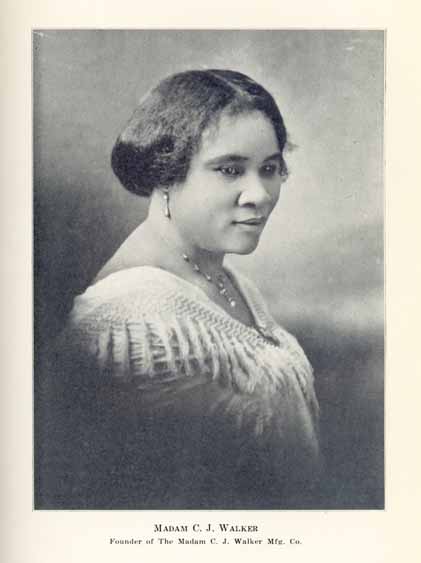
In defense of Madame Walker, she merely hustled to create a beauty product industry to provide service that millions of black women were already doing on their own. Black folks were creating lye, pomades and other homemade chemical concoctions and frying their hair long before Mme. Walker became the first black female millionaire. Since slavery, in fact.

So the real answer is:

60493.JPG
 
In defense of Madame Walker, she merely hustled to create a beauty product industry to provide service that millions of black women were already doing on their own. Black folks were creating lye, pomades and other homemade chemical concoctions and frying their hair long before Mme. Walker became the first black female millionaire. Since slavery, in fact.

So the real answer is:

60493.JPG

THANK YOU Dale. I think Madame CJ is unfairly maligned. She even stated that her intention was not to give black folks straight white folks hair. As you said, there was a lot of unsafe home style product use and for many a lack of sanitation that resulted in hair loss. She started out focusing on hair grease to prevent hair loss. I'm not proposing the straightening comb is a flagship of ethnic pride (clearly it isn't) but it's not fair to lay the good hair/bad hair thing solely at madame cj's feet when YT is to blame. Thanks again YT!

One of Madame CJ's descendent actually wrote the forward for a very popular book on natural hair care.
 
In defense of Madame Walker, she merely hustled to create a beauty product industry to provide service that millions of black women were already doing on their own. Black folks were creating lye, pomades and other homemade chemical concoctions and frying their hair long before Mme. Walker became the first black female millionaire. Since slavery, in fact.

So the real answer is:

60493.JPG

Thanks for that Bro. I had the material but not the time to post it.

Peace,

QueEx
 
Reminds me of the folks on here who were blasting Phyllis Wheatley as a sellout. I mean she was a flawed and tragic figure but sell-out? Ok, anyone who has been a black chattel slave in the 18th century, raise your hand. :hmm:

No one? :rolleyes: OK, uh huh...shaddup. :hmm:
 
Reminds me of the folks on here who were blasting Phyllis Wheatley as a sellout. I mean she was a flawed and tragic figure but sell-out? Ok, anyone who has been a black chattel slave in the 18th century, raise your hand. :hmm:

No one? :rolleyes: OK, uh huh...shaddup. :hmm:

:lol:
 
Reminds me of the folks on here who were blasting Phyllis Wheatley as a sellout. I mean she was a flawed and tragic figure but sell-out? Ok, anyone who has been a black chattel slave in the 18th century, raise your hand. :hmm:

No one? :rolleyes: OK, uh huh...shaddup. :hmm:

source: africawithin.com

Nationality - African American

Occupation - Entrepreneur, Philanthropist, Social Activist

Also Known As: Sarah Breedlove


Narrative Essay

As a manufacturer of hair care products for African American women, Madame C.J. Walker, born Sarah Breedlove (1867-1919), became one of the first American women millionaires.

Madame C.J. Walker, named Sarah Breedlove at birth, was born December 23, 1867, in Delta, Louisiana, to Owen and Minerva Breedlove, both of whom were emancipated slaves. The Breedloves worked as sharecroppers on a cotton plantation. At the age of six Sarah was orphaned, and in 1878, after the cotton crop failed and a yellow fever epidemic struck, the young girl moved to Vicksburg to live with her sister Louvinia and to work as a domestic. She worked hard from the time that she was very young, suffered great poverty, and had little opportunity to get an education. In order to escape the oppressive environment created by Louvinia's husband, Sarah married Moses McWilliams when she was only fourteen years old. At eighteen she gave birth to a daughter she named Lelia, and at twenty she was widowed.

Sarah then decided to move to St. Louis, where she worked as a laundress and in other domestic positions for eighteen years, joined St. Paul's African Methodist Episcopal Church, and put her daughter through the public schools and Knoxville College. Sarah, who was barely literate, was especially proud of her daughter's educational accomplishments.

By the time she was in her late thirties, Sarah was contending with hair loss because of a combination of stress and damaging hair care products. After experimenting with various methods, she developed a formula of her own that caused her hair to grow again quickly. She often recounted that after praying about her hair, she was given the formula in a dream. When friends and family members noticed how Sarah's hair grew back, they began to ask her to duplicate her product for them. She began to prepare her formula at home, selling it to friends and family and marketing it door to door.

With the help of her family and her second husband, Charles Joseph Walker, a newspaperman whom she had married in 1906 after she moved to Denver, she began to advertise a growing number of hair care products. She also adopted her husband's initials and surname as her professional name, calling herself Madam C.J. Walker for the rest of her life, even after the marriage ended. Her husband helped her develop mail marketing techniques for her products, usually through the medium of African American-owned newspapers. When their small business was successful, with earnings of about $10 a day, Walker felt that she should continue to expand, but her husband felt that she was too ambitious. Rather than allow her husband's wishes to restrain her, the couple separated.

Walker's business continued to develop, as she not only marketed her hair care products but also tutored African American men and women in their use, recruiting a group called "Walker Agents." Her products were often used in conjunction with a metal comb that was heated on the stove and used to straighten very curly hair. She also began to manufacture a facial skin cream. The hair process was controversial because many felt that African American women should wear their hair in natural styles rather than attempt to change the texture from curly to straight. In spite of critics, Walker's hair care methods gained increasing popularity among African American women, who enjoyed products designed especially for them. This resulted in growing profits for Walker's business and an increasing number of agents who marketed the products for her door to door.

Working closely with her daughter Lelia (who later changed her name to A'Lelia), Walker opened a school for "hair culturists" in Pittsburgh--Lelia College--which operated from 1908 to 1910. In 1910 the Walkers moved to Indianapolis, where they established a modern factory to produce their products. They also began to hire African American professionals who could direct various aspects of their operation. Among the workers were tutors who helped Walker get a basic education.

Walker traveled throughout the nation demonstrating her products, recruiting salespersons and practitioners, and encouraging African American entrepreneurs. Her rounds included conventions of African American organizations, churches, and civic groups. Not content with her domestic achievements, Walker traveled to the Caribbean and Latin America to promote her business and to recruit individuals to teach her hair care methods. Observers estimated that Walker's company had about three thousand agents for whom Walker held annual conventions where they were tutored in product use, hygienic care techniques, and marketing strategies. She also gave cash awards to those who were most successful in promoting sales.

At A'Lelia's urging, Walker purchased property in New York City in 1913, with the belief that a base in that city would be important. In 1916 she moved to a luxurious townhouse she had built in Harlem, and a year later to a posh estate called Villa Lewaro she had constructed at Irvington-on-Hudson, New York.

Although Walker and her daughter lived lavishly, they carefully managed each aspect of their business, whose headquarters remained in Indianapolis, and gave to a number of philanthropic organizations. According to rumor, Walker's first husband was lynched. Perhaps it was partially for this reason that Walker supported anti-lynching legislation and gave generously to the National Association for the Advancement of Colored People, eventually willing that organization her estate in Irvington-on-Hudson. The Walkers generously supported religious, educational, charitable, and civil rights organizations.

Although cautioned by her doctors that her fast-paced life was impairing her health, Walker did not heed the warnings. On May 25, 1919, when she was 51 years old, she died of hypertension. Her funeral service was held in Mother Zion African Methodist Episcopal Zion Church in New York City. Renowned African American educator Mary McLeod Bethune delivered the eulogy, and Walker was buried at Woodlawn Cemetery in the Bronx. Her daughter, A'Lelia, succeeded her as president of the Madame C.J. Walker Manufacturing Company.

Sources

Many articles, biographical sketches, and juvenile books have been written about Walker (sometimes called madam), including a comprehensive biography, On Her Own Ground: The Life and Times of Madam C.J. Walker by her great-great granddaughter, A'Lelia Bundles. Bundles' children's book is entitled Madam C.J. Walker (1991). Other books for youths are Penny Colman, Madam C.J. Walker: Building a Business Empire (1994); Marian Taylor, Madam C.J. Walker (1993); and Pat McKissack, Madam C.J. Walker: Self-Made Millionaire (1992). Biographical sketches of Walker appear in reference works such as the Dictionary of American Biography, Notable American Women, Notable Black American Women, Black Women in America, and the Dictionary of American Negro Biography.
Biography Resource Center

Not every Black person felt that straightening your hair was for the best at that time. Before my grandparents past on, they talked about the debate between Black folks over hair straightening and skin lightening. They were around at that time. Even Malcolm X had criticisms of Dr. King. Yes, Madam Walker’s hard work and ingenuity was heroic, particularly in light of the period in which it was accomplished. The question was who had a role in getting Black women in making them feel that straightening their hair was “acceptable”. After almost 100 years later, Black women still as a whole have questions about their physical self. Even Phyllis Wheatly had an epiphany.
 
Last edited:
I have had struggles with thisdebate about unprocessed hair vs. processed hair. I try to refrain from using natural because everyone does something to alter their appearance.

I came to a simple conclusion. It is fine to do both. (I still can't get down with the weave.) Still, there is a tremendous amount of resentment to unprocessed hair within our community, and until we remove that stigma attached to it then we will still remain mentally enslaved(politics of hair) because of our refusal to take ownership of the diverse ways in which we present ourselves to the world.

Others won't change, but we have to change and not in a manner that makes us more accepting. We have to be who we are, and only then can you garner respect from other communities.

Basically, you have to force people to accept it. They won't do it on their own.
 
Basically, you have to force people to accept it. They won't do it on their own.

Good point Massa. People are rarely comfortable with change. Sometimes somebody has to be ready to push the envelope.
 
I work in a corporate environment and I wish somebody WOULD tell me that my hair in inappropriate. Hairstyle is a matter of choice and individual expression. Any healthy, well-kept hairstyle is acceptable for most companies, as it should be.
 
The article said she resigned, whatever, whatever. Before any magazine, much less a major national publication is sent to press, it is proof read by layers of editors. Glamour knew. I wonder why any black women would subscribe to this publication.

That was my point. Having worked for a major corporation I know the practice was rubber stamped by their legal department. They got sloppy on this one and got caught. As for Ms. 20something I should've added blacklisted.
 
I work in a corprate office too and to be real I water myself down in order to advance (get my white girl imitation down) I mean there are so many blacks who do. However I would never be in a setting and listen to my race be disrespected. If I was in that meeting the sistah girl in me would of slipped out and I would of burned that motha fucka down. This post has made me consider wearing an afro but I don't know if I would be doing it just to prove that black is beautiful or to spite the white man. I think straight hair is sexy... and that how I wear my hair. Has nothing to do with trying to be white.

I think whites see so many negative images of blacks that they associate afros, braids, and dreds as being ghetto and/ or ignorant.

I will have to ponder this subject some more....
 
Back
Top