
Economists: Now is wrong time for Congress to cut spending

QueEx

Rising Star
Super Moderator

Economists: Now is wrong time
for Congress to cut spending​


McClatchy Newspapers
By Kevin G. Hall
Friday, July 29, 2011


WASHINGTON — Lawmakers trying to reach a deal on spending cuts in order to raise the nation's debt ceiling risk causing serious economic harm if they cut government programs too much in the near term, economists warn.

The U.S. economy grew at an anemic 1.3 percent rate from April to June, the Commerce Department reported Friday. It also revised downward the growth rate over the first three months of 2011 to just 0.4 percent.

Despite the weak growth, politicians aren't arguing
about stimulating the economy; rather they're
debating how quickly and how much to cut
spending, thus shaving economic
growth in the process.​

The U.S. Chamber of Commerce called on lawmakers Friday to be mindful of the weak economy.

"The recovery is clearly on a lower trajectory, and it will likely be some time before the economy rebounds to the point it will create much in terms of job growth," Martin Regalia, the group's chief economist, said in a statement.

That means, he said, that "the stakes on the debt limit debate ... are that much higher. With growth rates this low, even a small negative impact resulting from failure to increase the debt ceiling and defaulting on our obligations could turn the economy back into a recession."

While Republicans in the House of Representatives capture headlines by demanding steep spending cuts, the version proposed by Senate Democrats actually would thwart economic growth potentially more, according to two economic research groups.

Macroeconomic Advisers, a leading forecaster, said Thursday that a rewritten plan offered by House Speaker John Boehner, R-Ohio, would shave more than a tenth of a percentage point off of growth next year, while the plan being pushed by Senate Majority Leader Harry Reid, D-Nev., would cause an even larger hit on growth in fiscal 2013 — shaving almost half a percentage point.


That view was shared by Thomas Lam, Singapore-based chief economist at OSK-DMG, a joint venture of Malaysian securities firm OSK Holdings Bhd. and Germany's Deutsche Bank AG.

"Our calculations ... suggest that the Senate and House proposals, respectively, could lower economic growth on average by less than 0.5 percentage points, all else equal, over the next five years (from 2012 to 2016)," Lam said in a research note that suggested the Senate Democrat plan would hit the economy harder.

The chief economist for forecaster IHS Global Insight, Nariman Behravesh, warned Friday that "a weak economy will only make the tough decisions on the budget even more difficult and the case for fiscal austerity in the near-term even weaker."


Some House Republicans backed by tea party groups demand even deeper front-end cuts, perhaps as much as $100 billion, arguing that politicians can't be trusted to keep their promises further out.

That'd be dangerous, warned Mark Zandi, chief economist for forecaster Moody's Analytics.

"I think the idea is a very serious policy error," he said. "This would be the fodder for another recession. The economy may be able to digest $25-30 billion more (in federal spending cuts) ... but $100 billion, I don't think it could digest that."

Zandi, who's frequently cited by Republicans and Democrats alike, <SPAN style="BACKGROUND-COLOR: #ffff00">favors spending cuts "when the economy is off and running," but he cautions that "to add more fiscal restraint in the latter part of 2011 and 2012 would be a mistake."</span>


http://www.mcclatchydc.com/2011/07/29/118762/congress-proposed-spending-cuts.html


Economists: Now is wrong time
for Congress to cut spending​


McClatchy Newspapers
By Kevin G. Hall
Friday, July 29, 2011


WASHINGTON — Lawmakers trying to reach a deal on spending cuts in order to raise the nation's debt ceiling risk causing serious economic harm if they cut government programs too much in the near term, economists warn.

The U.S. economy grew at an anemic 1.3 percent rate from April to June, the Commerce Department reported Friday. It also revised downward the growth rate over the first three months of 2011 to just 0.4 percent.

Despite the weak growth, politicians aren't arguing
about stimulating the economy; rather they're
debating how quickly and how much to cut
spending, thus shaving economic
growth in the process.​

The U.S. Chamber of Commerce called on lawmakers Friday to be mindful of the weak economy.

"The recovery is clearly on a lower trajectory, and it will likely be some time before the economy rebounds to the point it will create much in terms of job growth," Martin Regalia, the group's chief economist, said in a statement.

That means, he said, that "the stakes on the debt limit debate ... are that much higher. With growth rates this low, even a small negative impact resulting from failure to increase the debt ceiling and defaulting on our obligations could turn the economy back into a recession."

While Republicans in the House of Representatives capture headlines by demanding steep spending cuts, the version proposed by Senate Democrats actually would thwart economic growth potentially more, according to two economic research groups.

Macroeconomic Advisers, a leading forecaster, said Thursday that a rewritten plan offered by House Speaker John Boehner, R-Ohio, would shave more than a tenth of a percentage point off of growth next year, while the plan being pushed by Senate Majority Leader Harry Reid, D-Nev., would cause an even larger hit on growth in fiscal 2013 — shaving almost half a percentage point.


That view was shared by Thomas Lam, Singapore-based chief economist at OSK-DMG, a joint venture of Malaysian securities firm OSK Holdings Bhd. and Germany's Deutsche Bank AG.

"Our calculations ... suggest that the Senate and House proposals, respectively, could lower economic growth on average by less than 0.5 percentage points, all else equal, over the next five years (from 2012 to 2016)," Lam said in a research note that suggested the Senate Democrat plan would hit the economy harder.

The chief economist for forecaster IHS Global Insight, Nariman Behravesh, warned Friday that "a weak economy will only make the tough decisions on the budget even more difficult and the case for fiscal austerity in the near-term even weaker."


Some House Republicans backed by tea party groups demand even deeper front-end cuts, perhaps as much as $100 billion, arguing that politicians can't be trusted to keep their promises further out.

That'd be dangerous, warned Mark Zandi, chief economist for forecaster Moody's Analytics.

"I think the idea is a very serious policy error," he said. "This would be the fodder for another recession. The economy may be able to digest $25-30 billion more (in federal spending cuts) ... but $100 billion, I don't think it could digest that."

Zandi, who's frequently cited by Republicans and Democrats alike, <SPAN style="BACKGROUND-COLOR: #ffff00">favors spending cuts "when the economy is off and running," but he cautions that "to add more fiscal restraint in the latter part of 2011 and 2012 would be a mistake."</span>


http://www.mcclatchydc.com/2011/07/29/118762/congress-proposed-spending-cuts.html


I absolutely understand what the economists in this article are saying and they may be right that further cuts in federal government spending may slow growth even more. We've created a conundrum for ourselves because we've established an economy where federal government spending is such an integral part. And the only way for the federal government to try to sustain this level of spending is to either borrow more & more money or raise taxes. However you feel about tax rates, it is generally agreed that raising taxes tends to slow growth since it reduces the amount of capital within the private economy (you know, the productive area of human activity on which the government relies upon to obtain any money for itself). Even President Obama implicitly admitted this when he said at the end of the recent "government shutdown threat" negotiations that "you don't raise taxes in a recession." If the principles about higher taxes slowing or stunting economic growth apply during a recession, what is it about a so-called recovery that keeps those same principles from applying?

Now, whenever the economy is eventually "off & running" again then let's say politicians finally agree to significantly cut federal spending. When that happens it will likely slow growth, at least initially, because so many jobs and individuals are linked to that spending. There will be pain, lots of it probably. But if the politicians and the American people continue to balk at those types of cuts, the pain will still be felt and even more greatly because more taxes will be needed to pay the ever rising interest payments on the debt. This scenario, which we're playing out today, will eventually come to a head where the government will be forced to drastically cut the spending and need to extract so much money from the private economy through taxes so that it can pay its debtors, that growth will be nearly impossible.

So we're in a situation where the spending and debt have become so great that there is no way to escape the great pain many of us will suffer, especially the middle class and the poor. That can't be avoided in any scenario, no matter how much we end up taxing the rich. Eventually there won't be enough money that the government can extract from the rich to "take care of" the middle class and the poor. Likewise, they won't have enough money to pay for the myriad of things that benefit the rich themselves and the well-connected and the rich will suffer, albeit to a much lower degree. So the question now is simply do we deal with the pain now and allow the country to adjust to the changes and build itself up again or do we put off the pain for now and just let it build up for us and our children to deal with at even greater degree later?
 
sgen432l.jpg


Tea_Bagger_HEAD_upAss.jpg


ktun117l.jpg
 
So we're in a situation where . . . there is no way to escape the great pain many of us will suffer, especially the middle class and the poor.

Do you not believe, then, that income brackets above the middle class and the poor should too suffer their fair proportion of the pain, for the greater good of all ? ? ?
 
Do you not believe, then, that income brackets above the middle class and the poor should too suffer their fair proportion of the pain, for the greater good of all ? ? ?

Hey thanks for a fair response instead of the idiotic one above. Raising the tax rates on people who already have the highest tax rates and pay majority of the income taxes the federal government collects certainly is an option. Just understand that raising those tax rates to pay down the debt will further increase the pain for everyone, not just the rich. As President Obama has implicitly admitted, higher taxes hurt economic growth. So while it will pay down the current debt at least for a time, we'll have to hope that it doesn't exacerbate the unemployment rate which will only lower tax revenue and increase the government burden due to the unemployment rolls rising.

So again it's an option, but is it smart? I'm not sure because what we're talking about witht those type questions is really how to contain the pain as much as possible while doing what is necessary, which is reducing the unsustainable spending levels. Some think that raising tax rates while not cutting the entitlement programs quite as much will help spread the pain. I'm not sure if that is so. If we knew for sure that it wouldn't exacerbate the pain for the poor, then that would be a more acceptable approach.

I personally don't see progressive income tax rates as fair. Saying the tax rates should "suffer a fair proportion of the pain" implies that certain individuals are in someway responsible for the debt because not enough of the money they earned was confiscated by the government. I don't agree with that implication. I do agree that tax rates shouldn't have been reduced while spending was simulatenoulsy increased, i.e. GW Bush. Again, the source of the problem is always the spending itself because the taxes are only necessary to cover spending of some sort.

I do believe those who earn more should pay more than those who earn less and they would pay proportionally more with a flat income rate minus the deductions. That does sound fair to me. You earn more you pay more. Those who say a flat income rate would have to be so high that it would be too burdensome to those with lower incomes must mean that it would be too burdensome if the government continued to spend on all that it does today. Again, the problem then is the spending and the scope of government involvement in the people's lives. And both sides want the government to do far too much, the insane foreign policy being just one example.

Also, I don't think that tax deductions of any sort are proper because the government should neither try to manipulate economic activity nor benefit particular individuals through tax codes. So I think all the deductions for everyone should eventually go. Again understand though, that does not help the economy. The conundrum. Basically the more we borrowed to spend today, the more we insured that we wouldn't be able to spend in the future. We all understand this in our individual lives.

So if we took this approach of raising taxes, the challenge years ahead would still be to insure that government spending had been reduced drastically so that the tax rates could be lowered later on so that the private economy could thrive again.
 
Do you not believe, then, that income brackets above the middle class and the poor should too suffer their fair proportion of the pain, for the greater good of all ? ? ?

I want you to respond to my response above, but I also would be interested to know who you think should determine what's "the greater good of all" and how they should go about determining it & bringing it about? Should this person or group of people's views trump the choices and will of individuals acting voluntarily if the individuals choices aren't directly harming someone else's person or property? If so, why? Thanks my man.
 
"The recovery is clearly on a lower trajectory, and it will likely be some time before the economy rebounds to the point it will create much in terms of job growth," Martin Regalia, the group's chief economist, said in a statement.

That means, he said, that "the stakes on the debt limit debate ... are that much higher. With growth rates this low, even a small negative impact resulting from failure to increase the debt ceiling and defaulting on our obligations could turn the economy back into a recession."

Martin Regalia? He was one of the cats that told us "the fundamental underpinnings of this economy are very, very solid" on April 27, 2007 (2 minutes into this interview)!

There's an old saying in Tennessee, I know it's in Texas, probably Tennessee, that says 'Fool me once [pause], shame on…shame on you. [Long pause] Fool me. [Pause] You can't get fooled again'. - "W"

Why don't they ask someone who was correct in analyzing the issues confronting our economy? Peter Schiff told us what was happening & why, long before the public started to see the collapse in late 2007. Peter Schiff Was Right
 
Last edited:
When Clinton and the Democrats raised taxes in 1993 with no Republican votes the economy had the longest span of growth in 30 years, the budget was balanced, the dollar was stronger than it was in 20 years and the size of the debt slow. Forgot?
 
When Clinton and the Democrats raised taxes in 1993 with no Republican votes the economy had the longest span of growth in 30 years, the budget was balanced, the dollar was stronger than it was in 20 years and the size of the debt slow. Forgot?

Starting in 1993 Clinton spent the following amounts (in millions of dollars). If we could only go back to Clinton era spending, we wouldn't have to raise taxes as the govt recieves over 2 Trillion a year now, in tax revenue!

Source

1993........$1,409,522
1994........$1,461,907
1995........$1,515,884
1996........$1,560,608
1997........$1,601,307
1998........$1,652,685
1999........$1,702,035
2000........$1,789,216
2001........$1,863,190

Obama wants to spend what......$3.8 Trillion?

Maybe it supports the claims from those who say Big Government doesn't work! ! !
 
Yeah, I've seen them, but I've been much too busy to respond. Business before <s>Bullshitting</s> . . . I mean intellectualizing on BGOL !

Oh my bad. I didn't think you'd have to spend this long on FactCheck.org before you found something you could use. Zing! ;)

I joke, I joke. Handle yo bidness playa!
 
Starting in 1993 Clinton spent the following amounts (in millions of dollars). If we could only go back to Clinton era spending, we wouldn't have to raise taxes as the govt recieves over 2 Trillion a year now, in tax revenue!

Source

1993........$1,409,522
1994........$1,461,907
1995........$1,515,884
1996........$1,560,608
1997........$1,601,307
1998........$1,652,685
1999........$1,702,035
2000........$1,789,216
2001........$1,863,190

Obama wants to spend what......$3.8 Trillion?

Maybe it supports the claims from those who say Big Government doesn't work! ! !


If we can get that corporate welfare the oil companies are enjoying, we can put that $1.8 trillion to use in the infrastructure that is crumbling. Where is the free market solution for that?


BTW, why isn't the free market creating jobs. Oh yea, in China.


<iframe width="425" height="349" src="http://www.youtube.com/embed/Rkgx1C_S6ls" frameborder="0" allowfullscreen></iframe>​
 
Betting against Congressional fiscal responsibility is one of the safest bets a man can make.

Gold $1660.70 Another record high!
 
Are they similar to the experts that told us about global warming. Paul Krugman types?


I would say those experts are credible. Site your credible experts.


source: Our Amazing Planet

Aug 1, 2011

All 50 States See Record Highs in July

The horrible July heat wave, lasting weeks in some cities, the entire month in others, affected nearly 200 million people in the United States at some point. Preliminary data show that 2,712 high-temperature records were either tied or broken in July, compared with 1,444 last year, according to the NCDC. At least one weather station in all 50 states set or tied a daily high temperature record at some point during July.

Two weather stations tied for the hottest temperature recorded during July. The Blythe station in Riverside County, Calif., and the Gila Bend station in Maricopa County, Ariz., both hit 120 degrees Fahrenheit (48.9 degrees Celsius) in July.

And while the weather hasn't been as hot in the Pacific Northwest, stations in states such as Oregon and Washington have also set or tied records. On July 7, Satus Pass station in Klickitat County, Wash., hit 91 F (32.8 C), tying a 1968 daily record high for the station. Baring station in King County hit 83 F, also tying a record high for the station on that day. Oregon's Silver Lake station in Lake County was also hot on July 7, hitting 95 F (35 C), a new daily record.

Even Alaska recorded unusually sweaty temperatures. The temperature at the Northway weather station in Southeast Fairbanks County hit a record 97 F (36.1 C) on July 11.

Newark, N.J., set an all-time high at 108 F (42.2 C) on July 22, breaking the record of 105 F (40.6 C), set in 2001.

In Washington, D.C., Dulles International Airport saw its hottest July on record this year and recorded its highest July temperature of all time at 105 F (40.6 C), on July 22. That same day, water in the nearby Potomac River was the hottest ever recorded at 96 F (35.4 C) (records go back to only 1988), reported the Capital Weather Gang blog.

The city of Morehead, Minn., had the dubious distinction as the hottest place on Earth for a day, said meteorologist Heidi Cullen of Climate Central, in an interview on National Public Radio. On July 19, the heat index there — a measure of humidity and temperature that indicates how hot the weather feels — was 134 F (56.7 C). (The National Weather Service later said this reading could be an anomaly due to the local weather station's location in a very wet field, and not representative of the entire town.)
 
I would say those experts are credible. Site your credible experts.


source: Our Amazing Planet

Aug 1, 2011

All 50 States See Record Highs in July

The horrible July heat wave, lasting weeks in some cities, the entire month in others, affected nearly 200 million people in the United States at some point. Preliminary data show that 2,712 high-temperature records were either tied or broken in July, compared with 1,444 last year, according to the NCDC. At least one weather station in all 50 states set or tied a daily high temperature record at some point during July.

Two weather stations tied for the hottest temperature recorded during July. The Blythe station in Riverside County, Calif., and the Gila Bend station in Maricopa County, Ariz., both hit 120 degrees Fahrenheit (48.9 degrees Celsius) in July.

And while the weather hasn't been as hot in the Pacific Northwest, stations in states such as Oregon and Washington have also set or tied records. On July 7, Satus Pass station in Klickitat County, Wash., hit 91 F (32.8 C), tying a 1968 daily record high for the station. Baring station in King County hit 83 F, also tying a record high for the station on that day. Oregon's Silver Lake station in Lake County was also hot on July 7, hitting 95 F (35 C), a new daily record.

Even Alaska recorded unusually sweaty temperatures. The temperature at the Northway weather station in Southeast Fairbanks County hit a record 97 F (36.1 C) on July 11.

Newark, N.J., set an all-time high at 108 F (42.2 C) on July 22, breaking the record of 105 F (40.6 C), set in 2001.

In Washington, D.C., Dulles International Airport saw its hottest July on record this year and recorded its highest July temperature of all time at 105 F (40.6 C), on July 22. That same day, water in the nearby Potomac River was the hottest ever recorded at 96 F (35.4 C) (records go back to only 1988), reported the Capital Weather Gang blog.

The city of Morehead, Minn., had the dubious distinction as the hottest place on Earth for a day, said meteorologist Heidi Cullen of Climate Central, in an interview on National Public Radio. On July 19, the heat index there — a measure of humidity and temperature that indicates how hot the weather feels — was 134 F (56.7 C). (The National Weather Service later said this reading could be an anomaly due to the local weather station's location in a very wet field, and not representative of the entire town.)


Hotter summers, colder winters, just as predicted.
But it's easier to be dumb.
 
That doesn't look like a bubble to you?

I have many responses but No, I don't think it's a bubble.

Honestly, I see the US Dollar being the "bubble"

1) credit crisis--> 2) sovereign debt crisis-->3) currency crisis.

Thats how I see it playing out & we're between 1 & 2 right now.
 
When Clinton and the Democrats raised taxes in 1993 with no Republican votes the economy had the longest span of growth in 30 years, the budget was balanced, the dollar was stronger than it was in 20 years and the size of the debt slow. Forgot?

Didn't you also say that Keynesianism saved the United States from the Great Depression?

It's not the politicians, ridiculous economic theories, and government that produce prosperity, it is production, resources, and technology.

Having all the competition destroyed after World War 2 created the unprecedented economic superpower that was the United States.

It had nothing to do with the politics afterward. You could have been the stupidest asshole in the world (like the whites in the United States) and still prospered in the 50s.

Likewise, Clinton didn't save the country. The Soviet Union fell, which basically eliminated the huge drain on the economy that is the United States military. All a President/Congress has to do is not declare war on anybody, and the United States will prosper.

Of course, not waging war on innocent people is a concept lost on today's politicians.

It is these asinine wars that are destroying the United States economy.

Everything else is just noise.
 
Didn't you also say that Keynesianism saved the United States from the Great Depression?

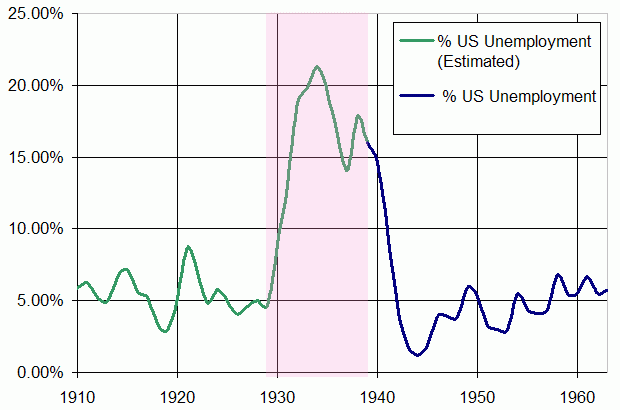
I did and it did. It was called the New Deal and then World War II. Isn't war spending essentially massive government spending?

After GW began spending the savings we were beginning to amassing from the Clinton administration and after the economic downturn of 911, the only thing that kept the economy moving was the Iraqi War, which was not paid for (The Economic Growth and Tax Relief Reconciliation Act of 2001 and the Jobs and Growth Tax Relief Reconciliation Act of 2003). Then the bill came due in 2007, the beginning of the Bush recession.

I agree that war is not the way to stimulate an economy. We can discuss the merits of WWII in another topic and most of us agree that that the Iraqi and Afghanistan wars were wrong and unnecessary, but WWII did contribute to the economic boom that lasted for 50 years.

source: Wikipedia

Data for 1910-1930 from Christina Romer (1986), "Spurious Volatility in Historical Unemployment Data", The Journal of Political Economy, 94(1): 1-37. Data for 1930-1940 from Robert M. Coen (1973). "Labor Force and Unemployment in the 1920's and 1930's: A Re-Examination Based on Postwar Experience", The Review of Economics and Statistics, 55(1): 46-55. Data for 1940-1960 from the US Bureau of Labor Statistics, Employment status of the civilian noninstitutional population, 1940 to date ftp://ftp.bls.gov/pub/special.requests/lf/aat1.txt,

US_Unemployment_1910-1960.gif


Likewise, Clinton didn't save the country. The Soviet Union fell, which basically eliminated the huge drain on the economy that is the United States military. All a President/Congress has to do is not declare war on anybody, and the United States will prosper.

Ah, good point. The ending of the Cold War should have resulted in a economic boom, however, we didn't get the peace dividend we were suppose to have. The massive military spending that launched the beginning of the cold war in 1952 and what President Eisenhower warned about did not end with the destruction of the Berlin Wall in 1989. In fact military spending has not significantly declined since the de facto ending of the Cold War.

What Clinton did do is increase federal tax revenues on upper incomes to 35% from 29% of the Regan era combined with cutting government programs such as so called welfare (Personal Responsibility and Work Opportunity Reconciliation Act).

I agree, we are still spending cold war money in a post cold war world. We still have weapons for enemies that don't exist, if the ever did.
 
Last edited:
Cuttting spending, raising retirement age, reducing benefits to entitlement programs is a tax increase on the poor and middle class. My tax rate is the same, however, I am getting less back in government benefits.

I think some Democrats knew about the precarious financial situation and is the reason Medicare for all wasn't adopted during the healthcare debate. A single payer system should be done at the state level rather than federal unless you are a small country.
 
Hey thanks for a fair response instead of the idiotic one above. Raising the tax rates on people who already have the highest tax rates and pay majority of the income taxes the federal government collects certainly is an option. Just understand that raising those tax rates to pay down the debt will further increase the pain for everyone, not just the rich. As President Obama has implicitly admitted, higher taxes hurt economic growth. So while it will pay down the current debt at least for a time, we'll have to hope that it doesn't exacerbate the unemployment rate which will only lower tax revenue and increase the government burden due to the unemployment rolls rising.

So again it's an option, but is it smart? I'm not sure because what we're talking about witht those type questions is really how to contain the pain as much as possible while doing what is necessary, which is reducing the unsustainable spending levels. Some think that raising tax rates while not cutting the entitlement programs quite as much will help spread the pain. I'm not sure if that is so. If we knew for sure that it wouldn't exacerbate the pain for the poor, then that would be a more acceptable approach.

I personally don't see progressive income tax rates as fair. Saying the tax rates should "suffer a fair proportion of the pain" implies that certain individuals are in someway responsible for the debt because not enough of the money they earned was confiscated by the government. I don't agree with that implication. I do agree that tax rates shouldn't have been reduced while spending was simulatenoulsy increased, i.e. GW Bush. Again, the source of the problem is always the spending itself because the taxes are only necessary to cover spending of some sort.

I do believe those who earn more should pay more than those who earn less and they would pay proportionally more with a flat income rate minus the deductions. That does sound fair to me. You earn more you pay more. Those who say a flat income rate would have to be so high that it would be too burdensome to those with lower incomes must mean that it would be too burdensome if the government continued to spend on all that it does today. Again, the problem then is the spending and the scope of government involvement in the people's lives. And both sides want the government to do far too much, the insane foreign policy being just one example.

Also, I don't think that tax deductions of any sort are proper because the government should neither try to manipulate economic activity nor benefit particular individuals through tax codes. So I think all the deductions for everyone should eventually go. Again understand though, that does not help the economy. The conundrum. Basically the more we borrowed to spend today, the more we insured that we wouldn't be able to spend in the future. We all understand this in our individual lives.

So if we took this approach of raising taxes, the challenge years ahead would still be to insure that government spending had been reduced drastically so that the tax rates could be lowered later on so that the private economy could thrive again.

Reading over your essay I had prepared several different responses but each one appeared to me that I hadn't answered what you asked. Perhaps, thats because when I am time challenged I don't have the time to sort through what appear to me to be conflicting or unsound premises and questions based on same.

Also, let me say that I’m not an economist and my undergrad background is not in economics or finance, but I notice that even those whose profession is economics and finance appear to differ over some of the things you appear to be asking.


If I read you correctly, you're saying that some type of tax increase coupled with lowering expenditures could be the way to go. If thats what you're saying, I agree. I do not believe that taxation alone can reduce our deficit.

If you're saying that now is not the time for a tax increase, I can't say that I agree with you. First, you didn't exactly spell out what kind of tax increase you feel would be improper and, secondly, there appears to be a misconception in one of your premises, i.e., "Raising the tax rates on people who already have the highest tax rates". That premise does not seem to jive with the facts -- that is -- some rates to GDP are at near historical lows. So, for me to be anymore specific, I would have to know exactly what tax increases are YOU basing your assumptions on, i.e., are YOU assuming an across-the-board rate increase?? Would such an increase be uniform among brackets or would there be different increases for different brackets??? Some of these I would certainly be opposed to.

Your statement to the effect that, ”raising those tax rates to pay down the debt” does not appear to be accurate. From what I’ve read, no one is proposing a tax increase, as the sole source, to pay down the debt. On the contrary, there have been proposals that combine a reduction of expenditures with an increase of taxation at some levels to help pay the debt – but you appear to be saying something that I have yet to hear being proposed. If someone is proposing tax increases as the sole source of debt reduction, I would be opposed to that.

Finally, I haven’t read where the President has said or implied that raising taxes during a recovery (which is my understanding of the present state of affairs) will ”hurt economic growth”. Perhaps you will post the citation for that statement. I’m not saying he hasn’t said it; I’m saying that I haven’t read or heard it.

Hope I have addressed the questions, if not, I await to be corrected.

Peace
 
Back
Top