Does Occupy Wall Street Need a Better Slogan?

Costanza

Rising Star
Registered
Does Occupy Wall Street Need a Better Slogan?

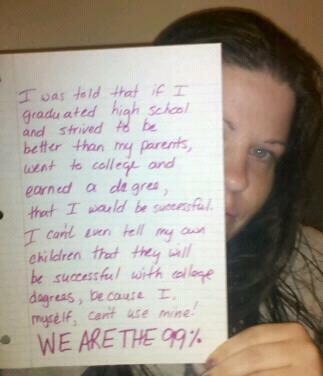
we-are-the-99.jpg

An Occupy Wall Street campaign demonstrator protests in Zuccotti Park, near Wall Street in New York.

Slogans can be tricky. Occupy Wall Street is learning this. There’s always a balance to be struck between catchy, memorable slogans and meaningful ones. When you start using a slogan to actually talk policy, that’s when this balance becomes really important.

For instance, I wrote the other day that a largely lender-driven debt forgiveness program would be a really good idea to get the economy back on firmer ground. Over at Salon, Alex Pareene suggested something similar if a tad more radical. Now pay attention to the slogan of the day and how it operates in Pareene’s jubilee suggestion:

Household debt is at 90 percent of GDP. Any stimulus proposal — even “dropping money from helicopters” — would result in a massive transfer of money from indebted Americans to cash-engorged banks, rather than the spending spree that would theoretically put us back to work.

[...]

So my immodest proposal is simply this: Individuals and households in the bottom 99 percent who owe debt to any large financial institution that received federal government support during and after the 2008 crisis should see their debt forgiven. That would certainly stimulate the economy, as most people would suddenly find themselves with a great deal more money to spend on iPads (and food, and clothing, and housing, and healthcare). The debt can be forgiven by decree or if the government really wants to it can step in to pay it itself; I don’t much care either way. (Though it’d be nice to see it just wiped off the books, to enrage the banks.)

Let’s wipe the debt of the 99 percent off the books, tell the financial sector to eat it, and get on with our lives.​

Setting aside the unintended consequences of the plan – at this rate of debt forgiveness you’d easily cause another crash as the financial sector collapsed in on itself – the really troubling thing with this suggestion to me is the use of the 99 percent meme. People in, say, the second percent at the top of the income pool are still fabulously wealthy. I mean, really, really stinking rich.

Josh Barro explains:

The 99th percentile of Americans, by income, starts with households earning incomes of $593,000. The “We Are the 99 percent” branding puts somebody making $500,000 per year on the oppressed-and-downtrodden side of the wage divide. Indeed, “99 percent” is so expansive a designation that it includes most of the bankers working on Wall Street.​

The 99% club is open to almost everyone, apparently, even people making half a million dollars a year. That’s a pretty big club. And when you craft a policy suggestion around something like this, as Pareene does, you inevitably stumble into pretty silly territory pretty quickly. Forgiving the debt of people making several hundred thousand dollars a year is preposterous, whereas incentivizing lenders to write down mortgages for working class Americans who got hit hard by the recession makes sense. We risk fumbling good policy ideas for the sake of catchy sloganeering campaigns.

So I understand this whole We Are the 99% thing, but it still doesn’t sit well with me. Most of us really aren’t up there in the 90′s or even the 70′s or 80′s. Indeed, the top 25% of American households have 87% of all the wealth in this country. So maybe We are the 75% is more appropriate. But if this is really going to be about regular Americans, working class people, and not just a bunch of dissatisfied college kids with too much time on their hands, it’s going to have to be more like We Are the 25%.

I support a return to balance, a return to an economy not so bound to the whims of risk-taking financiers. Finance has its value. It’s when the banks are getting bailed out on their bad bets and sinking a lot of working Americans in the process that something needs to change. The change we need most, however, is for the 25%, not the 99.

Oh, and speaking of annoying slogans, “ban corporate greed” is right up there. Corporations aren’t “greedy” – they’re just motivated by profit. Banning corporate greed is like banning union solidarity. What’s the point? Let’s do better than this. How about “There’s more to business than quarterly earning reports!” Yeah, that’ll get the fires of dissent burning.

Or hey, we could work to end corporate cronyism. I just think banning “greed” is like fighting a war against “terror” – kind of impossible.

P.S. I support Occupy Wall Street. This post is meant as constructive criticism, not as a denunciation of the protests at all. And I do understand that it sucks to be a college grad without a job, but people without higher education are hurting much worse:

ep_chart_001.jpg

See also Freddie deBoer for a smart, friendly critique of the movement:

Consider what the idea here is: that this protest becomes something worth considering when and only when it becomes about those who are most visible. Only when the young and college educated begin to express grievance, and only when that grievance concerns their material wealth and opportunity, do the protests begin to take off. It is extremely disturbing to me how quickly a movement opposing our system of prestige and wealth becomes a movement about those who thought they were entitled to succeed in that system. Complaining that a college education hasn’t moved you into the material comfort and social strata you wanted isn’t an argument against this system; it’s a complaint about the outcome of the system that tacitly asserts the value of that system. When someone says “I have a law degree and I work as a barista,” the necessary assumption of that statement is that their law degree entitles them to a certain material and social privilege. That privilege is precisely what animates the system they say they are protesting.

If the message is “I went to college and I don’t have the job and the car and the lifestyle I was promised,” then none of this means anything. These complaints, I’m sorry to say, are ultimately a way of saying “I didn’t get mine.” That’s not a rejection of our failing order. It is an embrace of it in the most cynical terms.

[...]

I have great sympathy for the people of my generation and those a little younger than me, as they are emerging from a childhood where they were told that they could have whatever they wanted into a world where they can’t. But they must recognize that the problem was always the promise, and not the failure to get what was promised. You can’t, actually, have everything you want. You are not entitled to the life you have dreamed. And we are not so wealthy that we can all live in opulence. If the goal is merely to restore the condition of the previous two decades and add more people to the ranks of the middle class, then that is the problem reasserting itself. After all, wages have been stagnant for decades. But the educated class was bought off by the widespread “prosperity” provided by endless easy credit and the phony growth of bubbles and illusory housing wealth. Those protesting because they thought they were entitled to a house and consumer electronics are announcing that they want to be bought off again.

To mean anything, this movement must be a movement that opposes both the means and the ends of the contemporary American engine of “success,” both out of a conviction that it is unfair and that it is unsustainable.. It cannot merely be a complaint about outcomes.​

http://www.forbes.com/sites/erikkain/2011/10/08/does-occupy-wall-street-need-a-better-slogan/
 
Occupy the Board Room, that is the slogan they need, instead of showing signs about how they can't pay student loans. A simple solution that doesn't involve the government getting involved with taxes.

Countries with low wealth inequality have the following characteristics:
1. No Employment at Will
2. High Unionization Rates
3. Workers get to elect 30-50 percent of the board seats
4. Universal Healthcare, Strong Social programs
5. Public Financing of Elections, No corporate money...
6. True Multi Party political system

You implement these reforms, your Gini coefficient will drop from being highest to the lowest like Germany, France, Canada, and Japan.

http://en.wikipedia.org/wiki/List_of_countries_by_income_equality
 
Last edited:
jN34EQOvVWuY0.PNG

<font face="arial unicode ms, helvetica, verdana" size="3" color="#000000">
They don't need a slogan. They need to "wake up" millions more American citizens, more 99 percenters, who have been anesthetized by the "corporate media of mass distraction" into a befuddled incoherence about why their living standard has steadily declined over the last thirty years. The hysterical hate filled reaction against "the factual truth" that this nascent movement represents on <s>FOX</s> FAKE & CNBC & CNN demonstrates that the oligarchs are deathly afraid that the majority of Americans will wake up from their stupor and suddenly realize who stole "the American dream".

There is an unprecedented waiting list to buy $35 Million dollar private jets. Rolls-Royce sales are up over 170%. Luxury retailers Neiman Marcus and Saks Fifth Avenue are having difficulty keeping $900 woman's shoes and $10,000 designer dresses in stock as these items are in such great demand.

Meanwhile Wal-Mart’s US sales are down for eight consecutive quarters as “regular-working-folks” see their income shrink or disappear as RepubliKlan politicians representing the 1% demand more layoffs and draconian cuts in wages and benefits. Food stamps usage is at an all-time-high. Real US unemployment which includes people who have given up looking for work is 25%. The RepubliKlan plan to cut the top tax bracket further, end most business regulations, end Unemployment insurance, will not create jobs. These policies will send more money up to the top 1% and create a nation of peons. Class-Warfare has been waged and won by the top fraction of 1%. The debris of that battle is a fractured American dream, which only functions consistently now in Hollywood movies.

Recent college graduates, even from America’s best universities can’t find jobs commensurate with their $100,000+ dollar diplomas. The top 1% and the oligarchs, now thanks to the SCOTUS Citizens United decision, can now secretly pump millions of dollars into politicians that pledge allegiance to protect their cossetted financial position. For the rest of us we are told that “this is the new normal”.

Herman Cain, the feckless tea party favorite RepubliKlan presidential candidate tells us "Don't blame Wall Street, don't blame the big banks, If you don't have a job and you are not rich, blame yourself!" Mr. Cain is basically telling the 99 percenters FUCK YOU I got mine Fuck You! For a Black man in AmeiKKKa to utter such bullshit shows the extent that Mr. Cain has sold-his-soul to the oligarchs for $$$$$$$$$. He sure didn't learn what he's saying at Morehouse College. Mr. Cain’s Ayn Rand inculcated “virtue-of-selfishness” bombast will surely endear him to the gilded class and bring a flood of campaign cash his way.

Meanwhile tomorrow Oct. 11, 2011 as we watch the Republican candidates engage in what is being called an ‘economic debate’ in New Hampshire, we will see if any of the questioners ask any serious questions about the evisceration of America’s middle class or outsourcing or the nations current historic income inequality or the 15% tax rate millionaires and billionaires including Mitt Romney pay. I doubt we will hear any of these questions asked. The oligarchs that own these media properties have deemed these questions; not permitted. Instead we will hear questions about how best to cut grandmas Medicare and how Americans must accept a lower standard of living with fewer benefits because we are competing with Communist China. How about a 25% tax on the 2 Trillion dollars that American companies are hoarding overseas? Not so much the corporations say; how about 5%, after all ”we are the job creators”— in China, India & Brazil.</font>

<hr noshade color="#ff0000" size="8"></hr>

inzAf98jMbrjV.gif


Panic of the Plutocrats


by Paul Krugman

October 10, 2011


http://www.nytimes.com/2011/10/10/opinion/panic-of-the-plutocrats.html

It remains to be seen whether the Occupy Wall Street protests will change America’s direction. Yet the protests have already elicited a remarkably hysterical reaction from Wall Street, the super-rich in general, and politicians and pundits who reliably serve the interests of the wealthiest hundredth of a percent.

And this reaction tells you something important — namely, that the extremists threatening American values are what F.D.R. called “economic royalists,” not the people camping in Zuccotti Park.

Consider first how Republican politicians have portrayed the modest-sized if growing demonstrations, which have involved some confrontations with the police — confrontations that seem to have involved a lot of police overreaction — but nothing one could call a riot. And there has in fact been nothing so far to match the behavior of Tea Party crowds in the summer of 2009.

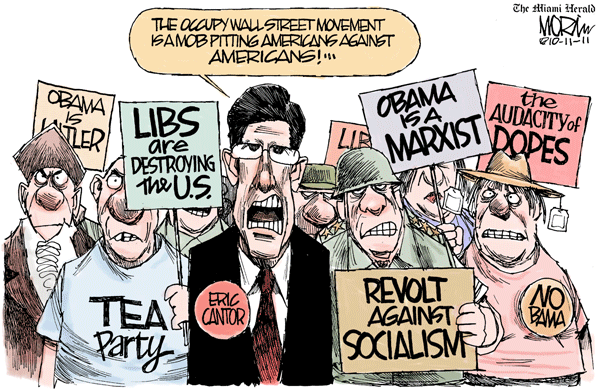
Nonetheless, Eric Cantor, the House majority leader, has denounced “mobs” and “the pitting of Americans against Americans.” The G.O.P. presidential candidates have weighed in, with Mitt Romney accusing the protesters of waging “class warfare,” while Herman Cain calls them “anti-American.” My favorite, however, is Senator Rand Paul, who for some reason worries that the protesters will start seizing iPads, because they believe rich people don’t deserve to have them.

Michael Bloomberg, New York’s mayor and a financial-industry titan in his own right, was a bit more moderate, but still accused the protesters of trying to “take the jobs away from people working in this city,” a statement that bears no resemblance to the movement’s actual goals.

And if you were listening to talking heads on CNBC, you learned that the protesters “let their freak flags fly,” and are “aligned with Lenin.”

The way to understand all of this is to realize that it’s part of a broader syndrome, in which wealthy Americans who benefit hugely from a system rigged in their favor react with hysteria to anyone who points out just how rigged the system is.

Last year, you may recall, a number of financial-industry barons went wild over very mild criticism from President Obama. They denounced Mr. Obama as being almost a socialist for endorsing the so-called Volcker rule, which would simply prohibit banks backed by federal guarantees from engaging in risky speculation. And as for their reaction to proposals to close a loophole that lets some of them pay remarkably low taxes — well, Stephen Schwarzman, chairman of the Blackstone Group, compared it to Hitler’s invasion of Poland.

And then there’s the campaign of character assassination against Elizabeth Warren, the financial reformer now running for the Senate in Massachusetts. Not long ago a YouTube video of Ms. Warren making an eloquent, down-to-earth case for taxes on the rich went viral. Nothing about what she said was radical — it was no more than a modern riff on Oliver Wendell Holmes’s famous dictum that “Taxes are what we pay for civilized society.”

But listening to the reliable defenders of the wealthy, you’d think that Ms. Warren was the second coming of Leon Trotsky. George Will declared that she has a “collectivist agenda,” that she believes that “individualism is a chimera.” And Rush Limbaugh called her “a parasite who hates her host. Willing to destroy the host while she sucks the life out of it.”

What’s going on here? The answer, surely, is that Wall Street’s Masters of the Universe realize, deep down, how morally indefensible their position is. They’re not John Galt; they’re not even Steve Jobs. They’re people who got rich by peddling complex financial schemes that, far from delivering clear benefits to the American people, helped push us into a crisis whose aftereffects continue to blight the lives of tens of millions of their fellow citizens.

Yet they have paid no price. Their institutions were bailed out by taxpayers, with few strings attached. They continue to benefit from explicit and implicit federal guarantees — basically, they’re still in a game of heads they win, tails taxpayers lose. And they benefit from tax loopholes that in many cases have people with multimillion-dollar incomes paying lower rates than middle-class families.

This special treatment can’t bear close scrutiny — and therefore, as they see it, there must be no close scrutiny. Anyone who points out the obvious, no matter how calmly and moderately, must be demonized and driven from the stage. In fact, the more reasonable and moderate a critic sounds, the more urgently he or she must be demonized, hence the frantic sliming of Elizabeth Warren.

So who’s really being un-American here? Not the protesters, who are simply trying to get their voices heard. No, the real extremists here are America’s oligarchs, who want to suppress any criticism of the sources of their wealth.


<hr noshade color="#0000ff" size="8"></hr>

icvNixRY2.jpg

icQokWX1j.png

ijo8lC.jpg

ibxWBn58N.gif

ilR1y8.PNG

jN34EQOvVWuY0.PNG


<hr noshade color="#0000ff" size="8"></hr>


download the entire movie,if you didn't SEE IT!

Code:
https://www.rapidshare.com/files/2304088662/IJ2010.part4.rar
https://www.rapidshare.com/files/1102626588/IJ2010.part3.rar
https://www.rapidshare.com/files/486068237/IJ2010.part2.rar
https://www.rapidshare.com/files/3023698177/IJ2010.part1.rar
 
Last edited:
If there was a protest in Iran trying to overthrow the government, there would be 24 hour dramatic news coverage here trying to stoke people to get involved.

It looks like a news block has been setup, non-corporate sponsored news is covering these events everyday. Or they are putting on

:hmm::hmm::hmm:
 
They don't need a slogan, they need a point. Okay, after you occupy Wall Street, what next? Have a tangible goal. It's getting to the point where if they don't start voicing one, either nationally or at the various local efforts, they just look like whiny posers.
 
Occupy the Board Room, that is the slogan they need, instead of showing signs about how they can't pay student loans. A simple solution that doesn't involve the government getting involved with taxes.

Countries with low wealth inequality have the following characteristics:
1. No Employment at Will
2. High Unionization Rates

3. Workers get to elect 30-50 percent of the board members

4. Universal Healthcare, Strong Social programs
5. Public Financing of Elections, No corporate money...
6. True Multi Party political system

You implement these reforms, your Gini coefficient will drop from being highest to the lowest like Germany, France, Canada, and Japan.

http://en.wikipedia.org/wiki/List_of_countries_by_income_equality

Bro, this might be the point where some point me out as a conservative, but, do you understand what you're saying here ??? The way I see it, you're saying that people who have not purchased an interest in a venture are somehow magically going to be given, allowed or gratuitously granted the right to make policy for those who do own an interest in the venture. I might be seeing this all wrong, (and I don't want to use the "C" or "S" word), but what you're supporting is tantamount to allowing the inmates to run the asylum.

:confused:
 

Occupy Wall Street:
More popular than you think


ws_nyc_AP111011020992_620x350.jpg


The conservative criticism of the Occupy Wall Street movement is that it is a "growing mob" (House majority leader Eric Cantor) of "shiftless protestors" (The Tea Party Express) engaged in "class warfare" (GOP presidential candidate Herman Cain) whose grievances - whatever they are - are far outside the political mainstream.


The polls don't back that up.

A new survey out from Time Magazine found that:

  • 54 percent of Americans have a favorable impression of the protests,

  • while just 23 percent have a negative impression.

An NBC/Wall Street Journal survey, meanwhile, found that:

  • 37 percent of respondents "tend to support" the movement,

  • while only 18 percent "tend to oppose" it.

The findings suggest that the right's portrait of the movement as a collection of lazy hippies who need to stop whining - to "take a shower and get a job" (Bill O'Reilly) - isn't resonating with most Americans.


That's because while the protesters' aims are vague - Bill Clinton said Wednesday that they need to start advocating specific political goals - their frustrations are easily identifiable and widely shared. The Occupy movement may be a big tent (one with room for opposition to fracking, calls for campaign finance reform, and a host of other positions), but nearly everyone involved says they are angry that a small group of wealthy Americans have grown increasingly rich while "the other 99 percent" have been left behind.


That's a belief that seems to be shared by Americans across the political spectrum. In 2010, as CBSNews.com reported in a story on the income and wealth divide last month, researchers and Harvard and Duke asked Americans how they thought wealth is spread among income groups, as well as how they thought it should be spread. Overwhelmingly, Americans said they wanted a more equitable distribution of wealth; they also underestimated just how large the wealth divide has grown. See chart:

table_wealth_divide_110906_2.jpg

As the study's authors noted, "All groups - even the wealthiest respondents - desired a more equal distribution of wealth than what they estimated the current United States level to be." Republicans, Democrats, independents, as well as rich, middle class and poor all said that wealth shouldn't be so concentrated among the highest earners.


That goes a long way toward explaining the Occupy movement's potential staying power and cultural resonance. While most Americans wouldn't camp out in the freewheeling quasi-society that has sprung up in Lower Manhattan, the vast majority seem to share the protesters' sense that the economic deck is stacked. They've seen the government bail out the banks that helped create the economic crisis, seen corporate profits hit all-time high after all-time high, seen CEO pay balloon to 350 times that of the average worker. They've seen average hourly earnings (adjusted for inflation) stagnate for half a century while CEO pay increased 300 percent since 1990. They've seen social mobility decline and friends and neighbors join the ranks of the long-term unemployed while the wealthiest Americans have had their tax burden reduced and have increased their share of the nation's wealth. (For the details behind these statistics, see the extraordinary valuable graphics put together by Business Insider.)


There's no denying that some of the protesters fit critics' characterization of them - many, though certainly not all, of the most committed demonstrators are the sort of outspoken young leftists that O'Reilly seems to disdain. And there's no question there is a wide variety of opinions about how to move forward - both within the movement and the public at large. But the polls and the data suggest that the protesters' underlying concerns resonate widely. Occupy Wall Street may have an uncertain future - demonstrators in New York may be de facto evicted Friday morning - but it clearly seems to have tapped into a widespread sense that the economic system is out of whack. And that makes it far more difficult for critics to blithely dismiss the protesters as outside the American mainstream.


logo.png


Occupy Wall Street Shifts From Protest To Policy Phase<br>
Protesters face the difficult and interesting task of leveraging their
influence to achieve concrete policy changes addressing their concerns.


by Michael Hiltzik

October 12, 2011


http://www.latimes.com/business/la-fi-hiltzik-20111012,0,114761.column

How do you know when a protest movement is starting to scare the pants off the establishment?

One clue is when the protesters are casually dismissed as hippies or rabble, or their principles redefined as class envy or as (that all-purpose insult) "un-American."

Nothing shows that as powerfully as the reaction to the Occupy Wall Street protests that have spread from the financial district in lower Manhattan to cities nationwide, including Los Angeles. Conservative politicians have condemned the Occupy Wall Street protesters as "mobs" supporting the "pitting of Americans against Americans" (Rep. Eric Cantor, R-Va.) and proponents of "class warfare" (GOP Presidential hopeful Herman Cain, who also hung on them the "anti-American" label).

mobs-111011.gif


On the other side of the aisle, Democrats are expressing support, if gingerly thus far, for the anger against the financial industry underlying the new protests: "People are frustrated, and the protesters are giving voice to a more broad-based frustration about how our financial system works" (President Obama) or "I support the message to the establishment…that change has to happen" (House Minority Leader Nancy Pelosi, D-San Francisco).

Progressives plainly hope that Occupy Wall Street will help give concrete form to a political narrative that so far has remained abstract in the public mind: That the financial industry has so far gotten a pass on its responsibility for the 2008 crash and escaped sufficiently stringent regulation, while government assistance to banks and Wall Street firms has left consumers in the dust.

But moving from protest to policy is the hardest leap that grass-roots organizations face, akin to turning a promising patent into a billion-dollar business. Occupy Wall Street is just now entering that very difficult, and very interesting, phase.

The principal rap against the protests is that they're inchoate — both in their ends (Are they articulating much more than an undifferentiated rage at banks and wealth?) and their organization (Are they more than idle hippies camping out in a downtown park?). Yet both points are erroneous.

For one thing, the concerns of the protesters are considerably more focused than their critics acknowledge. They involve the extreme inequality of wealth and income that has hobbled the U.S. economy over the last few decades, the imbalance between the government assistance given big banking institutions and that offered the homeowners who are their customers, and the failure to implement meaningful reform on elaborate financial strategies and instruments.

That the latter contributed overwhelmingly to the crash of 2008 is no secret. Jamie Dimon, chairman and CEO of JPMorgan Chase, acknowledged as much in his 2010 annual letter to shareholders. In it he listed six causes of the crisis, the first four of which were a lack of liquidity in money market funds and the rest of the short-term financial markets; high leverage (that is, excessive borrowing) "omnipresent" in the financial system; poor mortgage underwriting; and unregulated "shadow banking" (off-the-books investing and trading).

Those were not conditions that just happened to the banks, as though deposited by a meteor shower. They were created by the banks, including Dimon's, in an effort to exploit flaws and gaps in government regulations in quest of short-term profits. And the banks have been front and center in campaigns to dilute regulations proposed to address almost all of them.

Implicit in the protests is the idea that the banks have resumed their old practices with barely a hiccup, while pleading that the modest regulatory changes that have been passed have somehow hobbled their ability to do business. How do we know this plaint is a sham? One only has to look at the handsome resurgence of profits in the financial industry since 2008. According to the government's bureau of economic analysis, those profits reached an annualized $438.9 billion in the second quarter this year, up from $122.2 billion in calendar 2008.

<SPAN STYLE="background-color:YELLOW"><b>More telling, they accounted for nearly 32% of all U.S. corporate profits in the second quarter, up from 13.4% in 2008. That's important, because it documents an unhealthy domination of economic activity in the U.S. by financial transactions, many of which, as we've come to learn, contribute little to economic productivity.</b></span>{Bank Of America plans to fire 30,000 employees}
That ratio is not only too high, incidentally, it's way out of line with the historical norm, which is closer to the range of 8% to 12%.

jbaqbXPzFwGRGn.jpg


Meanwhile, the income disparity between the top earners and everyone else has soared. According to the Congressional Budget Office, in 1980 the share of all pre-tax income collected by the top 1% of earners was 9.1%; in 2006 it was 18.8% (federal taxation cut that share to 16.3%). In 1980, the average income of the top 1% was about 30 times that of the lowest 20% of households; in 2006 it was more than 100 times that of the lowest quintile.

These are the conditions and numbers that inspire the Wall Street protests. On a march through lower Manhattan staged last week by Occupy Wall Street, two placards were most commonly seen, says Todd Gitlin, a Columbia University expert in social movements and a former student activist who accompanied the march: "We are the 99%" and "The banks got bailed out, we got sold out."

As for planning, Occupy Wall Street has reached a delicate stage at which what may have been born as a ragtag protest is being infused with professionals from groups with organizational skills such as Moveon.org and labor unions. Those groups helped plan the attention-grabbing march Thursday, but the change may produce internal dissension over the participants' conflicting agendas.

Yet grass-roots movements rarely achieve much until they're yoked to movements with specific goals and the wherewithal to achieve them. After all, Rosa Parks was not just another seamstress angered by racial segregation on the bus system in her hometown of Montgomery, Ala.; she was the secretary of the local National Assn. for the Advancement of Colored People chapter. Her refusal to give up her seat to a white passenger one day in 1955 was a spontaneous act of civil disobedience, but it wasn't lost on civil rights leaders that her standing in the community, the stability of her home life and her personal dignity made her the ideal symbol of an organized bus boycott and a test case challenging segregation in court.

No one can know today whether this new protest has legs. ("It's somewhere between a moment and a movement," Gitlin says.) History warns, however, that it's unwise to dismiss it as merely the work of a rabble. In 1932, after an Army detachment under the command of Douglas MacArthur violently broke up a peaceable encampment of the Bonus Army — a movement of World War I veterans agitating for early payment of a promised government bonus to help overcome destitution caused by unemployment — President Herbert Hoover endorsed the bloody confrontation with the words "Thank God we still have a government in Washington that knows how to deal with a mob."

Listening to radio reports of the violence from his New York home, Franklin Roosevelt turned to his close aide Felix Frankfurter. "Felix," he said, "this elects me."


HeyEricCantor-764x1024.png


tom-111011.jpg


jN34EQOvVWuY0.PNG
 
Last edited:
I have one:
I Will Believe Corporations Are People When They Execute One In Texas!


Corporations don't get executed, they commit suicide.....and then....if your corporation is a 1,000,000,000,000 ($1 Trillion dollar) Bank (Bank of America, Citibank, Chase, etc.) they bring you (the corporation) back to life using tax payers dollars. If you commit corporate suicide like most of the corporations mentioned in the article below. Then you die and in a few cases the CEO and top officers can get some real jail time.
http://www.commondreams.org/views02/0712-02.htm
 
60 minutes ran some propaganda piece on TV, showing how the protest in Egypt didn't work so well and the military is in charge; trying to discourage people from protesting in the U.S. The timing couldn't be any more perfect.

Why isn't there any pressure on the military to give up power to setup a democracy? They pressured Fidel Castro everyday to give up power.

Occupy the Boardroom - Employees are equity partners in every business, more so than some high frequency trader that only owns stock for a few seconds.

http://www.eurofound.europa.eu/eiro/1998/09/study/tn9809201s.htm
 
Last edited:
60 minutes ran some propaganda piece on TV, showing how the protest in Egypt didn't work so well and the military is in charge; trying to discourage people from protesting in the U.S. The timing couldn't be any more perfect.

Why isn't there any pressure on the military to give up power to setup a democracy? They pressured Fidel Castro everyday to give up power.

Occupy the Boardroom - Employees are equity partners in every business, more so than some high frequency trader that only owns stock for a few seconds.

http://www.eurofound.europa.eu/eiro/1998/09/study/tn9809201s.htm

:confused:
 
:dunno:

I thought it already did . . .


enron.jpg

Texas didn't kill Enron, as muckraker10021 said it, committed suicide. In fact remnants of Enron exist to this day in a company by the name of the Ashmore Group.

What Texas did do is prosecute Ken Lay. And under a bizarre Texas law which no doubt was designed to shield criminal corporatists from punishment, in the end, Lay didn't have to pay a thing. Lay's supposed death, (private funeral, body cremated, case abated) he is probably living it up in some South American country under a new identity.

Can you name a corporation whose charter has been revoked due to criminal actions? Even Union Carbide who is still seekeing to be prosecuted in India for the 1984 negligent death of almost 2500 people is still pending.

Corporations have more rights than people!
 
Last edited:
:dunno:

I thought it already did . . .
enron.jpg

The free market executed Enron.....and to his credit, Bush allowed the bastards to fail. And magically, the world didn't come to an end.

As I reflect, if not for the Commodities Futures Modernization Act, signed by Clinton, the over-the-counter-energy trades would've been treated much differently, if created at all. See the "Enron loophole" :smh:

The Commodity Futures Modernization Act of 2000 (CFMA) is United States federal legislation that officially ensured the deregulation of financial products known as over-the-counter derivatives. It was signed into law on December 21, 2000 by President Bill Clinton. It clarified the law so that most over-the-counter (OTC) derivatives transactions between “sophisticated parties” would not be regulated as “futures” under the Commodity Exchange Act of 1936 (CEA) or as “securities” under the federal securities laws. Instead, the major dealers of those products (banks and securities firms) would continue to have their dealings in OTC derivatives supervised by their federal regulators under general “safety and soundness” standards. The Commodity Futures Trading Commission's desire to have “Functional regulation” of the market was also rejected. Instead, the CFTC would continue to do “entity-based supervision of OTC derivatives dealers.” These derivatives, especially the credit default swap, would be at the heart of the financial crisis of 2008 and the subsequent Great Recession.
 
Damn, you guys jumped on my Enron comment in a hurry with the seriousness, as you should have. I was only attempting light humor, but I didn't make that clear. Hence, you pounced, upon my light-hearted reference, and I agree.

T.O.: I am still hopeful that more of those involved with the 2008 economic collapse will have their day in court, though, that does appear less and less likely.

Lamar: In your zeal to throw bricks at Clinton, which I applaud, though I suspect your real aim is dust-up posters who you believe are in opposite to your particular brand of conservatism, (I admit, I'm guessing and, without more, I won't engage in Miss. Cleo'ism), are you not at least tacitly admitting that your free market must wear bridles ?

`
 
Lamar: In your zeal to throw bricks at Clinton, which I applaud, though I suspect your real aim is dust-up posters who you believe are in opposite to your particular brand of conservatism, (I admit, I'm guessing and, without more, I won't engage in Miss. Cleo'ism), are you not at least tacitly admitting that your free market must wear bridles ?

`


Lamarr is correct to blame Clinton, but seems to bypass blame for his free market ideologists. The problem was deregulation. Which began with the Depository Institutions Deregulation and Monetary Control Act of 1980, and then a series of legislations which hacked away a financial controls and finally culminated in the repeal of the Glass–Steagall Act with the Gramm–Leach–Bliley Act.

Also Lamarr never mentions President Obama's attempt to rectify Glass–Steagall with Dodd–Frank Wall Street Reform and Consumer Protection Act. The intransigence of the republicans and conservative Democrats in congress has prevented Obama from rectifying some of the issues caused by 30 years of free market ills. Yes Dodd–Frank is weak at best, due to the influence of Wall Street in our government.

Clinton should be held to his actions, but remember he left the economy in much better condition than what GW left for Obama.

The free market executed Enron.....and to his credit, Bush allowed the bastards to fail. And magically, the world didn't come to an end.


As I reflect, if not for the Commodities Futures Modernization Act, signed by Clinton, the over-the-counter-energy trades would've been treated much differently, if created at all. See the "Enron loophole"

And magically, the world didn't come to an end

Again revisionism. See California Electricity Crisis We are still paying for this in the form of the recession in general and California's massive debt in particular.

In fact Frontline had a documentary on this, Blackout.

Now I was all for Enron getting axed, but capitalistic excesses caused the problem from the start. More proof that capitalism is parasitic and will eventually consume itself. We are witnessing this.
 
Last edited:
Lamarr is correct to blame Clinton, but seems to bypass blame for his free market ideologists. The problem was deregulation. Which began with the Depository Institutions Deregulation and Monetary Control Act of 1980, and then a series of legislations which hacked away a financial controls and finally culminated in the repeal of the Glass–Steagall Act with the Gramm–Leach–Bliley Act.

Of course, I await LAMAR'S response to the various posts above, instead of us continuing to speculate what he means/doesn't mean or understands/doesn't understand. But with respect to your and my comments, I believe we are saying much the same thing. Most importantly I believe we are both saying that the events above, taken together, offer the strongest showing that unless regulated, the free market system is free to, has a propensity to, and will, run amok. Lamar tacitly admits it (when he blames Clinton's deregulation in post No. 17), but he seems to have suddenly gone silent.


Also Lamarr never mentions President Obama's attempt to rectify Glass–Steagall with Dodd–Frank Wall Street Reform and Consumer Protection Act. The intransigence of the republicans and conservative Democrats in congress has prevented Obama from rectifying some of the issues caused by 30 years of free market ills. Yes Dodd–Frank is weak at best, due to the influence of Wall Street in our government.

Yep, interesting isn't it. First he goes against his well articulated beliefs and everything he has heretofore said - - by admitting that deregulation was a mistake. So, how could he possibly follow that with another admission (again, against everything he has previously stated) that regulation of his free market model is warranted ???

Seems to me, you've finally manuevered him into: Catch 22. Or, is it Checkmate.

???

:confused:
 
Of course, I await LAMAR'S response to the various posts above, instead of us continuing to speculate what he means/doesn't mean or understands/doesn't understand. But with respect to your and my comments, I believe we are saying much the same thing. Most importantly I believe we are both saying that the events above, taken together, offer the strongest showing that unless regulated, the free market system is free to, has a propensity to, and will, run amok. Lamar tacitly admits it (when he blames Clinton's deregulation in post No. 17), but he seems to have suddenly gone silent.

Perhaps, you should ponder the "operative word" COULD.

Sure, if left alone: banks COULD do the right thing; the mining industry COULD do the right thing; the auto industry could do the right thing; and even humans (which, by the way are behind the industries just named) COULD do the right thing.

But, what does history tell you :sad:

Nuff' said!


Yep, interesting isn't it. First he goes against his well articulated beliefs and everything he has heretofore said - - by admitting that deregulation was a mistake. So, how could he possibly follow that with another admission (again, against everything he has previously stated) that regulation of his free market model is warranted ???

Seems to me, you've finally manuevered him into: Catch 22. Or, is it Checkmate.

???

:confused:

I thought we already established that Lamarr likes government when he likes government and is against it when he doesn't like government.
 
no, they need more numbers, more angry - but knowledgeable people and they need to mobile the rage into some significant legislative or influential political arm. Slogan is fine.
 
Yeah they need a better slogan, but they need to know what they are up against, these companies and the government engage in massive targeted surveillance on the internet, phone, TV, banks, anything electronic. How?, they built it and control it. They also have the capability to backdoor or setup key loggers on your computer to even monitor what you are typing. East German secret police type system.

Why is the purpose of this surveillance system?
Keep tabs on their employees, wage suppression, crush dissent. Camp out on employees that try to organize, file lawsuits, or to block them from getting employment.


I also noticed some type of tracking device to follow me around, it is probably using my phone or their is some type of device on my car. Finally, they can pump out propaganda all over the place where you live to shut you down. Everything is fair game, don't need any court order to do this, they just do it like criminals.

I have personally seen it, it is sickening that people participate for their own gain. I hate living here, I want to live somewhere without the secret police type system monitoring everybody.
 
Last edited:
Lamarr is correct to blame Clinton, but seems to bypass blame for his free market ideologists. The problem was deregulation. Which began with the Depository Institutions Deregulation and Monetary Control Act of 1980, and then a series of legislations which hacked away a financial controls and finally culminated in the repeal of the Glass–Steagall Act with the Gramm–Leach–Bliley Act.

Also Lamarr never mentions President Obama's attempt to rectify Glass–Steagall with Dodd–Frank Wall Street Reform and Consumer Protection Act. The intransigence of the republicans and conservative Democrats in congress has prevented Obama from rectifying some of the issues caused by 30 years of free market ills. Yes Dodd–Frank is weak at best, due to the influence of Wall Street in our government.

Clinton should be held to his actions, but remember he left the economy in much better condition than what GW left for Obama.


Again revisionism. See California Electricity Crisis We are still paying for this in the form of the recession in general and California's massive debt in particular.

In fact Frontline had a documentary on this, Blackout.

Now I was all for Enron getting axed, but capitalistic excesses caused the problem from the start. More proof that capitalism is parasitic and will eventually consume itself. We are witnessing this.

Is that all you got............Really? :smh:
 
[FLASH]http://www.msnbc.msn.com/id/32545640?launch=44936050&amp;width=420&amp;height=245[/FLASH]
 
[FLASH]http://www.msnbc.msn.com/id/32545640?launch=44935992&amp;width=420&amp;height=245[/FLASH]
 
Dear MoveOn member,
In a few short weeks everything's changed. America is finally talking about how our economy is rigged to advantage the wealthiest 1% over the rest of us.

Thanks to the bravery of the protesters down on Wall Street, real change is now possible. So we all need to drop what we're doing and go on offense.

In addition to providing all the support we can to #OccupyWallStreet, at MoveOn we're scrambling to launch a huge campaign to make Wall Street pay. We're organizing mass meetings in hundreds of cities. We've hired filmmakers to tell the stories that the mainstream media are ignoring. We're turning up the heat on the banks by helping people move their money. And we're helping organize two major national days of protest in November.

Together, we can make sure this momentum keeps building. But this all takes money—for materials, coordination, tech, and supporting thousands of volunteers. This is the moment. Can you chip in $5?

Yes, I can contribute $5 to help keep up the fight.
https://civic.moveon.org/donatec4/momentum.html?bg_id=hpc5&id=32109-19497973-QGqX1wx&t=2

The tide is turning. We have to capitalize on this momentum now—because those standing with Wall Street and the 1% won't stay quiet for long. Here are just a few of the things we're doing:

Building tools to help you, along with cities, pension funds, and universities, take money out of the banks that crashed our economy and keep profiting by hurting the 99%
Participating in a massive "Make Wall Street Pay" global day of action for November 5, where we all put those tools to move our money to use
Empowering people to hold teach-ins in their communities to tell their friends and neighbors the story of how our economy came to favor the 1% over the 99%
Working with partners to organize a massive day of action on November 17 before the congressional Super Committee's deadline, to make sure Washington creates Jobs Not Cuts and makes the ultra-rich pay
These are huge undertakings to match a huge moment. Can you chip in $5 now so we don't lose this opportunity?

Yes, I can contribute $5 to help keep the momentum going.
https://civic.moveon.org/donatec4/momentum.html?bg_id=hpc5&id=32109-19497973-QGqX1wx&t=3

Thanks for all you do.

–Daniel, Stefanie, Elena, Peter, and the rest of the team
 
I think the article made a pretty clear argument. It's basically a critique of the broadness that comes with 99%. Are people making over a half a million a year the same as the average person, let alone the downtrodden? Are we really one?

In some ways it's a good rallying point and binds the group to the issue of extreme income disparities. But is it honest and accurate? Or does 99 just sound good?
 
They don't need a slogan, they need a point. Okay, after you occupy Wall Street, what next? Have a tangible goal. It's getting to the point where if they don't start voicing one, either nationally or at the various local efforts, they just look like whiny posers.

I agree... I understand that they want to be nonpartisan but they should be more behind the jobs bill. Harry Reid's plan for a millionaire surtax perfectly corresponds with the 99% idea. To say they risk being co-opted is like saying black have been co-opted by the Democratic Party. The interests are just naturally aligned.
 
The other 1%...

Why Homelessness Is Becoming an Occupy Wall Street Issue
What the Occupy Wall Streeters are beginning to discover, and homeless people have known all along, is that most ordinary activities are illegal when performed in American streets.
By Barbara Ehrenreich | Mon Oct. 24, 2011 2:23 AM PDT


As anyone knows who has ever had to set up a military encampment or build a village from the ground up, occupations pose staggering logistical problems. Large numbers of people must be fed and kept reasonably warm and dry. Trash has to be removed; medical care and rudimentary security provided—to which ends a dozen or more committees may toil night and day. But for the individual occupier, one problem often overshadows everything else, including job loss, the destruction of the middle class, and the reign of the 1 percent. And that is the single question: Where am I going to pee?

Some of the Occupy Wall Street encampments now spreading across the US have access to Port-o-Potties (Freedom Plaza in Washington, DC) or, better yet, restrooms with sinks and running water (Fort Wayne, Indiana). Others require their residents to forage on their own. At Zuccotti Park, just blocks from Wall Street, this means long waits for the restroom at a nearby Burger King or somewhat shorter ones at a Starbucks a block away. At McPherson Square in DC, a twentysomething occupier showed me the pizza parlor where she can cop a pee during the hours it's open, as well as the alley where she crouches late at night. Anyone with restroom-related issues—arising from age, pregnancy, prostate problems, or irritable bowel syndrome—should prepare to join the revolution in diapers.

Of course, political protesters do not face the challenges of urban camping alone. Homeless people confront the same issues every day: how to scrape together meals, keep warm at night by covering themselves with cardboard or tarp, and relieve themselves without committing a crime. Public restrooms are sparse in American cities—"as if the need to go to the bathroom does not exist," travel expert Arthur Frommer once observed [6]. And yet to yield to bladder pressure is to risk arrest. A report entitled "Criminalizing Crisis," to be released later this month by the National Law Center on Homelessness and Poverty, recounts the following story from Wenatchee, Washington:

Toward the end of 2010, a family of two parents and three children that had been experiencing homelessness for a year and a half applied for a 2-bedroom apartment. The day before a scheduled meeting with the apartment manager during the final stages of acquiring the lease, the father of the family was arrested for public urination. The arrest occurred at an hour when no public restrooms were available for use. Due to the arrest, the father was unable to make the appointment with the apartment manager and the property was rented out to another person. As of March 2011, the family was still homeless and searching for housing.

What the Occupy Wall Streeters are beginning to discover, and homeless people have known all along, is that most ordinary, biologically necessary activities are illegal when performed in American streets—not just peeing, but sitting, lying down, and sleeping. While the laws vary from city to city, one of the harshest is in Sarasota, Florida [7], which passed an ordinance in 2005 that makes it illegal to "engage in digging or earth-breaking activities"—that is, to build a latrine—cook, make a fire, or be asleep and "when awakened state that he or she has no other place to live."

[8]It is illegal [9], in other words, to be homeless or live outdoors for any other reason. It should be noted, though, that there are no laws requiring cities to provide food, shelter, or restrooms for their indigent citizens.

The current prohibition on homelessness began to take shape in the 1980s, along with the ferocious growth of the financial industry (Wall Street and all its tributaries throughout the nation). That was also the era in which we stopped being a nation that manufactured much beyond weightless, invisible "financial products," leaving the old industrial working class to carve out a livelihood at places like Walmart.

As it turned out, the captains of the new "casino economy"—the stock brokers and investment bankers—were highly sensitive, one might say finicky, individuals, easily offended by having to step over the homeless in the streets or bypass them in commuter train stations. In an economy where a centimillionaire could turn into a billionaire overnight, the poor and unwashed were a major buzzkill. Starting with Mayor Rudy Giuliani in New York, city after city passed "broken windows" or "quality of life" ordinances making it dangerous for the homeless to loiter or, in some cases, even look "indigent," in public spaces.

No one has yet tallied all the suffering occasioned by this crackdown—the deaths from cold and exposure—but "Criminalizing Crisis" offers this story about a homeless pregnant woman in Columbia, South Carolina:

During daytime hours, when she could not be inside of a shelter, she attempted to spend time in a museum and was told to leave. She then attempted to sit on a bench outside the museum and was again told to relocate. In several other instances, still during her pregnancy, the woman was told that she could not sit in a local park during the day because she would be "squatting." In early 2011, about six months into her pregnancy, the homeless woman began to feel unwell, went to a hospital, and delivered a stillborn child.

Well before Tahrir Square was a twinkle in anyone's eye, and even before the recent recession, homeless Americans had begun to act in their own defense, creating organized encampments, usually tent cities [10], in vacant lots or wooded areas. These communities often feature various elementary forms of self-governance: food from local charities has to be distributed, latrines dug, rules—such as no drugs, weapons, or violence—enforced. With all due credit to the Egyptian democracy movement, the Spanish indignados, and rebels all over the world, tent cities are the domestic progenitors of the American occupation movement.

There is nothing "political" about these settlements of the homeless—no signs denouncing greed or visits from left-wing luminaries—but they have been treated with far less official forbearance than the occupation encampments of the "American autumn." LA's Skid Row endures constant police harassment, for example, but when it rained, Mayor Antonio Villaraigosa had ponchos distributed to nearby Occupy LA.

All over the country, in the last few years, police have moved in on the tent cities of the homeless, one by one, from Seattle to Wooster, Ohio, Sacramento to Providence, in raids that often leave the former occupants without even their minimal possessions. In Chattanooga, Tennessee, last summer, a charity outreach worker explained [11] the forcible dispersion of a local tent city by saying: "The city will not tolerate a tent city. That's been made very clear to us. The camps have to be out of sight."

What occupiers from all walks of life are discovering, at least every time they contemplate taking a leak, is that to be homeless in America is to live like a fugitive. The destitute are our own native-born "illegals," facing prohibitions on the most basic activities of survival. They are not supposed to soil public space with their urine, their feces, or their exhausted bodies. Nor are they supposed to spoil the landscape with their unusual wardrobe choices or body odors. They are, in fact, supposed to die, and preferably to do so without leaving a corpse for the dwindling public sector to transport, process, and burn.

But the occupiers are not from all walks of life, just from those walks that slope downwards—from debt, joblessness, and foreclosure—leading eventually to pauperism and the streets. Some of the present occupiers were homeless to start with, attracted to the occupation encampments by the prospect of free food and at least temporary shelter from police harassment. Many others are drawn from the borderline-homeless "nouveau poor," and normally encamp on friends' couches or parents' folding beds.

In Portland, Austin, and Philadelphia, the Occupy Wall Street movement is taking up the cause of the homeless as its own, which of course it is. Homelessness is not a side issue unconnected to plutocracy and greed. It's where we're all eventually headed—the 99 percent, or at least the 70 percent, of us, every debt-loaded college grad, out-of-work school teacher, and impoverished senior—unless this revolution succeeds.

http://motherjones.com/politics/2011/10/homelessness-occupy-wall-street
 
source: WCSH

Occupy Maine camp attacked with chemical bomb


PORTLAND, Maine (NEWS CENTER) -- Occupy Maine protesters camped out in Portland's Lincoln Park were attacked early Sunday morning when someone lobbed a chemical bomb at them. No one was seriously injured when the small, homemade bomb exploded near the camp's main meeting area around 4am.

Witnesses say they saw a small, silver sedan circle the park several times with the occupants yelling obscenities before the bomb exploded with a loud bang, followed by a thick cloud of smoke and foul smell.

"We had a car go by a couple times, honk at us, yell at us, tell us to go get jobs and call us evil names," said Stephanie Wilburn, describing what she and other members of the overnight guard detail in the camp saw and heard. "It came back around, it slowed down and then sped up."

They heard a loud clanging sound and went to check it out, but found nothing. After roughly 45 seconds had passed, the bomb exploded.

"It was like a 12-gauge shotgun boom with no reverberation, lots of smoke," described Wilburn. "It smelled really bad."

Portland Police were called to the scene and recovered evidence they hope will lead to the person responsible for the attack.

The bomb cause little damage, and besides a sore throat and minor hearing loss to Wilburn and another member of the security team, caused no injuries.

Members of Occupy Maine say they will not let the incident, or other threats they've received stop them from having their voices heard.

"We are prepared for the worst, hoping that we don't get the worst," she said. "We are stocked for the long haul. I have like 12 blankets on my bed for the winter, so we are ready for this. We are prepared. We are willing to stay here until something happens and changes, so a little bomb isn't going to scare us away."

Portland Police say the explosion in Lincoln Park may not have been the only one in the city Sunday morning. Acting Police Chief Michael Sauschuck says officers responding to another complaint around 3am heard a loud explosion in the vicinity of Monument Square. He says police so far have been unable to determine if it was another chemical bomb.

Portland Police have contacted the Federal Bureau of Alcohol, Tobacco and Firearms and the District Attorney's Office to see if the penalties for the crime could be elevated due to civil rights violations. Currently, the person responsible faces at least a charge of Criminal Use of Explosives, a Class C felony.

Portland Police ask that anyone with information about the incident contact them at 874-8533.
 
Occupy Wall Street is banned in China, but Capitalism is not. Interesting what the communists view as more of a threat.


source: Huffington Post


'Occupy' Blocked In China, Joins Banned Search Terms On Microblog


The Occupy Wall Street movement has spread around the world in recent days. It has led to clashes with police in Melbourne, violence in Rome and massive protests. Protests in the U.S. have even shown hints of conflict in recent days.

China is watching developments carefully and doesn't want the movement to spread to its nation. An Occupy China Facebook page has already sprung up, along with other chatter on the topic.

The latest development: Chinese authorities have blocked phrases with the word 'Occupy' on the popular Chinese microblog Sina Weibo, China Digital Times reports.

"As a Chinese internet company, we will continue to abide by Chinese laws and regulations," a Sina spokesman said earlier this year.

The following phrases are among those blocked, per China Digital Times:
Occupy Beijing, Occupy Shanghai, Occupy Guangzhou, Occupy Xi'an, Occupy Chongqin, Occupy Tianjin, Occupy Urumqi, Occupy Lhasa, Occupy Changsha, Occupy Wuhan, Occupy Nanchang, Occupy Fuzhou, Occupy Nanjing, Occupy Dalian, Occupy Hangzhou, Occupy Harbin, Occupy Chengdu, Occupy Kunming, Occupy Hohhot, Occupy Haikou, Occupy Zhengzhou, Occupy Changchun, Occupy Shenyang, Occupy Xining, Occupy Lanzhou, Occupy Taiyuan, Occupy Yinchuan, Occupy Shijiazhuang, Occupy Jinan, Occupy Nanning.​
Good.is senior editor Cord Jefferson wrote on the significance of the ban: "A good rule of thumb for life is that if the Chinese government is against it, you're probably doing something right."
 
Back
Top