Confirming Sotomayor

QueEx

Rising Star
Super Moderator
<font size="3">
The confirmation process begins early with veterans giving advice
about how to guide a Supreme Court nominee through Congress.


</font size><font size="4">

Shepherding Sotomayor

</font size>​


<script src="http://i.cdn.turner.com/cnn/.element/js/2.0/video/evp/module.js?loc=dom&vid=/video/politics/2009/05/27/yellin.shepherding.sotomayor.cnn" type="text/javascript"></script><noscript>Embedded video from <a href="http://www.cnn.com/video">CNN Video</a></noscript>
 
This was a smart decision on Obama's part. The only thing the republicans can challenge her on is the "making policies on the bench" question. No need to get ugly with the chick only because former republicans have endorsed her. Although, people raised hell with Alberto Gonzales, there's no need to follow the liberal mindset when it comes to opposing views.
 
This was a smart decision on Obama's part. The only thing the republicans can challenge her on is the "making policies on the bench" question. No need to get ugly with the chick only because former republicans have endorsed her. Although, people raised hell with Alberto Gonzales, there's no need to follow the liberal mindset when it comes to opposing views.

Surely you jest! Hell, they have already begun. I haven't had the time to get at it yet, but it has started in the blogosphere, with the republican backed/leading/supported fringe groups; AND . . . drum roll please . . . the de facto leader of the Republican Party, Rush Limpdick, the only known radio drug addict sporting a 20 million conservative hate-base; AND, none other than that som-bitch who broke his own Contract with America, Newted Gingrich.

I think she was an excellent pick for more reasons than you might imagine. Among those reasons, her nomination will serve to intensify the "Inclusion VS. Exclusion" debate (also manifested in the Cheney & Limpdick VS. Colin Powell and Moderates), (also known as the Moderate Republicans VS. the Wingnuts) that is ripping major holes in the party's ass right now.

ALL THAT . . . and the woman really isn't the flaming liberal that the wingnuts (thanks for term, V.G.) are trying to paint her as.

This is going to be GOOD. Somebody post me one of those "Get the Popcorn" gifs in this thread. Its going to be that entertaining to watch the "Wingnuts" bring the party crashing to a new awakenning.


QueEx
 
Surely you jest! Hell, they have already begun. I haven't had the time to get at it yet, but it has started in the blogosphere, with the republican backed/leading/supported fringe groups; AND . . . drum roll please . . . the de facto leader of the Republican Party, Rush Limpdick, the only known radio drug addict sporting a 20 million conservative hate-base; AND, none other than that som-bitch who broke his own Contract with America, Newted Gingrich.

I think she was an excellent pick for more reasons than you might imagine. Among those reasons, her nomination will serve to intensify the "Inclusion VS. Exclusion" debate (also manifested in the Cheney & Limpdick VS. Colin Powell and Moderates), (also known as the Moderate Republicans VS. the Wingnuts) that is ripping major holes in the party's ass right now.

ALL THAT . . . and the woman really isn't the flaming liberal that the wingnuts (thanks for term, V.G.) are trying to paint her as.

This is going to be GOOD. Somebody post me one of those "Get the Popcorn" gifs in this thread. Its going to be that entertaining to watch the "Wingnuts" bring the party crashing to a new awakenning.


QueEx

I know she isn't. That's why I said what I said in my first statement. What some of the right needs to understand that you can not do what the LEFT do. The right have 2 issues that will beat the democrats, the economy, and national security. With the economy, you have to sit/wait until the shit hits the fan from all of the spending *i.e. Tax hikes*. The national security part will play out for the republicans also. If they stick with these two issues 2010 would be easy to obtain.
 
<font size="5"><center>
Sotomayor's record reveals
that she's far from soft on crime</font size></center>


916-29web-SCOTUS-SOTOMAYOR-major.major_story_img.prod_affiliate.91.jpg

Judge Sonia Sotomayor of the Court of Appeals for the
Second Circuit


McClatchy Newspapers
By Michael Doyle
May 29, 2009


WASHINGTON — Before her Supreme Court nomination, Sonia Sotomayor put some crooks in prison and cut others some slack.

She's confronted killers and empowered police. She has also sympathized with inmates and challenged prosecutors. While tilting liberal in some areas, Sotomayor's five years in the Manhattan district attorney's office and 17 years on the federal bench appear to place her near the center in criminal law matters.

"She's a moderate," said Judge Guido Calabresi, a colleague on the 2nd Circuit Court of Appeals.

Like her colleagues, Sotomayor faced her share of sketchy prisoner appeals and complaints about lengthy sentences. More often than not, she agreed with the government's position. On substantive law enforcement powers, too, she's pleased police with rulings that, for instance, have upheld certain warrantless searches.

A McClatchy review of Sotomayor's appellate decision-making reveals her criminal-law inclinations. Of 90 criminal law-related cases considered by an appellate panel on which Sotomayor has served since January 2002, she's sided with the government 65 times and prisoners and defendants 25 times.

More telling may be the company she keeps.

Whether she's ruling for prosecutors and prison officials or for inmates and defendants, Sotomayor is nearly always in the majority. Among the cases McClatchy reviewed, Sotomayor dissented on a defendant's behalf only once. Overall, she's a team player on criminal law matters — undercutting one potential Republican line of attack.

"She's the opposite of an activist judge," Calabresi said.

Criminal law matters account for only a portion of the 75 or so cases considered annually by the Supreme Court. Among politicians and members of the public, though, these can be the most incendiary. Consequently, Sotomayor's service as an assistant district attorney in New York beginning in 1979 started her inoculation against potential soft-on-crime charges.

"There, Sonia learned what crime can do to a family and a community, and what it takes to fight it," President Barack Obama said.

Sotomayor says she focused on "street crimes, i.e, murders (and) robberies," although she also went after others. In 1983, for instance, she successfully prosecuted New York-area residents Clemente D'Alessio and Scott Hyman for selling pornographic films featuring children as young as 7. That same year, she won a murder conviction for a high-profile Harlem killer named Richard Maddicks, who's now serving a sentence of more than 67 years.

"I appeared almost daily in court as a prosecutor," Sotomayor told the Senate Judiciary Committee in 1992.

During her subsequent six-year stint as a U.S. District Court judge, Sotomayor started showing more nuance than that of a "street crimes" avenger.

In 1995, for instance, a man convicted of bribery and conspiracy named Wlodek Jan Lech sought to sanction federal prosecutors who'd kept secret information that would've helped the defense. Sotomayor agreed that the prosecutors' actions were "disturbing" and "astonishing," and she said she was "placing them on notice" that a recurrence could bring more serious consequences. Nonetheless, she sustained the prosecution's case.

In a similar vein, two years earlier, Sotomayor had voiced anguish in sentencing a nonviolent first-time offender named Louis Gomez to a mandatory minimum of five years — but her dismay didn't stop the punishment.

"This is one more example of an abomination being committed," Sotomayor told Gomez. "You do not deserve this, sir. I am deeply sorry for you and your family, but . . . I have no choice."

Asked about the episode in her 1997 appellate court confirmation hearing, Sotomayor stressed that she "imposed what the law required" even though she would've preferred "a different result."

An appellate court reversed or found errors in six of Sotomayor's trial court rulings, out of some 450 cases she presided over. None of the problematic rulings involved criminal matters.

Once Sotomayor joined the appellate court in 1998, she began ruling as part of a rotating three-member panel. She's participated in a total of more than 3,000 decisions, with criminal law-related cases that cover sentencing decisions, habeas corpus petitions and prosecutorial decision-making.

Sometimes, she's seen unsympathetic characters who happen to have a reasonable argument to make.

Last February, for instance, Elvin Lebron, a convicted member of a street gang that called itself "Sex, Money and Murder," sought more time to file an appeal. In agreeing, Sotomayor and two colleagues showed one facet of what might be called, for want of another word, empathy.

"We are concerned about the impact on the appearance of justice when (impoverished) litigants may not have financial access to (information needed) to understand and assert their legal rights," Sotomayor and the other two judges declared in an unsigned opinion.

More common, though, was Sotomayor's September opinion upholding the conviction of New York resident David J. Falso on child pornography charges. Sotomayor agreed that the FBI's 26-page affidavit "falls short of establishing probable cause," but she nonetheless concluded agents were "justified" in searching Falso's home.

"The search . . . uncovered over 600 printed-out images of child pornography," Sotomayor noted, adding "at least 50 of these images depicted pre-pubescent children engaging in explicit sexual poses and sexual conduct, including intercourse with adults."

Falso, 68, is currently scheduled to be in prison for another 22 years.


http://www.mcclatchydc.com/226/story/69086.html


 
factcheck_header_new.gif


<font size="5"><center>
Rush Limbaugh stated on May 26, 2009 that
Judge Sotomayor's decisions have been
overturned 80 percent of the time</font size></center>


May 28, 2009
Updated: May 29, 2009


<font size="4">Question:
So, what percentage of Sonia Sotomayor's opinions
have been overturned by the U.S. Supreme
Court ?​


Answer:
ONLY 3 of her appellate opinions have been overturned,
which is 1.3 percent of all that she has written and 60
percent of those have been reviewed by the Supreme Court.​
</font size>


Of the majority opinions that Judge Sonia Sotomayor has authored since becoming an appellate judge in 1998, three of them have been overturned by the Supreme Court.

Our search for appellate opinions by Sotomayor on the LexisNexis database returned 232 cases. That's a reversal rate of 1.3 percent.

But only five of her decisions have been reviewed by the justices. Using five as a denominator, the rate comes out to 60 percent.

We have contacted Rush Limbaugh to ask how he came up with the figure he used recently when he said, "She has been overturned 80 percent by the Supreme Court." We'll update this item if we receive a response. (See our May 29 update at the end for how Limbaugh may have calculated his 80 percent figure, and why we judge it to be mistaken.) In the week before President Barack Obama announced that he would nominate Sotomayor, the conservative Judicial Confirmation Network ran an Internet ad saying she had a "100 percent reversal rate," which is false. (We asked that group for back-up material, which a spokesman agreed to give us but which we never received; since Obama's announcement, the group has taken the ad down.)

In any case, 60 percent of the cases the Supreme Court has reviewed is not a particularly high number. In any given term, the Supreme Court normally reverses a higher percentage of the cases it hears. During its 2006-2007 term, for instance, the Court reversed or vacated (which, for our purposes here, mean the same thing) 68 percent of the cases before it. The rate was 73.6 percent the previous term.

In two of the three Sotomayor reversals, at least some of the more liberal justices dissented, agreeing with her holding.

  • One was a 5-4 decision in 2001 in Correctional Services Corporation v. Malesko, which involved an inmate who sought to sue a private contractor operating a halfway house on behalf of the Bureau of Prisons over injuries he sustained. [ukrl="http://caselaw.lp.findlaw.com/scripts/getcase.pl?court=2nd&navby=case&no=997995][color=blue][b]Sotomayor said he could[/color][/b][/url], but a majority of the justices disagreed.[/list]

    [list]In another case, [url="http://www.ca2.uscourts.gov/decisions/isysquery/69b2decd-527e-45b2-892e-42b4231ae999/4/doc/04-6692-ag_opn.pdf#xml=http://www.ca2.uscourts.gov/decisions/isysquery/69b2decd-527e-45b2-892e-42b4231ae999/4/hilite/"]Sotomayor wrote[/url] that under the Clean Water Act, the Environmental Protection Agency could not use a cost-benefit analysis to determine the best technology available for drawing cooling water into power plants with minimal impact on aquatic life. By a vote of 6-3 this year, the Supreme Court ruled otherwise in Entergy v. Riverkeeper.

  • The third reversal, in 2005, was a unanimous 8-0 decision in the case Merrill Lynch, Pierce, Fenner & Smith, Inc. v. Dabit. Sotomayor had written that a class action securities suit brought in state court by a broker/stockholder was not preempted by the 1998 Securities Litigation Uniform Standards Act. But the high court's opinion said it "would be odd, to say the least" if the law contained the exception that Sotomayor said it did.

The Supreme Court is expected to rule by the end of June on the much-discussed Ricci v. DeStefano case in which Sotomayor took part. It's not publicly known whether she wrote the unsigned, one-paragraph order in the reverse discrimination case involving firefighters in New Haven, Conn., to which all three of the judges hearing the case agreed. (That order later became an official opinion with the same wording at the behest of other 2nd Circuit judges.) The decision, upholding the ruling of the lower-court judge who first heard the case, said the city was justified in not certifying the results of an exam required for firefighters to be promoted after no African Americans scored highly enough to be considered.

(Note: We haven't analyzed cases in which Sotomayor merely voted with the majority, only those in which she is on record as having written the majority opinion. She also may have written some unsigned opinions or orders, such as the one in the Ricci case above, but we have no way of knowing if that's true or if so, how many she may have written.)

— Viveca Novak

Update, May 29: We wrote above that we didn’t know how Rush Limbaugh had calculated that Sotomayor “has been overturned 80 percent by the Supreme Court.” Since we posted, however, an alert reader has pointed us to something else Limbaugh said in the same May 26 show:


Rush: The Supreme Court has reversed Judge Sotomayor in four instances where it granted certiorari to review an opinion she authored. "In three of these reversals, the Court held that Judge Sotomayor erred in her statutory interpretation," meaning she goofed up on the law. She was overturned four times when she wrote the opinion, the lead opinion, and in three of the four cases the Supreme Court held that she erred in her statutory interpretation. The cases are Knight v. C.I.R., Merrill Lynch, Pierce, Fenner & Smith, Inc. v. Dabit, New York Times, Inc. v. Tasini, and Correctional Servs. Corp. v. Malesko. The cases are 2008, 2006, 2001, and 2001. So there you have it.​

Four out of five – as we noted above, Sotomayor has had five appellate decisions reviewed by the Supreme Court – is 80 percent. But Limbaugh is wrong on his cases, and thus wrong in his calculation. First, in Knight v. Commissioner of Internal Revenue, Sotomayor’s decision wasn’t “overturned” at all. In fact, it was upheld unanimously, though the justices faulted her reasoning.

Second, New York Times v. Tasini was one of Sotomayor’s 442 rulings as a district court judge. Limbaugh is correct that the Supreme Court upheld the appellate court ruling that had reversed her decision.

But we have not dived into her lower court jurisprudence, as opposed to her appellate majority opinions, nor have we seen a reliable analysis of it done by anyone else. We don’t know how many of her decisions in district court were appealed all the way to the Supreme Court, or what their disposition was. And third, Limbaugh didn’t include Entergy v. Riverkeeper, which was a clear reversal by the justices. Eliminating the cases Limbaugh shouldn’t have included and adding back in the one he should have brings us back to 60 percent.


<font size="4">Sources</font size>

Riverkeeper, Inc. v. EPA, 475 F.3d 83 (2007).

Dabit v. Merrill Lynch, 395 F.3d 25 (2005).

Ricci v. DeStefano, 530 F.3d 87 (2008).

Malesko v. Correctional Services Corp., 299 F.3d 374 (2000).

Correctional Services Corp. v. Malesko, 534 U.S. 61 (2001).

Entergy Corp. v. Riverkeeper, Inc. (Nos. 07-588, 07-589 and 07-597) (2008).

Merrill Lynch v. Dabit, 547 U.S. __ (2006).


http://www.factcheck.org/askfactcheck/what_percentage_of_sonia_sotomayors_opinions_have.html
 
<font size="5"><Center>Most Americans Want Sotomayor on Court</font size>
<font size="4">
Poll Indicates That 62 Percent Think Federal
Judge Should Be Confirmed by Senate</font size></center>


Washington Post
By Jon Cohen and Robert Barnes
Washington Post Staff Writers
Sunday, June 28, 2009


A sizable majority of Americans want the Senate to confirm Supreme Court nominee Sonia Sotomayor, and most call her "about right" ideologically, according to a new Washington Post-ABC News poll.

Senate hearings on Sotomayor, President Obama's pick to replace retiring Justice David H. Souter, begin in two weeks, and 62 percent of those polled support her elevation to the court. Sotomayor, 55, is currently a judge on the U.S. Court of Appeals for the 2nd Circuit in New York.

If confirmed, Sotomayor would become only the third female justice and the second on the current nine-member court. But there is no gender gap in support for her, with men and women about equally likely to be on her side.

Partisan differences, however, abound. Nearly eight in 10 Democrats and about two-thirds of independents said they want the Senate to confirm Sotomayor, but that drops to 36 percent of Republicans. Overall, most Republicans deem the judge a "more liberal" nominee than they would have liked.

But Obama's nominee also divides Republicans: While conservative Republicans are broadly opposed, most Republicans who describe themselves as moderate or liberal support her. More than seven in 10 conservative Republicans said she is too liberal, which is more than double the proportion of centrist or left-leaning Republicans who say so.

Some opposition to her, however, comes from the other side, as about one in five of those who want the Senate to reject her see her as insufficiently liberal.

Overall, 55 percent of Americans said Sotomayor is about right on a liberal-to-conservative scale. About a quarter said she is a more liberal nominee than they would have liked, about the same proportion who called Chief Justice John G. Roberts Jr. and Justice Samuel A. Alito Jr. too conservative when President George W. Bush nominated them.

This year, abortion politics again represent a deep dividing line in public attitudes, with about three-quarters of those who are pro-choice in all or most cases behind Sotomayor, compared with less than half of those who favor greater restrictions.

The majority of Americans who want the court to retain the landmark abortion decision Roe v. Wade has remained remarkably steady over the years, and currently six in 10 Americans would want the new justice to vote to uphold it.

This issue also exposes fissures in the GOP: Most Republican men would want Sotomayor to vote to overturn Roe, while Republican women split about evenly on the question.

Sotomayor would be the first Hispanic justice, and her speeches about how her life experiences and her close-knit Puerto Rican family in the Bronx have shaped her view of the judiciary have become somewhat controversial. Critics have seized on a passage in a 2001 speech she gave on separating personal views from an objective reading of the law: "I would hope that a wise Latina woman with the richness of her experiences would more often than not reach a better conclusion than a white male who hasn't lived that life."

But most Americans do not think her life experiences influence the way she decides cases: Fifty-nine percent said the fact that she is a women does not factor in, and 52 percent said the same about her racial and ethnic background.

Among the 33 percent who said her gender plays a role, more than twice as many say that is a good thing than a bad thing. The groups most apt to call her gender a factor are those with a postgraduate education and liberal Democrats, and they overwhelmingly approve. Here, too, is no gender gap in attitudes.

On race and ethnicity, however, some groups tip the other way: Half of Republican men and 59 percent of conservative Republicans said these play a role in her decision making, with most of those who do saying that that is a bad thing.

The telephone poll was conducted June 18 to 21, among a random national sample of 1,001 adults. The results have a margin of sampling error of plus or minus three percentage points.

Polling analyst Jennifer Agiesta contributed to this report.

http://www.washingtonpost.com/wp-dy.../06/27/AR2009062702476.html?wpisrc=newsletter
 
`


<font size="4">Sotomayor Facts:


  • <font size="3">The American Bar Association announced that the 54-year-old appellate judge is ''well qualified'' to serve on the nation's highest court. The unanimous recommendation is the association's highest grade for a potential judge.</font size>


  • <font size="3">A Senate Judiciary Committee study shows, that as an appellate judge, Sotomayor voted to affirm 92 percent of the criminal convictions that came before her.</font size>


  • <font size="3">Sotomayor nearly always sided with Republican appointees in criminal cases that the 2nd U.S. Circuit Court of Appeals considered, the study shows. She sat with Republican-named judges on more than 400 criminal cases as an appellate judge, and agreed with all Republican appointees 97 percent of the time.</font size>


  • <font size="3">Appellate panels on which Sotomayor served reversed only 2 percent of convictions. Among their affirmation rates: cases involving illegal firearms, 98 percent; drug offenses, 93 percent; criminal immigration violations, 92 percent; and economic crime, 93 percent.</font size>


`
 
I have no problem with her.
she has a great resume.

But i wonder when will Obama start talking with her about the legalization/amnesty of millions of law breaking illegals.
 
<font size="4">
Senate Panel Votes 13-6 in Favor of Sotomayor</font size>
Endorsement Sends Nomination to Senate Floor for Full Vote
Washington Post


_____________________________________

<font size="4">How the Committee Voted</font size>
In Favor:

Lindsey Graham, R-South Carolina;
Patrick Leahy, D-Vt.
Dianne Feinstein, D-Calif.,
Herb Kohl, D-Wisconsin;
Russ Feingold, D-Wisconsin;
Charles Schumer, D-New York;
Dick Durbin, D-Illinois;
Benjamin Cardin, D-Maryland;
Sheldon Whitehouse, D-Rhode Island;
Amy Klobuchar, D-Minnesota;
Ted Kaufman, D-Delaware;
Arlen Specter, D-Pennsylvania; and
Al Franken, D-Minnesota.


Against


Orrin Hatch, R-Utah;
Jeff Sessions, R-Alabama;
Chuck Grassley, R-Iowa;
Jon Kyl, R-Arizona;
John Cornyn, R-Texas; and
Tom Coburn, R-Oklahoma.

 
<font size="5"><center>
Sotomayor Confirmed by Senate, 68-31 </font size></center>


07soto5_600.jpg

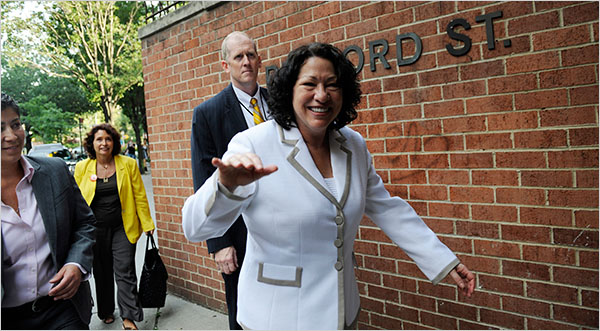
Sonia Sotomayor arrived at her home in Manhattan’s West Village on Thursday, after she was
confirmed to the Supreme Court. Robert Stolarik for The New York Times.


By CHARLIE SAVAGE
Published: August 6, 2009


WASHINGTON — The Senate on Thursday confirmed Judge Sonia Sotomayor as the nation’s first Hispanic Supreme Court justice, concluding a 10-week battle with a resounding victory for the White House.


<SPAN style="BACKGROUND-COLOR: #ffff00">The largely party-line vote, 68 to 31, brought Judge Sotomayor, 55, to the threshold of one of the United States’ most prestigious institutions, completing an extraordinary narrative arc that began in a Bronx housing project where the Puerto Rican girl was raised by her widowed mother</span>.

In brief remarks at the White House, <SPAN style="BACKGROUND-COLOR: #ffff00">President Obama hailed her confirmation as “breaking yet another barrier and moving us yet another step closer to a more perfect union.”</span>

“With this historic vote,” he said, “the Senate has affirmed that Judge Sotomayor has the intellect, the temperament, the history, the integrity and the independence of mind to ably serve on our nation’s highest court.”

A White House spokesman said the judge watched the vote on television in her chambers in New York City, and she released no statement. But when Judge Sotomayor returned to her West Village home Thursday night, she beamed and waved at neighbors who lined the sidewalks to clap and shout encouragement.

Chief Justice John G. Roberts Jr. is expected to swear the new justice in at a private ceremony at the Supreme Court on Saturday morning, a court spokeswoman said.

Leaders of conservative groups had tried to delay the confirmation vote, but Democrats pushed it through to ensure that Judge Sotomayor would be installed by September, when the court takes up a campaign-finance case left over from its last term. She is not expected to alter the balance of the court on most issues, as her views appear to be similar to those of David H. Souter, the retired justice she is succeeding.

Judge Sotomayor’s confirmation was never in much doubt, given Democrats’ numerical advantage in the Senate. But the final vote showed a partisan divide. No Democrat voted against her, while all but 9 of the chamber’s 40 Republicans did so. She will become the first justice nominated by a Democratic president to join the court since 1994.

Senator Edward M. Kennedy, Democrat of Massachusetts, is ailing and did not vote. But the rest of the Senate filled the chamber beneath a packed gallery, solemnly rising one by one to cast a vote in the hushed room. Senator Robert C. Byrd, the 91-year-old Democrat of West Virginia who has also been ill, made a rare appearance in a wheelchair, raising his hand and murmuring his assent with a smile when a clerk called his name.

During three days of debate on the Senate floor, Republicans labeled Judge Sotomayor a judicial activist, criticizing several of her speeches about foreign law and judicial diversity — including a now-famous line lauding a “wise Latina” judge — as well as her votes in cases involving Second Amendment rights, property rights and a racial discrimination claim brought by white firefighters in New Haven.

“Judge Sotomayor is certainly a fine person with an impressive story and a distinguished background,” the Senate Republican leader, Mitch McConnell of Kentucky, said this week. “But a judge must be able to check his or her personal or political agenda at the courtroom door and do justice evenhandedly, as the judicial oath requires. This is the most fundamental test. It is a test that Judge Sotomayor does not pass.”

Democrats portrayed Judge Sotomayor as a qualified judge whose biography — rising from humble beginnings to excel at two Ivy League universities, serve stints as a prosecutor and corporate lawyer, and then 17 years as a district and appeals court judge — is a classic American success story. Her judicial record, they said, is moderate and mainstream.

“Judge Sotomayor’s career and judicial record demonstrates that she has always followed the rule of law,” Senator Patrick J. Leahy, Democrat of Vermont and chairman of the Senate Judiciary Committee, said on Thursday. “Attempts at distorting that record by suggesting that her ethnicity or heritage will be the driving force in her decisions as a justice of the Supreme Court are demeaning to women and all communities of color.”

Many political strategists warned Republicans that opposing the first Hispanic nominated to the Supreme Court would jeopardize the party in future elections, and some Democrats sought to portray Republican opposition as an insult to Hispanics.

In July, the National Rifle Association, which historically has stayed out of judicial nomination fights, came out against Justice Sotomayor and said it would include senators’ confirmation vote in its legislative scorecard on gun-rights issues for the 2010 election, a pointed threat to Democrats from conservative-leaning states.

But both efforts to appeal to interest-group politics largely faltered.

The vote was “a triumph of party unity over some of the interest-group politics that you would have expected to play a bigger role,” said Curt Levey, executive director of the conservative Committee for Justice.

Many Republicans took pains to emphasize that their vote against Judge Sotomayor did not mean they were anti-Hispanic.

Before announcing his opposition to her nomination, Senator John McCain of Arizona, last year’s Republican presidential nominee, first described her as an “immensely qualified candidate” with an “inspiring and compelling” life story. And he dwelled on his support for Miguel Estrada, an appeals-court nominee of President George W. Bush whom Democrats blocked from a vote even though “millions of Latinos would have taken great pride in his confirmation.”

Many Republicans echoed Mr. McCain’s approach, and some conservatives noted that Hispanics are ideologically diverse. But for some Hispanic voters, the symbolism of the first Hispanic joining the Supreme Court — and the memory of who opposed her — could be all that lingers, said Janet Murguía, president of the National Council of La Raza, an Hispanic advocacy group.


“This is a singularly definitive historic moment,” Ms. Murguía said. “So it is a vote, I think, that will matter to the Latino community and will be remembered by the Latino community.”

The vote could also have lingering consequences for Democratic senators from conservative-leaning states who confirmed Judge Sotomayor’s nomination despite the N.R.A.’s opposition.

Manuel A. Miranda, a conservative judicial issues advocate, said he believed that the threat of lower ratings by the N.R.A. had an impact by prompting more Republicans to vote against Judge Sotomayor.

Matthew Dowd, a former political adviser to Mr. Bush who had warned Republicans to be civil, disagreed. The Supreme Court confirmation process has simply become increasingly polarized along party lines, Mr. Dowd said.

“My view is that gun rights had nothing to do with it,” Mr. Dowd said. “Supreme Court nominations have become dodgeball games, with Democrats lining up on one side and Republicans lining up on our side.”

Colin Moynihan contributed reporting from New York.

http://www.nytimes.com/2009/08/07/us/politics/07confirm.html
 
Back
Top