
Chinese General Threatens Use of A-Bombs if U.S. Intrudes

Dolemite

Star
Registered
washingtonpost

Chinese General Threatens Use of A-Bombs if U.S. Intrudes


By JOSEPH KAHN
Published: July 15, 2005

BEIJING, Friday, July 15 - China should use nuclear weapons against the United States if the American military intervenes in any conflict over Taiwan, a senior Chinese military official said Thursday.

"If the Americans draw their missiles and position-guided ammunition on to the target zone on China's territory, I think we will have to respond with nuclear weapons," the official, Maj. Gen. Zhu Chenghu, said at an official briefing.

General Zhu, considered a hawk, stressed that his comments reflected his personal views and not official policy. Beijing has long insisted that it will not initiate the use of nuclear weapons in any conflict.

But in extensive comments to a visiting delegation of correspondents based in Hong Kong, General Zhu said he believed that the Chinese government was under internal pressure to change its "no first use" policy and to make clear that it would employ the most powerful weapons at its disposal to defend its claim over Taiwan.

"War logic" dictates that a weaker power needs to use maximum efforts to defeat a stronger rival, he said, speaking in fluent English. "We have no capability to fight a conventional war against the United States," General Zhu said. "We can't win this kind of war."

Whether or not the comments signal a shift in Chinese policy, they come at a sensitive time in relations between China and the United States.

The Pentagon is preparing the release of a long-delayed report on the Chinese military that some experts say will warn that China could emerge as a strategic rival to the United States. National security concerns have also been a major issue in the $18.5 billion bid by Cnooc Ltd., a major Chinese oil and gas company, to purchase the Unocal Corporation, the American energy concern.

China has had atomic bombs since 1964 and currently has a small arsenal of land- and sea-based nuclear-tipped missiles that can reach the United States, according to most Western intelligence estimates. Some Pentagon officials have argued that China has been expanding the size and sophistication of its nuclear bombs and delivery systems, while others argue that Beijing has done little more than maintain a minimal but credible deterrent against a nuclear attack.

Beijing has said repeatedly that it would use military force to prevent Taiwan from becoming a formally independent country. President Bush has made clear that the United States would defend Taiwan.

Many military analysts have assumed that any battle over Taiwan would be localized, with both China and the United States taking care to ensure that it would not expand into a general war between the two powers.

But the comments by General Zhu suggest that at least some elements of the military are prepared to widen the conflict, perhaps to persuade the United States that it could no more successfully fight a limited war against China than it could against the former Soviet Union.

"If the Americans are determined to interfere, then we will be determined to respond," he said. "We Chinese will prepare ourselves for the destruction of all the cities east of Xian. Of course the Americans will have to be prepared that hundreds of cities will be destroyed by the Chinese."

General Zhu's threat is not the first of its kind from a senior Chinese military official. In 1995, Xiong Guangkai, who is now the deputy chief of the general staff of the People's Liberation Army, told Chas W. Freeman, a former Pentagon official, that China would consider using nuclear weapons in a Taiwan conflict. Mr. Freeman quoted Mr. Xiong as saying that Americans should worry more about Los Angeles than Taipei.

Foreign Ministry officials did not immediately respond to requests for comment about General Zhu's remarks.

General Zhu said he had recently expressed his views to former American officials, including Mr. Freeman and Adm. Dennis C. Blair, the former commander in chief of the United States Pacific Command.

David Lague of The International Herald Tribune contributed reporting for this article.
 
Testing, testing, testing, 1,2,3. Barking by an army general whose words are not official policy while the official policymakers remain quiet. The general words are enough to cause some alarm but they are more puffing than real. I would doubt that China is anxious for a nuclear exchange but the general is keeping the U.S. honest (much like throwing deep every now and then to keep the secondary honest). Without question, China has nuclear missiles that could do damage in the U.S., but the U.S. could just as easily make China glow, and moreso.

I wouldn't be surprised that the U.S. response would be low-key publicly while quietly making a few key adjustments in the coming months with naval forces by adding a few key elements to the pac-fleet within deployable range to remind China of the difficulty it would face in successfully deploying amphibious forces against Taiwan and to show vulnerability in the air.

China is just using the general to sabre rattle a little bit and to get an idea of the present U.S. resolve.

QueEx
 
I would think it is more of a probing nature to see how America feels about having a Nuclear War over an island that the US concedes is part of China through its "don't declare independence" rule for Taiwan. As time goes on this issue will grow as China's world strength grows. As a lesser becomes an equal or greater, they are more likely to test their new found position out.
 
Dolemite said:
I would think it is more of a probing nature to see how America feels about having a Nuclear War over an island that the US concedes is part of China through its "don't declare independence" rule for Taiwan. As time goes on this issue will grow as China's world strength grows. As a lesser becomes an equal or greater, they are more likely to test their new found position out.

Yeah, I pretty much agree.
 
Dolemite said:
I would think it is more of a probing nature to see how America feels about having a Nuclear War over an island that the US concedes is part of China through its "don't declare independence" rule for Taiwan. As time goes on this issue will grow as China's world strength grows. As a lesser becomes an equal or greater, they are more likely to test their new found position out.
Down the road, you're probably right. But a lot will occur in the meantime. In the interim, Taiwan has to see the cards being dealt and I wouldn't be surprised if it doesn't move to build its own defenses to make the point of decision later rather than nearer. Remember, no matter how many soldeirs China has, <u>they</u> have to cross the China Sea to occupy Taiwan. China is building an amphibious capability but each addition to a defense aimed at making that crossing hazardous postpones what may be the inevitable. Taiwan, with a little help, has the capability of building a credible defense. While the U.S. may not "Overtly" assist in building that defense, things have a way of arriving onshore.

QueEx
 
QueEx said:
Down the road, you're probably right. But a lot will occur in the meantime. In the interim, Taiwan has to see the cards being dealt and I wouldn't be surprised if it doesn't move to build its own defenses to make the point of decision later rather than nearer. Remember, no matter how many soldeirs China has, <u>they</u> have to cross the China Sea to occupy Taiwan. China is building an amphibious capability but each addition to a defense aimed at making that crossing hazardous postpones what may be the inevitable. Taiwan, with a little help, has the capability of building a credible defense. While the U.S. may not "Overtly" assist in building that defense, things have a way of arriving onshore.

QueEx
nah the US makes a point of not selling Taiwan anything worth shit. Without the threat of US intervention they'd be invaded yesterday
 
If China were to get Unocal, Taiwan isn't going anywhere, all they need to do is bide their time and China will come to them (Hong Kong is a perfect example of the capitalist virus infecting an old cold war communist). The next generation of Chinese leaders will be better exposed to the rest of the world and China knows it (that battle has already been lost). Rockawear and rap music will do what bomba can not in China. As far as war goes, China's biggest threat is conventional war, not nuclear. NOBODY wants to fight China in a conventional war.
 
Dolemite said:
nah the US makes a point of not selling Taiwan anything worth shit. Without the threat of US intervention they'd be invaded yesterday

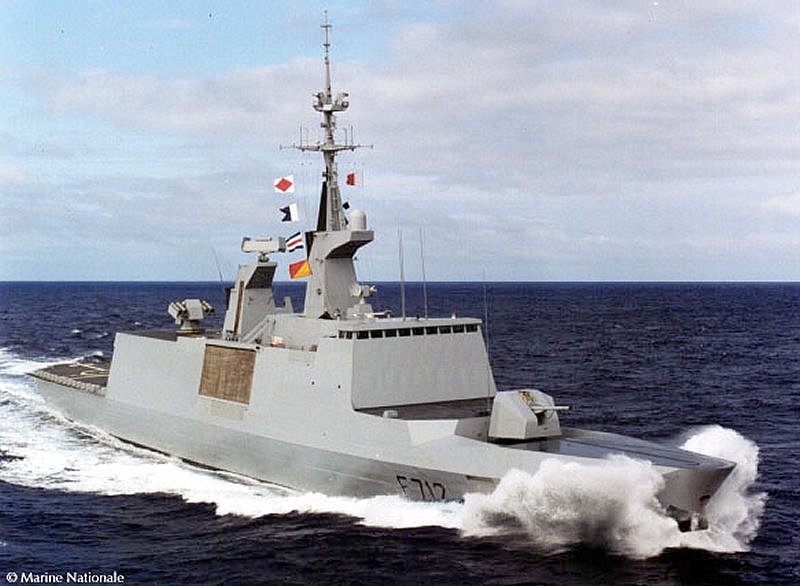
<font size="3">Not only does the U.S. sell selected systems to Taiwan, there are others that will, although China has threatened some that would. France for one, (oops, where's Greed LOL), has sold them 8 modern La Fayette class stealth frigates:

courbet-fh2.jpg


.

And Taiwan also produces some components and systems itself:

.

QueEx</font size>

<IFRAME SRC="http://www.globalsecurity.org/military/world/taiwan/navy-mod.htm" WIDTH=780 HEIGHT=1500>
<A HREF="http://www.globalsecurity.org/military/world/taiwan/navy-mod.htm">link</A>

</IFRAME>
 
Last edited:
If the US and China were to go to war, there would be no winners, we'd both fuck each other up and take the whole world along for the ride. I think both the Chinese and American big wigs know this.
 
Gods_Favorite said:
If the US and China were to go to war, there would be no winners, we'd both fuck each other up and take the whole world along for the ride. I think both the Chinese and American big wigs know this.


Co-sign
 
QueEx said:
Down the road, you're probably right. But a lot will occur in the meantime. In the interim, Taiwan has to see the cards being dealt and I wouldn't be surprised if it doesn't move to build its own defenses to make the point of decision later rather than nearer. Remember, no matter how many soldeirs China has, <u>they</u> have to cross the China Sea to occupy Taiwan. China is building an amphibious capability but each addition to a defense aimed at making that crossing hazardous postpones what may be the inevitable. Taiwan, with a little help, has the capability of building a credible defense. While the U.S. may not "Overtly" assist in building that defense, things have a way of arriving onshore.

QueEx


<font size="5"><center>Walker's World: Can Taiwan rely on the US?</font size></center>

By Martin Walker
UPI Editor
Feb. 8, 2006 at 2:10PM

A senior Taiwanese military commander has thrown complicated new factor into the latest skirmish in the recurrent war of words between politicians across the Taiwan Straits.

General Hu Chen-pu, the head of the General Political Warfare Bureau in the Ministry of defense, has publicly warned his civilian leaders that they cannot take American military assistance for granted, and that Taiwan has to be able to defend itself with its own resources.

"The U.S. has never promised to come to Taiwan's aid in the event of cross-strait hostilities. Nor has Taiwan anticipated such aid from the U.S. for we can never be sure if it would render us assistance," Hu said during a press briefing held this week at the ministry's new combat-maneuver training center.

General Hu's warning, which came as Beijing scolded Taiwan's President Chen Shui-bian as a "troublemaker and saboteur," were also intended to put pressure on the Taiwanese parliament finally to authorize the $18 billion re-armament plan that has long been stalled in the legislature. The U.S. has already agreed in principle to provide the Patriot anti-missile system, maritime patrol aircraft and submarines.

General Hu's caution that the United States may not necessarily rush to help if Taiwan is attacked reflects rising concern in the Pentagon and among senior figures in the U.S. Navy that the balance of military power is shifting significantly in China's coastal waters.

Recently retired naval officers have told United Press International that "it is now an open question" whether the Navy could again deploy two aircraft carrier task forces to the Taiwan Straits, as the Clinton administration did in 1996 when Chinese missile "tests" threatened to restrict shipping access to Taiwan's ports. The U.S. move, intended as a warning to Beijing, then calmed the situation, but China's re-armament program is changing the military balance.

The Pentagon's latest Quadrennial Defense Review, released last week, claims that China has "the greatest potential to compete militarily with the United States and field disruptive military technologies that could, over time, offset U.S. military advantages absent U.S. counter strategies."

"China continues to invest heavily in its military, particularly in its strategic arsenal and capabilities designed to improve its ability to project power beyond its borders. Since 1996, China has increased its defense spending by more than 10 percent in real terms in every year except 2003," says the QDR.

"The pace and scope of China's military build-up already puts regional military balances at risk. China is likely to continue making large investments in high-end, asymmetric military capabilities, emphasizing electronic and cyber-warfare; counter-space operations; ballistic and cruise missiles; advanced integrated air defense systems; next generation torpedoes; advanced submarines; strategic nuclear strike from modern, sophisticated land and sea-based systems; and theater unmanned aerial vehicles," the QDR goes on.

China's purchase of Kilo-class submarines and advanced Su-30 strike warplanes from Russia represents a serious military threat to the U.S. carriers, on which reinforcement of a threatened Taiwan would depend. Senior U.S. naval officers are concerned that the Bush administration has not yet thought through the implications of this, and of the possibility of losing an aircraft carrier to enemy action.

"That could mean losing 6,000 sailors - double the losses we suffered on 9/11," one newly retired admiral told this reporter recently. ""How do we retaliate for that? Do we counter-strike the Chinese mainland, when there are thousands of U.S. civilians and businessmen there, and corporate America is besieging Washington to warn that we might be hitting our own factories and essential trading partners?"

General Hu's remarks reflect similar concerns among the Taiwanese military, whose Integrated Assessment Office expects China to deploy some 1,800 ballistic missiles over the next 5 years, and to deploy a total of 50 diesel and nuclear submarines over the coming decade. By 2015, China is expected to deploy 38 new warships like the impressive new home-built "Shenzhen" destroyer, and there are plans to build aircraft carriers. For the moment, however, China's main naval asset is the fleet of 4 Russian-built Sovremenny-class missile destroyers, each carrying 54 Sunburn missiles, Russia's highly advanced SS-N-22 anti-ship missile that is a serious worry for the U.S. Navy.

Ironically, the integration of the economies of China and Taiwan has never been closer. China is Taiwan's biggest customer, taking 38 percent of Taiwanese exports last year, worth over $70 billion. After Japan and South Korea, Taiwan's is China's third largest source of imports.

But the cross-straits politics have been delicate since Taiwan elected President Chen, who last week suggested that the island should "forget about" reunification with the mainland and proposed to scrap the largely moribund National Unification Council. President Chen has lately backed away from his proposal for a new Taiwanese constitution to spell out the country's independence; a move that China says would provoke military action

Beijing's Taiwan Affairs Office slammed Chen this week, saying: "This demonstrates once again that he is a troublemaker and saboteur of cross-strait relations and peace and stability in Asia."

U.S. State department spokesmen also criticized President Chen's remarks, stressing that the U.S. maintained its long-standing policy of "one China" and opposes Taiwanese independence. But President Bush's statement, early in his first term, that the United States would "stand by Taiwan" in the event on an attack, and the offer of U.S. arms, has emboldened the pro-independence movement.

The concern that is growing in the U.S. Navy is that Taiwan is being politically provocative to Beijing while declining to boost its own defenses, largely because President Chen seems convinced that American protection is guaranteed - a complacency that Taiwan's own military now seems at pains to challenge.


http://www.washtimes.com/upi/20060208-015141-2677r.htm
 
QueEx said:
Testing, testing, testing, 1,2,3. Barking by an army general whose words are not official policy while the official policymakers remain quiet. The general words are enough to cause some alarm but they are more puffing than real. I would doubt that China is anxious for a nuclear exchange but the general is keeping the U.S. honest (much like throwing deep every now and then to keep the secondary honest). Without question, China has nuclear missiles that could do damage in the U.S., but the U.S. could just as easily make China glow, and moreso.

I wouldn't be surprised that the U.S. response would be low-key publicly while quietly making a few key adjustments in the coming months with naval forces by adding a few key elements to the pac-fleet within deployable range to remind China of the difficulty it would face in successfully deploying amphibious forces against Taiwan and to show vulnerability in the air.

China is just using the general to sabre rattle a little bit and to get an idea of the present U.S. resolve.

QueEx

Testing uh 1,4,6,7, ... Any country that tries to engage in war with the US is basicaly comiting suicide and sacrificing itself in hopes that it injures the US in the process... No country has the ability to destroy america and survive to talk about it but america can destroy any country and live to destroy many more. These small coutries allways talking about what they gonna do against america and when it goes down it is always the same story.

The smart thing america does is that is constantly fights an economic war against the whole planet and keeps it enemies financialy week and unable to arm themselves. Plus america uses financial muscle to gain acsess to land air and water spaces to have basses and ships in strategic positions to control counties considered a threat.

The only way america can be beaten at war is if 3 or more countries team up agains them and that aint happenin.
 
Rajnaty Cyaramchandeo said:
Testing uh 1,4,6,7, ... Any country that tries to engage in war with the US is basicaly comiting suicide and sacrificing itself in hopes that it injures the US in the process... No country has the ability to destroy america and survive to talk about it but america can destroy any country and live to destroy many more. These small coutries allways talking about what they gonna do against america and when it goes down it is always the same story.

The smart thing america does is that is constantly fights an economic war against the whole planet and keeps it enemies financialy week and unable to arm themselves. Plus america uses financial muscle to gain acsess to land air and water spaces to have basses and ships in strategic positions to control counties considered a threat.

The only way america can be beaten at war is if 3 or more countries team up agains them and that aint happenin.

ha...... china, russia , venuzala, all of north africa, syria, iran.... should i go on?....
 
it would only take Russia and china ............................and trust me the US economy can be killed easier then you may think it will take a number to countries to agree to kill americas economy but it can be done.........
 
dyhawk said:
it would only take Russia and china ............................and trust me the US economy can be killed easier then you may think it will take a number to countries to agree to kill americas economy but it can be done.........
... AND what will the U.S. be doing in the interim ???

QueEx
 
Who knows probably making the upper 1 percent richer................and ignoring the problem ...................pretty much after the damage is done they might just jump ship...........isn't that the trend so far
 
Same glass different view. I see it half full and I think you see it half empty. A difference of optimism and pessimism.

QueEs
 
<font size="5"><center>Taiwan Sets Self-Defense Objectives</font size>
<font size="4">Island Seeks to Preserve Autonomy With Boost in Military Spending</font size></center>

Washington Post
By Edward Cody
Washington Post Foreign Service
Sunday, May 21, 2006; Page A19

BEIJING, May 20 -- Taiwan unveiled its first formal national security policy Saturday, pledging to increase defense spending by 20 percent and urging China to cooperate in establishing a military buffer zone to lower tension in the Taiwan Strait.

The 162-page document, issued after long delays and extensive debate among President Chen Shui-bian's advisers, was designed as a guideline for this and future governments in defending the self-ruled island against any attack from China, officials said. Reflecting Chen's dream of full Taiwanese independence, it postulates that Taiwan's "overall strategic goal is to guarantee the country's sovereignty."

China had no immediate reaction. It has long insisted, however, that Taiwan is not a sovereign nation, but a province that must return to the Chinese fold. China has vowed to use force, though as a last resort, to prevent the island and its 23 million inhabitants from attaining formal independence.

In describing Taiwan's security environment, Chen's government compared the Chinese military to the Nazi war machine in World War II and asserted that China is bent on long-term military expansion that requires it to control Taiwan and the 100-mile-wide Taiwan Strait. In a recent interview, Chen said Taiwanese intelligence had information that China has a plan to attack the island within 10 years, but this assertion was not repeated in the strategy declaration.

Only by building up its own military and economic strength, the document declared, can Taiwan preserve its de facto independence and democratic system. To make that possible, it said, the government will boost military spending from 2.5 to 3 percent of gross domestic product.

Chen's government has been trying without success for the last several years to increase the military budget to accommodate an $18 billion purchase of U.S. weapons. The Legislative Yuan, controlled by the opposition Nationalist Party, has refused to approve the funds, saying the weapons package is too expensive and not appropriate to Taiwan's needs.

In addition, the document said, the Defense Ministry will go ahead with previously announced plans to reduce the 300,000-member military by a third over the next two years, in part by cutting back the length of required service from 18 months to one year.

The strategy declaration emphasized that overall national strength, not just weapons and soldiers, is key to Taiwan's security. It said Taiwan's position in the world should be enhanced by forging relations with more nations and international organizations, for instance, and the economy should be reinforced to avoid presenting China with new opportunities for pressure.

There was no mention of any shift away from Taiwan's fundamentally defensive military strategy and cultivation of ties with the United States, which has pledged to help in the island's defense but opposes unilateral steps toward independence. As the strategy was being debated over the months, reports in Taipei, the capital, said that some of Chen's advisers had pushed for a shift to a more offensive stance. This would be based mainly on cruise missiles, the reports said, which Taiwan can produce more cheaply than buying the PAC-3 defensive missile systems proposed by the United States.

"Any kind of countermeasures would be for defense," said Michael Tsai, deputy secretary general of Chen's National Security Council. "We're not pursuing preemptive capabilities, and we will not develop nuclear weapons or weapons of mass destruction."

The call for a buffer zone in the Taiwan Strait echoed earlier suggestions by Chen. He said tensions could be lowered and accidental conflicts avoided if both sides' military forces and missiles -- the strategy document specified cruise missiles -- were barred from the area around Taiwan.

When proposed earlier, the idea did not draw a response from China, which has an interest in maintaining pressure on Taiwan to prevent Chen from taking further steps toward formal independence. China's official New China News Agency announced Friday, for instance, that the Chinese military recently practiced amphibious landings, the kind that would be necessary for any invasion of Taiwan.

Stephen Young, director of the American Institute in Taiwan, the de facto U.S. Embassy, praised Chen's government for laying out its security thinking for the public in Taiwan and abroad. Repeating a frequent demand from Washington, he called on China to do the same.

"For a democratic society like Taiwan to try and present a comprehensive explanation of its national security policy is a welcome step," he said, "and I think it is a model China should follow and learn from, because they should be more transparent on these issues themselves."


Special correspondent Tim Culpan in Taipei contributed to this report.

http://www.washingtonpost.com/wp-dy...6052000941.html?referrer=email&referrer=email
 
<font size="5"><center>Pentagon Finds China Fortifying
Its Long-Range Military Arsenal</font size></center>


Washington Post
By Ann Scott Tyson
Washington Post Staff Writer
Wednesday, May 24, 2006; Page A17

China's military buildup is increasingly aimed at projecting power far beyond its shores into the western Pacific to be able to interdict U.S. aircraft carriers and other nations' military forces, according to a Pentagon report released yesterday that outlines continued concerns over China's rising strategic influence in Asia.

Chinese military planners are focusing to a greater degree than in the past on targeting ships and submarines at long ranges using anti-ship cruise missiles, partly in reaction to Taiwan Strait crises in 1995 and 1996 that saw the U.S. military intervene with carrier battle groups, the report said.

The People's Liberation Army "is engaged in a sustained effort to interdict, at long ranges, aircraft carrier and expeditionary strike groups that might deploy to the western Pacific," the report said. Long-term trends in China's development of nuclear and conventional weapons "have the potential to pose credible threats to modern militaries operating in the region," it said.

The annual report to Congress on China's military power also highlighted Beijing's purchases of Russian weapons, its positioning of as many as 790 Chinese short-range ballistic missiles opposite Taiwan and its nuclear weapons modernization. It warned that advances in nuclear missiles are spurring a debate among some high-ranking Chinese strategists over whether Beijing should change its "no first use" doctrine that bars using nuclear weapons except in response to a nuclear attack.

The 50-page report states that China's military buildup remains primarily focused on Taiwan, and notes that its current ability to sustain military power over long distances is limited. But the report also outlines Chinese military ambitions that go well beyond Taiwan, and reiterates the Pentagon's latest formulation on China's military threat, stating that "China has the greatest potential to compete militarily with the United States."

China's defense budget is expanding apace with the new investments, the report said. Beijing officially projects a growth in defense spending of 14.5 percent this year to about $35 billion. But the report, citing the U.S. Defense Intelligence Agency, puts the actual funding at twice or triple that amount -- or as much as $105 billion -- when all military-related spending is tallied.

The report details how the Chinese military is investing in cruise missiles, precision weapons and guidance systems that could target ships, submarines, aircraft and airbases as far away as the "second island chain" including the Mariana Islands and Guam. As part of this strategy, China is buying Russian aircraft, such as the IL-76 transport and IL-78 tanker aircraft, and has shown interest in the Su-33 maritime strike aircraft. China is in the early stages of "developing power projection for other contingencies other than Taiwan," said Peter W. Rodman, assistant secretary of defense for international security affairs.

On Taiwan, the report said China had deployed about 100 more short-range ballistic missiles to garrisons opposite the island, increasing the total from 650 to 730 last year to between 710 and 790 now. "The balance between Beijing and Taiwan is heading in the wrong direction," Rodman said, adding that "maybe our job is to be the equalizer if a contingency arises."

The internal debate over China's nuclear policy of no first use is unfolding as the nation upgrades its nuclear arsenal to include more mobile intercontinental ballistic missiles such as the DF-31A and the JL-2 submarine-launched ballistic missile, according to the report. Both missiles are expected to become operable as early as 2007 and be capable of striking the United States, it said.

China's stated doctrine, reaffirmed last fall during a visit to Beijing by Defense Secretary Donald H. Rumsfeld, is not to use nuclear weapons first. But senior U.S. defense officials said improvements in the quality and quantity of China's nuclear missiles had generated discussion among Chinese military and academic strategists over how and when to use them. "We take them at their word that they adhere to that doctrine," Rodman said. However, he said, "as their capabilities change they may be thinking about options that they didn't have before."

The report cites public comments by Chinese military officials and strategists stating that under certain extreme circumstances -- such as an all-out attack against the country by conventional forces -- that China should use nuclear weapons.

Any move to abandon the no-first-use doctrine would be "very destabilizing" in the region, a U.S. defense official said.

To address such concerns, the United States and China will soon start talks over nuclear strategy with the first U.S. visit by the head of China's nuclear arsenal, Jing Zhiyuan, the commander of the Second Artillery Corps, officials said. Jing will be hosted by his American counterpart, Gen. James E. Cartwright, chief of U.S. Strategic Command at Offutt Air Force Base in Nebraska. No date has been finalized for the visit, Rodman said.

The strategic talks illustrate the Bush administration's two-pronged approach to China's military buildup set down in the 2006 National Security Strategy: to engage with Chinese military leaders to influence their choices while hedging against potential threats.

Experts on China's military differed on the significance of the debate over nuclear policy. "The real issue is not 'no first use.' The real issue is: Under what conditions China will use nuclear weapons . . . how bad do things have to get for the threshold to be crossed?" said Evan S. Medeiros, an expert at Rand Corp. He noted that some Chinese military commentators have stated that a precision strike by conventional weapons on China's nuclear facilities could be tantamount to a small-scale nuclear attack and lead China to consider using nuclear weapons.

Other experts played down the importance of the nuclear debate in China. "They are primarily interested in increasing conventional options in regional contingencies and vis-a-vis Taiwan," said Kurt Campbell, a China expert at the Center for Strategic and International Studies.


http://www.washingtonpost.com/wp-dy...6052301552.html?referrer=email&referrer=email
 
Wait, does anyone REALLY find this bravado unusual or peculiar? I know I don't, it seems to make perfect sense to me. America quite frankly scares people. I will not reinvent the wheel here, but all that is needed to be said pretty much already has here.

Funny that Taiwan and America sees or claims to see something threatening or dangerous in Chinese Military and hegemonic expansion in the Pacific. WHile America, a foreign culture from thousands of miles abroad, look over the entire ordeal with a forever attentive and watchful eye.

Go figure...

But Nuclear war is an impractical move. Like GF said, there is no way to win. It is the ultimate gamble. Like hey let's destroy the entire game table and see what we can pick apart out of what's left of the remains...

Madness, this talk of using Nuclear weapons...
 
<IFRAME SRC="http://www.telegraph.co.uk/news/main.jhtml?xml=/news/2006/11/13/uchina113.xml" WIDTH=780 HEIGHT=1500>
<A HREF="http://www.telegraph.co.uk/news/main.jhtml?xml=/news/2006/11/13/uchina113.xml">link</A>

</IFRAME>

[hide]Chinese sub secretly stalks US fleet
By Sally Peck and agencies
Last Updated: 5:23pm GMT 13/11/2006


Blog: Playing submarines with China

A Chinese submarine secretly stalked a US aircraft carrier and surfaced within firing range of its torpedoes and missiles before being detected, The Washington Times has reported.

China's Song-class diesel-powered attack submarine shadowed the USS Kitty Hawk undetected and surfaced within five miles of the aircraft carrier on October 26, the newspaper reported, citing unnamed defence officials.

The submarine was discovered after it surfaced by one of the American fleet's aircraft on a routine surveillance flight, the newspaper reported.

The report emerged as Admiral Gary Roughead, commander of the American navy's Pacific fleet, made his first visit to China.

Admiral William J. Fallon, commander of the US forces in the Pacific, has been working with the Chinese on a military exchange programme in recent months.

The two countries have been working on a heightened military partnership in the wake of the North Korean nuclear test. China was widely praised for its role in brokering North Korea's return to the six-party talks.

The Chinese submarine was carrying Russian-made wake-homing torpedoes and anti-ship cruise missiles, according to the officials.

The Pentagon refused to comment on the alleged incident.

[ img]http://www.telegraph.co.uk/news/graphics/2006/11/13/uchina.jpg[/img]

[/hide]
 
Last edited:
<IFRAME SRC="http://news.bbc.co.uk/2/hi/asia-pacific/6278867.stm" WIDTH=780 HEIGHT=1500>
<A HREF="http://news.bbc.co.uk/2/hi/asia-pacific/6278867.stm">link</A>

</IFRAME>
 
Last edited:
<font size="5"><center>China rattles America's cage with satellite shot</font size><font size="4">
Look what we can do</font size></center>

The Register
By Lucy Sherriff
Published Friday 19th January 2007 10:27Â GMT

China is reported to have shot down one of its own satellites, sparking international criticism and concern over the strength and sophistication of the nation's military.

Although there is nothing to suggest the test was carried out with hostile intentions, the fact that China feels able to demonstrate the capability to destroy orbiting technology satellites does cause eyebrows to raise in global political circles.

According to reports in the magazine American Aviation Week and Space Technology last week, China used a medium range ballistic missile to take down an old weather satellite. The US confirmed that the test had taken place, adding its voice to international concerns.

National Security Council spokesman Gordon Johndroe said that satellite interception tests - the first to have taken place for 20 years - were "inconsistent with the spirit of co-operation" in the civil space arena.

Australia and Japan have both expressed concern, according to the BBC. Japanese chief cabinet secretary, Yasuhisa Shiozaki, said his government had asked China for an explanation, adding that Japan is concerned about the peaceful use of space, and the safety aspect of shooting down satellites.

Meanwhile, Australian foreign minister Alexander Downer said he did not want to see the incident spark "an arms race in outer space".

The test comes mere months after the US revamped its space policy, taking a more militaristic tone than in the past. The policy scrupulously avoided any commitment not to develop space-based weapons.

It doesn't take much imagination to see China's missile launch, which it has yet to confirm, as a reply to the US's new policy.

Both the US and the old USSR shot down satellites in the 1980s, but they curtailed their fun over concerns about where the debris might land.


http://www.theregister.co.uk/2007/01/19/china_satellite/
 
I'm going to throw out something that sounds far fetched real quick.

Would it be messed up if China help finance some of the terrorism organizations to make a diversion for us? Think about it, do you hear terrorism in CHINA? Who do you think get more of the oil in the middle east? The US or China? Just a thought.
 
<font size="5"><center>Space and Sea-Lane Control in Chinese Strategy</font size></center>

STRATFOR
By George Friedman
January 24, 2007


Aviation Week & Space Technology magazine, citing U.S. intelligence sources, has reported that China has successfully tested an anti-satellite (ASAT) system. According to the report, which U.S. officials later confirmed, a satellite was launched, intercepted and destroyed a Feng Yun 1C weather satellite, also belonging to China, on Jan. 11. The weather satellite was launched into polar orbit in 1999. The precise means of destruction is not clear, but it appears to have been a kinetic strike (meaning physical intercept, not laser) that broke the satellite into many pieces. The U.S. government wants to reveal as much information as possible about this event in order to show its concern -- and to show the Chinese how closely the Americans are monitoring their actions.

The Jan. 17 magazine report was not the first U.S. intelligence leak about Chinese ASAT capabilities. In August 2006, the usual sources reported China had directed lasers against U.S. satellites. It has become clear that China is in the process of acquiring the technology needed to destroy or blind satellites in at least low-Earth orbit, which is where intelligence-gathering satellites tend to operate.

Two things about this are noteworthy. The first is that China is moving toward a space warfare capability. The second is that it is not the Chinese who are announcing these moves (they maintained official silence until Jan. 23, when they confirmed the ASAT test), but Washington that is aggressively publicizing Chinese actions. These leaks are not accidental: The Bush administration wants it known that China is doing these things, and the Chinese are quite content with that. China is not hiding its efforts, and U.S. officials are using them to create a sense of urgency within the United States about Chinese military capabilities (something that, in budgetary debates in Washington, ultimately benefits the U.S. Air Force).

China has multiple space projects under way, but the one it is currently showcasing -- and on which the United States is focusing -- involves space-denial capabilities. That makes sense, given China's geopolitical position. It does not face a significant land threat: With natural barriers like the Himalayas or the Siberian wastes on its borders, foreign aggression into Chinese territory is unlikely. However, China's ability to project force is equally limited by these barriers. The Chinese have interests in Central Asia, where they might find power projection an enticing consideration, but this inevitably would bring them into conflict with the Russians. China and Russia have an interest in containing the only superpower, the United States, and fighting among themselves would play directly into American hands. Therefore, China will project its power subtly in Central Asia; it will not project overt military force there. Its army is better utilized in guaranteeing China's internal cohesiveness and security than in engaging in warfare.

Geopolitics and Naval Power

Its major geopolitical problem is, instead, maritime power. China -- which published a defense white paper shortly before the ASAT test -- has become a great trading nation, with the bulk of its trade moving by sea. And not only does it export an enormous quantity of goods, but it also increasingly imports raw materials. The sea-lanes on which it depends are all controlled by the U.S. Navy, right up to China's brown water. Additionally, Beijing retains an interest in Taiwan, which it claims as a part of China. But whatever threats China makes against Taiwan ring hollow: The Chinese navy is incapable of forcing its way across the Taiwan Strait, incapable of landing a multidivisional force on Taiwan and, even if it were capable of that, it could not sustain that force over time. That is because the U.S. Navy -- using airpower, missiles, submarines and surface vessels -- could readily cut the lines of supply and communication between China and Taiwan.

The threat to China is the U.S. Navy. If the United States wanted to break China, its means of doing so would be naval interdiction. This would not have to be a close-in interdiction. The Chinese import oil from around the world and ship their goods around the world. U.S. forces could choose to stand off, far out of the range of Chinese missiles -- or reconnaissance platforms that would locate U.S. ships -- and interdict the flow of supplies there, at a chokepoint such as the Strait of Malacca. This strategy would have far-reaching implications, of course: the Malacca Strait is essential not only to China, but also to the United States and the rest of the world. But the point is that the U.S. Navy could interdict China's movement of goods far more readily than China could interdict American movement of goods.

For China, freedom of the seas has become a fundamental national interest. Right now, China's access to the sea-lanes depends on U.S. acquiescence. The United States has shown no interest whatsoever in cutting off that access -- quite the contrary. But China, like any great power, does not want its national security held hostage to the goodwill of another power -- particularly not one it regards as unpredictable and as having interests quite different from its own. To put it simply, the United States currently dominates the world's oceans. This is a source of enormous power, and the United States will not give up that domination voluntarily. China, for its part, cannot live with that state of affairs indefinitely. China may not be able to control the sea itself, but it cannot live forever with U.S. control. Therefore, it requires a sea-lane-denial strategy.

Quite naturally, China has placed increased emphasis on naval development. But the construction of a traditional navy -- consisting of aircraft carriers, nuclear attack submarines and blue-water surface systems, which are capable of operating over great distances -- is not only enormously expensive, but also will take decades to construct. It is not just a matter of shipbuilding. It is also a matter of training and maturing a generation of naval officers, developing viable naval tactics and doctrine, and leapfrogging generations of technology -- all while trying to surpass a United States that already has done all of these things. Pursuing a conventional naval strategy will not provide a strategic solution for China within a reasonable timeframe. The United States behaves in unexpected ways, from the Chinese point of view, and the Chinese will need a solution within five years -- or certainly within a decade.

They cannot launch a competitive, traditional navy in that period of time. However, the U.S. Navy has a general dependency on -- and, therefore, a vulnerability related to -- space-based systems. Within the U.S. military, this is not unique to the Navy, but given that the Navy operates at vast distances and has sea-lane-control missions -- as well as the mission of launching aircraft and missiles against land-based targets -- it has a particular dependency on space. The service relies on space-based systems for intelligence-gathering, communications, navigation and tactical reconnaissance. This is true not only for naval platforms, but also for everything from cruise missile guidance to general situational awareness.

Take out the space-based systems and the efficiency of the Navy plummets dramatically. Imagine an American carrier strike group moving into interdiction position in the Taiwan Strait without satellite reconnaissance, targeting information for anti-ship missiles, satellite communications for coordination and so on. Certainly, ship-board systems could substitute, but not without creating substantial vulnerabilities -- particularly if Chinese engineers could develop effective jamming systems against them.

If the Chinese were able to combine kinetic ASAT systems for low-Earth orbit, high-energy systems for communications and other systems in geostationary orbit and tools for effectively denying the electromagnetic spectrum to the United States, they would have moved a long way toward challenging U.S. dominance of space and limiting the Navy's ability to deny sea-lanes to Chinese ships. From the Chinese point of view, the denial of space to the United States would undermine American denial of the seas to China.

Conjecture and Core Interests

There has been some discussion -- fueled by Chinese leaks -- that the real purpose of the Chinese ASAT launch was to prompt the Americans to think about an anti-ASAT treaty. This is not a persuasive argument because such a treaty would freeze in place the current status quo, and that status quo is not in the Chinese national interest.

For one thing, a treaty banning ASAT systems would leave the Chinese without an effective means of limiting American naval power. It would mean China would have to spend a fortune on a traditional navy and wait at least a generation to have it in place. It would mean ceding the oceans to the United States for a very long time, if not permanently. Second, the United States and Russia already have ASAT systems, and the Chinese undoubtedly assume the Americans have moved aggressively, if secretly, to improve those systems. Treaty or no, the United States and Russia already have the technology for taking out Chinese satellites. China is not going to assume either will actually dismantle systems -- or forget how to build them fast -- merely because of a treaty. The only losers in the event of an anti-ASAT treaty would be the countries that do not have them, particularly China.

The idea that what China really wants is an anti-ASAT treaty is certainly one the Chinese should cultivate. This would buy them time while Americans argue over Chinese intentions, it would make the Chinese look benign and, with some luck, it could undermine U.S. political will in the area of the military utilization of space. Cultivating perceptions that an anti-ASAT treaty is the goal is the perfect diplomatic counterpart to Chinese technological development. But the notion itself does not stand up to scrutiny.

The issue for the United States is not so much denying space to China as ensuring the survivability of its own systems. The United States likely has the ability to neutralize the space-based systems of other countries. The strategic issue, however, is whether it has sufficient robustness and redundancy to survive an attack in space. In other words, do U.S. systems have the ability to maneuver to evade attacks, to shield themselves against lasers, to continue their missions while under attack? Moreover, since satellites will be damaged and lost, does the United States have sufficient reserve satellites to replace those destroyed and launchers to put them in place quickly?

For Washington, the idea of an ASAT treaty is not the issue; the United States would love anything that blocks space capabilities for other nations. Rather, it is about building its own space strategy around the recognition that China and others are working toward denying space to the United States.

All of this is, of course, fiendishly expensive, but it is still a lot cheaper than building new naval fleets. The real problem, however, is not just money, but current military dogma. The U.S. military is now enthralled by the doctrine of asymmetric warfare, in which nonstate actors are more important than states. Forever faithful to the assumption that all wars in the future will look like the one currently being fought, the strategic urgency and intellectual bandwidth needed to prepare for space warfare does not currently exist within the U.S. military. Indeed, an independent U.S. Space Command no longer exists -- having been merged into Strategic Command, which itself is seen as an anachronism.

For the United States, one of the greatest prices of the Iraq war is not simply the ongoing conflict, but also the fact that it makes it impossible for the U.S. military to allocate resources for emerging threats. That always happens in war, but it is particularly troubling in this case because of the intractable nature of the Iraq conflict and the palpable challenge being posed by China in space. This is not a challenge that many -- certainly not those at the highest levels of military leadership -- have time to think about while concerned about the future of a few city blocks in Baghdad; but U.S. leaders might, in 10 years, look back on 2007 and wonder what their predecessors were thinking about.

Contact Us
Analysis Comments - analysis@stratfor.com
 
Gods_Favorite said:
If the US and China were to go to war, there would be no winners, we'd both fuck each other up and take the whole world along for the ride. I think both the Chinese and American big wigs know this.

The stakes are too high...
But eventually every weapon devoped gets used. Its a matter of who's the most prepared...
 
The Chinese have been threatening nuclear retaliation over Taiwan for decades. This is nothing new... it's the same old saber rattling. It must play well in China though, and that's probably why they continue to make such insane statements. The Chinese can barely feed themselves. The last thing they need, just at the point when they are starting to make some economic strides, is to have to divert their entire economy (much of which ultimately comes from the U.S., and which would be gone at the initiation of open hostilities) into an arms race with the U.S.
 
This is from http://www.fas.org/sgp/crs/row/RS21995.pdf, please read this...

Updated May 12, 2005

The PRC’s concerns about domestic terrorism, U.S.-PRC relations, China’s
international standing in a world dominated by U.S. power (particularly after the terrorist
attacks), and its image as a responsible leader helped explain China’s supportive stance.
However, Beijing also worried about U.S. military action near China, U.S.-led alliances,
Japan’s active role in the war (as quickly promised by Prime Minister Junichiro Koizumi),
greater U.S. (and Russian) influence in Central and South Asia at PRC expense, and U.S.
support for Taiwan — all exacerbating long-standing fears of “encirclement.” China
issued a Defense White Paper in December 2002. It said that major powers remained in
competition but that since the September 2001 attacks against the United States, countries
have increased cooperation. Although this paper contained veiled criticisms of the United
States for its military buildup, stronger alliances in Asia, and increased arms sales to and
enhanced military ties with Taiwan, it did not criticize the United States by name as in the
Defense White Paper of 2000. However, the Defense White Paper of December 2004
again criticized the United States by name.


FBI Office in Beijing.


On December 6, 2001, Francis Taylor, the State
Department’s Coordinator for Counter-terrorism, ended talks in Beijing that reciprocated
the September 25 meeting in Washington. He announced that the PRC agreed to give
“positive consideration” to a long-sought U.S. request for the FBI to set up a Legal
Attaché office at the U.S. Embassy, that counter-terrorism consultations would occur
semi-annually, and that the two sides would set up a Financial Counter-Terrorism
Working Group. He reported that Beijing’s cooperation has entailed coordination at the
U.N., intelligence-sharing, law enforcement liaison, and monitoring of financial
networks.12 The PRC approved the FBI office in February 2002, and the first semi-annual
meeting on terrorist financing was held at the Treasury Department in late May. The FBI
attaché arrived at the U.S. Embassy in Beijing in September 2002.

end of page-12 Department of State, press conference, Beijing, Dec. 6, 2001.


CRS-4
12 Department of State, press conference, Beijing, Dec. 6, 2001.
The PRC’s concerns about domestic terrorism, U.S.-PRC relations, China’s
international standing in a world dominated by U.S. power (particularly after the terrorist
attacks), and its image as a responsible leader helped explain China’s supportive stance.
However, Beijing also worried about U.S. military action near China, U.S.-led alliances,
Japan’s active role in the war (as quickly promised by Prime Minister Junichiro Koizumi),
greater U.S. (and Russian) influence in Central and South Asia at PRC expense, and U.S.
support for Taiwan — all exacerbating long-standing fears of “encirclement.” China
issued a Defense White Paper in December 2002. It said that major powers remained in
competition but that since the September 2001 attacks against the United States, countries
have increased cooperation. Although this paper contained veiled criticisms of the United
States for its military buildup, stronger alliances in Asia, and increased arms sales to and
enhanced military ties with Taiwan, it did not criticize the United States by name as in the
Defense White Paper of 2000. However, the Defense White Paper of December 2004
again criticized the United States by name.

Options and Implications for U.S. Policy
Summits and Strategic Ties. The counter-terrorism campaign helped to
stabilize U.S.-PRC relations up to the highest level, which faced tensions early in the
Bush Administration in April 2001 with the EP-3 aircraft collision crisis and U.S.
approvals of arms sales to Taiwan. According to the Final Report of the 9/11
Commission issued in July 2004, President Bush chaired a National Security Council
meeting on the night of September 11, 2001, in which he contended that the attacks
provided a “great opportunity” to engage Russia and China. President Bush traveled to
Shanghai in October 2001 for his first meeting with then PRC President Jiang Zemin at
the Leaders’ Meeting of the Asia Pacific Economic Cooperation (APEC) forum. Bush
called the PRC an important partner in the global coalition against terrorists but also
warned Jiang that the “war on terrorism must never be an excuse to persecute minorities.”
On February 21-22, 2002, the President visited Beijing (a trip postponed in October), after
Tokyo and Seoul. The President then hosted Jiang at Bush’s ranch in Crawford, TX, on
October 25, 2002, and Bush said that the two countries were “allies” in fighting terrorism.

FBI Office in Beijing. On December 6, 2001, Francis Taylor, the State
Department’s Coordinator for Counter-terrorism, ended talks in Beijing that reciprocated
the September 25 meeting in Washington. He announced that the PRC agreed to give
“positive consideration” to a long-sought U.S. request for the FBI to set up a Legal
Attaché office at the U.S. Embassy, that counter-terrorism consultations would occur
semi-annually, and that the two sides would set up a Financial Counter-Terrorism
Working Group. He reported that Beijing’s cooperation has entailed coordination at the
U.N., intelligence-sharing, law enforcement liaison, and monitoring of financial
networks.12 The PRC approved the FBI office in February 2002, and the first semi-annual
meeting on terrorist financing was held at the Treasury Department in late May. The FBI
attaché arrived at the U.S. Embassy in Beijing in September 2002.
 
<font size="5"><center>
U.S.-China relations to face strains</font size>
<font size="4">

Experts say Obama’s looming meeting with the Dalai Lama
and sale of weapons to Taiwan could sour ties</font size></center>


WaPost_333_GCH.gif

By John Pomfret
Sunday, January 3, 2010

WASHINGTON - The United States and China are headed for a rough patch in the early months of the new year as the White House appears set to sell a package of weapons to Taiwan and as President Obama plans to meet the Dalai Lama, U.S. officials and analysts said.

The Obama administration is expected to approve the sale of several billion dollars in Black Hawk helicopters and anti-missile batteries to Taiwan early this year, possibly accompanied by a plan gauging design and manufacturing capacity for diesel-powered submarines for the island, which China claims as its territory. The president is also preparing to meet the spiritual leader of Tibet, who is considered a separatist by Beijing. Obama made headlines last year when the White House, in an effort to generate goodwill from China, declined to meet the Dalai Lama, marking the first time in more than a decade that a U.S. president did not meet the religious leader during his occasional visits to Washington.

The expected downturn with Beijing comes despite a concerted effort by the Obama administration for closer ties. U.S. officials have held more high-level meetings with their Chinese counterparts — including a summit in Beijing in November — in the first year of this administration compared with the inaugural years of the four previous presidencies since relations were normalized with Beijing in 1979, records show.

"I think it's going to be nasty," said David M. Lampton, director of China studies at the Johns Hopkins School of Advanced International Studies and author of "The Three Faces of Chinese Power: Might, Money and Minds." That said, he added, "the U.S. and China need each other."


<font size="4">Sensitive time</font size>

The White House is hopeful, too, that the damage will be limited. "The U.S.-China relationship is now far broader and deeper than any one issue alone," said Ben Rhodes, a deputy national security adviser. "We will have disagreements . . . but we have demonstrated that we will work together on critical global and regional issues, such as economic recovery, nuclear proliferation and climate change, because doing so is in our mutual interest."

Still, the impending tension comes at a sensitive time. After hammering out a wobbly political deal with China on climate change in Copenhagen, the United States still needs China's help on three pressing international issues: Iran, North Korea and restructuring its economy so that its people consume more and export less. China recently backed a toughly worded statement on Iran by the International Atomic Energy Agency but continues to oppose enhanced sanctions, which the Obama administration has signaled it will pursue in 2010. The United States also seeks China's continued support in enforcing sanctions against North Korea and in pushing Pyongyang to return to nuclear disarmament talks.

Administration officials said they are sure China will react negatively to the arms sales and the meeting with the Dalai Lama. At a minimum, U.S. officials expect that President Hu Jintao will not attend a planned nuclear security summit scheduled for April. China could also halt the resumed U.S. dialogue with China's military, which had been one of the central goals of this White House's China policy. Any hopes for China's cooperation in Afghanistan are also in question.

One hint that China will limit the scope of its reaction came during Obama's meeting with Hu in November, analysts said. Hu used the formulation "sophisticated weapons" when speaking about any possible U.S. arms sale to Taiwan. U.S. officials took that to be a reference to a tranche of F-16 fighters that Taiwan has requested but that, according to U.S. sources, will not be on Taipei's shopping list this time.

"We hope that he [Obama] will not do that," said Zhou Wenzhong, China's ambassador to the United States, when asked about the possibility of the arms sales and the meeting with the Dalai Lama. "We have just had a very successful visit."


<font size="4">New assertiveness</font size>

Still, U.S. officials and analysts have noticed a new assertiveness — what one senior U.S. official called a "sense of triumphalism" — on the part of officials and the public in China. This stems from a sense in Beijing that the global economic crisis proves the superiority of China's controlled economy and its authoritarian political system — and that the West, and in particular the United States, is in decline.

This triumphalism was on display during the recently concluded climate talks in Copenhagen. China only sent a deputy foreign minister to meetings set for the level of heads of state; its representatives publicly clashed with their American counterparts. And during the climax of the conference, China's security team tried to block Obama and the rest of his entourage from entering a meeting chaired by China's prime minister, Wen Jiabao.

That type of swagger is new for China and it could make for a stronger reaction from Beijing.

"If they really believe the United States is in decline and that China will soon emerge as a superpower, they may seek to take on the U.S. in ways that will cause real problems," said Bonnie S. Glaser, an expert on China with the Center for Strategic and International Studies.

Complicating this picture is the view of some American analysts that the Obama administration — with its intensive outreach to Beijing — tried too hard in its first year to cultivate ties with China. Playing hard to get might have helped smooth out China's swagger, they suggest.

"Somehow the administration signaled to the Chinese that we need them more than they need us," Lampton said. "We're in the role of the supplicant."

The downturn would also occur at a time when China's long-established ally in the United States — the business community — is not as willing to argue on China's behalf as it was during rough patches in the past. China's government has made a series of moves to slow or reverse its market-oriented economic reforms over the last year that have prompted concern among many Western businesses. Although China has accused Washington of protectionist measures — on Wednesday, the United States imposed new duties on Chinese steel-piping imports — it also has moved aggressively to shut its markets to goods manufactured by Western companies in China. Now groups such as the U.S. Chamber of Commerce, which traditionally backed ties with China, find themselves in the unusual position of organizing a public letter-writing campaign to pressure China to change its policies.

"If they continue on this particular path in a strong and inflexible way, there will be a significant political backlash not just in the United States," said a senior U.S. trade official. "China needs to be aware of that."

http://www.msnbc.msn.com/id/34671422/ns/politics-washington_post
 
China’s hawks demand cold war on the US

MORE than half of Chinese people questioned in a poll believe China and America are heading for a new “cold war”.

The finding came after battles over Taiwan, Tibet, trade, climate change, internet freedom and human rights which have poisoned relations in the three months since President Barack Obama made a fruitless visit to Beijing.

According to diplomatic sources, a rancorous postmortem examination is under way inside the US government, led by officials who think the president was badly advised and was made to appear weak.

In China’s eyes, the American response — which includes a pledge by Obama to get tougher on trade — is a reaction against its rising power.

Related Links
Chinese super-rich eye London homes
Chinese airport dissident set to return home
Now almost 55% of those questioned for Global Times, a state-run newspaper, agree that “a cold war will break out between the US and China”.

An independent survey of Chinese-language media for The Sunday Times has found army and navy officers predicting a military showdown and political leaders calling for China to sell more arms to America’s foes. The trigger for their fury was Obama’s decision to sell $6.4 billion (£4 billion) worth of weapons to Taiwan, the thriving democratic island that has ruled itself since 1949.

“We should retaliate with an eye for an eye and sell arms to Iran, North Korea, Syria, Cuba and Venezuela,” declared Liu Menxiong, a member of the Chinese people’s political consultative conference.

He added: “We have nothing to be afraid of. The North Koreans have stood up to America and has anything happened to them? No. Iran stands up to America and does disaster befall it? No.”

Officially, China has reacted by threatening sanctions against American companies selling arms to Taiwan and cancelling military visits.

But Chinese analysts think the leadership, riding a wave of patriotism as the year of the tiger dawns, may go further.

“This time China must punish the US,” said Major-General Yang Yi, a naval officer. “We must make them hurt.” A major-general in the People’s Liberation Army (PLA), Luo Yuan, told a television audience that more missiles would be deployed against Taiwan. And a PLA strategist, Colonel Meng Xianging, said China would “qualitatively upgrade” its military over the next 10 years to force a showdown “when we’re strong enough for a hand-to-hand fight with the US”.

Chinese indignation was compounded when the White House said Obama would meet the Dalai Lama, the exiled spiritual leader of Tibet, in the next few weeks.

“When someone spits on you, you have to get back,” said Huang Xiangyang, a commentator in the China Daily newspaper, usually seen as a showcase for moderate opinion.

An internal publication at the elite Qinghua University last week predicted the strains would get worse because “core interests” were at risk. It said battles over exports, technology transfer, copyright piracy and the value of China’s currency, the yuan, would be fierce.

As a crescendo of strident nationalistic rhetoric swirls through the Chinese media and blogosphere, American officials seem baffled by what has gone wrong and how fast it has happened.

During Obama’s visit, the US ambassador to China, Jon Huntsman, claimed relations were “really at an all-time high in terms of the bilateral atmosphere ... a cruising altitude that is higher than any other time in recent memory”, according to an official transcript.

The ambassador must have been the only person at his embassy to think so, said a diplomat close to the talks.

“The truth was that the atmosphere was cold and intransigent when the president went to Beijing yet his China team went on pretending that everything was fine,” the diplomat said.

In reality, Chinese officials argued over every item of protocol, rigged a town hall meeting with a pre-selected audience, censored the only interview Obama gave to a Chinese newspaper and forbade the Americans to use their own helicopters to fly him to the Great Wall.

President Hu Jintao refused to give an inch on Obama’s plea to raise the value of the Chinese currency, while his vague promises of co-operation on climate change led the Americans to blunder into a fiasco at the Copenhagen summit three weeks later.

Diplomats say they have been told that there was “frigid” personal chemistry between Obama and the Chinese president, with none of the superficial friendship struck up by previous leaders of the two nations.

Yet after their meeting Obama’s China adviser, Jeff Bader, said: “It’s been highly successful in setting out and accomplishing the objectives we set ourselves.”

Then came Copenhagen, where Obama virtually had to force his way with his bodyguards into a conference room where the urbane Chinese premier, Wen Jiabao, was trying to strike a deal behind his back.

The Americans were also livid at what they saw as deliberate Chinese attempts to humiliate the president by sending lower-level officials to deal with him.

“They thought Obama was weak and they were testing him,” said a European diplomat based in China.

In Beijing, some diplomats even claim to detect a condescending attitude towards Obama, noting that Yang Jiechi, the foreign minister, prides himself on knowing the Bush dynasty and others among America’s traditional white, Anglo-Saxon, Protestant elite.

But there are a few voices urging caution on Chinese public opinion. “China will look unreal if it behaves aggressively and competes for global leadership,” wrote Wang Yusheng, a retired diplomat, in the China Daily.

He warned that China was not as rich or as powerful as America or Japan and therefore such a move could be “hazardous”.

It is not clear whether anyone in Beijing is listening.

http://www.timesonline.co.uk/tol/news/world/asia/article7017951.ece
 
Back
Top