China To Overtake US As Largest Manufacturer

thoughtone

Rising Star
Registered
source: Financial Times.com

By Peter Marsh in London

Published: August 10 2008 22:37 | Last updated: August 10 2008 22:37

China is set to overtake the US next year as the world’s largest producer of manufactured goods, four years earlier than expected, as a result of the rapidly weakening US economy.

The great leap is revealed in forecasts for the Financial Times by Global Insight, a US economics consultancy. According to the estimates, next year China will account for 17 per cent of manufacturing value-added output of $11,783bn and the US will make 16 per cent.

Last year the US was still easily in the top slot and accounted for a fifth of the total. China was second with 13.2 per cent.

John Engler, president of the National Association of Manufacturers, a Washington-based trade group, played down the effect of the projections. It was “inevitable” that China would take over on account of its size, he said. “This should be a wholesome development for the US, for it promises both political stability for the world’s largest country and continuing opportunities for the US to export to, and invest in, the world’s fastest-growing economy.”

As recently as last year, Global Insight economists predicted that the US would retain the top position until 2013, but a large downward revision in likely output this year and next is expected to cause the US to slip more quickly than had been expected.

The data underline the surge of China’s manufacturing-led economy in the past 20 years. In 1990, before economic reforms began to work, it accounted for a meagre 3 per cent of global manufacturing. Manufacturing accounted for just 17.5 per cent of global gross domestic product in 2007, but much activity in the considerably larger area of services, for instance in retailing, distribution, transport and communications, depends on it.

The expected change will end more than a 100 years of US dominance. It returns China to a position it occupied, according to economic historians, for some 1,800 years up to about 1840, when Britain became the world’s biggest manufacturer after its Industrial Revolution.

Global Insight counts manufacturing production for countries – including the activity of foreign-owned companies and local ones – as value-added output.

Value-added data are arrived at by subtracting “inputs” – such as purchases of materials, parts and services – from raw “gross output” as measured by the sales of individual companies. The data also use current-year figures.

If inflation adjustments are used to put the numbers in constant prices, the expected US position looks better, because its inflation over this period is predicted to be lower than China’s.
 
<font size="5"><center>As costs climb in China,
manufacturers look elsewhere</font size></center>


By RICK MONTGOMERY
The Kansas City Star
Tuesday, Aug 26, 2008

If Americans watching the Beijing Games were stunned by China’s changing economy, wait until they see price tags on Chinese-made goods this Christmas and beyond.


Building Pressure Has Costs Up 30 Percent

What’s bad news for consumers may be good news, experts say, for humanity: China is losing its distinction as the world champion of cheap manufacturing.

With pressures building against sweatshops and pollution in China, however, “Indonesia and Vietnam are just waiting to take their turns,” said Chris Kuehl of the Kansas City business consultant Armada Corporate Intelligence.

Consider the portable, 1,500-watt SteamMax Cleaner sold by a local outfit, Top Innovations, though made in China.

A tangled Bird’s Nest of factors — from labor reforms to shipping costs to the slashing of subsidies for exporters — has driven up the cost of making the $159 SteamMax and Top’s other household products by nearly 30 percent in two years.

“Until this year we’ve been able to absorb a lot of the increases” and kept pricing competitive, said company executive Benny Lee. “But you can’t absorb 30 percent.”


Manufacturers Looking Elsewhere

Costs have climbed so dramatically that about one in five multinational manufacturers in China has decided to move operations to other developing nations, according to a recent survey by Booz Allen Hamilton consultants.

Countries most cited in the study as alternatives were India, Vietnam, Thailand, Malaysia and Brazil, in that order.

“Generally, it’s a positive development,” said Jeff Willis of China Leads, a Kansas-based provider of Internet tools for U.S. companies seeking business in China. “What you’re seeing is the onward-forward march of China’s economy and inexorable rise of a middle class.”

Over the last quarter century, hundreds of millions of Chinese citizens crawled out of peasantry to work in low-wage factories, making “Made in China” a Wal-Mart staple. But eventually those workers developed skills that enabled many to seek higher wages from other manufacturers.

Just as predictably, government reforms to protect employees would arrive in the form of collective bargaining laws, overtime pay and limits on consecutive hours worked.

Also hurting manufacturers are China’s failings in keeping its air healthy and its products safe.

Dozens of factories that were forced to close for the Olympics will reopen in time to meet Christmas orders. But the least efficient plants are shuttered for good, part of the government’s five-year plan to build up renewable energy sources.

The U.S. toy market, reeling from last year’s reports of lead paint in China-made toys, is demanding stricter quality control and laboratory testing.

The testing has cut deeply into the profits of smaller manufacturers such as Phoenix-based Adorable Originals, maker of dolls and children’s clothing sold in boutiques. Chief executive officer Melanie Corpstein said the company will not raise prices anytime soon.

“I don’t think this is the right time to be asking for more from our customers, many of whom are struggling on their own,” said Corpstein. “But we are absolutely looking at factories in other countries. I feel it’s time for that.”

Last month, world-famous German teddy bear maker Steiff announced it was pulling out of China after only four years.

A Steiff executive told the Stuttgarter Nachrichten newspaper that it took six months to train workers on the bears’ intricate stitching, and “by then you might have already lost them to an automobile factory next door.”

“The workers there are actually protesting. We see walkouts. We see strikes,” said John Kennedy, a University of Kansas political scientist who just returned from rural Shaanxi province.

“You could see companies leaving China for the reasons they left America: Workers’ rights were strengthened and local governments began enforcing environmental laws.”

Such things should delight Americans who want greater accountability from the communist leadership, he said: “But will Americans say, ‘OK, I’m willing to pay double at Wal-Mart to make it happen’?”

Top Innovations has produced its small steam appliances in Chinese factories for about a decade. In recent months a confluence of pressure points has recast the low-cost calculus:

  • •Scaled-back subsidies. Last summer Beijing, under global pressure to curb its trade surplus, notified Top and other houseware exporters that key tax rebates of 13 percent or more would be sliced to 5 percent.

    “And then they tell you it takes effect in just 10 days,” said Lee, a Taiwanese American who moved to Kansas City in 1995. “You’re not even given time to prepare for an 8 percent loss.”

    China first dangled the export tax breaks in 1985 to lure billions of dollars in manufacturing.

  • •Overtime pay. A Chinese labor law that took effect Jan. 1 required employers to pay higher wages for overtime, to eliminate 12-hour shifts for temporary workers and to offer employment contracts and a social security program.

  • •High transportation costs. Fuel prices have jacked up the bill for shipping Top merchandise from a Shenzhen factory to a Kansas City distribution site.

    It costs about $4,000 for one container to make that trip today, compared with about $2,500 two or three years ago.


Effects on Globalization ?

The rising value of the Chinese currency versus the U.S. dollar — up 21 percent since 2005 — adds to the struggles of U.S. companies forking out yuan to pay for workers, parts and energy bills, said Albert Keidel of the Carnegie Endowment for International Peace.

If firms such as Top Innovations are considering moving some operations out of coastal China — once the epicenter of low-cost manufacturing — is the end of globalization in sight?

La-Z-Boy is opening a production line this month in North Carolina, signaling a desire to produce closer to a reliable U.S. customer base. But few forecasters go as far as economists Jeff Rubin and Benjamin Tal, who argued in a report last spring that “globalization is reversible.”

Lee can envision his steam vacuums being assembled in Vietnam or inland China — perhaps the next frontiers for a peasantry to climb the income ladder with factory jobs.

Chinese leaders “have learned from the Western world how to help the worker, and that’s good news for the worker,” he said.

“But it can become very difficult for the industries” to sustain profits at the box-store prices U.S. consumers have come to expect.


http://www.kansascity.com/746/story/766494.html
 
source: BBC

_47075508_003217063-1.jpg

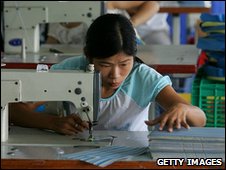
Many of China's exporters are low-cost manufacturers​

China 'overtakes Germany as world's largest exporter'

China's exports rose 17.7% in December, state media have reported, suggesting the country has overtaken Germany as the world's largest exporter.

The rise, compared to a year earlier, breaks a 13-month decline in trade as a result of the global downturn.

Xinhua said total exports for 2009 were $1.2tn (£749bn), but total foreign trade over the year was down 13.9%.

Correspondents say the figures will lead to new demands from China's competitors that it revalue the yuan.

Last year saw a continuing decrease in China's trade as the global economic downturn led to a fall in demand for its products.

But in the last few weeks of the year, there was a far greater rise than forecasters had expected, with foreign exports reaching $130.7bn, up 17.7% on the previous December.

China's General Administration of Customs (GAC) said exports overall in the year were $1.2tn, down 16% from in 2008, while imports were 11.2% down from a year earlier at $1.01tn.

The politically sensitive total trade surplus was down 34.2% to $196.1bn.

The figures suggests China will surpass Germany's export total for the whole of 2009, although this will not be confirmed until Germany's full-year data is published in February.

Yuan demand

A spokesman for GAC said the increase was "an important turning point" for the country.

"It is safe to say now that Chinese exporters have come right through the period of weakness," Xinhua quoted statistician Huang Guohua as saying.

The BBC's Chris Hogg in Shanghai says many of China's producers are low-cost manufacturers who assemble equipment such as i-Pods using foreign components.

The latest figures are being seen as an indication that those manufacturers have proved resilient in the downturn and are benefitting as their customers restock, says our correspondent.

But the figures are likely to lead to renewed complaints from China's trading competitors that its currency is undervalued, he added.

Led by the US, they say it is unfair that China has been able to make its good cheaper by keeping the yuan weak, but Prime Minister Wen Jiabao has said China "will not yield" to foreign demands that it revalue the currency.

Beijing has long said that it will not allow the yuan to trade freely until its domestic economy was strong enough to pick up any resulting decline in exports.

The slowing decline in Chinese trade has also been taken as a sign that the country's stimulus package is working.

Beijing raised tax rebates on exports several times in 2009, increased tax refunds and improved export credit insurance.
 
Back
Top