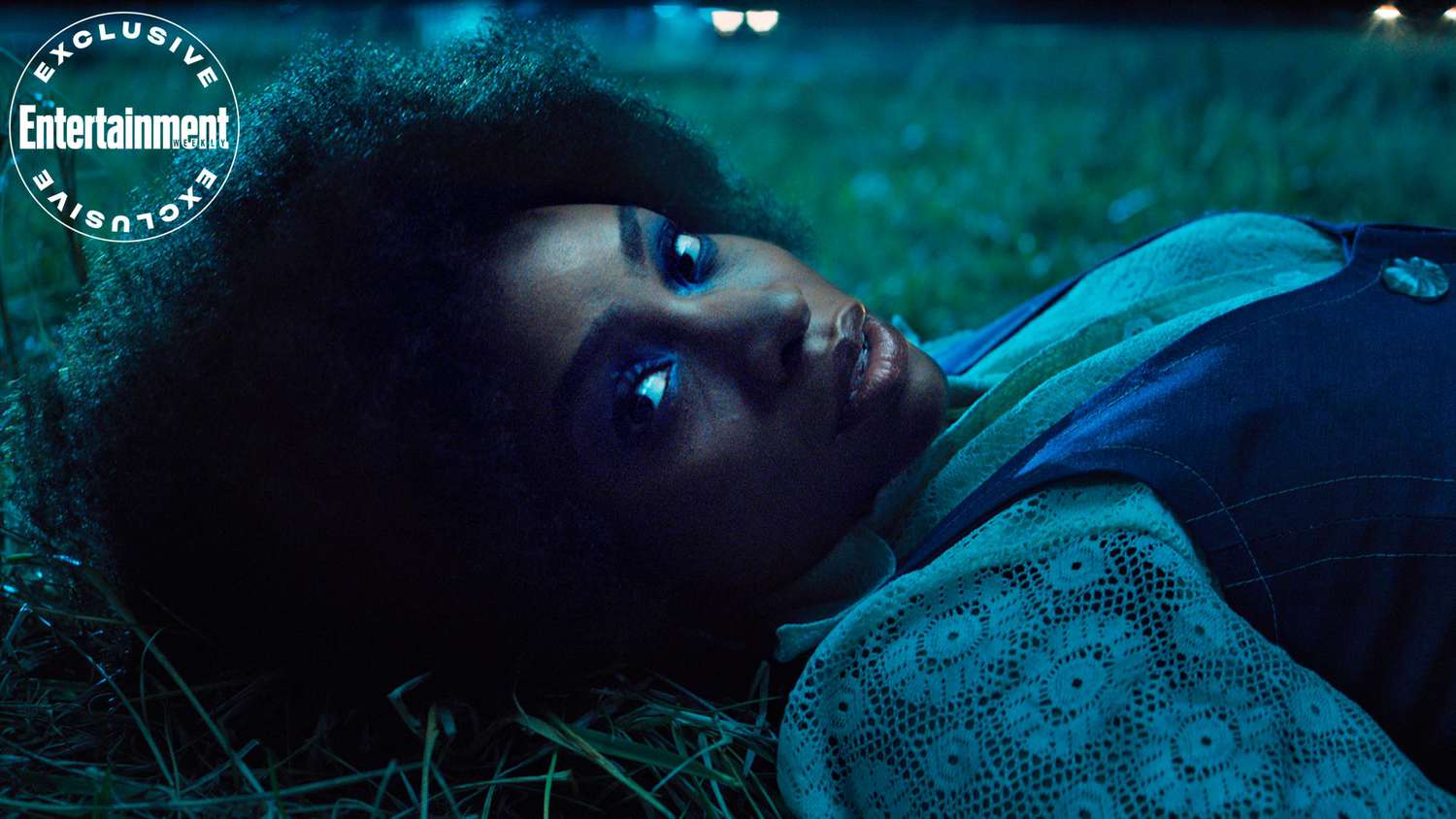


The Unfortunate and Obscure History of Monica Rambeau, the First Female Captain Marvel
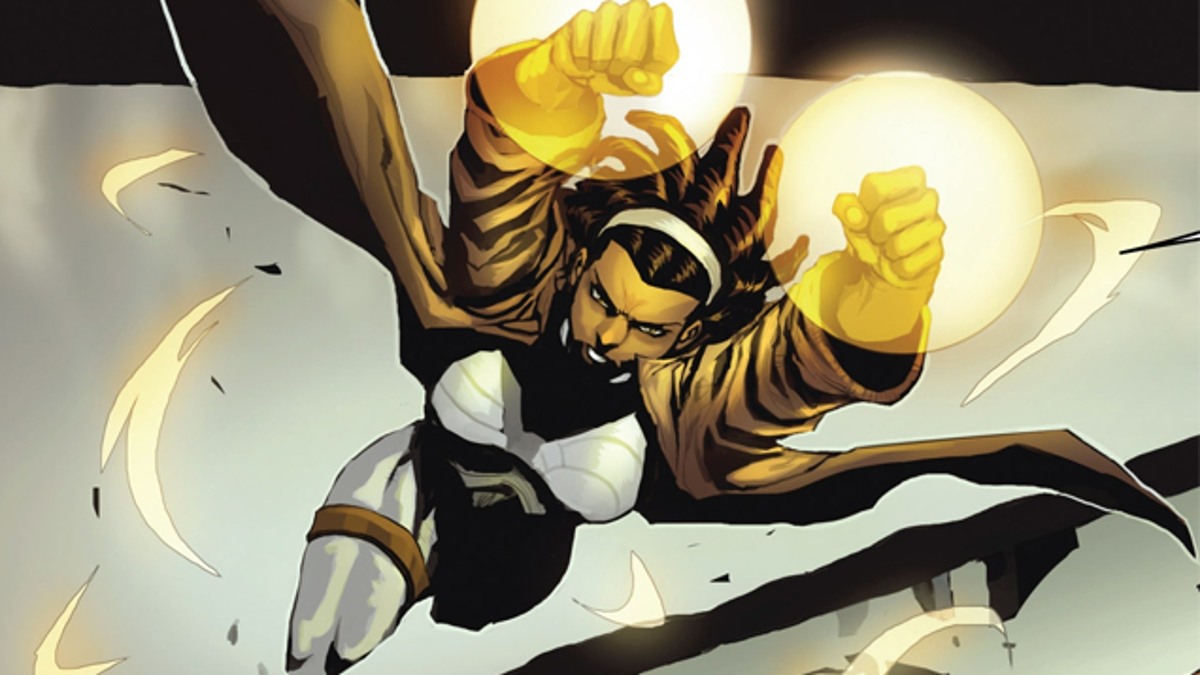
As Carol Danvers rides high in the comics as Captain Marvel, it’s hard to remember that she wasn’t the first woman to take on the mantle: back in 1982, Monica Rambeau became that woman. If you haven’t heard of her, though, there’s a reason. Here’s the sad story of the Captain Marvel comics forgot.
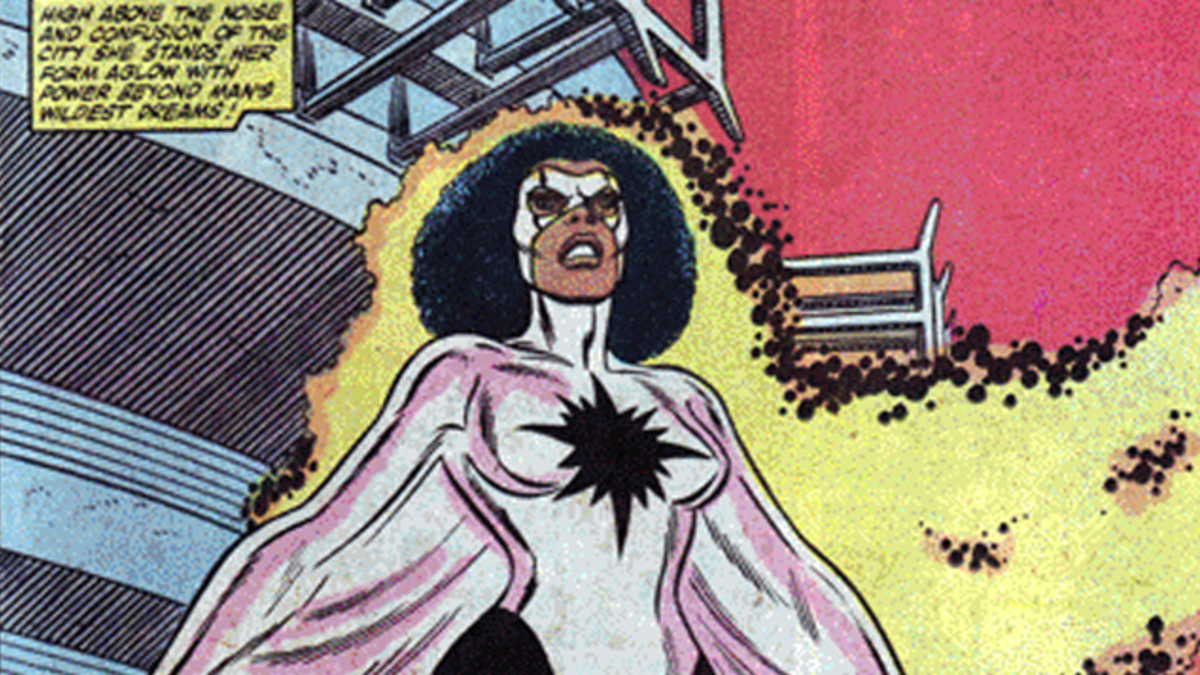
Monica’s creation as Captain Marvel extends beyond her own origins and back into the complicated history of the first Captain Marvel: Captain Marvel (a Kree alien named Mar-Vell) was first created in 1967 so Marvel could capitalize on a lapsed trademark.
Throughout the 1940s, Fawcett Comics published the wildly popular adventures of Billy Batson, a boy who could transform into the superhero Captain Marvel with cry of the a magic word “shazam”. But DC Comics sued Fawcett in the early ‘50s, claiming Captain Marvel was a copy of their own hero, Superman, and Fawcett were forced to end the comics. Marvel moved in on the character’s name, creating their own cosmic superhero so they could sit on the title—just as they had done so with Spider-Woman, She-Hulk and many other heroes. Fun side note: DC eventually brought Fawcett’s Captain Marvel back in their own comics, but were eventually forced by Marvel to rename him as Shazam in 2011.
But Captain Marvel as a series was not popular. Several reworks of the character didn’t help revamp the series, still Marvel felt obligated to keep putting comics out to keep the name under their ownership. Captain Marvel was published intermittently throughout the 70’s—including a short lived spinoff, Ms. Marvel, starring Carol Danvers—but ultimately the decision was made to kill off Mar-Vell and replace him. Captain Marvel succumbed to cancer in one of Marvel’s first ever graphic novels, The Death of Captain Marvel, in 1982. However, the company still needed to use his name to maintain control: step forward Monica Rambeau.
Although Monica was made by her creators Roger Stern and John Romita, Jr. to be the new Captain Marvel—and relatively rare at the time, as a black female superhero—Marvel never really intended to have her star in her own series as Mar-Vell did. She was essentially an entirely new hero to boot: she had no connections to Mar-Vell, and even her powers to manipulate and transform into any form of energy across the electromagnetic spectrum were nothing like Mar-Vell’s own. Monica made her debut in the 1982 Amazing Spider-Man Annual #16, which featured her getting her powers (and seemingly randomly deciding to call herself Captain Marvel) and Spider-Man encouraging her to join the Avengers so she could hone her powers.

From then on, Monica was confined to be a guest character in the ongoing Avengers comic. With no Captain Marvel series of her own, she regularly appeared throughout the ‘80s, becoming the first female African-American Avenger. Although Monica shared a strong bond with her fellow Avengers, and fans themselves appreciated her sarcastic, no-nonsense attitude (something that would persist strongly throughout her myriad appearances), there was never enough interest from either Marvel or fans for her to revive Captain Marvel as an ongoing series.
But she remained a prominent part of Avengers: when Wasp stepped down as the group’s leader, it was not Captain America or Iron Man who took her place, but Monica. She lead the team in several major engagements—she even got her first headlining comic in 1989, a one-shot Giant Size Captain Marvel—but her position as a main Avenger was cut short following a battle with the sea monster Leviathan in which Monica was severely injured, to the point of being rapidly aged and mostly depowered.
Although Monica eventually recovered from her ordeal, she had retired from the Avengers, serving only as a reservist for the team and making scattered guest appearances throughout the Avengers comics—but it was good enough for Marvel to keep hold of the Captain Marvel name. That is, until they decided to try again with a Captain Marvel comic in the mid ‘90s... but didn’t want to use a character as obscure as Monica had become.
In order to tie the Captain Marvel name back closer to the original Mar-Vell, Marvel created Genis-Vell, Mar-Vell’s son created from his father’s DNA after death by Mar-Vell’s lover, Elysius (comic books, everybody). Genis was designed to have his father’s powerset, and even a version of his father’s original suit—and to rub even more salt in the wound inflicted to Monica, he actually started using the Captain Marvel name while she was operating as Captain Marvel in a new 1995 Captain Marvel ongoing. The two had a falling out, and during 1996’s Avengers Unplugged storyline, Monica conceded the Captain Marvel title to Genis, taking on the codename Photon instead. Genis himself had a rough time as Captain Marvel—his first series only ran for 6 issues before being picked up again in 1999.
hoton Pulsar
As Photon, Monica slipped further into obscurity as a character in the latter half of the 1990s and early 2000s. As she had as Captain Marvel, she continued to serve with the Avengers, appearing as a reserve team member in times of need, but never on a consistent basis (the comics themselves touched upon this when Monica discovered that her mother, out of fear for Monica, had been intercepting calls from the Avengers requesting Monica’s assistance). Marvel increasingly had no idea what to do with her—and didn’t really care.
To add insult to injury again, Genis-Vell (who’s Captain Marvel series was cancelled in 2002) returned after a period of insanity, joining the Thunderbolts team in 2005. He no longer desired to use the Captain Marvel name—his sister, Phyla-Vell, had already taken it—so he chose a new one... Photon. Monica was once again understandably displeased (Genis was kind of an asshole, to boot), but decided on a codename she preferred: Pulsar.
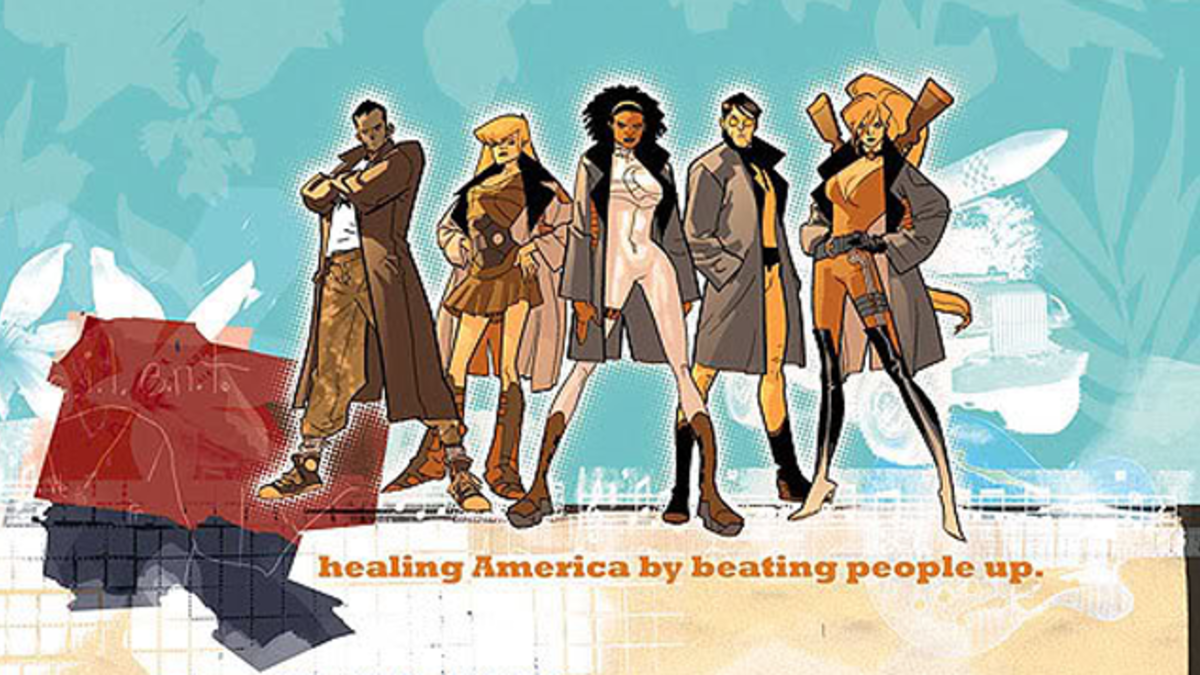
Pulsar as a name lasted even shorter—Monica instead mainly just went by her own name for a while, most notably as a member of Nextwave in 2006. Nextwave: Agents of H.A.T.E., a 12-issue experimental comedy series by Warren Ellis and Stuart Immonen, saw Monica (occasionally lovingly referred to as Auntie Monica) lead a team of rag-tag obscure Marvel heroes: Monster hunter Elsa Bloodstone, Tabitha Smith, Machine Man Aaron Stack, and a new character known only as the Captain.
Nextwave was short lived, but garnered a die-hard following of fans for Monica as a superhero. The goofy tone of the series played up to Monica’s trademark sarcasm, as well as a running joke of her constantly having to remind people around her that she once lead the Avengers. Although Nextwave ended after only a year—the original plan was to put the series on hiatus, as it was costly to keep Immonen on as a regular artist for the book, and for several years it was debated whether Nextwave actually existed in Marvel canon—but the seeds were quietly sown for Monica to come out of the depths of obscurity once more.
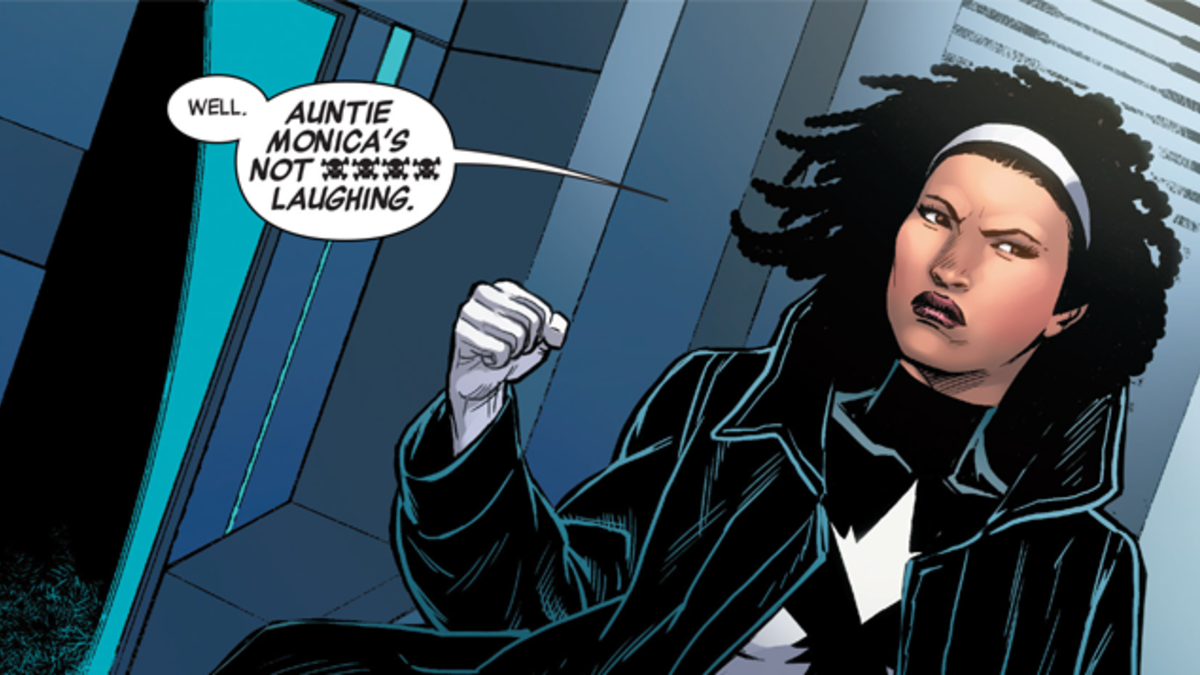
Following Nextwave, Monica continued to make guest appearances across the Avengers comics, sometimes operating under her old codename Pulsar—but the closest she got to her own series was the Marvel Divas miniseries, a lighthearted series about four female heroes who struggled to find romance. Monica even made a small cameo appearance in Carol Danver’s Captain Marvel comic, once again displeased that someone else had taken on the Captain Marvel name without informing her first.
But as Carol took off in popularity as the new Captain Marvel, Monica herself slowly edged towards the limelight once more in 2013—for the first time in nearly two decades, Monica would play a key role in an Avengers team (if not the main Avengers team itself). Now known as Spectrum, Monica became the field leader of the Mighty Avengers alongside Luke Cage, Blue Marvel, Ronin, Power Man, White Tiger, She-Hulk, and Falcon. The series continued under a rename last year to Captain America and The Mighty Avengers, and in the lead-up to the currently ongoing Secret Wars event, saw the team attempt to stave off the destruction of the current Marvel universe.
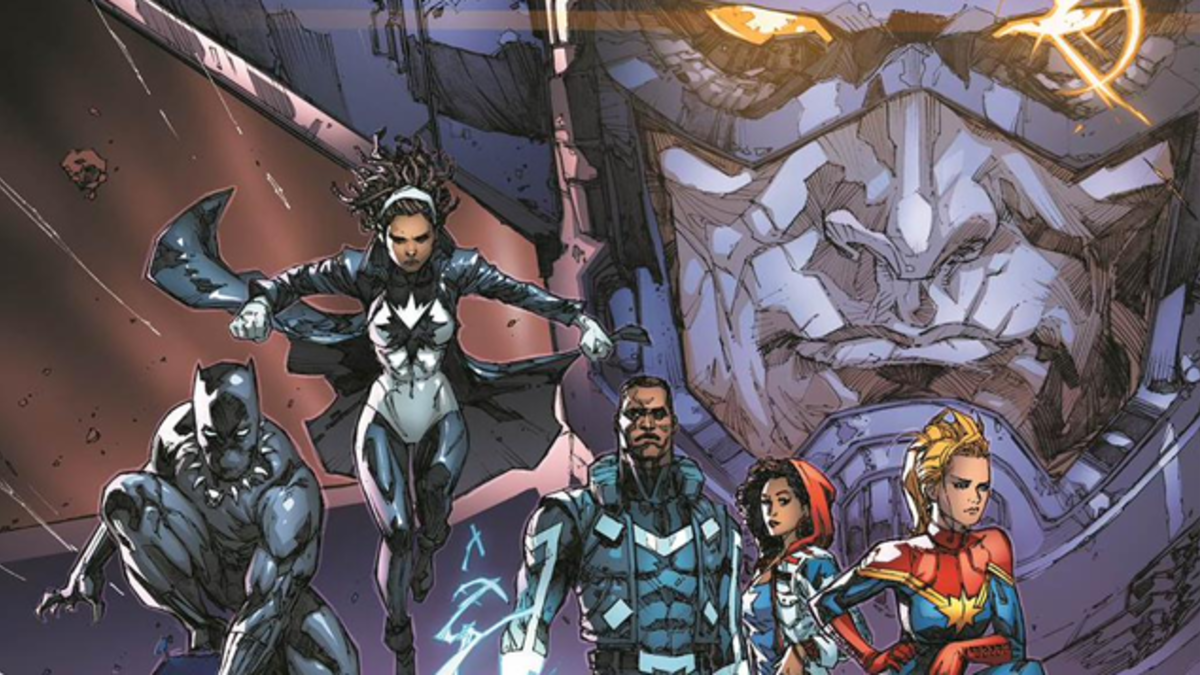
But what’s next for Monica Rambeau? Secret Wars has left her in limbo for now. In an attempt to stop an alternate Earth from destroying her own during Mighty Avengers’ “Last Days” arc, Monica was captured by an alternate Reed Richards and has since been absent from the ongoing storyline. There are even rumors that she will lose another codename in the upcoming “All-New, All-Different” Marvel Comics Universe—but we do know that she will return, this time as part of the Ultimates team alongside Captain Marvel, Black Panther, Blue Marvel, America Chavez, and, err... Galactus. At this point however for Monica’s ardent fans, at least it’s not obscurity once more.
But no matter what Marvel throws at Monica Rambeau, she’ll seemingly take it. As an important part of the complicated legacy of Captain Marvel and beyond—a legacy we’ll soon see on the big screen—it feels like it’s about time Monica deserved the chance to be in the limelight again. She’s deserved it, after all these years.
http://io9.com/the-unfortunate-and-obscure-history-of-monica-rambeau-1726108988
As Carol Danvers rides high in the comics as Captain Marvel, it’s hard to remember that she wasn’t the first woman to take on the mantle: back in 1982, Monica Rambeau became that woman. If you haven’t heard of her, though, there’s a reason. Here’s the sad story of the Captain Marvel comics forgot.
Monica’s creation as Captain Marvel extends beyond her own origins and back into the complicated history of the first Captain Marvel: Captain Marvel (a Kree alien named Mar-Vell) was first created in 1967 so Marvel could capitalize on a lapsed trademark.
Throughout the 1940s, Fawcett Comics published the wildly popular adventures of Billy Batson, a boy who could transform into the superhero Captain Marvel with cry of the a magic word “shazam”. But DC Comics sued Fawcett in the early ‘50s, claiming Captain Marvel was a copy of their own hero, Superman, and Fawcett were forced to end the comics. Marvel moved in on the character’s name, creating their own cosmic superhero so they could sit on the title—just as they had done so with Spider-Woman, She-Hulk and many other heroes. Fun side note: DC eventually brought Fawcett’s Captain Marvel back in their own comics, but were eventually forced by Marvel to rename him as Shazam in 2011.
But Captain Marvel as a series was not popular. Several reworks of the character didn’t help revamp the series, still Marvel felt obligated to keep putting comics out to keep the name under their ownership. Captain Marvel was published intermittently throughout the 70’s—including a short lived spinoff, Ms. Marvel, starring Carol Danvers—but ultimately the decision was made to kill off Mar-Vell and replace him. Captain Marvel succumbed to cancer in one of Marvel’s first ever graphic novels, The Death of Captain Marvel, in 1982. However, the company still needed to use his name to maintain control: step forward Monica Rambeau.
Although Monica was made by her creators Roger Stern and John Romita, Jr. to be the new Captain Marvel—and relatively rare at the time, as a black female superhero—Marvel never really intended to have her star in her own series as Mar-Vell did. She was essentially an entirely new hero to boot: she had no connections to Mar-Vell, and even her powers to manipulate and transform into any form of energy across the electromagnetic spectrum were nothing like Mar-Vell’s own. Monica made her debut in the 1982 Amazing Spider-Man Annual #16, which featured her getting her powers (and seemingly randomly deciding to call herself Captain Marvel) and Spider-Man encouraging her to join the Avengers so she could hone her powers.
From then on, Monica was confined to be a guest character in the ongoing Avengers comic. With no Captain Marvel series of her own, she regularly appeared throughout the ‘80s, becoming the first female African-American Avenger. Although Monica shared a strong bond with her fellow Avengers, and fans themselves appreciated her sarcastic, no-nonsense attitude (something that would persist strongly throughout her myriad appearances), there was never enough interest from either Marvel or fans for her to revive Captain Marvel as an ongoing series.
But she remained a prominent part of Avengers: when Wasp stepped down as the group’s leader, it was not Captain America or Iron Man who took her place, but Monica. She lead the team in several major engagements—she even got her first headlining comic in 1989, a one-shot Giant Size Captain Marvel—but her position as a main Avenger was cut short following a battle with the sea monster Leviathan in which Monica was severely injured, to the point of being rapidly aged and mostly depowered.
Although Monica eventually recovered from her ordeal, she had retired from the Avengers, serving only as a reservist for the team and making scattered guest appearances throughout the Avengers comics—but it was good enough for Marvel to keep hold of the Captain Marvel name. That is, until they decided to try again with a Captain Marvel comic in the mid ‘90s... but didn’t want to use a character as obscure as Monica had become.
In order to tie the Captain Marvel name back closer to the original Mar-Vell, Marvel created Genis-Vell, Mar-Vell’s son created from his father’s DNA after death by Mar-Vell’s lover, Elysius (comic books, everybody). Genis was designed to have his father’s powerset, and even a version of his father’s original suit—and to rub even more salt in the wound inflicted to Monica, he actually started using the Captain Marvel name while she was operating as Captain Marvel in a new 1995 Captain Marvel ongoing. The two had a falling out, and during 1996’s Avengers Unplugged storyline, Monica conceded the Captain Marvel title to Genis, taking on the codename Photon instead. Genis himself had a rough time as Captain Marvel—his first series only ran for 6 issues before being picked up again in 1999.
hoton Pulsar
As Photon, Monica slipped further into obscurity as a character in the latter half of the 1990s and early 2000s. As she had as Captain Marvel, she continued to serve with the Avengers, appearing as a reserve team member in times of need, but never on a consistent basis (the comics themselves touched upon this when Monica discovered that her mother, out of fear for Monica, had been intercepting calls from the Avengers requesting Monica’s assistance). Marvel increasingly had no idea what to do with her—and didn’t really care.
To add insult to injury again, Genis-Vell (who’s Captain Marvel series was cancelled in 2002) returned after a period of insanity, joining the Thunderbolts team in 2005. He no longer desired to use the Captain Marvel name—his sister, Phyla-Vell, had already taken it—so he chose a new one... Photon. Monica was once again understandably displeased (Genis was kind of an asshole, to boot), but decided on a codename she preferred: Pulsar.
Pulsar as a name lasted even shorter—Monica instead mainly just went by her own name for a while, most notably as a member of Nextwave in 2006. Nextwave: Agents of H.A.T.E., a 12-issue experimental comedy series by Warren Ellis and Stuart Immonen, saw Monica (occasionally lovingly referred to as Auntie Monica) lead a team of rag-tag obscure Marvel heroes: Monster hunter Elsa Bloodstone, Tabitha Smith, Machine Man Aaron Stack, and a new character known only as the Captain.
Nextwave was short lived, but garnered a die-hard following of fans for Monica as a superhero. The goofy tone of the series played up to Monica’s trademark sarcasm, as well as a running joke of her constantly having to remind people around her that she once lead the Avengers. Although Nextwave ended after only a year—the original plan was to put the series on hiatus, as it was costly to keep Immonen on as a regular artist for the book, and for several years it was debated whether Nextwave actually existed in Marvel canon—but the seeds were quietly sown for Monica to come out of the depths of obscurity once more.
Following Nextwave, Monica continued to make guest appearances across the Avengers comics, sometimes operating under her old codename Pulsar—but the closest she got to her own series was the Marvel Divas miniseries, a lighthearted series about four female heroes who struggled to find romance. Monica even made a small cameo appearance in Carol Danver’s Captain Marvel comic, once again displeased that someone else had taken on the Captain Marvel name without informing her first.
But as Carol took off in popularity as the new Captain Marvel, Monica herself slowly edged towards the limelight once more in 2013—for the first time in nearly two decades, Monica would play a key role in an Avengers team (if not the main Avengers team itself). Now known as Spectrum, Monica became the field leader of the Mighty Avengers alongside Luke Cage, Blue Marvel, Ronin, Power Man, White Tiger, She-Hulk, and Falcon. The series continued under a rename last year to Captain America and The Mighty Avengers, and in the lead-up to the currently ongoing Secret Wars event, saw the team attempt to stave off the destruction of the current Marvel universe.
But what’s next for Monica Rambeau? Secret Wars has left her in limbo for now. In an attempt to stop an alternate Earth from destroying her own during Mighty Avengers’ “Last Days” arc, Monica was captured by an alternate Reed Richards and has since been absent from the ongoing storyline. There are even rumors that she will lose another codename in the upcoming “All-New, All-Different” Marvel Comics Universe—but we do know that she will return, this time as part of the Ultimates team alongside Captain Marvel, Black Panther, Blue Marvel, America Chavez, and, err... Galactus. At this point however for Monica’s ardent fans, at least it’s not obscurity once more.
But no matter what Marvel throws at Monica Rambeau, she’ll seemingly take it. As an important part of the complicated legacy of Captain Marvel and beyond—a legacy we’ll soon see on the big screen—it feels like it’s about time Monica deserved the chance to be in the limelight again. She’s deserved it, after all these years.
http://io9.com/the-unfortunate-and-obscure-history-of-monica-rambeau-1726108988