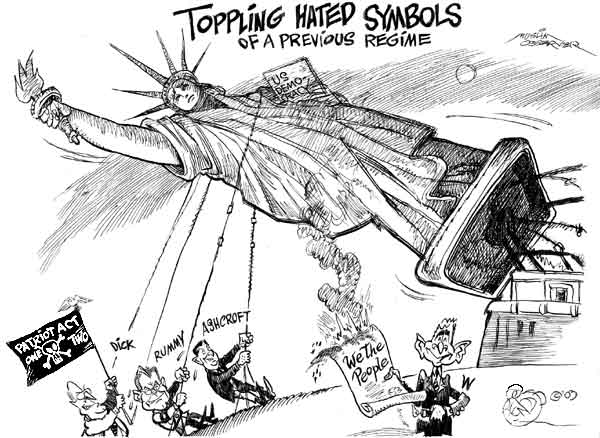
BUSH SAYS -"It's just a goddamned piece of paper"

muckraker10021

Superstar *****
BGOL Investor
<table id="table4" bgcolor="#bf001f" border="0" cellpadding="0" cellspacing="0" width="44%"><br /> <tr><td width="181"><img src="http://mywebpage.netscape.com/camarilla10028/Republiklan.jpg"><img src="http://mywebpage.netscape.com/camarilla10028/Republiklan.jpg"></td><br /> <td bgcolor="#bf001f"><br /> <table id="table5" bordercolorlight="#BF001F" bordercolordark="#BF001F" bgcolor="#bf001f" border="5" cellpadding="0" cellspacing="0" height="335" width="200"><br /> <tr><br /> <td><br /> <img src="http://www.nypress.com/17/31/news&columns/BUSH-FEATURE-300.jpg" border="0" height="335" width="200"></td><br /> </tr><br /> </table><br /> </td><br /> </tr><br /></table>

<hr noshade color="#ff0000" size="14"></hr>


<font face="arial black" size="6" color="#D90000">
Bush on the Constitution:
"It's just a goddamned piece of paper"</font>
<font face="Trebuchet MS, Arial Unicode MS, Microsoft sans serif, verdana" size="3" color="#000000">
<b>by Doug Thompson
Dec 9th, 2005,</b>

Last month, Republican Congressional leaders filed into the Oval Office to meet with President George W. Bush and talk about renewing the controversial USA Patriot Act.

Several provisions of the act, passed in the shell shocked period immediately following the 9/11 terrorist attacks, caused enough anger that liberal groups like the American Civil Liberties Union had joined forces with prominent conservatives like Phyllis Schlafly and Bob Barr to oppose renewal.

GOP leaders told Bush that his hardcore push to renew the more onerous provisions of the act could further alienate conservatives still mad at the President from his botched attempt to nominate White House Counsel Harriet Miers to the Supreme Court.

"I don't give a goddamn," Bush retorted. "I'm the President and the Commander-in-Chief. Do it my way."

"Mr. President," one aide in the meeting said. "There is a valid case that the provisions in this law undermine the Constitution."

"Stop throwing the Constitution in my face," Bush screamed back. "It's just a goddamned piece of paper!"

I've talked to three people present for the meeting that day and they all confirm that the President of the United States called the Constitution "a goddamned piece of paper."

And, to the Bush Administration, the Constitution of the United States is little more than toilet paper stained from all the shit that this group of power-mad despots have dumped on the freedoms that "goddamned piece of paper" used to guarantee.

Attorney General Alberto Gonzales, while still White House counsel, wrote that the "Constitution is an outdated document."

Put aside, for a moment, political affiliation or personal beliefs. It doesn't matter if you are a Democrat, Republican or Independent. It doesn't matter if you support the invasion or Iraq or not. Despite our differences, the Constitution has stood for two centuries as the defining document of our government, the final source to determine - in the end - if something is legal or right.

Every federal official - including the President - who takes an oath of office swears to "uphold and defend the Constitution of the United States."

Supreme Court Justice Antonin Scalia says he cringes when someone calls the Constitution a "living document."

""Oh, how I hate the phrase we have-a 'living document,'" Scalia says. "We now have a Constitution that means whatever we want it to mean. The Constitution is not a living organism, for Pete's sake."
As a judge, Scalia says, "I don't have to prove that the Constitution is perfect; I just have to prove that it's better than anything else."

President Bush has proposed seven amendments to the Constitution over the last five years, including a controversial amendment to define marriage as a "union between a man and woman." Members of Congress have proposed some 11,000 amendments over the last decade, ranging from repeal of the right to bear arms to a Constitutional ban on abortion.

Scalia says the danger of tinkering with the Constitution comes from a loss of rights.

"We can take away rights just as we can grant new ones," Scalia warns. "Don't think that it's a one-way street."

And don't buy the White House hype that the USA Patriot Act is a necessary tool to fight terrorism. It is a dangerous law that infringes on the rights of every American citizen and, as one brave aide told President Bush, something that undermines the Constitution of the United States.

But why should Bush care? After all, the Constitution is just "a goddamned piece of paper."


© Copyright 2005 Capitol Hill Blue

http://www.capitolhillblue.com/
</font>
 
Last edited:
acc-toilet-paper-holder_a.jpg
 
it shows that the foundation of the this country is not real, that it is the facade that jusitifies the corrupt goverment that went corrupt the day the "peice of paper was signed" it is for only those who believe, not those who know. and the comment that Ussh (Isssh) made, just confirms for those who know this is corrupt.
 
<font face="times new roman" size="4" color="#000000">
While too many Americans anxiously await the birth of the ‘Bradgelina’ baby whose mere picture will reportedly fetch upwards of 3 million dollars, the bush junta continues to shred the US Constitution in a manner unprecedented in American history.

In many other countries of the world such an obliteration of democracy would bring hundreds of thousands of people into the streets. In America, the masses sleep.

The article below is one of the most important articles you will read this year, if you value the American democracy we’ve all come to know and the American democracy the world used to respect</font>


<hr noshade color="#ff0000" size="14"></hr>


<img src="http://cache.boston.com/bonzai-fba/Reuters_Photo/2006/05/01/1146456546_0953.jpg">
<font face="arial" size="2" color="#000000"><b>Bush’s contention that he can ignore provisions of the Patriot Act,
whose renewal he ushered last month, has drawn scrutiny</b></font>


<font face="arial black" size="6" color="#d90000">Bush Challenges Hundreds Of Laws</font><font face="tahoma" size="4" color="#0000ff">
<b>President cites powers of his office, disregards the Constitution</b></font>

<font face="arial black" size="5" color="#333333">
Number of new statutes challenged</font>

<font face="arial" size="4" color="#0000FF">
Especially since the mid-1980s, presidents have sometimes declared that they can ignore a provision of a bill because they believe it is unconstitutional.
George W. Bush has set a new record in challenging congressional statues</font>

<img src="http://cache.boston.com/bonzai-fba/Globe_Graphic/2006/04/30/1146398946_3253.jpg">

<font face="georgia" size="3" color="#000000">
<b>By Charlie Savage, Globe Staff | April 30, 2006</b> <img src="http://www.philipkdick.com/images/boston-globe-logo.jpg">

WASHINGTON -- <span style="background-color: #FFFF51"><b>President Bush has quietly claimed the authority to disobey more than 750 laws enacted since he took office, asserting that he has the power to set aside any statute passed by Congress when it conflicts with his interpretation of the Constitution.

Among the laws Bush said he can ignore are military rules and regulations, affirmative-action provisions, requirements that Congress be told about immigration services problems, ''whistle-blower" protections for nuclear regulatory officials, and safeguards against political interference in federally funded research.</b></span>

Legal scholars say the scope and aggression of Bush's assertions that he can bypass laws represent a concerted effort to expand his power at the expense of Congress, upsetting the balance between the branches of government. <span style="background-color: #FFFF51"><b>The Constitution is clear in assigning to Congress the power to write the laws and to the president a duty ''to take care that the laws be faithfully executed." Bush, however, has repeatedly declared that he does not need to ''execute" a law he believes is unconstitutional.</b></span>

Former administration officials contend that just because Bush reserves the right to disobey a law does not mean he is not enforcing it: In many cases, he is simply asserting his belief that a certain requirement encroaches on presidential power.

But with the disclosure of Bush's domestic spying program, in which he ignored a law requiring warrants to tap the phones of Americans, many legal specialists say Bush is hardly reluctant to bypass laws he believes he has the constitutional authority to override.

Far more than any predecessor, Bush has been aggressive about declaring his right to ignore vast swaths of laws -- many of which he says infringe on power he believes the Constitution assigns to him alone as the head of the executive branch or the commander in chief of the military.

Many legal scholars say they believe that Bush's theory about his own powers goes too far and that he is seizing for himself some of the law-making role of Congress and the Constitution-interpreting role of the courts.

Phillip Cooper, a Portland State University law professor who has studied the executive power claims Bush made during his first term, said Bush and his legal team have spent the past five years quietly working to concentrate ever more governmental power into the White House.

''There is no question that this administration has been involved in a very carefully thought-out, systematic process of expanding presidential power at the expense of the other branches of government," Cooper said. ''This is really big, very expansive, and very significant."

For the first five years of Bush's presidency, his legal claims attracted little attention in Congress or the media. Then, twice in recent months, Bush drew scrutiny after challenging new laws: a torture ban and a requirement that he give detailed reports to Congress about how he is using the Patriot Act

Bush administration spokesmen declined to make White House or Justice Department attorneys available to discuss any of Bush's challenges to the laws he has signed.

Instead, they referred a Globe reporter to their response to questions about Bush's position that he could ignore provisions of the Patriot Act. They said at the time that Bush was following a practice that has ''been used for several administrations" and that ''the president will faithfully execute the law in a manner that is consistent with the Constitution."

But the words ''in a manner that is consistent with the Constitution" are the catch, legal scholars say, because Bush is according himself the ultimate interpretation of the Constitution. And he is quietly exercising that authority to a degree that is unprecedented in US history.

Bush is the first president in modern history who has never vetoed a bill, giving Congress no chance to override his judgments. Instead, he has signed every bill that reached his desk, often inviting the legislation's sponsors to signing ceremonies at which he lavishes praise upon their work.

Then, after the media and the lawmakers have left the White House, Bush quietly files ''signing statements" -- official documents in which a president lays out his legal interpretation of a bill for the federal bureaucracy to follow when implementing the new law. The statements are recorded in the federal register.

In his signing statements, Bush has repeatedly asserted that the Constitution gives him the right to ignore numerous sections of the bills -- sometimes including provisions that were the subject of negotiations with Congress in order to get lawmakers to pass the bill. He has appended such statements to more than one of every 10 bills he has signed.

''He agrees to a compromise with members of Congress, and all of them are there for a public bill-signing ceremony, but then he takes back those compromises -- and more often than not, without the Congress or the press or the public knowing what has happened," said Christopher Kelley, a Miami University of Ohio political science professor who studies executive power.

<b><font face="4">Military Link</font></b>

Many of the laws Bush said he can bypass -- including the torture ban -- involve the military.

The Constitution grants Congress the power to create armies, to declare war, to make rules for captured enemies, and ''to make rules for the government and regulation of the land and naval forces." But, citing his role as commander in chief, Bush says he can ignore any act of Congress that seeks to regulate the military.

On at least four occasions while Bush has been president, Congress has passed laws forbidding US troops from engaging in combat in Colombia, where the US military is advising the government in its struggle against narcotics-funded Marxist rebels.

After signing each bill, Bush declared in his signing statement that he did not have to obey any of the Colombia restrictions because he is commander in chief.

Bush has also said he can bypass laws requiring him to tell Congress before diverting money from an authorized program in order to start a secret operation, such as the ''black sites" where suspected terrorists are secretly imprisoned.

Congress has also twice passed laws forbidding the military from using intelligence that was not ''lawfully collected," including any information on Americans that was gathered in violation of the Fourth Amendment's protections against unreasonable searches.

Congress first passed this provision in August 2004, when Bush's warrantless domestic spying program was still a secret, and passed it again after the program's existence was disclosed in December 2005.

On both occasions, Bush declared in signing statements that only he, as commander in chief, could decide whether such intelligence can be used by the military.

In October 2004, five months after the Abu Ghraib torture scandal in Iraq came to light, Congress passed a series of new rules and regulations for military prisons. Bush signed the provisions into law, then said he could ignore them all. One provision made clear that military lawyers can give their commanders independent advice on such issues as what would constitute torture. But Bush declared that military lawyers could not contradict his administration's lawyers.

Other provisions required the Pentagon to retrain military prison guards on the requirements for humane treatment of detainees under the Geneva Conventions, to perform background checks on civilian contractors in Iraq, and to ban such contractors from performing ''security, intelligence, law enforcement, and criminal justice functions." Bush reserved the right to ignore any of the requirements.

The new law also created the position of inspector general for Iraq. But Bush wrote in his signing statement that the inspector ''shall refrain" from investigating any intelligence or national security matter, or any crime the Pentagon says it prefers to investigate for itself.

Bush had placed similar limits on an inspector general position created by Congress in November 2003 for the initial stage of the US occupation of Iraq. The earlier law also empowered the inspector to notify Congress if a US official refused to cooperate. Bush said the inspector could not give any information to Congress without permission from the administration.

<b><font size="4">Oversight Questioned</font></b>

Many laws Bush has asserted he can bypass involve requirements to give information about government activity to congressional oversight committees.

In December 2004, Congress passed an intelligence bill requiring the Justice Department to tell them how often, and in what situations, the FBI was using special national security wiretaps on US soil. The law also required the Justice Department to give oversight committees copies of administration memos outlining any new interpretations of domestic-spying laws. And it contained 11 other requirements for reports about such issues as civil liberties, security clearances, border security, and counternarcotics efforts.

After signing the bill, Bush issued a signing statement saying he could withhold all the information sought by Congress.

Likewise, when Congress passed the law creating the Department of Homeland Security in 2002, it said oversight committees must be given information about vulnerabilities at chemical plants and the screening of checked bags at airports.

It also said Congress must be shown unaltered reports about problems with visa services prepared by a new immigration ombudsman. Bush asserted the right to withhold the information and alter the reports.

On several other occasions, Bush contended he could nullify laws creating ''whistle-blower" job protections for federal employees that would stop any attempt to fire them as punishment for telling a member of Congress about possible government wrongdoing.

When Congress passed a massive energy package in August, for example, it strengthened whistle-blower protections for employees at the Department of Energy and the Nuclear Regulatory Commission.

The provision was included because lawmakers feared that Bush appointees were intimidating nuclear specialists so they would not testify about safety issues related to a planned nuclear-waste repository at Yucca Mountain in Nevada -- a facility the administration supported, but both Republicans and Democrats from Nevada opposed.

When Bush signed the energy bill, he issued a signing statement declaring that the executive branch could ignore the whistle-blower protections.

Bush's statement did more than send a threatening message to federal energy specialists inclined to raise concerns with Congress; it also raised the possibility that Bush would not feel bound to obey similar whistle-blower laws that were on the books before he became president. His domestic spying program, for example, violated a surveillance law enacted 23 years before he took office.

David Golove, a New York University law professor who specializes in executive-power issues, said Bush has cast a cloud over ''the whole idea that there is a rule of law," because no one can be certain of which laws Bush thinks are valid and which he thinks he can ignore.

''Where you have a president who is willing to declare vast quantities of the legislation that is passed during his term unconstitutional, it implies that he also thinks a very significant amount of the other laws that were already on the books before he became president are also unconstitutional," Golove said.

<b><font size="4">Defying Supreme Court</font></b>

Bush has also challenged statutes in which Congress gave certain executive branch officials the power to act independently of the president. The Supreme Court has repeatedly endorsed the power of Congress to make such arrangements. For example, the court has upheld laws creating special prosecutors free of Justice Department oversight and insulating the board of the Federal Trade Commission from political interference.

Nonetheless, Bush has said in his signing statements that the Constitution lets him control any executive official, no matter what a statute passed by Congress might say.

In November 2002, for example, Congress, seeking to generate independent statistics about student performance, passed a law setting up an educational research institute to conduct studies and publish reports ''without the approval" of the Secretary of Education. Bush, however, decreed that the institute's director would be ''subject to the supervision and direction of the secretary of education."

Similarly, the Supreme Court has repeatedly upheld affirmative-action programs, as long as they do not include quotas. Most recently, in 2003, the court upheld a race-conscious university admissions program over the strong objections of Bush, who argued that such programs should be struck down as unconstitutional.

Yet despite the court's rulings, Bush has taken exception at least nine times to provisions that seek to ensure that minorities are represented among recipients of government jobs, contracts, and grants. Each time, he singled out the provisions, declaring that he would construe them ''in a manner consistent with" the Constitution's guarantee of ''equal protection" to all -- which some legal scholars say amounts to an argument that the affirmative-action provisions represent reverse discrimination against whites.

Golove said that to the extent Bush is interpreting the Constitution in defiance of the Supreme Court's precedents, he threatens to ''overturn the existing structures of constitutional law."

A president who ignores the court, backed by a Congress that is unwilling to challenge him, Golove said, can make the Constitution simply ''disappear."

<font size="4"><b>Common practice in '80s</b></font>

Though Bush has gone further than any previous president, his actions are not unprecedented.

Since the early 19th century, American presidents have occasionally signed a large bill while declaring that they would not enforce a specific provision they believed was unconstitutional. On rare occasions, historians say, presidents also issued signing statements interpreting a law and explaining any concerns about it.

But it was not until the mid-1980s, midway through the tenure of President Reagan, that it became common for the president to issue signing statements. The change came about after then-Attorney General Edwin Meese decided that signing statements could be used to increase the power of the president.

When interpreting an ambiguous law, courts often look at the statute's legislative history, debate and testimony, to see what Congress intended it to mean. Meese realized that recording what the president thought the law meant in a signing statement might increase a president's influence over future court rulings.

Under Meese's direction in 1986, a young Justice Department lawyer named Samuel A. Alito Jr. wrote a strategy memo about signing statements. It came to light in late 2005, after Bush named Alito to the Supreme Court.

In the memo, Alito predicted that Congress would resent the president's attempt to grab some of its power by seizing ''the last word on questions of interpretation." He suggested that Reagan's legal team should ''concentrate on points of true ambiguity, rather than issuing interpretations that may seem to conflict with those of Congress."

Reagan's successors continued this practice. George H.W. Bush challenged 232 statutes over four years in office, and Bill Clinton objected to 140 laws over his eight years, according to Kelley, the Miami University of Ohio professor.

Many of the challenges involved longstanding legal ambiguities and points of conflict between the president and Congress.

Throughout the past two decades, for example, each president -- including the current one -- has objected to provisions requiring him to get permission from a congressional committee before taking action. The Supreme Court made clear in 1983 that only the full Congress can direct the executive branch to do things, but lawmakers have continued writing laws giving congressional committees such a role.

Still, Reagan, George H.W. Bush, and Clinton used the presidential veto instead of the signing statement if they had a serious problem with a bill, giving Congress a chance to override their decisions.

But the current President Bush has abandoned the veto entirely, as well as any semblance of the political caution that Alito counseled back in 1986. In just five years, Bush has challenged more than 750 new laws, by far a record for any president, while becoming the first president since Thomas Jefferson to stay so long in office without issuing a veto.

''What we haven't seen until this administration is the sheer number of objections that are being raised on every bill passed through the White House," said Kelley, who has studied presidential signing statements through history. ''That is what is staggering. The numbers are well out of the norm from any previous administration."

Exaggerated fears?
Some administration defenders say that concerns about Bush's signing statements are overblown. Bush's signing statements, they say, should be seen as little more than political chest-thumping by administration lawyers who are dedicated to protecting presidential prerogatives.

Defenders say the fact that Bush is reserving the right to disobey the laws does not necessarily mean he has gone on to disobey them.

Indeed, in some cases, the administration has ended up following laws that Bush said he could bypass. For example, citing his power to ''withhold information" in September 2002, Bush declared that he could ignore a law requiring the State Department to list the number of overseas deaths of US citizens in foreign countries. Nevertheless, the department has still put the list on its website.

Jack Goldsmith, a Harvard Law School professor who until last year oversaw the Justice Department's Office of Legal Counsel for the administration, said the statements do not change the law; they just let people know how the president is interpreting it.

''Nobody reads them," said Goldsmith. ''They have no significance. Nothing in the world changes by the publication of a signing statement. The statements merely serve as public notice about how the administration is interpreting the law. Criticism of this practice is surprising, since the usual complaint is that the administration is too secretive in its legal interpretations."

But Cooper, the Portland State University professor who has studied Bush's first-term signing statements, said the documents are being read closely by one key group of people: the bureaucrats who are charged with implementing new laws.

Lower-level officials will follow the president's instructions even when his understanding of a law conflicts with the clear intent of Congress, crafting policies that may endure long after Bush leaves office, Cooper said.

''Years down the road, people will not understand why the policy doesn't look like the legislation," he said.

And in many cases, critics contend, there is no way to know whether the administration is violating laws -- or merely preserving the right to do so.

Many of the laws Bush has challenged involve national security, where it is almost impossible to verify what the government is doing. And since the disclosure of Bush's domestic spying program, many people have expressed alarm about his sweeping claims of the authority to violate laws.

In January, after the Globe first wrote about Bush's contention that he could disobey the torture ban, three Republicans who were the bill's principal sponsors in the Senate -- John McCain of Arizona, John W. Warner of Virginia, and Lindsey O. Graham of South Carolina -- all publicly rebuked the president.

''We believe the president understands Congress's intent in passing, by very large majorities, legislation governing the treatment of detainees," McCain and Warner said in a joint statement. ''The Congress declined when asked by administration officials to include a presidential waiver of the restrictions included in our legislation."

Added Graham: ''I do not believe that any political figure in the country has the ability to set aside any . . . law of armed conflict that we have adopted or treaties that we have ratified."

And in March, when the Globe first wrote about Bush's contention that he could ignore the oversight provisions of the Patriot Act, several Democrats lodged complaints.

Senator Patrick J. Leahy of Vermont, the ranking Democrat on the Senate Judiciary Committee, accused Bush of trying to ''cherry-pick the laws he decides he wants to follow."

And Representatives Jane Harman of California and John Conyers Jr. of Michigan -- the ranking Democrats on the House Intelligence and Judiciary committees, respectively -- sent a letter to Attorney General Alberto R. Gonzales demanding that Bush rescind his claim and abide by the law.

''Many members who supported the final law did so based upon the guarantee of additional reporting and oversight," they wrote. ''The administration cannot, after the fact, unilaterally repeal provisions of the law implementing such oversight. . . . Once the president signs a bill, he and all of us are bound by it."

Lack of court review
Such political fallout from Congress is likely to be the only check on Bush's claims, legal specialists said.

The courts have little chance of reviewing Bush's assertions, especially in the secret realm of national security matters.

''There can't be judicial review if nobody knows about it," said Neil Kinkopf, a Georgia State law professor who was a Justice Department official in the Clinton administration. ''And if they avoid judicial review, they avoid having their constitutional theories rebuked."

Without court involvement, only Congress can check a president who goes too far. But Bush's fellow Republicans control both chambers, and they have shown limited interest in launching the kind of oversight that could damage their party.

''The president is daring Congress to act against his positions, and they're not taking action because they don't want to appear to be too critical of the president, given that their own fortunes are tied to his because they are all Republicans," said Jack Beermann, a Boston University law professor. ''Oversight gets much reduced in a situation where the president and Congress are controlled by the same party."

Said Golove, the New York University law professor: ''Bush has essentially said that 'We're the executive branch and we're going to carry this law out as we please, and if Congress wants to impeach us, go ahead and try it.' "

Bruce Fein, a deputy attorney general in the Reagan administration, said the American system of government relies upon the leaders of each branch ''to exercise some self-restraint." But Bush has declared himself the sole judge of his own powers, he said, and then ruled for himself every time.

''This is an attempt by the president to have the final word on his own constitutional powers, which eliminates the checks and balances that keep the country a democracy," Fein said. ''There is no way for an independent judiciary to check his assertions of power, and Congress isn't doing it, either. So this is moving us toward an unlimited executive power."

© Copyright 2006 Globe Newspaper Company.</font>
 
<font size="5"><center>High Court Rejects Detainee Tribunals</font size>
<font size="4">5 to 3 Ruling Curbs President's Claim Of Wartime Power</font size></center>

By Charles Lane
Washington Post Staff Writer
Friday, June 30, 2006; Page A01

The Supreme Court yesterday struck down the military commissions President Bush established to try suspected members of al-Qaeda, emphatically rejecting a signature Bush anti-terrorism measure and the broad assertion of executive power upon which the president had based it.

Brushing aside administration pleas not to second-guess the commander in chief during wartime, a five-justice majority ruled that the commissions, which were outlined by Bush in a military order on Nov. 13, 2001, were neither authorized by federal law nor required by military necessity, and ran afoul of the Geneva Conventions.

As a result, no military commission can try Salim Ahmed Hamdan, the former aide to Osama bin Laden whose case was before the justices, or anyone else, unless the president does one of two things he has resisted doing for more than four years: operate the commissions by the rules of regular military courts-martial, or ask Congress for specific permission to proceed differently.

"n undertaking to try Hamdan and subject him to criminal punishment, the Executive is bound to comply with the Rule of Law that prevails in this jurisdiction," Justice John Paul Stevens wrote in the majority opinion.

While the decision addressed only military commissions, legal analysts said its skeptical view of presidential power could be applied to other areas such as warrantless wiretapping, and that its invocation of the Geneva Conventions could pave the way for new legal claims by detainees held at the military facility in Guantanamo Bay, Cuba.

The ruling shifts the spotlight to Congress, whose members face reelection this fall and who have largely avoided the military commission issue since the Sept. 11, 2001, attacks because of its political uncertainties. The invitation for the president to turn to Congress was extended in a short concurring opinion by one of the justices in the majority, Stephen G. Breyer, who made it clear that the concerns of critics had penetrated deeply at the court.

"Where, as here, no emergency prevents consultation with Congress, judicial insistence upon that consultation does not weaken our Nation's ability to deal with danger. To the contrary, that insistence strengthens the Nation's ability to determine -- through democratic means -- how best to do so," Breyer wrote.

"The Constitution places its faith in those democratic means," Breyer concluded. "Our Court today simply does the same."

Joining Stevens and Breyer in the majority were Justices Anthony M. Kennedy, David H. Souter and Ruth Bader Ginsburg.

Perhaps the only silver lining for the administration was that the decision did not affect the government's authority to keep terrorism suspects at Guantanamo Bay or elsewhere, a point Bush emphasized in his reaction. "We take the findings seriously," he said. "The American people need to know that this ruling, as I understand it, won't cause killers to be put out on the street."

But the court's action was clearly a setback for the White House. At the high court, its approach to the war on terrorism has suffered the broadest in a series of defeats, and the administration has been sent back to the drawing board in dealing with hundreds of suspected members of the Taliban and al-Qaeda -- at a time when international pressure is mounting to shut down Guantanamo Bay.

This is not the situation the president envisioned when he unveiled the military commissions as a tough-minded alternative to the civilian trials that the Clinton administration had used against terrorists. As first outlined in 2001, the commissions did not give defendants a presumption of innocence or guarantee a public trial.

http://www.washingtonpost.com/wp-dyn/content/article/2006/06/29/AR2006062900928.html?referrer=email
 
<IFRAME SRC="http://www.washingtonpost.com/wp-dyn/content/article/2006/06/30/AR2006063001737.html?referrer=email" WIDTH=780 HEIGHT=1500>
<A HREF="http://www.washingtonpost.com/wp-dyn/content/article/2006/06/30/AR2006063001737.html?referrer=email">link</A>

</IFRAME>
 
Last edited:
The very reason why the masses, 75% disagree with Bush's policy but sit still in front of the TV watching American Idol eating cancer causing, heart attack provoking snacks and fast food and won't budge to fight for their freedom, allowing one Muthafukka to strip away our rights...disillusioned with comfort that "it wont affect me oh no, not me" :confused: Yeah, it's the piece of paper the country depends on to define what it is to be an American.... :angry: WAKE UP!!!

4-15-Liberating-the-USA.jpg
 
Editorial l

<font size="5"><center>Now, rules that are fair </font size></center>

From the Journal Sentinel
Posted: July 7, 2006

The high court stuck up for Congress in a recent ruling knocking down the makeshift military trials planned for foreign captives without the normal safeguards to ensure fair play. Now, Congress must at last stick up for itself.

The 5-3 ruling gives the legislative branch an opening to fulfill duties it had long shirked in the war on terrorism. It must draw up laws for handling the prisoners of this new kind of war. And the laws must abide by the Geneva Conventions and the U.S. Uniform Code of Military Justice, both of which President Bush's military commissions ran afoul of, as the ruling noted.

The Supreme Court's Hamdan vs. Rumsfeld decision rebukes the president's radical philosophy that he alone sets the rules for waging war. The decision was made necessary in part because the Republican-controlled Congress acquiesced in the usurpation of legislative power by the Republican White House - partisanship that disserved America by muting the checks and balances the nation's founders correctly thought were key to good government.

The immediate case centered on Salim Ahmed Hamdan, bodyguard and chauffeur of terrorist mastermind Osama bin Laden. Hamdan was captured in Afghanistan in late 2001, detained ever since at the U.S. Naval Base at Guantanamo Bay, Cuba, and eventually charged with conspiracy to attack civilians. Rather than using regular civilian or conventional military proceedings, Bush set up special military tribunals to try Hamdan and others.

The top court ruled that the tribunals were too stacked against defendants, in violation of the Geneva Conventions and the Uniform Code of Military Justice. What's more, the president lacked the authority to set up the tribunals, the majority held. After all, the Constitution specifically assigns to Congress the power to "make rules concerning captures on land and water." And Congress has done so, by establishing the Uniform Code. So - except for emergencies, which this case is not - a president can't supplant the code with his own procedures.

Congress must now weigh in and prescribe what to do with the 450 prisoners at Guantanamo Bay - languishing for years without trial. Several human rights organizations have rightly called for shutting down the prison. The ruling may have added to the logic of such a step. The prison's location, off the U.S. mainland, seemed a way to avoid American laws. But the Supreme Court has determined that the rule of law applies there anyway.

Doubtless, a number of inmates are bad people who must stay locked up for a long time - but only after being convicted of crimes. That's the way a fair, just and democratic society acts. Prisoners of war generally stay incarcerated until the end of hostilities. But as Bush has described it, the war on terrorism is amorphous, with no end in sight. Thus far, it has lasted longer than America's involvement in World War II. So should inmates who can be described as POWs stay locked up forever, without fair redress? At the very least, they need to have a fair chance to prove they are not threats, with the ability to face their accusers and examine the evidence arrayed against them.

Congress should have long ago wrestled with these issues. Now, it must not simply rubber-stamp what Bush has already done. Rather, it must insist on fair procedures.


From the July 8, 2006 editions of the Milwaukee Journal Sentinel

http://www.jsonline.com/story/index.aspx?id=459047
 
<font size="5"><center>Victory for the rule of law</font size>
<font size="4">When Guantanamo detainee won, 'we all won'</font size></center>

Sarasota Herald Tribune
July 8, 2007

In wartime, fear can be a soldier's worst enemy. Or a nation's.

In the immediate aftermath of the Sept. 11, 2001, attacks on the World Trade Center and the Pentagon, Congress and many Americans wanted President Bush to do what he believed necessary to wage a war on terrorism.

Unfortunately, the president and people in his administration seized on that vague mandate to unduly expand the power of the executive branch of government.

That viewpoint led the U.S. military, beginning in January 2002, to confine hundreds of terrorist suspects captured in Afghanistan and elsewhere in a detention facility at Guantanamo Bay, Cuba.

The Bush administration identified the detainees as "enemy combatants" who are not entitled to the rights accorded prisoners of war under the Geneva Conventions.

So far, the administration has charged only 10 of the detainees and has established military tribunals -- operating outside the military code of justice and international law -- to try those who are charged.

But on June 29, the Supreme Court ruled in the case of Hamdan v. Rumsfeld that Bush, in creating those tribunals, exceeded his presidential powers.

'A return to fundamental values'

Navy Lt. Cmdr. Charles Swift, a military lawyer assigned to represent Guantanamo detainee Salim Ahmed Hamdan, successfully argued that case against the administration.

Afterward, Swift summed up what the ruling means: "We can't be scared out of who we are."

In other words, the United States can best fight global and domestic terrorism by adhering to the Constitution and to traditional legal processes and treaties.

"I feel like we all won, that the rule of law won, and that is essentially what we are all about" as a nation, Swift told the Los Angeles Times. He called the ruling "a high water point" in American history. "It's a return to our fundamental values."

The government alleges that Hamdan is a former driver and bodyguard for al-Qaida leader Osama bin Laden. He is charged with conspiracy to commit terrorism.

Swift argued in court that the tribunals could not provide fair trials and said Hamdan should be tried under the established rules of the U.S. Uniform Code of Military Justice and the Geneva Conventions.

The court agreed.

Defenders of military justice

Swift is not the only hero in this historic drama. Others in the military also have fought against the idea of tribunals.

Among them was the Navy's top lawyer, Adm. Donald Guter, now the dean of Duquesne University Law School.

"We argued \[in 2002\] that this would come back to haunt us and it would taint the military justice system," Guter told the Los Angeles Times.

Marine Col. Dwight Sullivan, one of two military officers under whom Swift worked, praised the lawyer's "moral courage" in aggressively defending Hamdan.

"We all take an oath to protect and defend the Constitution of the United States and he has certainly done that, literally," Sullivan told the Seattle Post-Intelligencer.

The military lawyer's commitment to duty bodes well for a nation that will be at war with terrorists for years to come.

Swift said that when he told Hamdan about the Supreme Court's action, "I think he was awestruck that the court would rule for him, and give a little man an equal chance. Where he's from, that is not true."

We will be served well by our values.


Last modified: July 08. 2006 12:00AM

http://www.heraldtribune.com/apps/pbcs.dll/article?AID=/20060708/OPINION/607080679/1030
 
<font face="arial black" size="6" color="#d90000">The Imperial Presidency Crushed</font><font face="tahoma" size="4" color="#0000FF">

<strong>The Supreme Court's rejection of kangaroo military tribunals shackles Bush's legacy to Nixon's -- and could even land him in the dock for war crimes.</strong></font>
<br><strong>By Sidney Blumenthal</strong><font face="georgia" size="3" color="#000000">
<p align="left"><font color="#0000FF"><b>Jul. 06, 2006 </b></font>| The Supreme Court ruling in the case of <a href="http://caselaw.lp.findlaw.com/scripts/getcase.pl?court=US&amp;vol=000&amp;invol=05-184" target="_blank">Hamdan v. Donald Rumsfeld,</a> Secretary of Defense, et al., on June 29 did far more than settle the limited question of whether alleged terrorist detainees can be tried before secret military tribunals. By declaring Bush's position unconstitutional, the court in effect judged his concept of his presidency and his methods in his &quot;global war on terror&quot; illegitimate. In his majority opinion, Justice John Paul Stevens' strategic capitalization emphasized the larger point: &quot;The Executive,&quot; he wrote, &quot;is bound to comply with the Rule of Law.&quot;
<img src="http://www.indybay.org/uploads/2004/05/07/2_guantanamo11.jpg" border="3" align="right" /><br />
<br>Inside the Bush administration, senior legal authorities refer to their novel framing of the law as the &quot;war paradigm.&quot; Its origins can be traced to Vice President Dick Cheney's experience with the thwarting of Richard Nixon's imperial presidency and Cheney's subsequent decades-long effort to re-create it on a new basis. The attacks of Sept. 11 provided the casus belli for the concentration of power in an executive <a href="http://www.salon.com/news/feature/2006/06/23/state_secrets/index.html" target="_blank">unfettered by checks and balances.</a> Legal doctrines developed by neoconservative theorists, who happened to be appointed to key posts in the Justice Department's Office of Legal Counsel, were applied.
<br>Instantly, the war paradigm became operational. Cheney and his then-legal counsel and current chief of staff David Addington, directed John Yoo, deputy assistant director in the OLC, to write the key memos detailing the new imperial presidency. The first principle is that president as commander in chief can set or obey laws as he wishes. From that flowed Bush's dismissal of the Geneva Conventions, denigrated as &quot;quaint&quot; by then-White House legal counsel Alberto Gonzales, now U.S. attorney general. On Feb. 2, 2002, Bush signed a directive unilaterally withdrawing enforcement of the Geneva Conventions, specifically <a href="http://www.unhchr.ch/html/menu3/b/92.htm" target="_blank">Common Article 3,</a> which prohibits torture. He has also evaded the Foreign Intelligence Surveillance Court, ordering the National Security Agency to engage in warrantless eavesdropping on Americans; invested his vice president with presidential powers over classified intelligence; and imprisoned thousands of alleged terrorists without due process of law.
<img src="http://www.indybay.org/uploads/2004/05/07/5_guantanamo5.jpg" border="3" align="right" /><br />
<br>The political dimension of the war paradigm is inextricably linked to its legal one. It has the advantage of serving a polarizing politics. &quot;Either you are with us or you are with the terrorists,&quot; Bush said repeatedly after 9/11. Against the war paradigm Bush's warriors propped up a straw man they call the &quot;law-enforcement paradigm.&quot; The efficacy of law enforcement or the ineffectiveness of waging &quot;war&quot; is beside the point. Those for &quot;war&quot; are true patriots and strong, but those for &quot;law enforcement&quot; are weak and wimpy. &quot;One is sort of a crime-solving approach, a law-enforcement approach, and the other is a national strategy, military, intelligence, wartime approach,&quot; Cheney said.
<br>But even more than Cheney, Karl Rove, Bush's chief political advisor, has been the public advocate of the war paradigm as political wedge issue. Speaking before the Conservative Party of New York state last year, Rove said, ''Perhaps the most important difference between conservatives and liberals can be found in the area of national security. Conservatives saw the savagery of 9/11 and the attacks and prepared for war; liberals saw the savagery of the 9/11 attacks and wanted to prepare indictments and offer therapy and understanding for our attackers.&quot; In the demonized politics and legal netherworld of the war paradigm, the rule of law is for sissies.
<br>And yet Hamdan's case moved through the courts. Salim Ahmed Hamdan, believed to be a driver and bodyguard of Osama bin Laden, was captured in Afghanistan in 2001 and jailed at the Guant&aacute;namo prison camp. The Bush administration held him for a year without charges and then declared he would be tried at some unspecified time before a secret military commission on unspecified crimes of &quot;conspiracy.&quot; In this kangaroo court, Hamdan was not entitled to be present, or to see or learn any accusations or evidence against him. Hearsay would be admissible, though he'd never know what it might be. So Hamdan filed a suit challenging the legality of the tribunal and claiming he had rights under military and international law.
<br>Now the Supreme Court's decision has thrown Bush's war paradigm into profound crisis. As the Republicans nervously approach midterm elections, Bush, through Rove, is prompting the Republican Congress to uphold his discredited position in order to continue demonizing Democrats. But transforming the issue into another Manichaean battle of &quot;us&quot; versus &quot;the terrorists&quot; will not make his position any more constitutional.
<br>&quot;We conclude,&quot; reads the court's opinion, &quot;that the military commission convened to try Hamdan lacks power to proceed because its structure and procedures violate both the UCMJ [Uniform Code of Military Justice] and the Geneva Conventions.&quot;
<br>The ruling is sweeping in its rejection of Bush's claims; it leaves none of the precepts of his war paradigm standing. In its wake his imperial presidency, at least before the majesty of the law, is a ruin.
<br>Bush's insistence that the congressional <a href="http://news.findlaw.com/wp/docs/terrorism/sjres23.es.html" target="_blank">Authorization for the Use of Military Force</a> is the basis of his authority as commander in chief to assume bottomless extraordinary powers is dismissed. In the Hamdan case, his use of the congressional authorization to justify military commissions is discarded. But Bush has also cited the authorization for many of his dubious actions, from holding detainees without due process to domestic spying. The court's opinion is that the authorization cannot serve to &quot;expand or alter the authorization&quot; that Congress initially intended. The president's war powers, the court reminds him, does not contravene the Congress' war powers.
<br>Nor does the president's fiat override the Uniform Code of Military Justice or the Geneva Conventions. In the case of the UCMJ, according to the court, the president cannot suppress due process. In the case of the Geneva Conventions, he cannot withdraw from an international treaty of which the United States is a signatory. Justice Stevens, writing for the majority, said, &quot;The UCMJ conditions the President's use of military commissions on compliance not only with the American common law of war, but also with the rest of the UCMJ itself, insofar as applicable, and with the 'rules and precepts of the law of nations.'&quot;
<br>Bush's designation of Hamdan and other detainees as &quot;enemy combatants,&quot; a vague category of stateless persons not granted the international protections of prisoners of war, is tossed out. Stevens cites Common Article 3 of the Geneva Conventions, but without elaborating its substance. That article, in fact, forbids torture -- &quot;cruel treatment and torture [and] outrages upon personal dignity, in particular humiliating and degrading treatment.&quot; Here, therefore, the court rejects Bush's torture policy. (And, as we shall see, Anthony Kennedy raises Common Article 3 with possibly explosive consequences.)
<br>Whether Hamdan is associated with a power that signed or didn't sign the Geneva Conventions is irrelevant, despite Bush's argument that the issue is central. &quot;Common Article 3, then, is applicable here&quot; and, Stevens goes on, citing the court's collective opinion, &quot;requires that Hamdan be tried by a 'regularly constituted court affording all the judicial guarantees which are recognized as indispensable by civilized peoples.'&quot;
<br>Stevens' conclusion does not show any sympathy for Hamdan, or suggest that he has been unjustly imprisoned, or that he should be released. Contrary to Rove's earlier insinuations, he does not offer &quot;therapy&quot; or &quot;understanding.&quot; Stevens, however, does wear his heart on his sleeve on &quot;law enforcement.&quot; &quot;We have assumed, as we must, that the allegations made in the Government's charge against Hamdan are true,&quot; he writes. &quot;We have assumed, moreover, the truth of the message implicit in that charge -- viz., that Hamdan is a dangerous individual whose beliefs, if acted upon, would cause great harm and even death to innocent civilians, and who would act upon those beliefs if given the opportunity. It bears emphasizing that Hamdan does not challenge, and we do not today address, the Government's power to detain him for the duration of active hostilities in order to prevent such harm. But in undertaking to try Hamdan and subject him to criminal punishment, the Executive is bound to comply with the Rule of Law that prevails in this jurisdiction.&quot;
<br>Justices Stephen Breyer and Anthony Kennedy added to the impact of Stevens' opinion with important concurrences. Breyer underlined the point that the congressional authorization cannot be used by Bush to rationalize whatever action he chooses. &quot;The Court's conclusion,&quot; he writes, &quot;ultimately rests upon a single ground: Congress has not issued the Executive a 'blank check.'&quot; Breyer's citation of the phrase &quot;blank check&quot; is his way of evoking the justice who has just retired, Sandra Day O'Connor, and her opinion in Hamdi v. Rumsfeld, a case in 2004 that foreshadowed the Hamdan decision. The court ruled in that case that a U.S. citizen, held as an &quot;enemy combatant&quot; in Guant&aacute;namo, could not be detained indefinitely without the right to challenge his imprisonment and the right to counsel. O'Connor wrote, &quot;A state of war is not a blank check for the President.&quot;
<br>When O'Connor was on the court, she was considered to be the key swing vote. Now that pivotal spot belongs to Anthony Kennedy. His opinion is worthy of intense interest, however, for more than that reason. Kennedy ventures into territory where others have not. His disdain for Bush's position is palpable. He cites Justice Robert Jackson's famous opinion in the 1952 Youngstown case: &quot;When the President takes measures incompatible with the expressed or implied will of Congress, his power is at its lowest ebb.&quot; But Kennedy quotes Jackson not simply to expose the depth to which Bush has sunk. He is building toward another conclusion -- those who violate the Geneva Conventions can be prosecuted for war crimes.
<br>The Geneva Conventions, after all, constitute an international treaty, enacted by the Congress. &quot;By Act of Congress, moreover,&quot; Kennedy writes, &quot;violations of Common Article 3 are considered 'war crimes,' punishable as federal offenses, when committed by or against United States nationals and military personnel. See 18 U.S.C. &sect;2441. There should be no doubt, then, that Common Article 3 is part of the law of war as that term is used in &sect;821.&quot;
<br>Kennedy moves on to discuss why Bush's military commissions do not meet the &quot;general standards&quot; of &quot;civilized peoples.&quot; He has left dangling the open question of war crimes. But the opinion of a justice of the Supreme Court speaking in the majority is not merely a theory. Of all the justices, Kennedy, the swing moderate, has raised the most potentially volatile issue.
<br>But Bush, Cheney, Rumsfeld, et al., need not worry that they will soon find themselves in the dock. There is little chance that the Justice Department under Gonzales will ever pursue Kennedy's logic, let alone develop a convoluted argument for why it shouldn't apply.
<br>Indeed, Gonzales expressed dismay at the Supreme Court's decision. On cue and on message, he said, &quot;What this decision has done is, it's hampered our ability to move forward with a tool which we had hoped would be available to the president of the United States in dealing with terrorists.&quot; Nonetheless, he said that the administration would work with the Republican Congress &quot;to look at legislation&quot; and he was &quot;hopeful that we will have the ability to try people through military commissions.&quot;
<br>Within hours of the Supreme Court ruling, House Majority Leader John Boehner of Ohio circulated a memo, obviously already prepared, among Republican members that provided them with talking points: The court had given &quot;special privileges to terrorists&quot; and the Democrats were weak on terrorism. &quot;There is a clear choice between Capitol Hill Democrats who celebrate offering special privileges to violent terrorists, and Republicans who want the president to have the necessary tools to prosecute and achieve victory in the global war on terror,&quot; the memo stated.
<br>Though the Hamdan decision devastates the legitimacy of Bush's war paradigm, his instinct is to rally around it. Those legal minds in the administration behind the memos from which sprang the far-flung system of prisons holding droves of detainees without due process in Iraq and elsewhere -- possibly numbering in the tens of thousands, according to Lawrence Wilkerson, a chief of staff to former Secretary of State Colin Powell -- have proposed no gesture of transition. That is despite the immense damage done to American prestige. Instead, Rove has been given license to gin up reaction to the court decision as another opportunity for activating the Republican base.
<img src="http://www.indybay.org/uploads/2004/05/07/7_50_us_terror_guantanamo_2_0.jpe" border="3" align="right" /><br />
<br>Senior leadership in the military has long opposed Bush's war-paradigm policies. From the start the Judges Advocate General vehemently resisted the abrogation of legal standards. Then Powell, the former chairman of the Joint Chiefs of Staff, spoke for much of the military in his opposition. But they were ignored. Last year, the general counsel of the Navy, Alberto Mora, and Matthew Waxman, deputy assistant secretary of defense for detainee policy, strongly argued for adherence to Common Article 3. But Cheney, Rumsfeld and Addington suppressed them.
<br>For the national-security career professionals, Kennedy's opinion may provide a useful retort. CIA personnel, assigned control of secret detainee prisons, or &quot;black sites,&quot; may wonder if there might ever be circumstances in which they could be subject to war-crimes prosecution. In the unseen bureaucratic politics post-Hamdan, Kennedy's opinion may give them a handhold of resistance.
<br>For Rove, Bush's political spearhead, everything is short-term. Nothing matters but the midterm elections. A new issue that can be twisted to polarize and stir up Republicans is welcomed as a godsend. Through Rove's machinations and a one-party Republican Congress, Bush is attempting to create political immunity from constitutional wreckage.
<br>But the decision stands in history. Hamdan is a bookend on the imperial presidency; the decision in United States v. Nixon is the other. In his presentation to the Supreme Court, Nixon's attorney, James St. Clair, argued, &quot;The President wants me to argue that he is as powerful a monarch as Louis XIV, only four years at a time, and is not subject to the processes of any court in the land except the court of impeachment.&quot; On July 24, 1974, Chief Justice Warren Burger, speaking for the court, ruled that there was nothing in the Constitution to &quot;sustain an absolute, unqualified Presidential privilege of immunity from judicial process under all circumstances.&quot; Nixon was forced to give up his incriminating White House tapes, and he resigned on Aug. 9. In Nixon's fall began Cheney's dream.
<br>There are many monuments to presidents in Washington, but there is no Nixon memorial, only the Vietnam War Memorial. If there is ever a Bush Monument, it may be a cage surrounded by barbed wire, above which is engraved in marble the lasting judgment of Justice Stevens: &quot;THE EXECUTIVE IS BOUND TO COMPLY WITH THE RULE OF LAW.&quot;
<p align="right"><strong>-- By Sidney Blumenthal</strong>

http://www.salon.com/opinion/blumenthal/2006/07/06/hamdan/
</font>
 
<IFRAME SRC="http://www.mcclatchydc.com/detainees/story/38886.html" WIDTH=780 HEIGHT=1500>
<A HREF="http://www.mcclatchydc.com/detainees/story/38886.html">link</A>

</IFRAME>


[hide]<font size="5"><center>Easing of laws that led to detainee abuse
hatched in secret</font size></center>


McClatchy Newspapers
By Tom Lasseter
Wednesday, June 18, 2008


WASHINGTON — The framework under which detainees were imprisoned for years without charges at Guantanamo and in many cases abused in Afghanistan wasn't the product of American military policy or the fault of a few rogue soldiers.

It was largely the work of five White House, Pentagon and Justice Department lawyers who, following the orders of President Bush and Vice President Dick Cheney, reinterpreted or tossed out the U.S. and international laws that govern the treatment of prisoners in wartime, according to former U.S. defense and Bush administration officials.

The Supreme Court now has struck down many of their legal interpretations. It ruled last Thursday that preventing detainees from challenging their detention in federal courts was unconstitutional.

The quintet of lawyers, who called themselves the “War Council," drafted legal opinions that circumvented the military's code of justice, the federal court system and America's international treaties in order to prevent anyone — from soldiers on the ground to the president — from being held accountable for activities that at other times have been considered war crimes.

Sen. Carl Levin, who's leading an investigation into the origins of the harsh interrogation techniques, said at a hearing Tuesday that the abuse wasn't the result of "a few bad apples" within the military, as the White House has claimed. "The truth is that senior officials in the United States government sought information on aggressive techniques, twisted the law to create the appearance of their legality and authorized their use against detainees," said Levin, a Michigan Democrat.

The international conventions that the United States helped draft, and to which it's a party, were abandoned in secret meetings among the five men in one another's offices. No one in the War Council has publicly described the group's activities in any detail, and only some of their opinions and memorandums have been made public.

Neither the White House nor the Department of Defense has taken responsibility, and the U.S. military's top uniformed leadership remained silent in public while its legal code was being discarded. It was left to lawyers in the military's legal system, the Judge Advocate General's Corps, to defend the rule of law. They never had a chance.

Only one of the five War Council lawyers remains in office: David Addington, the brilliant but abrasive longtime legal adviser and now chief of staff to Cheney. His primary motive, according to several former administration and defense officials, was to push for an expansion of presidential power that Congress or the courts couldn't check.

Alberto Gonzales, first the White House counsel and then the attorney general, resigned last August amid allegations of perjury related to congressional hearings about the firings of U.S. attorneys.

The Defense Department in February abruptly announced the resignation of William J. Haynes II, the former Pentagon general counsel, amid sharp public criticism by military lawyers that he failed to ensure a just system of detainee trials at Guantanamo.

Even some conservatives have condemned former Justice Department lawyer John Yoo for what many called sloppy legal work in drafting key memorandums about detention policy. He's now a law professor at the University of California at Berkeley.

The last and least known member of the group, Timothy E. Flanigan, a former deputy to Gonzales, withdrew his nomination to be deputy attorney general in 2005 amid mounting questions in the Senate about his role in drafting the administration's legal definition of torture and other issues.

All five refused to answer questions from McClatchy for this story. Only Flanigan gave a reason, saying that he doesn't discuss past clients, in this case the U.S. government. Yoo previously has denied any connection between his work and detainee abuse.

The quintet did more than condone harsh treatment, however. It created an environment in which it was nearly impossible to prosecute soldiers or officials for alleged crimes committed in U.S. detention facilities.

The Bush administration pursued a strategy from the beginning to exempt American soldiers and operatives from legal repercussions for their actions, said Nigel Rodley, a British lawyer and professor who was the United Nations' special rapporteur on torture from 1993 to 2001.

The U.S. said it was continuing to follow the rule of law but at the same time it sidestepped any international treaties that could create problems for soldiers or officials, said Rodley, a member of the U.N. Human Rights Committee.

The legal architecture, he said, hinged on the notion that "The treaties that were relevant to U.S. criminal law were not relevant. That was the trick."

The administration, in other words, set out to circumvent any law that might have restricted Bush's detainee and interrogation programs.

MEMOS THAT PAVED THE WAY

A handful of legal opinions opened the way to the abuses documented in McClatchy's investigation. Among them:
  • In a Jan. 9, 2002, memorandum for Haynes, co-author Yoo opined that basic Geneva Convention protections known as Common Article Three forbidding humiliating and degrading treatment and torture of prisoners didn't cover alleged al Qaida or Taliban detainees — the entire incoming population of detainees in Afghanistan and Guantanamo.


  • In a memorandum to Bush dated Jan. 25, 2002, Gonzales said that rescinding detainees' Geneva protections "substantially reduces the threat of domestic criminal prosecution under the War Crimes Act." Doing so, Gonzales wrote, also would create a solid defense against prosecutors or independent counsels who may in the future "decide to pursue unwarranted charges based on Section 2441," the U.S. War Crimes Act, which prohibits violations of the Geneva Conventions. Gonzales added that by withholding Geneva protections and prisoner-of-war status, Bush could avoid case-by-case reviews of detainees' status.


  • On Feb. 7, 2002, Bush issued a memorandum declaring that alleged al Qaida or Taliban members wouldn't be considered prisoners of war and, further, that they wouldn't be granted protection under Common Article Three. Most nations accept Article Three, common to all four Geneva Conventions, as customary law setting the minimum standard for conduct in any conflict, whether internal or international.


  • An Aug. 1, 2002, memorandum that Gonzales requested from the Justice Department defined torture as "injury such as death, organ failure or serious impairment of body functions," a high bar for ruling interrogation techniques or detainee treatment illegal. U.S. law, according to the memorandum's analysis, "prohibits only extreme acts."


  • A March 14, 2003, memorandum that Yoo prepared at Haynes' request concluded that even if an interrogation method violated U.S. criminal statutes — such as the one against war crimes — the interrogators involved most likely couldn't be prosecuted because they were operating within the scope of Bush's constitutional authority to wage war against al Qaida and other militant groups.

"In wartime, it is for the president alone to decide what methods to use to best prevail against the enemy," Yoo wrote.

Now it appears that reinterpreting the law to lift legal protections for detainees could backfire. On May 13, the Pentagon announced that it was dropping all charges against Mohammed al Qahtani, a Saudi man held in Guantanamo who's accused of planning to take part in the 9-11 attacks as the "20th hijacker."

The official overseeing the case, Susan J. Crawford, gave no reason for the move, which followed the leak of an interrogation log that detailed harsh attempts at Guantanamo to break Qahtani mentally. Among the methods used were forcing him to act like a dog, putting women's underwear on his head, keeping him in stress positions and accusing him of homosexuality.

In its decision last week, the Supreme Court restored the right of habeas corpus, that is, the detainees’ right to challenge the cause of their detention.

The five lawyers on the War Council met every few weeks behind closed doors in Gonzales' or Haynes' office to plot legal strategy, according to Jack Goldsmith, a former senior Justice Department lawyer.

Several other former U.S. officials confirmed that the group was the driving force for White House policy on detainees.

Fears of future prosecution motivated many officials in the administration, Goldsmith said in his book "The Terror Presidency," published last year. The five lawyers saw legal opinions drafted by Yoo and others in the Justice Department's Office of Legal Counsel as a shield, Goldsmith wrote, that would make it hard to convict someone of acting on legal advice from the premier legal office in the administration.

"In my two years in the government, I witnessed top officials and bureaucrats in the White House and throughout the administration openly worrying that investigators acting with the benefit of hindsight in a different political environment would impose criminal penalties on heat-of-battle judgment calls," wrote Goldsmith, who declined interview requests.

As the head of the Office of Legal Council from the fall of 2003 to the summer of 2004, Goldsmith reversed the August 2002 and March 2003 opinions.

MILITARY LAWYERS CONCERNED

The military's lawyers were among those who were most concerned about what the new policies would mean for soldiers in the field.

Though not well known to the public, the Judge Advocate General's corps prides itself on defending the Uniform Code of Military Justice, the military's law book, which demands strict discipline and moral behavior in wartime. The legal officers are fond of saying that military commanders can depend on two people for honest advice: their chaplains and their JAG lawyers.

The military legal community complained, to little avail, that the policies hatched with the consent of Bush, Cheney and then-Defense Secretary Donald H. Rumsfeld were replacing decades of U.S. military policy on handling detainees.

When they protested, the War Council shut them out.

"We were absolutely marginalized," said Donald J. Guter, a rear admiral who served as the Navy's judge advocate general from 2000 to 2002. "I think it was intentional, because so many military JAGs spoke up about the rule of law."

Thomas Romig, a major general who was the Army's judge advocate general from 2001 to 2005, agreed that the JAGs were pushed to the side: "It was a disaster," he said.

Trust between the uniformed military lawyers and the Bush administration collapsed in the months after 9-11.

Guter said he began to think that Haynes "was playing games" in late 2001, when the two met regularly to figure out how to handle detainees in Afghanistan.

Haynes, then the Pentagon's head lawyer, had asked whether hundreds of the prisoners could be detained on Navy warships. The security and logistics involved in operating a ship while maintaining a maximum-security prison onboard would have been impossible. Guter thought that Haynes was raising such ideas to push him toward establishing a prison at the Guantanamo Bay U.S. Naval Base.

Guter said "it became apparent pretty quickly" that Haynes wanted a place "outside of the courts," where no judge could consider whether detainees were being held lawfully or under appropriate conditions.

"What they were looking for was the minimum due process that we could get away with," said Guter, who's now the dean of Duquesne University's law school. "I felt like they knew the answer they wanted to hear."

Romig recalled tense discussions with Yoo in November and December 2001 about setting up military commissions to try detainees.

"John Yoo wanted to use military commissions in the manner they were used in the Indian wars," Romig said. "I looked at him and said, 'You know, that was 100-and-something years ago. You're out of your mind; we're talking about the law.' "

The military commissions that the U.S. used against Native Americans during the mid-19th century were often ad hoc and frequently resulted in natives being hanged or shot.

"As they viewed it, due process is legal mumbo jumbo," said Romig, who's now the dean of Washburn University's law school. "They wanted to get them, get the facts and convict them. ... If you're caught as a terrorist, you're presumed guilty and you have to prove you're innocent. It was crazy."

When Romig objected to pushing the boundaries of interrogation procedures during meetings in late 2002 or early 2003, he recalled that civilian defense officials replied that the time for law had passed.

"Guys, it's time to wake up and smell the coffee. It's time to take the gloves off," Romig said he was told by Marshall Billingslea, a deputy to Douglas Feith — who was then the undersecretary of defense for policy, the Pentagon's third-ranking official.

Romig said that he and other military officers asked, "Do you realize the implications of what you're saying?"

Like many in the military, Romig doubted the quality of intelligence gathered by physical coercion.

Haynes, who also was present, had no objections to what Billingslea had said, according to Romig. Billingslea and Haynes declined requests for comment.

In June 2006, over the objections of the White House, the Supreme Court ruled that Common Article Three of the Geneva Conventions was applicable to detainees at Guantanamo Bay.

Four months later, Bush signed the Military Commissions Act, which said that no foreign unlawful combatant subject to trial by military commission could invoke the Geneva Conventions as a source of rights, and that no U.S. court or judge has jurisdiction to hear cases in which such detainees contest their incarceration.

The bill also rewrote part of the U.S. legal code on war crimes, changing the definition of a war crime from conduct that "constitutes a violation of Common Article 3" to the much higher standard of "a grave breach of Common Article 3."

Within that new definition, it excluded "pain or suffering incidental to lawful sanctions," meaning harsh treatment that's allowed by the Bush administration's legal interpretations.

Among those whom Bush thanked at a bill-signing ceremony were Cheney — Addington's main backer in the White House — and Gonzales.

Two years later, the Supreme Court ruled that detainees have the right to challenge their detention before federal judges, striking down that section of the Military Commissions Act. The 5-4 decision said the law applied to everyone: "From an early date it was understood that the king, too, was subject to the law."

The policies hatched in the offices of Gonzales, Addington and Haynes muddied decades of U.S. military policy on handling detainees.

Changes to detainee law such as rescinding Common Article Three give a "dehumanizing message about the people (detainees) we're dealing with," said Lt. Col. Bryan Broyles, a defense attorney in the Office of Military Commissions, which was set up to try detainees at Guantanamo.

"The people who pursue that sort of academic, intellectual pursuit," said Broyles, who represents Qahtani, "don't understand the effect it has on the people (soldiers) who only see the end result."

McClatchy Newspapers 2008

http://www.mcclatchydc.com/detainees/story/38886.html[/hide]
 
<font size="5"><center>
Secret Bush memos made public by Obama</font size>
<font size="4">
Document says no warrant needed
to search and seize terror suspects</font size></center>


Associated Press
March 2, 2009


WASHINGTON - The Justice Department on Monday released a long-secret legal document from 2001 in which the Bush administration claimed the military could search and seize terror suspects in the United States without warrants.

The legal memo was written about a month after the Sept. 11 terror attacks. It says constitutional protections against unlawful search and seizure would not apply to terror suspects in the U.S., as long as the president or another high official authorized the action.

Even after the Bush administration rescinded that legal analysis, the Justice Department refused to release its contents, prompting a standoff with congressional Democrats.

The memo was one of nine released Monday by the Obama administration.

Another memo showed that, within two weeks of Sept. 11, the administration was contemplating ways to use wiretaps without getting warrants.

The author of the search and seizure memo, John Yoo, did not immediately return a call seeking comment.

In that memo, Yoo wrote that the president could treat terrorist suspects in the United States like an invading foreign army. For instance, he said, the military would not have to get a warrant to storm a building to prevent terrorists from detonating a bomb.

Yoo also suggested that the government could put new restrictions on the press and speech, without spelling out what those might be.

"First Amendment speech and press rights may also be subordinated to the overriding need to wage war successfully," Yoo wrote, adding later: "The current campaign against terrorism may require even broader exercises of federal power domestically."

While they were once important legal pillars of the U.S. fight against al-Qaida, some of the memos were withdrawn in the final days of the Bush administration.

one of his first official acts as president, Barack Obama also signed an order negating the memos' claims until his administration could conduct a thorough review.

In a speech Monday, Obama's attorney general, Eric Holder said that too often in the past decade the fight against terrorism has been put in opposition to "our tradition of civil liberties."

That "has done us more harm than good," he declared. "I've often said that the test of a great nation is whether it will adhere to its core values not only when it is easy but when it is hard."

Copyright 2009 The Associated Press. All rights reserved. This material may not be published, broadcast, rewritten or redistributed.


http://www.msnbc.msn.com/id/29469663
 
<font size="5"><center>
Secret Bush memos made public by Obama</font size>
<font size="4">
Document says no warrant needed
to search and seize terror suspects</font size></center>


Associated Press
March 2, 2009


WASHINGTON - The Justice Department on Monday released a long-secret legal document from 2001 in which the Bush administration claimed the military could search and seize terror suspects in the United States without warrants.

The legal memo was written about a month after the Sept. 11 terror attacks. It says constitutional protections against unlawful search and seizure would not apply to terror suspects in the U.S., as long as the president or another high official authorized the action.

Even after the Bush administration rescinded that legal analysis, the Justice Department refused to release its contents, prompting a standoff with congressional Democrats.

The memo was one of nine released Monday by the Obama administration.

Another memo showed that, within two weeks of Sept. 11, the administration was contemplating ways to use wiretaps without getting warrants.

The author of the search and seizure memo, John Yoo, did not immediately return a call seeking comment.

In that memo, Yoo wrote that the president could treat terrorist suspects in the United States like an invading foreign army. For instance, he said, the military would not have to get a warrant to storm a building to prevent terrorists from detonating a bomb.

Yoo also suggested that the government could put new restrictions on the press and speech, without spelling out what those might be.

"First Amendment speech and press rights may also be subordinated to the overriding need to wage war successfully," Yoo wrote, adding later: "The current campaign against terrorism may require even broader exercises of federal power domestically."

While they were once important legal pillars of the U.S. fight against al-Qaida, some of the memos were withdrawn in the final days of the Bush administration.

one of his first official acts as president, Barack Obama also signed an order negating the memos' claims until his administration could conduct a thorough review.

In a speech Monday, Obama's attorney general, Eric Holder said that too often in the past decade the fight against terrorism has been put in opposition to "our tradition of civil liberties."

That "has done us more harm than good," he declared. "I've often said that the test of a great nation is whether it will adhere to its core values not only when it is easy but when it is hard."

Copyright 2009 The Associated Press. All rights reserved. This material may not be published, broadcast, rewritten or redistributed.


http://www.msnbc.msn.com/id/29469663
 
Back
Top