For the very, very, very, very, very, few of you peeps who will take 100 minutes out of your life existence to watch this film; I hope you will watch it and disseminate it widely. Bryan Stevenson is a sojourner for Black justice throughout AmeriKKKa ; he needs to be cloned at a minimum 1000 times. I'll take 10000 Bryan Stevensons over another Barack Obama.
Though his name is in the title and incidents from his personal story are told, “True Justice: Bryan Stevenson’s Fight For Equality” is not really a biographical documentary.
Rather this coolly passionate film mostly deals with Stevenson’s thoughts rather than his life, providing an involving examination and analysis of the ideas (and ideals) that consume the man’s every waking moment.
A public interest lawyer who is the founder and executive director of the Equal Justice Initiative, Stevenson tells us right off the bat that the phrase carved in stone on the U.S. Supreme Court building — Equal Justice Under Law — is way more than just words to him.
In addition, as an attorney gifted enough to have won the American Bar Association’s highest honor, Stevenson has argued before the court numerous times, winning his fifth case, Madison v. Alabama, earlier this year.
“The opposite of poverty,” he has said, “is not wealth. The opposite of poverty is justice.”
Stevenson’s devotion to equal justice made him a voice in Ava DuVernay’s impassioned 2016 doc “13th,” and this film, directed by Peter Kunhardt, Teddy Kunhardt and George Kunhardt, functions as a kind of companion piece to that work.
The Kunhardts are well-positioned to take on this story. Father Peter was the director of last year’s excellent “King in the Wilderness” documentary on Martin Luther King Jr.’s final years, and sons Teddy and George served as producers.
Though personal anecdotes are sparse here, “True Justice” starts with a potent one as Stevenson relates a childhood memory: he and his sister excitedly jumping into a motel swimming pool near Florida’s Walt Disney World.
“Chaos broke out,” he vividly remembers. “White parents hurriedly snatched their kids out of the pool. When we told our mother, she insisted we get back in the pool.
“What do you do with a memory like that?”
What Stevenson has done is mount a tireless campaign to, among other things, provide legal services to death row inmates, guilty or not.
Even after the civil rights advances of the 1960s, Stevenson was shocked to find that inside the South’s courtrooms little had changed.
“The judge was white, the jury was all white,” he says. “The only person of color was the person who was on trial.”
“Bryan is the work; it runs his life,” says Sia Sanneh, a senior attorney at the Equal Justice Initiative. “There is so much injustice, there is no room for anything else.”
A major component of Stevenson’s work is tenaciously taking on the cases of inmates unjustly convicted of murder, often finding a way to free them even if they have spent years on death row.
Key among these is Anthony Ray Hinton, who spent nearly 30 years on Alabama’s death row before being exonerated for crimes he did not commit.
Convictions like these, Stevenson maintains, are based on factors that push for guilty verdicts no matter where the facts point, including race, poverty, inadequate legal representation and prosecutorial indifference.
Beyond the specifics of the cases Stevenson has taken on, “True Justice” examines the attorney’s ideas concerning the societal factors that create injustice and what can be done to counteract them.
Stevenson talks passionately and persuasively about racial bias and the legacy of slavery in general and the horrors of lynching in particular; how the practice was implemented to terrify people.
“It was not secret, it wasn’t the Klan, people posed with the bodies, everyone was complicit,” he says.
“True Justice” ends with one of the most compelling of Stevenson’s projects, the National Memorial for Peace and Justice in Montgomery, Ala., a monument movingly dedicated to the victims of lynching.
To overcome all these evils, Stevenson says, “we have to be willing to tell the truth.” “True Justice” is a step in that direction.
Several years ago, my law office was fighting for the release of a black man who had been condemned, at the age of 16, to die in prison. Matthew was one of 62 Louisiana children sentenced to life imprisonment without parole for nonhomicide offenses. But a case I’d argued at the Supreme Court was part of a 2010 ruling that banned such sentences for juveniles, making our clients eligible for release.
Some had been in prison for nearly 50 years. Almost all had been sent to Angola, a penitentiary considered one of America’s most violent and abusive. Angola is immense, larger than Manhattan, covering land once occupied by slave plantations. Our clients there worked in fields under the supervision of horse-riding, shotgun-toting guards who forced them to pick crops, including cotton. Their disciplinary records show that if they refused to pick cotton — or failed to pick it fast enough — they could be punished with time in “the hole,” where food was restricted and inmates were sometimes tear-gassed. Still, some black prisoners, including Matthew, considered the despair of the hole preferable to the unbearable degradation of being forced to pick cotton on a plantation at the end of the 20th century. I was fearful that such clients would be denied parole based on their disciplinary records. Some were.
The United States has the highest rate of incarceration of any nation on Earth: We represent 4 percent of the planet’s population but 22 percent of its imprisoned. In the early 1970s, our prisons held fewer than 300,000 people; since then, that number has grown to more than 2.2 million, with 4.5 million more on probation or parole. Because of mandatory sentencing and “three strikes” laws, I’ve found myself representing clients sentenced to life without parole for stealing a bicycle or for simple possession of marijuana. And central to understanding this practice of mass incarceration and excessive punishment is the legacy of slavery.
The Ferguson prison, for young men ages 17 to 21, in Huntsville, Tex., in 1968.
It took only a few decades after the arrival of enslaved Africans in Virginia before white settlers demanded a new world defined by racial caste. The 1664 General Assembly of Maryland decreed that all Negroes within the province “shall serve durante vita,” hard labor for life. This enslavement would be sustained by the threat of brutal punishment. By 1729, Maryland law authorized punishments of enslaved people including “to have the right hand cut off ... the head severed from the body, the body divided into four quarters, and head and quarters set up in the most public places of the county.”
Soon American slavery matured into a perverse regime that denied the humanity of black people while still criminalizing their actions. As the Supreme Court of Alabama explained in 1861, enslaved black people were “capable of committing crimes,” and in that capacity were “regarded as persons” — but in most every other sense they were “incapable of performing civil acts” and considered “things, not persons.”
The 13th Amendment is credited with ending slavery, but it stopped short of that: It made an exception for those convicted of crimes. After emancipation, black people, once seen as less than fully human “slaves,” were seen as less than fully human “criminals.” The provisional governor of South Carolina declared in 1865 that they had to be “restrained from theft, idleness, vagrancy and crime.” Laws governing slavery were replaced with Black Codes governing free black people — making the criminal-justice system central to new strategies of racial control.
Prisoners from Ferguson picking cotton in 1968.
These strategies intensified whenever black people asserted their independence or achieved any measure of success. During Reconstruction, the emergence of black elected officials and entrepreneurs was countered by convict leasing, a scheme in which white policymakers invented offenses used to target black people: vagrancy, loitering, being a group of black people out after dark, seeking employment without a note from a former enslaver. The imprisoned were then “leased” to businesses and farms, where they labored under brutal conditions. An 1887 report in Mississippi found that six months after 204 prisoners were leased to a white man named McDonald, dozens were dead or dying, the prison hospital filled with men whose bodies bore “marks of the most inhuman and brutal treatment ... so poor and emaciated that their bones almost come through the skin.”
Anything that challenged the racial hierarchy could be seen as a crime, punished either by the law or by the lynchings that stretched from Mississippi to Minnesota. In 1916, Anthony Crawford was lynched in South Carolina for being successful enough to refuse a low price for his cotton. In 1933, Elizabeth Lawrence was lynched near Birmingham for daring to chastise white children who were throwing rocks at her.
It’s not just that this history fostered a view of black people as presumptively criminal. It also cultivated a tolerance for employing any level of brutality in response. In 1904, in Mississippi, a black man was accused of shooting a white landowner who had attacked him. A white mob captured him and the woman with him, cut off their ears and fingers, drilled corkscrews into their flesh and then burned them alive — while hundreds of white spectators enjoyed deviled eggs and lemonade. The landowner’s brother, Woods Eastland, presided over the violence; he was later elected district attorney of Scott County, Miss., a position that allowed his son James Eastland, an avowed white supremacist, to serve six terms as a United States senator, becoming president pro tempore from 1972 to 1978.
This appetite for harsh punishment has echoed across the decades. Late in the 20th century, amid protests over civil rights and inequality, a new politics of fear and anger would emerge. Nixon’s war on drugs, mandatory minimum sentences, three-strikes laws, children tried as adults, “broken windows” policing — these policies were not as expressly racialized as the Black Codes, but their implementation has been essentially the same. It is black and brown people who are disproportionately targeted, stopped, suspected, incarcerated and shot by the police.
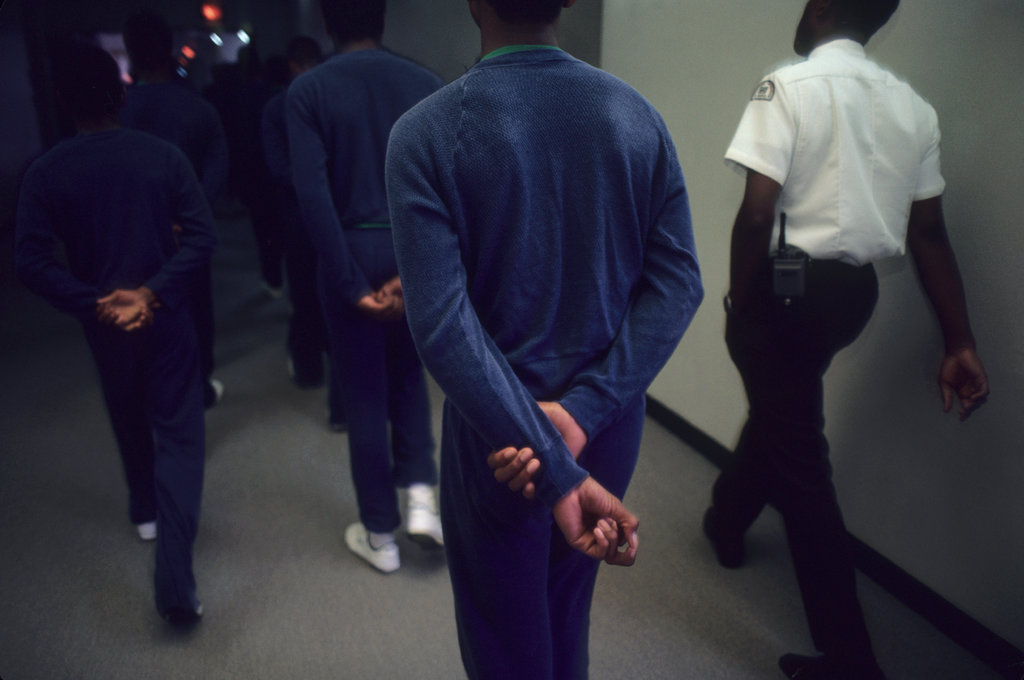
Students being led through the Shelby Training Center, owned by Corrections Corp. of America, CCA, a private juvenile detention facility in Memphis, in 1987.
Hundreds of years after the arrival of enslaved Africans, a presumption of danger and criminality still follows black people everywhere. New language has emerged for the noncrimes that have replaced the Black Codes: driving while black, sleeping while black, sitting in a coffee shop while black. All reflect incidents in which African-Americans were mistreated, assaulted or arrested for conduct that would be ignored if they were white. In schools, black kids are suspended and expelled at rates that vastly exceed the punishment of white children for the same behavior.
Inside courtrooms, the problem gets worse. Racial disparities in sentencing are found in almost every crime category. Children as young as 13, almost all black, are sentenced to life imprisonment for nonhomicide offenses. Black defendants are 22 times more likely to receive the death penalty for crimes whose victims are white, rather than black — a type of bias the Supreme Court has declared “inevitable.”
The smog created by our history of racial injustice is suffocating and toxic. We are too practiced in ignoring the victimization of any black people tagged as criminal; like Woods Eastland’s crowd, too many Americans are willing spectators to horrifying acts, as long as we’re assured they’re in the interest of maintaining order.
This cannot be the end of the story. In 2018, the Equal Justice Initiative, a nonprofit I direct, opened a museum in Montgomery, Ala., dedicated to the legacy of slavery and a memorial honoring thousands of black lynching victims. We must acknowledge the 400 years of injustice that haunt us. I’m encouraged: Half a million people have visited. But I’m also worried, because we are at one of those critical moments in American history when we will either double down on romanticizing our past or accept that there is something better waiting for us.
I recently went to New Orleans to celebrate the release of several of our Angola clients, including Matthew — men who survived the fields and the hole. I realized how important it is to stay hopeful: Hopelessness is the enemy of justice. There were moments of joy that night. But there was also heaviness; we all seemed keenly aware that we were not truly free from the burden of living in a nation that continues to deny and doubt this legacy, and how much work remains to be done.
Landmark US case to expose rampant racial bias behind the death penalty Capital punishment
Top capital lawyers head to North Carolina as judges consider
the cases of four inmates who faced ‘bleached’ juries
Marcus Robinson, a death row inmate, listens in court. Photograph: Shawn Rocco/Raleigh News & Observer/MCT via Getty Images
The dark secret of America’s death penalty – the blatant and intentional racial bias that infects the system, distorting juries and throwing inordinate numbers of African Americans on to death row – will be laid bare next week in North Carolina. Some of the country’s top capital lawyers will gather on Monday at the state supreme court in Raleigh. Over two days, they will present evidence that capital punishment is so deeply flawed and riddled with racial animus that it makes a mockery of basic principles of fairness and equal justice. The court’s seven judges will be asked to address a simple question. Will they allow men and women to be condemned to die despite powerful evidence that prosecutors deployed racially discriminatory tactics to put them on death row?
“We are taking an unprecedented look at whether the courts will tolerate proven racial bias in the death penalty,” said one of the case’s leading lawyers, Cassandra Stubbs, director of the American Civil Liberties Union (ACLU) capital punishment project. “We’re talking about fundamental rights that go to the integrity of the courts and the entire criminal justice system.”
At the heart of the case are four inmates facing execution: three African American men and a Native American woman. Over the past seven years Marcus Robinson, Quintel Augustine, Tilmon Golphin and Christina Walters have been on an extraordinary judicial roller coaster that has seen them taken off death row on grounds that their sentences were racially compromised, only to be slapped back on to it following a partisan backlash by the Republican-controlled state legislature.
In all four cases, a review of their trials found racial bias had been an “overwhelming” feature of how death sentences were secured. In particular, the juries had been “bleached”.
"A very stark and unmistakable
picture of discrimination emerges" - Cassandra Stubbs, ACLU
Black potential jurors were systematically struck off – consciously and intentionally – at a rate far higher than their white equivalents. As a result, juries were produced that were almost exclusively, or in Augustine’s case entirely, white.
“A very stark and unmistakable picture of discrimination emerges with compelling evidence that it is not an accident, it is purposeful,” Stubbs said.
The evidence Stubbs referred to was uncovered by a commission set up under North Carolina’s Racial Justice Act (RJA), an exceptional measure introduced in 2009 following a spate of exonerations of innocent people held in some cases for decades on death row. That so many innocent people, most of them African American, had come close to being killed by the state alarmed local politicians to the extent that the then Democratic-controlled assembly decided to root out racial discrimination from the death penalty once and for all.
In a historic break with the past, the RJA established that anyone who could prove race was a significant factor behind their death sentences would be deemed ineligible for capital punishment.
That new protection unleashed one of the most thorough investigations into the practice of the death penalty in US history. What it uncovered shocked even lawyers working on RJA cases.
‘The more we looked, the more we found’
First up was Cassandra Stubbs’s client, Marcus Robinson. He had just turned 18 in 1994 when he and his black co-defendant carjacked a white teenager, Erik Tornblom, at a gas station in Fayetteville.
Robinson, as prosecutors privately admitted at the time, did not pull the trigger when Tornblom was shot and killed – his co-defendant did. Yet Robinson was still condemned to death, becoming the youngest person at the time on the state’s death row.
When Stubbs began analyzing Robinson’s trial she discovered that the jury had been grossly skewed along race lines. During jury selection, in which both defense and prosecution lawyers have the right to exclude potential jurors so long as they have legitimate reasons, the prosecutor John Dickson struck out five of 10 black people in the pool.
Shirley Burns, center, mother of Marcus Robinson, listens in court. Photograph: Shawn Rocco/Raleigh News & Observer/MCT via Getty Images
- That 50% dismissal rate was almost four times the rate at which eligible white jurors were rejected: just 14%.
- A review of the record showed that Dickson asked demeaning questions of one black prospective juror, including whether the individual could read and had completed school – questions that were put to none of the white candidates.
“The more we looked, the more we found,” Stubbs told the Guardian. “These were explicit biases. It was overt racial discrimination.”
- Investigations of the other three cases under the RJA spotlight threw up even more disturbing evidence.
- At the trial of Augustine, who was charged with killing a police officer, they dug up handwritten notes in which the prosecutor had scrawled “thug” and “blk wino” against the name of two potential black jurors. By contrast, the same prosecutor described a white juror with alcohol issues as “drinks – country boy – ok”.
- Another prospective black juror had “blk/high drug area” placed beside her name, a reference to her largely African American neighborhood.
- The prosecutor ended up throwing out every single qualified black juror, producing an all-white jury.
- At Golphin’s 1998 trial on charges that he and his brother killed two highway patrol officers, an African American man in the jury pool overheard a couple of potential white jurors talking about the defendant. One said Golphin “should have never made it out of the woods” – an apparent lament that officers had arrested the 19-year-old rather than summarily executing him on sight.
When the black potential juror reported what he had overheard, he was struck off the jury pool. The white pair were left alone and may well have sat on the final jury.
The prosecutor ended up throwing out every single qualified black juror, producing an all-white jury.
"They feared that breaking the link
between the death penalty and race would remove too many people from death row" - Cassandra Stubbs
The cheat sheet Other stunning evidence of race bias will be raised at Monday’s hearing. At the 1993 trial of a black defendant named Rayford Burke, the prosecutor described him to the all-white jury as a “big black bull”.
More jaw-dropping still was how the courtroom was arranged by state officials at the 2010 trial of Andrew Ramseur for killing two white victims. Immediately behind the defense table, four rows of benches where the defendant’s family would normally have sat had been cordoned off with yellow crime-scene tape.
In full view of the all-white jury, Ramseur’s elderly grandparents were forced to sit in the proverbial “back of the bus” while the family of the white victims were allowed to locate themselves right behind the prosecution table.
Perhaps the most startling discovery of all was that North Carolina prosecutors were trained in how to get around constitutional prohibitions against selecting juries on race grounds.
The US supreme court has been crystal clear: jury “bleaching” is not allowed. In a 1986 ruling, Batson v Kennedy, the court ruled that jurors could not be dismissed on a racial basis – a valid cause had to be given. That unambiguous ban was reaffirmed just two months ago in the case of Curtis Flowers, a black man from Mississippi who was put on death row after the state prosecutor struck off five black potential jurors, leaving only one on the final jury.
The Flowers ruling was backed by seven of the nine justices. Underlining how little tolerance exists at the highest judicial levels for overt racial discrimination in jury selection, the Flowers opinion was written by Brett Kavanaugh, Donald Trump’s controversial pick, who denounced the Flowers prosecutor’s “relentless, determined effort to rid the jury of black individuals”.
None of this appears to have dissuaded some of North Carolina’s capital prosecutors from pursuing their objective of keeping death row populated with black prisoners. The court will hear that in 1995 a training scheme was set up for prosecutors statewide.
As part of the training, dubbed Top Gun II, attendees were given a handout titled “Batson Justifications: Articulating Juror Negatives”. The document was essentially a cheat sheet – it told prosecutors how they could skirt the clear prohibition on racial strikes by listing 10 “justifications” they could “articulate” to dismiss black people while disguising the race motive.
The list begins with this cod ground for dismissal: “Inappropriate dress – attire may show lack of respect for the system, immaturity or rebelliousness.” It is followed by “Physical appearance – tattoos, hair style, disheveled appearance may mean resistance to authority”.
Another “justification”: “Body language – arms folded, leaning away from questioner, obvious boredom may show anti-prosecution tendencies.”
Several of the state’s capital prosecutors sat through the training and there is evidence they went on to make use of it. The prosecutor in the Augustine case apparently quoted from the Top Gun cheat sheet as she was trying to justify to a judge in a separate trial why she had rejected a black juror.
‘Accept racial bias to keep the death penalty’ The evidence unleashed by the RJA investigation was so overpowering that it persuaded the North Carolina supreme court – the same panel that will host Monday’s hearing – to scrap the death sentences of Augustine, Golphin, Robinson and Walters in 2012. Their new punishment was far from soft: they would spend the rest of their natural lives behind bars
Nonetheless, that was not harsh enough for the Republican-controlled state legislature voted in in 2012. They made it their business to overturn the RJA the following year, disregarding the overwhelming evidence of racial wrongdoing and dragging the four inmates without any further judicial review back on to death row.
For Stubbs of the ACLU, there is only one conclusion to draw: Republicans in North Carolina were more concerned with preserving capital punishment than with ensuring the integrity of the judicial system.
“They feared that breaking the link between the death penalty and race would remove too many people from death row,” she said, “so they decided they were willing to accept racial bias to keep the death penalty.”
"The one category that is vastly more likely to get a death
sentence is when a black man kills a white woman"
- Frank Baumgartner
Stubbs and her fellow lawyers are hoping that Monday’s hearing will once again take their four clients off death row. They are also hoping that the proceedings will put a spotlight on discrimination that remains rampant across the state.
The statistics tell the story. North Carolina is 34% non-white, yet about 63% of death row inmates are non-white. A similar disparity is shown in the statewide statistics on jury selection.
A Michigan State University study found that black potential jurors in capital cases were dismissed through pre-emptory strikes at more than twice the rate of whites.
Frank Baumgartner, professor of political science at the University of North Carolina at Chapel Hill and co-author of Deadly Justice, a recent statistical portrait of the death penalty, said that the same racial faultline runs across all the 29 states that still have the death penalty. His analysis has shown that it is impossible to understand the death penalty without taking on board its grotesque racial distortions.
Baumgartner studied the 1,394 executions that took place in the US from 1976 to 2014 and found that the number of executions carried out for every 10,000 homicides was 65 when the victim was white but only 14 when the victim was black. When gender was factored in the disparity grew even larger, with 123 executions where the victims were white females and only nine for black males.
“The death penalty is reserved for very special categories,” Baumgartner said. “You would expect that to be the most heinous offenders, people who torture their victims and so on. But it’s not like that – the one category that is vastly more likely to get a death sentence is when a black man kills a white woman. The parallels to slavery and southern history are clear in the statistics nationwide.”
He added that he hoped Monday’s hearing, which he will be attending, would give America pause.
“It’s such a visceral and powerful idea,” he said. “To expose the death penalty for what it is: an ugly symbol of racial hierarchy designed to preserve the southern way of life.”