Breaking: S. Korean Warship Sunk

QueEx

Rising Star
Super Moderator
<font size="5"><center>South Korea Naval Vessel Sunk;
Cause Remains Unclear</font size></center>


Bloomberg
By Sangim Han and Bomi Lim
March 27, 2010


A South Korean naval vessel sank off Baengnyeong island in the Yellow Sea, near the border with North Korea, an official in the office of President Lee Myung Bak said. The cause was unclear, he said.

About 50 crew members were still being searched for, with 58 rescued, said the official, who declined to be identified in accord with government policy. The president convened a meeting of security officials to discuss the incident, said the official, giving no further details.

The ship, which was on patrol, started sinking about 9 p.m. Friday night because of a hole in its rear, the cause of which remains unclear, the official said.

South Korea’s navy fired a warning shot toward the north at objects that appeared on radar, the official said. The objects may have been a group of birds, the official said in response to earlier reports that the navy fired at an unidentified ship.

News of the sinking helped push up the price of U.S. two- year Treasuries and of gold as investors sought assets perceived to be safer.

“We had an oversold condition and when the Korea news hit the desks, gold took off,” said Frank McGhee, the head dealer at Integrated Brokerage Services LLC in Chicago.

To contact the reporter on this story: Sangim Han in Seoul at sihan@bloomberg.net
 
`

ap_south_korea_100326_mn.jpg

A South Korean woman watches a TV screen reporting
about a navy ship sinking, in Seoul, South Korea, March
26, 2010. Officials say a South Korean navy ship is sink
ing off the country's west coast near the maritime border
with North Korea. (Lee Jin-man/AP Photo)

A news report says a number of South Korean sailors
died when their military ship sank off an island not far
from North Korea.

South Korea's Yonhap news agency cited an unidentified
naval official early Saturday as saying there were some
deaths. The military says it cannot confirm the report but
says 58 of the 104 crew members on board the ship that
sank late Friday were safe.

http://abcnews.go.com/International/wireStory?id=10209959
 
<font size="3">
Timeline: North Korea – key events
since the end of the Korean war</font size>


A chronology of clashes between North and South Korea and Pyongyang and the US since 1953:

27 July 1953

The war ends when North and South Korea sign a truce – but there is no formal peace treaty, meaning the two countries remain technically at war. The Korean war cost two million lives.


15 August 1974

There is an assassination attempt on the then-South Korean president, Park Chung-hee, by a North Korean agent in Seoul. Park survives, but the first lady is killed.


9 October 1983
North Korean agents target the venue of a visit by the South's president, Chun Doo Hwan, to Burma, killing more than 20 people including four South Korean cabinet ministers. The president escapes.


29 November 1987

North Korea blows up a South Korean civilian airliner, killing 115 people. The US decides to include the North on its list of countries that support terrorism.


15 June 1999

More than 80 North Korean sailors die in the first Yellow Sea clash since the end of the war.


January 2002

The then US president, George Bush, makes his "axis of evil" speech, which links North Korea with Iran and Iraq.


July 2006

North Korea test-fires medium and long-range missiles.


9 October 2006

An international outcry follows North Korea's first nuclear test, and the UN sets up a series of sanctions.


March-May 2008

North Korea test-fires short-range missiles.


July 2008

A soldier shoots a South Korean tourist dead in the Mount Kumgang special tourism area of North Korea.​


http://www.guardian.co.uk/world/2010/mar/26/north-korea-south-korea-timeline
 
<font size="5"><center>
South Korean ship in troubled waters</font size>
<font size="4">

Details are sketchy, but <SPAN style="BACKGROUND-COLOR: #ffff00">if the sinking of Cheonan
was intentional, it creates a serious crisis for
the Koreas' neighbours and the US</span></font size></center>


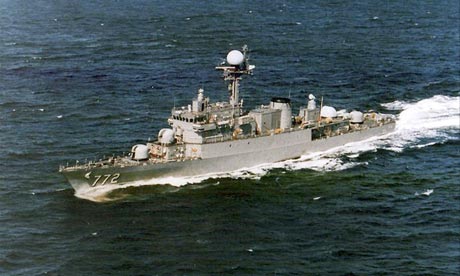
skoreanship.jpg

South Korean naval ship Cheonan patrols the sea in an unidentified location
in the territorial waters of South Korea. Photograph: Yonhap/Reuters


guardian.co.uk,
by Robert Farley
Friday 26 March 2010


Late last night, the South Korean patrol ship Cheonan suffered an explosion and sank. As of midnight Korean time, 58 of the 104 member crew of the Cheonan had been rescued. The cause of the sinking of the Cheonan, a 1,300 ton missile corvette, is as of yet unknown. However, the South Korean cabinet has convened an emergency meeting to deal with the situation, and some reports suggest that a North Korean torpedo may have struck the Cheonan.

Details remain sketchy, and at this point it is unclear whether Cheonan sank as the result of an attack, or because of an accidental explosion. Another South Korean patrol ship reportedly fired on North Korean targets in the area. The area in which Cheonan sank has recently seen several skirmishes between North and South Korean forces. In January, patrol vessels from each nation exchanged gunfire with one another. A similar exchange in November resulted in severe damage to a North Korean vessel, and the death of a North Korean sailor. The disputed area involves several islands that are claimed by both sides. South Korea recognises a UN-drawn line of demarcation, while North Korea does not.

If Cheonan sank because of an accident, the incident will serve as an example of the challenges presented by high tension situations like that between North and South Korea. In such situations, a lack of information can lead to considerable danger, as both sides face pressure to react without having a grasp of the full situation. If, on the other hand, Cheonan was destroyed by a torpedo, the situation must be considered extremely grave. Forty-six crewmen at last report have yet to be accounted for, and are unlikely to survive long in cold Korean waters. South Korea cannot ignore a provocation of this magnitude, and will likely be forced to respond in some fashion. South Korea's navy substantially outmatches its North Korean counterpart, but the North Korean response to any South Korean retaliation remains uncertain.

The problem of discerning North Korean intentions complicates factors. It is possible that the North Korean government ordered the attack in order to provoke the South, but the attack may instead have been launched by lower level local commanders. Even if this were the case, however, it would be impossible for South Korea to divine genuine North Korean intentions.

If the sinking of Cheonan was intentional, it creates a serious crisis for the Koreas' neighbours and for the United States. None of the US, Japan, or China desire the threat of major military action on the Korean Peninsula. The US, still embroiled in Iraq and Afghanistan, doesn't want another military confrontation on its plate. At the same time, it will be difficult for the US to restrain South Korea from some form of retaliation. Japan's patience with North Korea has similarly run thin, and it is unlikely that Tokyo could be relied on too heavily as a voice of caution. Beijing has only limited affection for its North Korean client, but certainly does not want war, or even the threat of war. North Korea's intentions remain mysterious; if it intended to signal its toughness and resolve to South Korea, it may have bitten off more than it can chew.

At this point, I suspect that officials in Beijing, Washington, Tokyo, and perhaps even Seoul are hoping that Cheonan sank becaue of an accidental explosion. If the North Koreans sank Cheonan and killed dozens of South Korean sailors, the situation in northeast Asia may become very dangerous very quickly.


http://www.guardian.co.uk/commentisfree/cifamerica/2010/mar/26/south-korean-ship-sinking
 
Back
Top