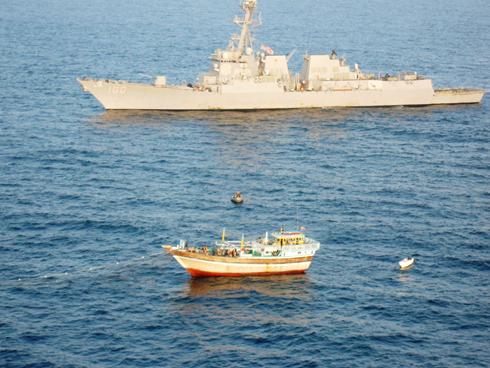
BREAKING! Iran & U.S. Navy have confrontation at sea

THE DIE HAS BEEN CAST

Just heard on Lou Dobbs that there have been previous incidents concerning Iranian small boats including an incident last month with shots fired.

U.S. Navy warning they are getting tired of this shit and if it continues someone is gonna get hurt.

It's heating up folks. From what I've seen none of the boats had any identifying markings on it saying they're Iranian. Be very cautious in what you believe from now on.
 
To all you sheep that continually believe what the government under the Bush regime feed to the willing press, here is just one small reason why I have long since stopped giving this corrupt administration the benefit of the doubt. I guess most of you are under 30 and are currently making good money in some sort of speculation field, because as far as I am concerned, I have seen it all before. Under democratic and republican administrations!

source: Salon.com

Abu Ghraib Officer Cleared
By BEN NUCKOLS Associated Press Writer
Jan 10th, 2008 | BALTIMORE -- The Army has thrown out the conviction of the only officer court-martialed in the Abu Ghraib scandal, bringing an end to the four-year investigation and drawing complaints from human rights activists of a Pentagon whitewash.

Lt. Col. Steven L. Jordan was cleared this week of any criminal wrongdoing by Maj. Gen. Richard J. Rowe, commander of the Military District of Washington. Jordan was instead given an administrative reprimand, a blot on his record.

Barring any startling new information, the decision means no officers or civilian leaders will be held criminally responsible for the prisoner abuse that embarrassed the U.S. military and inflamed the Muslim world.

Jordan, 51, of Fredericksburg, Va., was acquitted at his court-martial in August of charges he failed to supervise the 11 lower-ranking soldiers convicted for their roles in the abuse, which included the photographing of Iraqi prisoners in painful and sexually humiliating positions.

But he was found guilty of disobeying an order not to talk about the investigation, and the jury recommended a criminal reprimand, the lightest possible punishment.

Maj. Kris Poppe, Jordan's attorney, said he argued that Jordan "faced these very serious charges for a long period of time, that he had been found not guilty of any offense related to the abuse of detainees, and that he had a stellar record."

Rowe agreed.

"In light of the nature of the offense that Jordan had been found guilty of committing and the substantial evidence in mitigation at trial and in post-trial matters submitted by defense counsel, Rowe determined that an administrative reprimand was a fair and appropriate disposition of the matter," Joanna P. Hawkins, a military spokeswoman, said in a statement.

Eugene R. Fidell, a Washington lawyer who specializes in military law, said the decision was not at all surprising. If disobeying an order had been the only charge against Jordan, the matter almost certainly would not have gone to a court-martial, Fidell said.

But human rights advocates complained that the case did not go higher up the chain of command and said the decision sent a troubling message.

"It could not be more clear that prisoner abuse in Iraq and Afghanistan resulted from policies and practices authorized by high-level officials, including military and civilian leaders," said Hira Shamsi, an attorney with the National Security Project of the American Civil Liberties Union. "Although the abuse was systemic and widespread, the accountability for it has been anything but."

Mila Rosenthal, deputy executive director for research and policy for Amnesty International USA, said: "I think we're emboldening dictators and despots around the world. We're saying that it's OK to allow these kinds of abuses to flourish."

Jordan, who remains on active duty at Fort Belvoir, Va., did not respond to a request for comment through his lawyer, but told The Washington Post, which first reported the dismissal of his conviction on Thursday, that the Army "finally got it right."

"I'm still a little bit shocked by it all, but I'm gratified and glad that Gen. Rowe saw it for what it really is," he said. "I don't know if any officer needed to be held accountable, but I obviously don't believe it should have been me."

Jordan joins four other officers who received administrative, or non-criminal, punishment in the scandal, including former Brig. Gen. Janis Karpinski, who was in charge of all U.S.-run prisons in Iraq. She was demoted to colonel for dereliction of duty and an unrelated allegation of shoplifting.

The military found that criminal responsibility for the abuse of prisoners did not rise above Staff Sgt. Ivan L. Frederick, a military policeman who was paroled in October after serving about three years of an eight-year sentence.

Pfc. Lynndie England, who was shown in some of the most lurid photos holding a naked prisoner on a leash and posing with a pyramid of naked detainees, received a three-year sentence and was released after about 16 months.

The only soldier still behind bars for crimes at Abu Ghraib is former Cpl. Charles Graner Jr., who received a 10-year sentence for assault, battery, conspiracy, maltreatment, indecent acts and dereliction of duty.

Jordan acknowledged e-mailing a number of soldiers about the investigation, despite an order not to discuss the case.
 
To all you sheep that continually believe what the government under the Bush regime feed to the willing press, here is just one small reason why I have long since stopped giving this corrupt administration the benefit of the doubt. I guess most of you are under 30 and are currently making good money in some sort of speculation field, because as far as I am concerned, I have seen it all before. Under democratic and republican administrations!

source: Salon.com

Abu Ghraib Officer Cleared
By BEN NUCKOLS Associated Press Writer
Jan 10th, 2008 | BALTIMORE -- The Army has thrown out the conviction of the only officer court-martialed in the Abu Ghraib scandal, bringing an end to the four-year investigation and drawing complaints from human rights activists of a Pentagon whitewash.

Lt. Col. Steven L. Jordan was cleared this week of any criminal wrongdoing by Maj. Gen. Richard J. Rowe, commander of the Military District of Washington. Jordan was instead given an administrative reprimand, a blot on his record.

Barring any startling new information, the decision means no officers or civilian leaders will be held criminally responsible for the prisoner abuse that embarrassed the U.S. military and inflamed the Muslim world.

Jordan, 51, of Fredericksburg, Va., was acquitted at his court-martial in August of charges he failed to supervise the 11 lower-ranking soldiers convicted for their roles in the abuse, which included the photographing of Iraqi prisoners in painful and sexually humiliating positions.

But he was found guilty of disobeying an order not to talk about the investigation, and the jury recommended a criminal reprimand, the lightest possible punishment.


:smh::hmm::angry:
 
<font size="5"><center>Mischievous 'Filipino Monkey' could
have triggered latest US-Iran row</font size></center>


Matthew Weaver
Monday January 14, 2008
Guardian Unlimited

A heckling radio ham known as the Filipino Monkey, who has spent years pestering ships in the Persian Gulf, is being blamed today for sparking a major diplomatic row after American warships almost attacked Iranian patrol boats.
The US navy came within seconds of firing at the Iranian speedboats in the Strait of Hormuz on January 6 after hearing threats that the boats were attacking and were about to explode.

Senior navy officials have admitted that the source of the threats, picked up in international waters, was a mystery.

And now the US navy's journal, Navy Times, has claimed that the threats, which were broadcast last week by the Pentagon, are thought to have come from an infamous radio prankster.
It said the Filipino Monkey, who could be more than one person, listens to ship-to-ship radio traffic and then interrupts, usually with abusive insults.

Rick Hoffman, a retired captain, told the paper: "For 25 years, there's been this mythical guy out there who, hour after hour, shouts obscenities and threats. He used to go all night long. The guy is crazy.

"Could it have been a spurious transmission? Absolutely."

An unnamed civilian mariner told the Navy Times: "They come on and say Filipino Monkey in a strange voice. You're standing watch on bridge and all of a sudden it comes over the radio. It's been a joke out there for years."

Last week, the Iranians and the US issued different video versions of what took place.

On the Pentagon's version, a strange voice, in English, can be heard saying "I am coming to you. You will explode in a few minutes." The voice sounds different from one heard earlier in the recording and there is no background noise that would usually be picked up from a speedboat radio.

In the Iranian version, there is no hint of aggressive behaviour.

The Pentagon said it recorded the film and the sound separately and then edited them together to give a "better idea of what is happening".

But Commander Lydia Robertson, a navy spokeswoman, admitted: "We don't know for sure where they [the threats] came from. It could have been a shore station."

The US lodged a formal complaint with Iran over the incident, and the president, George Bush, warned Tehran of "serious consequences" unless it stopped such aggression.

During the 20-minute incident, five Iranian patrol boats swarmed around three US warships and came within 200 metres, puttingthe ships on alert.

The US navy said its gunners came within seconds of firing on the speedboats.


http://www.guardian.co.uk/iran/story/0,,2240533,00.html
 
Is it just me or do we sound like pussies with all this talk about Iran? WTF... why are we giving them warnings? If they get close and do some dumb shit... blast them. Period. Either way, it looks like they want to start a war so it's just a matter of time before they actually do something serious that's going to piss us off and force us to take action. Why even give them chance? Surprisingly, it's not Bush and his cronies faking a fuckin' tape. Why make the U.S. look any weaker?... the tape does a fine job of that. I know that our military service people have a lot more balls than to let a few Iranians in a speadboat fuck with them! That's almost like me trying to talk shit to Bill Gates about who has better jewelry... yeah... really fuckin' pointless. C'mon fam... let's get this country back on track and go back to what we do best... fuckin' other people up and not apologizing for it.
 
<font size="5">The Strait of Hormuz Incident
and U.S. Strategy</font size>


Strategic Forecasting, Inc.
Geopolitical Intelligence Report
By George Friedman
January 14, 2008

Iranian speedboats reportedly menaced U.S. warships in the Strait of Hormuz on Jan. 6. Since then, the United States has gone to great lengths to emphasize the threat posed by Iran to U.S. forces in the strait — and, by extension, to the transit of oil from the Persian Gulf region. The revelation of an Iranian threat in the Strait of Hormuz was very helpful to the United States, coming as it did just before U.S. President George W. Bush’s trip to the region. Washington will use the incident to push for an anti-Iranian coalition among the Gulf Arabs, as well as to push Iran into publicly working with the United States on the Iraq problem.

According to U.S. reports and a released video, a substantial number of Iranian speedboats approached a three-ship U.S. naval convoy moving through the strait near Iranian territory Jan. 6. (Word of the incident first began emerging Jan. 7.) In addition, the United States reported receiving a threatening message from the boats.

Following the incident, the United States began to back away from the claim that the Iranians had issued threats, saying that the source of the transmission might have been hecklers who coincidentally transmitted threats as the Iranian boats maneuvered among the U.S. ships. Shore-based harassing transmissions are not uncommon in the region, or in other parts of the world for that matter, especially when internationally recognized bridge-to-bridge frequencies are used. And it is difficult if not impossible to distinguish the source of a transmission during a short, intense incident such as this. The combination of Iranian craft in close proximity to U.S. warships and the transmission, regardless of the source, undoubtedly increased the sense of danger.

Two things are interesting.
First, the probability of a disciplined Iranian attack — and, by U.S. Navy accounts, the Iranian action was disciplined — being preceded by a warning is low. The Iranians were not about to give away the element of surprise, which would have been essential for an effective attack. While the commander on the scene does not have the luxury we have of dismissing the transmission out of hand — in fact, the commander must assume the worst — its existence decreases the likelihood of an attack. Attacking ships need every second they can get to execute their mission; had the Iranians been serious, they would have wanted to appear as nonthreatening as possible for as long as possible.

Second, the U.S. ships did not open fire. We do not know the classified rules of engagement issued to U.S. ship captains operating in the Strait of Hormuz, but the core guidance of those rules is that a captain must protect his ship and crew from attack at all times. Particularly given the example of the USS Cole, which was attacked by a speedboat in a Yemeni harbor, it is difficult for us to imagine a circumstance under which a ship captain in the U.S. Navy would not open fire if the Iranian boats already represented a significant threat.​

Spokesmen for the 5th Fleet said Jan. 13 that the U.S. ships were going through the process of determining the threat and preparing to fire when the Iranians disengaged and disappeared. That would indicate that speed, distance and bearing were not yet at a point that required a response, and that therefore the threat level had not yet risen to the redline. Absent the transition to a threat, it is not clear that this incident would have risen above multiple encounters between U.S. warships and Iranian boats in the tight waters of Hormuz.

The New York Times carried a story Jan. 12, clearly leaked to it by the Pentagon, giving some context for U.S. concerns. According to the story, the United States had carried out war games attempting to assess the consequences of a swarming attack by large numbers of speedboats carrying explosives and suicide crews. The results of the war games were devastating. In a game carried out in 2002, the U.S. Navy lost 16 major warships, including an aircraft carrier, cruisers and amphibious ships — all in attacks lasting 5-10 minutes. Fleet defenses were overwhelmed by large numbers of small, agile speedboats, some armed with rockets and other weapons, but we assume most operated as manned torpedoes.

STRATEGY AFTER THE NIE

The decision to reveal the results of the war game clearly were intended to lend credibility to the Bush administration’s public alarm at the swarming tactics. It raises the issue of why the U.S. warships didn’t open fire, given that the war game must have resulted in some very aggressive rules of engagement against Iranian speedboats in the Strait of Hormuz. But more important, it reveals something about the administration’s thinking in the context of Bush’s trip to the region and the controversial National Intelligence Estimate (NIE) on Iran’s nuclear program.

A huge controversy has emerged over the NIE, with many arguing that it was foisted on the administration against its will. Our readers know that this was not our view, and it is still not our view. Bush’s statements on the NIE were consistent. First, he did not take issue with it. Second, he continues to regard Iran as a threat. In traveling to the Middle East, one of his purposes is to create a stronger anti-Iranian coalition among the Arab states on the Arabian Peninsula. The nuclear threat was not a sufficient glue to create this coalition. For a host of reasons ranging from U.S. intelligence failures in Iraq to the time frame of an Iranian nuclear threat, a nuclear program was simply not seen as a credible basis for fearing Iran’s actions in the region. The states of the Arabian Peninsula were much more afraid of U.S. attacks against Iran than they were of Iranian nuke s in five or 10 years.

The Strait of Hormuz is another matter. Approximately 40 percent of the region’s oil wealth flows through the strait. During the Iran-Iraq war of the 1980s, the tanker war, in which oil tankers moving through the Persian Gulf came under attack from aircraft, provided a sideshow. This not only threatened the flow of oil but also drove shipping insurance rates through the roof. The United States convoyed tankers, but the tanker war remains a frightening memory in the region.

The tanker war was trivial compared with the threat the United States rolled out last week. The Strait of Hormuz is the chokepoint through which Persian Gulf oil flows. Close the strait and it doesn’t flow. With oil near $100 a barrel, closing the Strait of Hormuz would raise the price — an understatement of the highest order. We have no idea what the price of oil would be if the strait were closed. Worse, the countries shipping through the strait would not get any of that money. At $100 a barrel, closing the Strait of Hormuz would take an economic triumph and turn it into a disaster for the very countries the United States wants to weld into an effective anti-Iranian coalition.

The revelation of a naval threat from Iran in the Strait of Hormuz just before the president got on board Air Force One for his trip to the region was fortuitous, to say the least. The Iranians insisted that there was nothing unusual about the incident, and Foreign Ministry spokesman Mohammad Ali Hosseini said that “Some political factions in the U.S. are pursuing adventurism to help Bush to spread Iran-phobia in the region. U.S. officials should apologize to Iran, regional countries and the American people.” This probably won’t happen, but he undoubtedly will be grateful that the Iranians said there was nothing out of the ordinary about the incident. If this incident was routine, and if the U.S. war games have any predictive ability, it means that the Iranians are staging routine incidents, any one of which could lead to a military confrontation in the strait. Bush undoubtedly will be distributing the Iranian statement at each of his stops.

Leaving aside the politics for a moment, the Iranian naval threat is a far more realistic, immediate and devastating threat to regional interests than the nuclear threat ever was. Building an atomic weapon was probably beyond Iran’s capabilities, while just building a device — an unwieldy and delicate system that would explode under controlled circumstances — was years away. In contrast, the naval threat in the Strait of Hormuz is within Iran’s reach right now. Success is far from a slam dunk considering the clear preponderance of power in favor of U.S. naval forces, but it is not a fantasy strategy by any means.

And its consequences are immediate and affect the Islamic states in ways that a nuclear strike against Israel doesn’t. Getting the Saudis to stand against Iran over an attack against Israel is a reach, regardless of the threat. Getting the Saudis worked up over cash flow while oil prices are near all-time highs does not need a great deal of persuading. Whatever happened in the strait Jan. 6, Bush has arrived in the region with a theme of widespread regional interest: keeping the Strait of Hormuz open in the face of a real threat. We are not certain that a Nimitz-class aircraft carrier could be sunk using small swarming ships. But we are certain that the strait could be closed or made too dangerous for tankers for at least a short period. And we know that, as in land warfare, finding the bases that are launching ships as small as speedboats would be tough. This threat had substance.

By dropping the Iranian nuclear threat and shifting to the threat to the strait, Bush moves the Iran issue from being one involving the United States and Israel to being one that excludes Israel but involves every oil producer in the region. None of them wants this to happen, and all of them must take the threat seriously. If it can establish the threat, the United States goes from being an advocate against Iran to being the guarantor of very real Arab interests. And if the price Arabs must pay for the United States to keep the strait open is helping shut down the jihadist threat in Iraq, that is a small price indeed.

This puts Iran in a tough position. Prior to the issuance of the NIE, the Iranians had shifted some of their policies on Iraq. The decline in violence in Iraq is partly because of the surge, but it also is because Iran has cut back on some of the things it used to do, particularly supporting Shiite militias with weapons and money and urging them to attack Sunnis. It also is clear that the limits it had imposed on some of the Iraqi Shiite politicians in the latter’s dealings with their Sunni counterparts have shifted. The new law allowing Baath Party members to return to public life could not possibly have been passed without Iranian acquiescence.

Clearly, Iran has changed its actions in Iraq as the United States has changed its stance on Iranian nuclear weapons. But Iran shied away from reaching an open accommodation with the United States over Iraq following the NIE. Factional splits in Iran are opening up as elections approach, and while the Iranians have shifted their behavior, they have not shifted their public position. The United States sees a shift of Iran’s public position as crucial in order to convince Iraqi factions, particularly all of the Shiite parties, to move toward a political conclusion. Reining in militias is great, but Washington wants and needs the final step. The NIE shift, which took the nuclear issue off the table, was not enough to do it. By raising the level of tension over a real threat — and one that has undebatable regional consequences — the United States is hoping to shape the internal political discussion in Iran toward an open participation in reshaping Iraq.

Iran doesn’t want to take this step for three good reasons. First, it wants to keep its options open. It does not trust the United States not to use a public accord over Iraq as a platform to increase U.S. influence in Iraq and increase the threat to Iran. Second, Tehran has a domestic political problem. In the same way that Bush saw an avalanche of protest from his supporters over the NIE, the Iranians will see resistance to open collaboration. Finally, the Iranians are not sure they need a public agreement. From their point of view, they have delivered on Iraq, the United States has delivered on the NIE and things are moving in a satisfactory direction. Why go public? The American desire to show the Iraqi Shia that Iran has publicly abandoned the quest for a Shiite Iraq doesn’t do Iran a bit of good.

The Iranians have used the construction of what we might call a guerrilla navy as a lever with the United States and as a means to divide the United States from the Arabs. The Iranians’ argument to the Arabs has been, “If the United States pushes us too far, we will close the strait. Therefore, keep the Americans from pushing us too far.” The Americans have responded by saying that the Iranians now have the ability to close the Strait of Hormuz, potentially regardless of what the U.S. Navy does. Therefore, unless the Arabs want to be at the mercy of Iran, they must join the United States in an anti-Iranian coalition that brings Iran under control. In its wooing of the Arabs, Washington will emphasize just how out of control the Iranians are, pointing out that Tehran is admitting that the kind of harassment seen Jan. 6 is routine. One day — and the day will be chosen by Iran — this will all get really out of hand.

The Iranians have a great deal to gain from having the ability to close the strait, but very little from actually closing it. The United States is putting Iran in a position such that the Gulf Arabs will be asking Tehran for assurances that Iran will not take any action. The Iranians will give assurances, setting the stage for a regional demand that the Iranians disperse their speedboats, which are purely offensive weapons of little defensive purpose.

The United States, having simplified the situation for the Iranians with the NIE and not gotten the response it wanted, now is complicating the situation again with a completely new framework — a much more effective framework than the previous one it used.

In the end, this isn’t about the Strait of Hormuz. Iran isn’t going to take on the U.S. Navy, and the Navy isn’t quite as vulnerable as it claims — and therefore, the United States obviously is not nearly as trigger-happy as it would like to project. Washington has played a strong card. The issue now is whether it can get Iran into a public resolution over Iraq.

The Iranians appear on board with the private solution. They don’t seem eager for a public one. The anti-Iranian coalition might strengthen, but as clever as this U.S. maneuver is, it will not bring the Iranians public. For that, more concessions in Iraq are necessary. More to the point, for a public accommodation, the “Great Satan” and the charter member of the “Axis of Evil” need to make political adjustments in their public portrayal of one another — hard to do in two countries facing election years.

stratfor.com


 
Ahhh So thats what this was all about.

Bush's new crew is making some good strategic moves.

Now the question is how will Iran and Russia respond.

Stay tuned
 
A quick look around the net brought this to my attention. A regional viewpoint from Asia times online via Inter Press Service


Middle East
Jan 12, 2008


US beats a Middle East policy retreat
By Adam Morrow and Khaled Moussa al-Omrani

CAIRO - Recent months have witnessed several notable political reorientations in the Middle East, involving Iran, the Gulf states, Egypt and Lebanon. Several experts say the changes reflect a shift in Washington's regional strategy following recent policy setbacks.

"US policies in the region are either in retreat or undergoing re-examination," Ayman Abelaziz Salaama, international law professor at Cairo University, told Inter Press Service. "Washington's project for a new Middle East - launched in 2001


with the aim of redrawing the region to suit US interests - has failed."

The most notable manifestation of this retreat is considered to be Washington's apparent change of tack on Iran. A widely-publicized US intelligence report in early December devastated claims by both the George W Bush administration and Tel Aviv that Tehran was developing nuclear weapons. Since then, US statements suggest that - while Washington will continue to press for economic sanctions against Tehran - the notion of a US-led attack on the Islamic republic has been shelved.

What's more, the US State Department has shown a new willingness to engage Tehran diplomatically in an effort to garner Iranian cooperation in Iraq.

"The US has obviously changed course on Iran," Essam al-Arian, a leading member of Egypt's Muslim Brotherhood opposition movement and head of the group's political department, told IPS. "The intelligence report has ensured that a US-led war on Iran is off the table."

Bush is currently on a tour of the Middle East that will take him to Israel, Palestine, Kuwait, Bahrain, the United Arab Emirates, Saudi Arabia and Egypt

The apparent US stand-down has been accompanied by several signs of diplomatic rapprochement between Washington's Arab allies and Tehran.

In early December, Iranian President Mahmud Ahmadinejad was invited to attend a Gulf Cooperation Council (GCC) summit - a first for an Iranian head of state - held in Qatar. "It seems a new chapter has been opened in relations between the Persian and the Gulf states," Ahmadinejad reportedly told the conference.

Days later, at a regional security summit held in Bahrain, representatives from a number of Arab countries bluntly declared their opposition to a would-be military strike against Iran. "We want the military factor to be eliminated," GCC secretary general Abdul-Rahman al-Attiya said at the conference, which was also attended by US Defense Secretary Robert Gates.

According to Salaama, the Gulf states - like most of Washington's Arab allies in the region - are all too relieved to be rid of the specter of a US-Iran showdown.

"The last thing the GCC states want is to have Iran - just across the gulf - as an enemy," he said. "Also, with significant Shi'ite populations, they are more susceptible to Iranian influence than other countries in the region."

In a January 6 interview, Arab League secretary general Amr Moussa defended the right of Arab capitals to set their own policies vis-a-vis Tehran. "As long as it has no nuclear program, why should we isolate Iran?" he was quoted as saying in a reference to the recent US intelligence assessment.

Egypt, too, which has not had diplomatic relations with Iran since 1979, appears to be flirting with the idea of rapprochement.

Late last month, Ali Larijani, head of Iran's National Security Council, visited Cairo where he met with a number of prominent government officials. The visit, which came in the wake of other high-profile exchanges, has prompted considerable speculation that diplomatic normalization between Cairo and Tehran is on the horizon.

Along with the apparent shift on Iran comes political reorientations by US allies in Lebanon. Lebanon remains the scene of a drawn-out power struggle between the Western-backed government in Beirut and the opposition led by Shi'ite resistance group Hezbollah. The conflict has lately culminated in a full-blown presidential crisis, with both sides intent on deciding the choice of the country's next president.

In a notable shift last month, the anti-Syrian government majority announced its willingness to accept army commander Michel Suleiman as a potential presidential candidate. Previously, government figures had voiced opposition to Suleiman's candidacy in light of the army chief's amicable relationship with Hezbollah.

Notably, the about-face came despite earlier statements by US Secretary of State Condoleezza Rice in which she urged the government not to compromise on the issue of the presidency.

"The US didn't want Suleiman as president because of his good working relationship with Hezbollah," Abdel-Halim Kandil, political analyst and former editor-in-chief of opposition weekly al-Karama, told IPS. "But Washington was unable to impose this demand on its allies in the government."

According to Salaama, the shift must be seen within the context of Israel's inability - despite unqualified US support - to disarm Hezbollah during its 2006 summer with Lebanon.

"Israel, and by extension the US, failed to disarm Hezbollah by force," he said. "This changed the regional balance of power and had a profound impact on US policy in the Middle East."

In light of these developments, he added, the notion of disarming the Shi'ite resistance group - an ally of Iran and Syria - now seems farther away than ever.

"There may be UN Security Council resolutions calling for disarmament of Hezbollah, but they are far from being implemented," said Salaama.

Another factor in the seeming US policy retreat, say observers, is the US military's poor showing after almost five years in Iraq. "The US went from launching a quick war for regime change to maintaining a long-term occupation of Iraq," said Salaama. "Now, despite new counter-insurgency strategies, the American military remains bogged down with mounting military and economic losses."

According to Kandil, the US failure to win decisively in Iraq has forced Arab capitals to reassess the vaunted US military might. "Given the situation in Iraq, the Arab regimes now realize that US power isn't absolute - and can even be resisted," he said.

Military strategy aside, local observers also point to Washington's shattered credibility as an arbitrator in the Israel-Palestine conflict, particularly after the US-sponsored Annapolis summit in November.

Ostensibly held to restart the moribund Arab-Israeli peace process, the event was attended by representatives from Israel, the Ramallah-based Palestinian Authority and 16 Arab nations. But while the conference was heavy on Tel Aviv's security concerns, longstanding Arab demands - chief among them the establishment of a Palestinian state - were conspicuously absent.
"The Arabs went to Annapolis despite serious reservations, based on Washington's promises that Israel would show flexibility," said Kandil. "But the US totally failed to deliver, embarrassing the Arab regimes in front of their respective publics."

Arian echoed this theme, saying, "Even Arab governments allied with the US were deeply embarrassed by the lack of results."

Many Arab commentators also point to the US failure to advance the twin causes of democracy and human rights in the region - both of which had been major components of Washington's post-September 11, 2001, vision for a "new Middle East".

"The US can't call for democracy and human rights while simultaneously committing war crimes in Iraq and Afghanistan," said Salaama. "America was once seen as a champion of freedom - now it's perceived as a human rights violator."

According to Kandil, these accumulated US failures - both military and moral - have led the region's capitals to re-examine their priorities.

"Until now, the Arab regimes have blindly followed the US, thinking they needed it to keep them in power," he said. "But recent development are prompting them to reassesses this assumption. The era of US hegemony is ending," Kandil added. "And a new era of cooperation between regional actors - looking for new means to achieve their ends - has begun."

(Inter Press Service)
 
Official Version of US-Iranian 'Incident' Starts to Unravel - part 1 and 2

Gareth Porter, Investigative historian specializing in U.S. national security policy. His latest book is called "Perils of Dominance- Imbalance of Power and the Road to War in Vietnam."

The United States has lodged a formal diplomatic protest against Iran for its "provocation" in the Strait of Hormuz on Sunday morning. But new information reveals that the alleged Iranian threat to American naval vessels in the Strait might have been blown out of proportion.


<object type="application/x-shockwave-flash" width="450" height="370" wmode="transparent" data="http://www.liveleak.com/player.swf?autostart=false&token=96b_1200722680"><param name="movie" value="http://www.liveleak.com/player.swf?autostart=false&token=96b_1200722680"><param name="wmode" value="transparent"><param name="quality" value="high"></object>

Gareth Porter, Investigative historian specializing in U.S. national security policy. His latest book is called "Perils of Dominance- Imbalance of Power and the Road to War in Vietnam."

The United States has lodged a formal diplomatic protest against Iran for its "provocation" in the Strait of Hormuz on Sunday morning. But new information reveals that the alleged Iranian threat to American naval vessels in the Strait might have been blown out of proportion

<object type="application/x-shockwave-flash" width="450" height="370" wmode="transparent" data="http://www.liveleak.com/player.swf?autostart=false&token=f1a_1200723529"><param name="movie" value="http://www.liveleak.com/player.swf?autostart=false&token=f1a_1200723529"><param name="wmode" value="transparent"><param name="quality" value="high"></object>
 
US Navy rescues 13 Iranian sailors

piratesx-large.jpg


see my thread US Navy rescues 13 Iranian sailors
http://www.bgol.us/board/showthread.php?p=10958608#post10958608
 
Back
Top