Are Progressive Leaders Myopic About Race?

Art Vandelay

Importer/exporter
Registered
Are White Progressive Leaders like Sanders, Warren, and De Blasio Myopic About Race?
The economic rhetoric of progressive leaders can leave black people feeling left out. Here’s why.
By Joan Walsh
Salon
June 2, 2015


Sen. Bernie Sanders, the lifelong crusader for economic justice now running for the Democratic presidential nomination, has serious civil rights movement cred: he attended the historic 1963 March on Washington, where Dr. Martin Luther King Jr. and a quarter million people changed the country’s course when it came to race. It would be wrong and unfair to accuse him of indifference to issues of racial equality.

But in the wake of his picture-postcard campaign launch, from the shores of Vermont’s lovely Lake Champlain, Sanders has faced questions about whether his approach to race has kept up with the times. Writing in Vox, Dara Lind suggested that Sanders’ passion for economic justice issues has left him less attentive to the rising movement for racial justice, which holds that racial disadvantage won’t be eradicated only by efforts at economic equality. Covering the Sanders launch appreciatively on MSNBC, Chris Hayes likewise noted the lack of attention to issues of police violence and mass incarceration in the Vermont senator’s stirring kick-off speech.

These are the same questions I raised last month after watching Sen. Elizabeth Warren and New York Mayor Bill de Blasio hail the new progressive movement to combat income inequality at two Washington D.C. events. Both pointed to rising popular movements to demand economic justice, most notably the “Fight for $15” campaign. Neither mentioned the most vital and arguably most important movement of all, the “Black Lives Matter” crusade. (Which is odd, since “Fight for $15″ leaders have explicitly endorsed their sister movement.) And the agendas they endorsed that day made only minimal mention, if they mentioned it at all, of the role that mass incarceration and police abuse plays in worsening the plight of the African American poor.

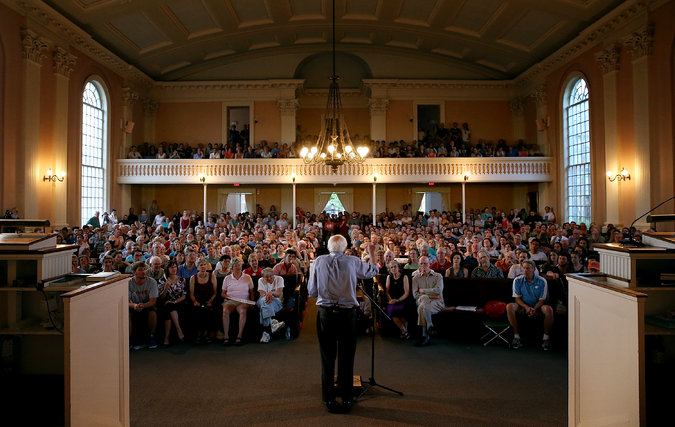
Looking at the overwhelmingly white Bernie Sanders event last week, I saw it again: the rhetoric and stagecraft employed by white progressives whom I admire too often– inadvertently, I think— leaves out people who aren’t white. Of course, Sanders’ home state of Vermont is 96 percent white, so his kickoff crowd predictably reflected that. But his rhetoric could have told a more inclusive story.

So could Elizabeth Warren’s. I love her stirring stories about her upbringing: the days when her mother’s minimum wage job could support a family, when unions built the American middle class, and when Warren herself could attend a public university for almost nothing. Like a lot of white progressives, she points to the post World War II era as a kind of golden age when income inequality flattened and opportunity spread, the result of progressive action by government. I’ve written about the political lessons of that era repeatedly myself.

But the golden age wasn’t golden for people who weren’t white. Yes, African American incomes rose and unemployment declined in those years. But black people were locked out of many of the wealth-generating opportunities of the era: blocked from suburbs with restricted covenants and redlined into neighborhoods where banks wouldn’t lend; left out by the GI Bill, which didn’t prevent racial discrimination; neglected by labor unions, which discriminated against or outright blocked black members. (That’s why I gave my book, “What’s the Matter with White People?”, the subtitle “Why We Long for a Golden Age that Never Was.”)

Conservatives look back at those post-World War II years as a magical time when men were men, women raised children, LGBT folks didn’t exist or stayed closeted, and the country was white. Progressives point to the government support that created that alleged golden age, but they too often make it sound rosier than it was for people who weren’t white. In fact some of those same policies of the 1950s helped create the stunning disparities between black and white family wealth, which leaves even highly paid and highly educated African Americans more vulnerable to sliding out of the middle class.

All of this leaves white progressives vulnerable to charges that they don’t understand the political world they live in today. “I love Elizabeth, but those stories about the ‘50s drive me crazy,” one black progressive told me after a recent Warren event.

Dara Lind points to Sanders’ socialist analysis as a reason he’s reluctant to focus on issues of race: he thinks they’re mainly issues of class. She samples colleague Andrew Prokop’s Sanders profile, which found:

Even as a student at the University of Chicago in the 1960s, influenced by the hours he spent in the library stacks reading famous philosophers, (Sanders) became frustrated with his fellow student activists, who were more interested in race or imperialism than the class struggle. They couldn’t see that everything they protested, he later said, was rooted in “an economic system in which the rich controls, to a large degree, the political and economic life of the country.”

Increasingly, though, black and other scholars are showing us that racial disadvantage won’t be undone without paying attention to, and talking about, race. The experience of black poverty is different in some ways than that of white poverty; it’s more likely to be intergenerational, for one thing, as well as being the result of discriminatory public and private policies.

Ironically, our first black president has exhausted the patience of many African Americans with promises that a rising economic justice tide will lift their boats. President Obama himself has rejected race-specific solutions to the problems of black poverty, arguing that policies like universal preschool, a higher minimum wage, stronger family supports and infrastructure investment, along with the Affordable Care Act, all disproportionately help black people, since black people are disproportionately poor.

At the Progressive Agenda event last month, I heard activists complain that they’d been told the same thing: the agenda will disproportionately benefit black people, because they’re disproportionately disadvantaged, even if it didn’t specifically address the core issue of criminal justice reform. (De Blasio later promised the agenda would include that issue.) But six years of hearing that from a black president has exhausted people’s patience, and white progressives aren’t going to be able to get away with it anymore.

Hillary Clinton could be the unlikely beneficiary of white progressives’ stumbles on race. The woman who herself stumbled facing Barack Obama in 2008 seems to have learned from her political mistakes. She’s taken stands on mass incarceration and immigration reform that put her nominally to the left of de Blasio’s Progressive Agenda on those issues, as well as the president’s. Clinton proves that these racial blind spots can be corrected. And American politics today requires that they be corrected: no Democrat can win the presidency without consolidating the Obama coalition, particularly the African American vote.

In fact, African American women are to the Democrats what white evangelical men are to Republicans: the most devoted, reliable segment of the party base. But where all the GOP contenders pander to their base, Democrats often don’t even acknowledge theirs. Clinton seems determined to do things differently, the second time around. The hiring of senior policy advisor Maya Harris as well as former Congressional Black Caucus director LaDavia Drane signal the centrality of black female voters to the campaign. In a briefing with reporters Thursday in Brooklyn, senior Clinton campaign officials said their polling shows she’s doing very well with the Obama coalition, despite her 2008 struggles – but she’s taking nothing for granted.

Pointing to Warren and Sanders’s shortcomings when it comes to racial politics doesn’t mean they’re evil, or they can’t learn to see things with a different frame. But they’re going to have to, or they’ll find that the populist energy that’s eclipsing Democratic Party centrists will be dissipated by racial tension no one can afford.
 
"Writing in Vox, Dara Lind suggested that Sanders’ passion for economic justice issues has left him less attentive to the rising movement for racial justice, which holds that racial disadvantage won’t be eradicated only by efforts at economic equality. Covering the Sanders launch appreciatively on MSNBC, Chris Hayes likewise noted the lack of attention to issues of police violence and mass incarceration in the Vermont senator’s stirring kick-off speech.


Increasingly, though, black and other scholars are showing us that racial disadvantage won’t be undone without paying attention to, and talking about, race."​


But, who said there was a panacea, in the first place ???


Progressives?

<iframe src="http://www.cnn.com/2015/05/06/politics/bill-clinton-crime-prisons-hillary-clinton/" width=800 height=1000></iframe>
 
Sanders and O’Malley Stumble During Black Lives Matter Protest
Sam Frizell/Phoenix, Arizona
July 18, 2015


<object id="flashObj" width="700" height="394" classid="clsid:D
<param name="movie" value="http://c.brightcove.com/services/viewer/federated_f9?isVid=1&isUI=1" /><param name="bgcolor" value="#FFFFFF" /><param name="flashVars" value="videoId=4362414754001&linkBaseURL=http%3A%2F%2Fti.me%2F1DnXl4F&playerID=1917933886001&playerKey=AQ~~,AAAAABGEUMg~,hNlIXLTZFZn-NQOazMchMDWH0SI1hX7f&domain=embed&dynamicStreaming=true" /><param name="base" value="http://admin.brightcove.com" /><param name="seamlesstabbing" value="false" /><param name="allowFullScreen" value="true" /><param name="swLiveConnect" value="true" /><param name="allowScriptAccess" value="always" /><embed src="http://c.brightcove.com/services/viewer/federated_f9?isVid=1&isUI=1" bgcolor="#FFFFFF" flashVars="videoId=4362414754001&linkBaseURL=http%3A%2F%2Fti.me%2F1DnXl4F&playerID=1917933886001&playerKey=AQ~~,AAAAABGEUMg~,hNlIXLTZFZn-NQOazMchMDWH0SI1hX7f&domain=embed&dynamicStreaming=true" base="http://admin.brightcove.com" name="flashObj" width="700" height="394" seamlesstabbing="false" type="application/x-shockwave-flash" allowFullScreen="true" allowScriptAccess="always" swLiveConnect="true" pluginspage="http://www.macromedia.com/shockwave/download/index.cgi?P1_Prod_Version=ShockwaveFlash"></embed></object>​

Democratic presidential candidate Martin O’Malley was midsentence when the chanting began. “What side are you on black people, what side are you on!” rang the chorus of around four dozen mostly black protesters streaming into a convention hall in Phoenix, Arizona, on Saturday.

A woman named Tia Oso grabbed the microphone as the protestors stormed the room.

“We are going to hold this space and acknowledge the names of black women who have died in police custody, and then Governor O’Malley we do have questions for you!” Oso said as the former two-term governor and his interviewer, Jose Antonio Vargas, watched helplessly. “As leader of this country will you advance an agenda that will dismantle structural racism in this country?” Oso asked.

“Yes,” O’Malley managed to answered, before he was drowned out again.

O’Malley was speaking at Netroots Nation, the country’s largest gathering of progressive activists when the proceedings broke down in a cacophony of boos, cheers and heckles on Saturday. Shortly afterward, Bernie Sanders, another Democratic candidate for president, was also silenced on the same stage by the group of Black Lives Matter protesters. Chanting, the activists shouted out the names of black women who have died in police custody and peppered the candidates with questions about their civil rights records.

A sea of mostly white progressives, including unions, laborers, bloggers, activists and musicians sat watching the drama unfold.

It was a moment that spoke to the tumult on the Democratic left and surprised even the organizers of the nine-year-old annual event. As the Democratic party increasingly coalesces around a progressive wish list like expanding Social Security and reining in Wall Street, the growing Black Lives Matter movement is calling loudly for the left to focus on racial injustice as well.

The two presidential candidates found themselves at the center of the chaos, both caught off guard and unable to answer the protestors.

“Black lives matter. White lives matter. All lives matter,” O’Malley said to boos and jeers.

After O’Malley exited, Sanders took the stage and flashed with annoyance. “If you don’t want me to be here that’s okay,” he said. “I don’t want to out-scream you.”


The Democratic presidential candidates have all addressed race on the campaign trail, each in their own way. Former Secretary of State Hillary Clinton—who was absent from the Phoenix conference—has called for automatic voter registration and fundamentally reforming the criminal justice system. Sanders has proposed for a massive jobs programs and raising the minimum wage, and O’Malley has discussed reforming policing and enhancing civilian review boards, among other measures.

In the wake of the police killings of Michael Brown, Eric Garner, Walter Scott and others, activists across the country have condemned mass incarceration and police brutality. They’ve reignited a nationwide debate about race that has brought down Confederate flags, humbled police chiefs and brought cities to a standstill.

But here in Phoenix, it appeared the candidates had misjudged the fervor of the Black Lives Matter movement that has swept the country.

O’Malley stood mutely watching for some ten minutes as protestors jeered, and when he finally edged in a word, he spoke broadly about “all of the lives that been lost to violence” and aroused the protestors anger by saying “all lives matter.” (O’Malley later said he “meant no disrespect.”)

Despite watching O’Malley fumble, Sander immediately began with his prepared stump speech, criticizing the media and calling for a political revolution, trying to speak over the protesters. “What are we doing here?” he grumbled to Vargas, who was unable to control the crowd. Halfway through his time, Sanders looked at the protesters and finally said “Black people are dying in this country because we have a criminal justice system that is out of control.”

Even at Netroots Nation, a Shangri-La for progressive idealism where protesters in the hot Phoenix sun pass around sunscreen and water bottles and gather afterwards for group meditation sessions, some attendees were flummoxed by the outpouring of racial anger. Many in the crowd said later they were confused and uncomfortable, though sympathetic. As the protesters chanted, one man called out “Let the Governor speak!”

The central question seemed to be about how progressives view economic injustice in the United States: as an issue primarily of income inequality, or racial unfairness.

Many of the African-American organizers at Netroots Nation complained that the conference prioritized economic inequality at the expense of racial justice.

“We have to center this conversation around blackness and anti-blackness. We cannot keep disguising structural racism as income inequality,” Angela Peoples, co-director of GetEqual and one of the hecklers, said afterward in an interview. “What we saw at this conference was a lack of acknowledgement of movement for black lives.”


The organizers of the conference said that racial justice stands at the center of Netroots Nation.

“Although we wish the candidates had more time to respond to the issues, what happened today is reflective of an urgent moment that America is facing today,” said a spokeswoman for Netroots Nation. “Netroots Nation stands in solidarity with all people seeking human rights.”

The Netroots Nation conference featured a number of panels on racism, including ones called “Building Black-Brown Coalitions,” “Examining Racial and Gender Bias,” “Reclaiming Media in the new Dawn of Black Liberation” and numerous others. A day earlier, Massachusetts Sen. Elizabeth Warren told a crowd to loud cheers that “black lives matter,” marking an important moment at the conference.

But Black Lives Matter activists are calling on the presidential candidates to make racial justice a central part of their campaigns, and demanded more from the Netroots organizers.

“They did not answer any of our questions,” Monica Simpson, one of the Black Lives Matter organizers said of Sanders and O’Malley. “Race has to be centered in all presidential candidate’s platforms.”


Observers said that O’Malley and Sanders both flubbed their shot on stage.

“It was a missed opportunity for both candidates. What Bernie did is he treated them as hecklers instead of a movement,” Charles Chamberlain, the executive director of Democracy for America, said in an interview. O’Malley’s comments were “incredibly tone deaf,” Chamberlain added.


O’Malley has promised to lay out a plan to reform the criminal justice. O’Malley said afterword in an interview with the digital show This Week in Blackness that he regrets that as Baltimore mayor and Maryland governor he did not push to expunge misdemeanors from nonviolent offenders’ records and seeking to lead the way on a body camera program for police officers.

The kerfuffle at Netroots for Sanders was especially pointed. As a student at the University of Chicago in the early 1960s, Sanders participated in one of the first sit-ins in the North protesting racial segregation, and was active in pushing to desegregate Chicago public schools. But Sanders tends to view racial injustice through an economic lens, putting forth jobs platforms intended to help the poor. When he was able to put in a word on stage, Sanders said the U.S. needs to create “an economy where people have good jobs and good wages”—a sentiment that did not satisfy the protestors.


With the group continuing to chant toward the stage, Vargas said it was time to wrap up. “Okay, good,” Sanders said.

To many in the audience, the Black Lives Matter showdown was an inspiring example of activism. “It was a moment we could stand in solidarity with the Black Lives Matter movement,” said attendee Alexandra Thebert, who is white. “It was a terrific example of how you can make change in the world.”

But only a few joined in when the protestors left the hall singing the African-American spiritual, “Oh, Freedom” — “Oh freedom, oh freedom … Before I’ll be a slave, I’ll be buried in my grave.”


Myopia? Something! How did these candidates run into this buzzsaw (Netroots Nation), so utterly unprepared :confused:
 
source: New York Times

Bernie Sanders a Virtual Unknown Among Black Voters

Senator Bernie Sanders of Vermont is climbing in the polls in Iowa and New Hampshire, and he has drawn thousands of people to rallies for his presidential campaign recently in Denver and Minneapolis. But the shooting last week in Charleston, S.C., has highlighted a daunting obstacle he faces in the Democratic primary contest: Black voters have shown little interest in him.

24SANDERS-web-master675.jpg

Blacks, a crucial constituency in Democratic presidential races, have been absent from Senator Bernie Sanders’s campaign events.Blacks, a crucial constituency in Democratic presidential races, have been absent from Senator Bernie Sanders’s campaign events.

Even his own campaign advisers acknowledge that Mr. Sanders is virtually unknown to many African-Americans, an enormously important Democratic constituency.

Though he led sit-ins as a civil rights activist in the 1960s, helped the Rev. Jesse L. Jackson Sr. pull off a surprising campaign victory in Vermont in 1988, and espouses liberal policy ideas broadly popular with many Democrats, Mr. Sanders has had little direct experience with black voters as a politician in a state that is 95 percent white. And they have been largely absent from his campaign events so far.
<aside class="marginalia related-coverage-marginalia nocontent robots-nocontent" data-marginalia-type="sprinkled" role="complementary">
</aside> Mr. Sanders, 73, had planned to start introducing himself to larger numbers of African-Americans last Sunday at a large gathering in Charleston, but he quickly postponed the event after the church killings. The massacre also revived debate over a highly charged issue on which Mr. Sanders has a mixed record: gun control.

<iframe scrolling="no" allowfullscreen="true" marginheight="0" marginwidth="0" id="nyt_video_player" title="New York Times Video - Embed Player" src="http://graphics8.nytimes.com/bcvideo/1.0/iframe/embed.html?videoId=100000003761034&playerType=embed" frameborder="0" height="373" width="480"></iframe>
Senator Bernie Sanders of Vermont said on the Senate floor on Tuesday that the country has a long way to go in terms of civil rights, and he mentioned his own experiences protesting segregation.

Hillary Rodham Clinton is working assiduously to cement her support among black voters. In an NBC/Wall Street Journal poll this week, 95 percent of nonwhite Democratic voters said they could see themselves supporting Mrs. Clinton for the nomination in the primary. Only about one-quarter of respondents said they could see themselves voting for Mr. Sanders.

And Mrs. Clinton is hardly sitting still: She has spoken out assertively on race relations and gun control over the past week, and she visited a black church on Tuesday near Ferguson, Mo., where the killing of an unarmed black man by a white police officer in August ignited protests.

Mr. Sanders has lamented “the ugly stain of racism that still taints our nation,” but he has yet to take the subject on in a forceful way.

Given the makeup of the Democratic primary electorate, Mr. Sanders’s capacity to win support among blacks represents a test of his relevance: It will help determine whether he can drain many votes from Mrs. Clinton or is bound to be merely a nuisance candidate with a following among the most ideologically driven liberal whites.

Mr. Sanders’s advisers concede that Mrs. Clinton is more familiar and popular among black Democrats, but they say his background and views will allow him to speak credibly to African-Americans in places like Charleston, Ferguson and elsewhere. His struggle, they say, is to introduce himself swiftly and on a broad scale so his remarks resonate and have an effect.

“We’re reaching out, but it’s no secret that Bernie represents a state that is heavily Caucasian, and his decades of work on issues of importance to African-Americans aren’t known amid the national conversation on race that is underway,” said Jeff Weaver, Mr. Sanders’s campaign manager. “I don’t think it’s presumptuous of him to speak out on these issues. And his message — the need for more good-paying jobs, and opening up higher education regardless of wealth and family background — will have strong appeal with African-Americans and many other voters.”

The challenge facing Mr. Sanders as a Ben & Jerry’s candidate seeking the nomination of President Obama’s party was on vivid display last month in Burlington, Vt., at his first campaign rally.

Nearly all the speakers who preceded him — including the two ice cream entrepreneurs — were white, as were nearly all the supporters, many of them in tie-dyed clothes, who packed a park on the shores of Lake Champlain. His jeremiads about campaign-finance overhaul and climate change inspired cheers and ovations. But he made no mention of problems of deep concern to many African-Americans, like policing, gun control, racial inequities or the high numbers of black men in prison.

“The Bernie Sanders voter is still a Volvo-driving, financially comfortable liberal who is pretty much white,” said Paul Maslin, a pollster who worked for the 2004 presidential campaign of Vermont’s last Democratic contender, Howard Dean. “I don’t see how Bernie takes large numbers of black voters away from Hillary Clinton, and he needs to if he wants any shot at the nomination.”

David Axelrod, formerly Mr. Obama’s chief strategist, noted that insurgent Democrats like Gary Hart and Mr. Dean who were able to win over many white voters fell short because they could not attract blacks.

25SANDERS2web-articleLarge.jpg

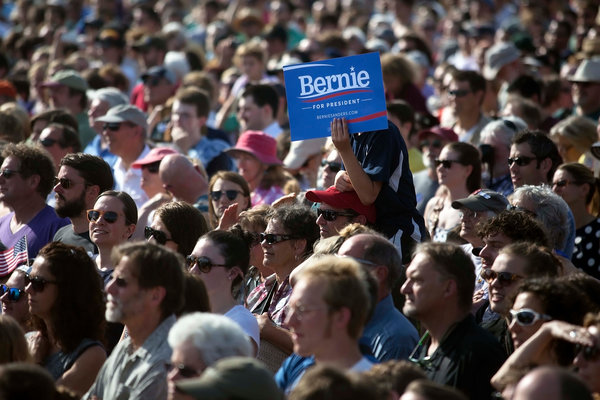
Supporters at Mr. Sanders's first campaign rally last month in Burlington, Vt. His events have drawn predominantly white crowds.

“There’s no doubt she understands coalition politics and she is burnishing her coalition,” Mr. Axelrod said of Mrs. Clinton. “You have to have a track record and some roots in these communities, and she does.”

Mr. Sanders, in a recent interview, said he believed his call for a “political revolution” to change an array of policies, such as ending tuition at public colleges, could win over black voters in the months ahead.

Indeed, when he visited New England College in Concord, N.H., last month, a few black and white undergraduates described how their student loans, ranging from $10,000 to $16,000, made them anxious about the future. Mr. Sanders responded with empathy but also with a fiery intensity that evoked his own days as a student activist, when he protested segregated campus housing at the University of Chicago and participated in the 1963 March on Washington.

Since then, though, his politics have been characterized by a focus on class-based solidarity and uplift, reflecting his style of democratic socialism. While Mr. Sanders endorsed the 1988 campaign of Mr. Jackson, who won the Vermont caucus that year, he also said at the time that he disagreed with Mr. Jackson about “whether the Democratic Party can be the real vehicle for social change,” and said a third party was necessary. (Mr. Jackson did not return messages seeking comment.)

Tad Devine, a senior adviser to the Sanders campaign, predicted that Mr. Sanders’s battles for equal rights and against income inequality would “resonate powerfully with African-American voters.”

He continued, “And we also believe that the way to win support from African-American voters in the primaries is to demonstrate that he is a viable candidate with a real chance to succeed by doing well in the early contests.”

One of those is the South Carolina primary, where Mr. Sanders’s challenge has been crystallized. The church massacre last week and the murder of a black man, Walter L. Scott, by a white police officer in April have thrust racial discrimination and gun access to the center of the campaign, in a state where blacks can represent a majority of primary voters.

Complicating matters for Mr. Sanders, the one issue on which he is not unambiguously to the left of Mrs. Clinton — gun control — is emerging as a critical litmus test. Representing a rural state with a rich hunting tradition, Mr. Sanders has a mixed record on guns. He first won a House seat in part because the incumbent Republican he defeated had supported an assault-weapons ban. (Mr. Sanders also supported the ban but opposed the Brady bill, which President Bill Clinton signed into law.)

By contrast, Mrs. Clinton has moved aggressively to emphasize her support for gun restrictions since the Charleston shootings, saying in an interview last week, “Let’s just cut to the chase: It’s guns.”

Mrs. Clinton, mindful of the biracial coalition Mr. Obama built in South Carolina in 2008 when he handed her a stinging loss, has already visited its African-American population centers twice. Mr. Sanders has yet to make his first trip.

“She’s talking about the issues we care about,” said Bakari Sellers, a former South Carolina state representative who is black and is supporting Mrs. Clinton. “Whether it’s voting rights or police reform, Hillary is attacking them head-on.”

As for Mr. Sanders, he said, “I’m not hearing Bernie Sanders’s name at the barbershops.”
 
I think those Netroots protestors were Hillary plants.
Could this be 2008 all over again?


source: Robert Reich

The main event at the Netroots Nation conference in Phoenix, Arizona last weekend was a “Presidential Town Hall” featuring one-on-one discussions between journalist and undocumented American Jose Antonio Vargas and presidential candidates Governor Martin O’Malley and Senator Bernie Sanders. It was upstaged by ‪#‎BlackLivesMatter‬ activists who demanded to be heard.

It’s impossible to overcome widening economic inequality without also dealing with the legacy of racial inequality, and impossible to overcome racial inequality without also reversing widening inequality. They are not the same but they are intimately related. Racial inequalities are baked into our political and economic system. Police brutality against black men and women, mass incarceration disproportionately of blacks and Latinos, housing discrimination that has resulted in racial apartheid across the nation, and voter suppression in the forms of gerrymandered districts, voter identification requirements, purges of names from voter registration lists, and understaffed voting stations in black neighborhoods – all reveal deep structures of discrimination that undermine economic inequality. Black lives matter.

But it would be a terrible mistake for the progressive movement to split into a “Black lives matter” movement and an “economic justice” movement. This would only play into the hands of the right. For decades Republicans have exploited the economic frustrations of the white working and middle class to drive a wedge between races, channeling those frustrations into bigotry and resentment. In short, the Republican strategy has been to divide-and-conquer. They want to prevent the majority of Americans – poor, working class, and middle-class, blacks, Latinos, and whites -- from uniting in common cause against the moneyed interests. We must not let them.

What do you think?
 
I think those Netroots protestors were Hillary plants.
Could this be 2008 all over again?


This "Plant Theory" (to embarrass her democratic opponents) only makes sense if:

(1) Hillary has plans to appear before them in some arena; and

(2) actually responds in detail to their detailed questions. No?

If so, I anxiously await their rendezvous !!!

But, under no circumstances should she be allowed to avoid them. :angry:


And, the Netrooters should then graciously give Sanders and O’Malley a re-match; and extend to the Republican candidates, the same privilege.
 
This "Plant Theory" (to embarrass her democratic opponents) only makes sense if:

(1) Hillary has plans to appear before them in some arena; and

(2) actually responds in detail to their detailed questions. No?

If so, I anxiously await their rendezvous !!!

But, under no circumstances should she be allowed to avoid them. :angry:


And, the Netrooters should then graciously give Sanders and O’Malley a re-match; and extend to the Republican candidates, the same privilege.

According to what I have seen of news clips, Hillary was invited to that event but she didn't attend.

Many in attendance were disappointed that she was a no show.
 
Myopia? Something! How did these candidates run into this buzzsaw (Netroots Nation), so utterly unprepared :confused:
I think Sanders was prepared-- he's been citing those same black youth unemployment numbers for months.

He just wasn't pandering. There's a difference.

Those protesters were WAY over the line with that "Say her name" shit. You should expect a candidate to care but you shouldn't expect them to parrot. They weren't willing to hear shit unless he said the exact buzzwords they wanted to hear.

I'm all for people demanding to be heard but you have to show some willingness to listen. In the grand scheme of things, it doesn't matter one bit if Bernie says "her name" which none of these protesters will remember in 8 years. This hashtag culture irks the shit out of me.


Just how black is Bernie Sanders?
By DEXTER THOMAS
July 19th 2015


Black Twitter was calling Democratic presidential candidate Bernie Sanders “black” on Sunday, and it’s not because of his civil rights pedigree. Well, not exactly.

To some politically minded Twitter users, the Bernie Sanders who spoke at Saturday’s Netroots Nation conference in Phoenix did not look like the civil rights rabble rouser that he has claimed to be. When protesters began chanting “say her name,” a reference to black women who have died in police custody, Sanders simply talked over the protesters. When asked to speak about recent events such as the death of Sandra Bland, a young black woman who died in a Texas jail after a traffic stop, he shifted the topic to the economy.

The next morning, Roderick Morrow, a host of the Black Guy Who Tips podcast, started a wildly funny hashtag called #BernieSoBlack.

After watching video of the conference, Morrow says, he wrote a few tweets expressing disappointment with Bernie Sanders. Soon, he was getting angry tweets from white Sanders supporters (whom he jokingly calls “Standers” – a play on Sanders’ name and “Stan,” a term for a maniacal fan).

“The Standers were angry that we were criticizing him for shutting down those women,” Morrow said in an interview. “They were telling me things like, ‘He was protesting for civil rights before you were born!’ They were saying I should just be thankful that he is here for us. It was almost like they were scolding me, saying that Bernie Sanders is blacker than me. So, I just took that to the extreme, and made a joke.”

The result was #BernieSoBlack.

Rod TBGWT @rodimusprime
Little known fact Bernie Sanders was actually the one who told John Carlos and Tommie Smith to put up black power fist in 68 #BernieSoBlack
10:45 AM - 19 Jul 2015
132 Retweets 163 favorites


Morrow posted a few more #BernieSoBlack tweets before leaving for work. By the time he looked at his phone two hours later, it was a trending topic.

The tweets are alternately funny and biting: Bernie’s so black he convinced Abraham Lincoln to free the slaves. Bernie’s so black he constantly gets pulled over by the police. Bernie’s so black he taught Jay-Z everything he knows.

Torchy Brown @MinoWarrior
#BernieSoBlack he gave Ron Karenga the idea for Kwanzaa.
4:31 PM - 19 Jul 2015
2 Retweets 1 favorite


But the conversation around the hashtag seems to be less about bashing Bernie Sanders, and more about voters' rights to push candidates.

“I don't think someone's history of advocating is something to mock,” Morrow said. “Bernie has been an ally, which I respect. But a lot of people, especially black people, feel that some of his supporters are being dismissive of any critique. Some of his fans that just don't want to hear it.”

Since #BernieSoBlack took off, some opposition has formed. Many tweeters are now using the hashtag to argue that the protesters were disrespectful, and to highlight Sanders’ past accomplishments.

Bipartisan Report @Bipartisanism
#BernieSoBlack that he was literally fighting for black rights before you were born.
12:07 PM - 19 Jul 2015
1,287 Retweets 1,228 favorites


“It’s ironic,” Morrow said of these tweets. “They don’t appreciate that we’re asking Bernie to do better.”

Morrow’s hashtag, dashed off in a few spare moments before a recording session, has had more impact than he expected. At a speech in Dallas on Sunday, mere hours after #BernieSoBlack had started, Sanders was more specific in addressing concerns about police brutality against blacks.

Soon after stepping off stage, Bernie Sanders' official account published a tweet that may have been in reference to the chants of “Say Her Name” that interrupted his speech. It read: “I will #SayHerName. Sandra Bland, Eric Garner, Freddie Gray and too many others.”

Later, the official account published another tweet. This one was identical, except without the #SayHerName hashtag. The original was deleted.

Bernie Sanders ✔@BernieSanders
Sandra Bland, Eric Garner, Freddie Gray and too many others.
3:58 PM - 19 Jul 2015
1,801 Retweets 2,173 favorites


#BernieSoBlack is still trending, and conversations about the proper way to criticize a candidate continue. Bernie Sanders – who for the record, is not actually black – seems to have heard the voice of Black Twitter, but may still be deciding how to address it.
 
What Would Malcolm X Think?
By ILYASAH SHABAZZ
FEB. 20, 2015


Of course, my father would be heartened by the youth-led movement taking place across the nation, and abroad, in response to institutional brutality. And he would appreciate the protesters’ fervor and skillful use of social media to rapidly organize, galvanize and educate. In a sense, his ability to boil down hard truths into strong statements and catchy phrases presaged our era of hashtag activism.

But he would be the first to say that slogans aren’t action.
They amount to nothing but a complaint filed against a system that does not care. In his speeches, he did not simply cry “Inequality!” — he demanded justice, and he laid out the steps necessary to achieve it.

He counseled smart action to circumvent the inevitable consequences of systemic injustice. When he spoke about “the ballot or the bullet,” America sat up and took notice as he articulated the searing reality that, if not granted the right to participate in the system, black citizens would have no recourse but to fight. The long-suppressed fury that was beginning to boil over in black communities lent credence to this warning. And when voting rights laws and practices changed, it was in no small part because of powerful white Americans’ fear of what could happen if they failed to act.

He would also critique the activists’ rhetoric itself. I imagine he would applaud the “Hands Up” gesture for its sheer dramatic effect, but also critique it as rank capitulation that ironically accommodates the very goal of police brutality — to intimidate and immobilize black citizens, forcing them into a defenseless posture if they hope to survive. He’d agree that “Black Lives Matter,” indeed — but also note that the uniformed police officers who disagree are not likely to be persuaded by a hashtag.

Above all, he would bemoan the lack of sustained, targeted activism. Yes, there are many people continuing the hard work that began after Ferguson. But far too many have moved on. Today when people speak about how we must fight racism, the “threat” feels empty. We have softened to the point of apathy, and everyone is so easily distracted from activism by pop culture and high-tech consumerism. How can we expect change when no one feels accountable to provide justice — including grand juries and district attorneys?

My father was never one to criticize without also offering a solution. First, he would challenge today’s young protesters to draw upon the nation’s rich history of activism and to appreciate better the contributions of those who have gone before them. What worked in Selma, in Chicago, in Watts — and what didn’t? As it is, today’s protesters often act like they are starting from square one. This disconnect cannot be dismissed as the hubris of youth; it is a symptom of our failure to teach this generation about black history and the way our economic and social systems actually function.

:smh::smh::smh::smh::smh:
 
If You are politically aware outside of the Congressional Caucus and Pres O you should know about alternatives. individuals are always late on the draw. The major final started two hours ago you can't jump up cram 2 days before. I'm being politically correct I know how uptight and sensitive we can be about not wanting to face the truth that many only engage when they are told too.
 
Back
Top