Are African Nations selling out to China?

younggiftedandblack

Rising Star
Platinum Member
Sir Francis Galton once outlined a daring (if by today's standards utterly offensive) new method to 'tame' and colonise what was then known as the Dark Continent. 'I should expect that the African seaboard, now sparsely occupied by lazy, palavering savages, might in a few years be tenanted by industrious, order-loving Chinese . . ."

Sir Francis Galton was ahead of his time. In the greatest movement of people the world has ever seen, China is secretly working to turn the entire continent into a new colony.

With little fanfare, a staggering 750,000 Chinese have settled in Africa over the past decade. More are on the way. The strategy has been carefully devised by officials in Beijing, where one expert has estimated that China will eventually need to send 300 million people to Africa to solve the problems of over-population and pollution.

Across Africa, the red flag of China is flying. Lucrative deals are being struck to buy its commodities - oil, platinum, gold and minerals. New embassies and air routes are opening up. The continent's new Chinese elite can be seen everywhere, shopping at their own expensive boutiques, driving Mercedes and BMW limousines, sending their children to exclusive private schools.

The pot-holed roads are cluttered with Chinese buses, taking people to markets filled with cheap Chinese goods. More than a thousand miles of new Chinese railroads are crisscrossing the continent, carrying billions of tons of illegally-logged timber, diamonds and gold.

The trains are linked to ports dotted around the coast, waiting to carry the goods back to Beijing after unloading cargoes of cheap toys made in China. Massive dams are being built, flooding nature reserves. The land is scarred with giant Chinese mines, with 'slave' labourers paid less than £1 a day to extract ore and minerals. Pristine forests are being destroyed, with China taking up to 70 per cent of all timber from Africa.

All over this great continent, the Chinese presence is swelling into a flood. Exclusive, gated compounds, serving only Chinese food, and where no blacks are allowed, are being built all over the continent. 'African cloths' sold in markets on the continent are now almost always imported, bearing the legend: 'Made in China'. China has seized a vice-like grip on a continent which officials have decided is crucial to the superpower's long-term survival.

Beijing has launched its so-called 'One China In Africa' policy because of crippling pressure on its own natural resources in a country where the population has almost trebled from 500 million to 1.3 billion in 50 years.

China is hungry - for land, food and energy. While accounting for a fifth of the world's population, its oil consumption has risen 35-fold in the past decade and Africa is now providing a third of it; imports of steel, copper and aluminium have also shot up, with Beijing devouring 80 per cent of world supplies. Fuelling its own boom at home, China is also desperate for new markets to sell goods. And Africa, with non-existent health and safety rules to protect against shoddy and dangerous goods, is the perfect destination.

The result of China's demand for raw materials and its sales of products to Africa is that turnover in trade between Africa and China has risen from £5million annually a decade ago to £6billion today. However, there is a lethal price to pay. There is a sinister aspect to this invasion. Chinese-made war planes roar through the African sky, bombing opponents. Chinese-made assault rifles and grenades are being used to fuel countless murderous civil wars, often over the materials the Chinese are desperate to buy.

Take, for example, Zimbabwe. Recently, a giant container ship from China was due to deliver its cargo of three million rounds of AK-47 ammunition, 3,000 rocket-propelled grenades and 1,500 mortars to President Robert Mugabe's regime. After an international outcry, the vessel, the An Yue Jiang, was forced to return to China, despite Beijing's insistence that the arms consignment was a 'normal commercial deal'.

Indeed, the 77-ton arms shipment would have been small beer - a fraction of China's help to Mugabe. He already has high-tech, Chinese-built helicopter gunships and fighter jets to use against his people. Ever since the U.S. and Britain imposed sanctions in 2003, Mugabe has courted the Chinese, offering mining concessions for arms and currency.

Mugabe is orchestrating his campaign of terror from a 25-bedroom, pagoda-style mansion built by the Chinese. Much of his estimated £1billion fortune is believed to have been siphoned off from Chinese 'loans'. Mugabe received £200 million last year alone from China, enabling him to buy loyalty from the army.

In another disturbing illustration of the warm relations between China and the ageing dictator, a platoon of the China People's Liberation Army has been out on the streets of Mutare, a city near the border with Mozambique, which voted against the president in the recent, disputed election.

Almost 30 years ago, Britain pulled out of Zimbabwe - as it had done already out of the rest of Africa, in the wake of Harold Macmillan's 'wind of change' speech. Today, Mugabe says: 'We have turned East, where the sun rises, and given our backs to the West, where the sun sets.'

Despite Britain's commendable colonial legacy of a network of roads, railways and schools, the British are now being shunned. According to one veteran diplomat: 'China is easier to do business with because it doesn't care about human rights in Africa - just as it doesn't care about them in its own country. All the Chinese care about is money.'

Nowhere is that more true than Sudan. Branded 'Africa's Killing Fields', the massive oil-rich East African state is in the throes of the genocide and slaughter of hundreds of thousands of black, non-Arab peasants in southern Sudan. In effect, through its supplies of arms and support, China has been accused of underwriting a humanitarian scandal. The atrocities in Sudan have been described by the U.S. as 'the worst human rights crisis in the world today'.

The Chinese - who now buy half of all Sudan's oil - have happily provided armoured vehicles, aircraft and millions of bullets and grenades in return for lucrative deals. According to Human Rights First, a leading human rights advocacy organisation, Chinese-made AK-47 assault rifles, grenade launchers and ammunition for rifles and heavy machine guns are continuing to flow into Darfur, which is dotted with giant refugee camps, each containing hundreds of thousands of people.

Between 2003 and 2006, China sold Sudan $55 million worth of small arms, flouting a United Nations weapons embargo. With new warnings that the cycle of killing is intensifying, an estimated two thirds of the non-Arab population has lost at least one member of their families in Darfur. Although two million people have been uprooted from their homes in the conflict, China has repeatedly thwarted United Nations denunciations of the Sudanese regime.

While the Sudanese slaughter has attracted worldwide condemnation, prompting Hollywood film-maker Steven Spielberg to quit as artistic director of the Beijing Olympics, few parts of Africa are now untouched by China. In Congo, more than £2billion has been 'loaned' to the government. In Angola, £3 billion has been paid in exchange for oil. In Nigeria, more than £5billion has been handed over.

In Equatorial Guinea, where the president publicly hung his predecessor from a cage suspended in a theatre before having him shot, Chinese firms are helping the dictator build an entirely new capital, full of gleaming skyscrapers and, of course, Chinese restaurants. After battling for years against the white colonial powers of Britain, France, Belgium and Germany, post-independence African leaders are happy to do business with China for a straightforward reason: cash.

With western loans linked to an insistence on democratic reforms and the need for 'transparency' in using the money (diplomatic language for rules to ensure dictators do not pocket millions), the Chinese have proved much more relaxed about what their billions are used for. Certainly, little of it reaches the continent's impoverished 800 million people. Much of it goes straight into the pockets of dictators. In Africa, corruption is a multi-billion pound industry and many experts believe that China is fuelling the cancer.

The Chinese are contemptuous of such criticism. To them, Africa is about pragmatism, not human rights. 'Business is business,' says Chinese Deputy Foreign Minister Zhou Wenzhong, adding that Beijing should not interfere in 'internal' affairs. 'We try to separate politics from business.' The Chinese do not use African labour where possible, saying black Africans are lazy and unskilled.

In Angola, the government has agreed that 70 per cent of tendered public works must go to Chinese firms, most of which do not employ Angolans. As well as enticing hundreds of thousands to settle in Africa, they have even shipped Chinese prisoners to produce the goods cheaply.

In Kenya, for example, only ten textile factories are still producing, compared with 200 factories five years ago, as China undercuts locals in the production of 'African' souvenirs. Where will it all end? As far as Beijing is concerned, it will stop only when Africa no longer has any minerals or oil to be extracted from the continent.

The people of this bewitching, beautiful continent, where humankind first emerged from the Great Rift Valley, desperately need progress. The Chinese are not here for that. They are here for plunder.

http://www.dailymail.co.uk/news/worl...Y-worried.html
 
These fools are worse than the America.

Yes, to an extent they are. They have their own section of the world. They see the negative image of us and think that it is true for the most part. We seem to instigate fear in a lot of races... Why is that?
 
The heart of sunny South London,Brixton, England, United Kingdom
My team = Chelsea...
and you?

Born & raised in Florida...

I have managed to make my way to London though.

Didn't see it all, but I can say ya'll got some real people over there. Before I went, you guys were just a comical accent to me. I've never been so wrong in my life...

Just for the record, for the board, and for all BGOL'ers: Please do not ever think that Americans are the only ones who can get gangsta... you might be in for a rude surprise...

Not that anything drastic happened to me. But I witnessed some things that made realize that sh*t is like that all over the world...

Thanks for your response CharlieDark. Though I have NO IDEA who your team is, you still get respect from me until you prove otherwise...

14damoney
 
Yes, to an extent they are. They have their own section of the world. They see the negative image of us and think that it is true for the most part. We seem to instigate fear in a lot of races... Why is that?

The answer to that question is known but unbelievable to most.
 
The answer to that question is known but unbelievable to most.

The Dynasty: I'm waiting for you to shake the atmosphere regarding what you know. Change some frequencies! You already have my respect. The most negative thing that you can get from me right now is maybe an intellectual disagreement.

At this point, you are required to respond. For the sake of human-kind, the sake of black lurkers, and because of your experience and natural willingness to share.

Help us, and stop hiding d@mmit!
 
Born & raised in Florida...

I have managed to make my way to London though.

Didn't see it all, but I can say ya'll got some real people over there. Before I went, you guys were just a comical accent to me. I've never been so wrong in my life...

Just for the record, for the board, and for all BGOL'ers: Please do not ever think that Americans are the only ones who can get gangsta... you might be in for a rude surprise...

Not that anything drastic happened to me. But I witnessed some things that made realize that sh*t is like that all over the world...

Thanks for your response CharlieDark. Though I have NO IDEA who your team is, you still get respect from me until you prove otherwise...

14damoney

No worries bruv!!
Everyone's trying their thing no matter the location same struggle
 
<font size="5"><center>Why has China bought Mugabe a mansion?</font size></center>

The Telegraph (UK)
By Christopher Booker
July 20, 2008

It may not be surprising that, as befits any mad dictator, President Mugabe is now the proud owner of a palatial £4.5 million mansion in Harare and a similarly lavish country hideaway, each fitted with the latest electronic security systems, including anti-aircraft missiles.

But why should all this have been provided for him by the People's Republic of China?

The explanation lies in a deal struck in 2005 whereby Mr Mugabe handed over to China his country's mineral rights, including the world's second largest reserves of platinum, worth £250 billion.

In return for allowing the Chinese to cart away more than half a billion pounds' worth of minerals a year, Mr Mugabe not only makes a vast personal fortune for himself and his henchmen, but is given all the arms he needs to keep his criminal regime in power, including guns, jet fighters and military vehicles. (For further details, see my colleague Richard North's EU Referendum website.)

Contrast this with our own Government's response to Mugabe's tyranny. Since Zimbabwe is included in the 28 areas of "common foreign policy" we have ceded to the EU, we can do nothing except in conjunction with our EU colleagues.

On Monday we saw the humiliating spectacle of Gordon Brown pleading with the EU's President, Nicolas Sarkozy, to add 36 more names to the list of Zimbabweans on whom the EU has imposed pathetically ineffectual "personal sanctions".

Otherwise, the EU's only contribution is to give Zimbabwe €25 million a year in aid, which Mr Mugabe welcomes as a way to give food to his supporters while the rest of his people starve.

All this provides a remarkable parallel to what is happening elsewhere in Africa:

  • In Sudan the tyrannical government is given full support by China in return for a monopoly on its large reserves of oil. Meanwhile, EU politicians wring their hands over the tragedy unfolding in Darfur, while a pitiful EU military force in Chad notably fails to protect a million helpless refugees from the genocide waged on them by China's friends in Khartoum.

  • In the Democratic Republic of the Congo, as we learned from an excellent report in The Daily Telegraph last week, China last January signed a "minerals for infrastructure" deal, worth £2.25 billion, under which it bought the rights to some of the world's richest copper and cobalt reserves, in return for building roads, railways, hospitals, dams and airports.

This is the country where, five years ago, the EU proudly sent its first military force bearing the ring of stars insignia - to achieve precisely nothing.

We now learn that the Congolese government had first proposed such a minerals deal to the EU but, according to the country's deputy minister for mines, the EU replied that it "did not have the muscle that was needed".

All over Africa we see a similar story. The ruthless but canny Chinese dictatorship props up equally ruthless and corrupt governments, as in Angola, in return for that continent's fabulous mineral reserves. Britain, which once ruled much of Africa, has handed over its policy-making to the EU, which does little but make sanctimonious and irrelevant gestures.

Yet this is the continent which, in 2005, both Tony Blair and Gordon Brown proclaimed was "at the top" of their international agenda. It was in the same year that, as the EU's acting president, Tony Blair flew to Beijing to sign an agreement making the EU and China "strategic partners". It is only too obvious which "partner's" strategy is proving the more successful.

http://www.telegraph.co.uk/opinion/main.jhtml?xml=/opinion/2008/07/20/do2007.xml


__________________________________

The article above is noteworthy for both the Chinese's influence in Africa AND the position that the British apparently finds themselves in its former colony.

QueEx

`
 
How China's taking over Africa; Why the West should Be Very worried

<font size="5"><center>How China's taking over Africa,
and why the West should be VERY worried </font size></center>


The Evening Standard
July 18, 2008

On June 5, 1873, in a letter to The Times, Sir Francis Galton, the cousin of Charles Darwin and a distinguished African explorer in his own right, outlined a daring (if by today's standards utterly offensive) new method to 'tame' and colonise what was then known as the Dark Continent.

'My proposal is to make the encouragement of Chinese settlements of Africa a part of our national policy, in the belief that the Chinese immigrants would not only maintain their position, but that they would multiply and their descendants supplant the inferior Negro race,' wrote Galton.

'I should expect that the African seaboard, now sparsely occupied by lazy, palavering savages, might in a few years be tenanted by industrious, order-loving Chinese, living either as a semidetached dependency of China, or else in perfect freedom under their own law.'


<center>
article-0-01FD664F00000578-148_468x286.jpg

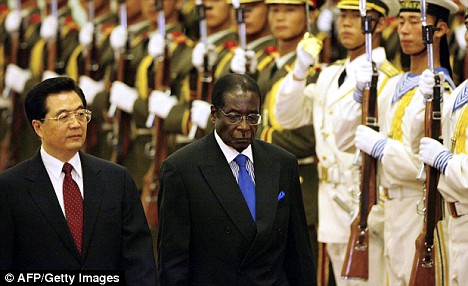
Close relations: Chinese President Hu Jintao accompanies Zimbabwe
President Robert Mugabe to a ceremony in the Great Hall of the People in Beijing
</center>


Despite an outcry in Parliament and heated debate in the august salons of the Royal Geographic Society, Galton insisted that 'the history of the world tells the tale of the continual displacement of populations, each by a worthier successor, and humanity gains thereby'.

A controversial figure, Galton was also the pioneer of eugenics, the theory that was used by Hitler to try to fulfil his mad dreams of a German Master Race.

Eventually, Galton's grand resettlement plans fizzled out because there were much more exciting things going on in Africa.

But that was more than 100 years ago, and with legendary explorers such as Livingstone, Speke and Burton still battling to find the source of the Nile - and new discoveries of exotic species of birds and animals featuring regularly on newspaper front pages - vast swathes of the continent had not even been 'discovered'.

Yet Sir Francis Galton, it now appears, was ahead of his time. His vision is coming true - if not in the way he imagined. An astonishing invasion of Africa is now under way.

In the greatest movement of people the world has ever seen, China is secretly working to turn the entire continent into a new colony.

Reminiscent of the West's imperial push in the 18th and 19th centuries - but on a much more dramatic, determined scale - China's rulers believe Africa can become a 'satellite' state, solving its own problems of over-population and shortage of natural resources at a stroke.

With little fanfare, a staggering 750,000 Chinese have settled in Africa over the past decade. More are on the way.

The strategy has been carefully devised by officials in Beijing, where one expert has estimated that China will eventually need to send 300 million people to Africa to solve the problems of over-population and pollution.

The plans appear on track. Across Africa, the red flag of China is flying. Lucrative deals are being struck to buy its commodities - oil, platinum, gold and minerals. New embassies and air routes are opening up. The continent's new Chinese elite can be seen everywhere, shopping at their own expensive boutiques, driving Mercedes and BMW limousines, sending their children to exclusive private schools.

The pot-holed roads are cluttered with Chinese buses, taking people to markets filled with cheap Chinese goods. More than a thousand miles of new Chinese railroads are crisscrossing the continent, carrying billions of tons of illegally-logged timber, diamonds and gold.


<center>
article-0-01EF338F00000578-792_468x286.jpg
</center>


The trains are linked to ports dotted around the coast, waiting to carry the goods back to Beijing after unloading cargoes of cheap toys made in China.

Confucius Institutes (state-funded Chinese 'cultural centres') have sprung up throughout Africa, as far afield as the tiny land-locked countries of Burundi and Rwanda, teaching baffled local people how to do business in Mandarin and Cantonese.

Massive dams are being built, flooding nature reserves. The land is scarred with giant Chinese mines, with 'slave' labourers paid less than £1 a day to extract ore and minerals.

Pristine forests are being destroyed, with China taking up to 70 per cent of all timber from Africa.

All over this great continent, the Chinese presence is swelling into a flood. Angola has its own 'Chinatown', as do great African cities such as Dar es Salaam and Nairobi.

Exclusive, gated compounds, serving only Chinese food, and where no blacks are allowed, are being built all over the continent. 'African cloths' sold in markets on the continent are now almost always imported, bearing the legend: 'Made in China'.

From Nigeria in the north, to Equatorial Guinea, Gabon and Angola in the west, across Chad and Sudan in the east, and south through Zambia, Zimbabwe and Mozambique, China has seized a vice-like grip on a continent which officials have decided is crucial to the superpower's long-term survival.

'The Chinese are all over the place,' says Trevor Ncube, a prominent African businessman with publishing interests around the continent. 'If the British were our masters yesterday, the Chinese have taken their place.'

Likened to one race deciding to adopt a new home on another planet, Beijing has launched its so-called 'One China In Africa' policy because of crippling pressure on its own natural resources in a country where the population has almost trebled from 500 million to 1.3 billion in 50 years.

China is hungry - for land, food and energy. While accounting for a fifth of the world's population, its oil consumption has risen 35-fold in the past decade and Africa is now providing a third of it; imports of steel, copper and aluminium have also shot up, with Beijing devouring 80 per cent of world supplies.


Fueling Its Own Boom

Fuelling its own boom at home, China is also desperate for new markets to sell goods. And Africa, with non-existent health and safety rules to protect against shoddy and dangerous goods, is the perfect destination.

The result of China's demand for raw materials and its sales of products to Africa is that turnover in trade between Africa and China has risen from £5million annually a decade ago to £6billion today.

However, there is a lethal price to pay. There is a sinister aspect to this invasion. Chinese-made war planes roar through the African sky, bombing opponents. Chinese-made assault rifles and grenades are being used to fuel countless murderous civil wars, often over the materials the Chinese are desperate to buy.

Take, for example, Zimbabwe. Recently, a giant container ship from China was due to deliver its cargo of three million rounds of AK-47 ammunition, 3,000 rocket-propelled grenades and 1,500 mortars to President Robert Mugabe's regime.

After an international outcry, the vessel, the An Yue Jiang, was forced to return to China, despite Beijing's insistence that the arms consignment was a 'normal commercial deal'.

Indeed, the 77-ton arms shipment would have been small beer - a fraction of China's help to Mugabe. He already has high-tech, Chinese-built helicopter gunships and fighter jets to use against his people.

Ever since the U.S. and Britain imposed sanctions in 2003, Mugabe has courted the Chinese, offering mining concessions for arms and currency.

While flying regularly to Beijing as a high-ranking guest, the 84-year-old dictator rants at 'small dots' such as Britain and America.

He can afford to. Mugabe is orchestrating his campaign of terror from a 25-bedroom, pagoda-style mansion built by the Chinese. Much of his estimated £1billion fortune is believed to have been siphoned off from Chinese 'loans'.

The imposing grey building of ZANU-PF, his ruling party, was paid for and built by the Chinese. Mugabe received £200 million last year alone from China, enabling him to buy loyalty from the army.

In another disturbing illustration of the warm relations between China and the ageing dictator, a platoon of the China People's Liberation Army has been out on the streets of Mutare, a city near the border with Mozambique, which voted against the president in the recent, disputed election.

Almost 30 years ago, Britain pulled out of Zimbabwe - as it had done already out of the rest of Africa, in the wake of Harold Macmillan's 'wind of change' speech. Today, Mugabe says: 'We have turned East, where the sun rises, and given our backs to the West, where the sun sets.'


Despite Britain's commendable colonial legacy of a network of roads, railways and schools, the British are now being shunned.

According to one veteran diplomat: 'China is easier to do business with because it doesn't care about human rights in Africa - just as it doesn't care about them in its own country. All the Chinese care about is money.'

Nowhere is that more true than Sudan. Branded 'Africa's Killing Fields', the massive oil-rich East African state is in the throes of the genocide and slaughter of hundreds of thousands of black, non-Arab peasants in southern Sudan.

In effect, through its supplies of arms and support, China has been accused of underwriting a humanitarian scandal. The atrocities in Sudan have been described by the U.S. as 'the worst human rights crisis in the world today'.


<center>
article-0-01F90D0B00000578-560_468x286.jpg

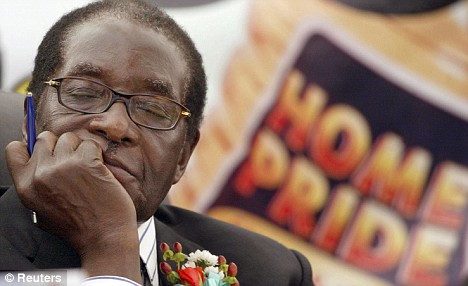
Mugabe has received hundreds of millions of pounds from Chinese sources
</center>


The government in Khartoum has helped the feared Janjaweed militia to rape, murder and burn to death more than 350,000 people.

The Chinese - who now buy half of all Sudan's oil - have happily provided armoured vehicles, aircraft and millions of bullets and grenades in return for lucrative deals. Indeed, an estimated £1billion of Chinese cash has been spent on weapons.

According to Human Rights First, a leading human rights advocacy organisation, Chinese-made AK-47 assault rifles, grenade launchers and ammunition for rifles and heavy machine guns are continuing to flow into Darfur, which is dotted with giant refugee camps, each containing hundreds of thousands of people.

Between 2003 and 2006, China sold Sudan $55 million worth of small arms, flouting a United Nations weapons embargo.

With new warnings that the cycle of killing is intensifying, an estimated two thirds of the non-Arab population has lost at least one member of their families in Darfur.

Although two million people have been uprooted from their homes in the conflict, China has repeatedly thwarted United Nations denunciations of the Sudanese regime.

While the Sudanese slaughter has attracted worldwide condemnation, prompting Hollywood film-maker Steven Spielberg to quit as artistic director of the Beijing Olympics, few parts of Africa are now untouched by China.

In Congo, more than £2billion has been 'loaned' to the government. In Angola, £3 billion has been paid in exchange for oil. In Nigeria, more than £5billion has been handed over.

In Equatorial Guinea, where the president publicly hung his predecessor from a cage suspended in a theatre before having him shot, Chinese firms are helping the dictator build an entirely new capital, full of gleaming skyscrapers and, of course, Chinese restaurants.

After battling for years against the white colonial powers of Britain, France, Belgium and Germany, post-independence African leaders are happy to do business with China for a straightforward reason: cash.

With western loans linked to an insistence on democratic reforms and the need for 'transparency' in using the money (diplomatic language for rules to ensure dictators do not pocket millions), the Chinese have proved much more relaxed about what their billions are used for.

Certainly, little of it reaches the continent's impoverished 800 million people. Much of it goes straight into the pockets of dictators. In Africa, corruption is a multi-billion pound industry and many experts believe that China is fuelling the cancer.


The Chinese are contemptuous of such criticism. To them, Africa is about pragmatism, not human rights. 'Business is business,' says Chinese Deputy Foreign Minister Zhou Wenzhong, adding that Beijing should not interfere in 'internal' affairs. 'We try to separate politics from business.'

While the bounty has, not surprisingly, been welcomed by African dictators, the people of Africa are less impressed. At a market in Zimbabwe recently, where Chinese goods were on sale at nearly every stall, one woman told me she would not waste her money on 'Zing-Zong' products.

'They go Zing when they work, and then they quickly go Zong and break,' she said. 'They are a waste of money. But there's nothing else. China is the only country that will do business with us.'

There have also been riots in Zambia, Angola and Congo over the flood of Chinese immigrant workers. The Chinese do not use African labour where possible, saying black Africans are lazy and unskilled.

In Angola, the government has agreed that 70 per cent of tendered public works must go to Chinese firms, most of which do not employ Angolans.

As well as enticing hundreds of thousands to settle in Africa, they have even shipped Chinese prisoners to produce the goods cheaply.

In Kenya, for example, only ten textile factories are still producing, compared with 200 factories five years ago, as China undercuts locals in the production of 'African' souvenirs.

Where will it all end? As far as Beijing is concerned, it will stop only when Africa no longer has any minerals or oil to be extracted from the continent.

A century after Sir Francis Galton outlined his vision for Africa, the Chinese are here to stay. More will come.

The people of this bewitching, beautiful continent, where humankind first emerged from the Great Rift Valley, desperately need progress. The Chinese are not here for that.

They are here for plunder. After centuries of pain and war, Africa deserves better.


http://www.thisislondon.co.uk/news/...hy+the+West+should+be+VERY+worried/article.do
 
Re: How China's taking over Africa; Why the West should Be Very worried

China is trying to Sustain it's population. I was watching a documentary on HBO about china and it's "1 child policy" and realised that they are in Trouble thats why they've become so bold in acquiring Resources and relocating people to Africa. It's just a matter of time before the whole thing blows up in their face , i can see Africans telling them to go back to their Land in the coming years. especially when they are killing local businesses..

The original intent of the one-child policy was economic, to reduce the demand of natural resources, maintaining a steady labor rate, reducing unemployment caused from surplus labour, and reducing the rate of exploitation
 
Last edited:
Perhaps the question should not be why are African Nations selling out to China but why is China willing to do business with corrupt brutal regimes?

The reason, according to me, is that China feels that it needs to industrialize on the cheap as much as it can because is still behind the US, EU, JAPAN, and almost tied with Germany, and has nearly 3 to 4 times the population of those countries/regions. This why it looks for resources/energy on the cheap and feels that it can do the same thing that Europeans did to African in building their industrial strenght off the cheap from Africa and other colonies during the late 19th and early 20th century.

http://en.wikipedia.org/wiki/List_of_countries_by_GDP_(nominal)
 
Re: How China's taking over Africa; Why the West should Be Very worried

^ Its population is one of the main reasons it feels that it must be able to get resources on the cheap.

With a huge population growth and increasing middle class in China, the pressure is higher now to show the people that they need & want to keep the current political system because it provides it benefits them.

China has always been scared of internal protests - its the reason they are so hostile to even the smallest protests because they fear that it may grow to become bigger and feel the need to squash them early with great force.
 
Re: How China's taking over Africa; Why the West should Be Very worried

Actually, I thought your earlier comments (before the edit) were more on point. You stated (paraphrasing) that because of its needs, China seems to be taking a page out of the European exploitation book -- that is, because it has so many people it needs resources on the cheap and it looks to Africa, like the European colonialist, to exploit resources, on the cheap.

I think there is lots of truth to your 'exploitation on the cheap' theory. What troubles me is how many who posts on this board seem to overlook and give a pass to China for doing shit that they claim others in the West 'would probably do' if given the opportunity. Granted, the Europeans African exploitation record is, well, atrocious. But I can't quite understand why people would turn their heads at the real and present Chinese fuck job to point fingers at history. History should never be forgotten; but if its lessons cannot be applied to understand and deal with the present, maybe some people have missed the history lesson.

QueEx
 
Re: How China's taking over Africa; Why the West should Be Very worried

Actually, I thought your earlier comments (before the edit) were more on point. You stated (paraphrasing) that because of its needs, China seems to be taking a page out of the European exploitation book -- that is, because it has so many people it needs resources on the cheap and it looks to Africa, like the European colonialist, to exploit resources, on the cheap.

I think there is lots of truth to your 'exploitation on the cheap' theory. What troubles me is how many who posts on this board seem to overlook and give a pass to China for doing shit that they claim others in the West 'would probably do' if given the opportunity. Granted, the Europeans African exploitation record is, well, atrocious. But I can't quite understand why people would turn their heads at the real and present Chinese fuck job to point fingers at history. History should never be forgotten; but if its lessons cannot be applied to understand and deal with the present, maybe some people have missed the history lesson.

QueEx

You mean this earlier post:

Perhaps the question should not be why are African Nations selling out to China but why is China willing to do business with corrupt brutal regimes?

The reason, according to me, is that China feels that it needs to industrialize on the cheap as much as it can because is still behind the US, EU, JAPAN, and almost tied with Germany, and has nearly 3 to 4 times the population of those countries/regions. This why it looks for resources/energy on the cheap and feels that it can do the same thing that Europeans did to African in building their industrial strenght off the cheap from Africa and other colonies during the late 19th and early 20th century.

http://en.wikipedia.org/wiki/List_of_countries_by_GDP_(nominal)

I don't think there is one factor to explain for their behavior - multiple things are happening in China.

The 'exploitation on the cheap' one might be more persuasive.

I agree that the international community being silent about it, including African nations, is unfortunate. They don't realize that they are true losers - both economically and especially in terms of political progress.

 
Re: How China's taking over Africa; Why the West should Be Very worried

West worried?
I think Africa should be worried!!!
 
Perhaps the question should not be why are African Nations selling out to China but why is China willing to do business with corrupt brutal regimes?

The reason, according to me, is that China feels that it needs to industrialize on the cheap as much as it can because is still behind the US, EU, JAPAN, and almost tied with Germany, and has nearly 3 to 4 times the population of those countries/regions. This why it looks for resources/energy on the cheap and feels that it can do the same thing that Europeans did to African in building their industrial strenght off the cheap from Africa and other colonies during the late 19th and early 20th century.

http://en.wikipedia.org/wiki/List_of_countries_by_GDP_(nominal)

heres a simpler answer. China is a brutal regime itself. They are willing to work with anyone no questions asked. They want whatever it is that they want regardless of whats going on in the host countries. You really cant expect the chinese to care about the people in other countries when their government treats its own citizens as "property". China much like the former USSR isnt benevolent nor does it pretend to be.

The only way to stop other countries from getting anything they want out of these african countries will be for these nations to get together and put their foot down. Until this happens dont expect anything to change.
 
wow...this was a very informative read....I had no idea...especially about them buying a mansion for Mugabe :smh:

emperialism and corruption :smh:

:eek: 70% of contracts having to go to Chinese firms in Angolo...wth...horrible

what can the people of the African countries do to fight this? I mean, I am a very optimistic person but I am also a realist...this would be a very hard battle to fight :smh:
 
Re: How China's taking over Africa; Why the West should Be Very worried

<font size="5"><center>
China has a Congo copper headache</font size></center>


Asia Times
By Peter Lee
March 11, 2010


An agreement between the Democratic Republic of Congo (DRC) and China in 2008 to swap 10 million tonnes of copper ore for US$9 billion worth of mine and civic infrastructure looked like a genuine win-win.

But ever since the International Monetary Fund (IMF) demanded renegotiation of the deal in May 2009, China and the DRC have been on a roller-coaster ride of risk. Today, Beijing anxiously eyes a growing list of major dysfunctional problems - and a $100 million adverse judgment in a Hong Kong court - that could derail the "deal of the century".

The deal, as originally conceived, cannily addressed three major issues.

The first was China's desire to make a big resource play and secure a source of copper and cobalt in Africa.

The second was DRC President Joseph Kabila's need to demonstrate progress on the reconstruction of his country, shattered by two decades of war that claimed as many as five million civilian lives, to increasingly dissatisfied voters as the 2010 presidential elections approached.

The third was onerous indebtedness, which forced the DRC to concentrate on the IMF's priorities of debt repayment and fiscal and financial reform instead of its own desperate need for social and infrastructure spending.


The Chinese deal was, in its essence, barter. The state-owned Export-Import Bank of China (China Eximbank) would fund the opening of a copper mine in the DRC's Katanga province for $3 billion and underwrite $6 billion of infrastructure projects, paid in two tranches. The bank would be repaid using profits of Sicomines, a joint venture between the DRC and China that would receive the rights to extract 10 million tonnes of copper and 600,000 tonnes of cobalt reserves from the Katanga mine.

Undoubtedly, the deal was a potential bonanza for China. In addition, Chinese companies might well have hoped to take advantage of the DRC government by manipulating the contracting process to provide the capacity-challenged and corruption-prone nation with overpriced infrastructure.

An expert on the DRC's developmental challenges told Asia Times Online he was pessimistic about what might be delivered. "I'm not sure what to expect, beyond a bit of new pavement on some old roads. I 'trust' a corrupt, but efficient government like Angola to squeeze value out of Chinese and Western companies. Not the DRC."

Nevertheless, for China as well the deal represented a remarkable leap of faith. At the time when the DRC was a financial, political and economic basket case, China agreed to put $6 billion into the country up front in the first four years before the mine - which would enter into production at 2014 at the earliest - had produced a pound of copper.

To its discredit, the West's response to news of the agreement was anger compounded by fear and jealousy. Kabila conveyed his resentment of this response in an interview with the New York Times: [1]

No sooner had the agreement been praised in Congo as a desperately needed lifeline than Congo's Western allies started griping that the Chinese got a sweetheart deal and began pressing Mr Kabila to revise the terms.

"What revolted me was the fact that there was resistance to this agreement and there was no counterproposal," Mr Kabila said.​

The West expressed its displeasure in a concrete way through the most effective avenue available to it - the IMF.

The IMF dominates the DRC's international economic activity through its administration of a debt workout process for so-called HIPC or "Highly Indebted Poor Countries".

The HIPC workout has been criticized as a coercive and self-serving exercise designed primarily to protect the interests of Western sovereign creditors who over-lent to developing countries.

To prevent a wave of national defaults, and avoid the need for creditors to immediately write off foreign debt that impoverished borrowers are unable to service, the IMF interposes itself to set fiscal and structural reform obligations in return for bridge financing and the employment of its good offices to effect eventual cancelation of debts by the Paris Club of the largest Western holders of bad national debt.

Somewhat absurdly, the DRC, even in the depths of the global recession in 2009, was making more than $170 million in interest payments to stay in the good graces of the IMF.

This self-sacrifice is necessary so that the IMF will eventually certify to the Paris Club creditors that their $6 billion share of the DRC's $11 billion foreign debt is worthy of being written off. The debt was actually incurred by the kleptocratic predecessor regime of Mobuto Sesi Seko, who fled the country in 1997 when it was still called Zaire; he died the same year.

It would appear that the IMF relishes the leverage it holds over the DRC by virtue of its control of the country's financial lifeline to the outside world, and resented the idea that the DRC could, through an ore-for-infrastructure swap, pursue its developmental goals in disregard of the priorities of the IMF and its Western backers.

In Le Monde diplomatique, journalist Colette Braeckman observed that "the institution headed by Mr Dominique Strauss-Kahn [the IMF] appears not to appreciate barter". [2]

She quoted Wu Zexian, the Chinese ambassador to the DRC, who dismissed the IMF's concerns about increased indebtedness:
"We have asked only one guarantee: that the state, where existing fields would not keep commitments, would allow us to undertake further exploration. We explained it in perfect French. The risks would be taken by China Eximbank, and alone ... "​
Nevertheless, the IMF declared that the China deal increased the DRC's potential foreign debt exposure to an unacceptable level and demanded that it be reduced in size. The IMF also made it clear that without a reduction in the deal it would not provide the necessary endorsements to the "Paris Club" that were needed to write off the DRC's debt.

After a brief show of defiance, the DRC crumbled, agreeing to defer the second $3 billion infrastructure tranche.

In this context, it is interesting to note that the reported scope of the reserves ceded to China under the deal is apparently unchanged: it is still 10 million tonnes of copper and 600,000 tonnes of cobalt. It could be argued that the Chinese obligations have been reduced by 33%, and the infrastructure benefits to the Congo reduced by 50%, while China still gets access to mineral reserves worth over $50 billion - not exactly a triumph of negotiating by the IMF on behalf of the DRC, if this is the actual state of play of the revised agreement.

The IMF's judgment in opposing the China deal in its original scope is open to question.

If the Congo was poised for free-market takeoff, the China deal could be criticized for crowding out development of the DRC's copper and cobalt reserves by eager private companies ready to risk their capital in a free market environment.

But this was manifestly not the case.

As the DRC's point man for mineral negotiations, Victor Kasongo, put it [3]:

"If China wants to dominate the world, it's not our business to stop them," Kasongo continues. "Who are we to close the door to them when we don't have water or electricity? If China doesn't come [to Congo], we're in big sh*t."​
It was widely believed that the IMF was simply taking sides with the West in the geopolitical tussle with China in Africa. Ghana Business News reported [4]:

The IMF's opposition to the deal represents an attempt by the West to counter China's investments in Africa, according to Gregory Mthembu-Salter of the South African Institute of International Affairs. "It's a confrontation between the Western donors and China in Congo," he said in a June 2 interview. "The fall guy in this will be the Congolese."​
In some quarters there were also suspicions that the IMF's campaign against the China deal was part of an effort to coerce the DRC into abandoning an initiative to which the West was violently opposed: the renegotiation of resource contracts concluded during the chaotic transitional period before the first DRC presidential election in 2006.

The most important contract at issue was for the immense copper mine at Tenke Fungurume, with reserves roughly twice the size of those ceded to the Chinese project.

During negotiations with the transitional regime in 2005, Western owners achieved enormous reductions in the entry fees and shares they had to set aside for the local partner under the original agreement concluded in 1996.

In 2005, the DRC negotiators on the Tenke Fungurume project blithely agreed to reduce the fee from $250 million to $50 million (which was an additional payment to $50 million that a predecessor company paid in 1997), and reduce their country's share from 45% to 17.5%. The reduction in share by the DRC represented the surrender of revenues from 5 million tonnes of copper - worth at least $30 billion - over the life of the mine.

By contrast, the 2008 Chinese deal promised a signing bonus of $350 million and a 32% share going to the DRC side, which included the parastatal mining company Gecamines and a somewhat mysterious local partner.

The appearance of impropriety was, if anything, exacerbated by the participation of the US government in the Tenke Fungurume talks.

The World Bank had mandated a moratorium on new mineral contract negotiations pending a legal review of existing contracts and Tenke Fungurume was apparently flagged as problematic.

The US government apparently ignored the ban. Indeed, it looks like the US government helped push through a renegotiated deal with the transitional regime in order to obtain more favorable terms, and a more solid legal footing than the project, as a relic of the previous dictatorship, originally possessed.

At the DRC's request, the Carter Center reviewed the 2005 minerals contract mess and painted a dispiriting picture of greed, opportunism, and apparent self-dealing at the expense of one of the poorest countries on earth: [5]

Nevertheless, according to information from Congolese and international sources, the US Embassy lobbied for the DRC government to sign the agreement with Phelps Dodge, the US mining company.

There are several reports that the embassy's political officer and temporary Charge d'Affairs was personally engaged in urging the President's office to sign. At the very least, there was no indication at any time that the US was concerned with the request for a moratorium. In fact, the ICG's [International Crisis Group's] July 2007 report notes that US officials attended a signing party hosted by Phelps Dodge upon conclusion of its contract, demonstrating unambiguous disregard for the moratorium.​
There's more:

The same official that is said to have actively lobbied for Phelps Dodge retired from the State Department in 2006. In September of that same year, she became "Vice-President for Government Relations, Africa" for Phelps Dodge, whose only major African interest is Tenke Fungurume. This official's important role at the US embassy and the timing of the move have fueled suspicion on the part of DRC government officials and others regarding the interests of Western governments.​
Despite its dismal provenance and calls to delay commitments until the pending contract reviews were completed, the Tenke Fungurume deal received a further seal of approval in the form of sizable investments from Western public financial institutions - $250 million from the US Overseas Private Investment Corporation, 100 million euros (US$136 million at today's rate) from the European Investment Bank and another $100 million from the African Development Bank.

Quixotically or determinedly, at the same time the Kabila government pursued the China agreement it decided to renegotiate the Tenke Fungurume contract and, in the process, pick a fight with the US and European Union countries that were backing the project.

There was a rush of anxiety in the West about "resource nationalism", coupled with concern that, if the DRC had ready recourse to Chinese support, it might become emboldened in its dealings with Tenke Fungurume - perhaps even threatening to modify the concession and re-allocate some of its reserves near the Sicomines site for China to develop.

There was also a silence on the apparent inequities of the Tenke Fungurume contract that contrasted with the widely and efficiently

disseminated expressions of concern by the IMF about the Chinese deal.
Intense US pressure and IMF carrots and sticks were apparently enough to get the DRC to back down on Tenke Fungurume and allow the West's flagship resource project to sail off unscathed - perhaps at the cost of the West's image as an honest broker and true friend of the DRC.

On February 15, 2010, the DRC e-mailed Bloomberg [6]:

Freeport's Congolese unit, Tenke Fungurume Mining Sarl, "has all the evidence" that its contract is legal, the National Assembly's Economic and Finance Commission said in the report e-mailed to Bloomberg News from the capital, Kinshasa. It recommends that the government allow Tenke to expand its mine in order to increase its payments of royalties and taxes. Though the renegotiation was legal, the contract was "badly negotiated" by the government, the commission said.​
Tenke Fungurume problem solved!

So apparently, is the Victor Kasongo problem.

In a move seemingly designed to curry favor simultaneously with Western mining interests and the IMF, Kasongo, the mining industry hard-charger characterized by Richard Behar [7] as "By all accounts ... a sharp and honest reformer" is gone.

Also gone is the office he held, all in the name of "efficiency", as Businessweek reported on February 20 [8]:

Victor Kasongo, the vice minister of mines, had his position cut.

The move reduces the number of ministerial positions in the government to 43 from 54 "for more efficiency," and aims to limit expenditures as Congo tries to qualify for a World Bank and International Monetary Fund debt relief program, a statement accompanying the order said. Kasongo was the public face of the mines' ministry and the man behind the recent review of all of Congo's mining contracts that resulted in the cancellation of a $553 million copper and cobalt project with Canada's First Quantum Minerals.​
China's problems are, on the other hand, definitely not solved.

The IMF's obsession with working out debt owed to the Paris Club creditors has done nothing to address the disposition of $5 billion of DRC debt held by non-Paris Club entities including, to Beijing's horror, vulture funds, the private investment firms and hedge funds that buy the liabilities of poor countries on the brink of debt relief.

DRC's particular curse is FG Hemisphere, a fund that, for an undisclosed sum, bought up $30 million worth of bad debt contracted by the Mobuto Sesi Seko regime in 1980 with Tito's Yugoslavia on a failed hydropower scheme. Through litigation, FG Hemisphere managed to grow this debt into an award of $100 million.

By virtue of the Hong Kong presence of a wholly owned subsidiary of China Railways, one of the Chinese partners in Sicomines, FG Hemisphere obtained a favorable judgment in Hong Kong blocking China from paying - or the DRC from receiving - $100 in million signing fees for the copper project until FG's award had been paid.

As usual, in the Western press there is considerably more handwringing about the damage that the financial derivatives markets would suffer if the activities of vulture funds were curtailed, than there is concern over the economic and developmental travails of the DRC if the payment is delayed.

And there is no acknowledgement of the IMF's questionable judgment in fixating on $6 billion the DRC owes the Paris Club creditors while neglecting to address the problem of its exposure to $5 billion in liabilities in the hands of non-Paris Club creditors and vulture funds.

As it deals with the hostility of the West and the IMF and the vagaries of international financial litigation, China also has to deal with the risks in the DRC's volatile domestic politics.

Gecamines, China's local partner in the Sicomines project, is slowly disintegrating into a morass of corruption, dysfunction and reorganization. A DRC parliamentary commission has alleged that $23 million of the first $50 million installment of the Chinese signing bonus has somehow gone missing.

Gecamines' chief executive officer Paul Fortin, who supported the China deal over the market-based refinance plan advocated by the World Bank for the DRC minerals sector, resigned in November 2009 after it became apparent that his control was limited and he had no knowledge of the tens of thousands of tonnes of copper allegedly diverted from his factories for private profit. Fortin was replaced by an executive with close ties to President Kabila's inner circle, who embarked on a major reorganization to establish presidential control over the wayward enterprise.

With the departure of Kasongo and Fortin, the two most credible and capable professional advocates of the China deal have left the scene.

Going forward, the crucial China dossier is now in the hands of Kabila and China's fortunes are closely linked to Kabila, his "Cinq chantier" or "Five Pillar" civil infrastructure initiatives and advisors that helps him navigate the deadly waters of DRC politics.

When compared with the West's record of self-serving and destructive interference in the DRC's affairs - and the immense corruption it engendered - China still enjoys a more favorable reputation in the DRC.

As the former coordinator of the United Nations Group of Experts on the DRC, Jason Stearns, told Asia Times Online:

There are, of course, Congolese skeptics of the Chinese engagement, but others point out the advantages of bartering mines for infrastructure. "You can't put a highway in your Swiss bank account," goes a popular saying in the Congo.​
Nevertheless, as China looms larger in African economic life - and contributes its share of bad behavior and economic disruption, it becomes a big political target.

Hostility to China and its cosy relationship with authoritarian rulers is becoming a staple of opposition parties and open-society organizations in Sub-Saharan Africa. The DRC is no exception.

A prominent open-society activist wasn't loath to invoke the monstrous colonial reign of King Leopold II of Belgium over the Congo in characterizing the Chinese deal. As the BBC tells us [9]:

"Our worry is that it is almost totally opaque," says Katanga-based lawyer Georges Kapiamba, who eventually obtained a copy [of the contract].

"It permits a group of Chinese to get more than the Congolese - it's not a win-win contract."

Kapiamba says the deal amounts to a licensed plundering of DR Congo's resources similar to that carried out under Leopold.
Kibale's opposition is also ready to play the China card [10]:

Jean-Lucien Mbusa, speaking on behalf of the main opposition, the Movement for the Liberation of the Congo (MLC), said that the deal "forces us to sell off our national heritage to the detriment of several generations".​
Most unnerving, a demand to renegotiate the China contract also appeared in a manifesto by Laurence Nkunda, the ferocious Tutsi warlord who rampaged through eastern DRC last year and at one time seemed to threaten the rickety foundations of Kabila's government.

In February 2010, China received a jolt of unfavorable publicity courtesy of Kabila's ruling party as a parliamentary commission reported on Gecamines' $23 million problem of the missing signing fee.

Although there was no implication made that China was at fault, the story was combined with circumstantial details of less-than-stellar Chinese performance on unrelated cellular network and agricultural projects in a critical and widely circulated report [11] by the newsletter Africa-Asia Confidential.

To demonstrate he is not in Beijing's pocket, Kabila let it be known that his office was ready to crack down on potential Chinese profiteering:

The Congolese shareholders say that they are getting tougher in negotiations. Before, they had to "close their eyes" to certain details, such as feasibility studies carried out by the same company that would later implement the project, a practice that led to overestimating of costs. Since November 2009, the quality control assignments of all infrastructure projects within the Sicomines framework have been subject to international tendering.​
As the Congolese say, things will be getting tougher in 2010 as the DRC moves towards its presidential election and the international jockeying for influence and advantage in Kinshasa intensifies. China can only hope it can continue to thread the needle and make it to 2014 - the year copper production starts - with its project and political standing largely intact.

<u>Notes</u>

1. For Congo's Leader, Middling Reviews NYT, April 4, 2009.

2. Le Congo et ses amis chinois September 2009.

3. Mineral Wealth of the Congo June 1, 2008.

4. DR Congo to adapt China deal to appease IMF January 6, 2009.

5. http://www.cartercenter.org/documents/drc_mining_contracts_113007.pdf

6. Congo Advised to Respect Contract With Freeport February 15, 2010.

7. Mineral Wealth of the Congo June 1, 2008.

8. Congo Cuts, Reshuffles Ministry Portfolios for More Efficiency February 21, 2010.

9. China's win-win in Africa

10. China steps up investment in Congo as war in east continues July 15, 2008.

11. Evidence of Grand Corruption Mounts in Beijing's Showcase $6 billion Barter Deal with the Kinshasa Government


Peter Lee writes on East and South Asian affairs and their intersection with US foreign policy.

(Copyright 2010 Asia Times Online (Holdings) Ltd. All rights reserved. Please contact us about sales, syndication and republishing.)


http://atimes.com/atimes/China_Business/LC11Cb02.html
 
Re: How China's taking over Africa; Why the West should Be Very worried

and almost 2 years after this thread was made...aint shit changed.


I know weakness & fear knows no color line now ah dayz, but globally African people have taking many steps back considering how we used to be.

Or course you have the great exceptions that people are willing to shine the light on, but considering how we used to be in the past, our strength and willingness to fight to the death, seems to have faded away for many of us.

The weakness and lack of strength displayed by the Africans in Africa is no different than the weakness and lack of strength displayed by Africans here in America. i honestly dont understand it.

Globally...the evils of the world are seriously out numbered, but we allow them to hold all the power. I dont get it.

When are the "abused" people of the world gonna get mad and start fucking mofo's up like we used to?

Why havent Black folks in other countries, especially the well off ones, never attempt to do any bizness with our borthas and sistas in Africa?

but anyways.....
With all due respect....I seriously despise scary/weak people.

considering the hell that a lot of us will witness in the near future
i think we all need to get our priorities in order
 
Last edited:
Honkeys are mad because Africa may not be their personal plaything any longer.

This is non-news dressed-up as important, like so much other BS that white boys put in the media to confuse, distract, and cover-up.
 
Yes, to an extent they are. They have their own section of the world. They see the negative image of us and think that it is true for the most part. We seem to instigate fear in a lot of races... Why is that?
FEAR:confused:
i don't think we are instigating fear in them fools
my perspective is that them chinese are laughing at us and im not talking about smirking they are blatantly laughing...
watch when Africa will be depleted of everything from minerals oil timber forest when all elephants will be extinct for their tusks and so on ...then we will see on what level their on. + you have them ignorant greedy ape looking presidents acting a damn fool..

damn what else can a continent ask for??
 
Honkeys are mad because Africa may not be their personal plaything any longer.

This is non-news dressed-up as important, like so much other BS that white boys put in the media to confuse, distract, and cover-up.
agreed
 
Africa urged to drive harder bargains with China
By David Dolan | Reuters – Fri, Apr 12, 2013

JOHANNESBURG (Reuters) - For more than a decade African governments have rolled out the red carpet for Chinese investors, trading oil, coal, iron ore and other resources for badly needed ports, roads and railways.

But policymakers and executives, worried the flood of cheap Chinese imports is sapping Africa's own manufacturing potential, say the continent must drive harder bargains with China.

The time has come, some say, to jettison the view of Beijing as Africa's benevolent partner, bound by a common resistance to the meddling West.

"The sad reality is that they are not comrades. Their companies are there to make profits like everyone else," Zimbabwean Finance Minister Tendai Biti told the Reuters Africa Investment Summit this week.

"The African textile industry has basically collapsed because of cheap Chinese imports ... Africa needs China but let's create an equitable relationship."

China's trade with Africa has surged from about $10 billion in 2000 to $166 billion in 2011, with much of that an exchange of African minerals for Chinese manufactured goods.

Nigerian Central Bank Governor Lamido Sanusi warned last month it was time for Africans to wake up to the realities of their relationship with China.

"It is a significant contributor to Africa's deindustrialisation and underdevelopment," he said in an opinion piece in the Financial Times that ruffled feathers in Beijing.

Even in South Africa, the continent's largest and most developed economy, manufacturing accounts for just 15 percent of GDP. It is even lower elsewhere, under 11 percent in Kenya and 10 percent in Nigeria.

AFRICA TO BLAME?

Part of the fault may lie with African policymakers, for not demanding enough from their Chinese counterparts at the bargaining table.

"If you allow the Chinese to come and rape you and take whatever they do because you're just looking at the money they bring, and if you're looking on a short-term basis, the country will suffer, there's no two ways about it," said Sipho Nkosi, CEO of South African mining company Exxaro Resources.

Africa must demand that China transfer skills and technology to the continent instead of allowing it to simply export raw materials, he said.

For some African politicians, part of China's attraction lies in its unwillingness to criticise local governments over human rights or corruption, unlike the West.

"You can't blame the donor only. You need to blame the receiving government as well," said Elias Masilela, the chief executive of South Africa's government pension fund.

African governments also needed to do more to put in place the infrastructure - including power and transport - that can support a domestic manufacturing industry, speakers said.

Sensitive to the criticism, China has been careful to frame its role in Africa as one that is mutually beneficial.

"Africa had a long colonial history and should know the nature of colonialism," Foreign Ministry spokeswoman Hua Chunying said last month in response to Sanusi's comments.

"Comparing China-Africa cooperation to the old colonial Western powers lacks any sense of logic."

LOAN-BACKED CHARM OFFENSIVE

Beijing has also responded with a charm offensive to ease concerns about its role on the world's poorest continent, including lobbying for South Africa's addition to the group of developing countries now called BRICS.

President Xi Jinping last month visited Africa on his first trip abroad as president.

While Xi outlined his Africa policy as a partnership among equals, China clearly holds the cash: it is offering $20 billion of loans to the continent between 2013 and 2015.

China's strength in low-cost, large-volume manufacturing has also helped some local industries, most notably telecoms, where handsets and equipment from the likes of Huawei and ZTE have made mobile phones affordable for millions of Africans.

"It probably has been more beneficial if one looks at it from our industry," said Sifiso Dabengwa, chief executive of South African telecommunications company MTN Group, told the Summit.

"They have driven prices down quite significantly."

http://news.yahoo.com/africa-urged-drive-harder-bargains-china-154648299.html
 
As Africa welcomes more Chinese factories, a new wariness sets in

As Africa welcomes more Chinese factories, a new wariness sets in
In Congo, Chinese are settling in with businesses and bargains that locals love. But at a giant copper smelting plant, Chinese and locals work together but live apart.

Some 6,000 miles away from his home in China, Robin Wei awakes on a cot beneath a white mosquito net. He gets dressed, opens the door of his bunker, and walks out into the rainy season toward the factory where he works.

Four years ago, Mr. Wei bade goodbye to his wife and daughter in Shanghai and boarded a flight to the heart of Congo's mineral belt. He lives and works at a Chinese-owned smelting plant that extracts copper from the rich ore, which is then sold for wire and pipes that go into building skyscrapers and cargo ships.

Congo also holds nearly half the world's known reserves of cobalt. It has vast reserves of high-grade copper, tantalum, and tin. Just 10 years ago, a ton of copper could fetch $1,700 on the world market. Today it goes for about $8,000.

Wei is one of hundreds of thousands of Chinese men and women – as many as 1 million by some estimates – who, at least for now, call Africa home. (Wei goes home to visit his wife and daughter once a year.) China has been investing heavily in Africa for more than a decade, and both China and its migrants are in what could be called a settling-in period as the story of a fast-growing Africa and a rising China unfolds.

Congo is increasingly influenced by the penetration of all things Chinese, and that in turn is bringing high hopes for development.

But it is also raising wariness here that Africa's new benefactor may sometimes be driven by the same self-interested motives as the Western nations that preceded it in the colonial and postcolonial periods.

Like most Chinese here, Wei lives a separate life, socializing exclusively with his Chinese co-workers except for an occasional foray down the street to buy groceries and exchange pleasantries with a Congolese street vendor.

Yet to the Congolese, the Chinese have increasingly become a necessary part of everyday life. To buy a cellphone, people go to Chinese electronics shops that offer knock-off Blackberry models at a third of the market price. When people want to enjoy a soccer game, they take a seat in the bleachers at Kinshasa's "Martyrs Stadium," a gift from China in 1993. A drive through downtown Kinshasa runs along a grand central boulevard, newly widened and repaved by a Chinese construction company.

Down the road from Wei's copper-smelting plant in the town of Lubumbashi, a Chinese doctor treats Congolese and Chinese patients with a combination of modern pharmaceuticals and ancient Chinese acupuncture. Grocery stores sell Chinese rice and sauces; there is even a Chinese casino.

Many Africans have welcomed Chinese migrants and their businesses. In a 2009 survey of 250 people in nine African countries, three-quarters said the Chinese way was a "very positive" or "somewhat positive" model of development.

Increasingly that Chinese model is defined by huge deals in which Chinese companies mine minerals or extract oil and build needed infrastructure for the African nation, often using Chinese skilled labor to do so.

The rising price of copper, for example, has prompted two Chinese state-owned companies to open the largest mine Congo has ever seen. In exchange for the rights to mine potentially billions of dollars' worth of copper for more than two decades, these companies are spending $3 billion upfront to build roads, bridges, and hospitals in Congo.

The Chinese are replicating this minerals-for-infrastructure model in other African countries, notably Zimbabwe, Guinea, and Angola. In 2009, China surpassed the United States as Africa's largest trading partner.

That China has moved 600 million people out of poverty over the past 35 years is a source of admiration for some African elites.

When asked in a different survey which model of development offers more promise for Africa's future – the Western one, which tends to keep private business separate from infrastructure that is considered "aid," or the Chinese model, which blends the two – Africans responded overwhelmingly with the latter. Many see China as more welcoming than the US. Twice a week, a line forms outside the Chinese Embassy in Kinshasa as Congolese students and businessmen arrive to apply for visas to work or study in China. They say it's far easier to get a visa to go there than to the US.

As relations deepen, however, a wider rift is opening between Chinese and Congolese at the workplace. Congo's leaders laud Chinese investors for creating jobs. But some here note that large Chinese companies often employ Chinese workers to do jobs that could easily be done by Congolese. Even Congolese who do get hired by Chinese companies may find their high expectations dashed.

On a rainy morning in Kinshasa, a group of Congolese men huddle under the overhang of a tin roof. The men are employed by the China Railway Engineering Corp. (CREC), a large construction company that is widening and paving the road that connects Kinshasa's airport to its downtown.

The men have been hired to dig trenches, direct traffic, and carry supplies, for which they earn $65 per month, just slightly above the minimum wage here.

The workers say they hardly interact at all with their Chinese managers. They eat and live separately from them. And they say most Chinese don't learn the local languages, French and Lingala, making conversation impossible. The men dress in street clothes because CREC doesn't provide them with uniforms.

"They don't give us boots or helmets. We work like this," says Maba Litile, pointing to the sandals he's wearing. "We work really hard, but the money is too little. If I found another job, I'd leave."

Far away on the outskirts of a mining town called Kolwezi, men, women, and often children spend their days digging with picks and shovels for bits of copper ore. Each week they push bicycles and wheelbarrows laden with bags of those rocks to sell to the Chinese.

In a riverbed that runs through town, Kayenda washes and cleans a batch of rocks before selling them. Like most Kolwezi miners, Kayenda says she's grateful to the Chinese for providing a means by which her family can earn an income. But also like many, she resents that the Chinese are getting rich off her hard work and her nation's minerals. "The way they are helping is giving jobs, but also they are stealing from us," she says.

Some see China as merely the newest player in a centuries-old pattern of foreign powers coming to make their fortunes from Congo's natural resources.

In theory, Congo should be rich, given its vast mineral wealth. But one wouldn't know it by looking at how the majority of Congo's 76 million people live. Rural families sleep in huts that flood when it rains. Only 4 percent have electricity.

Life in cities can also be bleak, as urbanites hustle to earn enough income to subsist. Despite its resources, Congo is the least developed country in the world, and it is also the world's most unlikely place for an individual to improve his or her livelihood, according to the United Nations.

It is hardly lost on Congolese that billions of Western aid and investment dollars have not alleviated Congo's poverty. Some say the West has had its chance. Yet the question of whether China will improve life in Congo more than did the investors who came before it remains unanswered.

On a rainy morning back at the copper-smelting factory where Wei works, a group of muscular Congolese men swing sledgehammers over their heads, then bring them crashing down upon black boulders. More men enter the machinery yard through a metal gate.

"Congolese, they really don't have a sense of time and distance. They're supposed to work at 7:30 but they come at 8 or 8:10 or 8:20," says Wei, who seems more intrigued than concerned.

Behind them, the three-story furnace melts the ore into copper lava, sending dust particles into the air. After an hour of watching rocks transform into molten copper, it becomes impossible to take a full breath without a burning sensation in the lungs. Yet only the few Congolese workers who handle the molten copper are given protective face masks.

All week, Wei and his Chinese colleagues work side by side with the Congolese men. As is typical for first-generation Chinese abroad, they eat only Chinese food while their Congolese employees place a pot atop the hot copper at the factory to cook cassava flour – a traditional East African lunch.

But on the weekends, Chinese workers struggle to feel at home in a place that remains largely foreign to them. Wei is one of only a few who speak the local languages. Some of Wei's Chinese co-workers say they have come seeking adventure. They are often new college graduates who face scarce job prospects at home, or they are leaving jobs in China to earn more money in Africa.

But in reality, Wei's co-workers tend to stay isolated from Congolese society altogether, rarely venturing beyond the concrete walls of the smelting complex. They spend their weekends tending gardens planted with Chinese vegetables, playing table tennis, and singing karaoke. Many are simply reconstructing their lives in China, here.

For many, China's influence in Congo will depend upon whether the Chinese stick around.

Some Chinese have lived here for more than a decade and intend to stay. But the business that brings so many Chinese migrants to Congo today could one day lure them away again as opportunities arise in other places. Whether the Chinese will be transient or put down roots here in Congo remains to be seen.

•This story was adapted from the new e-book "China's Congo Plan." Reporting was supported by the Pulitzer Center on Crisis Reporting and the Columbia University Graduate School of Journalism.

http://news.yahoo.com/africa-welcomes-more-chinese-factories-wariness-sets-141000907.html
 
Personally I never met an African (northern or the traditional AMERICAN concept of a African) I really cared for. They seem so Self centered, never care about the whole, just about themselves.
 
Personally I never met an African (northern or the traditional AMERICAN concept of a African) I really cared for. They seem so Self centered, never care about the whole, just about themselves.

Did you meet these "Africans" in white countries or in their home countries?
 
Back
Top