Apple is on it's death bed

The future of Apple cannot rest on a device.

That's why I made the initial post.

I have seen many device companies die, Nokia, Motorola etc.....

The future is machine learning & AI

The is a talent drain happening in Apple

Personal Asistants
The Siri team left and created Viv

Autonomous vehicles:
They pivoted and said they are working on the software piece

Connected cars:
nothing

IoT:
Nothing

AR/VR:
Nothing


Someone please fill this future list out for Apple.................


:hmm:
Aren't they integrating Siri in MacOS? I haven't upgraded in a year so I lost track of what MacOS is doing.
They definitely are doing their own Siri home device a la Amazon Echo.
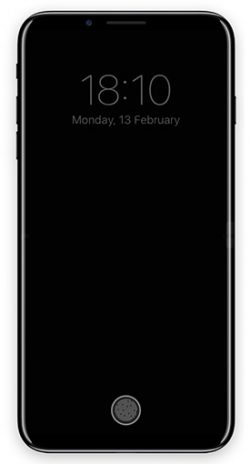
The 10 year iPhone will be their biggest phone ever. AR/MR capabilties. New form factor.

Although not tech nor innovative, they are doing a ton of content stuff. They are further diversifying their offerings in order to compete with Amazon and Google. Expect to see something with Apple TV too.

The truth is that the company hasn't been the same since Steve passed.
 
The future of Apple cannot rest on a device.

That's why I made the initial post.

I have seen many device companies die, Nokia, Motorola etc.....

The future is machine learning & AI

The is a talent drain happening in Apple

Personal Asistants
The Siri team left and created Viv

Autonomous vehicles:
They pivoted and said they are working on the software piece

Connected cars:
nothing

IoT:
Nothing

AR/VR:
Nothing


Someone please fill this future list out for Apple.................


:hmm:

So here's how I know you're a blowhard with only assumptions and anecdotes posing as facts. I'll provide you facts, not feelings, with actual links you can view.
  1. You say the future is machine learning and AI, who brought that idea first to the common man with Siri? The folks that left and created VIV, which was acquired by Samsung? Those folks? Really? So I wonder who from Apple is on the steering committee in the AI Consortium?
  2. There is a talent drain taking place at Apple? I guess people cant get new jobs or simply start their own? Apple has been accused of having a brain drain since before Jobs died and remember when he was accused of being the reason? Last I checked, this brain drain also got Apple some of the brightest minds from Tesla, BMW, Chrysler, Adobe, et al. The software piece is the smarter play, why? Easier implementation.
  3. Autonomous car? Why build a whole car, when you can simply create the software stack and lighten the load on auto-manufacturers. If you haven't used CarPlay, you've missed out. It just works, amazingly.
  4. IOT? Apple has never been an everything company. So that argument is a red-herring. They make computing and media consumptions with services attached that are simple to use and secure. That said, I know you know nothing about Apple, because HomeKit is the most stringent and secure platform on the market, the competitors will tell you that and agree. They opted to rush to market with off the factory parts and hobble together IOT and the big hack happened where peoples connected devices became bots and users were victim of ransomware. Not the HomeKit certified partners though. Who are they? Hmmmm
  5. AR/VR? LOL. Apple has been racking up patents, patents, and more patents, while deciding the play on AR/VR for a while now. The team at Apple have publicly stated that the idea of strapping a phone to your face is, well, stupid. The computing power to do it effectively would bind you to a powerful desktop and go against the very usability people have come to expect from Apple. Cook even famously stated, "My own view is that augmented reality is the larger of the two, probably by far, because this gives the capability for both of us to sit and be very present talking to each other, but also have other things visually for both of us to see," and being Apple, they dont just rush things out the door. They conceive, hone, polish, then release. And make further improvements along the way.
  6. The future of Apple cant rest on a device. If you would have read the earnings report, you would have seen, that despite hardware, Apple's Services division brought in more revenue last QTR than most Fortune 500 companies, last year. This QTR, $7.17B, with a B, for the Services unit. So please, find a bridge somewhere if you must troll. But learn and understand that facts are easily located and presented to flog so called prescient idiots such as yourself.
Hope you enjoyed the list.


I appreciate you putting some flesh on your opinion as opposed to that other guy with the emotional insults.

While you are passionate about Apple, I'm not easily excited as I have been around tech while.

1. There is no point arguing since you basically agreed with me that the future is ML & AI
2. Apple and Google engaged in preventing the free movement of talent i.e. anti-poaching and had to pay $325 million to settle:
http://www.latimes.com/local/lanow/la-fi-tn-apple-google-conspiracy-20140523-story.html
As I said there is a brain drain going on.
3. Moving to software we both agreed with autonomous vehicles. The fact that we know that and yet Apple got to that point after spending a shit load of money is telling, isn't it?
It means you give them a lot of credit.
4. So you say Apple has never been an everything company i.e. fuck IoT. Then you go on to mention Homekit and how secure it is as some measure of Apple getting to market dominance which is a false assertion.
The fact that you use the security of Homekit as some selling point shows how naive you are to how the market really works.
Remember Blackberry and how secure it was?
Guess where it is today?
5. AR/VR: your point is that Apple is racking up patents. What does that mean to you? market dominance?
Remember Qualcomm? Remember Motorola?
They had huge portfolio of patents?
Where are they today?
"racking up patents" don't mean shit if you don't use them.
Ask Elon Musk who gives away his IP
6. You pin the future of Apple on a device and quote 4Q numbers. Re-read that statement.
You posted a past financial performance to signify future performance.
Ever read a financial report buddy?
Ever seen the disclaimer at the bottom?
past performance does not guarantee future performance.
So don't ever, ever quote a past financial performance report to guarantee future performance.

Your argument sounds like you work in a Apple store at a mall.

Just really trivial without any historical context or precedents.

Box at your weight level buddy

:smh:
 
So here's how I know you're a blowhard with only assumptions and anecdotes posing as facts. I'll provide you facts, not feelings, with actual links you can view.
  1. You say the future is machine learning and AI, who brought that idea first to the common man with Siri? The folks that left and created VIV, which was acquired by Samsung? Those folks? Really? So I wonder who from Apple is on the steering committee in the AI Consortium?
  2. There is a talent drain taking place at Apple? I guess people cant get new jobs or simply start their own? Apple has been accused of having a brain drain since before Jobs died and remember when he was accused of being the reason? Last I checked, this brain drain also got Apple some of the brightest minds from Tesla, BMW, Chrysler, Adobe, et al. The software piece is the smarter play, why? Easier implementation.
  3. Autonomous car? Why build a whole car, when you can simply create the software stack and lighten the load on auto-manufacturers. If you haven't used CarPlay, you've missed out. It just works, amazingly.
  4. IOT? Apple has never been an everything company. So that argument is a red-herring. They make computing and media consumptions with services attached that are simple to use and secure. That said, I know you know nothing about Apple, because HomeKit is the most stringent and secure platform on the market, the competitors will tell you that and agree. They opted to rush to market with off the factory parts and hobble together IOT and the big hack happened where peoples connected devices became bots and users were victim of ransomware. Not the HomeKit certified partners though. Who are they? Hmmmm
  5. AR/VR? LOL. Apple has been racking up patents, patents, and more patents, while deciding the play on AR/VR for a while now. The team at Apple have publicly stated that the idea of strapping a phone to your face is, well, stupid. The computing power to do it effectively would bind you to a powerful desktop and go against the very usability people have come to expect from Apple. Cook even famously stated, "My own view is that augmented reality is the larger of the two, probably by far, because this gives the capability for both of us to sit and be very present talking to each other, but also have other things visually for both of us to see," and being Apple, they dont just rush things out the door. They conceive, hone, polish, then release. And make further improvements along the way.
  6. The future of Apple cant rest on a device. If you would have read the earnings report, you would have seen, that despite hardware, Apple's Services division brought in more revenue last QTR than most Fortune 500 companies, last year. This QTR, $7.17B, with a B, for the Services unit. So please, find a bridge somewhere if you must troll. But learn and understand that facts are easily located and presented to flog so called prescient idiots such as yourself.
Hope you enjoyed the list.
Nice observation. And respect for the time taken for the explainations. Thing is, I iterated many of these same points very early in this thread (maybe around year ago by now), and the OP is a person that only likes to hear himself talk, so it will be dismissed (or negated) for the most part. This has become evident as he has doubled down in defending his INACCURATE predictions.
 
Last edited:
Apple on Track to Buy 50% of Itself in Three Years

February 09, 2017


A path has appeared where Apple management can realistically buy back 50% of AAPL's outstanding shares within three years. With a stable iPhone business, a growing Services business, and U.S. corporate tax reform, Apple will have close to $300B of cash available to spend on share buyback in the coming years. The numbers are daunting, and as Apple management has shown no sign of curtailing its buyback plans, it's time for Wall Street to take notice.

Share Buyback 101

Share buyback is the opposite mechanism of an IPO or secondary offering. Instead of raising cash by selling shares, a company uses excess cash on its balance sheet to buy back its shares from investors. These shares are then retired, or removed from the market, resulting in a lower share count. By using cash to buy back stock, a company's assets and equity totals decline while debt remains the same, all else equal.

There are a few reasons for a company to buy back its stock.

  • Signaling effect. Management teams can use buyback to signal to Wall Street its confidence in future prospects. In addition, share buyback is often thought to be a sign that management views its stock as undervalued.
  • Balance sheet optimization. There is such a thing as holding too much cash on the balance sheet, especially if investors are not properly valuing it. By issuing low-cost debt to buy back stock, some companies will be able to lower their overall cost of capital, which is a value creation activity.
Buying back shares increases the ownership percentage for existing shareholders. If a management team buys back all of a company's shares except for one, that last remaining share would, in theory, own 100% of the company. Of course, in the real world, this example isn't likely as the last remaining shareholders would have little incentive to sell their shares to the company at a low price.

A few other considerations regarding share buyback:

  • Share buyback is not created equally. Not every company should repurchase their shares. Industry dynamics and company-specific issues may make share repurchases an unwise use of excess cash for some companies. Share buyback has gotten a bad rap on Wall Street in recent years because of its widespread use, including that by companies not in a strong position to be buying back shares. This buyback misuse has overshadowed examples of buyback representing a good use of excess cash.
  • Share buybacks don't create shareholder value. Contrary to popular belief, share buybacks don't create value for shareholders. While existing shareholders do get a greater share of the balance sheet via share buybacks, the act of using cash to buy back shares means they are getting a greater share of a smaller balance sheet. Meanwhile, share buyback does not have any direct impact on how a company performs when it comes to using its assets to generate cash flows. The one example in which buyback may produce a small amount of value for a company is when the overall cost of capital is reduced due to share repurchases.
  • Apple is not using buyback to secretly go private. One myth that has been circulating for years is that Apple is secretly using share buyback to go private. Not only is this false, but it ignores one crucial aspect found with Apple's share buyback program.Management is not holding on to repurchased AAPL shares. Instead, the shares are retired and removed from circulation. Existing shareholders see their ownership stakes rise due to buyback.

Apple's Buyback History

Since kicking off its buyback program in 2012, Apple management has repurchased 20% of outstanding AAPL shares. As shown in Exhibit 1, after peaking in 4Q12 at 6.6 billion shares, Apple's share count has declined by 20% to 5.3 billion at the end of 1Q17.

Since kicking off its buyback program in 2012, Apple management has repurchased 20% of outstanding AAPL shares. As shown in Exhibit 1, after peaking in 4Q12 at 6.6 billion shares, Apple's share count has declined by 20% to 5.3 billion at the end of 1Q17.


Exhibit 1: Apple Shares Outstanding (1Q11 to 1Q17)

Screen+Shot+2017-02-09+at+2.35.36+PM.png


Apple management has been a very reliable and consistent repurchaser of its stock. This stands at contrast with the average buyback program in which management teams are more interested in the positives associated with announcing a share buyback instead of actually parting ways with cash to repurchase stock. Share buyback authorizations often remain open as companies never finish their buyback programs. Apple has been an outlier in terms of its very aggressive pace of buyback, regardless of share price.

The Path to 50%

With 20% of shares already repurchased, here's how Apple management can repurchase an additional 30% of shares over the next three years to reach 50% of Apple outstanding shares:

1) Continue to funnel $30B to $35B of excess cash into share buyback every year. Apple is currently relying on operating cash flow (U.S.) and debt issuance to fund its share buyback. With the iPhone business displaying a new level of consistency and with a growing Services business, Apple will likely see similar levels of cash generation in the coming years. If Apple can funnel approximately $30B to $35B of cash into share buyback in FY17, FY18, and FY19, the company will be in a position to buy an additional 16% of outstanding shares by the end of 2019. As seen in Exhibit 2, simply keeping the status quo should bring shares outstanding to 4.5B shares in three years, a 32% reduction from the 2012 peak.

Exhibit 2: Apple Shares Outstanding (1Q11 to 1Q20E)

1486669226272


2) Bring back most of the $230B of cash held in foreign subsidiaries
. Apple currently has $230B of cash held in foreign subsidiaries. If Washington passes corporate tax reform and foreign cash is taxed at a rate of 15% or lower, Apple will bring back the vast majority, if not all, of this amount to the U.S. Apple will need this cash in the U.S. if it intends to use it for share buyback. Apple has been maintaining a deferred tax liability (now at $27B) related to foreign earnings as management has been accruing U.S. taxes related to unremitted foreign earnings. This will make it possible for Apple to pay tax on most of this foreign cash without taking a significant EPS hit.

3) Use $150B of repatriated cash to repurchase another 23% of AAPL shares. Assuming Apple pays taxes on foreign cash at some point in FY17 or FY18, Apple will have approximately $250B of cash, cash equivalents, and marketable securities on its balance sheet. If Apple uses 60% of this total for share buyback, Apple will be able to buy back 23% of outstanding shares. Management could repurchase these shares quickly through a modified Dutch auction tender offer. Even after spending $150B on buyback, Apple would still have close to $100B of cash left over on the balance sheet. While the company's net cash balance would be at a multi-year low given Apple's increasing amount of long-term debt (quickly approaching $100B), the company would still be kicking off $50B of cash each year. As seen in Exhibit 3, using more than 60% of repatriated cash, in addition to keeping the status quo in terms of quarterly buyback, would bring shares outstanding to 3.3B shares in three years, a 50% reduction from the 2012 peak.

Exhibit 3: Apple Shares Outstanding (1Q11 to 1Q20E)

1486669591413


Risk Factors


There are four risk factors that may derail Apple's path to buying back 50% of outstanding shares. Deteriorating business fundamentals may jeopardize the amount of cash flow generation required to maintain a robust buyback program. If iPhone unit sales decline more than 10% year-over-year, this may have a negative impact on buyback.

When it comes to corporate tax reform, if there are strings attached to the cash Apple brings back from foreign subsidiaries, this would have an adverse impact on Apple's plan to use the cash to buy back a significant portion of outstanding shares. If Washington simply lowers the tax rate on foreign cash instead of getting rid of the tax rate altogether, Apple may have more freedom as to how the cash is spent. Of course, there is no guarantee that Washington will be able to come to an agreement on corporate tax reform, although Tim Cook sounded confident in such reform occurring this year.

Apple's board would need to provide enough buyback authorization in order for management to use a significant portion of its cash to buy back shares. One likely scenario is that the board grants management larger share buyback authorization in FY17, FY18, and FY19, but it's spread out over a longer period. This would give management added flexibility when it comes to timing buyback.

The last risk factor is a rising AAPL share price. As shares increase in price, it will become that much more expensive for Apple to buy back its shares. If shares rise 10% in 2017, it will be 10% more expensive for Apple to buy back shares in 2018. If Apple shares increase in price, the path to repurchasing 50% of shares becomes that much more narrow. Of course, if AAPL shares fall in price, Apple will have a much easier time repurchasing 50% of outstanding shares, as buyback would require less cash.

Calling a Bluff

Apple's iPhone and Services businesses are throwing off more cash flow than management needs to run the business and to invest for the future (M&A and R&D). This produces a very rare situation of a company generating hundreds of billions of dollars of excess cash.

With shares trading in the vicinity of $130, Wall Street doesn't seem to believe Apple will actually spend $250B on buyback in the next three years. Wall Street thinks Apple is bluffing. Meanwhile, Apple has shown no indication that it will slow its share buyback pace and instead embrace a strategy of retaining excess cash for other purposes. This may set up a situation in which Wall Street calls out Apple on a bluff (i.e. the share price doesn't change much from current levels). In such a situation, Apple is given a clear path to buying back 50% of shares in three years.

The biggest takeaway from buying back 50% of outstanding shares is that Apple's shareholder base would essentially be cut in half. Shareholders as of year-end 2012 would see their ownership stake in Apple double in just seven years by simply holding on to their shares. This is quite rare on Wall Street. As Apple's path to buying back 50% of shares becomes more clear to Wall Street, Apple's share buyback program will gain more attention from investors.

https://www.aboveavalon.com/notes/2017/2/9/apple-on-track-to-buy-50-of-itself-in-three-years

 
Aren't they integrating Siri in MacOS? I haven't upgraded in a year so I lost track of what MacOS is doing.
They definitely are doing their own Siri home device a la Amazon Echo.
The 10 year iPhone will be their biggest phone ever. AR/MR capabilties. New form factor.

Although not tech nor innovative, they are doing a ton of content stuff. They are further diversifying their offerings in order to compete with Amazon and Google. Expect to see something with Apple TV too.

The truth is that the company hasn't been the same since Steve passed.
Siri is already in the latest Mac OS Sierra. It's kinda cool but Alexa is much better.
 
What the iPhone 7 reveals about Apple’s augmented-reality plans

Tim Cook can’t stop talking about how big an opportunity augmented reality represents.

BY TOM MAINELLI SEP 20, 2016, 2:30PM EDT

I believe that Apple’s next big iPhone release is going to feature augmented-reality technology. Obviously, nobody at Apple has said anything about such a product. But the now-shipping iPhone 7 Plus, complete with dual-camera technology, is the latest hint Apple is moving in that direction. This, along with several high-profile company purchases (Metaio in 2015 and PrimeSense in 2013), points to this technology eventually appearing in products.

One more thing: Apple CEO Tim Cook can’t stop talking about how big an opportunity augmented reality represents.

Dual-camera technology

Apple executives spent a great deal of time during the recent iPhone 7 launch event talking about the current and future capabilities of the two 12-megapixel cameras integrated into the iPhone 7 Plus. The first camera is a 28mm-equivalent lens that most would consider wide angle (the iPhone 7 has the same camera). The second is a 56mm equivalent and, while Apple’s Phil Schiller kept calling it a telephoto lens, the reality is that it’s actually more of a portrait lens.

In addition to giving the phone an effective 2x optical zoom, the dual cameras enable a long list of software capabilities that should result in notably better photos for most users. That’s interesting (and very useful), but what interests me more about this hardware is the fact that Apple could use the dual cameras to capture information about the objects and space in front of the cameras. Two cameras allow the device to capture and create depth-mapping information.

Earlier this year, I wrote about Lenovo’s Phab Pro 2, the first Tango-enabled smartphone. Tango is Google’s handheld augmented-reality platform. The Lenovo phone actually uses three cameras and a host of other sensors to capture motion, depth and local area information about the phone’s surroundings. The result is a device that knows where it is in space, which lets you do many fascinating things in augmented reality. To vastly oversimplify, think about what Pokémon Go does on your current smartphone, but many times smarter and more powerful.

Two key Apple acquisitions

Apple’s recent purchase of Metaio and PrimeSense makes me think it’s moving toward this handheld augmented-reality future. Apple bought Metaio in May, 2015. It was a German company, started in 2003, that sold software that pulled together camera images and computer-generated objects. Before the purchase, numerous companies used the technology to create applications for use in different vertical markets including retail, industrial and automotive. After completing the purchase, Apple took the product off the market. Many assume that Apple is working to create custom silicon in conjunction with this software for future products.

PrimeSense was an Israeli 3-D sensor company that Apple purchased for $345 million in 2013. The company had a mobile-sized 3-D sensor (code-named Capri) that worked with its software technology to scan and capture three-dimensional objects. The company was also a founding member of the open source framework called OpenNI (Natural Interaction) designed to capture body motion and hand tracking. Stories at the time of the acquisition noted that the Capri sensor was relatively expensive to produce, which kept it from gaining the attention of other device manufacturers. This is the type of tech Apple loves to integrate into its hardware to drive additional differentiation from the rest of the market.


Tim Cook on augmented reality

Finally, there are Tim Cook’s comments. In the most recent Apple earnings call, Cook pointed out that, while he thinks both virtual and augmented reality are interesting, he sees a much bigger opportunity in augmented reality, especially regarding commercial use cases (I strongly agree). More recently, in an interview on “Good Morning America,” Cook once again spelled out his enthusiasm for augmented reality. He noted that by using AR, two people can share a common experience, which is hard to do in the heavily isolated world of VR.

Now, it may well be that Cook’s recent comments around AR versus VR are meant to throw people off Apple’s trail. In fact, I think it’s highly likely that Apple is working on both technologies and, eventually, we may well see some eyewear that utilizes not only the technologies above but a future version of the company’s new W1 chip currently shipping in the AirPods. But here’s my bet: When Apple heads toward its next big hardware revision, we’ll see an iPhone (and maybe an iPad Pro) with AR capabilities.


AAPL stock opens at all-time record high of $133 after Goldman Sachs raises target price

Ben Lovejoy - Feb. 13th 2017 7:40 am PT @benlovejoy

aapl.png


AAPL has opened at an all-time record high of $133.00 after Goldman Sachs raised its target price for the stock. Pre-market trading saw the price climb as high as $133.09 before it dipped a fraction before the market opened. At the time of writing, the stock is trading at $133.68, up 1.2%.

While the price is a record for market opening, it’s not quite the highest level the stock has ever reached …


Back on April 28 2015, the stock at one point reached $134.54 before falling back again later in the day.

MarketWatch reports that Goldman raised its 12-month target for AAPL stock from $133 to $150, citing high expectations from the iPhone 8.

Analysts at Goldman Sachs said they expect the company’s 10th anniversary iPhone, due in September, to have software enhancements such as 3D sensing technology that are crucial to augmented reality. They believe augmented-reality features will be a “significant step-up in innovation” compared with the prior two product cycles.

MarketWatch notes that today’s opening price adds around 20 points to the Dow Jones Industrial Average, and that AAPL has climbed almost 23% in the past three months compared to a 8.1% increase for the Dow Jones.

https://9to5mac.com/2017/02/13/aapl...-133-after-goldman-sachs-raises-target-price/


Lot of kool-aid drinkers in here.

I don't give a fuck about Goldman and what they say, check their history trying to call tech.
Goldman cares about money not company so they will manipulate the stock up and down and make money on both sides.

That said.

A number of factors are slowing it's death:
1. Samsung took a big hit with the exploding Note 7. They are still trying to recover.
2. There is little life in the remaining Android phone market
3. Trump signals that he is going to allow repatriation of cash will be good for Apple.


Now FACTS:
1. Services business: The company said on Tuesday that services revenue, which includes digital music, Apple Pay, cloud storage and apps, jumped 18 percent in the fiscal first quarter to $7.2 billion from $6.1 billion a year ago. Analysts expected services revenue of $6.9 billion, according to data from FactSet.Jan 31, 2017.
i.e. they underperformed expectation on services revenue.
2. There is a lack of strategy around Mac product lines. Mac sales declined 10% in 2016.
3. Apple is trying to grow their content programming as a part of the Services Unit but failing:
"Apple TV is like off the radar now," said Ross Gerber, president and CEO of Gerber Kawasaki Wealth and Investment Management. "Using an Apple TV is actually worse than using cable used to be, and I thought the whole goal was to make it better. Really it's become just a Netflix portal. Apple absolutely needs to find direction with Apple TV and some sort of purpose."
Though Apple hasn't put a formal stake in the ground on as far as making more original programming, revolutionizing TV is an Apple ambition that dates back to co-founder Steve Jobs. But Gerber said he doesn't necessarily think Apple's found the right path.
Gerber told CNBC's "Closing Bell" that his Hollywood friends see Apple "poking around," but it doesn't make sense for Apple to pony up millions for creating content — something "they're not really that good at."
4. In the 4Q 2016, Tim Cook sold 38% of his stock: http://www.livetradingnews.com/appl...-cook-dumped-38-stock-16877.html#.WKJVAhIrJjs


Opinion:
1. Apple is using the absence of a strong Samsung to release a constant news cycle of "news"
2. Despite doing good numbers with iphone & apps, Apple needs a strategy to own the future. So far they have not. They have cash so you hope they will figure it out.

My opinion is that they are losing the race for the future every quarter.

They may have to acquire their way to the future but right now they are not spending as much as they should.

At the levels of cash on hand, cash become a liability (e.g currency fluctuations) hence the buyback.


Why would Tim Cook sell 38% of his stock in a company that is confident in being a rockstar in the future?

Now i'm getting flashbacks of Enron.
 
The future of Apple cannot rest on a device.

That's why I made the initial post.

I have seen many device companies die, Nokia, Motorola etc.....

The future is machine learning & AI

There is a talent drain happening in Apple

Personal Asistants
The Siri team left and created Viv

Autonomous vehicles:
They pivoted and said they are working on the software piece

Connected cars:
nothing

IoT:
Nothing

AR/VR:
Nothing


Someone please fill this future list out for Apple.................


:hmm:


I posted the above 4th Feb


Look at the news on 7th Feb

A Key Apple Executive Just Left

Feb 07, 2017
Apple to sell its products to big businesses and government, has left his position, the company said on Tuesday.

Apple hired Solomon, a longtime HP Inc. executive who had run HP's global consumer printing business, in 2015 as vice president for enterprise and government.

Solomon did not return a request for comment. Apple confirmed his departure but declined to comment further.

The impact of Solomon's departure on Apple's enterprise efforts was not immediately available, but Apple has increased its efforts to sell to large businesses in recent years.


Speaking at a conference hosted by Box in 2016, CEO Tim Cook said Apple had about $25 billion in enterprise sales in the previous year. "This is not a hobby," Cook said of Apple's enterprise efforts.In 2014, Apple launched a partnership with IBM to help build custom iOS applications for businesses. In 2016, Apple made a deal with Cisco so that iPhones would work better on Cisco's networking gear and also partnered with Deloitte to encourage more businesses to build iOS applications.

http://fortune.com/2017/02/07/apple-executive-just-left/


Don't believe me just watch.
Keep believing analysts

:lol:
 
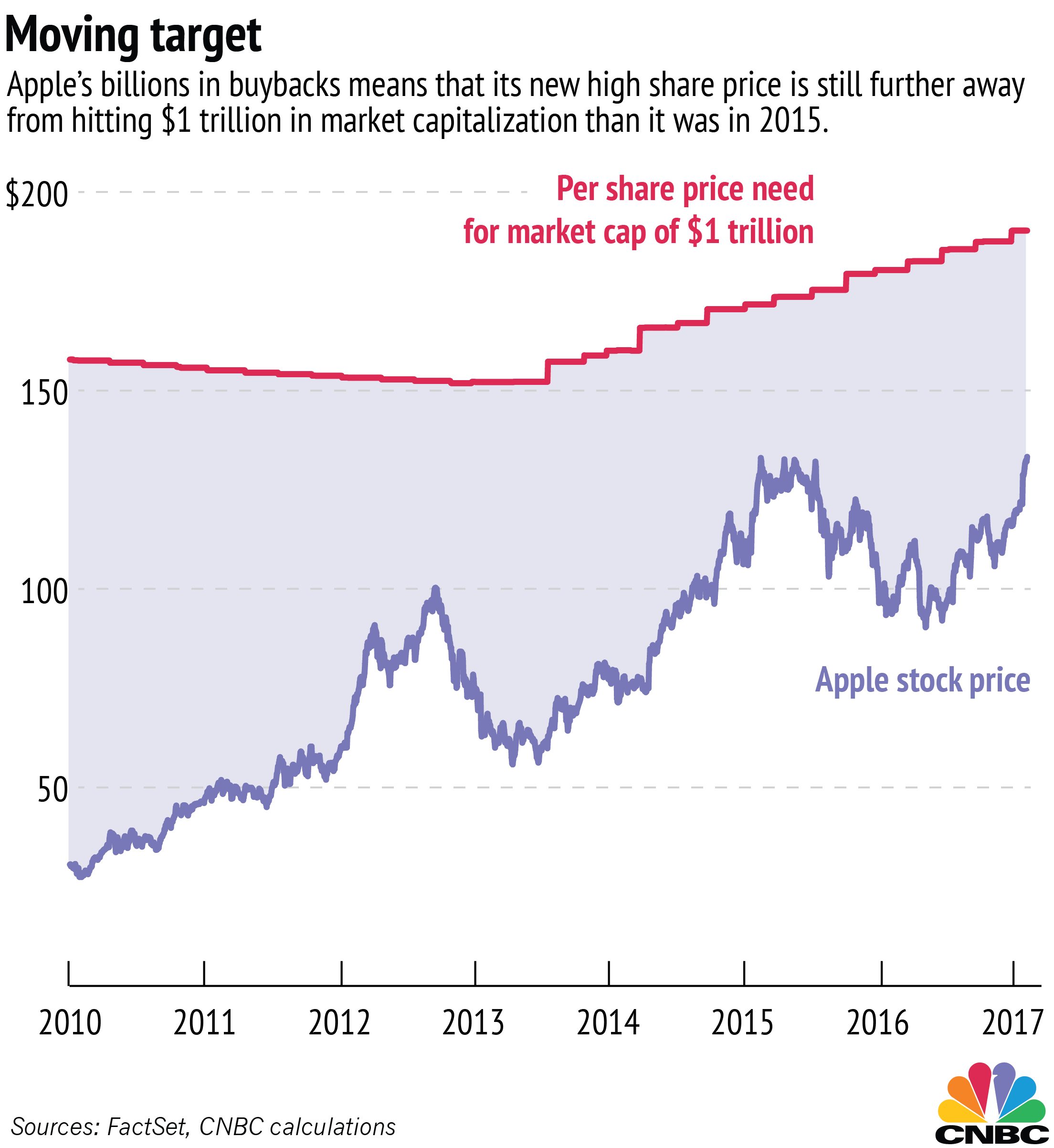
Don't be fooled by Apple's record high

Apple stock closed at an all-time high of $133.29 on Monday, but looks can be deceiving.

The company's market cap broke $700 billion, but it is still about $70 billion short of where it was the last time Apple's individual share price approached $133 two years ago. And despite the tech giant's high stock price, the actual performance of the company is worse than it was in 2015, with 16 percent lower net income and earnings per share down 9 percent.

In terms of reaching the elusive trillion-dollar market cap, the company is further away now than it was at other points in the last few years.


AppleHigh-01_0.png

That's how stock buybacks can change people's perspective of performance. A company's earnings per share can be increased by merely eliminating shares. Apple's $70 billion worth of buybacks in the last two years have accomplished that. Over the last five years, buybacks have wiped out more than a billion shares.

Since September 2015, 6 percent of the company's shares have been eliminated. That action alone would help EPS rise by 6 percent, but the 15 percent decline in actual earnings doesn't help. In rough terms, when "E" drops 15 percent and "S" drops 6 percent, you get about a 9 percent drop in EPS. That's where Apple is now compared to two years ago.

The last four quarters have garnered Apple $45.2 billion in net income — a huge drop from the $53.4 billion it earned in the four quarters ending September 2015.

Consider those numbers in context with this so-called record high price. Record stock prices don't mean record performances. Stock buybacks can drive up EPS, but they don't change the fundamentals of a company.

AppleHigh2-01.png

In summary, Apple is worth about 10 percent less today compared with two years ago because its actual business seems to be worth at least that much less, despite the higher stock price. To get back to where the company was in 2015, each share would have to jump up about $14 more.

Not every record is a meaningful one.


http://www.cnbc.com/2017/02/14/dont-be-fooled-by-apples-record-high.html
 
Apple's Stock Price Projected to Keep Rising on 'iPhone 8' Optimism
Monday March 6, 2017 9:34 pm PST by Joe Rossignol

iphone-8-mockup-250x464.jpg


While a 5.8-inch iPhone with an OLED display is likely around six months away from being announced, the stock market is always looking ahead, and several analysts think the smartphone will be a hit among customers.

Accordingly, over the past month, several financial analysts have raised their price targets for Apple's stock to between $150 and $185, per research notes obtained by MacRumors.

Citi analyst Jim Suva, for instance, raised his Apple stock price target to $160 today. Likewise, BMO Capital Markets analyst Tim Long rose his target to $160 in late February.

Apple's stock has already been on an impressive run this year so far, closing at $139.34 on Monday, just cents off its record-breaking high of $139.79 set last week.

Long in particular said he expects Apple's trio of new iPhone models, presumably arriving this September, to drive the "biggest refresh cycle" since the iPhone 6 in 2014.For the 2017 iPhone refresh, we expect some cannibalization by the premium model. While we expect like-for-like units to be 23 million lower, we model 34 million of unit volume from the new model. On balance, we estimate 11 million of incremental volume, the best launch since iPhone 6, though still less impactful. We believe this reflects conservatism in our estimates.iPhone 6 and iPhone 6 Plus were runaway hits as Apple's first smartphones with screen sizes as large as Samsung's competing Galaxy smartphones, but the iPhone's overall look and feel has gone largely unchanged since those models were introduced three years ago, and iPhone sales declined for the first time ever last year.

The so-called "iPhone 8," or whatever Apple names its tenth-anniversary iPhone, will likely be something fresh and new, however, which Long expects could drive existing iPhone users to upgrade.

Long estimated that the number of iPhones in use was around 715 million, including 228 million second-hand devices, as of December 2016. Of the new models, he estimated 31% of the installed base will be 2 years or older at the time of Apple's presumed September launch event.

This larger than usual base of customers with older iPhone models has led analysts such as Morgan Stanley's Katy Huberty and UBS's Steven Milunovich to expect a "supercycle" of iPhone upgrades through next year.

Huberty recently raised her price target to $154, up from $150, but with an "overweight" rating. She expects the 5.8-inch iPhone's significant form factor change, and rumored features such as wireless charging, longer battery life, 3D sensors, and more advanced AI software capabilities, to drive the accelerated upgrade cycle.

Milunovich raised his price target to $151 in late February, up from $138, and he maintained a "buy" rating.

Huberty and Milunovich are far more conservative than Drexel Hamilton analyst Brian White, who has maintained a $185 price target since last year. "We continue to believe that Apple remains one of the most underappreciated stocks in the world," he said in a research note shared with investors in early February.

Guggenheim Securities analyst Robert Cihra reportedly raised his price target to $180, up from $150, last week.

Billionaire investor Warren Buffett of Berkshire Hathaway went on an Apple stock buying spree over the past few months, increasing his position in the iPhone maker to around 133 million shares prior to the company's record-breaking earnings results at the end of January. His holding has likely netted him several billions.

Related Roundup: iPhone 8 (2017)
Tag: AAPL

https://www.macrumors.com/2017/03/07/iphone-8-boosting-aapl-price-targets/

 
Apple shares set all-time high on rumors of upcoming product release

By Mikey Campbell
Monday, March 20, 2017, 07:07 pm PT (10:07 pm ET)


Apple shares surged one percent to hit an all-time high of $141.46 at the end of trading on Monday following reports that the company's first hardware releases of 2017 could launch as early as Tuesday morning.

20634-22684-20294-21834-20203-21608-19842-20918-11197-3921-nasdaq-141125-l-2-l-l-l-l.jpg


The close caps off a day of rally trading that started at $140.44 before reaching a mid-day high of just over $141 two hours later. Shares continue to gather steam as of this writing, with AAPL sitting at $141.56 in after hours trading.

A series of rumored new product launches are thought to be driving the stock's performance. Apple in an update to its system status page earlier today revealed the company's online storefront is set to undergo maintenance early tomorrow. The downtime sparked speculation that Apple is preparing to make space for a new product, perhaps a minor low-end iPad refresh or a rumored 128-gigabyte iPhone SE.

According to a report last week, Apple is slated to launch new devices this week without the usual keynote presentation. Since a media event is not planned, minor product refreshes are anticipated.

Beyond tomorrow's supposed product launch, Apple is widely expected to unveil this year's iPad Pro collection in the coming days or weeks. Headlining for 2017 is a rumored 10.5-inch iPad Pro model that would stuff a thin-bezel display into a form factor just slightly larger than the current 9.7-inch iPad Pro.

An updated 12.9-inch iPad Pro is also anticipated, as is a less expensive 9.7-inch variant that could take the place of iPad Air 2 at the bottom of Apple's lineup.

Apple stock is on a roll going into 2017. Today's all-time high follows a string of record-breaking trading days set over the past five weeks. AAPL's first record day of 2017 came on Feb. 13 when the stock hit a high of $133.29. Shares climbed $135.01 a day later as Apple's market capitalization exceeded $700 billionfor the first time since 2015.

Company shares received another bump in late February when financial guru Warren Buffet's Berkshire Hathaway quadrupled its investment in Apple to more than 57 million shares at the end of 2016. Buffet later revealed his firm purchased about 120 million AAPL shares since Jan. 1, bringing the total up to 133 million shares worth more than $17 billion.

http://appleinsider.com/articles/17...me-high-on-rumors-of-upcoming-product-release


Apple closing stock price on the day @kayanation created this stupid thread:

104.35

Closing price today:


143.80

...AND THIS IS ONLY THE BEGINNING!!!
 
Last edited:
Apple closing stock price on the day @kayanation created this stupid thread:

104.35

Closing price today:


143.80

...AND THIS IS ONLY THE BEGINNING!!!


Brother

Apple stock was 199 at teh end of 2007


wtf is your point?


:smh::smh::smh:


Apple got a reprieve from the Samsung bullshit

Doesn't mean that they are innovating at the level they should be at
 
Apple stock was 199 at teh end of 2007
And what is your point? It has split by seven since then. It is now at it's highest market cap EVER in it's history.
Apple got a reprieve from the Samsung bullshit
So this means the stock will not go any higher at this point?
Doesn't mean that they are innovating at the level they should be at
Says who? You...and the rest of the hacks that have been WRONG for almost a decade.
 
Last edited:
Apple working on breakthrough glucose sensors for Apple Watch, report says

By Mikey Campbell
Wednesday, April 12, 2017, 06:30 pm PT (09:30 pm ET)


Apple has reportedly hired a team of biomedical engineers to develop noninvasive glucose sensors for integration in Apple Watch, a solution that could lead to continuous monitoring of blood sugar levels for users with diabetes.

20929-23359-17092-14273-12069-5621-4537b9d0c235664c3f41bf5982fc98e4f09fc47a_large_2x-l-l-l.jpg


Citing sources familiar with the matter, CNBC on Wednesday reported Apple's small biomedical engineering group is part of a "super secret" initiative, first imagined by late cofounder Steve Jobs, to create a noninvasive glucose monitoring solution. The company has been working on the project for at least five years, the report said.

Tracking blood sugar levels without drawing blood is a difficult feat, and many large corporations have attempted to create similar systems without success. If Apple is able to succeed where others have failed, it would not only be a boon for Apple Watch, but validate the company's recent interest in medical research.

The diabetes research team, stationed in an office building somewhere in Palo Alto, is said to be ready to conduct feasibility trials, a major step toward gaining necessary federal regulatory approvals. Apple could begin testing the process at clinical sites in and around the San Francisco Bay Area, according to the report.

While details are sparse, sources claim Apple's technology involves optical sensors capable of measuring indications of glucose in the blood stream through a user's skin. About 30 people were said to be part of the engineering team a year ago, though that number could have increased following acquisitions and recent hires from the biomedical field.

For example, Apple last June hired Dr. Rajiv Kumar, a pediatric specialist who formerly worked for Stanford Children's Health. Kumar was one of the first medical professionals to take advantage of Apple's HealthKit platform, facilitating a ResearchKit study on Type 1 diabetes monitoring. Though his previous work focused on diabetes, it is unclear if Kumar is part of Apple's glucose monitoring technology team.

Perhaps most closely aligned with today's report is a 2013 hiring spree that picked up former employees of defunct biotech company C8 MediSensors. Before going out of business, C8 specialized in non-invasive sensors capable of tracking substances in the body, including glucose.

Since the debut of HealthKit in 2014, Apple has increasingly focused on health and fitness products. A report last year suggests the company's interest in health sciences was sparked by a challenge from Jobs, who wanted to fix what he viewed as a disjointed healthcare system. Jobs believed technology could solve a data gap between patients and healthcare professionals, an idea that gave rise to HealthKit, ResearchKit and ultimately Apple Watch.

http://appleinsider.com/articles/17...h-glucose-sensors-for-apple-watch-report-says


I could go on and on with the foolishness in this thread, but I will only comment on the ONE important point raised here...."WHAT's NEXT" ? And again, something the BGOL tech "geniuses" completely missed. HEALTHCARE.

And again, Apple is ahead of the game with another Trojan...Apple Watch. This sector is a fucking goldmine. And even you Kaya can't deny this. Combined with the emerging wearable industry, Apple got it just right. In under a year it has become the leader in the wearable market. See the new Fitbit commercial. LoL. For starters, just wait until the sensors for non-penetrating glucose measurements get approved. Apple already aligned with IBM Watson to regulate the sensitive info. The convienience of Apple Pay on the watch. Again, forward thinking the tech "geniuses" don't even see.

CHAPPELLE_02_0205_NEGRODAMUS_640x360.jpg
 
Last edited:
Apple working on breakthrough glucose sensors for Apple Watch, report says

By Mikey Campbell
Wednesday, April 12, 2017, 06:30 pm PT (09:30 pm ET)


Apple has reportedly hired a team of biomedical engineers to develop noninvasive glucose sensors for integration in Apple Watch, a solution that could lead to continuous monitoring of blood sugar levels for users with diabetes.

20929-23359-17092-14273-12069-5621-4537b9d0c235664c3f41bf5982fc98e4f09fc47a_large_2x-l-l-l.jpg


Citing sources familiar with the matter, CNBC on Wednesday reported Apple's small biomedical engineering group is part of a "super secret" initiative, first imagined by late cofounder Steve Jobs, to create a noninvasive glucose monitoring solution. The company has been working on the project for at least five years, the report said.

Tracking blood sugar levels without drawing blood is a difficult feat, and many large corporations have attempted to create similar systems without success. If Apple is able to succeed where others have failed, it would not only be a boon for Apple Watch, but validate the company's recent interest in medical research.

The diabetes research team, stationed in an office building somewhere in Palo Alto, is said to be ready to conduct feasibility trials, a major step toward gaining necessary federal regulatory approvals. Apple could begin testing the process at clinical sites in and around the San Francisco Bay Area, according to the report.

While details are sparse, sources claim Apple's technology involves optical sensors capable of measuring indications of glucose in the blood stream through a user's skin. About 30 people were said to be part of the engineering team a year ago, though that number could have increased following acquisitions and recent hires from the biomedical field.

For example, Apple last June hired Dr. Rajiv Kumar, a pediatric specialist who formerly worked for Stanford Children's Health. Kumar was one of the first medical professionals to take advantage of Apple's HealthKit platform, facilitating a ResearchKit study on Type 1 diabetes monitoring. Though his previous work focused on diabetes, it is unclear if Kumar is part of Apple's glucose monitoring technology team.

Perhaps most closely aligned with today's report is a 2013 hiring spree that picked up former employees of defunct biotech company C8 MediSensors. Before going out of business, C8 specialized in non-invasive sensors capable of tracking substances in the body, including glucose.

Since the debut of HealthKit in 2014, Apple has increasingly focused on health and fitness products. A report last year suggests the company's interest in health sciences was sparked by a challenge from Jobs, who wanted to fix what he viewed as a disjointed healthcare system. Jobs believed technology could solve a data gap between patients and healthcare professionals, an idea that gave rise to HealthKit, ResearchKit and ultimately Apple Watch.

http://appleinsider.com/articles/17...h-glucose-sensors-for-apple-watch-report-says


CHAPPELLE_02_0205_NEGRODAMUS_640x360.jpg
Probably be released along side the "Apple Car"..
 
Probably be released along side the "Apple Car"..

Sure it is....
This just in....

Apple wins California DMV permit for testing self-driving car, could put tech on public roads

By Roger Fingas
Friday, April 14, 2017, 09:50 am PT (12:50 pm ET)


The California Department of Motor Vehicles on Friday added Apple to the list of companies with permission to test self-driving vehicles in the state, suggesting that the company is pushing through with work on "Project Titan." [Updated with Apple test car info]

20957-23413-smartcar-applecar-l.jpg


The win could even mean that Apple is ready to test a vehicle on public roads, Business Insider noted. Companies can't perform such tests in California without an Autonomous Vehicle Testing Permit.

Apple met with the state's DMV as far back as 2015, but despite this, testing ended up continuing in private. The most public the project has ever been is in Nov. 2016, when Apple submitted a letter to the National Highway Traffic Safety Administration, expressing interest in the autonomous field.

The company was at one point thought to be designing a top-to-bottom vehicle, but a number of obstacles led to the company reining in the project and switching to the more narrow focus of a self-driving platform. The company is expected to decide later this year whether to resume building a full-fledged car or partner with an existing automaker.

Indeed anything Apple puts on the roads is still likely be an existing car modified to test sensing and AI technology. Even if the company was far enough along with a custom design, driving it in public would ruin any surprise and hand ideas to competitors.

Away from prying eyes, Apple has allegedly been using virtual reality to test an augmented reality system. Facilities in countries as distant as Switzerland may be doing other work, though the major nexus of Apple's efforts is thought to be back in Sunnyvale, Calif.


20957-23414-19229-19363-18655-17932-applecar-motortrend-l-l-l.jpg


Early rumors suggested that Apple might have a finished car ready as soon as 2019. A more realistic date at this point is at least 2021, if not later depending on the impact of delays and whether or not Apple partners with an outside automaker.

Chinese ridehailing service Didi Chuxing —in which Apple invested $1 billion last year —recently set up a self-driving car lab near Apple's Cupertino headquarters, which could point towards a collaboration.

Update: Apple's permit covers three Lexus RX540h SUVs, and six drivers serving as backup.


http://appleinsider.com/articles/17...lf-driving-car-could-put-tech-on-public-roads
 
By Roger Fingas
Friday, April 14, 2017, 09:50 am PT (12:50


Looks like they're testing Lexus to me bruh..
"Indeed anything Apple puts on the roads is still likely be an existing car modified to test sensing and AI technology. Even if the company was far enough along with a custom design, driving it in public would ruin any surprise and hand ideas to competitors."
 
"Indeed anything Apple puts on the roads is still likely be an existing car modified to test sensing and AI technology. Even if the company was far enough along with a custom design, driving it in public would ruin any surprise and hand ideas to competitors."
Ok....
You're kind of ate up wit it ain't ya?...:giggle:
 
Apple iPhone Sales Fall Yet Again In Q2 2017

_89458831_gettyimages-518299348.jpg


On Tuesday, Apple (AAPL, Tech30) reported that it sold 50.8 million iPhones in the most recent quarter, down from 51.2 million units sold in the same quarter a year earlier.

A year ago, Apple reported its first ever decline in iPhone sales. The iPhone slump continued in the following two quarters, which led to Apple's first annual sales decline since 2001.

Apple managed to break its losing streak in the December quarter thanks to strong demand for the iPhone 7 Plus. But that reversal proved to be short lived.

Apple's overall sales for the March quarter rose to $52.9 billion from $50.6 billion a year earlier. But the slight dip in iPhone demand is nonetheless a red flag.

"We're seeing what we believe to be a pause in purchases on iPhone, which we believe are due to the earlier and much more frequent reports about future iPhones," Tim Cook, Apple's CEO, said on a conference call with analysts Tuesday.

The surprise sales decline pushed down Apple's stock more than 2% in after hours trading.

Ahead of the earnings, some analysts suggested users would hold off on purchasing new iPhones ahead of a much-hyped refresh expected later this year.

"It appears Apple users are holding off upgrading but not necessarily leaving the ecosystem," Steven Milunovich, an analyst with UBS, wrote in an investor note this week. "Investors need faith that users are waiting rather than switching."

Wall Street has been focused on pent up demand for the next iPhone, which will mark the smartphone's tenth anniversary.

For three years, the iPhone's exterior design has remained mostly unchanged, cutting into the demand for upgrades. However, the next iPhone model is rumored to have everything from wireless charging to a curved screen and a glass design.

iPhone sales aren't the only trouble spot for the company. Apple sold just shy of 9 million iPads in the quarter, down 13% from the previous year.

With two of its more mature hardware product categories in decline, Cook called attention to Apple's smartwatches, Beats products and the recently launched AirPods headphones.

Cook said if these products were lumped together into a standalone business, it would already be "well into the Fortune 500" in annual sales. The smallest company in the Fortune 500 does more than $5 billion in sales.

Apple's stock has soared to new highs in recent months on optimism for the next iPhone. The company's market cap was closing in on the $800 billion mark for the first time before the earnings report Tuesday.

http://money.cnn.com/2017/05/02/technology/apple-earnings-q2/


Apple iPhone sales fall again. Tim Cook blames rumor mill
 
Back
Top