Analysis: Obama's Supreme Court Pick

QueEx

Rising Star
Super Moderator
WTF is Obama Thinking ?

.

I know there is (and I'm trying to call you out); is there anyone out there who has that extra anticipation of seeing and trying to understand the nuances going on in the mind of a president who happens to have been a "ConLaw" professor who now actually gets the opportunity to select a Supreme Court nominee ??? I'm telling you, this should be really es·pe·ci·al !

Beat the press at its own game,

  • What, if anything, has Obama written on the subject ?

  • What, if anything, has Obama said in the past about selecting Justices of the Supreme Court -- or judges at the district court or appellate levels that should give us insight ?

  • What other hints have Obama given us that paint a picture of his would-be ideal selection ?

Of course, all of the above could go out of the window and the selection could come down purely to a 'political' pick, i.e., it has to be a woman or Latino.

A political choice (a woman or a woman who happens to be latino) could be a great choice. Is there anything out there that tells us that could be the case ??? And, if so, is there anything that tells us that would be a "compromise choice" from his "ideal choice." ? ? ?

QueEx
 
Re: WTF is Obama Thinking ?

Whoever the appointee is, I'm willing to bet that there is an affiliation with Goldman Sachs / Federal Reserve :D

Prove me wrong Mr. Obama!
 
Re: WTF is Obama Thinking ?

Whoever the appointee is, I'm willing to bet that there is an affiliation with Goldman Sachs / Federal Reserve :D

Prove me wrong Mr. Obama!

:lol:

Damn. That shit's not funny if it turns out that way...:smh:
 
Re: WTF is Obama Thinking ?

Whoever the appointee is, I'm willing to bet that there is an affiliation with Goldman Sachs / Federal Reserve :D

Prove me wrong Mr. Obama!
Do you ever recognize when the "thought process" is invoked ? ? ? - which begs for a response other than your knee-jerk: "Federal Reserve, One World Government, New World Order" responses ? ? ?

QueEx
 
Re: WTF is Obama Thinking ?

Do you ever recognize when the "thought process" is invoked ? ? ? - which begs for a response other than your knee-jerk: Federal Reserve, One World Government, New World Order responses ? ? ?

QueEx

Stop bein so sensitive QueEx, its just a joke but we'll see!
 
Re: WTF is Obama Thinking ?


<font size="3">

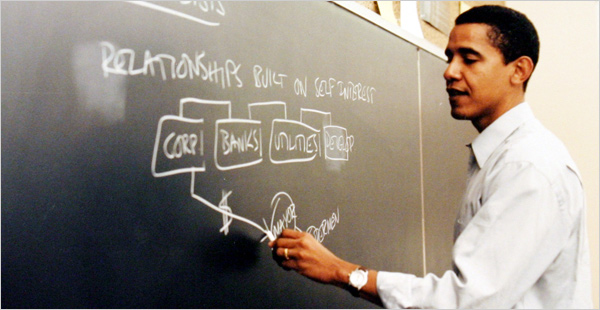
See, Inside Professor Obama’s Classroom

</font size>


30law_600.jpg
 
Re: WTF is Obama Thinking ?

.
  • What other hints have Obama given us that paint a picture of his would-be ideal selection ?

Of course, all of the above could go out of the window and the selection could come down purely to a 'political' pick, i.e., it has to be a woman or Latino.

A political choice (a woman or a woman who happens to be latino) could be a great choice. Is there anything out there that tells us that could be the case ??? And, if so, is there anything that tells us that would be a "compromise choice" from his "ideal choice." ? ? ?

QueEx

I expect it to be a woman or a minority, preferably both, and I would note that fairness is political when calling such a pick a "political choice"-- yes, it's a move which should pacify/delight whatever group is represented, but such representation also has to do with basic fairness.

Within those perameters, he still has a wide variety of people to pick from...
 
Re: WTF is Obama Thinking ?

Do you ever recognize when the "thought process" is invoked ? ? ? - which begs for a response other than your knee-jerk: "Federal Reserve, One World Government, New World Order" responses ? ? ?

QueEx

Obama's Treasury Secretary is a former president of the NY FED, his DHS Secretary is a lesbian with a Napeleon Complex who says anyone who is against One world government is a "right wing extremist" http://wnd.com/images/dhs-rightwing-extremism.pdf , his Secretary of Defense helped create and arm the Taliban and Al-Qaida, his Chief of Staff is a dual-Israeli citizen who fought for Israel during the Gulf War...the list goes on and on, how is it wrong to bring up these topics?

The fuck does it matter who Obama chooses when there's no such thing as justice anymore? He's not gonna have Condi, Powell, Cheney, Bush, Rumsfeld prosecuted...he doesn't acknowledge DoJ memos proving his Attorney General helped cover up the US gov'ts involvement in OKC, he won't even allow hearings on his citizenship to be scheduled.

"when any form of Government become destructive of these ends, it is the Right of the People to alter or to abolish it, and to institute new Government, laying its foundations on such principles and organizing its powers in such form, as to them shall seem most likely to effect their Safety and Happiness." - Declaration of Independence
 
Re: WTF is Obama Thinking ?

.

  • What, if anything, has Obama said in the past about selecting Justices of the Supreme Court -- or judges at the district court or appellate levels that should give us insight ?
<font size="3">
"We need somebody who's got the heart to recognize — the empathy to recognize what it's like to be a young teenaged mom, the empathy to understand what it's like to be poor or African-American or gay or disabled or old," . . . "And that's the criteria by which I'm going to be selecting my judges."

- Barack Obama, 2007​

What does that say ? ? ?

What does that mean ? ? ?


</font size>

QueEx

[hide]citation to the quote is:

http://bench.nationalreview.com/post/?q=ZmE2YzE3NmNhNGVhMGRhNjAxZDc2ZDBkOWFjNzllMzY=

[/hide]
 
Re: WTF is Obama Thinking ?

<font size="3">

Excerpts from Obama Judges - Courting Left, by Peter Ferrara in the National Review, October 30, 2008:</font size>


  • <font size="3">Obama has said he would appoint Supreme Court justices like Ruth Bader Ginsburg and David Souter
</font size>

  • <font size="3">Obama has openly criticized Justice Clarence Thomas. He said he would never appoint someone like Justice Antonin Scalia.
</font size>

  • <font size="3">Obama voted against both Chief Justice John Roberts and Justice Sam Alito during their Senate confirmations.
</font size>


  • <font size="3">Obama has said quite explicitly that judges should look at the social impact of their rulings, not just the law as written.
</font size>

  • <font size="3">He has said he would appoint judges who, beyond objective legal expertise, would have empathy in their rulings for an unwed pregnant teenager, or a gay man suffering from AIDS, or a homeless woman with nowhere else to turn.
</font size>
 
Re: WTF is Obama Thinking ?

<font size="3">
Excerpted from, Obama on judges: Protect the powerless, The Swamp, May 8, 2008:

In a wide-ranging interview Thursday on CNN's Situation Room, Democratic front-runner Barack Obama outlined his vision for the Supreme Court and the federal judiciary.

"My first criteria is to make sure these are people are capable and competent," he told Wolf Blitzer. "Ninety-five percent of the time the law is so clear that it's just a matter of applying the law. I'm not somebody who believes in a bunch of judicial law-making."

He cited Justices Stephen Breyer, Ruth Bader Ginsburg, and David Souter as examples of the kinds of justices he would appoint to the high court, noting that Souter was appointed by President George H.W. Bush. (Obama, as a constitutional law professor, undoubtedly knows that Souter was a bit of a tabula rasa when chosen and has been a huge disappointment to conservatives ever since, but he didn't mention that.)

Continuing, Obama said:

<SPAN style="BACKGROUND-COLOR: #ffff00">What you're looking for is somebody who is going to apply the law where it's clear. Now there's gonna be those five percent of cases or one percent of cases where the law isn't clear. And the judge has to then bring in his or her own perspectives, his ethics, his or her moral bearings. </span>

And <SPAN style="BACKGROUND-COLOR: #ffff00">In those circumstance what I do want is a judge who is sympathetic enough to those who are on the outside, those who are vulnerable, those who are powerless, those who can't have access to political power and as a consequence can't protect themselves from being being dealt with sometimes unfairly, that the courts [judges] become a refuge for justice</span>. That's been its historic role. That was its role in Brown v Board of Education.

<SPAN style="BACKGROUND-COLOR: #ffff00">We've got to make sure civil rights are protected. We have got to make sure civil liberties are protected. </span>Because oftentimes there are pressures that are placed on politicians to want to set civil liberties aside, especially at times when we've had terrorist attacks. Making sure we <SPAN style="BACKGROUND-COLOR: #ffff00">maintain our separation of powers</span> so we <SPAN style="BACKGROUND-COLOR: #ffff00">dont have a president who is taking over more and more power</span>.

 
Re: WTF is Obama Thinking ?

<object width="425" height="344"><param name="movie" value="http://www.youtube.com/v/ki8ymrhgVZY&hl=en&fs=1"></param><param name="allowFullScreen" value="true"></param><param name="allowscriptaccess" value="always"></param><embed src="http://www.youtube.com/v/ki8ymrhgVZY&hl=en&fs=1" type="application/x-shockwave-flash" allowscriptaccess="always" allowfullscreen="true" width="425" height="344"></embed></object>
 
Re: WTF is Obama Thinking ?


A former Judiciary Committee chairman, Sen. Orrin Hatch (R-Utah), predicted Obama will "pick a more liberal justice" than Souter, "a pro-abortion justice."

He said Obama's desire to find a candidate with <SPAN style="BACKGROUND-COLOR: #ffff00">"empathy"</span> for the downtrodden was <SPAN style="BACKGROUND-COLOR: #ffff00">just "code" for wanting an "activist judge."</span>

May 4, 2009, New York Daily News, President Obama advised not to replace David Souter with judge.


`
 
Re: WTF is Obama Thinking ?

<font size="5"><center>
Obama's challenge:
Selecting a truly diverse justice</font size></center>


782-20090505_SCOTUS_stats.small.prod_affiliate.91.jpg


McClatchy Newspapers
By Michael Doyle
Tuesday, May 5, 2009


WASHINGTON — Supreme Court diversity could mean many different things to President Barack Obama, if he wanted it to.

Justice David Souter's pending departure will leave Obama with a court consisting of six white men, one white woman and one African-American man. Even if the president appoints another woman, as many expect, the court will remain strikingly uniform.


<font size="3">The Changing Look of America</font size>

"We have a Supreme Court now that doesn't look like the American bar, let alone the country," Stanford Law School professor Pamela Karlan noted. "There are a lot of things this court is missing."

The Supreme Court, for instance, has never had a Latino justice, an Asian-American justice or an openly gay justice. None of the current justices has disabilities. None of the current justices has ever held elected office.

Potential candidates exist in each category, if Obama wants to opt for one.
Latino

Sonia Sotomayor, a judge on the New York-based 2nd U.S. Circuit Court of Appeals, was born to Puerto Rican parents.


Gay
Former Stanford Law School Dean Kathleen Sullivan has identified herself publicly as gay in recent years.


Disability

David Tatel, a highly regarded judge on the U.S. Court of Appeals for the District of Columbia Circuit, is legally blind.


Asian

Outgoing Yale Law School Dean Harold Koh, now nominated to serve as the State Department's legal adviser, is Korean-American.​


<font size="3">The Diversity Challenge</font size>

"The president . . . will be actively engaged in discussions both on the right type of candidate to pick (and on) ensuring diversity in their background and experience," White House spokesman Robert Gibbs said.

Diversity can be more than a matter of appearance, although researchers continue to study just what impact diversity can have. Female appellate judges, for instance, were more likely to rule in favor of plaintiffs in sex-discrimination cases, a 2005 Yale Law Journal study found.

"Wise old men and wise old women sometimes reach different conclusions," study author Jennifer L. Perisie concluded.

In a lighter vein, Sullivan told a 2006 audience at the University of California, Los Angeles, in a Williams Institute lecture on sexual orientation and public policy available on YouTube that "gay men and lesbians have our rituals, our creeds, incantations and special ways of dressing." Sullivan didn't respond to an e-mail seeking an interview.

Diversity, moreover, can cover many categories. In schooling and religion, too, the present court is cut from common cloth. Eight of the nine justices earned their law degrees from Ivy League schools. Six have never served in the military. Five are Roman Catholic.

In many ways, the court has always been monochromatic. The five current justices who graduated from Harvard Law School sustain a tradition of dominating the court. Harvard, Obama's alma mater, has produced more than twice as many Supreme Court justices over the past 220 years as the next most prolific law school.

Religious fidelity appears even more de rigueur: Only one justice in the court's history failed to declare membership in a church, and that was in the mid-19th century.

In other ways, however, the court has lost some of its earlier character. The 2006 retirement of Sandra Day O'Connor, a former Arizona state senator, took away the court's last seasoned politician. In the past, politicians ranging from governors such as Earl Warren to senators such as Hugo Black and even presidents such as William Howard Taft have applied their coalition-building skills on the court.

"I would love to see someone with political savvy," Karlan said.

Harvard Law School graduate Jennifer Granholm, for one, has twice won election as governor of Michigan; the last time, in 2006, with 56 percent of the vote. Harvard Law School graduate Deval Patrick likewise won election as the first African-American governor of Massachusetts, also with 56 percent of the vote.

Neither Granholm nor Patrick has served as a judge. Technically, that's not a Supreme Court job requirement. Franklin Delano Roosevelt's nominee Robert Jackson, esteemed as a great Supreme Court justice, never even graduated from law school. Warren won election three times as governor of California but never served as a judge before being named chief justice in 1953.

Obama once cited Warren as an example of what he's seeking, though he later suggested that direct courtroom experience also would be taken into account.

"I will look for those judges who have an outstanding judicial record, who have the intellect and who hopefully have a sense of what real-world folks are going through," Obama said while campaigning.

The White House hasn't hinted when the president will disclose a nominee to replace the retiring Souter.


http://www.mcclatchydc.com/226/story/67562.html[/urlf]
 
Re: WTF is Obama Thinking ?

OPINION

<font size="5"><center>
No need for Obama to choose
Latino for high court</font size></center>


Houston Chronicle
By GREGORY RODRIGUEZ
May 15, 2009


What does a Mexican-hating right-wing radio shock jock named Jay Severin have in common with President Barack Obama’s yet-to-be-named U.S. Supreme Court nominee? The former is, and the latter probably will be, a signifier of a new political calculus that is lowering the profile of the burgeoning Hispanic electorate.

Between 1998 and 2008, the Hispanic share of the national electorate nearly doubled from 3.6 percent to 7.4 percent of all voters. In 2000, Hispanic voters were so heavily courted that pundits labeled them the new soccer moms. But despite that surge, by 2008, Hispanic had been downgraded almost to a political footnote.

To be sure, the campaigns went after Hispanic voters, and in the end, Hispanics expanded Obama’s margin of victory in a few battleground states — primarily Colorado, New Mexico and Nevada. But in the final analysis, they received a lot less attention last year than they did in 2000. In fact, the liveliest campaign discussion about Hispanic voters revolved around the idiotic — and yet widely believed — suggestion from the Hillary Clinton camp that Hispanics would not vote for a black man.

But the dimming spotlight on this voting bloc had less to do with the Democratic nominee than it did with the rightward lurch of the Republican Party. Immigration reform activists like to say that Hispanics rejected the GOP because of the Republicans’ anti-immigrant stance, but the truth is simpler than that.

In 2000, George W. Bush made outreach to Hispanics a central part of his effort to cast himself as a “compassionate conservative.” He promised immigration reform; he went to Mexico on his first foreign trip (Obama went to Canada); he leaked word of a possible Supreme Court nominee. Bush charmed, courted and routinely acknowledged Hispanic voters. And although he hadn’t delivered on promises, Bush nonetheless raised his Hispanic support from 35 percent in 2000 to 44 percent in 2004.

But as the White House and the GOP tilted rightward, not only did outreach dry up, but anti-Hispanic rhetoric on its fringes increased. For all their insistence that race has nothing to do with their stance on immigration, the right’s nativist activists do spew an awful lot of nasty remarks. After the election, Mel Martinez, Florida senator and former chairman of the GOP, admitted that voices within his party were spouting “anti-Hispanic rhetoric.”

The problem isn’t just those voices — although radio blowhard Severin, a former GOP consultant, recently was suspended for calling Mexican immigrants “leeches” and “the world’s lowest of primitives.” The bigger problem is that there’s no longer a strong Republican voice that mitigates or mutes the harsh racism of the far right.

In the end, perhaps as much as anything else, it was GOP negligence that gave last year’s Democratic nominee a 14-percentage-point jump in Hispanic support compared with 2004. While John Kerry won 53 percent of the Hispanic vote in 2004, Obama captured 67 percent four years later. In California and Nevada, Obama’s numbers were 74 percent and 76 percent, respectively. And according to a recent Gallup poll, Hispanic voters aren’t suffering from buyer’s remorse: Obama has an 85 percent approval rating among Hispanics.

Paradoxically, it might be that such lopsided support means there will not be a Hispanic nominated to replace retiring Supreme Court Justice David H. Souter. It’s one thing to put a Hispanic such as U.S. Appeals Court Judge Sonia Sotomayor, a New Yorker and the daughter of Puerto Rican immigrants, on the short list. But without solid Republican competition for Hispanic votes, the pressure to name her is minimal. (Besides, the White House is no doubt aware that Puerto Ricans make up less than 10 percent of the U.S. Hispanic population and, if Obama is looking for gains in that demographic, such a selection would have little political resonance in Western battleground states and among the two-thirds of Hispanics who are of Mexican origin.)

All this adds up to Democratic complacency vis-a-vis Hispanic voters (and probably no Hispanic nominee). Democrats have other constituencies — generally more sophisticated, monied and politically savvy — to tend to.

In the meantime, a survey published last week by the nonpartisan Latino Decisions found that 63 percent of respondents identify the economy and jobs as the “most important issue for the new administration this year” (at 12 percent, immigration reform was a distant second). That means that, like most Americans, Hispanics have money on their minds. And if the president helps ease the financial crisis, he’s likely to keep their support no matter what else he does.

Democratic strategists surely recognize the growing role Hispanics will play in the future of politics in this country. The question is how far out of their way they will go to court them, especially without the presence of Republicans vying for Hispanics’ electoral love.

Rodriguez is director of the California Fellows Program at the New America Foundation.


http://www.chron.com/disp/story.mpl/editorial/outlook/6426550.html
 
Re: WTF is Obama Thinking ?

The above article was wrong to say that the Hispanic shift away from the Republican party was simpler than the "Republicans’ anti-immigrant stance," dismissing that as some sort of activist fantasy but then going on to attribute it to "harsh racism of the far right" and "anti-Hispanic rhetoric on the fringes." What the hell does the author think inspired that?

I didn't know Sotomayor was Puerto Rican, that will make a difference in how "Hispanics" perceive it-- being in the Southwest I think Mexican when I hear Hispanic; I hate that term, but I mean Mexicans here.

I think the article is short-sighted overall. As it pointed out, Democratic dominance of that voting bloc is a new phenomenon and the article seems to say "it can be taken for granted" even though it was practically even in 2000. Most people aren't even paying attention to who gets put on the Court, but among those who do, the Democratic party being the first to establish any real diversity in a branch of government that has had damn near zero will help to solidify the image of the Democrats as the party of diversity and the Republicans as the old white man party of the dinosaurs. There may not be much gain in 2012-- though it certainly wouldn't hurt and would almost have to be some gain-- but if you think about the long term interest of the Democratic party, it's nowhere near as trivial as the author makes it seem.

It would be stupid and a huge missed opportunity if Obama nominated a white man, regardless of his politics... It's not crucial that he nominate someone Hispanic specifically, but it is crucial that it be a minority female...
 
Re: WTF is Obama Thinking ?

<font size="5"><center>

The Pick Will Be Announced

May 26, 2009

10:30 a.m.

EDT

</font size>
</cente
 
Re: WTF is Obama Thinking ?

He may help bridge the gap between latinos and blacks.....if we got together we would be a force man....
 
The courts is not where policy is made. This video surfaced a few weeks ago.
Her job is to interpret the law not make laws. That is what congress is for.
On the contrary, courts rightfully consider policy considerations everyday and the decisions made reflect, in part, those policy considerations. Some policy consideration is inherent in every case. The whole idea of "Policy" gets elevated status as a "Buzz Word", however, when there is a fear (as you seem to have), that the policies under consideration are not the ones those on the right feel should be considered.

QueEx
 
<font size="5"><center>
Sonia Sotomayor
is Obama's Supreme Court nominee</font size>
<font size="4">

Federal jurist Sotomayor would become the first Latino
member of the high court. The president calls his nominee
'inspiring' and says he wants a justice with 'a common touch.'</font size></center>


47127923.jpg

President Barack Obama announces federal appeals court judge Sonia
Sotomayor, right, as his nominee for the Supreme Court today in an
East Room ceremony at the White House in Washington


Los Angeles Times
By Mark Silva
May 26, 2009


Reporting from Washington -- President Obama today nominated federal judge Sonia Sotomayor of New York for the Supreme Court, positioning the longtime federal jurist to become the first Latino member of the nation's highest court.

Sotomayor, first appointed to the federal district court for the Southern District of New York by Republican President George H.W. Bush in 1991, sits on the 2nd Circuit Court of Appeals. She was elevated to the circuit court, one of the nation's most prestigious, by Democratic President Bill Clinton in 1998.

Obama, who has said that he wants a new justice with "a common touch" and a measure of "empathy," also is offering a measure of ethnic diversity to a court dominated by white men in his replacement of the retiring Justice David Souter. The nine-member court includes just one female justice, Ruth Bader Ginsburg, and one black justice, Clarence Thomas.

"I have decided to nominate an inspiring woman, who I believe will make a great justice," said Obama, standing with Sotomayor by his side in the East Room of the White House.

The president said he had considered many factors.


"First and foremost is a rigorous intellect, a mastery of the law, an ability to hone in on key issues. . . . Second is a recognition of the limits of the judicial role . . . that a judge's job is to interpret, not make law," he said. "Yet these qualities alone are insufficient. We need something more."

What's also needed on the high court, the president said, is "experience that can give a person a common touch and a sense of compassion, an understanding of how the world works and how ordinary people live."

Sotomayor, who was raised in a Bronx housing project and attended some of the nation's most prominent universities, spoke of the inspiration that both her family and the law have provided.

"I chose to be a lawyer and ultimately a judge because I find endless challenge in the complexities of the law," she said. "For as long as I can remember, I have been inspired by the achievement of our founding fathers. They set forward principles that have endured for more than two centuries. . . .

"It would be a profound privilege for me to play a role in applying those principles in the . . . controversies we face today," the president's nominee said. "I am an ordinary person who has been blessed with extraordinary opportunities and experiences."

Sotomayor, 54, has a life story with a compelling narrative, the kind likely to appeal to many of the senators who will consider her confirmation to the high court.

Her parents moved to New York City from Puerto Rico during World War II, and Sotomayor was raised by her mother in housing projects in the South Bronx after her father, with a third-grade education, died during her childhood. Her father's death came one year after Sotomayor was diagnosed with diabetes -- a diagnosis she says spurred her to give up her dream of law enforcement for a career in law.

Sotomayor graduated from Princeton University and Yale University's Law School, where she was an editor of the Yale Law Journal.

"I stand on the shoulders of countless people," she said as the president presented her for nomination today.

"Yet there is one extraordinary person who is my life's inspiration," she said of her mother, in the audience. "My mother has devoted her life to my brother and me. . . . She often worked two jobs to help support us after Dad died. I have often said that I am all I am because of her. And I am only half the woman that she is."

Out of school, Sotomayor secured a job as an assistant district attorney in the Manhattan office of the legendary Robert Morgenthau. She was working in private practice before Bush named to her to the federal district court.

Sotomayor not only has legal wisdom, Obama said, but also "the wisdom accumulated from an inspiring life's journey."

Among the 450 cases that she has been involved in, the president cited one, an injunction in the Major League Baseball strike, ordering team owners to return to bargaining. "Some say the judge, Sotomayor, saved baseball," Obama said.

Born in the South Bronx, she was raised near Yankee Stadium, the president noted of his nominee, a "Yankee fan."

Yet some conservatives are critical of Sotomayor, whom they consider a "judicial activist," signaling a robust debate over Obama's appointment as the Senate Judiciary Committee holds expected confirmation hearings in July.

"Judge Sotomayor is a liberal judicial activist of the first order who thinks her own personal political agenda is more important that the law as written," said Wendy E. Long, court counsel for the Judicial Confirmation Network, in a statement issued today. "She thinks that judges should dictate policy, and that one's sex, race and ethnicity ought to affect the decisions one renders from the bench."

Sotomayor has long been viewed as a potential Supreme Court choice, and her nomination rewards Latino advocacy groups, who have long championed a Latino nominee. Obama was elected president with a strong majority of the nation's Latino vote, and community leaders have urged both Obama and his predecessor to nominate a Latino justice. Sotomayor has frequently spoken about her Latina identity.

In a speech at UC Berkeley in 2001, Sotomayor suggested that her background and heritage helped guide her decision-making. "I would hope that a wise Latina woman with the richness of her experiences would more often than not reach a better conclusion than a white male who hasn't lived that life," Sotomayor said.

That quote -- and that speech -- will be cited by opponents, who will charge that Sotomayor will not serve as the sort of neutral "umpire" that Chief Justice John Roberts claimed to be during his confirmation hearings in 2005. Instead, they will argue that Sotomayor will favor disadvantaged groups over others.

The president, who will travel to Egypt next week for an address to the Muslim world and then travel through Germany and Africa, wants to see his Supreme Court nominee confirmed before the Senate's August recess and ready for the start of the high court's fall term in October.

In securing the nomination, Sotomayor was chosen over considerable competition, including U.S. Solicitor General Elena Kagan and federal appellate judge Diane Wood of Chicago, whom many viewed as the favorite because of her connection to Obama's hometown. Homeland Security Secretary Janet Napolitano also was reported to be one of the president's four finalists.

mdsilva@tribune.com

Washington correspondents James Oliphant, Peter Nicholas and Christi Parsons contributed to this report.


http://www.latimes.com/news/nationworld/nation/la-na-sonia-sotomayor27-2009may27,0,3835713.story


 
<font size="5"><center>
Sotomayor's resume, record on notable cases</font size></center>


Cable News Network
May 26, 2009


(CNN) -- Here is a look at the resume and record of federal Judge Sonia Sotomayor, whom President Barack Obama has chosen as his nominee for the U.S. Supreme Court.


• Age 54 (Born June 25, 1954, New York City)


<font size="3">Judicial Career
• U.S. Appeals Court judge, 2nd Circuit, 1998-present

• U.S. District Court judge, 1992-1998

• Nominated to federal bench by Bush in 1991, Clinton in 1997​

<font size="3">Government/Legal Career
• Former N.Y. County Assistant District Attorney, 1979-1984

• Former private practice attorney, Pavia & Harcourt, New York, 1984-1992​

<font size="3">Politics
• Confirmed by Senate 67-29 in 1998

• Confirmation to current seat took over 1 year

• Was opposed by majority of GOP senators

• Was unopposed in 1991 confirmation process​

<font size="3">Historic Milestones If Nominated
• Would be first Hispanic Supreme Court justice

• Would be third female Supreme Court Justice (second on current Court)​

<font size="3">Education
• J.D., Yale Law School, 1979

• B.A., Princeton, 1976 (summa cum laude)​

<font size="3">Academic Positions
• Adjunct Professor, New York University School of Law since 1998; lecturer-in-law, Columbia Law School, since 1999

Professional Associations

• American Bar Association

• Puerto Rican Bar Association

• Hispanic National Bar Association

• Association of Judges of Hispanic Heritage

• New York Women's Bar Association

<font size="3">Judicial Committees & Activities
• Former Member, Second Circuit Task Force on Gender, Racial and Ethnic Fairness in the Courts​

<font size="3">Other Activities
Former member, Board of Directors, New York City Campaign Finance Board; Former member, Board of Directors, State of New York Mortgage Agency; Former member, Board of Directors, Puerto Rican Legal Defense & Education Fund; Former member, Board of Directors, Maternity Center Association; Former member, New York City Campaign Public Finance Board (Mayor's Appointee); Former member, Board of Directors, State of New York Mortgage Agency (Governor's Appointee)​

Hoors & Awards
Herbert L. Lehman College, Degree of Law Honoris Causa, 1999; Brooklyn Law School Degree of Juris Doctor Honoris Causa, 2001; Princeton University, Degree of Juris Doctor Honoris Causa, 2001;​

Publications
Statehood and the Equal Footing Doctrine: The Case for Puerto Rican Seabed Rights, 88 Yale Law Journal 825 (1979); Sonia Sotomayor & Nicole A. Gordon, Returning Majesty to the Law and Politics: A Modern Approach, 30 Suffolk U.L. Rev. 35 (1996)​

Possible Controversial Positions and Statements

  • Wrote the 2008 opinion supporting the City of New Haven's decision to throw out the results of a firefighter promotion exam because almost no minorities qualified for promotions. The Supreme Court heard the case in April 2009 and a final opinion is pending.

  • Sided with environmentalists in a 2007 case that would have allowed the EPA to consider the cost-effectiveness of protecting fish and aquatic life in rivers and lakes located near power plants. Was overturned by the Supreme Court.

  • Supported the right to sue national investment firms in state court, rather than in federal court. Was overturned unanimously by the Supreme Court.

  • Ruled that a federal law allowing lawsuits against individual federal government officers and agents for constitutional rights violations also extends to private corporations working on behalf of the federal government. Was overturned by the Supreme Court.

  • Sotomayor was first appointed to the federal bench in 1991 by a Republican President, George Bush, but it was a Democrat, Sen. Patrick Moynihan, who recommended her to Bush.

  • In a 2005 panel discussion at Duke University, Sotomayor told students that the federal Court of Appeals is where "policy is made." She and other panelists had been asked by a student to describe the differences between clerking in the District Court versus in the Circuit Court of Appeals. Sotomayor said that traditionally, those interested in academia, policy, and public interest law tend to seek circuit court clerkships. She said, "All of the legal defense funds out there, they're looking for people with Court of Appeals experience. Because it is -- Court of Appeals is where policy is made. And I know, and I know, that this is on tape, and I should never say that. Because we don't 'make law,' I know. [audience laughter] Okay, I know. I know. I'm not promoting it, and I'm not advocating it. I'm, you know. [audience laughter] Having said that, the Court of Appeals is where, before the Supreme Court makes the final decision, the law is percolating. Its interpretation, its application." [Duke University School of Law, 2/25/2005, 43:19, http://realserver.law.duke.edu/ramgen/spring05/lawschool/02252005clerk.rm]

  • At a 2001 U.C. Berkeley symposium marking the 40th anniversary of the first Latino named to the federal district court, Sotomayor said that the gender and ethnicity of judges does and should affect their judicial decision-making. From her speech:


    "I wonder whether by ignoring our differences as women or men of color we do a disservice both to the law and society....

    "I further accept that our experiences as women and people of color affect our decisions. The aspiration to impartiality is just that - it's an aspiration because it denies the fact that we are by our experiences making different choices than others....

    "Our gender and national origins may and will make a difference in our judging. Justice O'Connor has often been cited as saying that a wise old man and wise old woman will reach the same conclusion in deciding cases. I am also not so sure that I agree with the statement. First, as Professor [Martha] Minnow has noted, there can never be a universal definition of wise. Second, I would hope that a wise Latina woman with the richness of her experience would more often than not reach a better conclusion than a white male who hasn't lived that life." [U.C. Berkeley School of Law, 10/26/2001]​

Cases Reviewed by the Supreme Court

  • Ricci v. DeStefano 530 F.3d 87 (2008) -- decision pending as of 5/26/2009

  • Riverkeeper, Inc. vs. EPA, 475 F.3d 83 (2007) -- reversed 6-3 (Dissenting: Stevens, Souter, Ginsburg)

  • Knight vs. Commissioner, 467 F.3d 149 (2006) -- upheld, but reasoning was unanimously faulted

  • Dabit vs. Merrill Lynch, 395 F.3d 25 (2005) -- reversed 8-0

  • Empire Healthchoice Assurance, Inc. vs. McVeigh, 396 F.3d 136 (2005) -- reversed 5-4 (Dissenting: Breyer, Kennedy, Souter, Alito)

  • Malesko v. Correctional Services Corp., 299 F.3d 374 (2000) -- reversed 5-4 (Dissenting: Stevens, Souter, Ginsburg, Breyer)

  • Tasini vs. New York Times, et al, 972 F. Supp. 804 (1997) -- reversed 7-2 (Dissenting: Stevens, Breyer)

  • Affirmative Action (New Haven firefighter case): Sotomayor was part of a three-judge panel that ruled in February 2008 to uphold a lower court decision supporting the City of New Haven's decision to throw out the results of an exam to determine promotions within the city's fire department. Only one Hispanic and no African-American firefighters qualified for promotion based on the exam; the City subsequently decided not to certify the results and issued no promotions. In June 2008, Sotomayor was part of a 7-6 majority to deny a rehearing of the case by the full court. The Supreme Court agreed to review the case and heard oral arguments in April 2009. Ricci v. DeStefano 530 F.3d 87 (2008)

  • Environment (Protection of fish at power plants): Sotomayor, writing for a three-judge panel, ruled that the Environmental Protection Agency may not engage in a cost-benefit analysis in implementing a rule that the "best technology available" must be used to limit the environmental impact of power plants on nearby aquatic life. The case involved power plants that draw water from lakes and rivers for cooling purposes, killing various fish and aquatic organisms in the process. Sotomayor ruled that the "best technology" regulation did not allow the EPA to weigh the cost of implementing the technology against the overall environmental benefit when issuing its rules. The Supreme Court reversed Sotomayor's ruling in a 6-3 decision, saying that Sotomayor's interpretation of the "best technology" rule was too narrow. Justices Stevens, Souter, and Ginsburg dissented, siding with Sotomayor's position. Riverkeeper, Inc. vs. EPA, 475 F.3d 83 (2007)

  • Taxes (Deductability of trust fees): In 2006, Sotomayor upheld a lower tax court ruling that certain types of fees paid by a trust are only partly tax deductable. The Supreme Court upheld Sotomayor's decision but unanimously rejected the reasoning she adopted, saying that her approach "flies in the face of the statutory language." Knight vs. Commissioner, 467 F.3d 149 (2006)

  • Finance (Rights of investors to sue firms in state court): In a 2005 ruling, Sotomayor overturned a lower court decision and allowed investors to bring certain types of fraud lawsuits against investment firms in state court rather than in federal court. The lower court had agreed with the defendant Merrill Lynch's argument that the suits were invalid because the Securities Litigation Uniform Standards Act of 1998 required that such suits be brought only in federal court. The Supreme Court unanimously overturned Sotomayor's ruling in an 8-0 decision, saying that the federal interest in overseeing securities market cases prevails, and that doing otherwise could give rise to "wasteful, duplicative litigation." Dabit vs. Merrill Lynch, 395 F.3d 25 (2005)

  • Health Insurance (Reimbursement of insurance benefits): In 2005, Sotomayor ruled against a health insurance company that sued the estate of a deceased federal employee who received $157,000 in insurance benefits as the result of an injury. The wife of the federal employee had won $3.2 million in a separate lawsuit from those whom she claimed caused her husband's injuries. The health insurance company sued for reimbursement of the benefits paid to the federal employee, saying that a provision in the federal insurance plan requires paid benefits to be reimbursed when the beneficiary is compensated for an injury by a third party. The Supreme Court upheld Sotomayor's ruling in a 5-4 opinion. Justices Breyer, Kennedy, Souter, and Alito dissented. Empire Healthchoice Assurance, Inc. vs. McVeigh, 396 F.3d 136 (2005)

  • Civil Rights (Right to sue federal government and its agents): Sotomayor, writing for the court in 2000, supported the right of an individual to sue a private corporation working on behalf of the federal government for alleged violations of that individual's constitutional rights. Reversing a lower court decision, Sotomayor found that an existing law, known as "Bivens," which allows suits against individuals working for the federal government for constitutional rights violations, could be applied to the case of a former prisoner seeking to sue the private company operating the federal halfway house facility in which he resided. The Supreme Court reversed Sotomayor's ruling in a 5-4 decision, saying that the Bivens law could not be expanded to cover private entities working on behalf of the federal government. Justices Stevens, Souter, Ginsburg, and Breyer dissented, siding with Sotomayor's original ruling. Malesko v. Correctional Services Corp., 299 F.3d 374 (2000)

  • Intellectual Property[/b] (Distribution of freelance material): As a district court judge in 1997, Sotomayor heard a case brought by a group of freelance journalists who asserted that various news organizations, including the New York Times, violated copyright laws by reproducing the freelancers' work on electronic databases and archives such as "Lexis/Nexis" without first obtaining their permission. Sotomayor ruled against the freelancers and said that publishers were within their rights as outlined by the 1976 Copyright Act. The appellate court reversed Sotomayor's decision, siding with the freelancers, and the Supreme Court upheld the appellate decision (therefore rejecting Sotomayor's original ruling). Justices Stevens and Breyer dissented, taking Sotomayor's position. Tasini vs. New York Times, et al, 972 F. Supp. 804 (1997)

Other Notable Cases
</font size>
  • Abortion (Mexico City policy): Sotomayor ruled against an abortion rights group in its challenge to the so-called "Mexico City Policy," which states that nations that receive U.S. funds may neither perform nor promote abortions. The abortion rights advocates alleged that the policy violated their First Amendment, due process, and equal protection rights. Sotomayor upheld a lower court ruling dismissing the case, saying that the group's First Amendment rights had not been violated and that it had not been denied due process. On the equal protection claim, Sotomayor wrote, "The Supreme Court has made clear that the government is free to favor the anti-abortion position over the pro-choice position, and can do so with public funds." Sotomayor did not address the underlying abortion issue. Center for Reproductive Law and Policy vs. Bush, 304 F.3d 183 (2002)

  • Major League Baseball Strike: As a district court judge, Sotomayor issued an injunction against team owners for alleged violations of the National Labor Relations Act during collective bargaining negotiations with the MLB players association. The owners had sought to end the system of free agency and salary arbitration and imposed a lock-out against players as negotiations began to break down. The ruling ended the longest baseball strike in history. National Labor Relations Board vs. Major League Baseball, 880 F. Supp. 246 (1995)


http://www.cnn.com/2009/POLITICS/05/26/sotomayor.resume/?iref=hpmostpop
 
On the contrary, courts rightfully consider policy considerations everyday and the decisions made reflect, in part, those policy considerations. Some policy consideration is inherent in every case. The whole idea of "Policy" gets elevated status as a "Buzz Word", however, when there is a fear (as you seem to have), that the policies under consideration are not the ones those on the right feel should be considered.

QueEx[/QUO

Obama himself said this morning that he wants a justice who can intepret the law. This goes against what he stated this morning. To be frank, I know he's gonna pick a liberal just as Bush tried to pack the court with conservatives. Having said that, do you not think the statements she made regarding policy need to be clarified. Are you willing to rubber stamp everything your messiah says until it reaches your back yard? If you visit the Dred Scott case you may ( I doubt ) attempt to see my point. The justices in the Dred Scott case were acting upon policy and not the rule of law. That clip was the judge in her own words if you can't see that then it is you with the agenda.
 
On the contrary, courts rightfully consider policy considerations everyday and the decisions made reflect, in part, those policy considerations. Some policy consideration is inherent in every case. The whole idea of "Policy" gets elevated status as a "Buzz Word", however, when there is a fear (as you seem to have), that the policies under consideration are not the ones those on the right feel should be considered.

QueEx

Obama himself said this morning that he wants a justice who can intepret the law. This goes against what he stated this morning. To be frank, I know he's gonna pick a liberal just as Bush tried to pack the court with conservatives.
If you understand this, why you bitching ??? Because your guy didn't win ???


Having said that, do you not think the statements she made regarding policy need to be clarified.

NO.

Are you willing to rubber stamp everything your messiah says until it reaches your back yard?

Mr. Obama is not my messiah. He only appears that way to the hateful and the jealous, the "C & C" - - Crackers and Coloreds. Us right-thinking Black people know and appreciate intelligence and don't mistake it for the Chariot coming for to carry us home -- as whites do because of their guilt and as colored do because, yall just scared when massa scared. :lol:

If you visit the Dred Scott case you may ( I doubt ) attempt to see my point. The justices in the Dred Scott case were acting upon policy and not the rule of law. That clip was the judge in her own words if you can't see that then it is you with the agenda.

(1) I don't view most clips, especially those where the poster doesn't put up some kind of intro describing it. You didn't and I didn't waste my time.

(2) What I "Dred" are you "Scots" whinning and fuckin crying just when someone else gets a turn.


QueEx
 
Conservatives are going to grill her on the Ricci v. DeStefano decision... I wonder how the SC will handel it since they just heard oral arguments for the case.

I mentioned it in other places and I'll say it again, I think she'll be fine for the SC.
 
Conservatives are going to grill her on the Ricci v. DeStefano decision... I wonder how the SC will handel it since they just heard oral arguments for the case.

I mentioned it in other places and I'll say it again, I think she'll be fine for the SC.

I believe you're right. Lou Dobbs on CNN is already settling in on <u>DeStefano</u>. I'm going to look for a postable version of the court of appeals decision (I don't want to post it from my WestLaw account for fear it might give hackers a challenge). I have found the transcript of the oral argument before the Supreme Court. I'm going to see if I can post it as a frame.

Do you think a separate thread for DeStafano would be good for discussion ???


QueEx
 
Re: WTF is Obama Thinking ?

Whoever the appointee is, I'm willing to bet that there is an affiliation with Goldman Sachs / Federal Reserve :D

Prove me wrong Mr. Obama!

Try the right wing/conservative funded Federalist Society.
 
Back
Top