6 Million Americans Living On NOTHING But Food Stamps

<img src="http://www.snapfashion.co.uk/img/press/theguardian.jpg" width="500">
<font face="arial black" size="5" color="#d90000">
I'm A College Graduate Who Had To Go On Food Stamps</font><font face="tahoma" size="4" color="#0000FF"><b>
The GOP wants to cut welfare again. Too often, we talk about poverty in the abstract,<br> rather than people with ordinary problems</b></font>

<img src="http://static.guim.co.uk/sys-images/Guardian/Pix/pictures/2013/9/13/1379103229481/Andy-Fitzgerald.jpg">
<font face="arial" size="3" color="#000000"><b>by Andy Fitzgerald | September 15 2013 | Guardian USA guardian.com | </b>http://www.theguardian.com/commentisfree/2013/sep/15/food-stamp-republican-cuts-stigma?commentpage=1</font>

<font face="helvitica, verdana, arial" size="3" color="#000000">
<br>When I first heard a friend of mine from college was on food stamps, I was shocked. We were both recent graduates of a top liberal arts college, and I could not fathom that someone from my school was in such a &quot;desperate&quot; situation. Not long after, I was on food stamps as well.
<br>The past year since I left graduate school has pretty much been: job application, job application, job application, interview, rejection, another job application, temp work, job application, another temp job, more job applications. For nearly eight months, I was unable to secure opportunities that weren't sporadic or temporary, making it difficult to pay rent and buy food. I remember the night I decided to apply for food stamps: I put my hand into my change jar – the one I used to casually toss coins into so I wouldn't have to carry them around in my pockets – and I felt the bottom of the jar. I was taking my final quarters, dimes and nickels to a fast food restaurant, hoping I had enough for a burger and fries.
<br>With Congress now back in session, House Republicans – with Eric Cantor leading the charge – are pushing hard for more than $40 Billion in cuts to food stamps (officially dubbed Supplemental Nutrition Assistance Program or &quot;Snap&quot;). If they get what they want, 4-6 million Americans could lose benefits.
<br>Social welfare programs are always a political flash-point. When President Clinton's administration passed &quot;welfare reform&quot; in the 90s, the left strongly criticized him for gutting the social safety net, and high-ranking officials in the department of health and human services resigned, including two assistant secretaries. During the 2012 election, then GOP presidential candidate Newt Gingrich referred to President Obama as &quot;the food stamp president&quot;. Many pointed out that, without explicitly mentioning race, Gingrich was trying to leverage existing racial prejudice by accusing a black president of allowing poor people who lack &quot;personal responsibility&quot; – that is, in rightwing terms, black people – to swell the US welfare rolls.
<br>The rhetoric advocating cuts to programs like Snap – and, in fact, the broader discourse over anti-poverty and social assistance programs – carry racial overtones and a stigma about the kinds of people who use these programs: &quot;lazy&quot;, &quot;freeloading&quot;, &quot;welfare queens&quot; who drive Cadillacs and have plasma TVs. Lately, young white people on Snap are criticized for what they buy. Apparently, there are &quot;hipsters&quot; on food stamps who purchase organic, grass-fed hamburger or other items deemed too &quot;bourgie&quot; for someone on welfare.
<br>The most shocking thing for me this past year was not the harshness of the current economy or the level of competition for jobs I coveted, but when I realized that I, too, used to view myself as different from and better than people on food stamps. I have long been an advocate for a strong safety net, but I never thought I would be &quot;one of those people&quot; on it. Too often, we talk about people in poverty in the abstract, rather than as Americans with ordinary problems.
<br>The reality, particularly in the current economy, is that many hardworking people from a variety of backgrounds find themselves in a position where they could, and should, use government assistance. As a report summaries of Snap participation rates from the US department of agriculture (which administers the program) points out:
<blockquote>
When eligible individuals do not participate, they lose out on nutrition assistance that could stretch their food dollars at the grocery store, and their communities lose out on the economic benefits provided by new Snap dollars flowing into local markets.
</blockquote>
The point is that any individual who qualifies for Snap should use it regardless of race, background, education, gender identity, or misplaced sense of pride. The more this view is socially accepted, the more we can have an honest conversation about the safety net without prejudice and stereotypes.
<br>Were I given the opportunity to speak to Eric Cantor, Newt Gingrich, or other critics perpetuating myths about Snap, I would share my personal story. Food stamps kept me from going hungry, and gave me the support necessary to eventually secure an internship at the Guardian.
<br>People on food stamps are people; with friends and family, difficulties and aspirations. People also have pride. When we perpetuate myths about social assistance, we discourage those who are eligible from enrolling. America shouldn't let people go hungry. Assistance programs should be about giving people a hand up, not about putting them down.</font>

<hr noshade color="#0000ff" size="8"></hr>

699080ca-07a6-403b-8bb0-478b7b78df61.png
 

Poor White Cash: GOP and Food Stamps​

Republicans have become so deluded that they're
engaged in class warfare against their own loyal voters.


poor%20white_food%20stamp_large.jpg

A woman counts out food stamps while shopping for groceries in NYC Sept. 18, 2003. (Andrew Burton/Getty Images)


This week, House Republicans passed a nutrition bill that eliminates $39 billion from the Supplemental Nutrition Assistance Program, previously known as food stamps. Nearly 47 million Americans currently rely on SNAP -- roughly 15 percent of the population -- and 17.6 million U.S. households are considered food insecure, which means they aren't sure where their next meal will come from. According to the U.S. Department of Agriculture (pdf), nearly 17 million of these people are children, 5 million are seniors and 300,000 are elderly veterans.

And despite prevailing racial stereotypes, which first became mainstream during President Ronald Reagan's tenure and his propagation of the myth of a "welfare queen" from the South Side of Chicago, the overwhelming majority of food stamp recipients are white. And curiously, many of them are Republicans. USDA data show that in 2011, 37 percent of food stamp users (pdf) were from white, non-Hispanic households.

And of the 254 counties where the number of food stamp recipients doubled between 2007 and 2011, Republican Mitt Romney won 213 in last year's presidential election. Bloomberg's John McCormick and Greg Giroux compiled research revealing that Kentucky's Owsley County -- which backed Romney with 81 percent of its vote -- had the largest proportion of food stamp recipients of all the communities where Romney won.

What is most curious is that this isn't surprising. The poorest states in the union tend to be the most reliably red, with Alabama, Mississippi, Louisiana, Kentucky, Tennessee and Arkansas among the top 10.

According to the Bloomberg research, more than half of Owsley County's population -- 52 percent -- received food stamps in 2011 alone. The county's racial makeup is 97.6 percent white, and it has a median household income of $19,344 -- in comparison with the national median household income of $52,762. In fact, 4 in 10 of the country's residents live below the poverty line, based on U.S. census statistics.

Republican Rep. Hal Rogers, who represents Owsley County and won his 16th term in the House of Representatives last year, boldly joined the GOP majority that voted to cut billions from food stamp services. It seems mind-boggling that Rogers also won 84 percent of the vote, yet in matters that most concern the economic interests of his constituents, he acts with impunity.

And Rogers isn't alone.

Two-thirds of the 39 legislators who represent America's 100 hungriest counties voted "yea" on behalf of the measure, which eventually passed 217-210. Reps. Andy Barr (R-Ky.), Paul Broun (R-Ga.), Gregg Harper (R-Miss.) and a host of others joined. In fact, all but 15 members of the Grand Old Party voted in favor.

Why?

It has become a rite of passage within Republican circles to oppose government spending and all things Obama, but one would think that poverty and hunger had no political affiliation. They do, however.

Not only have congressional Republicans committed to cutting basic services like food stamps and threatened a government shutdown to stop the funding of health care services to the most vulnerable among us, but they have also shown little inclination to end the automatic budget cut known as sequestration.

This means that in addition to the jobs lost during the recession and since the sequester first took effect, an additional estimated 900,000 jobs could be lost in the coming year. That would only exacerbate the poverty levels in America and devastate the communities now struggling to stay afloat.

Keep in mind that the GOP, its Tea Party Caucus and House Speaker John Boehner have refused to bring President Obama's American Jobs Act to the House floor for a simple vote. That alone, with its investments in education and infrastructure spending, could have created an additional 2 million jobs, according to initial reports] from the Congressional Budget Office.

Republicans have become either so deluded or so unhinged that in their effort to undermine the legacy of this first African-American president, they have, in fact, waged war on their most loyal base supporters.

Media reports have focused on the fact that the House bill is dead on arrival in the Senate and would never be signed into law by the president, which is true. But food stamp recipients also face all-but-certain cuts starting Nov. 1 because a temporary boost from the 2009 Recovery Act is set to expire.

All this as the nation watches as carnival barkers in the GOP threaten a government shutdown and vow to fight Obama on increasing the debt limit, which places the full faith and credit of the United States in jeopardy.

It seems that Republicans are happy to play the fiddle as Washington burns. And their response to the poor, the hungry and needy is "Eat cake."


Edward Wyckoff Williams is a contributing editor at The Root. He is a columnist and political analyst, appearing on Al-Jazeera, MSNBC, ABC, CBS Washington and national syndicated radio. Follow him on Twitter and Facebook.


SOURCE


As Washington debates, some U.S. states proceed with food stamps cuts

As Washington debates, some U.S. states proceed with food stamps cuts
By Kevin Murphy | Reuters
Sat, Sep 28, 2013

KANSAS CITY, Kansas (Reuters) - As Congress and the White House debate proposed cuts in the federal food stamps program, Kansas and Oklahoma are going ahead with reductions that could leave thousands of people without subsidies for food if they do not find work, or sign up for job training.

The two states will require healthy adults through the age of 49 with no dependents to work at least 20 hours per week, or be in job training, in order to be eligible for food stamps.

The change takes effect on Tuesday, when those states allow a federal waiver of the work requirement to expire. Wisconsin will take a similar step next July, bringing to eight the number of states requiring work to get the assistance.

"These are people who should be working," said Theresa Freed, spokeswoman for the Kansas Department for Children and Families. "There are plenty of jobs available."

A near-record 48 million Americans - or about one in seven - receive food stamps, government data shows.

The Food Stamp Program administered by the U.S. Agriculture Department provides paper coupons or debit cards for low-income people to buy food. But states can ask for the work requirement to be added, which Oklahoma and Kansas have done.

Phyllis Gilmore, Secretary of the Kansas Department for Children and Families, announced the work requirement in early September. In Oklahoma, a bill approved by state lawmakers earlier this year made the change. Both of those two states, as well as Wisconsin, have a Republican governor and Republican-controlled legislature.

Oklahoma House Speaker T.W. Shannon said the work requirement would help food stamp recipients to "break their addiction to government subsidies."

The change will affect about 20,000 Kansas residents, state officials said. Oklahoma Department of Human Services spokesman Mark Beutler said he was not sure how many people would be affected there.

The changes have drawn criticism from some advocates for the poor and unemployed.

"It's the wrong thing to do," said Louis Goseland, campaign director for Sunflower Community Action, based in Wichita, Kansas. "It's not as though starving 20,000 people will do anything to change unemployment. It is punitive to the most vulnerable people in the state."

President Barack Obama's economic stimulus package in 2009 suspended the work requirement nationwide to help the growing number of unemployed during the recession. Even as the economy and job picture have improved, the waiver has remained in most states.

Five states - Delaware, New Hampshire, Utah, Vermont and Wyoming - have not used the waiver in recent years for a variety of reasons, according to a recent report by Pew Charitable Trusts, an independent public policy research group.

The waiver still allows unemployed people to get food stamps, but only for three months within a 36-month period. That means in Kansas and Oklahoma some people will have three months from October 1 either to find a job or enroll in a federal job-training program.

The tighter restrictions follow a vote by the Republican-majority U.S. House of Representatives on September 24 to cut food stamp spending by $40 billion.

Obama has threatened to veto the bill if it passes the Senate. The White House said foods stamps help stave off poverty and hunger.

One provision of the House bill would limit healthy adults with no dependents to three months of food stamps over a three-year period unless they were working or in a job training program, similar to what will soon be required in Kansas, Oklahoma and Wisconsin.

http://news.yahoo.com/washington-debates-u-states-proceed-food-stamps-cuts-204215124.html
 
Food stamp debit cards not working in many states

In case you were wondering why your card didn't work.


Food stamp debit cards not working in many states
By The Associated Press | Associated Press
54 mins ago

People in Ohio, Michigan and 15 other states found themselves unable to use their food stamp debit-style cards on Saturday, after a routine test of backup systems by vendor Xerox Corp. resulted in a system failure.

"While the electronic benefits system is now up and running, beneficiaries in the 17 affected states continue to experience connectivity issues to access their benefits. Technical staff is addressing the issue and expect the system to be restored soon," Xerox spokeswoman Jennifer Wasmer said in an emailed statement. "Beneficiaries requiring access to their benefits can work with their local retailers who can activate an emergency voucher system where available. We appreciate our clients' patience while we work through this outage as quickly as possible."

U.S. Department of Agriculture spokeswoman Courtney Rowe underscored that the outage is not related to the government shutdown.

Shoppers left carts of groceries behind at a packed Market Basket grocery store in Biddeford, Maine, because they couldn't get their benefits, said fellow shopper Barbara Colman, of Saco, Maine. The manager put up a sign saying the EBT system was not in use. Colman, who receives the benefits, called an 800 telephone line for the program and it said the system was down due to maintenance, she said.

"That's a problem. There are a lot of families who are not going to be able to feed children because the system is being maintenanced," Colman said. She planned to reach out to local officials. "You don't want children going hungry tonight because of stupidity," she said.

Colman said the store manager promised her that he would honor the day's store flyer discounts next week.

Ohio's cash and food assistance card payment systems went down at 11 a.m., said Benjamin Johnson, a spokesman for the Ohio Department of Job and Family Services. Ohio's cash system has been fixed, but he said that its electronic benefits transfer card system is still down. Johnson said Xerox is notifying retailers to revert to the manual system, meaning customers can spend up to $50 until the system is back online. Recipients of the state's supplemental nutrition assistance program, or SNAP, should call the 800 number on the back of their card, and Xerox will guide them through the purchase process.

Illinois residents began reporting problems with their cards — known as LINK in that state — on Saturday morning, said Januari Smith, spokeswoman for the Illinois Department of Human Services.

Smith said that typically when the cards aren't working retailers can call a backup phone number to find out how much money customers have available in their account. But that information also was unavailable because of the outage, so customers weren't able to use their cards.

"It really is a bad situation but they are working to get it fixed as soon as possible," Smith said. "We hope it will be back up later today."

In Clarksdale, Miss. — one of the poorest parts of one of the poorest states in the nation — cashier Eliza Shook said dozens of customers at Corner Grocery had to put back groceries when the cards failed Saturday because they couldn't afford to pay for the food. After several hours, she put a sign on the front door to tell people about the problem.

"It's been terrible," Shook said in a phone interview. "It's just been some angry folks. That's what a lot of folks depend on."

Mississippi Department of Human Services director Rickey Berry confirmed that Xerox, the state's EBT vendor, had computer problems. He said he had been told by midafternoon that the problems were being fixed.

"I know there are a lot of mad people," Berry said.

Sheree Powell, a spokeswoman for the Oklahoma Department of Human Services, started receiving calls around 11:30 a.m. about problems with the state's card systems. More than 600,000 Oklahomans receive SNAP benefits, and money is dispersed to the cards on the first, fifth and 10th days of every month, so the disruption came at what is typically a high-use time for the cards.

Oklahoma also runs a separate debit card system for other state benefits like unemployment payments. Those cards can be used at ATMs to withdraw cash. Powell said Xerox administers both the EBT and debit card systems, and they both were down initially.

Like Ohio's Johnson, Powell said that Oklahoma's cash debit card system has since been restored, but the EBT cards for the SNAP program were still down. Powell said Oklahoma's Xerox representative told them that the problems stemmed from a power failure at a data center, and power had been restored quickly.

"It just takes a while to reboot these systems," she said, adding that she did not know where the data center was located.

Powell said that some grocery store cashiers had been speculating that the federal government's shutdown caused the problem, but state officials have been assured that that is not the case.

"We are hopeful it will be up this afternoon but we were not given a specific time frame," she said.

David Akerly, a spokesman for Michigan's Department of Human Services, also confirmed that residents in his state have reported problems using their cards.

http://news.yahoo.com/food-stamp-debit-cards-not-working-many-states-195122366.html
 
Walmart Says Food Stamp Shopping Spree Was 'Right Choice'

Walmart Says Food Stamp Shopping Spree Was 'Right Choice'
By SUSANNA KIM | ABC News
Tue, Oct 15, 2013

Walmart has no regrets about allowing a wild shopping spree at two of its Louisiana stores when an electronic glitch lifted the spending caps on the cards of food stamp recipients.

"We know we made the right choice," Walmart spokesman Kory Lundberg told ABCNews.com today.

The chain has no regrets even though Louisiana's Department of Children and Family Services said food stamp recipients should have been limited to $50 each during the emergency and that Walmart will have to pay the difference.

Lundberg declined to comment about how much the company may have lost or why it did not follow the emergency $50 limit.

Another Walmart spokeswoman Kayla Whaling said, "Our focus was to continue serving our customers."

Food stamp recipients jammed into Walmarts in Mansfield and Springhill Saturday when word of the glitch spread.

Springhill Police Chief Will Lynd said some customers were buying eight to ten grocery carts full of food.

The store in Mansfield temporarily closed because of overcrowding and Mansfield Chief of Police Gary Hobbs said some shoppers left with up to eight carts of food and then went back for more.

The food shelves were left bare and all the meat was sold as well, Lynd said.

The shopping frenzy was triggered when the Electronic Benefits Transfer system went down because a back-up generator failed at 11 a.m. EST Saturday during a regularly-scheduled test, according to Xerox, a vendor for the EBT system and based in Norwalk, Conn. The outage erased limits on the EBT cards.

The EBT system was affected in 17 states, where individuals and households access programs like Supplemental Nutritional Assistance Program, Temporary Assistance for Needy Families, and other programs.

http://news.yahoo.com/walmart-says-food-stamp-shopping-spree-choice-223744223.html
 
star.png
logo.png


Scrooge Republicans Prefer Pentagon White
Elephants To Food Stamps For Poor Children


<img src="http://www.juancole.com/images/2012/01/juan-cole.jpeg" width="100">
by Juan Cole | November 1, 2013 | http://www.juancole.com/2013/11/republicans-elephants-children.html

As of today, Republican cuts in food stamp support, presents a challenge for nearly 23 million American households in keeping their children from hunger. Some 76% of SNAP or food stamp-receiving households include children, the elderly or a disabled person, and 83% of all SNAP assistance goes to such challenged households. The image of a single male lying on a couch drinking beer bought with food stamps is just cheap Scrooge propaganda.

Note that these families are in dire straits not because they are lazy but because Republican lawmakers reduced regulation and oversight of Wall Street banks and investment companies, who promptly engaged in unwise or illegal practices that crashed the US economy in 2008 and after. There has been no recovery to speak of for the non-rich since. Americans who resort to food stamps have increased by 25% in the past four years. So these struggling American families are being punished by the GOP twice– many of them lost their jobs because of bad banking practices or because the Bush economic downturn. And now the minor amelioration of their condition offered by the US government has been cut back.

These are the actions of a Scrooge ruling class, of mean rich white people (though in fact the majority of recipients of food stamps are also white). The same GOP congressmen ran up huge budget deficits for the benefit of their constituencies in the Bush era, and wasted over a trillion dollars on wars of aggression abroad, but now all of a sudden are interested in balanced budgets and austerity.

17% of Republicans say that someone in their household has received food stamps. <span style="background-color: #FFFF00"><b>Recipients are disproportionately young, including children, and disproportionately women. Only 22% of Latinos say they have used them. While African-Americans are twice as likely to have resorted to them as whites, since they are only 12% of the population, they are still a small minority of recipients.</b></span>

Here are some things that Congress could have cut instead of food for poor children:

Development of the F-35 fighter jet will cost over $9 billion <span style="background-color: #FFFF00"><b>this year and $395.7 billion over all. It is corporate welfare of the first water, an enormous White Elephant, completely unnecessary at a time when the US military has nothing approaching a peer in the world. It is years behind schedule and 70% over budget. Canceling it would allow you to put back the $5 billion for food stamps for at least 80 years and probably more, since there will be more cost over-runs.</b></span>

Then there is the SSN-774 Virginia-Class Submarine. Nothing wrong in principle with this item, but they cost $4.3 billion apiece, just about the cost of the food stamps that have just been cut. Republican standard-bearer Mitt Romney just last year ran on producing 3 of these submarines a year rather than two. In other words, he wanted to increase the budget deficit by nearly $5 Billion a year for the sake of one extra submarine annually. If the GOP is willing to buy an extra submarine (which we don’t actually need– which of our enemies rules the underwater realm?) a year for that much, then it is hard to see why they are so pressed to cut $5 billion in food stamps.

<span style="background-color: #FFFF00"><b>The United States is spiralling down into a basic indecency and callousness not seen since the age of the Robber Barons of the late 19th century. The Koch brothers and other mean rich white people are intent on rolling back all the gains of the Progressive era and the New Deal, returning us to the jungle.</b></span>

The only good thing about it is that sooner or later the sleeping giant that is the American people will be awakened by the lashes of injustice and the selfishness of a small coterie of the super-rich. And then perhaps we’ll get a new and more robust progressivism that will change the nation and the world.


troops-thanks-stamps.gif
<img src="http://www.bartcop.com/wilder-think-takers.jpg" width="425">


<hr noshade color="#0000FF" size="8"></hr>
 
nytlogo379x64.gif


Prudence or Cruelty?


6b4e93f2-5892-485f-bc8f-41d87fdb27e3.jpg


by Nicholas D. Kristof | November 16, 2013

http://www.nytimes.com/2013/11/17/opinion/sunday/prudence-or-cruelty.html?_r=2&

WHEN members of Congress debate whether to slash the food stamp program, they should ask if they really want more small children arriving at school having skipped breakfast.

As it is, in the last few days of the month before food stamps are distributed, some children often eat less and have trouble focusing, says Kisha Hill, a teacher in a high-poverty prekindergarten school in North Tulsa, Okla.

“Kids can’t focus on studying when their stomachs are grumbling,” Hill told me.

Some 47 million Americans receive food stamps, including some who would otherwise go hungry — or hungrier. <span style="background-color: #FFFF00"><b>A recent government study found that about 5 percent of American households have “very low food security,” which means that food can run out before the end of the month. In almost a third of those households, an adult reported not eating for an entire day because there wasn’t money for food.</b></span>

<span style="background-color: #FFFF00"><b>Meanwhile, 14 percent of American toddlers suffer iron deficiency. Malnutrition isn’t the only cause, but it’s an important one — and these children may suffer impaired brain development as a result.</b></span>

This kind of malnutrition in America is tough to measure, because some children are simultaneously malnourished and overweight, but experts agree it’s a problem. <span style="background-color: #FFFF00"><b>We expect to find malnourished or anemic children in Africa and Asia, but it’s dispiriting to see this in a country as wealthy as our own.</b></span>

Let me take that back. It’s not just dispiriting. It’s also infuriating.

“The cutback in food stamps represents a clear threat to the nutritional status and health of America’s children,” says Dr. Irwin Redlener, the president of the Children’s Health Fund and a professor of pediatrics at Columbia University. Dr. Redlener said that one result of cutbacks will be more kids with anemia and educational difficulties.

Food stamp recipients already took a cut in benefits this month, and they may face more. The Senate Democratic version of the farm bill would cut food stamps by $4 billion over 10 years, while the House Republican version would slash them by $40 billion.

<span style="background-color: #FFFF00"><b>More than 90 percent of benefits go to families living below the poverty line, according to federal government data, and nearly two-thirds of the recipients are children, elderly or disabled. </b></span>

Let’s remember that the government already subsidizes lots of food. When wealthy executives dine at fancy French restaurants, part of the bill is likely to be deducted from taxes, which amounts to a subsidy from taxpayers.

<span style="background-color: #FFFF00"><b>How is it that food subsidies to anemic children are more controversial than food subsidies to executives enjoying coq au vin? </b></span>

Meanwhile, the same farm bill that is hotly debated because of food stamps includes agricultural subsidies that don’t go just to struggling farmers but also, in recent years, to 50 billionaires or companies they are involved in, according to the Environmental Working Group, a Washington research group.

Among the undeserving people receiving farm subsidies has been a New York Times columnist. Yes, I have been paid $588 a year not to grow crops on wooded land I own in Oregon (I then forward the money to a maternity hospital in Somaliland). When our country pays a New York journalist not to grow crops in an Oregon forest, there’s a problem with the farm bill — but it’s not food stamps.

Granted, safety-net spending is more about treating symptoms of poverty than causes, and we may get more bang for the buck when we chip away at long-term poverty through early education, home visitation for infants, job training and helping teenagers avoid unwanted pregnancies.

That said, food stamps do work in important ways. For starters, they effectively reduce the number of children living in extreme poverty by half, according to the Center on Budget and Policy Priorities in Washington.

By improving nutrition of young children, food stamps also improve long-term outcomes. In recent years, mounting scholarship has found that malnutrition in utero or in small children has lasting consequences. One reason seems to be that when a fetus or small child is undernourished, it is programmed to anticipate food shortages for the remainder of its life. If food later becomes plentiful, the metabolic mismatch can lead to diabetes, obesity and heart disease.

An excellent study last year from the National Bureau of Economic Research followed up on the rollout of food stamps, county by county, between 1961 and 1975. It found that those who began receiving food stamps by the age of 5 had better health as adults. Women who as small children had benefited from food stamps were more likely to go farther in school, earn more money and stay off welfare.

So slashing food stamp benefits — overwhelmingly for children, the disabled and the elderly — wouldn’t be a sign of prudent fiscal management by Congress. It would be a mark of shortsighted cruelty.


billCOLOR.gif
<img src="http://khq.images.worldnow.com/images/23875849_BG1.jpg" width="500">
 
<img src="http://www.snapfashion.co.uk/img/press/theguardian.jpg" width="500">

<font face="helvitica, verdana, arial" size="3" color="#000000">
<br>

<br>The rhetoric advocating cuts to programs like Snap – and, in fact, the broader discourse over anti-poverty and social assistance programs – carry racial overtones and a stigma about the kinds of people who use these programs: &quot;lazy&quot;, &quot;freeloading&quot;, &quot;<SPAN style="BACKGROUND-COLOR: #ffff00">welfare queens&quot; who drive Cadillacs</span> and have plasma TVs. Lately, young white people on Snap are criticized for what they buy. Apparently, there are &quot;hipsters&quot; on food stamps who purchase organic, grass-fed hamburger or other items deemed too &quot;bourgie&quot; for someone on welfare.


</font>


Poor White Cash: GOP and Food Stamps​

Republicans have become so deluded that they're
engaged in class warfare against their own loyal voters.


poor%20white_food%20stamp_large.jpg

A woman counts out food stamps while shopping for groceries in NYC Sept. 18, 2003. (Andrew Burton/Getty Images)


This week, House Republicans passed a nutrition bill that eliminates $39 billion from the Supplemental Nutrition Assistance Program, previously known as food stamps. Nearly 47 million Americans currently rely on SNAP -- roughly 15 percent of the population -- and 17.6 million U.S. households are considered food insecure, which means they aren't sure where their next meal will come from. According to the U.S. Department of Agriculture (pdf), nearly 17 million of these people are children, 5 million are seniors and 300,000 are elderly veterans.

And despite prevailing racial stereotypes, which first became mainstream during President Ronald Reagan's tenure and his propagation of the <SPAN style="BACKGROUND-COLOR: #ffff00">myth of a "welfare queen"</span> from the South Side of Chicago, the overwhelming majority of food stamp recipients are white. And curiously, many of them are Republicans. USDA data show that in 2011, 37 percent of food stamp users (pdf) were from white, non-Hispanic households.


The Return of the Welfare Queen


Republicans see class warfare as a winning message, but they
risk hurting the blue-collar whites the party depends on.


6e5bc5dba.jpg


LOUISVILLE, Ky. — The welfare queen, she has risen.

Spawned by Ronald Reagan to turn blue-collar whites against the Democratic Party, then buried by Bill Clinton with a law "ending welfare as we know it," she's been excavated under the first African-American president as Republicans inveigh against the costs of health insurance and food stamps for the poor.

Twenty-five Republican-led states have—astoundingly—rebuffed billions of federal dollars under Barack Obama's signature healthcare law to offer Medicaid insurance to more poor people. To justify this unprecedented rejection of federal relief, these governors and state lawmakers say they just do not believe Washington will keep its promise to pick up the tab. Republicans in Congress are egging them on, denouncing Obamacare's disastrous launch as proof of the arrogance and folly of big government.

But all of this opposition carries an unmistakable undertone of class warfare, a theme easy to exploit in states such as Kentucky, packed with low-income white voters who have a strong distaste for the federal government. To hear the rhetoric coming from Capitol Hill and the campaign trail, Medicaid and food-stamp recipients are a bunch of shiftless freeloaders living high on king crab legs and free health care, all on the backs of hardworking Americans.

Medicaid expansion is "the principal reason your kids' college tuition is going up," Senator Mitch McConnell of Kentucky charged at a press conference here.

New Medicaid recipients "have no personal responsibility for their health," said state Senator Joni Ernst of Iowa, a Republican running for the U.S. Senate, in a memo from the state capital.

And in Louisiana, Senate candidate and Republican Representative Bill Cassidy hypothesized about a single woman forced to pay high premiums under Obamacare who thinks her neighbor could make more money. "But he would rather work fewer hours or work for cash or, perhaps, live out of wedlock so that he and his girlfriend both qualify for the taxpayer-provided free insurance," Cassidy wrote in a newspaper column.

The tirades don't stop at Medicaid.

The rhetoric about rewarding indolence is also pervading the debate over the farm bill, passed with subsidies for big agriculture—but no food-stamp funding for the first time in four decades. Representative Louie Gohmert of Texas said he's heard "so many times" from constituents standing in line at the grocery store behind a shopper buying king-crab legs. "Then he sees the food-stamp card pulled out and provided. He looks at the king-crab legs and looks at his ground meat and realizes because he does pay income tax, he doesn't get more back than he pays in. He is actually helping to pay for the king-crab legs when he can't pay for them for himself."

The mythical welfare queen was accused of driving a Cadillac and pumping out babies to keep the government checks coming; under the "food-stamp president," as Republican Newt Gingrich dubbed Obama, she (or he) nets free healthcare and expensive shellfish.

"Newscasts tell stories of young surfers who aren't working but cash their food stamps in for lobster," wrote Majority Whip Kevin McCarthy in a memo before the House vote, referring to a California beach bum who flaunted his food-stamp-financed lifestyle on Fox News. "Costing taxpayers $80 billion a year, middle-class families struggling to make ends meet themselves foot the bill for a program that has gone well beyond a safety net for children, seniors, and the disabled."


The facts defy the stereotypes. The largest group
of food-stamp recipients is white; 45 percent of all
beneficiaries are children; and most people eligible
for Medicaid are families with children in which at
least one person in the household has a job.​


But pitting makers against takers is simply smart, hardball politics for some Republicans. McConnell, Cassidy, and Ernst all face GOP primaries that will be largely decided by a mostly white conservative base that hates the welfare state.


CLICK HERE: FOR THE REST OF THE STORY, i.e.,
What the Needy Really Look Like;
Denying Dependency;
Red-State Poverty;
Geography & Perception; and
the hope for a Blue-Collar Pickup?​


I don't see this as a means to decrease the size of government. It is to stifle dissent, anybody talking noise online or protesting wealth distribution could be fired and put on the street to starve to death.


Forget these Virginia Republicans, you got one passing a patent troll bill and another cutting food stamps. They need to talk about creating jobs to decrease the size of government.


They need to clean the trash up on the streets that follow me around in white cars and break into my computer snooping around.
 
Dollar stores are now getting too expensive for many Americans

Dollar stores are now getting too expensive for many Americans
By Matt Phillips @MatthewPhillips
January 10, 2014

At first glance, the fortunes of American families have significantly improvement recently. Household net worth has rebounded back to roughly where it was before the financial crisis.

Why? A surge in stock and real estate prices. The stock market is up 46% since the end of 2010. And after years of pain, housing prices are rising too.

There’s a catch. While about 50% of Americans own some kind of stocks—either individual shares or mutual funds—the richest Americans own most of the market. That means most of the exceptional stock market gains accrued to what Federal Reserve research describe as “a small number of wealthy families.”

Homeownership is a bit more democratic. Houses account for a larger chunk of the assets of the US middle-class compared to the wealthy. But again, the poor are left out.

No, the poor rely not on asset prices, but on wages, Social Security, and government transfer payments for their income. That hasn’t been a good place in recent years. Wages have been stagnant. Government transfer payments have been under fire. (Extended unemployment benefits expired late last month for roughly 1.4 million Americans after a federal program lapsed. And it seems like the US Congress is set to cut transfer payments such as the US food stamps program.)

Economists argue that things like food stamps and unemployment act as crucial bits of stimulus when the economy is weak. Cutting them can act as a headwind to growth. That’s certainly the case for low-end retailers such as Family Dollar. The store chain’s shares fell sharply this week after it reported disappointing earnings. Family Dollar CEO Howard Levine had this to say on the subject:

For the last several quarters, we’ve discussed the economic challenges our customers are facing. Over the last two years, I think we’ve seen a growing bifurcation in households. Higher-income households who have benefited from market gains, better employment opportunities, or improvements in the housing markets have become more comfortable and confident in their financial situation. But our core lower-income customers have faced high unemployment levels, higher payroll taxes, and more recently reductions in government-assistance programs. All of these factors have resulted in incremental financial pressure and reduction in overall spend in the market.

Translation? As poor Americans come under more and more pressure, more and more of Family Dollar’s revenue is tied to low-margin sales of necessities like food. (Sales were strongest during the first fiscal quarter in Family Dollar’s “consumables” category, especially in areas like frozen food.)

The fact that so many Americans are being forced to curtail spending at the cheapest discount retailers should give anybody cheering the US recovery something to think about.

http://qz.com/165733/dollar-stores-are-now-getting-too-expensive-for-many-americans/
 
Food stamp cut hits Ky. county harder than most

Food stamp cut hits Ky. county harder than most
50 years into war on poverty, food stamp cuts hit Ky.'s Owsley County harder than most
By Brett Barrouquere and Dylan t. Lovan, Associated Press | Associated Press
Mon, Jan 13, 2014

BOONEVILLE, Ky. (AP) -- Rosanna Troyer is coping with the drop in her federal food assistance from $367 to $303 by cutting back on meat purchases and buying more canned goods and macaroni and cheese.

Her 12-year-old daughter is already sick of the hot dogs they've been eating frequently at their home in Owsley County, which has the lowest median household income of any U.S. county outside Puerto Rico.

"She says 'mom, can't we have something else? I told her, you got to wait, maybe next month," said the 36-year-old Troyer.

Troyer is one of the more than 47 million Americans who receive food stamps, all of whom saw their allotment drop on Nov. 1 as a temporary benefit from the 2009 economic stimulus ran out. Few places feel the difference as profoundly as Owsley County, an overwhelmingly white and Republican area whose own representative in Congress voted against renewing the benefit.

The drop came ahead of the 50th anniversary of President Lyndon Johnson's call for a "War on Poverty," an initiative aimed at expanding the government's role in education and health care as poverty reduction strategies. The food stamp program grew out the initiative Johnson launched with his Jan 8, 1964 speech.

The programs played a role in bringing Owsley County and other parts of Appalachia out of what has been described as "third-world conditions" where people died of starvation, said Jason Bailey, director of the Kentucky Center for Economic Policy in Frankfort.

"The absolute level of poverty is better," Bailey said. "But, the gap between central Appalachia and the rest of the country has not closed. In a relative sense, it's just as big."

Across Kentucky, nearly 900,000 people who need food stamps saw a proposed cut of $40 billion from the food stamp program, also known Supplemental Nutrition Assistance Program. And, with the cut in benefits, it appears the gap will widen, particularly in a place like Owsley County in a rural, poor area in Kentucky's Appalachian foothills, said Jason Dunn, director of the Division of Family Support for the Kentucky Cabinet of Health and Family Services.

Owsley County, home to 4,722 residents, is poor even by Appalachian standards. Its median household income of $19,351 is the lowest outside of Puerto Rico, according to census results. The county is more than 99 percent white.

In 2009, the last year available, government benefits accounted for 53 percent of personal income.

Over 41 percent of residents — four in 10 — fall below the poverty line. In 2011, the most recent year available, 52 percent received food stamps.

"It's a very poor county and I see a lot of people struggling, I mean it isn't a day you see somebody, pushing strollers or a cart down the street trying to find pop cans so they can take it in ... to get a little bit of change," Troyer said. "It's tough."

Republican U.S. Rep. Hal Rogers, who represents the 5th Congressional District that includes Owsley County, voted not to renew extra funding for the food assistance program that had been allocated as part of the federal stimulus in 2009 — a vote critics called a cutback — even though it affects about a third of his constituents. Rogers said the program is needed in eastern Kentucky, but is also badly in need of reforms to keep "scammers, lottery winners, gamblers and others who may be able to work" out of the program. Rogers won re-election in 2012 with 84 percent of the vote.

Conservatives are pushing cuts as they seek to target benefits to the neediest people, arguing that those who are truly hungry should have no problem getting assistance if they apply. The final bill will most likely crack down on states that give recipients $1 in heating assistance in order to trigger higher food stamp benefits. Republicans say anyone who truly qualifies for a higher benefit still can get it through SNAP.

State Sen. Robert Stivers, R-Manchester, represents Owsley County and the neighboring area. Stivers said food assistance and other War on Poverty programs have helped some people break the cycle of poverty, but left others "accustomed to it and created a cycle of dependence."

Stivers said dependence caused by food stamps and other assistance has led to a devaluing of education among some recipients and contributed to drug abuse in the region.

"If you had extreme poverty 50 years ago and you continue to have extreme poverty 50 years from then, and probably maybe even more poverty, can you sit here and say it has quantifiable measurements of success?" Stivers said. "And I think the numbers would tell you it probably has not been a success."

Cleda Turner, the director of Owsley County Outreach charitable organization, sees the poverty every day. The Outreach center packs food backpacks weekly for students identified by schools as being in need. The backpacks, which contain non-perishable foods such as peanut butter and boxed goods, are given out on Friday to ensure the children have food for the weekends.

"In the winter time there is always a greater need," said Turner, a native of the county. "There's a greater need for covers, like blankets and quilts. There's more need for food because of the heat bills going so high."

Turner has spoken with families who have seen food stamps cut by $200 per month. In some cases, Turner said, senior citizens are being forced to decide between buying medication and paying for food.

"And a lot of them do without medicines because they can't afford them," Turner said.

Troyer, who has been receiving food assistance for two months, says she is finding ways to shop smarter, make due with what is available and learn to love hot dogs.

"I wasn't really surprised, I just kind of grin and bear it, you do what you can do, that's about it," Troyer said.

http://news.yahoo.com/food-stamp-cut-hits-ky-131011085.html
 
The New Face of Food Stamps: Working Americans

The New Face of Food Stamps: Working Americans
By Hope Yen
Posted: 1/27/2014 1:51:13 EST

WASHINGTON (AP) - In a first, working-age people now make up the majority in U.S. households that rely on food stamps - a switch from a few years ago, when children and the elderly were the main recipients.

Some of the change is due to demographics, such as the trend toward having fewer children. But a slow economic recovery with high unemployment, stagnant wages and an increasing gulf between low-wage and high-skill jobs also plays a big role. It suggests that government spending on the $80 billion-a-year food stamp program — twice what it cost five years ago — may not subside significantly anytime soon.

Food stamp participation since 1980 has grown the fastest among workers with some college training, a sign that the safety net has stretched further to cover America's former middle class, according to an analysis of government data for The Associated Press by economists at the University of Kentucky. Formally called Supplemental Nutrition Assistance, or SNAP, the program now covers 1 in 7 Americans.

The findings coincide with the latest economic data showing workers' wages and salaries growing at the lowest rate relative to corporate profits in U.S. history.

President Barack Obama's State of the Union address Tuesday night is expected to focus in part on reducing income inequality, such as by raising the federal minimum wage. Congress, meanwhile, is debating cuts to food stamps, with Republicans including House Majority Leader Eric Cantor, R-Va., wanting a $4 billion-a-year reduction to an anti-poverty program that they say promotes dependency and abuse.

Economists say having a job may no longer be enough for self-sufficiency in today's economy.

"A low-wage job supplemented with food stamps is becoming more common for the working poor," said Timothy Smeeding, an economics professor at the University of Wisconsin-Madison who specializes in income inequality. "Many of the U.S. jobs now being created are low- or minimum-wage — part-time or in areas such as retail or fast food — which means food stamp use will stay high for some time, even after unemployment improves."

The newer food stamp recipients include Maggie Barcellano, 25, of Austin, Texas. A high school graduate, she enrolled in college but didn't complete her nursing degree after she could no longer afford the tuition.

Hoping to boost her credentials, she went through emergency medical technician training with the Army National Guard last year but was unable to find work as a paramedic because of the additional certification and fees required. Barcellano, now the mother of a 3-year-old daughter, finally took a job as a home health aide, working six days a week at $10 an hour. Struggling with the low income, she recently applied for food stamps with the help of the nonprofit Any Baby Can, to help save up for paramedic training.

"It's devastating," Barcellano said. "When I left for the Army I was so motivated, thinking I was creating a situation where I could give my daughter what I know she deserves. But when I came back and basically found myself in the same situation, it was like it was all for naught."

Since 2009, more than 50 percent of U.S. households receiving food stamps have been adults ages 18 to 59, according to the Census Bureau's Current Population Survey. The food stamp program defines non-elderly adults as anyone younger than 60.

As recently as 1998, the working-age share of food stamp households was at a low of 44 percent, before the dot-com bust and subsequent recessions in 2001 and 2007 pushed new enrollees into the program, according to the analysis by James Ziliak, director of the Center for Poverty Research at the University of Kentucky.

By education, about 28 percent of food stamp households are headed by a person with at least some college training, up from 8 percent in 1980. Among those with four-year college degrees, the share rose from 3 percent to 7 percent. High-school graduates head the bulk of food stamp households at 37 percent, up from 28 percent. In contrast, food stamp households headed by a high-school dropout have dropped by more than half, to 28 percent.

The shifts in food stamp participation come amid broader changes to the economy such as automation, globalization and outsourcing, which have polarized the job market. Many good-paying jobs in areas such as manufacturing have disappeared, shrinking the American middle class and bumping people with higher levels of education into lower-wage work.

An analysis Ziliak conducted for the AP finds that stagnant wages and income inequality play an increasing role in the growth of food stamp rolls.

Taking into account changing family structure, higher unemployment and policy expansions to the food stamp program, the analysis shows that stagnant wages and income inequality explained just 3.5 percent of the change in food stamp enrollment from 1980 to 2011. But from 2000 to 2011, wages and inequality accounted for 13 percent of the increase.

Several economists say food stamp rolls are likely to remain elevated for some time. Historically, there has been a lag before an improving unemployment rate leads to a substantial decline in food stamp rolls; the Congressional Budget Office has projected it could take 10 years.

"We do not expect income inequality stabilizing or declining in the absence of real wage growth or a significant reduction in unemployment and underemployment problems," said Ishwar Khatiwada, an economist for the Center for Labor Market Studies at Northeastern University who reviewed the Labor and Commerce departments' wage data.

Full- and part-time workers employed year-round saw the fastest growth in food stamp participation since 1980, making up 17 percent and 7 percent of households, respectively. In contrast, the share of food stamp households headed by an unemployed person has remained largely unchanged, at 53 percent. Part-year workers declined in food stamp share.

http://www.realclear.com/us/2014/01/27/the_new_face_of_food_stamps_workingage_americans_5372.html
 
Boehner Seeks to Keep States From Avoiding Food-Stamp Cut

Boehner Seeks to Keep States From Avoiding Food-Stamp Cut
By Alan Bjerga and Derek Wallbank
Mar 13, 2014 5:21 PM CT

House Republicans should act to block states from avoiding $8.6 billion in food-stamp cuts lawmakers enacted last month, House Speaker John Boehner said.

“Since the passage of the farm bill, states have found ways to cheat, once again, on signing up people for food stamps,” Boehner told reporters today in Washington. “And so I would hope that the House would act to try to stop this cheating and this fraud from continuing.”

At least six states including New York and Pennsylvania are triggering extra federal nutrition spending by adding money to a home-heating subsidy tied to increased U.S. food-stamp aid. The guidelines are included in a revamp of agriculture policy enacted last month.

The other states include Connecticut, Oregon, Montana and Rhode Island. More states are considering the approach, thwarting deficit-conscious lawmakers in Congress who thought that setting a higher threshold for food stamps would reduce spending on the benefits.

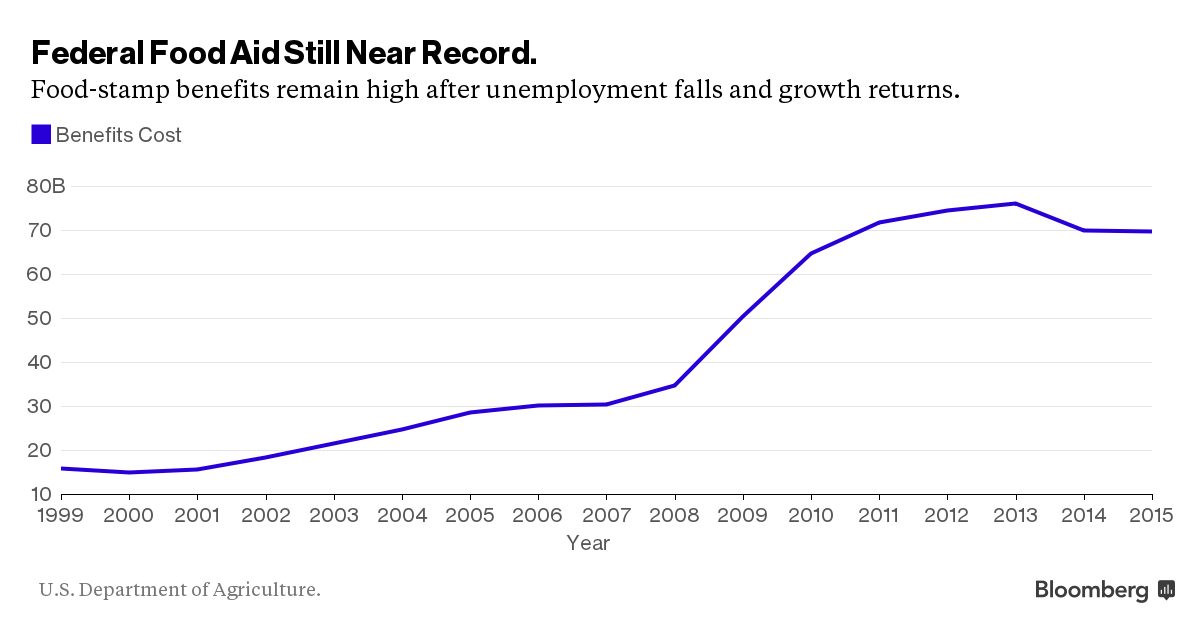
Federal spending on food stamps -- formally called the Supplemental Nutrition Assistance Program, or SNAP -- has more than doubled in the past five years, with most of the money spent at retailers including Supervalu Inc. (SVU) and Kroger Co. (KR) The program cost a record $79.9 billion in fiscal 2013, almost one-eighth of the roughly $650 billion a year Americans spend on groceries.

Some of that food aid is tied to the Low Income Home Energy Assistance Program, also known by its acronym, LIHEAP.

Heating Assistance

Under the previous farm law, states that gave residents as little as $1 a year in home-heating assistance -- a move nicknamed “heat-and-eat” -- could qualify that person’s household for an average of $1,080 in additional food stamps annually from the U.S. government.

About 15 states and the District of Columbia operated such programs. The new law raises to $20 a year the home-heating aid needed for a household to receive extra food-stamp money. The idea is that most of those 15 states would stop qualifying residents for the food aid and save the U.S. government money.

That’s not happening in the six states, which are diverting funds from other programs to spend on heating assistance. New York, for instance, said it raised home-heating spending by $6 million, triggering an additional $457 million a year in federal food-stamp spending to about 300,000 households.

‘Seems Odd’

“It seems odd that anybody would have a problem with states doing what the provision allows,” said Ellen Vollinger, a food-stamp lobbyist with the Food Research and Action Center in Washington, which encouraged states to create heat-and-eat programs. “The farm bill anticipated that some states would continue, and some would not continue.”

States that are qualifying residents for the extra aid are being unfair to taxpayers, Boehner said today.

“We just passed a farm bill, and we find states finding ways around the farm bill and frankly perpetuating the fraud that we were trying to stop,” he told reporters.

Anti-hunger organizations are lobbying states to allocate the extra money to preserve benefits as state officials agree to boost home-heating subsidies.

“By taking advantage of ‘heat and eat,’ Rhode Island is ensuring that our state’s most vulnerable residents such as the elderly and disabled citizens continue to benefit from the SNAP program,” Rhode Island Governor Lincoln Chafee, a Democrat who formerly served in the U.S. Senate as a Republican, said in a statement earlier this week.

“The advantage of this provision is clear,” said Chafee, who said continuing such programs would preserve $69 million in federal money for his state, aiding about 69,000 households.

About 46.8 million Americans received food stamps in December, the latest month data were available, the USDA said March 7. Almost half of all food stamps are redeemed at big-box retail chains such as Wal-Mart Stores Inc. (WMT), while most of the rest are used at supermarkets such as Safeway Inc., (SWY) according to data collected by Bloomberg.

http://www.bloomberg.com/news/2014-...keep-states-from-avoiding-food-stamp-cut.html
 
Re: Boehner Seeks to Keep States From Avoiding Food-Stamp Cut


Politicians from the hungriest counties
voted to cut food stamps


http://www.msnbc.com/msnbc/humphreys-zavala-americas-hungriest-counties


042114-food-insecurity-final_counties.png


Democrats, including Gallego, defended the cut as a compromise that prevented harsher benefit reductions. Democratic Rep. Jim McGovern of Mass., who represents a district affected by the Farm Bill cuts, dismissed that reasoning.

“If you believe that, I have a bridge to sell you for 10 bucks” he said. “I think that what some of the right-wingers learned was that going after [food stamps] in one big cut was probably unattainable, given that Democrats still control the Senate. I think they believe they can chip away at it.”

That means that if Republicans get their way—and especially if the party manages to take control of the Senate in this year’s midterm elections—food stamps in Humphreys County and Zavala County might soon be on the chopping block. Leading Republicans House Speaker John Boehner and Wisconsin Rep. Paul Ryan, have already signaled their interest in further cuts.


link
http://www.bloomberg.com/news/artic...-seven-americans-despite-recovery?cmpid=twtr1


Participation near record levels even as unemployment declines
  • Government waivers, uneven recovery blamed for ongoing need


Wendee Crofoot lost her job as a fundraiser for a non-profit in 2011. After exhausting her savings and giving up her Mountain View, California, apartment she ended up working part-time as a restaurant cashier.

The low pay qualified her for food stamps,so she signed up. “It wasn’t something I imagined would ever happen,” said Crofoot, 46. “There just weren’t any jobs.”

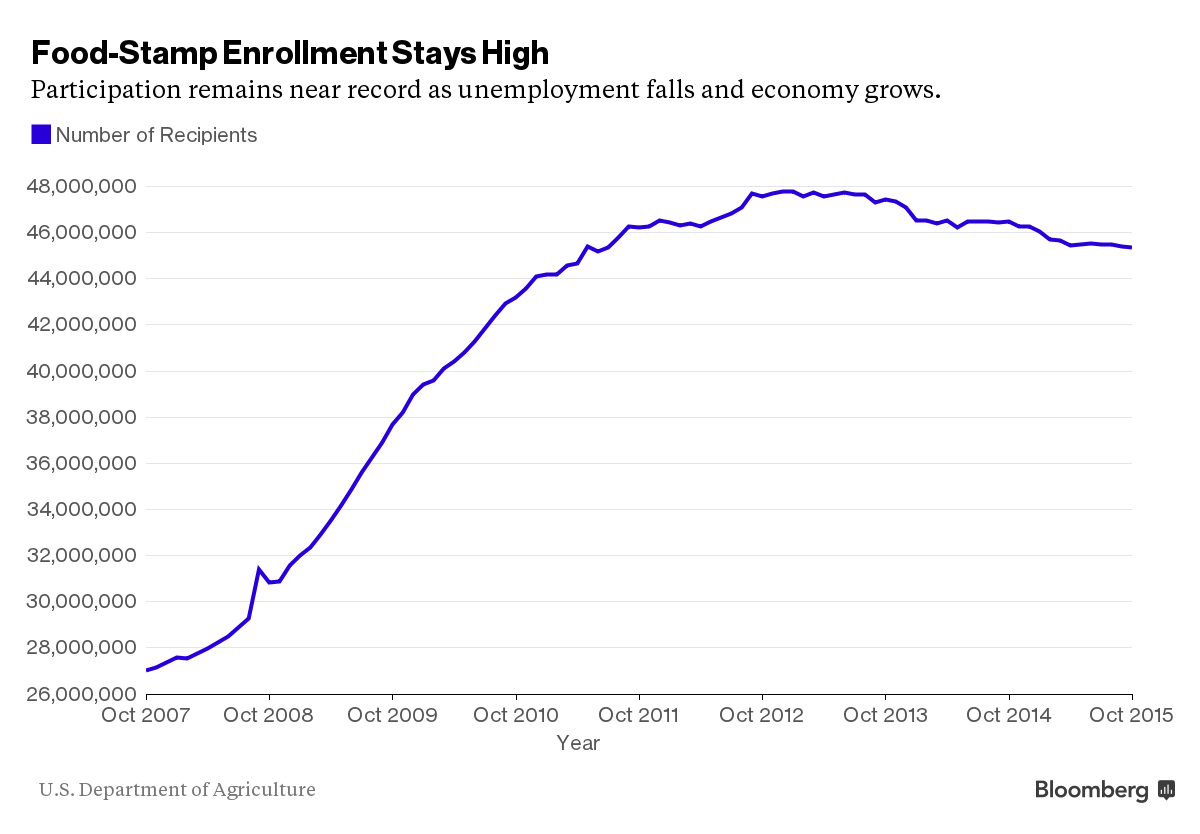
During the 2007-2009 recession, state and federal governments actively encouraged people like Crofoot to take advantage of the aid. Millions did, and many are still claiming benefits. Enrollment in the Supplemental Nutrition Assistance Program, the formal name for food stamps, remains near record levels, even as the unemployment rate has fallen by half.


“When unemployment was rising people said enrollment would fall sharply when things got better," said Parke Wilde, an associate professor of nutrition policy at Tufts University in Boston. "That hasn’t happened.”

Another economic downturn could send costs to new heights.

-1x-1.png

About 45.4 million Americans, roughly one-seventh of the population, received nutrition aid last October, the most recent month of data. Unemployment was 5 percent that month. The last time joblessness fell to that level, in April 2008, 28 million Americans used food stamps, and the program cost less than half of what the government paid out last year.

Even though eligibility rules remained unchanged during the recession, annual spending for the program, administered by states with federal dollars, more than doubled in five years to a record $76.1 billion in 2013.


Sign-Up Easier
Several reasons explain the high numbers. Governments have made it easier to sign up for the program. More than 85 percent of eligible food-stamp recipients took assistance in 2013, the most recent year of available data, compared to 70 percent in 2008. The higher sign-up rate among those qualified accounts for 8.6 million more people on food stamps -- about half of the program’s total increase.

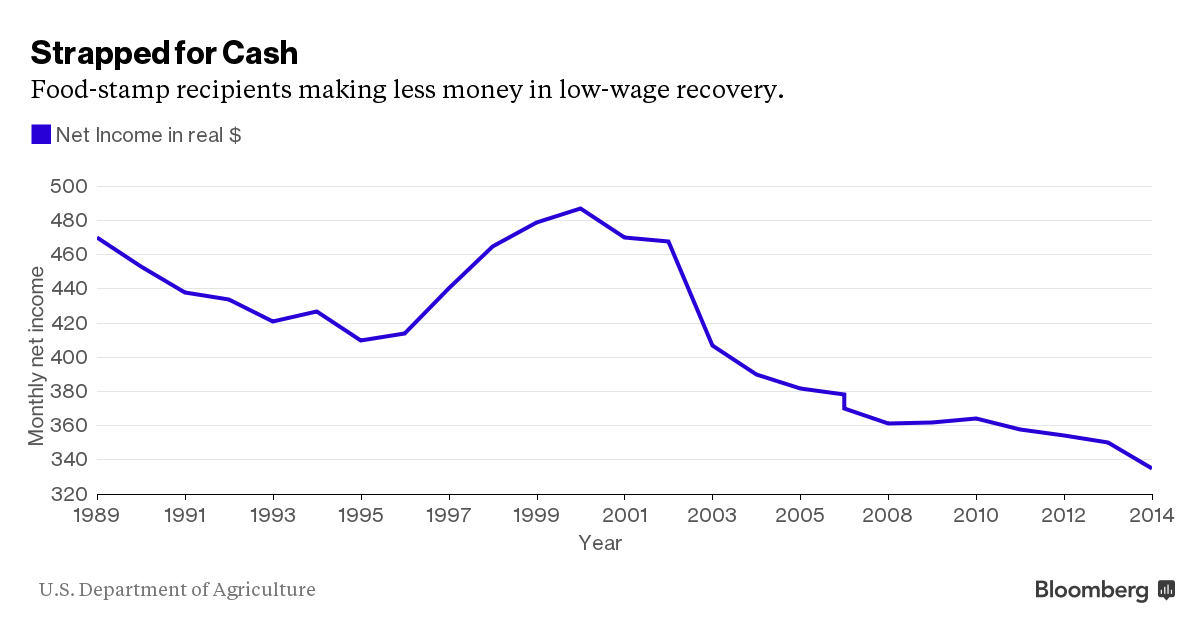
The uneven recovery has swelled the ranks of long-term unemployed and reduced the number of people working or looking for work, further boosting demand. Even for those with jobs, pay may be lower than in the past: In real dollars, SNAP recipients in 2014 had net incomes of $335 a month, the lowest since at least 1989.

Uneven Recovery
“The economy’s recovery is bifurcated,” said Kevin Concannon, the USDA undersecretary who heads the program. That makes food stamps crucial to "a very challenged safety net,” said Concannon, who previously directed state-level food-stamp programs in Maine, Oregon and Iowa.

-1x-1.png

The program became an issue in the 2012 presidential campaign, as Republican contender Newt Gingrich called President Barack Obama a "food stamp president." It still smolders, with Republicans including presidential candidate Jeb Bush saying SNAP needs to be reined in.

States began expanding food stamps during the George W. Bush administration and intensified efforts with the financial crisis.

So-called categorical eligibility, in which qualifying for one aid program automatically enrolls someone in food stamps, allowed potential recipients to bypass federal asset tests. State-administered “heat and eat” programs qualified people who received a token home-heating benefit.

Heat-and-eat expanded SNAP in the subsidized housing where Barb Bailly lives in Madison, Wisconsin. Bailly, 65, took a job bagging groceries after being dismissed from her job with a state agency. She retired at 62 and lives on SNAP and Social Security benefits.

“I was underemployed for years. I used credit cards to make expenses,” she said. “I have to be very careful with my money, but I can get by now.”

Three-Month Limit
Able-bodied, unemployed adults aged 18-49 who don’t have children are supposed to be limited to three months of food stamp benefits during a 36-month period. That can be extended during tough job markets, a provision that’s boosted the percentage of recipients who fit that description to 10.3 percent in 2014 from 6.7 percent in 2007.

Adding adults who should be able to find jobs has helped make the program too expensive to maintain, said Robert Rector, a research fellow at the Washington-based Heritage Foundation, which wants less social spending. It also creates ill will, as consumers see people in grocery checkouts who they think shouldn’t qualify.

Waivers and categorical eligibility are being used in unintended ways to keep federal dollars flowing, he said. “States have become accustomed to putting people in the program,” he said.

Government Dependence
Food stamps encourage government dependence, he said.

“Clearly there’s a group of people who are not in the labor force, and 10 years ago they would have been. Now they’re relying on food stamps.”

Suggestions that states and able-bodied workers are gaming the system angers Caitlin Segura, 28, who quit her job to care for her father, who died from cancer last year.

Unable to find steady work since, “I’m not going on a shopping spree for $100 a month” with food stamps, said Segura, who is covering rent on a $1,600-a-month apartment in Vallejo, California, with her father’s insurance money. "Food is one thing I don’t have to worry about, even if it means eating ramen for three weeks straight,” she said.

Push for Reform
Efforts to roll back the program in Congress have found little success.

Proposals from then-House Budget Committee Chairman Representative Paul Ryan of Wisconsin, now Speaker of the House, to turn the program into block grants have never made it into a final budget. Under the grants, states would administer the program as they saw fit at a lower cost to the federal government.

Republican-backed restrictions on categorical eligibility didn’t make it into a reauthorization Congress passed in 2014. That law did include higher thresholds for heat-and-eat programs. But most states met the new requirements, keeping their aid.

-1x-1.png

Some enrollment-boosting measures, such as the waivers for able-bodied workers, are being discontinued as unemployment declines. But a bigger food stamp program has become part of the U.S. social landscape, as lower-income populations continue to struggle and states use federal aid to support them, said Wilde, the Tufts professor.

“The U.S. is a bit strange among advanced economies in that we don’t like to give people cash,” he said. “SNAP plays a bigger role for low-income Americans because everyone needs food, and it’s an acceptable form of assistance.”

Crofoot’s assistance is ending: She’s found a second part-time job, one she said she hopes will get her career back on track. Her food-stamp benefits stopped last month.

“I called two weeks ago to cancel,” she said. “I’ve lost my savings. All the things you count on for your future, they’re gone.

“But I’m grateful to everyone who helped.
 
December 27, 2017

REPUBLIKLANS_END_FOOD_STAMPS.jpg


97_percent_poor_counties_meme.jpg

97 of the nation's 100 poorest counties in red states?
yYf4iyjs_3SsmHOm-3A7hKnaQy9y_04seYtGNNNtSNnbq9mXqIXm1QnrKoahWHtuN9z33DsbzEvDxCQHz0LgAGvHukFfDF4gPZCCRlxMjA7zjUqaJtgXHdO1PPrhW7T7r9EpkU5u

KKK-for_Trump.jpg


The RepubliKlan agenda is a 1000% ZERO for the Cac blue collar workers that foolishly and out-of-desperation voted for Drumpf in 2016.

But.....Now that it is apparent to all but the most recalcitrant racist ignoramuses that Trump has NO intention of making their meager lives better,— but in fact— is committed to taking away the $$$ little that they have left, including their Medicaid — these republiklan "dittoheads" got screwed by their "dear leader" betraying their dumb clusterfucked asses.


dae476f070d6576a964375e807ed1911.jpg

imrs.php

Drumpf's Moronic "They-Killing-Themselves-With-Opioids, Heroin & Meth" Voters

People in the “Reality Based” world know that anti Blacks & browns RACISM and willful proud ignorance coupled with meth & heroin and prescription opiods addiction is wiping these morons out...it's the dumb cacs plauge! Trump conned them just like the prosperity pimping preachers that they tithe 10% of their meager earnings to.


American_Whites_Killing_Themselves_2015.jpg


https://www.nytimes.com/2015/11/03/health/death-rates-rising-for-middle-aged-white-americans-study-finds.html


Why Are White Americans Dying Off? Check These Charts
- March 23, 2017
https://psmag.com/why-are-white-americans-dying-off-check-these-charts-4863da7c74e1


The Forces Driving Middle-Aged White People's 'Deaths Of Despair' - March 23, 2017
http://www.npr.org/sections/health-...g-middle-aged-white-peoples-deaths-of-despair

'Deaths of despair' on the rise among blue-collar whites - March 25, 2017
http://thehill.com/homenews/state-w...-despair-on-the-rise-among-blue-collar-whites[/URL]

LuckovichCanaryCoalMine_1000.jpg
 
I have not read the article yet but I read a few of the comments. Our health is our only real wealth, this is the world's best kept secret. Our only real hope of anything is when we finally see somebody that has overcome the system we were born in. All over the world wealth is controlled by white power. Being a carbon copy ensures success. It can only be changed by someone that overcomes it.
Most of the wealth I have accumulated at a certain time in my life went toward my health. It is yet to pay off but I know eventually it will.
Can you image the people that wanted Jesus dead and the ones that crucified him coming to him for help with health problems? Or can you image the people that Jesus helped and healed coming to him for education, jobs, etc.? Nobody should have to sell their souls or manhood to survive. The ones doing it without knowing it would be just like the brainwashed ones in Jonestown. It is not their fault.
The real crooks of the world will continue to build a military with a hidden agenda, space programs with a hidden agenda, lifestyle that is really suicidal,etc.
Nobody should be on foodstamps or welfare. And Dick Gregory was right, companies like Lockheed Martin and others is welfare for the ones in the click. There should also be no homeless anywhere in the world. Their was a time when it was only blacks on the face of the earth. And this is the real target of trying to keep us from getting the earth back. Others are just collateral damage in this struggle.
 
Back
Top