3 Steps Could Lower Oil Prices, but Nobody'll Take Them

QueEx

Rising Star
Super Moderator
<font size="5"><center>These steps could lower oil prices,
but nobody'll take them</font size></center>


754-9web-Oil_Prices-AP-major.major_story_img.prod_affiliate.91.jpg

A gas customer fills up Monday in Burlington, Vt.


McClatchy Newspapers
By Kevin G. Hall
Monday, June 9, 2008

WASHINGTON — As gasoline prices soar to new records, America's president — and the two men who hope to succeed him — are offering only partial or long-term solutions and ignoring three steps that many experts say could bring some relief now.

Americans began this workweek by crossing a dismal threshold, paying a once-unthinkable nationwide record average of $4.02 per gallon Monday for unleaded gasoline, with the prospect of even higher prices in months ahead.

On Monday, President Bush said one answer is to increase oil drilling in Alaska and offshore. Presumptive Republican presidential nominee John McCain's chief economic adviser renewed McCain's call to suspend the 18.4 cent-per-gallon federal gasoline tax. Presumptive Democratic nominee Barack Obama called for a windfall profits tax on oil companies.

Independent experts, however, said that government could take at least three other steps that could force oil and gasoline prices down immediately. Neither Bush nor McCain nor Obama endorse any of them.

  • Perhaps the quickest action, the experts said, would be ordering curbs on financial speculation. Financial industry heavyweights have acknowledged in recent testimony before Congress that such speculation is driving oil prices higher.

    Pension funds, endowments and other big institutional investors are pumping big money into index funds linked to commodities, including oil, driving up demand — and prices. The popular Goldman Sachs Commodities Index attracted $260 billion in investment last year, compared to $13 billion five years earlier.

    Complicating any effort to harness that, about 30 percent of the trading in crude oil is done in "dark areas" — markets in London and Dubai — that aren't regulated by the U.S. Commodity Futures Trading Commission (CFTC).

    President Bush could order the CFTC to regulate U.S. investments in those markets with a snap of his fingers, said Michael Greenberger, a law professor at the University of Maryland and a former director of trading for the CFTC.

    "Essentially this could be ended this afternoon if the Bush administration had the stomach to do it," he said. "Those abdications of responsibility and allowing these exchanges to trade in 'dark' markets ... provides an environment for speculators to thrive."

    The CFTC is investigating the link between speculation and oil prices but hasn't scheduled any action.

  • A second partial solution would be to boost the supply of oil available on the market by releasing as much as 1 million barrels a day of oil now held in the nation's Strategic Petroleum Reserve. That step is being pushed by, among others, the Center for American Progress, a Democratic think tank run by several former Clinton administration officials.

    Do that for 90 days — through the summer driving season when consumer demand for gasoline is highest — and the reserve would lose less than 15 percent of the oil held in case of national emergency.

    "Put that on the market, and the price of oil will fall," said Daniel J. Weiss, a senior fellow at the center.

    It's not entirely clear that U.S. refineries could handle all that extra oil, but it would signal to traders of oil contracts that the U.S. market is adequately supplied.

  • Finally, the Federal Reserve could act to boost the weak dollar, which has led oil producers to demand higher prices for oil, because oil generally is traded in dollars. Oil producers want higher prices to offset the cost of converting dollars into euros and other currencies that have grown stronger against the dollar.

    The best way to bolster a currency is to boost interest rates, but the Federal Reserve has been reluctant to do that with America teetering on the brink of recession. The central bank in Europe, where growth is more robust, is poised to raise rates, however. That could weaken the dollar further, and drive oil prices even higher.

Senate Democrats on Tuesday will try to muster 60 votes to allow a vote on legislation that could significantly affect the oil industry and oil prices. The legislation would, among other things, instruct CFTC regulators to require investors to plunk down more of their own money if they want to speculate in oil markets.

Instead, Douglas Holtz-Eakin, McCain's chief economic adviser, told McClatchy that a "holiday from the 18.4 cent per gallon federal gasoline tax has lowered prices every time it's been tried "and it is felt all through the economy."

The idea of a gas-tax holiday has little traction in the Democratic Congress, however, and many economists oppose it as likely to spur consumption and make things worse.

Speaking in Raleigh, N.C., Obama on Monday repeated his call for a tax on high oil company profits to fund aid programs for the poorest Americans.

"I'll make oil companies like Exxon pay a tax on their windfall profits, and we'll use the money to help families pay for their skyrocketing energy costs and other bills," he said.

Longer term though, Obama said, the only answers are to increase use of alternative energy — solar, wind, biodiesel, clean-coal technology — and to increase fuel-mileage standards for vehicles and develop hybrid-electric cars, which will take time.

McCain's longer-term answers turn more toward increasing production of oil from offshore and from oil-shale deposits in the mountain West.

McClatchy Newspapers 2008


http://www.mcclatchydc.com/227/story/40360.html
 
A great solution, would be to rebuild the railway system, we have a stockade of coal, that could be used to run trains, the process is diffrent, but possible. Encouraging public transit that would remove alot of the bigger vessels from the road ways and decrease the need for oil, fuel prices would drop because there would be less demand for gasoline and diesel...
 
A great solution, would be to rebuild the railway system, we have a stockade of coal, that could be used to run trains, the process is diffrent, but possible. Encouraging public transit that would remove alot of the bigger vessels from the road ways and decrease the need for oil, fuel prices would drop because there would be less demand for gasoline and diesel...

I've been seeing a lot of "Clean Coal" ads lately that sound a like lot like those happy sounding "incredible, edible egg" commercials. Hell, everyone knows that if coal is clean then that incredible egg is absent of cholesterol. Neither are true but, I guess we gotta consume something.

I follow your supply and demand theory but what about all of that increase in Asian demand that I keep hearing about? Is that increase not nullifying our decrease ?

QueEx
 
A great solution, would be to rebuild the railway system, we have a stockade of coal, that could be used to run trains, the process is diffrent, but possible. Encouraging public transit that would remove alot of the bigger vessels from the road ways and decrease the need for oil, fuel prices would drop because there would be less demand for gasoline and diesel...

I've always thought trains have been a great neglected form of transport in the US.

Japan has superfast trains.
Europe has superfast trains.

Why doesn't the US have superfast trains?

The oil and car lobby.

Unfortunately, trains are a long-term solution. But, if they had taken care of business in the 70s (during the last oil crisis), this wouldn't be an issue today.

I don't like any of the measures mentioned in the article above (regulating markets, using the strategic oil reserve, raising interest rates).
 
A great solution, would be to rebuild the railway system...

It's a chicken egg thing (which comes first).

FIRST, people have to stop driving their cars and start lining up at the train station. THEN, we'll see movement to improve mass transportation.

If ten percent of some downtown bank or insurance company's employees show up late for work every day complaining about overcrowded trains and buses, you can be sure the mayor will learn about it quick. Probably discover that these companies suddenly have funds to spend on municipal bonds, too.
 
I know to some, it's a pipe dream, to some, but as in the world of traveling road shows and carnivals, the baseball field saying "build it and they will come"... It's pretty much nostalgia to most, who don't use the rails to travel. Lazy and easiser, to slide the credit card, gas up the Honda and drive, a trip to the market, around the block to drop off the kids, vist to say hello grandma.

All collectively intelligent people, need is an OPTION, a destination, a departure time and an arrival time, it's really that simple, TRAINs move many people, collectively, willfully efficently...
 
That's old school.

The new mantra is, "Show me the money!"

That shit is old too, the latest is sit on your fat ass and watch REALITY TV, featuring people who have the same issues you do, just broadcasted, encouraging you to do absolutely nothing, NOTHING, gripe and make yourself feel just a little better, while chomping on fattening food and holding the remote, during commercials, click over to FOX, for the latest misinformation broadcast, BRAINWASHED fucks...
 
That's old school.

The new mantra is, "Show me the money!"

Build it and they will come is relevant just look at the housing market. Although it's in decline they built it and people in record numbers opted in... the principle is sound as long as there is thought and convenience built into the objectives.
 
3 steps that nobody will take:

-public transit

-ride a bike

-walk

You can't blame the government without looking at yourself first.
 
<font size="4">
Is nobody considering what the federal government
did following the Arab Oil Embargo of 1973-1974 ???

</font size>


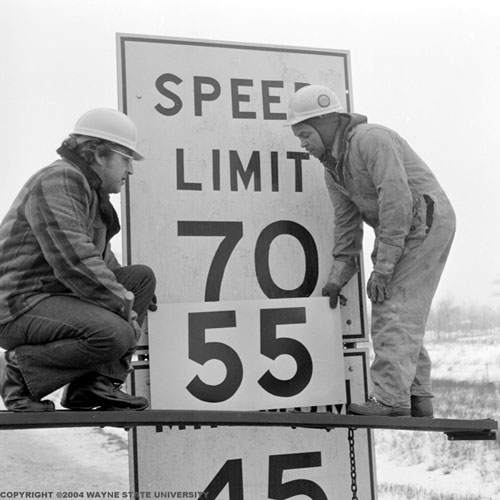
ID38009_speedlimit.jpg


`
 
3 Ways to Lower Gas Prices

[FLASH]http://www.liveleak.com/e/2ed_1213364080[/FLASH]
free the energy market NOW!:angry:
 
$4 a gallon... hmm, in my opinion it will have to go up another dollar before we're willing to change our lifestyle. Till then, we'll just moan, complain, and make a few posts.

I think the oil producing nations are starting to get fearful of the backlash. Remember when the american auto workers kept racheting up their wage demands? How did that work out for them? The same goes for oil. As it continues to climb, other fuels become more cost effective, until one day...poof, the oil market shrinks considerably. I think the oil producing nations are fearing this is a runaway train and they will be the victims of the wreck in the long run.
 
I'm with Bush on this one.


Bush to Congress: Embrace energy exploration now

By H. JOSEF HEBERT, Associated Press Writer 45 minutes ago

With gasoline topping $4 a gallon, President Bush urged Congress on Wednesday to lift its long-standing ban on offshore oil and gas drilling, saying the United States needs to increase its energy production. Democrats quickly rejected the idea.

"There is no excuse for delay," the president said in a statement in the Rose Garden. With the presidential election just months away, Bush made a pointed attack on Democrats, accusing them of obstructing his energy proposals and blaming them for high gasoline costs. His proposal echoed a call by Republican presidential candidate John McCain to open the Continental Shelf for exploration

"Families across the country are looking to Washington for a response," Bush said.

Congressional Democrats were quick to reject the push for lifting the drilling moratorium, saying oil companies already have 68 million acres offshore waters under lease that are not being developed.

House Speaker Nancy Pelosi called Bush's proposals "another page from (an)... energy policy that was literally written by the oil industry — give away more public resources."

Sen. Barack Obama, the Democrats' presumptive presidential nominee, rejected lifting the drilling moratorium that has been supported by a succession of presidents for nearly two decades.

"This is not something that's going to give consumers short-term relief and it is not a long-term solution to our problems with fossil fuels generally and oil in particular," said Obama. Senate Majority Leader Harry Reid, lumping Bush with McCain, accused them of staging a "cynical campaign ploy" that won't help lower energy prices.

"Despite what President Bush, John McCain and their friends in the oil industry claim, we cannot drill our way out of this problem," Reid said. "The math is simple: America has just three percent of the world's oil reserves, but Americans use a quarter of its oil."

Bush said offshore drilling could yield up to 18 billion barrels of oil over time, although it would take years for production to start. Bush also said offshore drilling would take pressure off prices over time.

There are two prohibitions on offshore drilling, one imposed by Congress and another by executive order signed by Bush's father in 1990. Bush's brother, Jeb, fiercely opposed offshore drilling when he was governor of Florida. What the president now proposes would rescind his father's decision — but the president took the position that Congress has to act first and then he would follow behind.

Asked why Bush doesn't act first and lift the ban, Keith Hennessey, the director of the president's economic council, said: "He thinks that probably the most productive way to work with this Congress is to try to do it in tandem."

Before Bush spoke, the House Appropriations Committee postponed a vote it had scheduled for Wednesday on legislation doing the opposite of what the president asked — extending Congress' ban on offshore drilling. Lawmakers said they wanted to focus on a disaster relief bill for the battered Midwest.

Bush also proposed opening the Arctic National Wildlife Refuge for drilling, lifting restrictions on oil shale leasing in the Green River Basin of Colorado, Utah and Wyoming and easing the regulatory process to expand oil refining capacity.

With Americans deeply pessimistic about the economy, Bush tried to put on the onus on Congress. He acknowledged that his new proposals would take years to have a full effect, hardly the type of news that will help drivers at the gas stations now. The White House says no quick fix exists.

Still, Bush said Congress was obstructing progress — and directly contributing to consumers' pain at the pump.

"I know the Democratic leaders have opposed some of these policies in the past," Bush said. "Now that their opposition has helped drive gas prices to record levels, I ask them to reconsider their positions."

Bush said that if congressional leaders head home for their July 4 recess without taking action, they will need to explain why "$4 a gallon gasoline is not enough incentive for them to act. And Americans will rightly ask how high gas prices have to rise before the Democratic-controlled Congress will do something about it."

Bush said restrictions on offshore drilling have become "outdated and counterproductive."

In a nod to the environmental arguments against drilling, Bush said technology has come a long way. These days, he said, oil exploration off the coastline can be done in a way that "is out of sight, protects coral reefs and habitats, and protects against oil spills."

Congressional Democrats, joined by some GOP lawmakers from coastal states, have opposed lifting the prohibition that has barred energy companies from waters along both the East and West coasts and in the eastern Gulf of Mexico for 27 years.

On Monday, McCain made lifting the federal ban on offshore oil and gas development a key part of his energy plan. McCain said states should be allowed to pursue energy exploration in waters near their coasts and get some of the royalty revenue.

Obama retorted that the Arizona senator had flip-flopped on that issue.

http://news.yahoo.com/s/ap/20080618/ap_on_go_pr_wh/offshore_oil
 
I have to say AH, you shocked me with this one. Never did I expect to see you take
the same position as any conservative would. But hell, when comes down to money,
many a people lose their principles.

Assuming that drilling offshore and in the ANWR is the right thing to do, how does
Obama now get with it? He's attacked McCain for his (partial) flip-flop; can Obama
now reverse his own course and support drilling ??? Will the enviromentalist ever
forgive Obama if he does ???

QueEx
 
Back
Top