Colin Alert ....

Just thought it be a good read
http://marvel.com/news/story/15240/a_marvel_black_history_lesson_pt_1
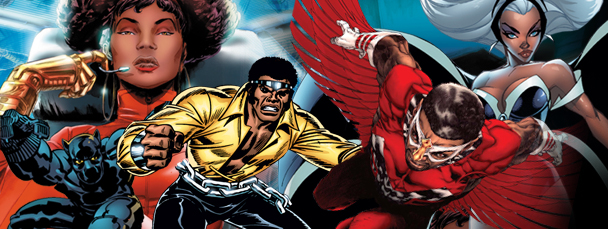
A Marvel Black History Lesson Pt. 1
Beginning an exploration of the rich and complex evolution of the black character at Marvel, from Gabe Jones through Storm
Posted Feb 18, 2011 3:14 pm
Updated Feb 18, 2011 3:18 pm
By David Brothers
It isn't immediately obvious, but the evolution of black characters in the Marvel Universe has intersected with black history in real life off and on over the past 50 years. Sometimes Marvel's forward-looking approach to racial politics resulted in the company making history, and at other points, they simply ended up with the right book in the right place at the right time. Marvel's characters run the gamut from normal people to godlike super heroines, and their black characters reflect that diversity.
 Gabriel "Gabe" Jones isn't Marvel's first black character, but he's a good place to start. Stan Lee and Jack Kirby created him in 1963 as a cast member in SGT. FURY AND HIS HOWLING COMMANDOS #1. Not content with creating one of—if not the very—first explicitly Jewish heroes in comics in Private Izzy Cohen, Lee and Kirby rewrote history when they introduced Private Jones. The U.S. military was not integrated until 1948, but Jones served alongside Nick Fury and his Commandos in World War II just the same. While the rest of the Commandos were shouting "WAH-HOOO!" to let the Nazis know they were coming, Jones blew on his trumpet and lead the way into battle.
While this doesn't seem like a big deal to those of us living in 2011, there are several reasons why the existence of Gabe Jones is notable. War comics have generally been enormously popular with kids; they glamorize the United States, present an easy to digest definition of heroism, and were often used to deliver simple, but sometimes necessary, life lessons. Heroes in war comics—Fury and his Commandos—included, were honorable men first and foremost. They lived by a strong moral code and treated everyone fairly, especially their enemies. By placing Jones on the team without any fanfare, Lee and Kirby were making a very clear statement: African Americans are just as normal and honorable as everyone else.
On top of that, on August 28, 1963, Doctor Martin Luther King led the March on Washington, which led to the Civil Rights Act. Doctor King's "I Have A Dream" speech and Gabe Jones both represent the same ideals: that all men, everywhere, are created equal, and that racial harmony is both natural and the future of mankind.
 In 1966, The Black Panther made his debut in the pages of FANTASTIC FOUR #52. He came just after a series of issues that helped make the Lee/Kirby run. FANTASTIC FOUR #48-50 told the first Galactus story, while #51 was "This Man, This Monster," one of the all-time best single issue stories ever. In #52, the First Family of Marvel took a vacation to Wakanda at the Panther's request. Rather than sunny beaches and palm trees, they find themselves in the middle of an ambush. The Panther surprises and beats his future allies before the timely intervention of Wyatt Wingfoot upsets his plans.
Whether it was luck or simply being in tune with the zeitgeist, Lee and Kirby created The Black Panther a few short months before Bobby Seale and Huey P. Newton founded the Black Panther Party for Self-Defense in Oakland. Marvel's Black Panther represented something that was rare in real life: an African country that avoided being colonized by European governments. Wakanda was self-sufficient, technologically advanced, and had been for centuries, serving as a symbol of African ingenuity and power. On top of that, the Panther's defeat of the Fantastic Four thanks to careful planning and Reed Richards's deep respect for his technological prowess showed that black heroes were just as capable as any other super hero.
The Panther went on to join the Avengers before eventually gaining a starring role in JUNGLE ACTION. Don McGregor, Rich Buckler, Gil Kane and Billy Graham created a genuinely epic story that took the character back to Wakanda. They dealt with what happens when a monarch leaves his country for an extended period of time, and over the course of the story, incorporated mature subject matter like the effect of violence on children, the ravages of war, and the disintegration of a marriage.
 One of the many things I love about The Black Panther is how he adds yet another piece to the complexity of the Marvel Universe,” says current BLACK PANTHER: THE MAN WITHOUT FEAR writer David Liss. “Unlike the other major black characters, BP is African, not African American, and this allows [him] to engage with unique issues, especially regarding American foreign policy. Like so many great Marvel heroes, he is both supremely competent and an alienated loner, but his ability to serve as a sounding board for colonial and post-colonial discourses makes him unique. I know that I, for one, love a character who raises some interesting and thought-provoking questions while, at the same time, kicking ass.”
“Since his introduction, T’Challa has always been an icon and a role model,” adds former BLACK PANTHER writer Jonathan Maberry. “He was ethical, he had values, he had nobility and dignity, he was brilliant, and he was a leader rather than a follower. Imagine the impact of all that on kids like me: white kids growing up in economically depressed neighborhoods, where bigotry was commonplace and racial intolerance was the primary lesson we learned at home. Suddenly there was a black character who wasn’t the white guy’s sidekick. He wasn’t any kind of second string—or worse—stereotype. He was equal to Reed Richards. T’Challa’s values were based on a worldview rather than an America-centric view, which was also something kids like me hadn’t really encountered.
“The kicker for me came with a guest appearance in FANTASTIC FOUR #119, in which T’Challa was arrested and imprisoned in a fictional country clearly based on South Africa. The Human Torch and The Thing came to help him break out. This was the first ‘apartheid’ story in comics, and it blew me away. There was a lot of subversive subtext in it, too. Consider, The Human Torch, though white, is ‘red’ when aflame. The Thing, also white, is brown—well, orange, but close enough—in his rock form. What we have here, subtly mixed into the story, are white men, red men, and various shades of brown men working together to showcase the foolishness and backward cruelty of apartheid.
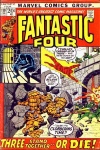 "The image that was burned into my young mind was the panel that showed their feet as they walk through the rubble of the prison wall, and the placards indicating separate entries for ‘Whites’ and ‘Coloreds’ being crushed underfoot. It’s no joke to say that T’Challa and the stories written about him in the 60’s helped open my eyes and my mind to the positive power of diversity and the destructive stupidity of prejudice.”
Joseph "Robbie" Robertson first appeared in 1967's AMAZING SPIDER-MAN #51 as a minor background character, but over the next few decades, he grew into an invaluable member of Spider-Man's supporting cast. Something that was lacking in young Peter Parker's life was a living father figure. While Uncle Ben had a tremendous effect on Spider-Man's development, he didn't truly have a man he could speak to and fully trust.
J. Jonah Jameson was wise and an experienced newsman, but his vendetta against Spider-Man and general curmudgeonly nature made him hard to approach. Captain Stacy came close to being what Parker needed, but he died early in their relationship. Others, like Curt Connors or Miles Warren, came with their own pitfalls. Norman Osborn, of all people, had the potential to be a solid father figure, but quickly evolved into Spider-Man's worst enemy, and we all know where that story went.
Robbie filled the niche with aplomb. He's a kind man, more than willing to share his life experiences when necessary, and always up to assist Spider-Man when he needs it. While it hasn't ever been outright stated, there is definitely the implication that Robbie knows that Peter Parker is Spider-Man. The fact that he has kept Peter's secret all these years speaks volumes of his character.
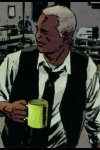 “What I liked about Robbie [as a reader] was he was one of the few adults in the book that Pete could confide in—in fact if you look back, he’s one of the few sane people in the book,” observes AMAZING SPIDER-MAN editor Steve Wacker. “With his vest, rolled up sleeves and loosened tie, I always got the impression that this was a real newspaper guy who somehow stumbled into the comic. He remains a perfect foil to Jonah’s never ending histrionics and a reminder that the Bugle was—and is—a pretty solid news organization, despite its hatred for Spidey.”
In 1969, Stan Lee and Gene Colan created Sam "The Falcon" Wilson for CAPTAIN AMERICA #117. Sam Wilson was a normal man before The Red Skull used the Cosmic Cube to attempt to give him the ability to speak to Redwing, his falcon. After acquiring a flying harness and befriending Captain America, Falcon joined the Marvel Universe, and soon the Avengers. His connection with Redwing was soon expanded to be a mental link to any type of bird, giving him access to an unparalleled network of eyes for reconnaissance. After all, who notices the hundreds of thousands of birds that live and fly through every city?
Jack Kirby took control of the character in the mid-70’s and created a landmark run in the pages of CAPTAIN AMERICA. The cover title was styled “Captain America & The Falcon,” giving the Falcon equal billing with the Sentinel of Liberty, and Kirby's story lived up to that billing in a beautiful way.
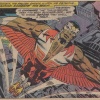 Kirby's approach was a breath of fresh air. There was no real reason for either man to be subordinate to the other, as each had his own skills and areas of expertise. Rather than having a student/teacher or hero/sidekick relationship, Cap and Falcon were best friends who lived, ate, and fought together on an equal footing. They told each other what to do, they argued, and eventually, they agreed with each other. They were friends first, and that was a more than welcome change from how many other black super heroes were portrayed in the comics industry at the time. Some black characters were different versions of other heroes, rather than being their own man, while others were relegated to sidekick status.
“The Falcon was the very first African-America super hero, as opposed to The Black Panther, who preceded him, but wasn't American,” notes Marvel Senior Vice President of Publishing Tom Brevoort. “In a time when the struggle for civil rights was very much at the forefront of the American dialogue, The Falcon brought some of those issues concerning the black experience onto the comic book page for the very first time. He was so popular that he rapidly became a co-headliner on the series. Not just a reflection of Cap, The Falcon was his own man, and steadily expanded on and improved his arsenal of weaponry and powers, aided by characters such as The Black Panther, who developed the Falcon's wings.
“The Falcon was also the first super hero of color to get his own action figure back in the 1970’s, reflecting his importance to the times.” Brevoort continues. “In recent years, The Falcon has reversed his traditional role, taking on a position as mentor and older brother to James Barnes, the current Captain America, in the same manner in which Steve Rogers once mentored him.”
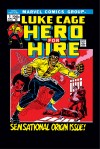 After The Falcon came Luke Cage, the first black super hero to star in his own ongoing title, thanks to Archie Goodwin and John Romita Sr. On the surface, HERO FOR HIRE #1 introduced a character who was an attempt to tie in to the “blaxploitation” craze that was beginning to sweep Hollywood. Cage was an ex-con, wrongly convicted, who escaped prison and came back to Harlem to clear his name and make some money. He spoke with a funky type of jive, worked in the ghetto, and was a little edgier than a lot of other heroes.
While the blaxploitation angle may have been Cage's genesis, the execution gave him a style all his own. Cage is a hustler, in the best possible sense of the word. After acquiring powers and returning home, he realized that he needed funds. A chance encounter convinced him to use his powers to solve the money problem. He took on the trappings of a super hero—the costume, and later a codename—so that he could market himself appropriately. His trademark yellow shirt and silver tiara were things he picked out because they were the most like a costume. He knew his target audience and just what he had to do to get their attention. He's aware of exactly who he is and what he needs to do.
"Street smarts" is something that's difficult to convey in comics. In Cage's case, "street smarts" represent a different, but no less useful, type of intelligence from something like Tony Stark's advanced robotics knowledge or Reed Richards's general super-brain. He knows how to get around in life and accomplish what he needs, and more than that, he knows how to do it well.
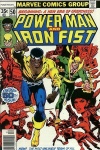 Cage's origin story involves experiments on prisoners as part of what has since been revealed to be the Super Soldier Project. This provides a light and slightly eerie parallel to the Tuskegee Experiment, which began in 1932 and ended in 1972. This tremendously unethical experiment involved almost 400 poor black men whose disease was left intentionally untreated. The men were given free medical exams, but misled as to the nature of their sickness. This went on even after a cure was found. Cage's story provides an unintentional counterpoint to past injustices, and represents a triumph over adversity.
On top of that, with the introduction of POWER MAN & IRON FIST in 1978, a team-up comic where Luke Cage's blaxploitation and Iron Fist's kung fu collide, Marvel managed to tap into pop culture to great effect once more. Blaxploitation films proved popular with black audiences, but so did kung-fu movies. The poorly translated movies featured uplifting tales of brotherhood, underdogs prevailing against various versions of “The Man,” and secret strength being found in humble packages. While these are values of universal appeal, it's easy to see why they might hold special resonance with black audiences.
1975's AMAZING SPIDER-MAN #140 introduced Glory Grant to the Marvel Universe, and she soon became another classic member of the cast. Glory went from being a friendly neighbor to a good friend before ending up as J. Jonah Jameson's secretary. Jameson, despite his traditionally grumpy demeanor, took a liking to Glory, which may be a milestone in and of itself. Grant has popped up several times in the recent past, always as stylish and cheery as her first appearance.
MARVEL PREMIERE #20, released the same month as Glory's debut, was the first true appearance of Misty Knight, co-founder of Knightwing Restorations with her best friend Colleen Wing and current organizer of the Heroes for Hire network. When you consider her prominent afro and her no-nonsense demeanor, it's easy to see the similarities to the roles Pam Grier played in movies like “Coffy” and “Foxy Brown.” Misty was smart, stylish, sexy, and more than willing to get her hands dirty to get the job done, just like Grier's characters.
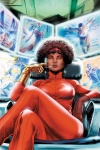 “Misty was originally a character created off the back of commercial movie trends in the 70’s, so it’s great to see that she has become one of those really rounded, complete characters in the Marvel Universe,” note Dan Abnett and Andy Lanning, the current co-writers of HEROES FOR HIRE, in which Misty stars. “Like Rick Jones, she has real personality and is absolutely woven into the fabric of Marvel continuity. It’s very human characters like Misty that sustain the Marvel Universe as a backdrop for the mega stars like Captain America and Thor and Spider-Man.”
GIANT-SIZE X-MEN #1 introduced the third new black woman of 1975: Ororo Munroe, better known as Storm. If Gabe Jones stood for reality, Black Panther for ingenuity, Robbie Robertson for integrity, The Falcon for equality, Luke Cage for self-awareness, and Misty Knight for unadulterated cool, Storm was the combination of all of their traits and more. She was the daughter of a Kenyan princess and a photojournalist from Harlem, and therefore a direct link from African Americans and the continent known as "the Motherland." She was powerful on a world-class level, refused to allow anyone to be her master, and commanded a massive amount of respect from all who knew her.
Five years after her first appearance, Storm became leader of the X-Men after besting Cyclops in combat, a monumental feat for a black character, and doubly so for a black female character. The X-Men are the big-time, as far as super hero teams go, and having a black woman leading the group into battle was a big deal. Over the course of her career, Storm has consistently risen in stature, becoming one of the best-loved characters in Marvel's stable.
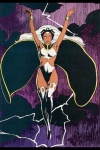 “Besides being arguably Marvel’s most prominent female hero, Storm is also one of its most versatile characters,” states Daniel Ketchum, editor of the 2008-2009 X-MEN: WORLDS APART limited series, which starred Storm. “Over the course of her history, she’s been a thief, a goddess, leader of the X-Men and Queen of an African nation. As such, she creates unique avenues for stories in any title in which she appears. This, coupled with her formidable presence and visually-explosive powers, makes Storm an indispensible asset to the X-Men franchise and the Marvel Universe at large.”
Storm represented a shift in how black characters in comics were portrayed. Companies and readers had clearly become more comfortable with embracing black characters, whether as supporting cast members or headliners. The spectrum of black characters created between 1963 and 1975 speaks volumes. From unpowered normal heroes to supporting cast members to super heroes and, finally, eventual leaders, Marvel rapidly and wholeheartedly embraced the values spoken of in Doctor Martin Luther King Jr.'s "I Have A Dream" speech. There was nowhere to go but up, and the next 40 years proved that.
Our Black History Month retrospective continues next week as we move into the 1980’s and beyond
Just thought it be a good read
http://marvel.com/news/story/15240/a_marvel_black_history_lesson_pt_1
A Marvel Black History Lesson Pt. 1
Beginning an exploration of the rich and complex evolution of the black character at Marvel, from Gabe Jones through Storm
Posted Feb 18, 2011 3:14 pm
Updated Feb 18, 2011 3:18 pm
By David Brothers
It isn't immediately obvious, but the evolution of black characters in the Marvel Universe has intersected with black history in real life off and on over the past 50 years. Sometimes Marvel's forward-looking approach to racial politics resulted in the company making history, and at other points, they simply ended up with the right book in the right place at the right time. Marvel's characters run the gamut from normal people to godlike super heroines, and their black characters reflect that diversity.
While this doesn't seem like a big deal to those of us living in 2011, there are several reasons why the existence of Gabe Jones is notable. War comics have generally been enormously popular with kids; they glamorize the United States, present an easy to digest definition of heroism, and were often used to deliver simple, but sometimes necessary, life lessons. Heroes in war comics—Fury and his Commandos—included, were honorable men first and foremost. They lived by a strong moral code and treated everyone fairly, especially their enemies. By placing Jones on the team without any fanfare, Lee and Kirby were making a very clear statement: African Americans are just as normal and honorable as everyone else.
On top of that, on August 28, 1963, Doctor Martin Luther King led the March on Washington, which led to the Civil Rights Act. Doctor King's "I Have A Dream" speech and Gabe Jones both represent the same ideals: that all men, everywhere, are created equal, and that racial harmony is both natural and the future of mankind.
Whether it was luck or simply being in tune with the zeitgeist, Lee and Kirby created The Black Panther a few short months before Bobby Seale and Huey P. Newton founded the Black Panther Party for Self-Defense in Oakland. Marvel's Black Panther represented something that was rare in real life: an African country that avoided being colonized by European governments. Wakanda was self-sufficient, technologically advanced, and had been for centuries, serving as a symbol of African ingenuity and power. On top of that, the Panther's defeat of the Fantastic Four thanks to careful planning and Reed Richards's deep respect for his technological prowess showed that black heroes were just as capable as any other super hero.
The Panther went on to join the Avengers before eventually gaining a starring role in JUNGLE ACTION. Don McGregor, Rich Buckler, Gil Kane and Billy Graham created a genuinely epic story that took the character back to Wakanda. They dealt with what happens when a monarch leaves his country for an extended period of time, and over the course of the story, incorporated mature subject matter like the effect of violence on children, the ravages of war, and the disintegration of a marriage.
“Since his introduction, T’Challa has always been an icon and a role model,” adds former BLACK PANTHER writer Jonathan Maberry. “He was ethical, he had values, he had nobility and dignity, he was brilliant, and he was a leader rather than a follower. Imagine the impact of all that on kids like me: white kids growing up in economically depressed neighborhoods, where bigotry was commonplace and racial intolerance was the primary lesson we learned at home. Suddenly there was a black character who wasn’t the white guy’s sidekick. He wasn’t any kind of second string—or worse—stereotype. He was equal to Reed Richards. T’Challa’s values were based on a worldview rather than an America-centric view, which was also something kids like me hadn’t really encountered.
“The kicker for me came with a guest appearance in FANTASTIC FOUR #119, in which T’Challa was arrested and imprisoned in a fictional country clearly based on South Africa. The Human Torch and The Thing came to help him break out. This was the first ‘apartheid’ story in comics, and it blew me away. There was a lot of subversive subtext in it, too. Consider, The Human Torch, though white, is ‘red’ when aflame. The Thing, also white, is brown—well, orange, but close enough—in his rock form. What we have here, subtly mixed into the story, are white men, red men, and various shades of brown men working together to showcase the foolishness and backward cruelty of apartheid.
Joseph "Robbie" Robertson first appeared in 1967's AMAZING SPIDER-MAN #51 as a minor background character, but over the next few decades, he grew into an invaluable member of Spider-Man's supporting cast. Something that was lacking in young Peter Parker's life was a living father figure. While Uncle Ben had a tremendous effect on Spider-Man's development, he didn't truly have a man he could speak to and fully trust.
J. Jonah Jameson was wise and an experienced newsman, but his vendetta against Spider-Man and general curmudgeonly nature made him hard to approach. Captain Stacy came close to being what Parker needed, but he died early in their relationship. Others, like Curt Connors or Miles Warren, came with their own pitfalls. Norman Osborn, of all people, had the potential to be a solid father figure, but quickly evolved into Spider-Man's worst enemy, and we all know where that story went.
Robbie filled the niche with aplomb. He's a kind man, more than willing to share his life experiences when necessary, and always up to assist Spider-Man when he needs it. While it hasn't ever been outright stated, there is definitely the implication that Robbie knows that Peter Parker is Spider-Man. The fact that he has kept Peter's secret all these years speaks volumes of his character.
In 1969, Stan Lee and Gene Colan created Sam "The Falcon" Wilson for CAPTAIN AMERICA #117. Sam Wilson was a normal man before The Red Skull used the Cosmic Cube to attempt to give him the ability to speak to Redwing, his falcon. After acquiring a flying harness and befriending Captain America, Falcon joined the Marvel Universe, and soon the Avengers. His connection with Redwing was soon expanded to be a mental link to any type of bird, giving him access to an unparalleled network of eyes for reconnaissance. After all, who notices the hundreds of thousands of birds that live and fly through every city?
Jack Kirby took control of the character in the mid-70’s and created a landmark run in the pages of CAPTAIN AMERICA. The cover title was styled “Captain America & The Falcon,” giving the Falcon equal billing with the Sentinel of Liberty, and Kirby's story lived up to that billing in a beautiful way.
“The Falcon was the very first African-America super hero, as opposed to The Black Panther, who preceded him, but wasn't American,” notes Marvel Senior Vice President of Publishing Tom Brevoort. “In a time when the struggle for civil rights was very much at the forefront of the American dialogue, The Falcon brought some of those issues concerning the black experience onto the comic book page for the very first time. He was so popular that he rapidly became a co-headliner on the series. Not just a reflection of Cap, The Falcon was his own man, and steadily expanded on and improved his arsenal of weaponry and powers, aided by characters such as The Black Panther, who developed the Falcon's wings.
“The Falcon was also the first super hero of color to get his own action figure back in the 1970’s, reflecting his importance to the times.” Brevoort continues. “In recent years, The Falcon has reversed his traditional role, taking on a position as mentor and older brother to James Barnes, the current Captain America, in the same manner in which Steve Rogers once mentored him.”
While the blaxploitation angle may have been Cage's genesis, the execution gave him a style all his own. Cage is a hustler, in the best possible sense of the word. After acquiring powers and returning home, he realized that he needed funds. A chance encounter convinced him to use his powers to solve the money problem. He took on the trappings of a super hero—the costume, and later a codename—so that he could market himself appropriately. His trademark yellow shirt and silver tiara were things he picked out because they were the most like a costume. He knew his target audience and just what he had to do to get their attention. He's aware of exactly who he is and what he needs to do.
"Street smarts" is something that's difficult to convey in comics. In Cage's case, "street smarts" represent a different, but no less useful, type of intelligence from something like Tony Stark's advanced robotics knowledge or Reed Richards's general super-brain. He knows how to get around in life and accomplish what he needs, and more than that, he knows how to do it well.
On top of that, with the introduction of POWER MAN & IRON FIST in 1978, a team-up comic where Luke Cage's blaxploitation and Iron Fist's kung fu collide, Marvel managed to tap into pop culture to great effect once more. Blaxploitation films proved popular with black audiences, but so did kung-fu movies. The poorly translated movies featured uplifting tales of brotherhood, underdogs prevailing against various versions of “The Man,” and secret strength being found in humble packages. While these are values of universal appeal, it's easy to see why they might hold special resonance with black audiences.
1975's AMAZING SPIDER-MAN #140 introduced Glory Grant to the Marvel Universe, and she soon became another classic member of the cast. Glory went from being a friendly neighbor to a good friend before ending up as J. Jonah Jameson's secretary. Jameson, despite his traditionally grumpy demeanor, took a liking to Glory, which may be a milestone in and of itself. Grant has popped up several times in the recent past, always as stylish and cheery as her first appearance.
MARVEL PREMIERE #20, released the same month as Glory's debut, was the first true appearance of Misty Knight, co-founder of Knightwing Restorations with her best friend Colleen Wing and current organizer of the Heroes for Hire network. When you consider her prominent afro and her no-nonsense demeanor, it's easy to see the similarities to the roles Pam Grier played in movies like “Coffy” and “Foxy Brown.” Misty was smart, stylish, sexy, and more than willing to get her hands dirty to get the job done, just like Grier's characters.
GIANT-SIZE X-MEN #1 introduced the third new black woman of 1975: Ororo Munroe, better known as Storm. If Gabe Jones stood for reality, Black Panther for ingenuity, Robbie Robertson for integrity, The Falcon for equality, Luke Cage for self-awareness, and Misty Knight for unadulterated cool, Storm was the combination of all of their traits and more. She was the daughter of a Kenyan princess and a photojournalist from Harlem, and therefore a direct link from African Americans and the continent known as "the Motherland." She was powerful on a world-class level, refused to allow anyone to be her master, and commanded a massive amount of respect from all who knew her.
Five years after her first appearance, Storm became leader of the X-Men after besting Cyclops in combat, a monumental feat for a black character, and doubly so for a black female character. The X-Men are the big-time, as far as super hero teams go, and having a black woman leading the group into battle was a big deal. Over the course of her career, Storm has consistently risen in stature, becoming one of the best-loved characters in Marvel's stable.
Storm represented a shift in how black characters in comics were portrayed. Companies and readers had clearly become more comfortable with embracing black characters, whether as supporting cast members or headliners. The spectrum of black characters created between 1963 and 1975 speaks volumes. From unpowered normal heroes to supporting cast members to super heroes and, finally, eventual leaders, Marvel rapidly and wholeheartedly embraced the values spoken of in Doctor Martin Luther King Jr.'s "I Have A Dream" speech. There was nowhere to go but up, and the next 40 years proved that.
Our Black History Month retrospective continues next week as we move into the 1980’s and beyond