A Theory of Consciousness?

sean69

Star
BGOL Investor
By Dr. Gerald Edelman, Nobel Prize winner in Medicine (discovery of molecular structure of antibodies), Founder and Director of the Neurosciences Institute and Chair of Neurobiology at the Scripps Research Institute discusses: the brain, consciousness, Neural Darwinism, the theory of neuronal group selection (TNGS), and reentrant feedback connections.

 
Last edited:
transfering one conciousness to a prostectic comign soon


12634649_ori.jpg
 
Hey Sean69, not that it may apply here, but what do you think about transmitting memory or consciousness via organs?

Aren't there cases where somebody receives an organ and starts to have memories or act like the person they got it from(to an extent of course).


Hey Sean69, not that it may apply here, but what do you think about transmitting memory or consciousness via organs?

Aren't there cases where somebody receives an organ and starts to have memories or act like the person they got it from(to an extent of course).


i've heard of those claims before and as far as I'm aware there's no supporting scientific evidence for it. Do you know of any?
I'm almost certain that there's no know mechanism for body tissues other than those of the brain to store and transmit and process memory.
 
Here's the full video: you can skip past the intro if you want to Edelman's lecture @ 19:00

Mad props to ScorpDiesel for the assist with the embed:yes:

[FLASH]http://video.google.com/googleplayer.swf?docid=7437432153763631391&hl=en&fs=true[/FLASH]

Link: http://video.google.com/videoplay?docid=7437432153763631391#
PowerPoint Presentation: http://www.almaden.ibm.com/institute/resources/2006/Almaden Institute Gerald Edelman.ppt


My comments:
1) His theory (TNGS) rejects dualism, reductive naturalism and the notion of the brain as an algorithmic computing machine ("Turing Machine"). Rather, he suggests that the brain works in a "context dependent" process via perceptual categorization which is adaptive (through neuronal group-selection). And through "re-entrant" feed-back mechanisms (which effectively modulate synaptic firing/connectivity) it generates responses to stimuli with respect to value systems/rewards.

The process of memory is dynamic and creative and NOT information-retrieving and replicative like how computers work. This shits on all digital physics matrix type brain-in-a-vat ideas of consciousness. Consciousness is modulated by attention and NOT by a programed (intrinsic or extrinsic) set of instructions.

2) His referencing of the concept of degeneracy in all of biology is brilliant! Check what he says from 1:06

"... ambiguity is powerful because interaction degenerate systems cause associativity, and we need that to start with ... metaphors begin ..."

3) What's impressive, to me, is that he's actually a developed an empirically founded scientific theory--not a hypothesis--that can be further developed as measurement efficacy improves.

4) When you think about it, his theory of neural Darwinism explains and helps understand why neurons are the only cells in the body that never renew.

5) Check out his exchange with the electrical engineer dude that asks the question @ 1:16:25. Edelman asks him if he believe evolution is a Turing Machine. Dude says he can write genetic algorithms that can 'simulate' effects that underlie evolution. Edelman pretty much ethers that point by saying that a) then you should be able to write a genetic program that can predict the out come of evolution in a million years. Can't be done. and b) you can't generate that program ab intio without human involvement.

6) When you think about it, the "demon" of reductionism is that it inevitably eventually breaks down to "the first cause" problem. In other words, reductionism works for science up to the point where matter, or the idea, is irreducible. At which point a creationist theory is developed (Big-Bang, etc). This, imo, is why the quest for a TOE solely based on the reductionist approach is futile.

 
Nice, i will watch the video and make appropriate comments in a few(its possible that some of these questions may have been addressed in the video). In the interm a thought that has occupied my mind for a few, Consciousness of animals like say a dog or cat.


1) Are all animals and even other people level of consciousness the same? Is their Degrees of Consciousness?

2) Is Consciousness even real? Meaning is it just a set of unique programming that have certain algorithms that approximates what we know as consciousness( some evolutionary benefit for this)?

3) In ref to #2, if we can program say a robot to be what we consider conscious by what ever definition it encompasses...love, self-aware, etc etc...does that make it conscious?
 
Last edited:
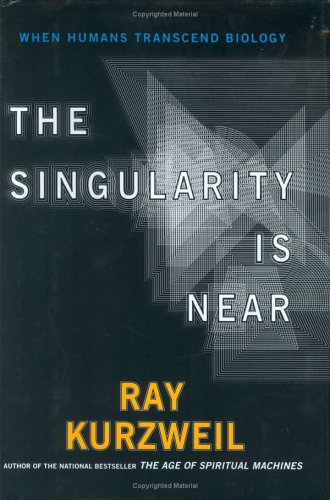
For anyone who is interested in good ole Ray Ray's postulations.


book25.jpg


amazon said:
How much do we humans enjoy our current status as the most intelligent beings on earth? Enough to try to stop our own inventions from surpassing us in smarts? If so, we'd better pull the plug right now, because if Ray Kurzweil is right we've only got until about 2020 before computers outpace the human brain in computational power. Kurzweil, artificial intelligence expert and author of The Age of Intelligent Machines, shows that technological evolution moves at an exponential pace. Further, he asserts, in a sort of swirling postulate, time speeds up as order increases, and vice versa. He calls this the "Law of Time and Chaos," and it means that although entropy is slowing the stream of time down for the universe overall, and thus vastly increasing the amount of time between major events, in the eddy of technological evolution the exact opposite is happening, and events will soon be coming faster and more furiously. This means that we'd better figure out how to deal with conscious machines as soon as possible--they'll soon not only be able to beat us at chess, but also likely demand civil rights, and might at last realize the very human dream of immortality.

The Age of Spiritual Machines is compelling and accessible, and not necessarily best read from front to back--it's less heavily historical if you jump around (Kurzweil encourages this). Much of the content of the book lays the groundwork to justify Kurzweil's timeline, providing an engaging primer on the philosophical and technological ideas behind the study of consciousness. Instead of being a gee-whiz futurist manifesto, Spiritual Machines reads like a history of the future, without too much science fiction dystopianism. Instead, Kurzweil shows us the logical outgrowths of current trends, with all their attendant possibilities. This is the book we'll turn to when our computers first say "hello."

http://www.megaupload.com/?d=2PF0ZAW0
 
Was there ever really a separation?

To the degree at which Kurzweil is postulating in all of his work, yes. He is asserting that human consciousness (or soul if you will) will eventually be encapsulated within a bio-mechanical organism.


I presume you are referring to our ongoing dependence/reliance on technology in the pursuit of mastering our enviornment.
 
Here is another drop


51BZN18MBCL.jpg


amazon said:
Renowned inventor Kurzweil (The Age of Spiritual Machines) may be technology's most credibly hyperbolic optimist. Elsewhere he has argued that eliminating fat intake can prevent cancer; here, his quarry is the future of consciousness and intelligence. Humankind, it runs, is at the threshold of an epoch ("the singularity," a reference to the theoretical limitlessness of exponential expansion) that will see the merging of our biology with the staggering achievements of "GNR" (genetics, nanotechnology and robotics) to create a species of unrecognizably high intelligence, durability, comprehension, memory and so on. The word "unrecognizable" is not chosen lightly: wherever this is heading, it won't look like us. Kurzweil's argument is necessarily twofold: it's not enough to argue that there are virtually no constraints on our capacity; he must also convince readers that such developments are desirable. In essence, he conflates the wholesale transformation of the species with "immortality," for which read a repeal of human limit.

In less capable hands, this phantasmagoria of speculative extrapolation, which incorporates a bewildering variety of charts, quotations, playful Socratic dialogues and sidebars, would be easier to dismiss. But Kurzweil is a true scientist—a large-minded one at that—and gives due space both to "the panoply of existential risks" as he sees them and the many presumed lines of attack others might bring to bear. What's arresting isn't the degree to which Kurzweil's heady and bracing vision fails to convince—given the scope of his projections, that's inevitable—but the degree to which it seems downright plausible.


http://www.megaupload.com/?d=Q1Q646FV
 
To the degree at which Kurzweil is postulating in all of his work, yes. He is asserting that human consciousness (or soul if you will) will eventually be encapsulated within a bio-mechanical organism.

I presume you are referring to our ongoing dependence/reliance on technology in the pursuit of mastering our environment.

Nah, I am referring to what we create as an extension of thee consciousness ... screw Kurzwell, tell me what YOU think ....

Bottom line is this if consciousness is transferable who is to say this carbon based form isn't already a bio-mechanical organism??
What is the difference?

The monacle becomes the bifocal, which becomes the contact lens, which becomes the lasik implant ...
 
You have any recommendations for me?

Another good one is The Age of Intelligent Machines.... this was one of my favorites Are We Spiritual Machines?: Ray Kurzweil vs. the Critics of Strong A.I. (I actually walked away from this one thinking we are still a very long ways from cracking the strong A.I. problem...)
 
Nice, i will watch the video and make appropriate comments in a few(its possible that some of these questions may have been addressed in the video). In the interm a thought that has occupied my mind for a few, Consciousness of animals like say a dog or cat.

1) Are all animals and even other people level of consciousness the same? Is their Degrees of Consciousness?

2) Is Consciousness even real? Meaning is it just a set of unique programming that have certain algorithms that approximates what we know as consciousness( some evolutionary benefit for this)?

3) In ref to #2, if we can program say a robot to be what we consider conscious by what ever definition it encompasses...love, self-aware, etc etc...does that make it conscious?
He addresses your questions in this interview in Discover Magazine: What Makes You Uniquely "You"?

According to him:

1) Consciousness is a 'process' that involves 'awareness' and there's 2 states: primary and secondary consciousness. Animals possess the former. Humans the later, self-awareness. Excerpt from the interview:

How does this primary consciousness contrast with the self-consciousness that seems to define people?
Humans are conscious of being conscious, and our memories, strung together into past and future narratives, use semantics and syntax, a true language. We are the only species with true language, and we have this higher-order consciousness in its greatest form. If you kick a dog, the next time he sees you he may bite you or run away, but he doesn’t sit around in the interim plotting to remove your appendage, does he? He can have long-term memory, and he can remember you and run away, but in the interim he’s not figuring out, “How do I get Kruglinski?” because he does not have the tokens of language that would allow him narrative possibility. He does not have consciousness of consciousness like you.

2) Consciousness is not a thing. It's a process. It's not a computer program. There's obvious evolutionary benefit:

What is the evolutionary advantage of consciousness?
The evolutionary advantage is quite clear. Consciousness allows you the capacity to plan. Let’s take a lioness ready to attack an antelope. She crouches down. She sees the prey. She’s forming an image of the size of the prey and its speed, and of course she’s planning a jump. Now suppose I have two animals: One, like our lioness, has that thing we call consciousness; the other only gets the signals. It’s just about dusk, and all of a sudden the wind shifts and there’s a whooshing sound of the sort a tiger might make when moving through the grass, and the conscious animal runs like hell but the other one doesn’t. Well, guess why? Because the animal that’s conscious has integrated the image of a tiger. The ability to consider alternative images in an explicit way is definitely evolutionarily advantageous.

3) It's not programmable. It's context-dependent, dynamic, embodied and must be developed ad hoc. This is what makes his Brain Based Device different from conventional A.I. (see slide 40 of the ppt. presentation link I posted)
 
Nah, I am referring to what we create as an extension of thee consciousness ... screw Kurzwell, tell me what YOU think ....

Bottom line is this if consciousness is transferable who is to say this carbon based form isn't already a bio-mechanical organism??
What is the difference?

The monacle becomes the bifocal, which becomes the contact lens, which becomes the lasik implant ...

clarify your question again for me please. I misunderstood you the first time.


Another good one is The Age of Intelligent Machines.... this was one of my favorites Are We Spiritual Machines?: Ray Kurzweil vs. the Critics of Strong A.I. (I actually walked away from this one thinking we are still a very long ways from cracking the strong A.I. problem...)


I will check it out
 
Nah, I am referring to what we create as an extension of thee consciousness ... screw Kurzwell, tell me what YOU think ....

Bottom line is this if consciousness is transferable who is to say this carbon based form isn't already a bio-mechanical organism??
What is the difference?

The monacle becomes the bifocal, which becomes the contact lens, which becomes the lasik implant ...
Good question. Do you personally believe that consciousness is transferable? By transferable I mean via a program. Unless you have some alternative mechanism. Just asking.
 
He addresses your questions in this interview in Discover Magazine: What Makes You Uniquely "You"?

According to him:

1) Consciousness is a 'process' that involves 'awareness' and there's 2 states: primary and secondary consciousness. Animals possess the former. Humans the later, self-awareness. Excerpt from the interview:

How does this primary consciousness contrast with the self-consciousness that seems to define people?
Humans are conscious of being conscious, and our memories, strung together into past and future narratives, use semantics and syntax, a true language. We are the only species with true language, and we have this higher-order consciousness in its greatest form. If you kick a dog, the next time he sees you he may bite you or run away, but he doesn’t sit around in the interim plotting to remove your appendage, does he? He can have long-term memory, and he can remember you and run away, but in the interim he’s not figuring out, “How do I get Kruglinski?” because he does not have the tokens of language that would allow him narrative possibility. He does not have consciousness of consciousness like you.

Im not sure i agree with his example, especially if its the hall mark of what he considers the secondary consciousness. I own a dog and i can tell you it can plot and strategies in reference to previous events and in some cases startlingly well. In addition in one of my previous jobs i had to go into peoples back yards for technical inspections and their were certain dogs that anticipating me positioned themselves in the most perfect way...is he suggesting that these things are by chance and not some conscious scheming(based off previous events)?


3) It's not programmable. It's context-dependent, dynamic, embodied and must be developed ad hoc. This is what makes his Brain Based Device different from conventional A.I. (see slide 40 of the ppt. presentation link I posted)

With this how can it not be encode for by some form of rudimentary "programming"? he mentioned in the video how dynamic our brains are and i get that...but the fact that we're so similar in what" we do as people" suggest that we cant be that "context-dependent, dynamic," their has to be some sorta static underlay, some common recipe(algorithm) for the cake, or else we all wouldn't have things that look like cake would we?
 
clarify your question again for me please. I misunderstood you the first time.
It wasn't really a right or wrong question ... just asking for an opinion ...

Good question. Do you personally believe that consciousness is transferable? By transferable I mean via a program. Unless you have some alternative mechanism. Just asking.

I am not sure, but my personal belief is that consciousness is programmable... but then that just opens a pandora's box of other deeper existential questions, because if consciousness can be programmed then it is essentially just another body part like the eye, hand, or heart ... which to me means there is something behind this consciousness in the being or simply put consciousness is not a sign of 'life'

Some of the Eastern Practices teach of this 'Higher Being' and I tend to agree but that is neither here nor there or has any place in a 'scientific' discussion IMO
 
Back
Top