

Obama Supporters on Far Left Cry Foul

keysersoze

Star
Registered
Obama Supporters on Far Left Cry Foul
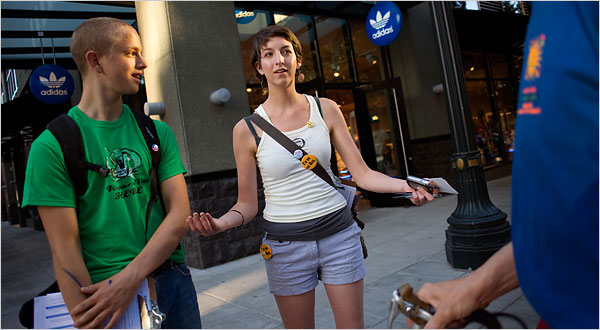
13liberals-600.jpg

Noah Litwer and Mollie Ruskin, Politicorps fellows, recruiting voters for Mr. Obama in Portland.​

By WILLIAM YARDLEY
PORTLAND, Ore. — In the breathless weeks before the Oregon presidential primary in May, Martha Shade did what thousands of other people here did: she registered as a Democrat so she could vote for Senator Barack Obama.

Now, however, after critics have accused Mr. Obama of shifting positions on issues like the war in Iraq, the Bush administration’s program of wiretapping without warrants, gun control and the death penalty — all in what some view as a shameless play to a general election audience — Ms. Shade said she planned to switch back to the Green Party.

“I’m disgusted with him,” said Ms. Shade, an artist. “I can’t even listen to him anymore. He had such an opportunity, but all this ‘audacity of hope’ stuff, it’s blah, blah, blah. For all the independents he’s going to gain, he’s going to lose a lot of progressives.”


Of course, that depends on how you define progressives.

As Ms. Shade herself noted, while alarm may be spreading among some Obama supporters, whether left-wing bloggers or purists holding Mr. Obama’s feet to the fire on one issue or another, the reaction among others has been less than outrage.

For all the idealism and talk of transformation that Mr. Obama has brought to the Democratic Party — he managed to draw a crowd of more than 70,000 here in May — there is also a wide streak of pragmatism, even among many grass-roots activists, in a party long vexed by factionalism.

“We’re frustrated by it, but we understand,” said Mollie Ruskin, 22, who grew up in Baltimore and is spending the summer here as a fellow with Politicorps, a program run by the Bus Project, a local nonprofit that trains young people to campaign for progressive candidates. “He’s doing it so he can get into office and do the things he believes in.”

Nate Gulley, 23, who grew up in Cleveland and is also here as a Politicorps fellow, said too much was being made of Mr. Obama’s every move.

“It’s important not to get swept up in ‘Is Obama posturing?’ ” Mr. Gulley said. “It’s self-evident that he’s a different kind of candidate.”

Bob Fertik, president of Democrats.com, a progressive Web site, started asking his readers last month to pledge money to an escrow fund for Mr. Obama, as opposed to contributing to him outright. The idea was to make Mr. Obama rethink his decision to support the Bush administration’s wiretapping measure.

Mr. Obama initially said he would try to filibuster a vote, but on Wednesday he was among 69 senators who voted for the measure, which to many liberals represents a flagrant abuse of privacy rights. The legislation grants legal immunity to telecommunications companies that cooperated with the wiretapping program.

So far, 675 people have pledged $101,375 to Mr. Fertik’s escrow fund, money that theoretically would be donated to Mr. Obama once he showed a firm commitment to progressive values, Mr. Fertik said.

But Mr. Fertik also said that while Mr. Obama’s change on the spying issue upset some supporters, it was not necessarily emblematic of a troubling shift to the center. He said he continued to support the senator, though he added, “We don’t see the need to close our eyes and hold our noses until November.”

Still, others warned that Mr. Obama risked being viewed as someone who parses positions without taking a principled stand.

“I’m not saying we’re there yet, but that’s the danger,” said David Sirota, a liberal political analyst and author. “I don’t think there’s disillusion. I think there’s an education process that takes place, and that’s a good thing. He is a transformative politician, but he is still a politician.”

Joe McCraw, 27, a video engineer from San Carlos, Calif., who writes three liberal blogs, said Mr. Obama’s shift on the domestic spying measure was a watershed moment.

“This is the first time I’ve ever seen him lie to us, and it makes me feel disappointed,” Mr. McCraw said. “I thought he was going to stand up there, stand by his campaign promises like he said he would, and it turns out he’s another politician.”

Many Obama supporters said the most vocal complaining about various policy positions was largely relegated to liberal bloggers and people who might otherwise support Ralph Nader, the Green Party candidate, or Dennis J. Kucinich, the liberal Ohio congressman who dropped out of the presidential race earlier this year.

“I think it’s accentuated by the fact that Obama’s appeal is an appeal to idealism,” said Kari Chisholm, who runs a blog, blueoregon.com, and does Internet strategy for Democratic candidates. “They believe their ideology is the only idealism and Obama’s is very mainstream. I’m not surprised they’re getting a little cranky. They’ve always been kind of cranky. A mainstream Democrat has always been too mainstream for them.”

Some of Mr. Obama’s supporters say he is less vulnerable to accusations of flip-flopping on issues because his campaign ultimately has been built on his biography and philosophy.

“I don’t think the test on him is in an explicitly narrow set of check boxes that have to get filled,” said Kevin Looper, executive director of Our Oregon, a liberal advocacy group. “I think it’s about do his campaign and his message embody serious changes for the direction of the country?”

Mr. Looper and many other supporters said Mr. Obama was solid on core Democratic concerns like the environment, social and economic justice and how to balance taxes among economic groups. Of course, his stands on more specific issues appeal to many supporters, too.

Rhys Warburton, a 25-year-old Brooklyn resident who teaches earth science at a public high school, said he supported Mr. Obama because he thought the senator was more likely to end the Iraq war. If Mr. Obama takes a few steps to the center that will not change his opinion, he said, and “it doesn’t make the others any better or more attractive to vote for.”

Before the Oregon primary in May, Mr. Obama held a rally here in Portland that made news not for what the senator said but for what he saw: more than 70,000 people came to hear him speak on a bright Sunday along the Willamette River.

The startling size of the crowd, followed by Mr. Obama’s resounding win here on May 20, helped cement his status as the presumptive nominee. And for some, even far beyond Oregon, it confirmed what Mr. Obama had been telling voters from the start: that he really is different.

“Seventy-five thousand people do not attend political rallies unless something truly magical is happening,” Bob Blanchard wrote on May 18 in the comment section accompanying an account of the rally on the New York Times’s Web site. “Our great country will soon close the book on ‘government by division,’ and embrace ‘government by inclusion.’ ”

Asked last week whether Mr. Obama’s vote on the surveillance law or any other recent statements or actions had altered how he felt about the candidate, Mr. Blanchard, of North Smithfield, R.I., said “absolutely not.”

“When are these people going to go, anyway?” Mr. Blanchard said of left-wing critics he believes have hurt Democrats in past elections. “My attitude is lighten up on the guy. We want to win. Moving to the center is not a crime in this country.”:yes::yes::yes:

Ms. Shade, the Green-turned-Democrat-returned-Green voter, spoke about Mr. Obama while leaning out her second-floor apartment window, where she has placed homemade signs urging the impeachment of President Bush. Others say “Free Gaza” and “Occupation is Terrorism.” She said twice that the American political system was “rotten.”

“You realize,” Ms. Shade said, her voice fading with resignation, “that you’re talking to somebody who’s pretty far out of the mainstream.”


-----

My own personal 2 cents are that it was not smart of him to go with the wiretapping bill... I'm a little angry at him for supporting that bill. :angry:
 
He royally F-ed up. There is no way around it. :smh:Whether it was to show he is a centrist, whether it was to get "the right" on board - WHATEVA the F-N reason was it was dumb as s***. The dems have capitulated to this administration when they were the minority and when they came roaring back after the 2006 elections. NOTHING they have promised since then has come to pass.:angry: Dude had a chance to stand up and he caved with the rest of them.


Obama got A LOT of support because he routinely pointed out the misgivings of the republicans and Bush. AND he said he would filibuster a bill that had ANY immunity for the telecoms.He LIED. Sorry to rain on the Kool Aid party most of the cats on this board throw every Obama post. This was not a good look and he is going to pay for it. NOT wishing ill on him, not saying he still won't get my vote, but you can't be the change candidate and keep voting the same way as the rest of your soft @$$ democrat crew. No one is buying that bulls*** anymore - not even from him.:smh:


http://www.bgol.us/board/showthread.php?t=280092&highlight=fisa

http://www.bgol.us/board/showthread.php?t=277664&highlight=fisa
 
He royally F-ed up. There is no way around it. :smh:Whether it was to show he is a centrist, whether it was to get "the right" on board - WHATEVA the F-N reason was it was dumb as s***. The dems have capitulated to this administration when they were the minority and when they came roaring back after the 2006 elections. NOTHING they have promised since then has come to pass.:angry: Dude had a chance to stand up and he caved with the rest of them.


Obama got A LOT of support because he routinely pointed out the misgivings of the republicans and Bush. AND he said he would filibuster a bill that had ANY immunity for the telecoms.He LIED. Sorry to rain on the Kool Aid party most of the cats on this board throw every Obama post. This was not a good look and he is going to pay for it. NOT wishing ill on him, not saying he still won't get my vote, but you can't be the change candidate and keep voting the same way as the rest of your soft @$$ democrat crew. No one is buying that bulls*** anymore - not even from him.:smh:


http://www.bgol.us/board/showthread.php?t=280092&highlight=fisa

http://www.bgol.us/board/showthread.php?t=277664&highlight=fisa

...well he is a POLITICIAN.
 
Tis true. However, this was a truly defining vote that he cast and he flip flopped and botched it. There are other issues though, but not as important to me than this right now.

Like what? I think the erosion of civil liberties under the Bush Administration was one of the worst historically... I hope this is challenged in the Supreme Court and defeated.
 
Tis true. However, this was a truly defining vote that he cast and he flip flopped and botched it. There are other issues though, but not as important to me than this right now.

dude, when the far left, or far right ever won an election?

You have to understand that majority of Americans are pretty much conservatives by nature. No one wants to pay high taxes, and have a weak military. Hell people on this board look down on gay people STILL. People want to drive what they want to drive, smoke where ever, own a gun, and have a lot of money. The only thing that people want from the left is to make shit easier to achieve such things.

Obama knows this. Not to mention, what the far left going to do, not vote for OBAMA. Nigga please....
 
The highly educated, very affluent LEFT, my neighboors here in the Upper East Side of Manhattan, who 90% are voting for Obama, the so-called liberal elite are killing me with this cover on the latest New Yorker Magazine.

They stupidly think that the humor & parody that this cover represents can be understood by the RepubliKlan knuckledraggers who are suddenly calling themselves independents. I don’t think so.

The long article in the mag about Obama will further confuse the ”Low information” voters who represent the majority of the docile American populace.

READ IT : http://www.newyorker.com/reporting/2008/07/21/080721fa_fact_lizza


barack_newyorker_cover_july2008.jpg


<hr noshade color="#0000FF" size="12"></hr>

logo_time_print.gif


DIVIDED THEY FALL

a_eskinsley_0721.jpg


June 10th 2008

by Michael Kinsley


http://www.time.com/time/printout/0,8816,1821662,00.html

Consider the Republican Party. Many Republicans dislike John McCain with a passion that has lasted for years. Asked to explain, they refer to the McCain-Feingold campaign-finance-reform law (which they thought, incorrectly as it turns out, would bite Republicans more than Democrats), or his opposition (since rescinded) to the Bush tax cuts, or what they regard as his tiresome and preening routine as a maverick. They resent his mutual love affair with the press (which he jokingly refers to as "my base"). They remember a lot of foolish talk a while back about how McCain might switch parties and become a Democrat. And yet almost all of these McCain haters will vote for him in November.

Now consider the Democratic Party. The one-on-one rivalry between Senators Hillary Clinton and Barack Obama lasted only about three months from beginning to end. Their policy disagreements are negligible. For many Clinton supporters, the chance to elect an African-American President represents the culmination of a cause they have been fighting for all their lives. Yet almost half of Clinton supporters tell pollsters that they will not vote for Obama. And Clinton's big-money backers are deflecting money and energy away from their party's presumptive nominee.

What is their problem? News reports suggest that disgruntled Clinton supporters are angry about alleged sexism in the coverage of her campaign, while other Democrats are upset at Obama's recent moves toward the center. The second complaint is childish. Securing your base and then moving to the center is the fundamental move of politics, like the basic steps of the fox-trot. And Obama is hardly responsible for Clinton's press coverage. But there is no easy way these folks can vent their anger at Chris Matthews. So they are taking their revenge on people without health care, women who need abortions, and others who they (if they supported Hillary) must think will be harmed by a Republican victory in the fall. That'll show 'em.

If you listen to a lot of right-wing talk radio (as I do), you can hear the troops being rallied. O.K., so maybe McCain isn't really our type. But he's our nominee. And consider the alternative! Obama is the most radical left-winger since the French Revolution. He is a fanatical leveler who hates rich people and despises success. Plus, he's an élitist snob. And his wife thinks she's better than everyone else because she's black. Truth to tell, the radio guys would rather have had Clinton to rail against, out of habit if nothing more. They spent most of their energy during primary season going after her. (Hillary nostalgia is surely one reason they are so obsessed with Michelle Obama.) But they have turned their guns on Barack Obama with remarkable ease and speed.

Democrats aren't like that. It's not that they're too nice or too principled, or too unwilling to be ruthless. The hatred of George W. Bush on the left--and the eagerness to see him gone--is at this point as extreme as anything the right has to offer. (I know this because I share it.) The desire to win for winning's sake is pretty deep, too. Furthermore, as I suggested in this space a few weeks ago, it is at least an open question as to whether Democrats this year will attempt to match the Republicans in their willingness to "swift-boat"--that is, to play dirty in what they regard as a noble cause.

But true, professional unscrupulousness--the kind of do-anything-to-win pragmatism that Democrats envy in Republicans--requires more than just working yourself up into a lather of dislike. Sometimes, in fact, it requires the opposite: putting aside your dislike, your disappointments, your anger, your feelings of betrayal. In the case of Hillary Clinton's erstwhile supporters, all of these feelings seem overwrought to me. But there is no point in arguing about this, or at least not now. Now is the time to just get over it.

Barack Obama has refused $84 million of government money for the fall campaign because he believes he can raise more privately. For the Democrats to find it easier than the Republicans to raise money is a recent development, and a somewhat inspiring one. Affluent people who give to the Republican Party are advancing their own class interests, whereas those who give to the Democrats generally aren't. This suggests an admirable seriousness about their giving. On the other hand, if they go off in a snit when their candidate loses the nomination, that will suggest that they aren't really in this out of progressive passion--they just find politics an amusing hobby, like racehorses or yachts.


the far left movement is all but DEAD in this country...fuck em.

obama is doing the right thing.
 
Like what? I think the erosion of civil liberties under the Bush Administration was one of the worst historically... I hope this is challenged in the Supreme Court and defeated.


I agree wholeheartedly^^^.:yes:

as for the other part. dude we are not on opposite sides here. unfortunately you the em-PHA-sis on the wrong sy-LA-ble :D(mike myers reference - anyway)


"...but not as important to me than this [FISA] right now".


The first part of the sentence was of no consequence.:smh:


... NOT wishing ill on him, not saying he still won't get my vote, but you can't be the change candidate and keep voting the same way as the rest of your soft @$$ democrat crew...

I'll take you one further... He WON'T get my vote. But neither will McCain, so as far as voting goes, I'm running out of options (IF I decide to vote at all).

I don't think he's stupid, so therefore I don't think he's F-N up. I think his true colors are showing. If dude really meant what he said previously he would have never voted to give the telecoms immunity.

ACTIONS SPEAK LOUDER THAN WORDS.

It appears to me, that he ampped up his appeal for the Democratic Candidacy just to get in. But he realizes that sooner or later, he's going to have to fall into step with the plan of the real-powers-that-be.

He can talk like Martin Luther King all day long, but when it comes time to put pen to paper, or vote yea or nay, he's not going to contradict any MAJOR stepping point for the North American Union or NWO... and trust me, the telecom immunity was Major...

While soothing us with WORDS and APPEARANCE, if he is to remain in the running, it was imperative for him to show "the powers" that he'd be a good boy by ACTION...

My concern, is that Obama is going to be the GOAT... and I do not mean Greatest Of All Time. I mean the Sacrificial Goat.

Look at the economy, the housing markets, the gas prices, the food prices, the falling dollar etc...

If things don't come to a head before he's elected (and I believe he will be), then they'll come to a head while he's in office. Then everyone looking for someone to blame, will look to the Pres and see dark skin.

Which will be one more knock on us... and we don't even really have anything to do with all this crap. But he's the figure-head and who does he look like?

Yeah, G.W.B. took us further into hell than anybody. But he'll be chilling at his new home in South America that he bought while all of this is going down.

Obama IMHO is a tool... with the perfect characteristics to lull us back to sleep after G.W.B.'s antics for the last eight years...

... I'm not ashamed to say he will not get my vote...
 
Last edited:
<font size="5"><center>
Dems Finding Success in Center</font size><font size="4">

The Democratic Party has claimed the middle
of the political spectrum by running more
centrist and conservative candidates</font size></center>

Real ClearPolitics
By Reid Wilson
July 18, 2008

As Republicans look toward rebuilding their party and inching back to the majority, an accurate diagnosis of what went wrong will be critical to finding the eventual cure. Taking a look at the long list of GOP retirements this year, one thing becomes clear: The Democratic Party has claimed the middle of the political spectrum by running more centrist and conservative candidates.

Twenty-nine members of the current House Republican Conference will not be members of the same conference next year. Most, 23, are retiring from public service, while a handful of others are seeking higher office or have already lost their primary battles. Of those members who are retiring, a significant number include the rapidly dwindling breed of moderates, members who resembled Bob Dole more than Bob Dornan. At the same time, a new breed of Democrats are storming the Capitol, moderates in their own right who more closely hue to Gene Taylor than to Gene McCarthy.

As Republicans are replacing their own moderates, Democrats have thrown open their arms to candidates who might make a liberal from San Francisco blush. According to National Journal's 2007 House vote rankings, fifteen Democrats have liberal scores below, and conservative scores above, the median, while not a single Republican scored above the 50% marker on the liberal side or below it on the conservative side.

The number of more centrist and conservative Democrats is increasing. Of the forty-one freshmen elected in 2006, including three who had served in Congress previously, fifteen spent their first year earning liberal scores of 55% or less. In the three special elections Democrats won earlier this year, two of those winners -- Reps. Don Cazayoux of Louisiana and Travis Childers of Mississippi -- are likely to compile similarly conservative voting records.

They join the likes of Taylor, also of Mississippi, Jim Marshall and John Barrow of Georgia, and John Tanner and Lincoln Davis of Tennessee. The 2006 freshman class also added a boatload of new conservative Democrats, including Reps. Heath Shuler, of North Carolina, Chris Carney of Pennsylvania and Joe Donnelly of Indiana.

Those new members of Nancy Pelosi's party were recruited less for their ability to compliment any liberal policy aim and more for their ability to win the districts. That's how the party plans to win seats this year, too, DCCC executive director Brian Wolff told Real Clear Politics. "These are going to be the more fiscally responsible" Democrats, he said. "We're not talking about a lot of progressive Democrats that are running."

Those more moderate members have already created a new and increasingly powerful coalition in Congress. Thirteen freshmen are members of the Blue Dog coalition of fiscally conservative Democrats, which this session has earned a more prominent seat at the leadership table.

While Democrats are building their ranks of moderates, Republicans are losing their centrists. Of the twenty nine members who will not be back next year, at least twelve are considered moderates. Members like Tom Davis of Virginia, Jim Saxton of New Jersey and Illinois' Ray LaHood will step aside at the end of their terms, further pushing this breed of Republican moderate down the path to extinction.

As conservatives have taken over the Republican Party, moderates have increasingly been the victims. The Club for Growth, which has made a crusade of ousting what it sees as members who are not conservative enough, helped Rep. Tim Walberg knock off Rep. Joe Schwarz in Michigan in 2006 and this year backed State Senator Andy Harris, who beat Rep. Wayne Gilchrest in the Maryland Republican primary. Gilchrest and Schwarz were two of the most centrist Republicans in the conference. The Club for Growth also backed conservative Rep. Steve Pearce over moderate Rep. Heather Wilson in the fight for New Mexico's Senate seat.

Democrats are seeking new targets ahead of November, and it should come as little surprise that the remaining moderate Republicans are some of their top targets. In a major television advertising reservation last week, the DCCC reserved millions on behalf of Democratic candidates challenging moderate Reps. Christopher Shays of Connecticut, Nevada's Jon Porter and Michigan's Joe Knollenberg.

Moderate members tend to represent moderate districts, so seats being vacated by Reps. Jim Ramstad, in Minnesota, Vito Fossella, in New York, Deborah Pryce, in Ohio, and Wilson and Davis are also on Democrats' top target list. In those seats, where independent voters reign, Republicans face more evidence that they have lost the center. Independent voters told pollsters at Pew Research Center they favored the generic Democratic congressional candidate by a 44%-34% margin.

There remains a great American middle that will determine who owns the majority in Congress. Republicans, in their search for their conservative roots, have abandoned that middle to Democrats like Childers and Cazayoux. Until they find a way to replace their extreme right with their more moderate middle as the face of the party and as the winners of GOP primaries, Democrats will own the center, and with it, the gavels in both chambers of Congress.

Reid Wilson is an associate editor and writer for RealClearPolitics. He can be reached at reid@realclearpolitics.com

http://www.realclearpolitics.com/articles/2008/07/dems_finding_success_in_center.html
 
Face it. The far left like the far right are whiners. Always have been, always will be. It's what they do.

-VG
 
<font size="5"><center>Anger on left: Obama shifts to the center</font size><font size="4">
CAMPAIGN CONFLICT PLAYS OUT ONLINE</font size></center>


By Frank Davies
Mercury News Washington Bureau
Article Launched: 07/20/2008 01:33:49 AM PDT


WASHINGTON - Liberal activists are blasting Barack Obama for shifting toward the center on a variety of issues, creating a tension that poses risks for his candidacy. But in another sign of how the Internet is changing politics, the conflict has led to a surprisingly direct give-and-take between candidate and critics - a development that may prove healthy for the campaign.

Just as Obama mastered Internet politics as he swept toward the nomination, now activists and bloggers are using some of the same tools to bring pressure to bear on the candidate. Obama, a former community organizer, is responding in kind - and says he's happy to be held accountable.

"Just receiving and listening isn't enough online," said Zephyr Teachout, an online pioneer for the 2004 Howard Dean campaign who participated Friday in Netroots Nation, a gathering of activists and bloggers in Austin. "People will push back, talk back, and the Internet makes that easier."

The debate focuses on Iraq, wiretapping and whether the Illinois senator is moving away from progressive principles as he begins a high-profile foreign trip and prepares for the general election. Some activists warn Obama could ultimately face a drop-off in enthusiasm and donations from his Democratic base - and his moves already are fueling significant opposition.

Case in point: More than 24,000 people have joined a group on my.barackobama.com, a social-networking site set up by the campaign, that implored Obama to oppose a compromise on a major surveillance bill.
Instead, Obama voted for the bill, which effectively grants immunity to telecommunications companies involved in the Bush administration's warrantless wiretapping program. He had threatened to filibuster that provision a few months ago.

Some supporters on the Web site chastised Obama for turning his back on the Constitution. Some wanted their donations back. Markos Moulitsas, founder of the influential Daily Kos blog, said he would withhold contributions because Obama was "betraying his claims of being a new kind of politician."

Then, as he prepared to leave for an overseas trip, Obama signaled some flexibility on his timetable for removing combat troops from Iraq, saying he would "refine" his position after talking to ground commanders.

In recent weeks, Obama also said he supported gun rights, the death penalty in some non-murder cases and his own version of President Bush's faith-based initiatives. In a speech on patriotism, he chided MoveOn.org, a group that helped him secure the nomination, for its "Gen. Betray Us" ad targeting Gen. David Petraeus.

Some liberals seethed. Some were surprised that Obama "was acting like a politician, doing what he thinks he needs to do to get elected," said Rick Jacobs, founder of the Courage Campaign, a grass-roots progressive group in California.

Most activists will vote for him, "but it dims the enthusiasm, and puts a damper on his fundraising base," said Jacobs, who was "very disappointed" by Obama's reversal on surveillance.


<font size="4">Customary shift</font size>

Seeking the center during the general election is a time-honored quest for presidential candidates, and John McCain is trying to walk the same line. McCain, in fact, may face a deeper lack of enthusiasm in his party among conservatives who have clashed with him over the years.

Obama, still not well-known to many voters, has to be wary of being pigeonholed as a conventional liberal, said Steve Schier, a political scientist at Carleton College in Minnesota. And if he shifts too much or too quickly, "then he runs the risk of being seen as an opportunist and flip-flopper," he added.

Independents who don't see the world through a left-right prism may be uneasy if they are unsure of Obama's core principles. Activist and blogger Arianna Huffington made a similar point: "My problem isn't that Obama doesn't always agree with me. My problem is that Obama has started to not always agree with himself - falling prey to the conventional wisdom sirens."

But Obama moved quickly to respond to the criticism - and he addressed his critics directly, on the Internet. He posted a lengthy explanation of his surveillance vote on my.barackobama.com, telling angry backers that "I'm happy to take my lumps." He added, "I'm certainly not perfect, and expect to be held accountable too."

He also gave a major speech on Iraq and broader security issues, renewing his pledge to "safely redeploy combat forces" from Iraq in 16 months, and send additional forces to Afghanistan. "It's time to end this war," Obama wrote about Iraq in a New York Times opinion article Monday.

Jacobs said Obama saw the backlash to his surveillance vote "and needed to get back on track on Iraq."

Teachout said the sharp criticism from thousands of Obama backers on the campaign's own Web site is a sign of strength "that will puncture the idea that anything but abject loyalty hurts your campaign."


<font size="4">Activists' choices</font size>

Barbara O'Connor, a longtime observer of California politics and a Democrat, said Democratic groups are coming around to Obama, including feminist activists who backed Hillary Clinton.

"All those bloggers from California - where are they going to go, vote for McCain?" asked O'Connor, who heads the Institute for the Study of Politics and the Media at California State University-Sacramento.

O'Connor points to a Field Poll, released Wednesday, that shows Obama with a 24-point lead in the state, and the backing of 80 percent of Clinton supporters (8 percent favored McCain). Three times as many Obama voters (51 percent) as McCain voters (17 percent) said they were "very enthusiastic" about their candidate.

As of June, there has been no drop-off in donations. The Obama campaign took in $52 million last month.

There's another factor that animates some of the tension between activists and Obama. Liberal blogs tend to be confrontational. Their success as an organizing tool has been fueled by anger over the Bush administration.

Obama's tone and approach to politics is inclusive, stressing cooperation beyond what he calls "caricatures of left and right."

"Listen to Obama, and you hear a bit of Arnold," said O'Connor, referring to Gov. Arnold Schwarzenegger's pleas for "post-partisan" solutions. "I think that's what Obama really is - post-partisan."

Contact Frank Davies at fdavies@mercurynews.com or (202) 662-8921.


http://www.mercurynews.com/politics/ci_9939610?nclick_check=1
 
Face it. The far left like the far right are whiners. Always have been, always will be. It's what they do.

-VG

Come on VG, that 9s really unfair to say that they are whiners. They "far left" are reason issues like environmental pollution, due process for criminal defendants, death penalty, and tons of other issues are now part of the main stream political discussion and "center" issues.

I'm not 100% with the left's agenda but a generalization like that is unwarranted.

Issues like medical insurance was once a "far left" issue. Now its become one of the central platform points of the democratic party.
 

Come on VG, that 9s really unfair to say that they are whiners. They "far left" are reason issues like environmental pollution, due process for criminal defendants, death penalty, and tons of other issues are now part of the main stream political discussion and "center" issues.

I'm not 100% with the left's agenda but a generalization like that is unwarranted.

Issues like medical insurance was once a "far left" issue. Now its become one of the central platform points of the democratic party.

Giving dogs and cats rights, trees have feelings, global warming shit, that is the MO of the far left.

Blacks have their place, tax breaks for the super wealthy, deregulation and no oversight over banks and financial institutions is the Modus Operandi of the far right. Take any of that away and they whine like little bitches. Plan and simple. They both want what they want and there is no compromise.

-VG
 
Obama's reluctant populism irks left

<font size="5"><center>
Obama's reluctant populism irks left</font size></center>


100304_obama_ohio_218.jpg

Obama reads insurers a letter from a woman
whose premiums went up 40 percent.


P O L I T I C O
By CAROL E. LEE
March 13, 2010


Sometimes in the fight for health reform or tighter rules on Wall Street, President Barack Obama unleashes his podium-pounding, “Yes, we can” side.


And sometimes, critics say, Obama’s just a part-time populist.


The differences in tone can be jarring — and infuriating to his liberal supporters. Obama in December fired shots at “fat cat bankers,” then told bankers at the White House the next day he didn’t mean to vilify anyone or dictate their pay.


He denounced the “twisted logic” of big Wall Street bonuses, then suggested recently he doesn’t begrudge the mega-buck payouts.


Ten days ago, Obama confronted health insurance CEOs during a White House meeting with a letter from a woman whose premiums went up 40 percent.


It had the makings of a signature moment in the health care fight — the president standing up for average Americans — yet just before Obama arrived, reporters were escorted out of the room. So there was no footage of the exchange and no record of the insurance executives’ reaction.


The White House simply released a photograph of the president reading the letter, and press secretary Robert Gibbs told reporters, “I'll let the insurance executives speak for themselves.”


It’s not the first time Obama’s supporters have wanted to see more heat and less cool, and the economic crisis and the anti-establishment mood of the country have left Obama trying to channel and harness public anxiety and anger. But his engagement at times has been tepid, and he often comes off as halting — at one moment a fiery populist and at another a pragmatic consensus-seeker.


“Populism isn’t something that you pick and choose to emphasize when it’s helpful to moving your legislative agenda. It’s something that you try to live every day in the way that you talk about issues and the way that you relate to people,” said Rep. Bruce Braley (D-Iowa), who is chairman of the Populist Caucus.


“The president has a long way to go. He keeps sending mixed messages where he’ll do something that appears to be populist, like condemning the actions of Wall Street, and then he’ll be sitting down with corporate executives and planning strategy.”


Obama the politician matched the moment back in November 2008, when voters weary of President George W. Bush flocked to his promise of change.


Now the times have changed, and they’re looking to Obama to feel as angry as they are about the failing economy and the sense that Wall Street is out of whack and that Washington seems incapable of doing anything about it. That mood, plus a strong disdain of Obama, has fueled the conservative tea party movement, but it’s not strictly partisan. A lot of voters are mad, and many want a sense the president is mad too.


That kind of populism demands a stark view of the world, a clear-cut villain, good guys vs. bad guys, or big guys vs. little guys. Obama comes across as far more cerebral, a figure who embraces nuance, who is hesitant to single out a boogeyman. But populism and nuance don’t mix — and for Obama, that seems to muffle his message, when a satisfying shotgun blast might do.


“In a lot of ways his instincts about how to solve the problems may have been right, but they weren’t stylistically what people wanted, which was somebody to go beat the hell out of the banks and insurance companies,” said Democratic strategist Joe Trippi. “So I think him emerging with a fire right now against the insurance companies is much more in sync with where the people are than the consensus-builder he tried to be the first year or so.”


Obama, too, is a card-carrying member of the elite meritocracy (Harvard, a lawyer, a former senator), so it’s not like banking CEOs are the enemy to him. In fact, the comment where he said he doesn’t “begrudge” big bonuses came in response to a question about JPMorgan Chase CEO Jamie Dimon, a longtime friend and Democratic donor.


For the White House, it’s a balancing act, and Obama has tried to channel growing voter anger in a way that compliments his natural style, as a politician who takes the long view and would rather talk to the so-called enemy than shout at him, Gibbs said in an interview.


“The president has always thought of himself, when he was in the state Senate and the U.S. Senate, as somebody who could take on big issues by bringing different viewpoints together to make progress. And sometimes if you’re on either extreme of this, I think you tend to be less involved in the solutions, because you’re simply out there just driving your own point,” Gibbs said.


“The times require, and I think, quite frankly, people want, more than somebody who will sympathize with their frustration,” he added. “Somebody who can sympathize with your anger by visibly showing their anger will only get you so far.”


On the meeting with insurers, Gibbs said opening up the moment was unnecessary and would have run counter to Obama’s preferred approach, which is to foster “honest discussions” with stakeholders without them worrying “that each and every meeting is about a press event.”


“We made our point,” Gibbs said.


The problem for Obama is his posture can leave the impression that he’s out of touch.


Ed Rollins, a Republican consultant and senior fellow at the Peter S. Kalikow Center for the Study of the American Presidency, describes Obama as cerebral with “a little demagogue in him from time to time.” Traditional populists, Rollins notes, “don’t care what they rail against and have not always been handicapped by a cerebral approach.”


Still, there are flashes of a tougher stance. On the road near Philadelphia on Monday, he took on insurance companies with a harsher tone than he has struck during the entire yearlong health care debate. He criticized them some two dozen times and said they’re all about “making big profits.”


By the end of the speech the president was hunched over the microphone and jabbing his finger in the air, as he encouraged the cheering crowd to “stand with me and fight with me!”


“That’s the most fiery I've seen him since the early campaign,” said Sen. Arlen Specter (D-Pa.), who was traveling with the president.


But two days later in the St. Louis area, Obama’s delivered a mild-tempered speech, focusing on fraud and waste to a more muted crowd. The evening itself, which also included two fundraising events, offered a snapshot of Obama’s ups and downs.


“He got, by all accounts, a little bit more fired up later in the night,” Gibbs said, acknowledging that Obama’s tone had shifted from Monday to Wednesday.


The reason for Obama’s populist fits and starts, surmised former Ross Perot campaign manager Clay Mulford, is because he’s working with bankers and insurance companies as he knits together his proposals — making it harder to demonize them.


“You see the inconsistency because they’re in on the game,” Mulford said.


Obama’s passionate critique of the process of politics in Washington — something he’s hit hard in the past week — is a more winnable argument, Mulford said, than his railing against Big Business or Big Government.


Obama still has managed to convey empathy. A Pew poll in January found that 64 percent of respondents think Obama is “someone who cares about people like me” — a number that did not decline much in the latter part of 2009, said Michael Dimock, associate director for polling at Pew Research Center.


“I think back to the campaign, and you even saw it then: He could give these really fired-up speeches and get the crowds stomping their feet, and then he’d go into the debate and he was just Mr. Cool again,” said Dimock.


After a rough first year, the White House has tried to tune in more closely. Obama now does monthly White House to Main Street stops to discuss the economy. He is pushing a jobs bill intended to benefit the middle class and small businesses.


But as in the campaign, his aides believe he should not adjust to match the country’s mood every time it changes.


“If you do that, you’re going to end up becoming three or four different things over the course of three or four different years because of whether or not the strain holds the whole time,” Gibbs said. “I think if you’re always in fifth gear and you’re always running hot, you can’t really nuance that. Something can’t really get you exercised because you’re always really exercised.”


That stance continues not to sit well with liberals.


“It’s not something you turn on or turn off depending on the day to try to make a point,” Braley said. “That’s the difference that I’m waiting to see in how the president approaches these critical issues.”


http://www.politico.com/news/stories/0310/34360.html
 
Re: Obama's reluctant populism irks left

<font size="5"><center>
Left to Obama: We're not happy</font size></center>


100607_obama_1423_ap_218.jpg

The White House says Obama has worked hard
to achieve the goals of his progressive agenda,
especially health reform.


P o l i t i c o
By GLENN THRUSH
June 7, 2010


<font size="3">The left has a message for Barack Obama: Shape up, or we’re shipping out. </font size>

A high-profile conclave of progressives, which served as a platform for supporting Obama in years past, opened in Washington on Monday amid growing disenchantment with the president over the Gulf oil spill, health care, jobs, immigration and political deal cutting.

Liberal activists warned that Obama can no longer count on a progressive base that was supposed to protect Democrats from a mass wipeout in the midterms in 2010 and propel him to reelection in 2012.

“We are not apathetic, we are not depressed — we are willing to get out and fight for the people who fight for us,” said Ilyse Hogue, MoveOn.org’s campaign director, at the Campaign for America’s Future annual meeting. “But no longer can they count on us for a solid Democratic vote. We are getting more sophisticated to understand that not all Democrats are created equal.”

The criticism of Obama during the lightly attended opening day was more visceral than issue specific and more in the vein of familial disapproval than open revolt. It’s also not clear where liberals, who helped fueled Obama’s ascent to the presidency, might turn in 2012 if Obama is on the ballot.

But the left's lack of enthusiasm for its representation in Washington — the "enthusiasm gap" between dispirited liberals and hyperenergized conservatives — is palpable and poses a real danger to Obama and his congressional allies, said veteran progressive Robert Borosage, who organized the conference.

“We have the energy and the willingness to mobilize; we can be a huge ally or a huge obstruction,” he warned. “No president wants trouble in the base, and Obama doesn’t want trouble in his base.”

Sterling Newberry, an economist and consultant who has attended the event for years, said the mood of the left could be read by the several dozen empty chairs in the ballroom during the opening session of the conference.

“It wasn’t always like this,” he said of the turnout. “The Republicans out of power are fired up to vote, and the Democrats who are in power are de-motivated.”

The White House said Obama has worked hard to achieve the goals of his progressive agenda, especially health reform.

“During his first 500 days in office, President Obama has fulfilled his commitment to bring the change we need to Washington by signing historic health care reform legislation that will reduce costs for millions of families and small businesses, implementing education reforms that will lay the foundation for our nation’s long-term economic strength and reducing the influence of special interests that has changed business as usual in Washington,” said White House spokesman Joshua Earnest.

Obama took a bit of beating at the conference last year – after it was renamed “America's Future Now” from the catchier, pre-Obama “Take Back America” – for his early compromises on health care. His aides have always viewed the conference with some ambivalence, considering its leadership as more aligned with red-meat populists like Howard Dean and John Edwards. But Obama got the hero’s welcome during appearances in 2006 and 2007, when he bashed Bush, reveled in a long standing ovations and delivered a speeches not too dissimilar from the red-meat addresses delivered on Monday.

“These are Americans who still believe in an America where anything's possible - they just don't think their leaders do,” Obama said in 2006. “These are Americans who still dream big dreams -they just sense their leaders have forgotten how.”

Answers for solving the problem were in shorter supply: Those in attendance said there wasn't a magic solution but demanded progress on ending the Iraq and Afghanistan wars and proof that Obama was willing to expend political capital to pass immigration reform despite dim hopes of passage on the Hill.


And like Obama’s critics on the right, many progressives seized on the administration’s response to the Gulf oil spill to vent their larger frustrations.

“We thought that an election was victory. We forgot that candidates don’t deliver change, that they become part of the system,” said Phaedra Ellis-Lamkins of Green for All, a progressive environmental group that opposes Obama’s loosening of offshore oil exploration restrictions.

“While I voted for Barack Obama and I would again, he is not enough and we [need to] push him and say that his handling of BP is atrocious at best,” she said to applause at the Omni Shoreham Hotel. “I believe in the president, but I believe in the needs of the people of the Gulf more. ... I believe in holding people accountable, even people we love.”

Despite the subcapacity attendance on the first day, the event, sponsored by unions and progressive groups, is still a big draw to liberals, with planned Tuesday appearances by House Speaker Nancy Pelosi (D-Calif.) and former Democratic National Committee Chairman Howard Dean.

Former SEIU President Andy Stern, a major Obama supporter who serves on his deficit reduction commission, cast the conflict in slightly different terms, saying the left needed to provide “the wind” in Obama’s sails — to propel his agenda leftward.

Arianna Huffington, founder of The Huffington Post, said most of Obama’s problems stem from Obama’s quest for bipartisanship with Republicans on almost every issue, including offshore oil drilling.

“Bipartisanship is not the way to find American change. So far bipartisanship has brought us a no-strings-attached bailout. It has brought us the freedom from the burden of an affordable public option [in health care reform]. It has also brought us an ongoing war in Afghanistan, … and every day we see more penguins and dolphins covered in bipartisanship,” she said.

Huffington said she still backs Obama but called for “Change 2.0.”

All presidents grapple with satisfying their base: George W. Bush’s political team, led by Karl Rove, spent much of its time quelling potential revolts from the religious right, whose leaders accused the White House of slow-walking its anti-abortion and pro-school-prayer agenda.

With white independents deserting in droves, Obama and Democrats desperately need the party’s fractious core of liberal supporters. Recent polls show that progressives are far less willing to turn out to back Democrats this year — and far less energized than the GOP base and conservative tea party activists.

Obama’s relationship with the left took a big hit on health care reform when the administration agreed to major deals with drug companies and signed off on a deal to strip the public option from the Senate bill.

And the left also was rankled by administration efforts to stop progressive Rep. Joe Sestak (D-Pa.) from challenging Obama’s hand-picked candidate, Sen. Arlen Specter (D-Pa.). Obama’s decision to back Sen. Blanche Lincoln (D-Ark.), however anemically, against Lt. Gov. Bill Halter in the Democratic primary has pitted him against Big Labor.

Halter supporter Markos Moulitsas, founder of the Daily Kos blog, never called out Obama by name but said that a Lincoln loss would send a message to the D.C. establishment.

“We’re going to take out Blanche Lincoln in Arkansas,” said Moulitsas. “It’s an unprecedented alliance between netroots labor and the environmental movement … to realize that we have to hold people in D.C. accountable. ... They are immune to reason, they are immune to public opinion. ... They are not immune to losing elections, and that’s where it hurts.”

But even Moulitsas acknowledged the difficulty in getting progressives to speak with one voice on the issues.

He suggested that Democrats, like Republicans -- and Obama circa '08 -- stress broader principles and eschew specific policy platforms: “What you get is irrelevant and scary to the American people. ... If we’re talking to people, the less details the better.”


http://www.politico.com/news/stories/0610/38222.html
 
<font size="3">
<center>
The arguments and comments in this thread from 2008, before
Barack Obama was elected president, still resonate in 2010.
</center>

QueEx
</font size>
 
the far left movement is all but DEAD in this country...fuck em.

obama is doing the right thing.


Oh yea? In 4 to 8 years, the corpitist's will have this country so fucked up, that the people will be begging for another FDR!

BTW, He is still my President and i back him, but he is operating from a skewed perspective.

source: Huffington Post


While Whacking Critics, Obama Gets Facts Wrong


WASHINGTON -- While arguing at Tuesday's press conference that his progressive critics are being sanctimonious and overly pure, President Obama flatly misstated the history of the Social Security program and disregarded the central intent of the public health insurance option.

Both concerns were raised Wednesday by economics blogger and former Clinton Treasury official Brad DeLong.

At the press conference (see the transcript), Obama defended his controversial decision to give in to Republican demands for a massive tax cut for the rich on the grounds that "in order to get stuff done, we're going to compromise."

His prime example: "This is why FDR, when he started Social Security, it only affected widows and orphans. You did not qualify. And yet now it is something that really helps a lot of people."

As it happens, Obama said the same thing in October, in an interview with Comedy Central's Jon Stewart: "When Social Security was passed, it applied to widows and orphans and it was a very restricted program, and over time that structure that was built ended up developing into the most important social safety net that we have in our country." That did not go unnoticed in the blogosphere, either.

Obama's overall point -- that Social Security wasn't born fully grown -- was exactly right. But his facts were exactly wrong. The Social Security Act, as first signed into law by Franklin Delano Roosevelt in 1935, paid retirement benefits to the primary worker -- and not to their widows and orphans. It wasn't until a 1939 change that the law added benefits for survivors and for the retiree's spouse and children.

It's possible that Obama was confusing FDR's law with what some consider a precursor of sorts, the Civil War Pension program. That program, which dates back to 1862, provided benefits linked to disabilities incurred in the war and pensions for widows and orphans.
The White House press office chose not to address the issue.

Less objectively false, and yet more offensive to progressives, was Obama's dismissive remark about the hard-fought battle to establish a government-run insurance program as an option in case the private market failed to provide consumers with adequate and reasonably priced policies. Here's what Obama said about that:
[T]his notion that somehow we are willing to compromise too much reminds me of the debate that we had during health care. This is the public option debate all over again. So I pass a signature piece of legislation where we finally get health care for all Americans, something that Democrats had been fighting for for a hundred years, but because there was a provision in there that they didn't get that would have affected maybe a couple of million people, even though we got health insurance for 30 million people and the potential for lower premiums for 100 million people, that somehow that was a sign of weakness and compromise.​
To support Obama's statement, an administration official pointed the Huffington Post toward a November 2009 Congressional Budget Office memo's conclusion that "Roughly one out of eight people purchasing coverage through the exchanges would enroll in the public plan, CBO estimates, meaning that total enrollment in that plan would be 3 million to 4 million."

But, Obama's fairly large rounding error aside, the public option was not simply a matter of enrollees. What the president conspicuously disregarded was that the central point of the public option was that its existence would exert enormous competitive pressure on the private insurance system. The goal was not to serve a particularly large number of people directly -- that would only happen if the private offerings were terribly inadequate. The goal was to keep the private sector honest. So no matter how many people it enrolled, "the provision," as Obama put it "would have affected" tens of millions.

There were also a few problems with the rhetorical structure of Obama's comments. If he truly believes that good things start small, like Social Security did, then criticizing the public option for starting small isn't logically consistent. And the tax cut he agreed to is hardly a half measure in the right direction; it's a colossal collapse in the wrong direction.


<CENTER>*************************</CENTER>
 
Re: Obama's reluctant populism irks left

Seems like

<font size="4">Déjà vu</font size>

All over again.

`
 
Re: Obama's reluctant populism irks left

Seems like

Déjà vu

All over again.

`


You got that right!

<object width="640" height="390"><param name="movie" value="http://www.youtube.com/v/4mRRKz9E0m8&hl=en_US&feature=player_embedded&version=3"></param><param name="allowFullScreen" value="true"></param><param name="allowScriptAccess" value="always"></param><embed src="http://www.youtube.com/v/4mRRKz9E0m8&hl=en_US&feature=player_embedded&version=3" type="application/x-shockwave-flash" allowfullscreen="true" allowScriptAccess="always" width="640" height="390"></embed></object>
 
Re: Obama's reluctant populism irks left

<font size="3">
Understand the difference between the expectations of hope and change smacked up against the reality of governing. A lack of undestanding, in my opinion, the far left - and the far right, share in common.

QueEx
</font size>
 
Does this prove that you may be Far Left, from which point everything else appears right ? ? ?

QueEx


Why, because I refuse to accept a politician that claimed "Change We Can Believe In," and now takes the expedient route to appease his enemies?

I find it quite interesting that anyone that dares to question the status quo that has be foisted on the American people for thirty years and in particular the last ten years is labeled "far left." A term that seems to hold increased derision in the southern US and increasingly by the descendants of those that dared to question the status quo of Jim Crow and segregation and were labeled "far left." Is proclaiming blind allegiance to our elected offices the only way to support a cause?

I guess the supporters of GW were right. refrain from criticisms of his policies until he is out of office and then claim you were bamboozled.

<object width="640" height="390"><param name="movie" value="http://www.youtube.com/v/4mRRKz9E0m8&hl=en_US&feature=player_embedded&version=3"></param><param name="allowFullScreen" value="true"></param><param name="allowScriptAccess" value="always"></param><embed src="http://www.youtube.com/v/4mRRKz9E0m8&hl=en_US&feature=player_embedded&version=3" type="application/x-shockwave-flash" allowfullscreen="true" allowScriptAccess="always" width="640" height="390"></embed></object>
 
Why, because I refuse to accept a politician that claimed "Change We Can Believe In," and now takes the expedient route to appease his enemies?
Not because you refuse to accept; but, perhaps, because you refuse to see political realities. I'm not happy with the outcome either but professionally I believe that I understand the art of settlement which often involves engaging in reasoned compromise.

Unless you have the might to force your desired outcome to the exclusion of the other side, you can never have it exactly the way you want it. And, even if you have that kind of might, invariably it tends to lead to ones eventual downfall.

In this case, even prior to the midterms when the democrats out numbered republicans in "name" (i.e., they all called themselves democrats), the political reality was the party was fractured ideologically (the dems are of every stripe from conservative, moderate, centrist, and left to far left). Hence, even when the democrats held the "Name" advantage, it did not necessarily hold the ideological advantage. Despite that incongruity, some things were successfully pushed, but they seem to have come at a costly price.


I find it quite interesting that anyone that dares to question the status quo that has be foisted on the American people for thirty years and in particular the last ten years is labeled "far left." A term that seems to hold increased derision in the southern US and increasingly by the descendants of those that dared to question the status quo of Jim Crow and segregation and were labeled "far left." Is proclaiming blind allegiance to our elected offices the only way to support a cause?

Now, now T.O., don't go getting emotional. If "far left" is distasteful, how about "uncompromising element" of the party? I don't care for the labels either, but I do see an element of the democratic party (just as there is an element of the Repubicans and Librarians as well) that wants it its way, damn the realities.


I guess the supporters of GW were right. refrain from criticisms of his policies until he is out of office and then claim you were bamboozled.

Criticism is in order. But, constructive critic must be tempered, in my opinion, by understanding and appreciating the political lay-of-the-land.

QueEx
 
P.S.

As I said, I don't like all elements of the proposal -- but as I said in another thread, I don't think that this is over yet. Elements of the democratic party which do not like the President's proposed compromise are still being heard and a final vote has yet to be taken. If their numbers are strong enough, we may very well see changes in the proposal before its all said and done. The people are being treated to "real-time" negotiation and haggling. Enjoy. Learn.

QueEx
 
oh snap. I was looking for this thread but could not find it. I took a lot is -ish back then for speaking up about Obama - yet still voting for him. I can't believe, two years later, after all that has been done - or not done - by him there are still people proclaiming this dude is play ing chess. smdh. More like roulette.
 
P.S.

As I said, I don't like all elements of the proposal -- but as I said in another thread, I don't think that this is over yet. Elements of the democratic party which do not like the President's proposed compromise are still being heard and a final vote has yet to be taken. If their numbers are strong enough, we may very well see changes in the proposal before its all said and done.

<font size="3">The people are being treated to "real-time" negotiation and haggling. Enjoy. Learn.</font size>

QueEx

<font size="5"><Center>
Tax-cut deal exposes inner workings
(and non-workings) of D.C.</font size></center>


Washington Post
By Ezra Klein
Washington Post Staff Writer
Friday, December 10, 2010


The temperature in Washington dipped into the 20s last week, and here in the capital, that seems to be the point when hell freezes over: President Obama reached an agreement on the Bush tax cuts with the Republican Senate leader who said "the single most important thing we want to achieve is for President Obama to be a one-term president."

Sen. Bernard Sanders, a socialist from Vermont, and Sen. Jim DeMint, an arch-conservative from South Carolina, threatened to filibuster theagreement. Liberal Democrats said they'd prefer a permanent extension of most of the tax cuts, and the architect of those cuts said the country couldn't afford anything more than a temporary extension.

It's been a little confusing.

But it's also been clarifying.


The tax-cut deal, in which the Republicans will give the White House about $300 billion in stimulus in return for the White House giving Republicans about $130 billion in tax cuts for the wealthiest Americans, laid bare some old and new realities of how Washington works - and doesn't work - right now. It's worth going through them one by one:

1) No one really cares about the deficit. No sooner had Alan Simpson and Erskine Bowles completed their work on the deficit reduction package than Democrats and Republicans reached a bipartisan accord to add $900 billion to the debt. Republicans wanted their unpaid-for tax cuts for the rich, Democrats wanted their unpaid-for stimulus measures and both sides wanted the unpaid-for tax cuts for income under $250,000. I think it's appropriate to spend while the economy is weak and then repay when it's strong, but then, I didn't just get elected to Congress by promising to rein in spending.

2) Obama is better at the inside game than the outside game. Sarah Palin likes to ask the president "how that hopey-changey stuff" is going. The answer, it seems, is that the changey stuff is going well, but the hopey stuff is proving more troublesome. Obama might have campaigned in 2008 as the inspirational newcomer who had no patience for the broken ways of Washington, but he has governed like a Washington veteran with little patience for inspired outsiders. In health-care reform, in the stimulus, in financial regulation and in the tax-cut deal, Obama has been a tough negotiator able to move his agenda through a gridlocked Congress - but he has not been able to enthuse Democrats or inspire popular support for his initiatives. He has been prickly when questioned about it.

3) And he's not over health-care reform. Among the president's most passionate moments during the post-deal news conference was his long, impromptu scolding of dissatisfied progressives who're making this into "the public option debate all over again." Obama went on to complain that liberals were so focused on the public option that they lost sight of the rest of the health-care bill - which was much larger. And he's right about that. But it's also time for him to get over it.

4) Republicans really, really, really care about tax cuts for rich people. Many Democrats had been operating under the theory that Republicans would simply obstruct everything Democrats attempted, as that was the best way to make Obama a one-termer. At least when it comes to tax cuts for very wealthy Americans, that's not true. Republicans agreed to far more in unemployment insurance and stimulus proposals than anyone expected, and sources who were involved in the negotiations agree that the mistake Democrats made going in was underestimating how much Republicans wanted the tax cuts for the rich extended.

5) It's still Ronald Reagan's world, at least when it comes to taxes. The Sturm und Drang over the tax cuts for the rich obscured the Democrats' massive capitulation on the tax cuts for everyone else. Even the party's liberals had accepted Obama's argument that the tax cuts for income of less than $250,000 - which includes the bulk of the Bush tax cuts - should be permanently extended. Another way of saying that is Democrats had agreed that the Clinton-era tax rates were too high. If you put it to most Democrats that way, they'd protest vigorously. The economy boomed under Clinton, and the Democratic Party is proud of the efforts it made to balance the budget. But Democrats are so terrified of being accused of raising taxes that they've conceded to the Bush tax rates for 98 percent of Americans.

6) We need tax reform, now more than ever. The end result of this deal is going to be an even weirder tax code than we have now - and the one we have now is pretty weird. We're extending old tax cuts and credits and adding new ones. Some of those may be extended further. Businesses won't want to see deductions for investments expire, and workers won't want to see the payroll-tax cut expire, and the super-rich won't want to see the tax exemption for estates up to $5 million expire. There are so many constituencies fighting for so many breaks that the only hope we're going to have when we actually do need to reduce the deficit - which isn't yet, but will be soon - is to start from square one on the tax code.

http://www.washingtonpost.com/wp-dyn/content/article/2010/12/10/AR2010121002242.html
 
<font size="3">

Bill Clinton, (NPR, December 13, 2010), more than most, knows how to stir up Republicans. After shambling into the White House briefing room on Friday for an impromptu Q&A, he noted that <SPAN style="BACKGROUND-COLOR: #ffff00">"a lot of the hard-core conservatives think that Republicans gave too much" on the deal with President Obama to extend Bush-era tax rates</span>.</font size>
 
`

demint.jpg


<font size="3">Sen. Jim DeMint (R-SC) holds a news conference at the U.S. Capitol in Washington, DC. DeMint is urging fellow Republicans not to pass the tax deal put together by President Obama and Congressional Republicans.

He doesn’t like the fact that the tax cut extension is temporary and he doesn’t like the extension of unemployment insurance.

“I don’t think we need to extend unemployment any further without paying for it, and without making some modifications such as turning it into a loan at some point. It then encourages people to go back to work,” DeMint said.

Even the estate tax provision – which has enraged liberals because it would cut the scheduled increase in the estate tax from 55 percent to 35 percent and only apply it to estates valued at over $5 million – doesn’t satisfy DeMint.

<SPAN style="BACKGROUND-COLOR: #ffff00">“It raises the death tax,” DeMint says, presumably because this year, in an anomaly, the estate tax is zero percent.</span>


</font size>​
 
<font size="3">
Swindle of the year


By Charles Krauthammer
Friday, December 10, 2010


<SPAN style="BACKGROUND-COLOR: #ffff00">Barack Obama won the great tax-cut showdown of 2010</span> - and <SPAN style="BACKGROUND-COLOR: #ffff00">House Democrats don't have a clue that he did</span>.

  • <font size="3">In the deal struck this week, the president negotiated the biggest stimulus in American history, larger than his $814 billion 2009 stimulus package. </font size>

  • <font size="3">It will pump a trillion borrowed Chinese dollars into the U.S. economy over the next two years - which just happen to be the two years of the run-up to the next presidential election. </font size>

<SPAN style="BACKGROUND-COLOR: #ffff00">This is a defeat?</span>

If Obama had asked for a second stimulus directly, he would have been laughed out of town. Stimulus I was so reviled that the Democrats banished the word from their lexicon throughout the 2010 campaign. And yet, despite a very weak post-election hand, Obama got the Republicans to offer to increase spending and cut taxes by $990 billion over two years. Two-thirds of that is above and beyond extension of the Bush tax cuts but includes such urgent national necessities as windmill subsidies.

No mean achievement. After all, these are the same Republicans who spent 2010 running on limited government and reducing debt. And this budget busting occurs less than a week after the president's deficit commission had supposedly signaled a new national consensus of austerity and frugality.

Some Republicans are crowing that Stimulus II is the Republican way - mostly tax cuts - rather than the Democrats' spending orgy of Stimulus I. <SPAN style="BACKGROUND-COLOR: #ffff00">That's consolation?</span> This just means that Republicans are two years too late. Stimulus II will still blow another near-$1 trillion hole in the budget.

At great cost that will have to be paid after this newest free lunch, the package will add as much as 1 percent to GDP and lower the unemployment rate by about 1.5 percentage points. That could easily be the difference between victory and defeat in 2012.

Obama is no fool:
While getting Republicans to boost his own reelection chances, he gets them to make a mockery of their newfound, second-chance, post-Bush, Tea-Party, this-time-we're-serious persona of debt-averse fiscal responsibility.

And he gets all this in return for what? For a mere two-year postponement of a mere 4.6-point increase in marginal tax rates for upper incomes. And an estate tax rate of 35 percent - it jumps insanely from zero to 55 percent on Jan. 1 - that is somewhat lower than what the Democrats wanted.


FULL ARTICLE

</font size>​
 
<font size="3">

Senator-elect Pat Toomey (R-PA) echoed Krauthammer in a recent Fox News interview. <SPAN style="BACKGROUND-COLOR: #ffff00">"I think that the president didn't do too bad a job in negotiating this deal,"</span> he said. <SPAN style="BACKGROUND-COLOR: #ffff00">"He made one little concession and in return he got all kinds of spending that he wanted</span> that's not offset — extended unemployment without spending offsets."

 
Not because you refuse to accept; but, perhaps, because you refuse to see political realities. I'm not happy with the outcome either but professionally I believe that I understand the art of settlement which often involves engaging in reasoned compromise.

Politics is a blood sport. You may compromises if your opponent is amenable to compromise. Either way, you wait for your opponent to blink and then you have the upper hand in the compromise. Obama blinked and his opponents got the upper hand.

Unless you have the might to force your desired outcome to the exclusion of the other side, you can never have it exactly the way you want it. And, even if you have that kind of might, invariably it tends to lead to ones eventual downfall.

You assume that the opponent has legitimate points of view in the argument. Some things, let me re-phrase, most things are not gray, but if you are at heart a centrist with no true convictions then you will enter in negotiations with the goal of giving in on your core convictions.

In this case, even prior to the midterms when the democrats out numbered republicans in "name" (i.e., they all called themselves democrats), the political reality was the party was fractured ideologically (the dems are of every stripe from conservative, moderate, centrist, and left to far left). Hence, even when the democrats held the "Name" advantage, it did not necessarily hold the ideological advantage. Despite that incongruity, some things were successfully pushed, but they seem to have come at a costly price.

In reality, it has been only a hand full of Democrats mucking up the works. In congress, just about every piece of legislations passed and then sent to the Senate. The right wing talking point that Nancy Pelosi is a failure is just a lie. She has accomplished more than just about any modern Speaker of the House. Now the Senate is another story. Due to the rules of the super majority of the Senate, the minority has managed to assert themselves. Four senators that claim to caucus with the Democrats have managed to allow the label of ineffective Senate to flourish. Well since the midterms, the majority of the conservative and so called moderate democratic senators were voted out. The liberal and progressive Congressional Democrats are now stronger than before. And in the Senate, the Democrats still have a majority. May be the Democratic party is in the process of purging themselves the way the Republicans have done over the last 15 years?


Now, now T.O., don't go getting emotional. If "far left" is distasteful, how about "uncompromising element" of the party? I don't care for the labels either, but I do see an element of the democratic party (just as there is an element of the Repubicans and Librarians as well) that wants it its way, damn the realities.


Emotional? I'm a proud lefty! And if you think my views are far left, you are definitely under the age of 35. The US has moved so far right, that the center is actually tilting right. Remember Nixon got impeached for a lot less than what GW did!


Criticism is in order. But, constructive critic must be tempered, in my opinion, by understanding and appreciating the political lay-of-the-land.

QueEx


I guess you think the criticism of the corporatisation of our society should be tempered. That goodness for Julian Assange. At least one journalist is doing their job!
 
Back
Top