

Supreme Court Justices Attended Koch Event, Sparking Ethics Debate

thoughtone

Rising Star
Registered
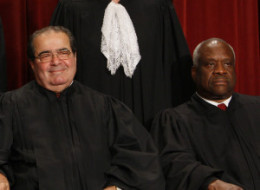
s-SCALIA-THOMAS-KOCH-INDUSTRIES-large.jpg

source: Think Progress

What Role Have Scalia And Thomas Played In The Koch Money Machine?


Earlier today, ThinkProgress’ Lee Fang revealed several documents outlining the details of one of right-wing billionaire Charles Koch’s secret convenings of corporate political donors. As Koch revealed to the Wall Street Journal in 2006, the purpose of these meetings is to recruit “captains of industry” to fund the conservative infrastructure of front groups, political campaigns, think tanks and media outlets. Buried in this document, however, is a surprising revelation about the role two supposedly impartial jurists have played in these extended fundraising solicitations: “Past meetings have featured such notable leaders as Supreme Court Justices Antonin Scalia and Clarence Thomas.”

A Supreme Court justice lending a hand to a political fundraising event would be a clear violation of the Code of Conduct for United States Judges, if it wasn’t for the fact that the nine justices have exempted themselves from much of the ethical rules governing all other federal judges. Nevertheless, a spokesperson for the Supreme Court tells ThinkProgress that “[t]he Justices look to the Code of Conduct for guidance” in determining when they may participate in fundraising activities. Under that Code:
Fund Raising. A judge may assist nonprofit law-related, civic, charitable, educational, religious, or social organizations in planning fund-raising activities and may be listed as an officer, director, or trustee. A judge may solicit funds for such an organization from judges over whom the judge does not exercise supervisory or appellate authority and from members of the judge’s family. Otherwise, a judge should not personally participate in fund-raising activities, solicit funds for any organization, or use or permit the use of the prestige of judicial office for that purpose. A judge should not personally participate in membership solicitation if the solicitation might reasonably be perceived as coercive or is essentially a fund-raising mechanism.
Scalia and Thomas’ participation in these fundraising gatherings also call into question whether they can be impartial in any number of cases brought by Koch-aligned groups seeking immunity to the law. Most significantly, the Koch brothers have contributed significantly to efforts to stop the Affordable Care Act from going into effect, and a number of attendees at the Koch’s secret meetings include health industry moguls with a direct financial stake in the litigation challenging health reform (Justice Thomas’ wife, of course, actively lobbied against the Affordable Care Act).

Court observers hoping that Scalia and Thomas will recuse themselves from cases backed by the “Kochtopus” shouldn’t hold their breath, however. During the Bush Administration, Justice Scalia infamously refused to recuse himself from a suit against Vice President Dick Cheney even after it was revealed that Scalia and Cheney went on a duck hunting trip together during the pendancy of Cheney’s case. Scalia also came under ethical fire when he skipped Chief Justice Roberts’ swearing in ceremony to attend a junket to a Ritz-Carlton resort funded by the right-wing Federalist Society; and Thomas accepted more than $42,000 in free gifts in just six years on the Supreme Court.

At the very least, however, Scalia and Thomas should publicly disclose exactly what role they played in supporting Koch’s secret fundraising network. These fundraising meetings exist for the purpose of eliminating laws and regulations that corporate America does not like, and a sitting Supreme Court justice can do a great deal to advance this purpose (indeed, Scalia and Thomas both already handed an enormous gift to the Koch’s corporate network by joining the egregious decision in Citizens United v. FEC). The two justices’ attendance at these events raise serious questions about whether Scalia and Thomas are deciding cases impartially — or whether they are pushing the exact same agenda as all the Koch events’ other attendees.
<!-- post updates would go here in theory -->
 
source: Think Progress


Wall Street Titan Ken Langone, GOP Presidential Candidate Herman Cain At Koch Brothers Meeting

This weekend, David and Charles Koch, co-owners of the Koch Industries conglomerate of chemical, timber, oil and manufacturing interests, are hosting their twice annual meeting to coordinate strategy and raise funds for the conservative movement. In October, ThinkProgress brought these meetings to light with a memo detailing the last Koch event, held in June, where corporate interests collaborated to help Republicans dominate the election last year. The memo we published showed that the last meeting included a number of wealthy business executives, along with leaders from the U.S. Chamber of Commerce and Glenn Beck. Previous meetings have featured top Republican politicians and conservative Supreme Court justices. ThinkProgress is reporting from the ground in Rancho Mirage for this meeting, and has learned new information about the attendees:
Ken Langone, an investment banker and founder of Home Depot, is attending the Koch meeting this weekend. Langone helped found the new Karl Rove network of front groups known as American Action Network, American Action Forum, and American Crossroads/Crossroads GPS, which together delivered an unprecedented wave of attack ads against Democrats last year. Langone and his fundraiser, Fred Malek, attended previous Koch meetings.

Karl Crow, a Koch-funded operative, will unveil a new voter-targeting system to help Republicans win back the White House in 2012. Last summer, Crow published a memo arguing that corporations should take advantage of the Citizens United decision to flood money into the midterm elections. His memo also claimed that the decision could give corporations unlimited power to coerce their employees into supporting particular pieces of legislation or candidates.

The first “serious” GOP contender for the presidency, Herman Cain, is at the Koch meeting. Cain, a talk show host and former CEO of Godfather’s Pizza, has been a frequent guest at events sponsored by Koch front groups like Americans for Prosperity.
On Thursday, ThinkProgress revealed other attendees of this year’s Koch meeting, like billionaires Richard DeVos and Diane Hendricks. Majority Leader Rep. Eric Cantor (R-VA) will be in attendance, according to National Review. Also, we learned that 40% of the donors this weekend will be new to the Koch meetings, and that Charles Koch has promised to match ever dollar raised with one of his own.


<!-- post updates would go here in theory -->Update Ronald Erickson, "CEO of Holiday Companies, a Minnesota based petroleum retail and wholesale convenience business with operations in twelve states across the Upper Midwest and Alaska," is at the Koch meeting.

<!-- end #entryContent -->
 
source: Politico


Koch conference under scrutiny


<!--/.story-toolbar-->
110127_beck_rush_demint_et_al_ap_605.jpg
The conferences have drawn A-listers like Beck, Limbaugh, DeMint and others. | AP Photos Close


<!--/.slideshow-components-->
<!--/.slideshow-->
<IFRAME id=iframe_odiogo_0 height=0 src="" frameBorder=0 width=290 name=iframe_odiogo_0 scrolling=no></IFRAME>
This weekend, for the eighth straight year, the billionaire Koch brothers will convene a meeting of roughly 200 wealthy businessmen, Republican politicians and conservative activists for a semi-annual conference to raise millions of dollars for the institutions that form the intellectual foundation – and, increasingly, the leading political edge – of the conservative movement.

In the past, the meetings have drawn an A-list of participants – politicians like Sen. Jim DeMint of South Carolina, leading free-market thinkers including American Enterprise Institute president Arthur Brooks, talkers Rush Limbaugh and Glenn Beck and even Supreme Court justices - to mingle with the wealthy donors who comprise the bulk of the invitees. The meetings adjourned after soliciting pledges of support from the donors – sometimes totaling as much as $50 million – to non-profit groups favored by the Kochs.
<!--/.story-embed-->


For the most part, the meetings, which are closed to the public and reporters, have attracted little attention outside conservative circles. But very different circumstances surround the Koch conference set to begin Saturday at an exclusive resort outside Palm Springs, Calif.

The Koch brothers – Charles and David – have come under intense scrutiny recently for their role in helping start and fund some of the deepest-pocketed groups involved in organizing the tea party movement such as Americans for Prosperity, and for steering cash towards efforts to target President Barack Obama, his healthcare overhaul, and congressional Democrats in the run-up to the 2010 election.

Liberal critics have launched a campaign to highlight what they say is the systematic way in which the Kochs use their political giving to advance a conservative economic and regulatory agenda designed to further the interests of their oil, chemical and manufacturing empire.

Common Cause, the liberal watchdog group, is planning a protest called “Uncloaking the Kochs” and what it calls “the billionaires caucus” on Sunday a few miles down the road from the resort in Rancho Mirage, Calif., where this weekend’s conference will be held, and a handful of reporters have made plans to try to cover the Koch’s closed-door gathering.

While the Koch conferences have taken on an undeniably political edge – a June summit featured sessions on voter mobilization efforts for the 2010 midterms as well as solicitations for an ad campaign attacking Democratic lawmakers – those who have attended the meetings say the critics have it all wrong.

“The main goal of the seminars appeared to me to be education on the challenges that face the American system of free enterprise and democracy, and what people can do about them,” said Virginia Gov. Bob McDonnell, a conservative Republican who has attended at least seven of the meetings.

McDonnell, who is not attending this weekend’s conference, said he was introduced to the gatherings by “free market friends up in Northern Virginia, some in the Koch enterprises institution,” and he cast the conferences as playing an important role in the political process.

“Groups on the right, left and in the middle get together all over this great country to exercise their first amendment rights to talk about these issues - some of them are public. Some of them are closed meetings,” he said. “So, to the degree that some on the left may be trying to attack these Koch seminars is really ridiculous.”

Until recently, the secrecy surrounding the meetings had always been tight.


A packet distributed to participants at the last session, held in June in Aspen, Colo., warned attendees not to talk to the press about the meetings, to wear their nametags at all times, and stressed that the meetings are “confidential” and “invitation-only.”

When that packet, which contained a tentative agenda and the names of about 200 invitees hand-picked by the Kochs, was leaked to the New York Times and the White House-allied ThinkProgress blog, it prompted a concerted effort by Koch operatives to locate the source of the leak.

<!--/.story-embed-->
Wealthy business leaders – in particular – have reason to be cautious about publicizing their participation in the conferences and might not participate if they were open to the public, said Herman Cain, a conservative activist and former CEO of Godfather’s Pizza who has participated in three Koch conferences and plans to attend this weekend’s.

“If you happen to be someone who sits on the board of a corporation or you own your own company, and you’re quoted out of context, it could impact your relationship with your owners, your stockholders and your employees,” he said. “That’s why the meetings are closed, so that you don’t have to try to say what’s politically correct. You can just talk about solutions and ideas about what needs to be done in order to try to make this country stronger.”

But the scrutiny from the media, liberal watchdogs and Democrats, including the White House, not only failed to discourage new participants, asserted a source close to the Kochs, it may have increased interest for this weekend’s meeting. “As a result of left-wing attacks, attendance is booming,” said the source.

In addition, the Kochs have been asking select participants to talk publicly about the conference to counter any effort to frame it as a secretive cabal.

Still, when contacted by POLITICO, most of those who had attended past conferences either refused to comment or would do so only on background, with some expressing concern about running afoul of the Koch brothers – who are reportedly worth $21.5 billion each – and being blacklisted from receiving invitations or funding.

According to a POLITICO analysis of Federal Election Commission and Internal Revenue Service Records, participants in last year’s Aspen conference, their clients and companies, have accounted for $48.3 million in contributions to mostly conservative candidates and causes since 2003.

And those tallies don’t include contributions to Koch-backed non-profit groups such as Americans for Prosperity or the Cato Institute which are registered under sections of the tax code that don’t require them to disclose their donors, making it difficult to accurately assess the total impact of Koch-linked giving.

Cain, who is openly discussing a long-shot bid for the 2012 GOP presidential nomination as a tea party alternative to the front-runners, echoed McDonnell that the left’s criticism is hypocritical.

“The liberals in this country are always looking for a big conservative target, but the Democracy Alliance does the same thing – so why is this one so suspect?” he said, citing a group of Democrat-allied donors who have been meeting twice a year in secret since 2005.

In some ways, the comparison between the groups is apt.

Democracy Alliance, which kicked a POLITICO reporter out of its November meeting, was patterned after the Kochs’ efforts to steer major donor funding to a set of permanent think tanks and policy-based non-profits that aren’t directly linked to elections.

And POLITICO has learned the Kochs are trying to launch a voter micro-targeting operation called Themis that their operatives hope will one day rival the Democrats’ vaunted Catalist database, which was funded with help from Democracy Alliance.

<!--/.story-embed-->
Plus, the Kochs are becoming targets for the left in the same way the billionaire financier George Soros, a founding Democracy Alliance donor, has long been vilified by conservatives.

Former U.S. Attorney General Ed Meese, who has attended almost every Koch conference and sits on the board of the Mercatus Center at George Mason University, which the Kochs helped create and fund, rejected the Soros comparison. Conservative attacks on Soros, he said, “have been scrupulous in being careful with the truth and presenting only facts, whereas on the left, you have a lot of false and misleading rhetoric about the Kochs.”

Charles and David Koch each own about 40 percent of the Wichita, Kansas-based Koch Industries, which was founded by their father in the 1940s as an oil concern. Today, it’s the second-largest privately held company in the U.S., with interests in producing and distributing oil, chemicals, energy, pulp and paper, and various other concerns.

Students of libertarian free-market philosophy, the Koch brothers, their foundations and company focused their giving in the 1970s, 80s and 90s on think tanks that churned out mountains of studies and white papers promoting libertarian-infused free-market policies and legislation.

The family’s money either launched or helped launch such pillars of the conservative establishment as the Cato Institute, the Mercatus Center, and the Institute for Justice, while the Koch-funded Citizens for a Sound Economy, founded in 1984, engaged in so-called grassroots lobbying on a narrow range of issues that sometimes seemed to jibe with the interests of the Koch’s companies.

By the mid-point of the Bush administration, though, many fiscal conservatives had become disenchanted with what they saw as the fiscally reckless course charted by the Republicans who controlled both the White House and Congress.

It was against this backdrop that David Koch spearheaded the creation of Americans for Prosperity and that Charles Koch began organizing the donor conferences, with the inaugural meeting occurring in Chicago in 2003.

While critics have charged that their support for free markets represents a thinly veiled rationale to oppose federal regulation, one donor who has attended six or seven Koch conferences insists it is a fundamental belief.

“For the left to characterize the Kochs’ efforts in the policy arena as self-interested is to misjudge the extent to which they are motivated by an intellectual belief system,” said the donor, “just as the philanthropic efforts of George Soros and Peter Lewis and others on the left are driven by their very different beliefs.”

But their newfound prominence as liberal targets is due largely to their support for more activist groups, many of which have sought to harness or fan the energy of the tea party movement.

Their summer 2010 Aspen conference, for instance, featured a heavy emphasis on the efforts of Koch-linked groups to shape the midterm elections by rallying grassroots activists around issues important to the tea party.
<!--/.story-embed-->


An ad was screened attacking Obama’s healthcare overhaul, and plans were announced to air it in districts of vulnerable congressional Democrats who supported it, while Karl Crow, a former Koch Foundation staffer who left to run Themis last year, introduced the project to donors.

Tim Phillips, president of Americans for Prosperity, which David Koch helped found in 2004 and which played a leading role in organizing early tea party events, talked about his group’s effort to mobilize voters ahead of the midterms, as well as its planned $45-million campaign ripping Democrats in 50 swing House districts and half a dozen targeted Senate races.

At the luncheon on the final day, a donor stood up and pledged $1 million to fund some of the Koch-backed non-profits, followed by a number of other 7-figure pledges, and a combined $12 million pledge by the Koch brothers, according to multiple attendees, one of whom estimated that the pledges received at that luncheon alone totaled $25 million.

But the Kochs and their operatives have expressed some uneasiness about being linked to grassroots activism, generally, and tried to distance themselves from the tea party movement, specifically.

“I’ve never been to a tea-party event,” David Koch in July told New York magazine in a rare interview. “No one representing the tea party has ever even approached me.”

In a May interview with FrumForum, Koch’s top executive, Richard Fink, said of Americans for Prosperity: “I don’t consider them a Tea Party institution,” then clarified “While they participate in events with tea party groups, our support of them has included no funds specifically for tea party-related efforts.”

A session at the January 2009 Koch donor conference in Palm Springs seemed to highlight the tension between the establishment and the new populist, grassroots movement. It featured a spirited debate about how best to advance free-market conservative principles in Washington between DeMint, who was then emerging as a champion of the anti-establishment conservative movement that became a pillar of the tea party, and Sen. John Cornyn, chairman of the National Republican Senatorial Committee.

Cornyn told the donors about Republican efforts to win more seats in the Senate, while DeMint made the argument – as he has repeatedly, both before and since – that the cause would be better served by having a GOP minority comprised entirely of uncompromising conservative purists, than having a majority compromised of moderates and centrists.

“That’s a pretty establishment crowd,” said someone familiar with the panel. “But DeMint completely won them over.”


<!--/.story-text-->
<!--/.story-wrapper -->


source: Politico


Koch meeting draws protests

By: Kenneth P. Vogel
January 30, 2011 11:06 PM EST

RANCHO MIRAGE, Calif. – Inside the walled-off resort where the billionaire Koch brothers convened their annual conference of major conservative donors, Washington Examiner columnist Tim Carney on Sunday gave a speech about the corrosive impact of “corporate welfare and bailouts, and the destructive influence of the Big Business lobby in Washington.”

Outside, though, hundreds of protesters accused David and Charles Koch and their assembled donors of being poster children for that very problem by funneling huge – and mostly undisclosed – donations into front groups pushing a political agenda intended to boost their profits at the expense of average Americans.

As participants in the invitation-only conference watched from behind a heavily guarded gate, protestors pressed towards sheriff’s deputies guarding the entrance, waving signs reading “Koch Kills” and “Uncloak the Kochs,” and chanting “David and Charles Koch: Your corporate greed is making us broke.”

The Riverside County Sheriff’s department pegged the protest at between 800 and 1,000 people (though organizers claimed it was twice that) and said they arrested 25 protestors. They were primarily associated with the liberal activist groups Code Pink and Ruckus Society, which had planned the protests and negotiated the arrests ahead of time with authorities, while the Federal Aviation Administration restricted air traffic over the resort - a couple days after the environmental activist group Greenpeace flew a blimp over this tony suburb of Palm Springs that was emblazoned with stylized portraits of David and Charles Koch bracketing the words “Koch Brothers; Dirty Money.”

Conservative provocateur and media entrepreneur Andrew Breitbart – who had spoken to last year’s conference but did not attend this weekend’s – rollerbladed through Sunday’s crowd of protesters, gleefully provoking arguments and hecklers.

“This is a protest against capitalism, against libertarianism, against the free market,” Breitbart asserted, calling the Koch conference goers “good and decent people … who create jobs.”

Through their oil and chemical company Koch Industries, the Koch brothers have been holding the conferences twice a year since 2003, with the winter meetings typically in the Palm Springs area, and the summer meetings in Colorado. But this was the first year the meeting attracted the attention of protesters – or really anyone at all, beyond the attendees.

The meetings bring together roughly 200 conservative business titans and dignitaries hand-picked by the Koch brothers to discuss the conservative movement and allocate millions of dollars in contributions to Koch-linked non-profit groups. Those who attend are warned not to mention the meetings publicly, and every previous meeting went off without a word in the press.


But in recent months, the Koch brothers have been on the receiving end of a blitz of intense scrutiny for their role in helping start and fund some of the deepest-pocketed groups involved in organizing the tea party movement, such as Americans for Prosperity, and for steering cash toward efforts to target President Barack Obama, his health-care overhaul, and congressional Democrats in the run-up to the 2010 election.

And liberal watchdog groups led by Common Cause pounced on the Rancho Mirage meeting as a chance to highlight the flow of corporate money into politics, after the leak of a letter from Charles Koch inviting potential participants to the meeting, which he wrote would “develop strategies to counter the most severe threats facing our free society and outline a vision of how we can foster a renewal of American free enterprise and prosperity.”

Despite the publicity, the conference drew a slew of prominent politicians and conservative donors, including House Majority Leader Eric Cantor, Home Depot lead investor Ken Langone, former Attorney General Ed Meese, Americans for Prosperity President Tim Phillips, long-shot GOP presidential candidate Herman Cain and former Jack Abramoff associate and Bush appointee Patrick Pizzella. Other big donors, including retired Sysco chief John Woodhouse and Amway founder Rich DeVos, were expected to attend, as well.

The luxury resort was closed to everyone except Koch conference-goers and those attending a meeting of federal judges from the Ninth Circuit, who coincidentally had scheduled their gathering for the same hotel, and who were expected to bring a significant security presence as well.

Various media outlets ran items previewing the Koch conference. Yet the conference itself attracted relatively little national media, with some television news sources explaining that the organizers’ barring the press made it difficult to cover, and also citing the saturation coverage of the unrest in Egypt, as diminishing the bandwidth for stories on a secretive conservative donor conference.

NBC News was the only network to send a national camera crew, and its mission was at least partly to get footage to air Monday on the “Rachel Maddow Show,” whose host has repeatedly criticized the Kochs, suggesting they control the tea party and use it for their own interests.

Tea Party activists “were essentially instructed to rally against things like climate change legislation by” the Kochs, Maddow said last year, asserting the brothers use “dad’s money” to fund political groups that pursue an agenda “that is hard-core ideological, hard-core conservative” and also serves their bottom line.

Russia Today, a state-funded channel that airs English language programming on cable providers in major American markets, also was on the scene Sunday, shooting footage of the protests and an earlier Common Cause panel for an expose on corporate influence in government.

That was the narrative offered by speakers at the protest at a Sunday morning Common Cause event in a nearby movie theater, including activist Jim Hightower and former Obama administration official Van Jones.

The Kochs are “only interested in their own gain, only interested in their own profit,” charged Jones, “and we are here to put a stop to that kind of treachery against our country … We will not live on an economic plantation run by the Koch brothers. We will not do that. We refuse to do that.”

Hightower asserted the Kochs “are out to supplant our democracy with their plutocracy” and said “this is about the very soul of America.”
Outside the resort gate, Sophie Korn, a 24-year old teacher who had yelled “arrest Breitbart” at the conservative provocateur, said she drove the two hours from her Los Angeles home to join the protest because the Kochs “are one of the biggest funders of climate change denial and it makes me sick that they’re able to use their private wealth to corrupt our democracy.”

Korn is affiliated with the Ruckus Society, which was selling T-shirts depicting David and Charles Koch as two-headed “Kochtopus,” its tentacled arms grasping bags of cash, with the proceeds going to bail out their arrested comrades. But she said “the goal today is not to get a lot of people arrested. It’s to bring attention to the corrosive corporate power that’s had some serious consequences on the well being of Americans.”

Carney, who was introduced at the conference by Charles Koch, said his speech, which was closed to the press like the rest of the conference, cautioned the corporate titans at the Koch conference against lobbying the government for special treatment, and instead urged them to support policies that would create an even-playing field on which the free market could play out.

"You can’t tell whether they’re listening to you and watching or glaring at you,” he said after his talk, though he added that “a couple people told me they appreciated what I was saying.”
 
source: Think Progress

Why We Doubt Clarence Thomas

At an event sponsored by the right-wing Federalist Society, Justice Clarence Thomas lashed out at his many critics — including ThinkProgress — claiming that we are attacking him as part of some nefarious plot to undermine the Supreme Court as an institution:
He also lashed out at his critics, without naming them, asserting they “seem bent on undermining” the High Court as an institution. Such criticism, Thomas warned, could erode the ability of American citizens to fend off threats to their way of life.
“You all are going to be, unfortunately, the recipients of the fallout from that – that there’s going to be a day when you need these institutions to be credible and to be fully functioning to protect your liberties,” he said, according to a partial recording of the speech provided to POLITICO by someone who was at the meeting.
Listen:

<OBJECT id=flashObj codeBase="http://download.macromedia.com/pub/shockwave/cabs/flash/swflash.cab#version=6,0,40,0" classid=clsid:d27cdb6e-ae6d-11cf-96b8-444553540000 width=320 height=272>


<embed id="flashObj" type="application/x-shockwave-flash" width="320" height="272" src="http://c.brightcove.com/services/viewer/federated_f9?isVid=1" name="flashObj" allowscriptaccess="always" swliveconnect="true" allowfullscreen="true" seamlesstabbing="false" base="http://admin.brightcove.com" flashvars="videoId=804939554001&playerID=19407224001&playerKey=AQ~~,AAAAAETmrZQ~,EVFEM4AKJdQtJLv7zbMPiBGChHKnGYSG&domain=embed&dynamicStreaming=true" bgcolor="#FFFFFF"></embed></OBJECT></P>
As the news outlet which originally broke the story that Justice Thomas unethically attended a Koch-sponsored political fundraiser, ThinkProgress is honored by Thomas’ suggestion that we have become so powerful that we are capable of undermining an entire branch of the federal government. Yet, if Thomas is really concerned that the Supreme Court’s legitimacy is being undermined, he should direct his criticism far closer to home:​
So the truth is that ThinkProgress and other Thomas doubters hardly deserve the credit he gives us for undermining the Court’s credibility. Justice Thomas is inflicting far greater wounds on the Court’s legitimacy than any of his critics could ever cause.​
 
Back
Top