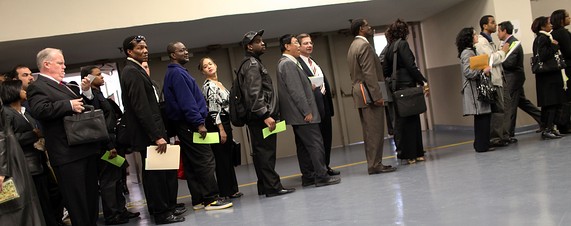
Vanishing Jobs, Rising Unemployment

Internet, Nuclear Technology (Manhattan Project) which led to civilian uses, insuring Nuclear Plants, Satellites, HDTV, Roads for the Big 3 to sell cars, GPS, Housing (Secondary Mortgage Market), Hybrid technology, tax credits to sell these cars (Volt, Tesla, Leaf)

Prevented panic runs on the banks that would have collapsed the economy, the reason you can put your money in the bank without worry. Provide subsidies for farmer to produce food, otherwise there would be more food 'insecurity'

It isn't all about the private sector producing jobs, if anything capitalism is fucking up, leaving 15 million laying around doing nothing, who would be starving on the street if it wasn't for unemployment and the other safety net program. What wealth or jobs is capitalism creating for the 15 million people that are unemployed?

:dance:
 
check out the question Que, he's trying to get me to argue his points for him.


My point is govt policies don't really assist the private sector create jobs. In my lifetime, all I've witnessed is deindustrialization & globalization. I'll just take the auto industry, It's now obvious, they were healthier before NAFTA, CAFE standards, and other "managed" trade policies that made us uncompetitive.

Looking at how most industries have outsourced their work, isn't it also obvious govt policies are not condusive to creating private-sector jobs?


What auto companies? Prior to CAFE standards Toyota, Honda, BMW etc. were just blips on a chart. Now they are among the world leaders, able to adapt to a changing world of markets, gasoline prices, safety and pollution standards while the American companies bitch and whine, piss and moan about the 'burdens" of regulation. Chrysler has been hemorrhaging for over 40 years or so and GM has been withering under its own mismanagement. Ford is holding its own and will most likely will emerge even stronger. GM and Chrysler have been operating under poor business models regardless of what government policies were in place at any one time. One of your problems Lamarr is, like so many other libertarians/conservatives is that you can point the finger at what the so called government has done to business, but will not recognize or admit what failures bossiness are dong to themselves.
 
The recession will continue through 2011.

Work hard to keep the job you have or start working for yourself. Whether it be legitimate or underground.
 
<font size="5"><center>
U.S. Added 290,000 Jobs in April </font size>
<font size="4">

The largest gain in employment since March 2006 - following an
upwardly revised 230,000 increase in March; However, as a
reminder of the labor market's continued weakness, the
unemployment rate increased to 9.9% last month.</font size></center>


OB-IK467_tape05_F_20100506172936.jpg


Wall Street Journal
By LUCA DI LEO
and JEFF BATER
May 7, 2010


The U.S. economy in April added jobs at the fastest pace in four years, but the unemployment rate unexpectedly rose.

The Labor Department said nonfarm payrolls rose by a higher than expected 290,000 jobs last month -- the largest gain since March 2006. That followed an upwardly revised 230,000 increase in March.


Economists polled by Dow Jones Newswires were expecting payrolls to rise by 180,000. The March figure was originally reported as a 162,000 increase.

Taking into account revisions to prior months, the U.S. economy added an average of 143,000 jobs a month in the first four months of the year, which may fuel optimism about the job market's recovery.

However, as a reminder of the labor market's continued weakness, the unemployment rate increased to 9.9% last month. Economists were expecting it to remain at March's 9.7% level.

The two numbers are calculated by the Bureau of Labor Statistics in different ways. The payroll figure is taken from a survey of employers, while the jobless rate is calculated using a household survey.

The U.S. economy has lost nearly 8.5 million jobs over the past two years, more than half of today's total unemployed. Although the downturn probably ended 10 months ago, companies have been reluctant to ramp up hiring as they await for more evidence of a stronger economy. In the meantime, they're focusing on producing more with fewer workers.

The employment numbers came a day after the Dow industrials took a harrowing 998.5 point plunge in a five-minute selloff. The WSJ's Dennis Berman, Evan Newmark and Dave Kansas discuss.

Total government employment, which include state and local jobs, rose by 59,000, helped by the influx of the Census workers. The decennial Census accounted for 66,000 of the employment boost last month. As those jobs will be lost in the second half of the year, some economists cautioned not to read too much into the headline figure. Census hires in March were 48,000.

Beyond government jobs, the report showed that the private sector created 231,000 jobs. Manufacturing continued to trend up, rising by 44,000. The industry, which is leading the economy's recovery, has added 101,000 jobs since December. Construction, a sector that has been suffering, added 14,000 jobs in April.

However, investors should be cautious about concluding from the April data that the jobs market is now out of the woods.

Economists expect the unemployment rate to fall very slowly as discouraged job seekers who had stopped looking for work return to the labor force and are counted as unemployed. The size of the labor force rose by 805,000 in April, the Labor Department said.

The U.S. Federal Reserve expects the unemployment rate to remain above 9.0% until the end of 2010 as the economy continues to recover only slowly.

The jobs report shouldn't change the Fed's view that short-term interest rates must remain at a record low for an "extended period." At its last meeting Apr. 27 and 28, the Fed said the economy was strengthening and the jobs market was starting to improve, but kept rates close to zero to support a fragile recovery.

In a sign the labor market remains weak, a broader measure of unemployment continued to edge up. The so-called underemployment rate, which includes those who have quit job hunting as well as those working part time because they can't find full-time work, rose to 17.1% in April from 16.9% the previous month. In January, the underemployment rate stood at 16.5%.

Average hourly earnings of all employees rose by just $0.01 to $22.47 in April. Earnings of private production and nonsupervisory employees rose $0.05 to $18.96.

Write to Luca Di Leo at luca.dileo@dowjones.com and Jeff Bater at jeff.bater@dowjones.com


http://online.wsj.com/article/SB100...2760855258.html?mod=WSJ_Markets_MIDDLETopNews
 
The largest gain in employment since March 2006 - following an upwardly revised 230,000 increase in March; However, as a reminder of the labor market's continued weakness, the unemployment rate increased to 9.9% last month.

How can both employment AND UN-employment increase at the same time??!?!?!??

The government and the mass media really think people are stupid (or cowards).

Maybe they're right, if no one calls out this obvious BS.
 
How can both employment AND UN-employment increase at the same time??!?!?!??

The government and the mass media really think people are stupid (or cowards).

Maybe they're right, if no one calls out this obvious BS.

Or, perhaps you aren't as smart as you think you are ?

For starters: the number of jobs coming available can increase; while the number of persons entering the job market can increase, at a faster pace.

QueEx
 
Or, perhaps you aren't as smart as you think you are ?

For starters: the number of jobs coming available can increase; while the number of persons entering the job market can increase, at a faster pace.

QueEx

Let's say I'm not smart.

This "not smart" person asks, "How can two opposite things (unemployment and employment) both go in the same direction?"

It's like saying I'm going up AND down...

or in AND out...
or right AND left...

If someone who is not smart can see it makes no sense, why publish it? What's the point?

This is coming from the Wall Street Journal which is more reason why I stopped taking mass media seriously.
 
How can both employment AND UN-employment increase at the same time??!?!?!??

The government and the mass media really think people are stupid (or cowards).

Maybe they're right, if no one calls out this obvious BS.


It has nothing to do with stupidity or the gullibility of the public. The unemployment rate going up as the number of monthly jobs created increases is a function of how unemployment statistics are compiled.

There is no government subterfuge or obfuscation going on. There or hundreds of thousands, if not millions of people who HAVE STOPPED EVEN LOOKING for work. These ‘discouraged workers’ who want work, but have stopped looking for work, are not counted as officially unemployed. Only people who have actively sought work in the prior four weeks are counted in the headline unemployment number 9.9% (May 7th 2010). As these ‘discouraged workers’ return to “looking-for-a-job” status, they are once again counted as unemployed; therefore you got an increase in the unemployment rate form 9.7% to 9.9% (May 7th 2010)

The results today (May 7th 2010) of 290,000 monthly jobs created are anemic. The US economy should be creating 400,000 to 600,000 jobs per month in order to really decrease the REAL unemployment rate which including ‘discouraged workers’ is actually 18%.

The untold reality that the corporate media has deliberately avoided telling the 90% of Americans whose SOLE source of news is television, is that the jobs they are looking for & fired from, HAVE BEEN OUTSOURCED TO FOREIGN COUNTRIES.

I’m not just talking about garment industry & manufacturing jobs, I’m talking about Computer Engineers, Radiologist M.D.’s, C.P.A. (Certified Public Accountants), Software Engineers, Financial Analysts MBA’s, and hundreds of other so-called white collar jobs which require a four year college degree.
I will start a separate thread about this under-reported reality soon.

However to put this entire US unemployment rate into perspective let us not forget another fact that the corporate media of mass distraction has deliberately avoided telling the 90% of Americans whose SOLE source of news is television. That fact is :
<SPAN style="background-color:yellow">
There has been ZERO net job creation in the USA since December 1999.
</span>
<blockquote>
No previous decade going back to the 1940s had job growth of less than 20 percent. Economic output rose at its slowest rate of any decade since the 1930s as well.

Middle-income households made less in 2008, when adjusted for inflation, than they did in 1999. 1999 to 2009 was the first decade of falling median incomes since figures were first compiled in the 1960s.

And the net worth of American households -- the value of their houses, retirement funds and other assets minus debts -- has also declined when adjusted for inflation, compared with sharp gains in every previous decade since data were initially collected in the 1950s.

Who controlled the macro economic policy of the US during the last decade?? Was it not the RepubliKlans led by the Bushit administration??

READ:http://www.washingtonpost.com/wp-dyn/content/article/2010/01/01/AR2010010101196.html
</blockquote>
bvb5y.jpg

2vkkdv7.jpg


<hr noshade color="#ff0000" size="6"></hr>

wsjLogo.gif


Bush On Jobs: The Worst Track Record On Record


January 9, 2009 http://wsj.bush.jobs.failure

President George W. Bush entered office in 2001 just as a recession was starting, and is preparing to leave in the middle of a long one. That’s almost 22 months of recession during his 96 months in office.

His job-creation record won’t look much better. The Bush administration created about three million jobs (net) over its eight years, a fraction of the 23 million jobs created under President Bill Clinton’s administration and only slightly better than President George H.W. Bush did in his four years in office.

Here’s a look at job creation under each president since the Labor Department started keeping payroll records in 1939. The counts are based on total payrolls between the start of the month the president took office (using the final payroll count for the end of the prior December) and his final December in office.

Because the size of the economy and labor force varies, we also calculate in percentage terms how much the total payroll count expanded under each president. The current President Bush, once taking account how long he’s been in office, shows the worst track record for job creation since the government began keeping records. –Sudeep Reddy

8vwuwy.png

 
Last edited:
290,000 New Jobs Created In April, But Unemployment Rate Jumps To 9.9%

http://www.businessinsider.com/april-jobs-report-2010-5


A lot more jobs were created (290K vs. expectations of 180K), but the workforce grew, so the unemployment rate

jumped from 9.7% to 9.9%.


Nonfarm payroll employment rose by 290,000 in April, the unemployment rate
edged up to 9.9 percent, and the labor force increased sharply, the U.S.
Bureau of Labor Statistics reported today. Job gains occurred in manufactur-
ing, professional and business services, health care, and leisure and hospi-
tality. Federal government employment also rose, reflecting continued hiring
of temporary workers for Census 2010.


The BLS's U-6 number, which is sometimes called the "real" unemployment rate, because it takes into discouraged workers who aren't looking for work ticked up in April from 16.9% to 17.1%.

Here are some other internals;

Persons unemployed 15 weeks or longer held steady at 5.8%.
The average workweek increased .1 hours to 34.1 hours.
Average hourly earnings increased by a single penny to $22.47.
The Federal Government created 66,000 of the 290K jobs gained through the census.
The birth/death adjustment (guess) added 188,000 jobs, which bears will seize on
The Health Care industry created 20,000 new jobs.
Manufacturing added 44,000 jobs (strong)


Household Survey Data

In April, the number of unemployed persons was 15.3 million, and the unem-
ployment rate edged up to 9.9 percent. The rate had been 9.7 percent for the
first 3 months of this year. (See table A-1.)

Among the major worker groups, the unemployment rate for whites (9.0 percent)
edged up in April, while the rates for adult men (10.1 percent), adult women
(8.2 percent), teenagers (25.4 percent), blacks (16.5 percent), and Hispanics
(12.5 percent) showed little or no change. The jobless rate for Asians was
6.8 percent, not seasonally adjusted. (See tables A-1, A-2, and A-3.)

The number of long-term unemployed (those jobless for 27 weeks and over) con-
tinued to trend up over the month, reaching 6.7 million. In April, 45.9 percent
of unemployed persons had been jobless for 27 weeks or more. (See table A-12.)

Among the unemployed, the number of reentrants to the labor force rose by
195,000 over the month. (See table A-11.)

In April, the civilian labor force participation rate increased by 0.3 percent-
age point to 65.2 percent, as the size of the labor force rose by 805,000. Since
December, the participation rate has increased by 0.6 percentage point. The em-
ployment-population ratio rose to 58.8 percent over the month and has increased
by 0.6 percentage point since December. (See table A-1.)

The number of persons employed part time for economic reasons (sometimes refer-
red to as involuntary part-time workers) was about unchanged at 9.2 million in
April. These individuals were working part time because their hours had been cut
back or because they were unable to find a full-time job. (See table A-8.)

About 2.4 million persons were marginally attached to the labor force in April,
compared with 2.1 million a year earlier. (The data are not seasonally adjusted.)
These individuals were not in the labor force, wanted and were available for work,
and had looked for a job sometime in the prior 12 months. They were not counted
as unemployed because they had not searched for work in the 4 weeks preceding
the survey. (See table A-16.)

Among the marginally attached, there were 1.2 million discouraged workers in
April, up by 457,000 from a year earlier. (The data are not seasonally adjusted.)
Discouraged workers are persons not currently looking for work because they be-
lieve no jobs are available for them. The remaining 1.2 million persons marginal-
ly attached to the labor force had not searched for work in the 4 weeks preceding
the survey for reasons such as school attendance or family responsibilities. (See
table A-16.)


Establishment Survey Data

In April, nonfarm payroll employment rose by 290,000. Sizable employment gains oc-
curred in manufacturing, professional and business services, health care, and in
leisure and hospitality. Federal government employment increased due to the hiring
of temporary workers for Census 2010. Since December, nonfarm payroll employment
has expanded by 573,000, with 483,000 jobs added in the private sector. The vast
majority of job growth occurred during the last 2 months. (See table B-1.)

Manufacturing added 44,000 jobs in April. Since December, factory employment has
risen by 101,000. Over the month, gains occurred in several durable goods indus-
tries, including fabricated metals (9,000) and machinery (7,000). Employment also
grew in nondurable goods manufacturing (14,000).

Mining added 7,000 jobs in April, with most of the increase in support activities
for mining. Since last October, mining has added 39,000 jobs.

In April, construction employment edged up (14,000), following an increase of 26,000
in March. Over the month, nonresidential building and heavy construction added 9,000
jobs each.

Employment in professional and business services rose by 80,000 in April. Temporary
help services continued to add jobs (26,000); employment in this industry has in-
creased by 330,000 since September 2009. Employment also rose over the month in ser-
vices to buildings and dwellings (23,000) and in computer systems design (7,000).

In April, health care employment grew by 20,000, including a gain of 6,000 in hospi-
tals. Over the past year, health care employment has increased by 244,000.

Employment rose by 45,000 in leisure and hospitality over the month. Much of this
increase occurred in accommodation and food services, which added 29,000 jobs. Food
services employment has risen by 84,000 over the past 4 months, while accommodation
has added 18,000 jobs over the past 3 months.

Federal government employment was up in April, reflecting the hiring of 66,000 tem-
porary workers for the decennial census.

Over the month, employment changed little in wholesale trade, retail trade, informa-
tion, and financial activities.

Employment in transportation and warehousing fell by 20,000 in April, reflecting a
large decline in courier and messenger services.

In April, the average workweek for all employees on private nonfarm payrolls increased
by 0.1 hour to 34.1 hours. The manufacturing workweek for all employees increased by
0.2 hour for the second straight month to 40.1 hours, and factory overtime was up by
0.1 hour over the month. The average workweek for production and nonsupervisory em-
ployees on private nonfarm payrolls increased by 0.1 hour to 33.4 hours in April.
(See tables B-2 and B-7.)

Average hourly earnings of all employees in the private nonfarm sector increased by
1 cent to $22.47 in April. Over the past 12 months, average hourly earnings have in-
creased by 1.6 percent. In April, average hourly earnings of private-sector production
and nonsupervisory employees increased by 5 cents to $18.96. (See tables B-3 and B-8.)

The change in total nonfarm payroll employment for February was revised from -14,000
to +39,000, and the change for March was revised from 162,000 to 230,000.

 
Republicans Rip Obama For POSITIVE Jobs Report

<object width="450" height="370"><param name="movie" value="http://www.liveleak.com/e/ea5_1273768632"></param><param name="wmode" value="transparent"></param><param name="allowscriptaccess" value="always"></param><embed src="http://www.liveleak.com/e/ea5_1273768632" type="application/x-shockwave-flash" wmode="transparent" allowscriptaccess="always" width="450" height="370"></embed></object>
:smh:
 
<font size="5"><center>
With good jobs going away,
middle class downsizes</font size></center>


The good paying, predominantly white-collar jobs that once sustained many American communities are disappearing at an alarming rate, keeping the unemployment rate stubbornly high despite the end of the Great Recession.

More troubling, these jobs in accounting, financial analysis, commercial printing and a broad array of other mostly white-collar occupations are unlikely to come back, experts predict.

There isn't a single cause to the trend:

  • Some of it is explained by changing technology,

  • some of it is the result of automation.

  • <SPAN style="BACKGROUND-COLOR: #ffff00">Sending well-paying jobs to low-cost centers abroad is another big part of the story</span>.

  • So is global competition from emerging economies such as China and India.


<IFRAME SRC="http://www.mcclatchydc.com/2010/11/11/103600/middle-class-downsizes-as-its.html" WIDTH=780 HEIGHT=1500>
<A HREF="http://www.mcclatchydc.com/2010/11/11/103600/middle-class-downsizes-as-its.html">link</A>

</IFRAME>
 
Back
Top