
GOP Begins Laying Out Campaign Against Obama's Court Pick

thoughtone

Rising Star
Registered
The party of no.

source: Huffington Post

The framework of the forthcoming battle over Barack Obama's Supreme Court pick began to materialize on Sunday, as a range of Republican officials sent out trial-balloon criticisms of a pick that is likely weeks away from being announced.

Talk of a filibuster was not directly addressed or, for that matter, ruled out. Republicans on the talk show circuit repeatedly noted that Obama himself had voted against cloture on the nomination of Samuel Alito in late January 2006.

"Well, I'm not a payback type of guy," Sen. Richard Shelby declared during an appearance on CNN. "I think you have to keep moving. On the other hand, a lot of us were aware of then Senator Obama's votes against Alito and I believe against Roberts. But I think Obama has -- President Obama has got some strong cards to deal. I hope he makes a great choice for the court."

Generally, however, Republicans tried to duck discussion of holding up a Supreme Court nominee in committee or Senate - in the process, spurring speculation that they would do just that.

"They need to get back to interpreting the law, and ultimately too many times lately they point to international law instead of the U.S. Constitution," Sen. John Ensign said when asked about holding up the nominee, during an appearance on Fox News Sunday. "We need to get back to what the Supreme Court is supposed to be about."

As for the president's process of selecting a nominee, GOPers were already sounding alarm. Sen. Orrin Hatch, who formerly chaired the Judiciary Committee, said that the broad standards that Obama had laid out for a Court pick -- including the quality of empathy -- were tantamount to committing himself to an "activist judge."

"Well, it's a matter of great concern," said Hatch on ABC's This Week. "If he's saying that he wants to pick people who will take sides, he has also said a judge has to be a person of empathy? What does that mean? Usually that's a code word for an activist judge. But he also said that he's going to select judges on the basis of their personal politics, their personal feelings, their personal preferences. Now, you know, those are all code words for an activist judge who is going to, you know, be partisan on the bench."

On the whole, every GOPer who took to the cameras on Sunday granted the president the right to choose someone who was of a liberal judicial mindset. "Elections have consequences," acknowledged former Massachusetts Governor Mitt Romney. But they pledged to put up a fight if the person was not of the requisite intellectual and legal qualifications.

"The key thing," added Romney, "and the place we draw the line is this: is a individual who will follow the constitution or the law or is this an individual who believes in making the law? And if it's the latter, I think we should stand up and scream loud and hard."
 
This is going to be interesting, to say the least.

QueEx
It certainly will be. GOP will rale against anyone he selects so he should just go ahead an select a liberal hispanic. Doing so will put the Republicans in a quandry. If they fight hard against it they'll lose even more of the latino vote than they already have. And Obama on the other hand will solidify his favorable standing with that particular voting bloc. :hmm:
 
It certainly will be. GOP will rale against anyone he selects so he should just go ahead an select a liberal hispanic. Doing so will put the Republicans in a quandry. If they fight hard against it they'll lose even more of the latino vote than they already have. And Obama on the other hand will solidify his favorable standing with that particular voting bloc. :hmm:

I wouldn't disagree with you at all, especially for the "Political" reasons you pointed out.

However, I think he should appoint not just a so-called "Liberal", but he should appoint a "Persuader".

Adding a mere Liberal to the Court doesn't really change the present balance there since Souter voted on many occasions with the Liberal wing anyway. A "Persuader", on the other hand, who has a liberal bent might be more of a "Game Changer". That is, he needs to appoint someone with strong legal-reasoning persuasion skills that has a chance of affecting one or more of those in the conservative wing, depending on the issue, to moderate or move toward the ideological/legal center.

In my opinion, a Persuader could have a huge impact while a mere liberal may just end up voting with, other liberals on a losing side.


QueEx
 
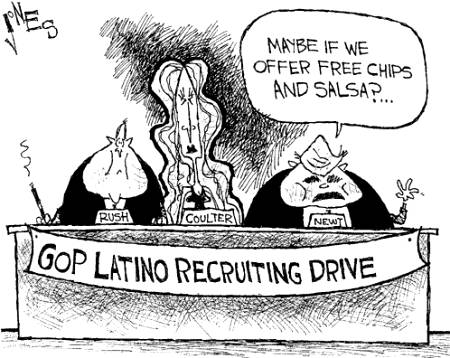
pigboy-salsa.jpg


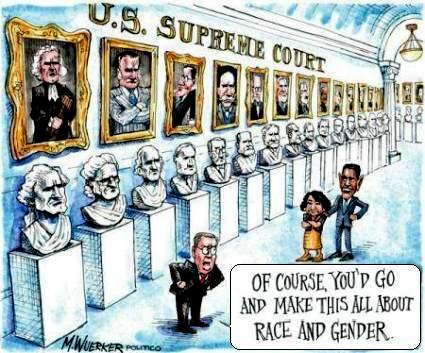
soto-race-and-gender.jpg


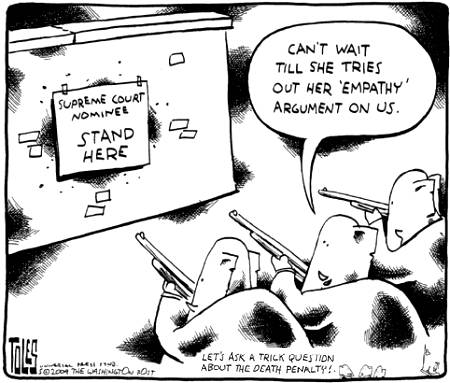
2vhsn45.jpg


sotomayor-attack.jpg
 
I'm in no position to question her qualifications. That said, it troubles me that she made the statement about appeals court is where policy is made. I hope no one here would want to be a defendant in a court of law whereas a justice didn't follow the rule of law. I think she be questioned like all others about any controversial statements. Republicans shouldn't be hypocrites in this matter due to the demanded up or down votes with Bush's picks.
 
I'm in no position to question her qualifications. That said, it troubles me that she made the statement about appeals court is where policy is made. I hope no one here would want to be a defendant in a court of law whereas a justice didn't follow the rule of law. I think she be questioned like all others about any controversial statements. Republicans shouldn't be hypocrites in this matter due to the demanded up or down votes with Bush's picks.
This shows that you don't know shit about the subject.

QueEx
 
Sotomayor's confirmation is a slam dunk. Even Republicans can't be so stupid as to think that they are in a position to withstand a vicious Latino backlash, especially with 2010 being such an important election year. Personally, I'd like to see them try to derail her nomination.
 
The Judge Blockade Begins

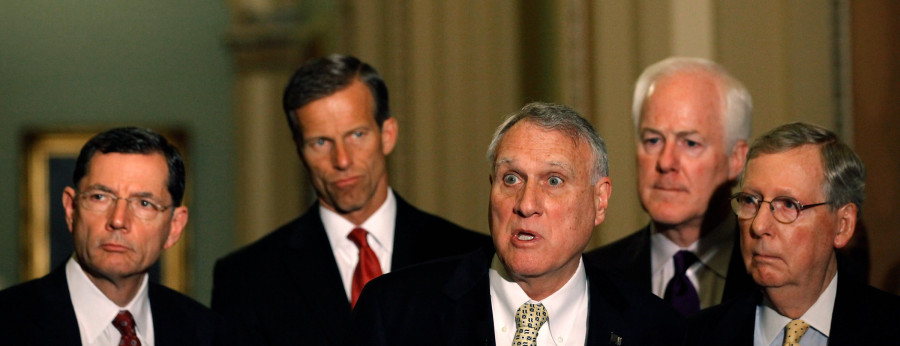
r-SENATE-REPUBLICANS-huge.jpg


source: Roll Call

GOP Begins Judge Blockade


With less than four and a half months until Election Day, Senate Republicans are shutting off the bipartisan spigot when it comes to confirming President Barack Obama’s nominees to the nation’s top courts and will present a unified front against his circuit court picks through November.

Senate Minority Leader Mitch McConnell (Ky.) made the decision to blockade nominations official Wednesday when he informed his colleagues that he would invoke the “Thurmond Rule” from now until after the elections.

Named after the late Sen. Strom Thurmond (R-S.C.) — and alternately called the “Leahy Rule” by some Republicans after Judiciary Chairman Patrick Leahy (D-Vt.) — the doctrine holds that within six months of a presidential election, the opposition party can, and typically does, refuse to allow votes on circuit court judges.

Republican sources said the GOP will impose its blockade on circuit court judges now but that district court nominees will likely continue to be confirmed until at least early September, when cooperation on lower court picks has traditionally ended.

According to GOP lawmakers, McConnell, Senate Judiciary ranking member Chuck Grassley (Iowa) and other top leaders discussed imposing the Thurmond Rule during Wednesday’s weekly Steering Committee luncheon for conservatives.

Grassley said he told his colleagues that “we ought to be instituting the Leahy-Thurmond rule right now,” arguing that Republicans have shown Obama the same deference on circuit court judges as Democrats showed former President George W. Bush.

“By this time, nobody can say it’s not fair to this president based on the number of nominations we’ve put up,” Grassley said.

McConnell’s decision was welcomed by his GOP colleagues.

“We’re in that window [of time] now,” Senate Republican Conference Chairman John Thune (S.D.) said. He added, “I think it’s about time, and it’s something we ought to do.”

National Republican Senatorial Committee Chairman John Cornyn (Texas) agreed, saying, “I think this is about the time. This is traditionally when the curtain comes down on circuit court judges.” Cornyn, who is also a member of the Judiciary Committee, noted that Obama shouldn’t be overly concerned because “if he’s elected [again], it means only a few months delay anyway.”

Sen. Orrin Hatch (R-Utah), a longtime member of the Judiciary Committee, said the invocation of the Thurmond Rule was only a matter of time. Hatch noted that “it’s always been used,” since Thurmond first blocked the nomination of Justice Abe Fortas to Chief Justice of the United States in 1968.

Individual Republicans during the past year have vowed to block one or more of Obama’s judicial nominees for a variety of reasons. Sen. David Vitter (R-La.) earlier this month cited the looming presidential election for his decision to filibuster a district court judge from Baton Rouge.

Saying he has “bent over backwards to cooperate” with Obama on nominations, Vitter told the Advocate newspaper, “Now that it’s a few months before a presidential election, however, I’m going to let the people speak before supporting any others.”

But the decision by leadership to formally invoke the Thurmond Rule raises the stakes significantly because an individual Senator’s filibuster can be overcome — so long as enough Republicans are willing to vote with Democrats. With McConnell now backing use of the Thurmond Rule, that appears unlikely to happen.

Leahy acknowledged the reality of the situation: “It’s an election year, and I understand that.”

Still, he said he was concerned that Republicans were invoking it this early in the cycle. “I would just remind them that in President Bush’s first and second terms, we went late in the year confirming judges” before Democrats called an end to bipartisanship on judicial nominations, Leahy said.

Indeed, Democrats said that between June and November 2004, the Senate confirmed 25 of Bush’s nominees, while during that same period in 2008 the Senate confirmed 22 judicial nominations. Democrats also point to the fact that there are currently 75 judicial vacancies that need to be filled, which is significantly higher than in either 2004 or 2008.

Recently, judicial nominations had been one of the few bright spots in the increasingly divided, bitter chamber.

Senate Democratic Conference Vice Chairman Charles Schumer (N.Y.) as late as last week noted the bipartisanship of the judicial confirmation process.

“All around this chamber, there are green shoots of bipartisan activity. In the last two months alone, we have overhauled the postal system, approved a multiyear transportation program, renewed the Violence Against Women Act, streamlined drug approval rules at the FDA, renewed the Export-Import Bank and passed a bill to help business startups. We have confirmed 20 judges and put the Federal Reserve Board at full strength for the first time in six years,” Schumer noted in a June 7 floor speech.

But Republicans counter that they are on the same pace of confirming circuit judges as Democrats were under Bush, noting that in 2004, the Senate confirmed five circuit court nominees, and in 2008, the chamber confirmed four, with the last confirmation coming in June in both years. Thus far this year, the Senate has confirmed five of Obama’s nominees, including the confirmation of Andrew Hurwitz to the 9th Circuit Court of Appeals on Tuesday.

Hurwitz’s road to confirmation, however, may have foreshadowed the coming blockade, considering GOP backers, such as Minority Whip Jon Kyl (Ariz.), were barely able to muster the eight Republican votes needed to help Democrats overcome a filibuster. And with the Thurmond rule being invoked, Hurwitz may be the last circuit judge to see confirmation this year.

Republicans point to the bipartisan nature of the Thurmond Rule, which was invoked by Senate Majority Leader Harry Reid (D-Nev.) during the 2008 election.

“What are we going to do the rest of this year? You know, there is a Thurmond doctrine that says: After June, we will have to take a real close look at judges in a presidential election year. June is fast approaching. I believe that is the time set forth in the Thurmond doctrine,” Reid said in an April 2008 floor speech.
 
Re: The Judge Blockade Begins

logo-head.gif


Broken Judicial Nominations Process Limps Into Lame-Duck Session

RepubliKlan Senators Block All Approved Judical Nominees Who Are Women And People-Of-Color Despite Judicial Emergencies


........Unprecedented Republican tactics of procedural obstruction have left 23 Obama nominees languishing on the Senate floor, 17 of whom were reported out of the Judiciary Committee without Republican opposition.
<SPAN STYLE="background-color:YELLOW"> Meanwhile, while the Senate dithers, the Administrative Office of the Courts has declared “JUDICIAL EMERGENCIES” in 50 federal courts, affecting 30 states, MEANING THERE AREN'T ENOUGH JUDGES TO ADEQUATELY SERVE THE NEEDS OF JUSTICE. </span>

In addition to being desperately needed and largely uncontroversial, these nominees represent the hope of creating a federal judiciary that is representative of our nation’s demographic diversity.
<b><SPAN STYLE="background-color:YELLOW">Thirteen of the pending nominees are people of color and 10 are women. Many would be historic “firsts” in their respective courts if confirmed to the bench....... </span></b>

READ: http://www.bgol.us/board/showpost.php?p=9076896&postcount=9

<hr noshade color="#ff0000" size="6"></hr>

ilO8Gw.gif


For Obama, A Record On Diversity But
Delays On Judicial Confirmations


<SPAN STYLE="background-color:YELLOW"><b><br> ......Getting nominees confirmed has proved a challenge for the administration. A recent report from the Constitutional Accountability Center in Washington said the federal judiciary had had more than 750 days with at least 80 vacancies on the federal bench, which adds to the workload of an already overburdened judiciary. </b></span><div align="right"><!-- MSTableType="layout" --><img src="http://i.min.us/ij8xWw.PNG" align="right"></div>
<SPAN STYLE="background-color:YELLOW"><b><br> &ldquo;Never before has the number of vacancies risen so sharply and remained so high for so long during a president&rsquo;s term,&rdquo; wrote the group, which noted that all presidents come into office with a backlog that gets worked down more quickly over time.....</b></span>

READ:
http://www.bgol.us/board/showpost.php?p=10312852&postcount=10
 
source: CNN


Supreme Court possibilities if Obama is reelected


Washington (CNN) -- Here is an unofficial list of potential nominees for the Supreme Court if President Barack Obama is reelected. This list was compiled from a number of legal and political sources, including government officials deeply involved in the selections of Justices Sonia Sotomayor (2009) and Elena Kagan (2010).

The Obama administration, like those before, keeps an informal list of possible high court nominees to consider in the event of a sudden vacancy. But serious vetting only begins when such a vacancy occurs or is announced in advance by the retiring justice.

Election raises stakes for possible high court vacancies

Kamala Harris, California attorney general

kamala-harris.jpg


Born 1964. She was elected to her current job in 2010. She is part African-American, part Asian-American. Her father is a Jamaican-born Stanford University economics professor and her mother is an Indian-born (native Tamil) physician who works as a breast cancer specialist. Harris is a former San Francisco district attorney and author of "Smart on Crime." Her political savvy, ethnic background, telegenic personality, law enforcement credentials, and early support of President Obama's 2008 candidacy make her a favorite for any high court vacancy in any second-term, and possibly for U.S. Attorney General. Complications: Harris may seek re-election in 2014 and then may run for governor the following year.

Judge Paul Watford, 9th Circuit U.S. Court of Appeals, San Francisco

watford.jpg


Born 1967. His age and race (African-American) have made him a favorite among some liberal court watchers. Named to the appeals court in 2012. Clerked for conservative Judge Alex Kozinski on the 9th Circuit, and later for liberal Justice Ruth Bader Ginsburg. A former federal prosecutor and law firm partner. Supporters call him an ideological moderate, which may not sit well with progressives seeking a stronger left-leaning voice.

Supreme Court possibilities if Romney is elected

Judge Jacqueline Hong-Ngoc Nguyen, 9th Circuit U.S. Court of Appeals, San Francisco
JacquelineHNguyen.jpg


Born 1965 in Dalat, Vietnam (as Hong-Ngoc Thi Nguyen). Named to the court in 2012 after two years as a federal district court judge. She could make history as the high court's first Asian-American justice. Nguyen is already the first Asian-American woman to sit on a federal appeals court. A former state judge, federal prosecutor, and private attorney. She moved with her family to the United States when she was 10, just after the fall of South Vietnam to the Communists, and her parents eventually set up a doughnut shop in North Hollywood, California.

Kathryn Ruemmler, White House counsel

kathrynruemmler.jpg


Born 1971. Has enjoyed a meteoric rise in private practice and government circles. She most famously helped lead the prosecution in the Enron fraud case in 2006. She earned high praise in the White House for helping spearhead legal defense of the health care overhaul bill championed by President Obama, whose constitutionality was ultimately upheld by the Supreme Court. She also supervised the vetting, and shepherded the Kagan and Sotomayor high court nominations through the Senate. No judicial experience, but recall President George W. Bush tapped his White House counsel Harriet Miers to the Supreme Court, before she withdrew from consideration.

Toobin: Why are candidates silent on Supreme Court?

Mary Murguia, 9th Circuit U.S. Court of Appeals, San Francisco

52953871.jpg


Born 1960. Named to her current job by President Obama in 2010, after service as a federal district court judge in Arizona. The Kansas native is the daughter of Mexican immigrants. Her twin sister is noted civil rights leader Janet Murguia, and her older brother, Carlos Murguia is also a federal judge.

Lisa Madigan, Illinois attorney general

6a00e554550884883301156fee89ff970c-250wi


Born 1966. Elected as the state's highest law enforcement official in 2002. She is the adopted daughter of longtime Illinois House Speaker Mike Madigan. A former state senator, she worked down the hall from fellow lawmaker Barack Obama. She gained national prominence after seeking a motion to have former Gov. Rod Blagojevich temporarily removed from office in 2008. She also argued a search and seizure case before the justices in 2004. Her long friendship with the president, political skills, and law enforcement background have made her a favorite.

Judge Diane Wood, 7th Circuit U.S. Court of Appeals, Chicago

Wood_Diane_(Judicial%20Robe%202009)(2).jpg


Born 1950. Has sat on the bench since 1995. Twice a finalist for the high court vacancies in 2009-10. Considered a mainstream liberal, well-regarded by many legal analysts as a strong, articulate progressive voice. Former clerk for Justice Harry Blackmun, and served in both the Reagan and Clinton Justice departments. Like fellow 7th Circuit judges Richard Posner and Frank Easterbrook -- both conservative heavyweights considered for the Supreme Court by President George W. Bush -- Wood teaches part-time at the University of Chicago. Her age may dampen her chances.

Judge Merrick Garland, U.S. Court of Appeals, D.C. Circuit

judge-merrick-garland.jpg


Born 1952. Finalist for the high court seats that went to Sonia Sotomayor and Elena Kagan. A possible compromise choice, considered a relative judicial moderate on the high-profile appeals court. Four current justices came directly from the D.C. circuit. Garland was a former associate deputy attorney general and supervised the criminal prosecution of the 1995 Oklahoma City bombing, which could play well in the post 9/11 environment. His perceived "moderate" views may not sit well with some liberals.
 

White House withdraws
Caitlin Halligan nomination


caitlin-halligan-judge.jpg

New York lawyer Caitlin Halligan asked President Obama to
withdraw her nomination
to the U.S. Court of Appeals for
the District of Columbia Circuit. (Politico via AP)


Washington Post
March 22, 2013

The White House has withdrawn the nomination of Caitlin Halligan to the U.S. Court of Appeals for the District of Columbia Circuit, weeks after Republicans filibustered a vote on her nomination for the second time.

Halligan requested that President Obama withdraw her nomination.

“I am deeply grateful to you for your confidence in me, and your steadfast support of my nomination,” she wrote in a letter to the president. “After much reflection, I believe that the time has come for me to respectfully ask that you withdraw my pending nomination from further consideration by the United States Senate.”

Read Halligan’s letter.

Halligan is general counsel for the Manhattan district attorney’s office and previously served as solicitor general of New York state.

Senate Republicans argued that <SPAN style="BACKGROUND-COLOR: #ffff00">Halligan’s work pursuing a lawsuit against the gun-manufacturing industry on behalf of the state</span> showed her to be a “judicial activist” who would not hold a strict view of the Constitution.

___________________

Question: Wouldn't that make the Republican Attorneys General who filed lawsuits in behalf of their states seeking to block Healthcare --- mere “judicial activist” as well ???


SOURCE


Obama 'Deeply Disappointed' in
Withdrawal of Judicial Nominee


March 22, 2013


President Barack Obama said he was "deeply disappointed" in Caitlin
Halligan's decision to withdraw her nomination to U.S. Court of Appeals
for the District of Columbia circuit after Senate Republicans blocked her
confirmation.

'"I am deeply disappointed that even after nearly two and a half years,
a minority of senators continued to block a simple up-or-down vote
on her nomination,"
Obama said in a statement. "This unjustified
filibuster obstructed the majority of Senators from expressing their
support. I am confident that with Caitlin’s impressive qualifications
and reputation, she would have served with distinction."


Halligan, faces opposition in part because of her work on a case that
attempted to hold gun manufacturers liable for their products, has
been nominated three times.

The Senate voted 51-41 earlier this month. The nomination needed
60 votes in order to move forward.

The D.C. Circuit has seven active judges and four vacancies. Until last
month, for more than 40 years, the court has always between eight
and 12 judges.

"The D.C. Circuit is considered the nation's second-highest court, but
it now has more vacancies than any other circuit court," Obama said.
"This is unacceptable."


SOURCE


source: Salon

Think Hagel’s bad? Just wait until there’s a Supreme Court opening

The Hagel battle is actually a dry run for the next justice fight -- and it's clear that the GOP will filibuster

Compare that Russian meteor hit earlier this week to the one that wiped out the dinosaurs. Got that? Now think about the Chuck Hagel filibuster — and what we can expect if a Supreme Court seat opens up sometime soon.

The Hagel filibuster seems to have fired up interest in Senate procedure, but it’s actually a little difficult to figure out what, if anything, is so unprecedented. The one thing that’s clearly new is that it’s the first time a cabinet nominee has lost a cloture vote. However, it’s certainly not the first time that 60 votes was required for a cabinet post; it’s not the first time that a cabinet nomination was delayed by opposition; and if current reports are correct, it won’t be the first time a cabinet nomination has been defeated by a filibuster. It certainly isn’t the first time a cloture vote has failed on an executive branch pick, or even a high-profile pick.

Some of this is just partisanship. Republicans are making the absurd claim that a 60-vote requirement isn’t a filibuster. Democrats are exaggerating how unprecedented this move is.

Still, the political press, and perhaps even Senate Democrats, seem surprised that Republicans really mean what they’ve been saying ever since Barack Obama was elected about requiring 60 votes to move anything through the Senate. And if there was a Senate norm against filibustering cabinet nominations, Republicans have no intention of honoring it.

And that matters because of the other supposed “tradition” that will be tested the first time there’s a Supreme Court opening: No Court selection has been denied by filibuster.

Now, the first problem with that claim is the case of Abe Fortas in 1968. The Senate took a cloture vote, which failed, and Fortas’ name was withdrawn. Senators opposing Fortas, however, claimed that it wasn’t really a filibuster — more or less in exactly the way that Republicans this week denied that the filibuster against Hagel was a “real” filibuster.

When it comes to norms, however, what really matters isn’t what actually happened in 1968 but what people now think happened. And during the judicial nomination fights when George W. Bush was president, Democrats called Fortas a precedent for judicial filibusters, while Republicans denied it. A contested precedent, presumably, is not a very strong precedent.

In the modern era, the key vote was Clarence Thomas, who was confirmed by a 52-48 vote, despite intense opposition, with no filibuster.

While Bush was president, John Roberts was confirmed without a cloture vote; Samuel Alito, however, received a cloture vote. Cloture succeeded by a 72-25 margin, and then he was confirmed 58-42. Was that a filibuster? Sure — the 25 who voted against cloture were also voting to kill the nomination if it couldn’t get to 60. However, it was a filibuster that was barely supported by a majority of the Democratic opposition.

Which gets us to Barack Obama. There was no cloture vote on either Sonya Sotomayor, who was confirmed 68-31, or Elena Kagan, confirmed 63-37. Republicans, to be sure, will tell you that there was no filibuster in either case; indeed, in neither case did Republicans attempt to draw out the vote or force a cloture vote. Was that because they were abiding by a norm against filibusters? Or because they didn’t bother since they didn’t have the votes?

The evidence, up to now, has been mixed. On the one hand, Mitch McConnell and other have repeatedly said that it’s a 60-vote Senate; on the other, they claim that there was no filibuster on the two Supreme Court selections. But now we know more. Now we know that John Cornyn and others are perfectly capable of denying that the Hagel filibuster is a filibuster … and thus we know to discount any claims about when or how they would “filibuster.”

Which leaves this: Since day one of the Obama presidency, Republicans have adopted the principle that every nominee needs 60 votes. It’s not an absolute; as the final vote on Hagel will probably show if all goes as planned after the current Senate recess. Some Republicans in some situations will be willing to vote “yes” on cloture and “no” on nominations (I’m not aware of any of them having done so on legislation, but it might have happened). But it’s relatively rare.

Moreover, while the party pressure on Hagel is probably slim, since there’s virtually nothing substantive at stake in the nomination, a Supreme Court pick … well, we all know what that means. It will be a circus — and unlike the situation in 2009 and 2010, Republican activists and members of Republican-aligned interest groups will know that all they need to defeat the nominee is a unified GOP voting against cloture. It’s not certain that Democrats wouldn’t be able to find five Republicans anyway. If so, it’s not certain that Republicans would press for a cloture vote they expected to lose. And yes, it’s possible that at a few Republicans could be yes/no votes.

But we all know that the number is 60, not a simple majority. Any Supreme Court nomination will need those five Republicans willing to vote for cloture. Whether they admit it or not, that’s a filibuster — and it promises to be the battle of the century.
 
Back
Top