Somalia Pirates & Hijackers

Makeherhappy

Potential Star
Registered
Why are they talking about this like it just happen.

First link is a google search link that points to 6/11/05

http://www.google.com/search?hl=en&...PIA:en&q=pirates+at+sea+attacking+cruise+ship

I included the link because of that 6/11/05 date on 1 page second selection.

A. Jones was talking about this a couple of months back.

Been to countless news sites, and unfortunately the news, none of them have talked about when this happened.

Could someone clear this up?
 
Re: Pirate Ship attacking cruise

"The International Maritme Bureau has for several months warned ships to stay at least 150 miles away from Somalias coast,citing at least 25 attacks in those waters since March 15--compared to just 2 in all of 2004"


They gonna have to start giving escorts to these ships to stop these pirates.Ain't safe antwhere now. :smh: :smh:
 
Re: Pirate Ship attacking cruise

Brown Pride said:
"The International Maritme Bureau has for several months warned ships to stay at least 150 miles away from Somalias coast,citing at least 25 attacks in those waters since March 15--compared to just 2 in all of 2004"


They gonna have to start giving escorts to these ships to stop these pirates.Ain't safe antwhere now. :smh: :smh:

:smh: right.

Count cruisin off the coast of Madagascar out :lol:
 
Re: Pirate Ship attacking cruise

<center>
1.jpg
</center>


<IFRAME SRC="http://news.bbc.co.uk/1/hi/world/africa/4424264.stm" WIDTH=780 HEIGHT=1500>
<A HREF="http://news.bbc.co.uk/1/hi/world/africa/4424264.stm">link</A>

</IFRAME>
 
Last edited:
Re: Pirate Ship attacking cruise

Makeherhappy said:
Why are they talking about this like it just happen.

First link is a google search link that points to 6/11/05

http://www.google.com/search?hl=en&...PIA:en&q=pirates+at+sea+attacking+cruise+ship

I included the link because of that 6/11/05 date on 1 page second selection.

A. Jones was talking about this a couple of months back.

Been to countless news sites, and unfortunately the news, none of them have talked about when this happened.

Could someone clear this up?
This recent episode DID just happen last weekend off the coast of Somalia! The "Seaborn Spirit" is the name of the ship and the cruise line in question is a subsiduary of Carnival Cruises. If you follow your same link now you will find the story all over the place.
 
Re: Pirate Ship attacking cruise

<font size="4"><center>
Since November 5 ... at least five other attacks have taken
place ... Overall seven ships and crews have been
taken into captivity in that section of the Indian Ocean</font size></center>


<IFRAME SRC="http://www.cnn.com/2005/WORLD/africa/11/12/pirate.mothership/index.html" WIDTH=780 HEIGHT=1500>
<A HREF="http://www.cnn.com/2005/WORLD/africa/11/12/pirate.mothership/index.html">link</A>

</IFRAME>
 
Last edited:
Re: Pirate Ship attacking cruise

<font size="5"><center>Somali pirates release hijacked ship</font size></center>
<font size="4"><center>Somali pirates have freed a ship and its crew
after holding them hostage for almost one month
off Somalia's north-east coast</font size></center>

ABC News
November 20, 2005

The Maltese-owned San Carlo tanker had been hijacked on October 20 in the Indian Ocean as it made its way from Bahrain to South Africa.

It is carrying a 24-member Greek crew and a cargo of gas.

"We have information that the vessel was released yesterday and we believe that it is making its way to its original destination which is South Africa," said Andrew Mwangura, program coordinator at the Kenyan Seafarers' Association.

"We don't know whether any ransom was paid, but I am sure that some compensation would have been given to the captors for them to release the ship."

According to the International Maritime Bureau, there have been at least 25 hijackings and attempted seizures of vessels by Somali pirates since March.

There are still six ships being held along with their crews by pirates.

At least five ships have been attacked weeks in a sharp rise of banditry in the busy Indian Ocean corridor off the coast of the East Africa.

The northern and southern parts of Somalia's coastline link trade routes for key commodities like oil, grains and iron ore from the Gulf and the Red Sea down to the Mozambique Channel.

Thousands of merchant ships snake down past the Somali coast to the Cape of Good Hope every year.

Somalia has been ruled by rival warlords since dictator Mohammed Siad Barre was overthrown in 1991.

Many warlords gangs who smuggle drugs, weapons and people by road, sea and air around the region, experts say.

Piracy is a lucrative and growing offshoot of this trade.

http://www.abc.net.au/news/newsitems/200511/s1510658.htm
 
Re: Pirate Ship attacking cruise

<IFRAME SRC="http://news.bbc.co.uk/1/hi/world/africa/4471536.stm" WIDTH=780 HEIGHT=1500>
<A HREF="http://news.bbc.co.uk/1/hi/world/africa/4471536.stm">link</A>

</IFRAME>
 
Last edited:
Re: Pirate Ship attacking cruise

<font size="5"><center>US warship monitors pirates </font size>
<font size="4">A US warship is heading towards the Somali coast
where a United Nations-chartered cargo ship was
hijacked by pirates, say aid officials</font size></center>

BBC News
Monday, 26 February 2007, 10:41 GMT


UN staff say the hijacked ship, the MV Rozen, is at anchor after delivering food aid in north-eastern Somalia.

There have been no reports of demands from the pirates who boarded the ship armed with AK-47s. It is not known if any of the 12 crew have been injured.

Piracy was rampant in Somalia, but stopped during recent Islamist rule.

Since the overthrow of the Union of Islamic Courts at the turn of the year, Somalia has been descending back into the violence and chaos seen in the previous 16 years, and this latest incident raises fears of a resumption of lawlessness on the seas as well.

A World Food Programme spokesman, Said Warsame, said the US warship was still in international waters, but was heading towards the port of Bargal in the Puntland area, where the MV Rozen has docked.

US officials in Nairobi have not confirmed the reports.

"The administration in Puntland is also involved in efforts to secure the release of the vessel and its crew," Mr Warsame told the BBC.

Puntland's Ports Minister Sa'id Mohamed Raage said three police speed boats were planning to surround the pirates.

A policeman said the boats were now in range of the ship.

The crew is composed of six Kenyans and six Sri Lankans, including the captain.

"We asked them to stop going further because our biggest concern is the safety of the 12 crew on board," Col Abdi Ali Hagafe told the BBC.

Concern

WFP says there are no demands for ransom.

"We know it has been hijacked by pirates but we do not know how many pirates there are," the WFP's Stephanie Savariaud said.

Ms Savariaud said the Rozen had delivered 1,800 tonnes of food aid to the semi-autonomous Puntland region of Somalia and was returning to its home port of Mombasa in Kenya.

The Rozen was attacked last year off a port south of Mogadishu, but dodged the pirates that time, the WFP said.

In October, Kenya jailed a group of Somali pirates after they were captured by the by the US Navy off the Somali coast.

Meanwhile five people were injured when an unidentified attacker hurled an explosive device at a stall selling fuel in the Somali capital, Mogadishu.

A police officer was among those wounded in the explosion in the north of the capital.

Witnesses said the attacker escaped in a vehicle which sped from the scene.

http://news.bbc.co.uk/2/hi/africa/6395033.stm
 
Re: Pirate Ship attacking cruise

<font size="5"><Center>Somali pirates capture Ukrainian cargo ship
loaded with military hardware</font size>
<font size="4">

• Whereabouts of hijacked freighter still unknown
• Armed gangs have already captured 30 ships this year</font size></center>


Xan Rice in Nairobi
The Guardian
Saturday September 27 2008

Somali pirates have captured a Ukrainian cargo ship carrying military hardware, including grenade launchers and 33 Russian-made tanks, in the latest brazen attack in the most dangerous waters in the world.

The MV Faina was hijacked on Thursday off the coast of Somalia, where Islamist insurgents are battling government and Ethiopian troops in some of the heaviest fighting in years.

The Ukrainian defence minister, Yury Yekhanurov, said the cargo also included "a substantial quantity of ammunition and spare parts".

Russia, which has three citizens among the 21 crew members, responded to the news yesterday by sending a warship to Somalia to address "the rise in pirate attacks, especially against Russian citizens".

It is not yet known where the freighter, which flies under a Belize flag but is managed by the Ukrainian company Tomax Team Inc, is being held.

The heavily armed Somali pirate gangs, who have captured at least 30 ships this year, are rarely interested in a ship's cargo, preferring to extract a ransom for the vessel and its crew that frequently amounts to millions of pounds.

But the presence of arms and ammunition on board the Faina make it an especially dangerous seizure in a country ruled only by the gun for 17 years.

The destination of the tanks also raised serious questions, especially given the current instability across the Horn of Africa.

Ukraine insisted the deal was "in accordance with international law", and said that the weapons had been sold to Kenya, which it said had already received 77 T-72 tanks from Ukraine in 2007. The Kenyan government later issued a statement confirming that it had purchased the cargo aboard the MV Faina for its military forces.

Andrew Mwangura, head of East African Seafarers' Assistance Programme in Mombasa, which closely monitors piracy in the region, said that the Faina's manifest showed merely that she was carrying cargo weighing 2,320 tonnes.

He said that Ukrainian ships had twice offloaded heavy weaponry, including tanks, at Mombasa port in recent times, but that the hardware had been transferred to south Sudan, which is holding on to a fragile peace after ending a 20-year civil war with the Khartoum government in 2005. The claim could not be independently verified.

Mwangura said that there had been no demands as yet from the pirates holding the Faina, but that he expected the tanks would be used as a "bargaining chip" to extract a large ransom.

Typically, the pirates send a list of the crew's nationalities and cargo to intermediaries abroad, who decide on the size of the ransom and facilitate payments from shipping companies or governments.

Somalia's weak government, which has no coastguard, says it is powerless to stop the pirates who stalk the busy shipping lanes along the country's 2,300-mile coastline. Launching high-powered speedboats from captured "mother ships", the gangs can strike more than 200 nautical miles from shore in the Gulf of Aden, the main sea link between Europe and Asia, as well as along Somalia's east coast.

Patrols by the multinational taskforce in Djibouti in recent years have failed to act as a deterrent.

Alarmed by the surge in attacks, the security council in June authorised countries to send warships into Somali waters, with the government's consent, to combat piracy.

Since then, France has twice sent commandos to rescue French citizens aboard captured yachts held on the Somali coast, and last week it drafted a resolution urging states to deploy naval vessels and military aircraft to take on the pirates.

But the chaotic and desperate situation on land in Somalia means that there is no shortage of young gunmen eager to join in the lucrative plunder at sea, regardless of the risk.

The Islamist-led insurgency targeting government troops, African Union peacekeepers and Ethiopian forces who swept into Somalia to oust an Islamist regime in December 2006 is now stronger than ever.

Over the past five days battles in Mogadishu have claimed at least 80 lives, with 15,000 people fleeing the city. Since January 160,000 people have been displaced from the capital, adding to the 700,000 people who left Mogadishu due to the conflict in 2007.

With drought also affecting large parts of the country, Somalia is facing a humanitarian crisis that may be the worst in Africa.

At least 3.2 million people need urgent food aid, but the rampant insecurity and deliberate targeting of all foreigners means delivering relief is extremely difficult and dangerous.

The pirates, who are not directly linked to the insurgency, have previously contributed to the crisis by hijacking ships chartered by the World Food Programme, making deliveries by sea - the easiest and cheapest method - impossible without escorts from international warships.

Backstory

Indonesia has long held the dubious record as the piracy capital of the world. But in 2008 Somali pirates surged to the top of the table both in their frequency of attacks and the money made.

During the first six months of the year there were 24 reported attempts to hijack ships in Somali waters. Since then the heavily armed gangs have been working overtime, seizing four ships in 48 hours in August - a record for modern-day pirates. At least a dozen ships and 200 international crew members are being held near the village of Eyl, on Somalia's eastern coastline.

The East African Seafarers' Assistance Programme estimates that there are now more than 1,000 gunmen working for the five main pirate groups in Somalia, which have about 50 high-powered speedboats at their disposal. The gunmen can earn thousands of dollars in just a few months - a fortune in a war-ravaged country.

But it is the Somali financiers, usually sitting in Kenya, Dubai, Canada and the UK, that are making the big money. They keep the bulk of the ransom, which for a European or Japanese-owned ship, or one with westerners on board, can run into millions of pounds.​


http://www.guardian.co.uk/world/2008/sep/27/3
 
Re: Pirate Ship attacking cruise

<font size="4">Somali pirate demands $20m ransom for cargo ship</font size>

Associated Press
September 28, 2008

MOGADISHU, Somalia (AP) — A man claiming to be a spokesman for the Somali pirates who seized a ship laden with Russian tanks says they want $20 million to release the vessel.

Sugule Ali says others who have made earlier ransom demands did not speak for the particular pirates who hijacked the Ukrainian-operated cargo ship Faina on Thursday.

Ali spoke Sunday to The Associated Press from the deck of the Faina via satellite phone. He also handed the phone to the ship's captain — who also spoke with AP — to prove his location.

Ali says "We want ransom, nothing else. We need $20 million for the safe release of the ship and the crew."

Ali also warned against any nation taking military action to regain the ship.

http://ap.google.com/article/ALeqM5igGmlfz-K3g6EyC2vN8yK10vpCugD93FPPO80
 
Re: Pirate Ship attacking cruise

<font size="5"><center>
Warships head for skirmish with pirates</font size></center>


Edmund Sanders in Nairobi, Kenya
September 29, 2008

SOMALI pirates who seized a Ukrainian freighter carrying arms were yesterday surrounded by foreign warships off Harardhere, on the central Somalia coastline, a Somalian official and witnesses said.

"We are getting information that three warships are tracking the pirates and two of them are very close to the hijacked ship," the adviser to the presidency of the semi-autonomous region of Puntland, Bile Mohamoud Qabowsade, told Agence France-Presse in Mogadishu by telephone:

  • "One of these ships is from the United States;

  • Two ships are from the European Union countries; and

  • A Russian warship was heading for the area on Saturday.

It was not immediately clear if this was one of the vessels that surrounded the freighter late yesterday.

Despite being pursued by ships from two of the world's biggest naval powers, the pirates showed no sign of surrendering the freighter, Faina, which they boarded on Thursday as it was taking 33 Russian-built T-72 tanks to Kenya. Instead, unconfirmed reports said, they were demanding a $US35 million ($42 million) ransom to hand over their booty. CNN reported yesterday that they had lowered their price to $US5 million.

The pirates warned against any raids by the US or Russian navies.

Although it appears the hijackers were unaware of the vessel's cargo when they struck, the floating cache of weapons has raised fears that the military supplies could fall into the hands of insurgents or criminals.

The brazen seizure occurred in the dangerous international waters off the Horn of Africa, where pirates are able to exploit Somalia's lawlessness.

US officials questioned why the Ukrainian vessel, loaded with weapons and delivering goods as part of a government-to-government transaction, travelled through some of the world's most-dangerous waters without any security.

Kenyan officials on Saturday dismissed reports about the ransom demand.

"The Kenyan Government does not and will not negotiate with international criminals, pirates and terrorists," a Government spokesman said in a statement. But experts predict a ransom payment is still the most likely outcome because a raid might endanger hostages.


Pirates Siezied a Greek Oil Tanker on Friday

A Greek oil tanker was also seized nearby by pirates on Friday, maritime officials said. French commandos have intervened twice this year to rescue its citizens taken hostage off Somalia.

Pirates operate with relative freedom and impunity in and around the Somalian port city of Eyl in the semi-autonomous Puntland region, where officials say more than 300 hostages are being held and several hijacked ships are docked.


Pirates Well Armed

"These pirates are well-armed groups with rocket-propelled grenades and automatic weapons," said Mr Qabowsade. "Even super-power governments have been unable to chase away the pirates."

While the fate of the Faina remains unresolved, the bizarre nature of the cargo has put greater scrutiny on the rampant piracy off Somalia's coast.

The international community has only recently begun to respond to the threat to commercial and recreational vessels plying these waters.

Earlier this month, the US Navy said one of its ships appeared to have been fired on by pirates.

Los Angeles Times

http://www.smh.com.au/news/world/wa...sh-with-pirates/2008/09/28/1222540246528.html
 
Re: Pirate Ship attacking cruise

<font size="5"><center>
Somali pirates want $20M ship ransom
crewman dies</font size></center>


ALeqM5hA4KZXcJ8UViqBxFhMHLreQPLPQQ

ALeqM5gJroZMjYYxeuFioAYY4D5MsIl1uA


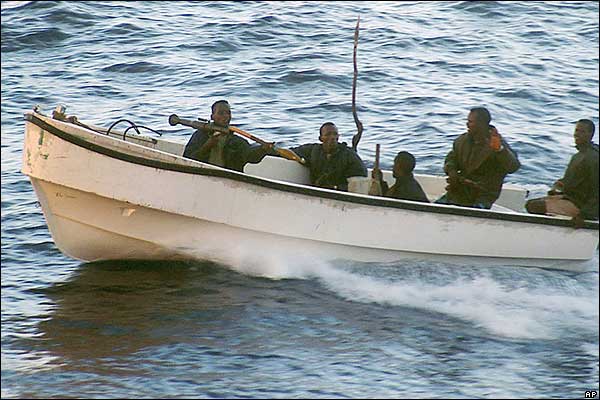
In these pictures released by U.S. Navy, Sunday, Sept.
28, 2008, Somali pirates in small boats are seen alongside
the hijacked "Faina". The captain of a hijacked Ukrainian
ship off the coast of Somalia says one crew member has
died and he can see a U.S. ship about a mile from his
freighter. Viktor Nikolsky told The Associated Press that
a Russian sailor died Sunday because of hypertension.
e was speaking from the deck of the Faina via a satellite
phone. One of the pirates who seized the ship handed a
satellite phone to Nikolsky so he could speak to the AP.
Nikolsky says other crew members are fine and he can
see three ships about a mile away, including one carrying
an American flag. The Faina is laden with Russian tanks
destined for Kenya. Somali pirates hijacked it Thursday.
(AP Photo/U.S. Navy/ho)


Associated Press
By MOHAMED OLAD HASSAN
September 28, 2008


MOGADISHU, Somalia (AP) — As a heavily armed U.S. destroyer patrolled nearby and planes flew overhead Sunday, a Somali pirate spokesman told The Associated Press his group was demanding a $20 million ransom to release a cargo ship loaded with Russian tanks.

The spokesman also warned that the pirates would fight to the death if any country tried military action to regain the ship, and a man who said he was the ship's captain reported that one crew member had died.

Pirates seized the Ukrainian-operated ship Faina off the coast of Somalia on Thursday as it headed to Kenya carrying 33 Russian-built T-72 tanks and a substantial amount of ammunition and spare parts. The ordnance was ordered by the Kenyan government.


The guided missile destroyer USS Howard was stationed off the Somali coast on Sunday, making sure that the pirates did not remove the tanks, ammunition and other heavy weapons from the ship, which was anchored off the coast.

ALeqM5i8mG6mQCYqRKaDhTRHnSApil080A

In this May 28, 2008 file photo, the U.S. Navy destroyer,
USS Howard, sails off the coast of Hawaii during sonar
exercises, on Wednesday, May 28, 2008. The Howard,
off the coast of Somalia closed in Saturday, Sept. 27,
2008, on a hijacked Ukrainian ship loaded with tanks
and ammunition, watching it to ensure the pirates who
seized it do not try to remove any cargo or crew. (AP
Photo/Hugh E. Gentry, File)​

A spokesman for the U.S. 5th fleet said the Navy remained "deeply concerned" over the fate of the ship's 21-member crew and cargo.


U.S. - Russian Cooperation ?

In a rare gesture of cooperation, the Americans appeared to be keeping an eye on the Faina until the Russian missile frigate Neustrashimy, or Intrepid, reaches the area. The Russian ship was still in the Atlantic on Sunday, the Russian navy reported.


ALeqM5iztzGRx8UdEc72UzUYDS7dUHV28A

In this July 30, 2006 file photo Russian missile frigate Neustras-
himy seen in the Baltic Sea port of Baltiisk, Russia. Russian navy
spokesman Capt. Igor Dygalo told The Associated Press on Friday
that the missile frigate Neustrashimy, left Baltiisk port and is now
ordered directly to the Somalia coast following the high jacking
of a Ukrainian ship on Thursday. Pirates seized a Ukrainian ship,
the Faina, carrying 33 Russian-built T-72 tanks and a substantial
quantity of ammunition and spare parts, off the Horn of Africa
and are now seeking a ransom. (AP Photo)​

Pirate spokesman Sugule Ali said he was speaking Sunday from the deck of the Faina via a satellite phone — and verified his location by handing the phone over to the ship's captain, who also spoke with the AP. It was not possible to further confirm their identities.

"We want ransom, nothing else. We need $20 million for the safe release of the ship and the crew," Ali said, adding that "if we are attacked, we will defend ourselves until the last one of us dies."

Five nations have been sharing information to try to secure the swift release of the ship and its crew — Ukraine, Somalia, Russia, the United States and Britain. Kenyan government spokesman Alfred Mutua, however, insisted his country will not negotiate with pirates or terrorists.

Ali said planes have been flying over the Faina. It was not known which country the planes belonged to. He also said others who made earlier ransom demands did not speak for the pirates holding the ship.

A man who said he was the captain of the seized ship and who identified himself as Viktor Nikolsky told the AP that a Russian crew member died Sunday because of hypertension.

"The rest of us are feeling well," Nikolsky said, adding that he could see three ships about a mile away, including one carrying an American flag.

Both Ali and Nikolsky spoke on a satellite phone number the AP got from a Somali journalist who spoke to Ali earlier in the day. The conversation lasted about 30 minutes. Ali spoke in Somali with a central Somalian accent and Nikolsky spoke in broken English.

Russian media had earlier identified Nikolsky as the first mate, yet he identified himself to the AP as the ship's captain. It was not possible to immediately resolve the discrepancy.

U.S. Navy spokesman Lt. Nathan Christensen told AP that the San Diego-based USS Howard had made contact with the Faina on Sunday.

"While we can't get into details, I will say there has been basic bridge-to-bridge communication established with the ship," Christensen told the AP in a phone interview from the 5th Fleet's Mideast headquarters in Manama, Bahrain.

Christensen said the Navy was aware of one crew member's death, but did know what the cause was.

Pirate attacks worldwide have surged this year and Africa remains the world's top piracy hotspot, with 24 reported attacks in Somalia and 18 in Nigeria this year, according to the International Maritime Bureau's piracy reporting center.

Attacking ships has become a regular source of income for pirates in Somalia, a war-torn country without a functioning government since 1991.

Christensen said the Faina was anchored off Somalia's coast near the central town of Hobyo.

"What's on board is of concern to us as much as the criminal activity," Christensen told the AP, adding that the Navy does not want the tanks and other weapons to end up "in the wrong hands."

Christensen refused to say what the crew of the American destroyer would do if the pirates began to offload the tanks and weapons.

"It's a very complex situation and we do not want to speculate on any particular aspect of it," he said.

According to its Web site, the USS Howard has surface-to-air missiles, Tomahawk cruise missiles, anti-submarine rockets, torpedoes, and a five-inch rapid-fire deck gun.

In the latest hijacking in the area, a Greek tanker with a crew of 19 carrying refined petroleum from Europe to the Middle East was ambushed Friday in the Gulf of Aden, according to the International Maritime Bureau.

http://ap.google.com/article/ALeqM5igGmlfz-K3g6EyC2vN8yK10vpCugD93FSFT00
 
Re: Pirate Ship attacking cruise

<IFRAME SRC="http://news.bbc.co.uk/1/hi/world/africa/7650415.stm" WIDTH=780 HEIGHT=1500>
<A HREF="http://news.bbc.co.uk/1/hi/world/africa/7650415.stm">link</A>

</IFRAME>
 
Re: Pirate Ship attacking cruise

<IFRAME SRC="http://news.bbc.co.uk/1/hi/world/africa/7721445.stm" WIDTH=780 HEIGHT=1500>
<A HREF="http://news.bbc.co.uk/1/hi/world/africa/7721445.stm">link</A>

</IFRAME>
 
Re: Pirate Ship attacking cruise

<font size="5"><Center>
Somali pirates seize supertanker
loaded with crude</font size></center>


ap_saudi_kenya_pirates_sirius_star_17nov08_eng_175.jpg

This undated picture made
at an unknown location
shows the Sirius Star tanker
conducting a trial run in
South Korea. Somali pirates
have hijacked the Saudi-
owned oil tanker the Sirius
Star off the Kenyan coast,
the U.S. Navy said Monday,
Nov. 17, 2008. The tanker
owned by Saudi oil company
Aramco, is 330 meters (1,080
feet), about the length of an
aircraft carrier, making it one
of the largest ships to sail the
seas. It can carry about 2
million barrels of oil. Lt. Nathan
Christensen, a spokesman for the
U.S. Navy's 5th Fleet, said the
Sirius Star was carrying crude at
the time of Saturday's hijacking,
but he did know how much. (AP
Photo/ Newsis via Daewoo shipping
yards and commissioned )


Associated Press
By BARBARA SURK
November 17, 2008


DUBAI, United Arab Emirates (AP) — Somali pirates hijacked a supertanker hundreds of miles off the Horn of Africa, seizing the Saudi-owned ship loaded with crude and its 25-member crew, the U.S. Navy said Monday.

It was the largest ship pirates have seized, and the farthest out to sea they have successfully struck.

The hijacking highlighted the vulnerability of even very large ships and pointed to widening ambitions and capabilities among ransom-hungry pirates who have carried out a surge of attacks this year off Somalia.

Saturday's hijacking of the MV Sirius Star tanker occurred in the Indian Ocean far south of the zone patrolled by international warships in the busy Gulf of Aden shipping channel, which leads to and from the Suez Canal. A U.S. Navy spokesman said the bandits were taking it to a Somali port that has become a haven for seized ships and bandits trying to force ransoms for them.

Maritime security experts said they have tracked a troubling spread in pirate activity southward into a vast area of ocean that would be extremely difficult and costly to patrol, and this hijacking fits that pattern.

"It is very alarming," said Cyrus Mody, manager of the International Maritime Bureau. "It had been slightly more easy to get it under control in the Gulf of Aden because it is a comparatively smaller area of water which has to be patrolled, but this is huge."

The tanker, owned by Saudi oil company Aramco, is one of the largest ships to sail the seas. It is 330 1,080 feet long, or about the length of an aircraft carrier, and can carry about 2 million barrels of oil.

Fully loaded, the ship's cargo could be worth about $100 million. But the pirates would have to way of selling crude and no way to refine it in Somalia.

Lt. Nathan Christensen, a spokesman for the U.S. Navy's 5th Fleet, said the Sirius Star was carrying crude at the time of the hijacking, but he did know how much. He also had no details about where the ship was sailing from and where it was headed at the time of the attack.

Christensen said the bandits were taking the ship to an anchorage off Eyl, a northeastern Somali port town that is a haven for pirates and the ships they have seized.

The ship was sailing under a Liberian flag and its 25-member crew includes citizens of Croatia, Britain, the Philippines, Poland and Saudi Arabia. A British Foreign Office spokesman said there were at least two British nationals aboard the vessel.

The Sirius Star was attacked more than 450 nautical miles southeast of Mombasa, Kenya, the U.S. 5th Fleet said in a statement from its Middle East headquarters in Bahrain.

"It's the largest ship we've seen hijacked and one attacked farthest out on the sea," Christensen said.

The capturing of the oil tanker represents a "fundamental shift in the ability of pirates to be able to attack merchant vessels," he said.

Classed as a Very Large Crude Carrier, the Sirius Star was commissioned in March and is 318,000 dead weight tons.

With a full load, the ship's deck would be lower to the water, making it easier for pirates to climb aboard with grappling equipment and ladders, as they do in most hijackings.

It is not clear if there was a security team on the vessel. An operator with Aramco said no one was available to comment after business hours. Calls went unanswered at Vela international, the Dubai-based marine company that operated the ship for Aramco.

Somali pirates are trained fighters, often dressed in military fatigues, using speedboats equipped with satellite phones and GPS equipment. They are typically armed with automatic weapons, anti-tank rocket launchers and various types of grenades.

As pirates have become better armed and equipped, they have sailed farther out to sea in search of bigger targets, including oil tankers, among the 20,000 tankers, freighters and merchant vessels transiting the Gulf of Aden each year. Attacks have increased more than 75 percent this year.

With most attacks ending with million-dollar payouts, piracy is considered the most lucrative work in Somalia. Pirates rarely hurt their hostages, instead holding out for a huge payday.

The strategy is effective: A report last month by a London-based think tank said pirates have raked in up to $30 million in ransoms this year alone.

In Somalia, pirates are better-funded, better-organized and better-armed than one might imagine in a country that has been in tatters for nearly two decades.

They do occasionally get nabbed, however. Earlier this year, French commandos used night vision goggles and helicopters in operations that killed or captured several pirates, who are now standing trial in Paris. The stepped-up international presence recently also appears to have deterred several attacks.

Raja Kiwan, a Dubai-based analyst with PFC Energy, said the hijacking raises "some serious questions" about securing such ships on the open seas.

"It's not easy to take over a ship" as massive as an oil tanker, particularly VLCC's that can transport about 2 million barrels of crude, he said. He said such vessels typically have armed guards but could not say if that was the case with the Sirius Star.

Pirates have gone after oil tankers before, most recently in October when they were thwarted by a Spanish military plane.

Warships from the more than a dozen nations as well as NATO forces have focused their anti-piracy patrols in the Gulf of Aden, increasing their military presence in recent months.

But Saturday's hijacking occurred much farther south.

Graeme Gibbon Brooks, managing director of British company Dryad Maritime Intelligence Service Ltd, said the increased international presence is simply not enough.

"The coalition has suppressed a number of attacks ... but there will never be enough warships," he said, describing an area that covers 2.5 million square miles.

He said the coalition warships will have to be "one step ahead of the pirates. The difficulty here is that the ship was beyond the area where the coalition were currently acting."

Associated Press writers Katharine Houreld, Elizabeth A. Kennedy and Tom Maliti in Nairobi, Kenya, and Jason Keyser and Tarek el-Tablawy in Cairo, Egypt, contributed to this report.


http://www.google.com/hostednews/ap/article/ALeqM5gZeyeAHtrDVQhPXkHEQd_aeCPCWQD94GQ75G0

 
Re: Pirate Ship attacking cruise

<IFRAME SRC="http://www.newsweek.com/id/165954/page/1" WIDTH=780 HEIGHT=1500>
<A HREF="http://www.newsweek.com/id/165954/page/1">link</A>

</IFRAME>
 
<font size="5"><Center>To turn the tide on piracy in Somalia,
bring justice to its fisheries</font size>
<font size="4">
A coalition force tasked with fishery protection
would address a root cause of the crisis.</font size></center>


Christian Science Monitor
By Katie Stuhldreher
from the November 20, 2008 edition

Washington - In the past few weeks, a failed state that was forgotten for more than a decade once again made the world take notice. While Somalia's weak transitional government fails to assert control on land, a band of highly organized pirates have taken firm control of the country's sea lanes.

The pirates' recent seizure of a Ukrainian ship transporting military hardware and a Saudi oil supertanker has prompted the world to take action, with many countries sending warships to patrol the area around the Somali coast and Gulf of Aden. A longer-term solution may prove simpler and less costly: Forget about freight and focus on fishing.

Beyond the immediate need to temporarily send warships to police the troubled waters, a coalition force tasked with fishery protection should be deployed. It could be done under the auspices of the United Nations, African Union, or a coalition of willing states. This option will address a root cause of the piracy problem, rob the modern-day buccaneers of their legitimacy, and be more acceptable to the region as an enduring part of the solution.

First, this option will address the very problem that originally sparked this rise in piracy. The problem of piracy in Somalia originated about a decade ago because of disgruntled fishermen.

The headless state had no authority to patrol its tuna-rich coastal waters and foreign commercial vessels swooped in to cast their nets. This proved a slap in the face for Somalis, who saw these vessels as illegal and raking in profits at the expense of the local impoverished population. To make matters worse, there were reports that some foreign ships even dumped waste in Somali waters.

That prompted local fishermen to attack foreign fishing vessels and demand compensation. The success of these early raids in the mid-1990s persuaded many young men to hang up their nets in favor of AK-47s. Making the coastal areas lucrative for local fishermen again could encourage pirates to return to legitimate livelihoods.

Second, a fishery protection force will eliminate the pirates' source of legitimacy. The pirates' spokesman, Sugule Ali, told the international press last month that his men executed attacks to prevent illegal fishing and dumping in their waters.

Although this claim may seem thin, it matters to the pirates' public image and sense of legitimacy. If the international community steps in to address their concerns, they will lose the one pretense they continue to stand upon for internal support and credibility.

Third, an international force sent to protect local industry will achieve the same goal as warships but in a more acceptable way. The principal reason piracy thrives along Somalia's coast is that there is no coastal authority to patrol these waters. Armed foreign ships will still serve to fill that vacuum and deter attacks, but with the explicit mission of serving Somalia's people – the very people who have chalked up enough reasons to dislike foreign military interventions and are likely to view the presence of warships as intimidation.

Skeptics could argue that intimidation is just what these lawless bandits need. However, temporary crackdowns have not uprooted the problem yet. The Union of Islamic Courts brutally suppressed piracy during the brief period they controlled the Somali capital in 2006, but the pirates waited them out and resurged stronger than ever.

In response to pressure, the pirates also tend to migrate further down the long Somali coastline to focus operations in areas of the sea that are more difficult to patrol. A fishery protection force, however, could convince pirates that it is here to stay and futile to evade.

Piracy will not be eradicated from the region until Somalia becomes a stable, functioning state with a thriving economy. A robust fishery protection force can keep piracy under control in the meantime while the world shifts its resources to this bigger problem. This creative solution could make Somali waters more secure and give its people much-needed hope for the future.

• Katie Stuhldreher is a graduate student at the Elliot School of International Affairs at George Washington University, where she's currently researching Somali piracy.

http://www.csmonitor.com/2008/1120/p09s01-coop.html
 
Indian Navy Shows The Way,Sinks Pirate Ship.

<object width="450" height="370"><param name="movie" value="http://www.liveleak.com/e/3e6_1227167971"></param><param name="wmode" value="transparent"></param><embed src="http://www.liveleak.com/e/3e6_1227167971" type="application/x-shockwave-flash" wmode="transparent" width="450" height="370"></embed></object>
:eek:
Operation draws praise from around the globe.
New Delhi: Indian Navy's warship INS Tabar sunk a Somali pirate ship in the Gulf of Aden. It is the first time since 1971 that the Indian Navy has struck an enemy vessel.


INS Tabar sunk the ship following an exchange of gunfire on Monday night and the operation has brought India praise from the world.


The Indian Navy has pulled off an anti-p More..iracy operation which even the French and American warships have been unable to in the past few weeks.


"When we opened fire, the ammunition which was stacked on the mother boat caught fire and there were explosios were heard," Indian Navy Spokesperson Commander Nirad Sinha said.


The success comes barely a week after INS Tabar foiled two piracy attempts in the area.


But with seven reported piracies in the last 12 days by Somali bandits, including that of a Saudi super tanker carrying a $100 million worth of crude oil, the magnitude of the problem is clear.


With the Somali piracy crisis escalating to unprecedented levels, India is taking a lead role in combating the menace. This international crisis could legitimise India's role as the premier maritime power in the region.


In fact, India's role as the prime anti-piracy campaigner may just give a push to its initiative to forge a security framework of Indian Ocean navies, which could have the beginnings of an Asian NATO-like organisation.


"We would like to cooperate with other countries in the Indian Ocean region as also the UN umbrella to ensure that Indian ocean is an area of peace and stability," Commander Sinha said.


India's Navy Chief Sureesh Mehta recently declared piracy as an act of war, signaling a free hand to his force to take the problem head on. The Naval muscle also appears set to give an edge to New Delhi's diplomacy.
 
Re: Indian Navy Shows The Way,Sinks Pirate Ship.

<font size="5"><center>
Pirates chase, open fire on U.S. cruise liner</font size>
<font size="4">
Official: Ship carrying 1,000 passengers
'very fortunate' to escape hijack bid</font size></center>


081202-nautica-hmed-345a.hmedium.jpg

The M/S Nautica is seen at port in Sultan Qaboos, near Muscat,
Oman, on Dec. 9, 2007. Pirates in the Gulf of Aden failed in a bid
to capture the luxury vessel.


MSNBC
December 2, 2008


NAIROBI, Kenya - Pirates near Somalia chased and shot at a U.S. cruise liner with more than 1,000 people on board but failed to hijack the vessel, a maritime official said Tuesday.

The liner, carrying 656 international passengers and 399 crew members, was sailing in the Gulf of Aden on Sunday when it encountered six pirates in two speedboats, said Noel Choong who heads the International Maritime Bureau's piracy reporting center in Malaysia.

The pirates fired at the passenger liner but the larger boat was faster than the pirates' vessels, Choong said.

"It is very fortunate that the liner managed to escape," he said, urging all ships to remain vigilant in the area.

The ship's owner, Oceania Cruises Inc., identified the vessel as the M/S Nautica.


32-day voyage

In a statement on its Web site, the company said pirates fired eight rifle shots at the liner as it sailed along a maritime corridor patrolled by an international naval coalition, but that the ship's captain increased speed and managed to outrun the skiffs. All passengers and crew are safe and there was no damage to the vessel, it said.

The Nautica was on a 32-day cruise from Rome to Singapore, with stops at ports in Italy, Egypt, Oman, Dubai, India, Malaysia and Thailand, the Web site said. Based on that schedule, the liner was headed from Egypt to Oman when it was attacked.

The liner arrived in the southern Oman port city of Salalah on Monday morning, and the passengers toured the city before leaving for the capital, Muscat, Monday evening, an official of the Oman Tourism Ministry said Tuesday. The official spoke on condition of anonymity because he was not authorized to speak to the media.

The U.S. Navy's 5th Fleet, based in Bahrain, said it was aware of the failed hijacking but did not have further details.


International warships patrol the area and have created a security corridor in the pirate-infested waters under a U.S.-led initiative, but the attacks have not abated.

In about 100 attacks on ships off the Somali coast this year, 40 vessels have been hijacked, Choong said. Fourteen remain in the hands of pirates along with more than 250 crew members.

In two if the most daring attacks, pirates seized a Ukrainian freighter loaded with 33 battle tanks in September, and on Nov. 15, a Saudi oil tanker carrying $100 million worth of crude oil.


Ransom agreed for freighter?

Ukraine's Foreign Ministry spokesman Vasyl Kyrylych said Monday that negotiations with Somali pirates holding the cargo ship MV Faina are nearly completed, the Interfax news agency reported.

A spokesman for the Faina's owner said Sunday that the Somali pirates had agreed on a ransom for the ship and it could be released within days.

Somalia has not had a functioning government since 1991, and pirates have taken advantage of the country's lawlessness to launch attacks on foreign shipping from the Somali coast. Around 100 ships have been attacked so far this year.


'Disorder'

Somali prime minister Nur Hassan Hussein said Tuesday that his country has been torn apart by 18 years of civil war and cannot stop piracy alone.

"The piracy problem is part of the legacy of the situation of the country. This 18 years of civil war is followed by disorder," Hussein told The Associated Press in an interview in the Kenyan capital of Nairobi.

Stopping piracy is "not something Somalia can do alone. This needs a tremendous effort," he said.

Hussein has appealed for international troops, as his government's Ethiopian allies have said they would pull out their forces by the end of the year.

The Ethiopians are all that has stood between the shaky administration and Islamic insurgents who have seized control of all of southern Somalia except for the capital and the parliamentary seat of Baidoa.

http://www.msnbc.msn.com/id/28011013
 
Re: Indian Navy Shows The Way,Sinks Pirate Ship.

:eek:
<center>Operation draws praise from around the globe.

<font size="4">New Delhi: Indian Navy's warship INS Tabar
sunk a Somali pirate ship in the Gulf of Aden. </font size></center>


It is the first time since 1971 that the Indian Navy has struck an enemy vessel.

INS Tabar sunk the ship following an exchange of gunfire on Monday night and the operation has brought India praise from the world.

The Indian Navy has pulled off an anti-p More..iracy operation which even the French and American warships have been unable to in the past few weeks.


"When we opened fire, the ammunition which was stacked on the mother boat caught fire and there were explosios were heard," Indian Navy Spokesperson Commander Nirad Sinha said.


<font size="5"><center>Official confirms Indian navy sank wrong ship</font size><font size="4">
Hijacked Thai trawler, not Somali pirate 'mother ship,' was destroyed</font size></center>


Associated Press
VIA - MSNBC
November 26, 2008

KUALA LUMPUR, Malaysia - A suspected pirate vessel that was destroyed by the Indian navy last week near Somalia was actually a Thai fishing trawler that had been hijacked by pirates, a maritime official said Wednesday.

Noel Choong, who heads the International Maritime Bureau's piracy reporting center in Kuala Lumpur, said one Thai crew member died when the Indian frigate INS Tabar fired on the boat in the Gulf of Aden on Nov. 18.

Fourteen others are missing and a Cambodian sailor was rescued four days later by passing fishermen, he said. The IMB received a report on the apparent mistake late Tuesday from Bangkok-based Sirichai Fisheries, which owned the Ekawat Nava5 vessel, he said.

"The Indian navy assumed it was a pirate vessel because they may have seen armed pirates on board the boat which has been hijacked earlier," Choong said.

India's navy last week said the INS Tabar, which began patrolling the gulf on Nov. 2, battled a pirate "mother vessel" on Nov. 18, setting the ship ablaze.

In New Delhi, Indian navy spokesman Commander Nirad Sinha admitted Wednesday it was possible the ship was hijacked but defended the INS Tabar's action, saying it was responding to pirates' threat to attack it.

"In so far as we are concerned, both its description and its intent were that of a pirate ship," he said. "Only after we were fired upon did we fire. We fired in self defense. There were gun-toting guys with RPGs on it."


[v]Cambodian survivor relays mishap[/v]

Choong said Sirichai Fisheries found out about the mishap after speaking to the Cambodian sailor, who is now recuperating in a hospital in Yemen. The trawler was headed from Oman to Yemen to deliver fishing equipment when it was hijacked, he said.

"We are saddened with what has happened. It's an unfortunate tragedy. We hope that this incident won't affect the anti-piracy operation by the multi-coalition navies there," Choong added.

Somalia, an impoverished nation caught up in an Islamic insurgency, has not had a functioning government since 1991. Somali pirates have become increasingly brazen recently, seizing eight vessels in the past two weeks, including a Saudi supertanker loaded with $100 million worth of crude oil.

There have been 96 pirate attacks so far this year in Somali waters, with 39 ships hijacked. Fifteen ships with nearly 300 crew are still in the hands of pirates, which have demanded multimillion dollar ransom.

At present, warships from Denmark, India, Malaysia, Russia, the U.S. and NATO patrol a vast international maritime corridor, escorting some merchant ships and responding to distress calls in the area.

Shippers worldwide have called for a military blockade of the waters off Somalia's coast to intercept pirate vessels heading out to sea, but NATO officials said there were no such plans. France has also rejected such a call, saying it was not feasible.

© 2008 The Associated Press. All rights reserved. This material may not be published, broadcast, rewritten or redistributed.


http://www.msnbc.msn.com/id/27903621/
 
Indian navy captures 23 pirates in Gulf of Aden

capt.7452fcd0dc184258932fb7edb4dd1428.india_piracy_nav102.jpg


NEW DELHI — The Indian navy captured 23 pirates who threatened a merchant vessel in the lawless waters of the Gulf of Aden and a German naval helicopter thwarted another attack Saturday on a freighter being chased by speedboats off Yemen.

The successes came days before Secretary of State Condoleezza Rice was to ask the United Nations to authorize "all necessary measures" against increasingly bold Somalian pirates operating in one of the world's busiest shipping lanes.

An Indian navy ship, the INS Mysore, was escorting merchant ships in waters off Somalia's coast Saturday when it received a distress call from seamen on board the MV Gibe, who said they were being fired on by two boats that were approaching fast.

The Mysore and its helicopter sped to the scene, and the pirate boats attempted to escape when they saw them, according to a statement from the Indian government.

Indian marine commandoes boarded the pirate boats and seized "a substantial cache of arms and equipment," including seven AK-47 assault rifles, three machine guns, a rocket-propelled grenade launcher and other weapons, the statement said. They also found a GPS receiver and other equipment.

The pirates were from Somalia and Yemen, two countries on the coast of the Gulf of Aden. The Gibe was flying an Ethiopian flag but little else was known about it, the Indian statement said.

Last month, India's navy drew criticism after sinking a Thai fishing trawler that had been commandeered hours earlier by pirates. At least one Thai crew member was killed in the attack, which the Indian navy had originally announced by saying it had sunk a pirate "mother ship." The Indian navy defended its actions, saying it had fired in self-defense.

Somali pirates have become increasingly brazen and recently seized a Saudi supertanker loaded with $100 million of crude oil. Many of the vessels are taken to pirate-controlled regions in Somalia, where they are held for ransom.

It was not immediately clear what would happen to the pirates captured by the Indians, or where they would be taken. The statement said only that the prisoners and their weapons would be "handed over to appropriate authorities ashore."

Most foreign navies patrolling the Somali coast have been reluctant to detain suspects because of uncertainties over where they would face trial, since Somalia has no effective central government or legal system.

Also on Saturday, a German military spokesman said a navy frigate had chased away pirates in speedboats pursuing an Ethiopian freighter off the coast of Yemen.

The German frigate responded to a distress call from the freighter, and a helicopter took off from the deck to investigate. The pirates turned away from the freighter as the helicopter flew overhead, said the spokesman, who declined to give his name in line with military policy.

An estimated 1,500 pirates are based in Somalia's semiautonomous Puntland region, raking in millions of dollars.

Secretary of State Condoleezza Rice will present a draft Security Council resolution next week asking the United Nations to authorize "all necessary measures" against piracy from Somalia.

However, the commander of the U.S. Navy's 5th Fleet expressed doubt Friday about the wisdom of launching attacks against Somali pirates on land, as the draft proposes.

U.S. Vice Adm. Bill Gortney told reporters that it is difficult to identify pirates, and the potential for killing innocent civilians "cannot be overestimated."

The threat of pirates recently prompted a German cruise ship to evacuate some 420 passengers and crew after the company decided not to risk their safety as the ship passed through the Gulf of Aden.

The passengers and crew have rejoined the M/S Columbus — which is on a six-month round-the-world trip — in Oman's port of Salalah after three days in Dubai, Hamburg-based cruise operator Hapag-Lloyd said Saturday.

The ship and a limited crew made it through the gulf without incident, a company spokeswoman said.
 
Re: Indian Navy Shows The Way,Sinks Pirate Ship.

<font size="5"><Center>New year sees at least five
Somalia pirate attacks: IMB</font size></center>


ALeqM5hARV_pgyhajeAvO6_ZkDISSw4WDQ
ALeqM5gecHQ7Aq56FwXhvQYW9VlWjnKLoQ

Photo shows weapons seized
from presumed Somali pirates
who were arrested off the
Somali coast


AFP
January 3, 2009


KUALA LUMPUR (AFP) — The first days of 2009 have seen at least five pirate attacks off Somalia, but the bandits are becoming desperate as the international community cracks down, a maritime watchdog said Saturday.

An Egyptian cargo ship with 28 crew on board was hijacked on New Year's Day, while four other vessels were threatened but managed to escape, some with the help of warships and aircraft belonging to nations patrolling the region.

"There have been a lot of attacks in the past few days, but many of these attacks have not been successful," said Noel Choong, head of the International Maritime Bureau (IMB) piracy reporting centre in Kuala Lumpur.

"The pirates are now beginning to be more desperate because it's harder to hijack ships than before," he told AFP.

More naval warships are patrolling the Gulf of Aden, and the European Union has implemented a convoy system under which merchant vessels are escorted in groups, he said.

"But that doesn't mean that they (pirates) can't attack the ships. The warships can't be everywhere at the same time, it's just too huge an area. So the pirates are finding places where warships are absent and choosing to attack there."


Pirates Becoming More Aggressive

Choong said that because of the threat to their lucrative business, pirates were becoming more aggressive.

"As soon as the pirates spot the ships they fire their weapons -- they are really trying their best to get hold of the ships."

The IMB's reporting centre has confirmed five attacks so far this year, all in a small area with a 60-mile radius and suspected to be carried out by one or more groups of pirates.


Five Attacks New Year's Day

The first was on New Year's Day when a Malaysian warship helped Indian seamen fight off heavily-armed bandits attempting to board an oil tanker.

The second came just an hour later, when attackers managed to hijack the Egyptian-managed cargo ship which is carrying a load of fertiliser.

Several hours later a Greek bulk carrier was fired on, but the captain took evasive measures and managed to escape, Choong said.

Then on January 2, at least five pirates attacked a German-managed tanker, firing their machine guns at the ship which had 21 crew on board.

"The captain increased the ship's speed along with other manoeuvres and managed to escape," said Choong.

In the fifth attack, a Greek tanker was fired on but the pirates fled when a Spanish aircraft arrived at the scene.

In a sixth incident not yet reported to the IMB, the Danish navy said one of its anti-piracy warships rushed to the rescue of a cargo ship in the Gulf of Aden Friday and rescued five pirates after they were forced into the water.

Choong said that seafarers were becoming more adept at avoiding attacks, following instructions to maintain 24-hour vigils and radar watches, and taking evasive manoeuvres when they spot pirates.

"At the same time they are making calls for help and that's the only way they can escape," he said.

According to IMB data, pirates are currently holding 15 vessels with some 300 crew members taken hostage.


100 Attacks in 2008; Earned 120 Million in Ransom

Pirates attacked more than more than 100 ships in 2008 off the coast of Somalia and in the Gulf of Aden, and raked in an estimated 120 million dollars in ransom money.

The UN Security Council gave nations a one-year mandate in December to act inside lawless Somalia to stop the rampant attacks in the waterway, which is part of the Suez Canal route from Europe to Asia.


http://www.google.com/hostednews/afp/article/ALeqM5jHoldJzkRtJ49wTYW-jHG0P8Oy2g
 
Re: Indian Navy Shows The Way,Sinks Pirate Ship.

`

Pirates Seize U.S. Ship With U.S. Crew Off Coast of Somalia


08pirates-600.jpg

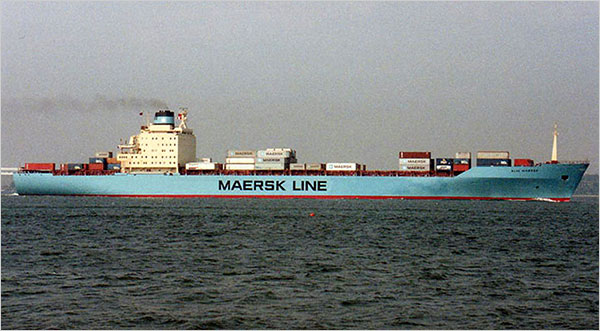
An undated file photo of the Maersk Alabama container ship, formerly called the Maersk Alva.


`
 
One of the many reasons unions need to be brought back in to prominence.

source: Southern Maryland Newspapers

Majority of crew that retook the hijacked Maersk Alabama belongs to Seafarers International Union

Pirates hijack ship carrying crew trained at Piney Point; vessel reportedly retaken
Wednesday, April 8, 2009
By JESSE YEATMAN

Staff Writer

Posted at 2:21 p.m. Wednesday

A cargo ship hijacked Wednesday by pirates off the coast of Africa contained a dozen crew members represented by the Seafarers International Union, which trains at a facility in Piney Point.

The ship is now presumed to be under the control of its crew again, Defense Department officials said Wednesday afternoon, according to an American Forces Press Service report.

The United States container ship Maersk Alabama was delivering food and other humanitarian aid to Kenya in Africa when Somali pirates hijacked it, according to news reports.

A statement issued Wednesday by the Seafarers International Union confirmed 12 of the 20 American mariners aboard the vessel were represented by the union. SIU members train at represents the Paul Hall Center for Maritime Training and Education located in Piney Point, where most all of the members attend classes at the center at some point for certification and training.

"It goes without saying that the SIU is deeply concerned about the mariners aboard the Maersk Alabama," the statement said. "Our thoughts and prayers are with the crew members, officers and their families."

The Associated Press and other news services reported early afternoon Wednesday that a U.S. official said the crew had retaken control and had one pirate in custody. The status of the other pirates was unknown, the official said, but they were reported to "be in the water."

However, both a Seafarers Union International representative and an executive of the company that owns the vessel could not confirm retaking the Maersk Alabama at that time.

A toll-free phone number is being established for the family members of the crew and officers currently aboard the ship. Family members will be contacted as soon as possible with that number, the "Maersk Alabama Assistance Line." Updated details and other forms of help will be available through that phone number, according to the release.

The vessel is part of the U.S. Maritime Security Program and is carrying humanitarian aid cargo to Africa. Some of the officers are represented by the Marine Engineers' Beneficial Association while the rest are represented by the International Organization of Masters, Mates & Pilots.

source: Mother Jones

Another Miracle Brought to You By America's Unions (This Time With Pirates!)

— By Nick Baumann | Wed April 8, 2009 9:25 AM PST

Now that the American crew members of the Maersk Alabama have retaken the ship from four Somali pirates (USA! USA! USA!), it's important to note that like all the people involved with the safe landing of US Airways Flight 1549 in the Hudson River in January, the crew members of the Maersk Alabama are union members. (Thanks to Marcy Wheeler for the blog title and the meme.) The unions in question are the Seafarers International Union, which represents 12 of the 20-person crew, the Marine Engineers’ Beneficial Association (MEBA), and the International Organization of Masters, Mates & Pilots (MM&P). As former safety chairman of the Airline Pilots Association, Chesley Sullenberger, the hero pilot of Flight 1549, fought to make sure his colleagues got the training they needed to do what he did in January. And as I just heard on Fox News (and confirmed with the SIU), crew members of the Maersk Alabama received anti-piracy training from (where else?) their union. You can see an SIU member at small arms training at the union's Paul Hall Center for Maritime Training and Education in the photo to the right (more photos here). In addition to small arms training, the Hall Center offers anti-terror, basic safety, first aid, and other security-related courses.
 
<font size="5"><center>
How will Somali-American pirate standoff end?</font size><font size="6">

SCENARIOS </font size></center>


Reuters
By Andrew Cawthorne
Friday, April 10, 2009


NAIROBI (Reuters) - Somali pirates have captured their first American hostage, a cargo ship's captain.

They and their prisoner are drifting on a lifeboat without fuel, and are being tracked by a U.S. warship and other naval vessels in the area.

How will the saga end?


NEGOTIATED SOLUTION?

  • The four pirates holding ship captain Richard Phillips are drifting on a lifeboat from the Maersk Alabama freighter, which they briefly hijacked on Wednesday before the 20-man American crew regained control. They have guns, but are without fuel, and it is not clear how much food and water they have.

  • So despite having Phillips, the pirates are still in a precarious situation. Friends in contact with the gang say they want a ransom. But Washington may not want to set a precedent by paying one, and would be more likely to promise them safe passage home if they release their hostage.

  • The USS Bainbridge, a naval destroyer, is near the lifeboat and the FBI is involved in negotiations.

  • Somali pirates are always motivated by financial gain, and generally treat hostages relatively well. Former hostages speak of being fed goat meat and allowed to phone relatives.


VIOLENCE?

  • Many around the world wonder why naval vessels do not simply storm boats seized by Somali pirates, given their superior firepower. This seldom happens, however, due to the risk of death or injury to hostages.

  • U.S. officials have said they are seeking a peaceful solution to secure Phillips' freedom, but will not rule out any option, and are sending more ships to the area.

  • One of the ships on its way is the USS Halyburton, a guided missile frigate with two helicopters on board.

  • The pirates say they will fight if attacked.


PROTRACTED SAGA?

  • The pirates may be prepared to wait as long as it takes to achieve their ends, but a big factor is food and water. It is not clear what supplies the gang have on the lifeboat, and whether the nearby USS Bainbridge is prepared to provide any extra provisions during negotiations.


PIRATE REINFORCEMENT?

  • At least two boats full of armed pirates have left shore pledging to help their friends.

  • Experts and Somalis, however, believe that is largely symbolic, as the Americans would be sure to block -- and possibly sink -- any such boats from approaching.


INTERNATIONAL RESPONSE?

  • It has taken the involvement of Americans this week to swing the international spotlight again onto the long-running Somali piracy phenomenon.

  • However the standoff ends, diplomats hope Washington's heightened concern over piracy will bring a second phase in the international response. A deployment of foreign naval ships around the Gulf of Aden at the end of last year and start of 2009 appears merely to have pushed the pirates further out into the Indian Ocean.

  • How the world's navies can patrol such a vast area -- against fast and flexible gangs using "mother ships," speedboats and sophisticated tracking devices -- is quite a problem. The pirates are also often indistinguishable from fishermen prior to launching an attack, meaning that preemption is hard.


POLITICAL SOLUTION?

  • Everyone agrees the real solution to piracy is achieving peace and stable central government in Somalia.

  • That has eluded the Horn of Africa nation since 1991, when warlords toppled a military dictator.

  • Since then, there have been 15 attempts to restore central government, the latest being the administration of President Sheikh Sharif Ahmed, formed in a U.N.-brokered peace process earlier this year.

  • Though an Islamist himself, Ahmed faces an insurgency by Islamist militants who attack his government and African Union (AU) peacekeepers regularly. The government has little tangible control beyond certain areas of Mogadishu.

  • Violence has intensified poverty in Somalia, where many of the young and unemployed now view the riches available from piracy as a dazzling alternative.


http://uk.reuters.com/article/UKNews1/idUKTRE5390PE20090410?pageNumber=1&virtualBrandChannel=0
 
ya'll do know this is just the beginning of things to come....

This shit isn't a coincidence.

Obama and company need to start growing some nuts, or its going to be a crazy four years.
 
ya'll do know this is just the beginning of things to come....

This shit isn't a coincidence.

Obama and company need to start growing some nuts, or its going to be a crazy four years.

Shit for brains, the jacking started under Bush. Remember the oil tanker? What did big balls republican macho man Bush do? Maybe you would rather have a hostage killed while trying to prove a point. By now you should have figured out why the republicans/conservatives got voted out of office. Lack of thinking is your trade mark.
 
Shit for brains, the jacking started under Bush. Remember the oil tanker? What did big balls republican macho man Bush do? Maybe you would rather have a hostage killed while trying to prove a point. By now you should have figured out why the republicans/conservatives got voted out of office. Lack of thinking is your trade mark.

Tha fuck are you talking about dude. Is Bush in office????

Bush didn't get voted out of office, McCain LOST. There's a fucking difference. National security wasn't the reason why McCain lost either. It was the economy. I thought you was smart THOUGHT.

Back to the subject, just like Biden warned us, our enemies are going to test us. One day, talking isn't going to get you anywhere. One day, you going to have to kill a couple of people to let everyone know the United States isn't the one to be fucked with. If you disagree with that, you might need to check your manhood at the political door. Especially you THOUGHT....
 
Tha fuck are you talking about dude. Is Bush in office????

Bush didn't get voted out of office, McCain LOST. There's a fucking difference. National security wasn't the reason why McCain lost either. It was the economy. I thought you was smart THOUGHT.

Back to the subject, just like Biden warned us, our enemies are going to test us. One day, talking isn't going to get you anywhere. One day, you going to have to kill a couple of people to let everyone know the United States isn't the one to be fucked with. If you disagree with that, you might need to check your manhood at the political door. Especially you THOUGHT....

The Republicans lost. Top to bottom. Currently the GOP is preventing a Senator from taking office. It was the war and economy among other things. Thank you President Bush. We are not the only targets of the hijacking. Many other country's vessels have been hijacked. Maybe your family should have been on that French boat, and then we can show that we won’t be fucked with. You talk a lot of shit for an internet bully!
 
Back
Top