

States - Experiments in Democracy

Greed

Star
Registered
If You Like Michigan's Economy,
You'll Love Obama's
By PHIL GRAMM and MIKE SOLON
September 13, 2008; Page A13

Despite the federal government's growing economic dominance, individual states still exercise substantial freedom in pursuing their own economic fortune -- or misfortune. As a result, the states provide a laboratory for testing various policies.

In this election year, the experience of the states gives us some ability to look at the economic policies of the two presidential candidates in action. If a program is not playing in Peoria, it probably won't work elsewhere. Americans have voted with their feet by moving to states with greater opportunities, but federal adoption of failed state programs would take away our ability to walk away from bad government.

Growth in jobs, income and population are proof that a state is prospering. But figuring out why one state does well while another struggles requires in-depth analysis. In an effort to explain differences in performance, think tanks have generated state-based economic freedom indices modeled on the World Economic Freedom Index published by The Wall Street Journal and the Heritage Foundation.

The Competitiveness Index created by the American Legislative Exchange Council (ALEC) identifies "16 policy variables that have a proven impact on the migration of capital -- both investment capital and human capital -- into and out of states." Its analysis shows that "generally speaking, states that spend less, especially on income transfer programs, and states that tax less, particularly on productive activities such as working or investing, experience higher growth rates than states that tax and spend more."

Ranking states by domestic migration, per-capita income growth and employment growth, ALEC found that from 1996 through 2006, Texas, Florida and Arizona were the three most successful states. Illinois, Ohio and Michigan were the three least successful.

The rewards for success were huge. Texas gained 1.7 million net new jobs, Florida gained 1.4 million and Arizona gained 600,000. While the U.S. average job growth percentage was 9.9%, Texas, Florida and Arizona had job growth of 18.5%, 21.4% and 28.9%, respectively.

Remarkably, a third of all the jobs in the U.S. in the last 10 years were created in these three states. While the population of the three highest-performing states grew twice as fast as the national average, per-capita real income still grew by $6,563 or 21.4% in Texas, Florida and Arizona. That's a $26,252 increase for a typical family of four.

By comparison, Illinois gained only 122,000 jobs, Ohio lost 62,900 and Michigan lost 318,000. Population growth in Michigan, Ohio and Illinois was only 4.2%, a third the national average, and real income per capita rose by only $3,466, just 58% of the national average. Workers in the three least successful states had to contend with a quarter-million fewer jobs rather than taking their pick of the 3.7 million new jobs that were available in the three fastest-growing states.

In Michigan, the average family of four had to make ends meet without an extra $8,672 had their state matched the real income growth of the three most successful states. Families in Michigan, Ohio and Illinois struggled not because they didn't work hard enough, long enough or smart enough. They struggled because too many of their elected leaders represented special interests rather than their interests.

What explains this relative performance over the last 10 years? The simple answer is that governance, taxes and regulatory policy matter. The playing field among the states was not flat. Business conditions were better in the successful states than in the lagging ones. Capital and labor gravitated to where the burdens were smaller and the opportunities greater.

It costs state taxpayers far less to succeed than to fail. In the three most successful states, state spending averaged $5,519 per capita. In the three least successful states, state spending averaged $6,484 per capita. Per capita taxes were $7,063 versus $8,342.

There also appears to be a clear difference between union interests and the worker interests. Texas, Florida and Arizona are right-to-work states, while Michigan, Ohio and Illinois are not. Michigan, Ohio and Illinois impose significantly higher minimum wages than Texas, Florida and Arizona. Yet with all the proclaimed benefits of unionism and higher minimum wages, Texas, Florida and Arizona workers saw their real income grow more than twice as fast as workers in Michigan, Ohio and Illinois.

Incredibly, the business climate in Michigan is now so unfavorable that it has overwhelmed the considerable comparative advantage in auto production that Michigan spent a century building up. No one should let Michigan politicians blame their problems solely on the decline of the U.S. auto industry. Yes, Michigan lost 83,000 auto manufacturing jobs during the past decade and a half, but more than 91,000 new auto manufacturing jobs sprung up in Alabama, Tennessee, Kentucky, Georgia, North Carolina, South Carolina, Virginia and Texas.

So what do the state laboratories tell us about the potential success of the economic programs presented by Barack Obama and John McCain?

Mr. McCain will lower taxes. Mr. Obama will raise them, especially on small businesses. To understand why, you need to know something about the "infamous" top 1% of income tax filers: In order to avoid high corporate tax rates and the double taxation of dividends, small business owners have increasingly filed as individuals rather than corporations. When Democrats talk about soaking the rich, it isn't the Rockefellers they're talking about; it's the companies where most Americans work. Three out of four individual income tax filers in the top 1% are, in fact, small businesses.

In the name of taxing the rich, Mr. Obama would raise the marginal tax rates to over 50% on millions of small businesses that provide 75% of all new jobs in America. Investors and corporations will also pay higher taxes under the Obama program, but, as the Michigan-Ohio-Illinois experience painfully demonstrates, workers ultimately pay for higher taxes in lower wages and fewer jobs.

Mr. Obama would spend all the savings from walking out of Iraq to expand the government. Mr. McCain would reserve all the savings from our success in Iraq to shrink the deficit, as part of a credible and internally consistent program to balance the budget by the end of his first term. Mr. Obama's program offers no hope, or even a promise, of ever achieving a balanced budget.

Mr. Obama would stimulate the economy by increasing federal spending. Mr. McCain would stimulate the economy by cutting the corporate tax rate. Mr. Obama would expand unionism by denying workers the right to a secret ballot on the decision to form a union, and would dramatically increase the minimum wage. Mr. Obama would also expand the role of government in the economy, and stop reforms in areas like tort abuse.

The states have already tested the McCain and Obama programs, and the results are clear. We now face a national choice to determine if everything that has failed the families of Michigan, Ohio and Illinois will be imposed on a grander scale across the nation. In an appropriate twist of fate, Michigan and Ohio, the two states that have suffered the most from the policies that Mr. Obama proposes, have it within their power not only to reverse their own misfortunes but to spare the nation from a similar fate.

Mr. Gramm is a former Republican senator from Texas. Mr. Solon founded the consulting firm Capitol Legistics.

http://online.wsj.com/article/SB122126282034130461.html?mod=opinion_main_commentaries
 
I would appreciate if you red/bold sections that you think are relevant.
I consider it all relevant that's why I post it.

It's not shocking that many people on this board don't consider the entire context of something to be relevant.

This forum has been shifting towards Main board Colinism territory for a while.
 
How Not to Balance a Budget

How Not to Balance a Budget
SEPTEMBER 13, 2008

Anyone who thinks the path to "fiscal discipline" is through higher taxes ought to look at the current budget spectacles in New York and California. The two liberal states have among the highest tax burdens in the country, yet both now find themselves with huge budget deficits and are debating still higher taxes to close the gap.

ED-AI115_3nyca_NS_20080905180850.gif


California has the highest state income tax rate in the country (10.3%), while New York State also has a high income tax rate (6.85%), with the combined state and city rate rising to 10.5% in New York City. Their overall government spending totals also happen to top the national charts. And, what do you know, California is $15 billion in the red this year while New York is trying to close a $6.4 billion 2009 budget hole, which budget expert E.J. McMahon of the Manhattan Institute expects to grow to $26 billion over three years.

California hasn't even passed a budget yet, many weeks into the fiscal year. The Democrats in Sacramento have proposed a series of new taxes on businesses and individuals with incomes above $1 million. Their plan would raise the top income tax rate to 12%, which would be the highest in the nation. They would also repeal a tax law allowing businesses to carry forward losses against future profits.

In August, Governor Arnold Schwarzenegger abandoned his promise not to raise taxes and proposed a hike in the sales tax -- by one percentage point for three years, which would bring the rate in many cities to as high as 9%. California taxpayers are fortunate that state law requires a two-thirds majority to pass a budget, which gives Republicans in the legislature leverage to block these tax hikes. They realize that these budget showdowns are the only chance they have to force even modest spending restraint.

A similar mess is playing out in Albany, where Assembly Democrats and Republicans have passed a budget with two added tax rates. Millionaires would face a one-percentage-point rate income tax hike (to 11.5% in New York City), while anyone making more than $5 million would get hit with another 0.85-point hike (to 12.35% in NYC). A new business tax of 4% would also apply to hedge fund managers.

The politicians who want all these new taxes are the same ones who scratch their heads and wonder why so many hedge funds are already based in Connecticut, or why Manhattan is losing its status as financial capital of the world. So far the only voice of reason has been Democratic Governor David Paterson, who has attacked the tax increase and wants spending cuts first.

Mr. Paterson knows what he's talking about, as New York State spending has climbed by 45% in the last five years, according to the Manhattan Institute. As for California, its spending soared to $145 billion in 2008 from $104 billion in 2004. Every time the politicians raise taxes, they merely lift their spending by as much or more, and then plead poverty and demand another tax hike during the next economic slowdown.

The "progressives" who dominate politics in these states target the rich on grounds that they have the ability to pay. They also have the ability to leave. From 1997-2006, New York State lost 409,000 people (not counting foreign immigrants). For every two people who move into the state, three flee. Maybe the problem for New York is merely bad weather, not high taxes.

Except that sunny California is experiencing a similar exodus. Over the past decade 1.32 million more native-born Americans left the Golden State than moved in -- despite beaches, mountains and 70-degree weather. Mostly the people who have fled are the successful, the talented and the rich.

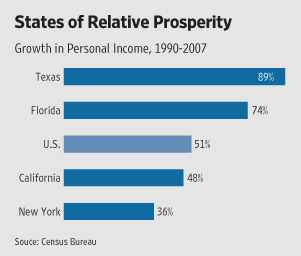
If taxes don't matter, then maybe someone can explain the divergent economic paths of California and New York and America's two other most populous states, Florida and Texas. The latter two states have no personal income tax. Personal income has been growing about 50% faster in Florida and Texas than in California and New York. (See chart.) This year Texas became the No. 1 state for Fortune 500 corporate headquarters. About a dozen of those 58 corporations once called New York or California home, and taxes are one reason they departed.

We realize that none of this will matter to the Sacramento and Albany politicians, whose only priority is taking ever more money from the private economy to feed their patronage interests. But perhaps it will serve as a lesson to other states that haven't yet embarked on this tax-and-spend road to red ink and slower growth.

http://online.wsj.com/article/SB122126219384430423.html
 
It's better to read the data on the actual webpage rather than this post.

Election Fact of the Day

Obama leads in 18 out the 19 states with the largest recent declines in home prices, whereas McCain leads in 13 out the 14 states with the largest recent increases in home prices.

http://gregmankiw.blogspot.com/2008/11/election-fact-of-day.html


State-by-State Polls Compared to Economic Indicators
November 1, 2008, 1:47 pm

Tip O’Neill once declared that “all politics is local.” The economy has become the central issue in the 2008 presidential campaign, but not all states are feeling the downturn equally. The following chart illustrates the economic differences among the states and how it might be affecting voters’ preferences.

The latest NBC/Wall Street Journal poll shows voters’ top concern in the coming election is the economy, and 49% of respondents said Sen. Barack Obama would do a better job fixing the economy, compared to 28% who said Sen. John McCain would do better.

The chart, which uses polling data from political Web site Real Clear Politics, tracks three key indicators of voter sentiment about the economy. One is the unemployment rate in the individual states for September, the most recent month for which data are available. Job losses on a national scale have been escalating this year, with the unemployment rate for the nation reaching 6.1%. However, on a state level the rate varies from a low of 3.2% in South Dakota to a high of 8.8% in Rhode Island.

Personal income can also affect voter psychology. The numbers in the chart represent the income growth from the second quarter of 2007 to the second quarter of 2008, the most recent period for which data are available. During that the consumer price index across the nation was running at about 5%. To keep pace with inflation, income has to rise at the same rate.

The decline in home prices also has been a top issue on voters’ minds. The data in the chart are from the Office of Federal Housing Enterprise Oversight house price index for the second quarter, the most recent period for which data are available. The Ofheo index (renamed the Federal Housing Finance Agency house price index) only tracks mortgages backed by Fannie Mae and Freddie Mac. Some economists prefer the S&P/Case-Shiller home price index, which shows a steeper decline in prices from 2007 to 2008, but that measure doesn’t break down its data by state. The most recent data from Case-Shiller can be found here.

Sen. Obama enjoys a lead in all but two of the states that have seen a decline in house prices according to Ofheo index, including four states that went to President Bush in the 2004 election. The two states in which Sen. McCain leads in polling? His home state of Arizona and Alaska, the home state of his running mate, Gov. Sarah Palin. –Phil Izzo

http://blogs.wsj.com/economics/2008/11/01/state-by-state-polls-compared-to-economic-indicators/
 
These think-tanks are propaganda factories.

The three most successful states are Texas, Arizona, and Florida?

And, of course, it is for the very reasons the think-tank wants to promote.

It couldn't possibly be because the banks made sure to make credit available to Arizona and Florida for an outrageous real estate bubble.

And, why should Texas do well when the President of the United States of America for the entire decade is from that state and has been pushing the oil agenda the entire time, which is the engine driving Texas economic growth.

Illinois, Ohio, and Michigan simply have not had the dollars and credit flowing into them the way these other states have.

You give any state money (or a President for 8 years) and it is going to do well.

You don't need a think tank to know that.
 
The Big-Spending, High-Taxing, Lousy-Services Paradigm

William Voegeli
The Big-Spending, High-Taxing, Lousy-Services Paradigm
California taxpayers don’t get much bang for their bucks.
Autumn 2009

In 1956, the economist Charles Tiebout provided the framework that best explains why people vote with their feet. The “consumer-voter,” as Tiebout called him, challenges government officials to “ascertain his wants for public goods and tax him accordingly.” Each jurisdiction offers its own package of public goods, along with a particular tax burden needed to pay for those goods. As a result, “the consumer-voter moves to that community whose local government best satisfies his set of preferences.” In selecting a jurisdiction, the mobile consumer-voter is, in effect, choosing a club to join based on the benefits that it offers and the dues that it charges.

America’s federal system allows, at the state level, for 50 different clubs to join. At first glance, the states seem to differ between those that bundle numerous high-quality public benefits with high taxes and those that offer packages of low benefits and low taxes. These alternatives, of course, define the basic argument between liberals and conservatives over the ideal size and scope of government. Except for Oregon, John McCain carried every one of the 17 states with the lowest tax levels in the 2008 presidential election, while Barack Obama won every one of the 17 at the top of the list except for Wyoming and Alaska.

It’s not surprising, then, that an intense debate rages over which model is more satisfactory and sustainable. What is surprising is the growing evidence that the low-benefit, low-tax alternative succeeds not only on its own terms but also according to the criteria used by defenders of high benefits and high taxes. Whatever theoretical claims are made for imposing high taxes to provide generous government benefits, the practical reality is that these public goods are, increasingly, neither public nor good: their beneficiaries are mostly the service providers themselves, and their quality is poor. For evidence, look to the two largest states in the nation, which are fine representatives of the liberal and conservative alternatives.

One out of every five Americans is either a Californian or a Texan. California became the nation’s most populous state in 1962; Texas climbed into second place in 1994. They are broadly similar: populous Sunbelt states with large metropolitan areas, diverse economies, and borders with Mexico producing comparable demographic mixes. Both are “majority-minority” states, where non-Hispanic whites make up just under half of the population and Latinos just over a third.

According to the most recent data available from the Census Bureau, for the fiscal year ending in 2006, Americans paid an average of $4,001 per person in state and local taxes. But Californians paid $4,517 per person, well above that national average, while Texans paid $3,235. It’s worth noting, by the way, that while state and local governments in both California and Texas get most of their revenue from taxes, the revenue is augmented by subsidies from the federal government and by fees charged for governmental services and facilities, such as trash collection, airports, public university tuition, and mass transit. California had total revenues of $11,160 per capita, more than every state but Alaska, Wyoming, and New York, while Texas placed a distant 44th on this scale, with revenues of all governmental entities totaling $7,558 per person.

What might interest Tiebout is that while California and Texas are comparable in terms of sheer numbers, their demographic paths are diverging. Before 1990, both states grew much faster than the rest of the country. Since then, only Texas has continued to do so. While its share of the nation’s population has steadily increased, from 6.8 percent in 1990 to 7.9 percent in 2007, California’s has barely budged, from 12 percent to 12.1 percent.

Unpacking the numbers is even more revealing—and, for California, disturbing. The biggest contrast between the two states shows up in “net internal migration,” the demographer’s term for the difference between the number of Americans who move into a state from another and the number who move out of it to another. Between April 1, 2000, and June 30, 2007, an average of 3,247 more Americans moved out of California than into it every week, according to the Census Bureau. Over the same period, Texas saw a net gain, in an average week, of 1,544 people. Aside from Louisiana and Mississippi, which lost population to other states because of Hurricane Katrina, California is the only Sunbelt state that had negative net internal migration after 2000. All the other states that lost population to internal migration were Rust Belt basket cases, including New York, Illinois, New Jersey, Michigan, and Ohio.

As Tiebout might have guessed, this outmigration has to do with taxes. Besides Mississippi, every one of the 17 states with the lowest state and local tax levels had positive net internal migration from 2000 to 2007. Except for Wyoming, Maine, and Delaware, every one of the 17 highest-tax states had negative net internal migration over the same period. Conservative researchers’ technical explanation for this phenomenon is: “Well, duh.” Or, as Arthur Laffer and Stephen Moore wrote in the Wall Street Journal earlier this year: “People, investment capital and businesses are mobile: They can leave tax-unfriendly states and move to tax-friendly states.”

Summarizing the findings of a report they wrote for the American Legislative Exchange Council, Laffer and Moore pointed out that between 1998 and 2007, the states without an individual income tax “created 89 percent more jobs and had 32 percent faster personal income growth” than the states with the highest individual income-tax rates. California’s tax and regulatory policies, the report predicts, “will continue to sap its economic vitality,” while Texas’s “pro-growth” policies will help it “maintain its superior economic performance well into the future.” The clear implication is that California should become more like Texas.

At this point, defenders of the high-benefit, high-tax paradigm push back. Remember the other half of Tiebout’s equation, they say. There’s no need for a state to be like Texas if its high taxes and extensive regulations are part of a package deal that yields more and better public goods and an attractive quality of life.

But that, it turns out, is a big “if.” It’s true that many people are less sensitive to taxes and more concerned about public goods, and these consumer-voters will congregate in places with extensive services. But it’s also true, all things being equal, that everyone would rather pay lower than higher taxes. The high-benefit, high-tax model can work, but only if the high taxes actually purchase high benefits—that is, public goods that far surpass the quality of those available to people who pay low taxes.

And here, California is decidedly lacking. The biggest factor accounting for California’s loss of population to the other 49 states, bond ratings that would embarrass Chrysler or GM, and state politics contentious and feckless enough to shame a banana republic, has to be its public sector’s diminishing willingness and capacity to fulfill its promises to taxpayers. “Twenty years ago, you could go to Texas, where they had very low taxes, and you would see the difference between there and California,” Joel Kotkin, executive editor of NewGeography.com and a presidential fellow at Chapman University in Southern California, told the Los Angeles Times this past March. “Today, you go to Texas, the roads are no worse, the public schools are not great but are better than or equal to ours, and their universities are good. The bargain between California’s government and the middle class is constantly being renegotiated to the disadvantage of the middle class.”

Similarly, the CEO of a manufacturing company in suburban Los Angeles told a Times reporter that his business suffered less from California’s high taxes than from its ineffectual services. As a result, the company pays “a fortune” to educate its employees, many of whom graduated from California public schools, “on basic things like writing and math skills.” According to a report issued earlier this year by McKinsey & Company, Texas students “are, on average, one to two years of learning ahead of California students of the same age,” though expenditures per public school student are 12 percent higher in California.

State and local government expenditures as a whole were 46.8 percent higher in California than in Texas in 2005–06—$10,070 per person compared with $6,858. And Texas not only spends its citizens’ dollars more effectively; it emphasizes priorities that are more broadly beneficial. In 2005–06, per-capita spending on transportation was 5.9 percent lower in California than in Texas, and highway expenditures in particular were 9.5 percent lower, a discovery both plausible and infuriating to any Los Angeles commuter losing the will to live while sitting in yet another freeway traffic jam. With tax revenues scarce and voters strongly opposed to surrendering more of their income, Texas officials devote a large share of their expenditures to basic services that benefit the most people. In California, by contrast, more and more spending consists of either transfer payments to government dependents (as in welfare, health, housing, and community development programs) or generous payments to government employees and contractors (reflected in administrative costs, pensions, and general expenditures). Both kinds of spending weaken California’s appeal to consumer-voters, the first because redistributive transfer payments are the least publicly beneficial type of public good, and the second because the dues paid to Club California purchase benefits that, increasingly, are enjoyed by the staff instead of the members.

Californians have the best possible reason to believe that the state’s public sector is not holding up its end of the bargain: clear evidence that it used to do a better job. Bill Watkins, executive director of the Economic Forecast Project at the University of California at Santa Barbara, has calculated that once you adjust for population growth and inflation, the state government spent 26 percent more in 2007–08 than in 1997–98. Back then, “California had teachers. Prisoners were in jail. Health care was provided for those with the least resources.” Today, Watkins asks, “Are the roads 26 percent better? Are schools 26 percent better? What is 26 percent better?”

The steady deterioration of California’s public services hasn’t gone unnoticed. Shortly after his stunning ascension to the governor’s office in 2003, Arnold Schwarzenegger established an advisory commission, the California Performance Review (CPR), to recommend ways to make governance in California smarter, cheaper, and better. The commission labored through 2004 before delivering a doorstop report with more than 1,200 recommendations for streamlining this and consolidating that, along with an assessment that implementing the full list of changes could save California $32 billion over the first five years.

And then . . . nothing, really. The 2,500-page report was “dead on arrival,” according to Bill Whalen of the Hoover Institution, “because it was too complicated for voters to rally behind and legislators didn’t want to see it enacted.” Citizen Schwarzenegger may have assumed that his personal star power and the CPR recommendations’ plodding good sense would make a politically irresistible combination. Such reckoning failed to account for the formidable ability of even the most obscure and otiose governmental body to hunker down, defend its turf, and outlast mere politicians.

The CPR, for example, recommended abolishing dozens of California’s commissions and advisory boards, either outright or by folding their activities into a simpler and more rational organizational structure. Five years later, few of these vestigial organs have been removed. The many that remain include the Commission on Aging, whose lead accomplishment for 2009 is getting the legislature to declare a Fall Prevention Week (which began on the first day of autumn, naturally); the Apprenticeship Council, “which has been in place since the 1930s,” according to the CPR, and “is no longer needed to perform regulatory and advisory responsibilities”; the Board of Barbering and Cosmetology; the Court Reporters Board; and the Hearing Aid Dispensers Bureau.

The point is not that turning a flamethrower on every item in the Museum of Governmental Anachronisms would have saved California a great deal of money. It is, rather, that abolishing these boards and commissions, whose names are talk-radio punch lines, would have been the easy calls, the obvious first steps toward giving California’s taxpayers a decent return on their surrendered dollars. Yet even the low-hanging fruit proved out of reach. The path of least resistance was to do the same old thing, not the sensible thing.

The resistance comes from the blob of interest groups, inside and outside government, that like California’s public sector just fine the way it is and see reform as a threat to their comfortable, lucrative arrangements. It turns out, for example, that all the pointless boards and commissions are bulletproof because they provide golden parachutes to politicians turned out of the state legislature by California’s strict term limits. In the middle of the state’s most recent budget crisis, State Senator Tony Strickland proposed a bill to eliminate salaries paid to members of boards and commissions who, despite holding fewer than two formal hearings or official meetings per month, had received annual compensation in excess of $100,000. The bill died in committee.

James Madison would have to revise—or possibly burn—Federalist No. 10 if he were forced to account for the new phenomenon of the government itself becoming the faction decisively shaping its own policy and conduct. (See “Madison’s Nightmare” in City Journal’s 2009 special issue, “New York’s Tomorrow.”) This faction dominates because it’s playing a much longer game than the politicians who come and go, not to mention the citizens who rarely read the enormous owner’s manual for the Rube Goldberg machine they feed with their dollars. They rarely stay outraged long enough to make a difference.

Take entitlements and public-employee pensions, which are, Watkins says, “the real source of the state’s fiscal distress.” A 2005 study by the Legislative Analyst’s Office (California’s version of the Congressional Budget Office) found that pensions for California’s government employees “surpassed the other states—often significantly—at all retirement ages.” California government workers retiring at age 55 received larger pensions than their counterparts in any other state (leaving aside the many states where retirement as early as 55 isn’t even possible). The California Foundation for Fiscal Responsibility periodically posts a list of retired city managers, state administrators, public university deans, and police chiefs who receive pensions of at least $100,000 per year. The latest report shows 5,115 lucky members in this six-figure club. The state’s annual bill for polishing their gold watches is $610 million.

Again, the most vivid part of the problem is not the most important. California would move only slightly closer to regaining fiscal health if it scraped the gilding off the pensions and health benefits of its most lucratively retired employees. But when even a flagrant example of a government’s serving its workforce better than its citizens is politically unassailable, it’s hard to be hopeful about the mundane reforms needed to change the rest of the economically debilitating public-employee retirement system. The California Performance Review suggested the sensible thing: gradually substituting defined-contribution for defined-benefit pension plans. (According to a report by the Pew Center on the States, just 20 percent of the nation’s private-sector employees are enrolled in a defined-benefit pension plan, compared with 90 percent of public-sector employees.) To no one’s shock, the state legislature has rejected all proposals to curb the state’s financial obligations to its retired and retiring employees.

If California doesn’t want to be Texas, it must find a way to be a better California. The easy thing about being Texas is that the government has a great deal of control over the part of its package deal that attracts consumer-voters—it must merely keep taxes low. California, on the other hand, must deliver on the high benefits promised in its sales pitch. It won’t be enough for its state and local governments to spend a lot of money; they have to spend it efficiently and effectively.

The optimistic assessment is that things are going to get worse in California before they get better. The pessimistic assessment is that they’re going to get worse before they get much worse. As is often the case, hanging around with the pessimists is less fun but more instructive. The current recession has driven California’s state government into what amounts to a five-month budget cycle, according to Dan Walters of the Sacramento Bee. He estimates that the budget deal tortuously wrought in July should start falling apart in October, because it was predicated on pie-in-the-sky revenue estimates and because so many of its spending cuts are being challenged, often successfully, in the courts.

The recession will eventually end and California’s finances will improve, say the optimists. Given the state’s pervasive political bias against efficient and effective public services, however, the question is whether its finances will ever get truly well. States that have grown accustomed to thinking of the engine that drives their economies as an inexhaustible resource—whether it’s Michigan and the auto industry, New York and Wall Street, or California and the vision of the sunlit good life that used to attract new residents—find it tough to compete again for what they thought would be theirs forever, and to plan budgets for lean years that turn into lean decades. Instead, they invest their hopes in a deus ex machina that will rescue them from the hard choices they dread.

For California’s governmental-industrial complex, a new liberal administration and Congress in Washington offer plausible hope for a happy Hollywood ending. Federal aid will replace the dollars that California’s taxpayers, fed up with the state’s lousy benefits and high taxes, refuse to provide. Americans will continue to vote with their feet, either by leaving California or disdaining relocation there, but their votes won’t matter, at least in the short term. Under the coming bailout, the new 49ers—Americans in the other 49 states, that is—will be extended the privilege of paying California’s taxes. At least they won’t have to put up with its public services.

William Voegeli is a contributing editor of The Claremont Review of Books and a visiting scholar at Claremont McKenna College’s Salvatori Center. His book on the American welfare state will be published by Encounter in 2010.

http://www.city-journal.org/2009/19_4_california.html
 
Republican gubernatorial wins in New Jersey and Virginia have given Greed some balls to post his dribble again. I guess he wants us to return to the economic meltdown GW imposed on the world last fall.
 
California Suggests Suicide; Texas Asks: Can I Lend You a Knife?

California Suggests Suicide; Texas Asks: Can I Lend You a Knife?
Joel Kotkin
Nov. 15 2010

In the future, historians may likely mark the 2010 midterm elections as the end of the California era and the beginning of the Texas one. In one stunning stroke, amid a national conservative tide, California voters essentially ratified a political and regulatory regime that has left much of the state unemployed and many others looking for the exits.

California has drifted far away from the place that John Gunther described in 1946 as “the most spectacular and most diversified American state … so ripe, golden.” Instead of a role model, California has become a cautionary tale of mismanagement of what by all rights should be the country’s most prosperous big state. Its poverty rate is at least two points above the national average; its unemployment rate nearly three points above the national average. On Friday Gov. Arnold Schwarzenegger was forced yet again to call an emergency session in order to deal with the state’s enormous budget problems.

This state of crisis is likely to become the norm for the Golden State. In contrast to other hard-hit states like Pennsylvania, Ohio and Nevada, which all opted for pro-business, fiscally responsible candidates, California voters decisively handed virtually total power to a motley coalition of Democratic-machine politicians, public employee unions, green activists and rent-seeking special interests.

In the new year, the once and again Gov. Jerry Brown, who has some conservative fiscal instincts, will be hard-pressed to convince Democratic legislators who get much of their funding from public-sector unions to trim spending. Perhaps more troubling, Brown’s own extremism on climate change policy–backed by rent-seeking Silicon Valley investors with big bets on renewable fuels–virtually assures a further tightening of a regulatory regime that will slow an economic recovery in every industry from manufacturing and agriculture to home-building.


Texas’ trajectory, however, looks quite the opposite. California was recently ranked by Chief Executive magazine as having the worst business climate in the nation, while Texas’ was considered the best. Both Democrats and Republicans in the Lone State State generally embrace the gospel of economic growth and limited public sector expenditure. The defeated Democratic candidate for governor, the brainy former Houston Mayor Bill White, enjoyed robust business support and was widely considered more competent than the easily re-elected incumbent Rick Perry, who sometimes sounds more like a neo-Confederate crank than a serious leader.

To be sure, Texas has its problems: a growing budget deficit, the need to expand infrastructure to service its rapid population growth and the presence of a large contingent of undereducated and uninsured poor people. But even conceding these problems, the growing chasm between the two megastates is evident in the economic and demographic numbers. Over the past decade nearly 1.5 million more people left California than stayed; only New York State lost more. In contrast, Texas gained over 800,000 new migrants. In California, foreign immigration–the one bright spot in its demography–has slowed, while that to Texas has increased markedly over the decade.

A vast difference in economic performance is driving the demographic shifts. Since 1998, California’s economy has not produced a single new net job, notes economist John Husing. Public employment has swelled, but private jobs have declined. Critically, as Texas grew its middle-income jobs by 16%, one of the highest rates in the nation, California, at 2.1% growth, ranked near the bottom. In the year ending September, Texas accounted for roughly half of all the new jobs created in the country.

Even more revealing is California’s diminishing preeminence in high-tech and science-based (or STEM–Science, Technology, Engineering and Mathematics) jobs. Over the past decade California’s supposed bulwark grew a mere 2%–less than half the national rate. In contrast, Texas’ tech-related employment surged 14%. Since 2002 the Lone Star state added 80,000 STEM jobs; California, a mere 17,000.

Of course, California still possesses the nation’s largest concentrations of tech (Silicon Valley), entertainment (Hollywood) and trade (Port of Los Angeles-Long Beach). But these are all now declining. Silicon Valley’s Google era has produced lots of opportunities for investors and software mavens concentrated in affluent areas around Palo Alto, but virtually no new net jobs overall. Empty buildings and abandoned factories dot the Valley’s onetime industrial heartland around San Jose. Many of the Valley’s tech companies are expanding outside the state, largely to more business-friendly and affordable places like Salt Lake City, the Research Triangle region of North Carolina and Austin.

Hollywood too is shifting frames, with more and more film production going to Michigan, New Mexico, New York and other states. In 2002, 82% of all film production took place in California–now it’s down to roughly 30%. And plans by Los Angeles County, the epicenter of the film industry, to double permit fees for film, television and commercial productions certainly won’t help.

International trade, the third linchpin of the California economy, is also under assault. Tough environmental regulations and the anticipated widening in 2014 of the Panama Canal are emboldening competitors, particularly across the entire southern tier of the country, most notably in Houston. Mobile, Ala., Charleston, S.C., and Savannah, Ga., also have big plans to lure high-paid blue collar jobs away from California’s ports.

Most worrisome of all, these telltale signs palpable economic decline seem to escape most of the state’s top leaders. The newly minted Lieutenant Governor, San Francisco Mayor Gavin Newsom, insists “there’s nothing wrong with California” and claims other states “would love to have the problems of California.”

But it’s not only the flaky Newsom who is out of sync with reality. Jerry Brown, a far savvier politician, maintains “green jobs,” up to 500,000 of them, will turn the state around. Theoretically, these jobs might make up for losses created by ever stronger controls on traditional productive businesses like agriculture, warehousing and manufacturing. But its highly unlikely.

Construction will be particularly hard hit, since Brown also aims to force Californians, four-fifths of whom prefer single-family houses, into dense urban apartment districts. Over time, this approach will send home prices soaring and drive even more middle-class Californians to the exits.

Ultimately the “green jobs” strategy, effective as a campaign plank, represents a cruel delusion. Given the likely direction of the new GOP-dominated House of Representatives in Washington, massive federal subsidies for the solar and wind industries, as well as such boondoggles as high-speed rail, are likely to be scaled back significantly. Without subsidies, federal loans or draconian national regulations, many green-related ventures will cut as oppose to add jobs, as is already beginning to occur. The survivors, increasingly forced to compete on a market basis, will likely move to China, Arizona or even Texas, already the nation’s leader in wind energy production.

Tom Hayden, a ’60s radical turned environmental zealot, admits that given the current national climate the only way California can maintain Brown’s “green vision” will be to impose “some combination of rate heights and tax revenues.” Such an approach may help bail out green investors, but seems likely to drive even more businesses out of the state.

California’s decline is particularly tragic, as it is unnecessary and largely unforced. The state still possesses the basic assets–energy, fertile land, remarkable entrepreneurial talent–to restore its luster. But given its current political trajectory, you can count on Texans, and others, to keep picking up both the state’s jobs and skilled workers. If California wishes to commit economic suicide, Texas and other competitors will gladly lend them a knife.

http://blogs.forbes.com/joelkotkin/...ts-suicide-texas-asks-can-i-lend-you-a-knife/
 
Texas, the center of fiscal discipline?


<iframe src="http://politifact.com/texas/statements/2010/mar/04/bill-white/white-says-texas-debt-has-doubled-under-perry/" width=800 height=1000></iframe>
 
Back
Top