
You are using an out of date browser. It may not display this or other websites correctly.
You should upgrade or use an alternative browser.
You should upgrade or use an alternative browser.
UPDATE: Donald Trump Takes Office as the 47th US President
- Thread starter DC_Dude
- Start date



Yeah see I disagree.....He did say YNs but also called white folks rednecks as well....
But from my perspective, I believe he was insuating what Fred Hampton and the Black Panther Party tried to do with the Rainbow Coaltion....
Unite folks of all races and economic backgrounds to come together and fight the system as a whole....
Chicago 1969: When Black Panthers aligned with Confederate‑flag‑wielding, working‑class whites
Published: January 8, 2017 8:32pm EST
Share article
Print article
Editor’s note: This article was published on Jan. 8, 2017.
In the 2016 presidential election, Donald Trump won the white vote across all demographics except for college-educated white women. He did especially well among working class white voters: 67 percent of whites without a college degree voted for him.
Some post-election analysis marveled at how the white working class could vote against its own interests by supporting a billionaire businessman who is likely to support policies that cut taxes for the rich and weaken the country’s social safety net. Since the New Deal, the Democratic Party has been seen as the party of working people, while Republicans were considered the party of the elites. Donald Trump was able to flip this narrative to his advantage. Election 2016 balkanized issues and made it seem impossible to work on racism, sexism, poverty and economic issues all at once. A core question moving forward for social justice advocates and the Democratic Party is how they can move beyond identity politics and attract working-class voters of all races, building stronger coalitions among disparate groups.
One place to look for inspiration and instruction might be 1960s social movements that understood the power of alliances across identities and issues. During this period, a radical coalition formed that might seem impossible today: A group of migrant southerners and working-class white activists called the Young Patriots joined forces with the Black Panthers in Chicago to fight systemic class oppression.
So how did this alliance form? And how can its lessons be applied to today’s political moment?
An unlikely alliance
In the post-civil rights era, a militant Black Power movement emerged, with the Black Panther Party for Self Defense forming in 1966. Inspired by Malcolm X and other international black thought leaders, the group embraced armed struggle as a potential tool against organized racial oppression – a radical break from the philosophy of nonviolent protest. A large faction of the group developed in Chicago, where one of the party leaders was a young man named Fred Hampton.
We believe good journalism is good for democracy and necessary for it.
Learn more
Chicago in the 1960s was a brutal place for poor people. Black, brown and white people all dealt with poverty, unemployment, police violence, substandard housing, inadequate schools and a lack of social services. Ethnic and racial groups each created their own social service and activist networks to combat every kind of oppression.
One was the Young Patriot Organization (YPO), which was based in Hillbilly Harlem, an uptown neighborhood of Chicago populated by displaced white southerners. Many YPO members were racist, and they flaunted controversial symbols associated with southern pride, such as the Confederate flag. But like blacks and Latinos, the white Young Patriots and their families experienced discrimination in Chicago. In their case, it was because they were poor and from the South.
In his short time as a Black Panther leader, Fred Hampton wanted to advance the group’s goals by forming a “Rainbow Coalition” of working class and poor people of all races.
Former members of the Chicago Panthers and YPO tell different versions of the same story of how the groups connected: Each attended the other’s organizing meetings and decided to work together on their common issues. Over time, the Black Panthers learned to tolerate Confederate flags as intransigent signs for rebellion. Their only stipulation was that the white Young Patriots denounce racism.
Eventually, Young Patriots rejected their deeply embedded ideas of white supremacy – and even the Confederate flag – as they realized how much they had in common with the Black Panthers and Latino Young Lords.

Despite many differences, the two groups united under the umbrella of economic justice. Redneck Revolt
Assumed to be natural enemies, these groups united in their calls for economic justice. In the Aug. 9, 1969 issue of The Black Panther newspaper, the party’s chief of staff, David Hilliard, admiringly called the Young Patriots “the only revolutionaries we respect that ever came out of the mother country.” Recalling his work with the YPO, former Black Panther Bobby Lee explained that “The Rainbow Coalition was just a code word for class struggle.”
In the end, the Illinois Panthers brought together various elements of the black community, Confederate flag-waving southern white migrants (Young Patriots), Puerto Ricans (Young Lords), poor white ethnic groups (Rising Up Angry, JOIN Community Union, and the Intercommunal Survival Committee), students and the women’s movement. The disparate groups under the coalition’s umbrella pooled resources and shared strategies for providing community services and aid that the government and private sector would not. Initiatives included health clinics, feeding homeless and hungry people, and legal advice for those dealing with unethical landlords and police brutality.
In 2016, a stark racial divide is exposed
Almost 50 years after the original Rainbow Coalition, the U.S. electorate remains divided along racial lines. Even though Donald Trump asked black Americans, “What do you have to lose?” by voting for him and abandoning the Democratic Party, it didn’t work: Only 8 percent of black voters (and 28 percent of Latino and 27 percent of Asian voters) cast ballots for Trump. Blacks and Latinos are well-represented in the working class, and people of color will become the majority in the working class in 2032.

A button depicts the partnership between the Young Patriots and the Black Panthers.
Much 2016 post-election attention has focused on working-class white voters, who have been characterized as “forgotten” and “angry” for being left out of the economic recovery. Yet African-Americans have been far worse off; since the 2007 recession, the unemployment rate of African-Americans is nearly double that of Hispanics and more than twice that of whites.
Hillary Clinton was the candidate who collected the most diverse voter base – the 2016 Democratic National Convention in Philadelphia looked like the Rainbow Coalition redux – and she was expected to win the election. However, that visual hid racism’s residual and deeply entrenched place in U.S. society. One of the lessons of the 2016 election is that the country is not as advanced in its work on ending racism and discrimination as most would like to believe. Donald Trump did not have to do much to capitalize on this.
The Rainbow Coalition members in 1960s Chicago understood how difficult it is to build coalitions across identities. Former Black Panther Bobby Lee recalled working with the Young Patriots:
The coalition, bringing together seemingly polar opposite Black Panthers and Young Patriots, showed that real interactions allow people to understand that their struggles are not essentially different. Donald Trump probably was sincere when he invited African-Americans to join his movement. He simply didn’t realize that a glib invitation would not produce the same results as real coalition-building over a period of time.
The lesson to learn from studying 1960s social movements is that lasting change toward economic and racial justice will probably be built brick by brick, person to person and “real slow.”
I am glad you shared this. White people love to side step racism for classism. I agree classism is a problem, but what happens when you get rid of classism? WE still have to deal with racism! So it doesn't help Black people to fight classism first. That only helps White people, and I don't trust white people to remember that racism is a problem that needs to be addressed once classism has been dealt with (see EVERY promise the government has made to Black people) White folks still feel forgotten, and Black and brown people are used as the scapegoat! "Boy, I hope that Black pilot has the right stuff!" "Immigrants are taking all the jobs!" Classists using racism to divide, take that tool of racism away and it is harder for classists to divide compared to 50-60 years ago.
Hell, there are entire communities that rocked with us when they were in the same boat as us, but once they got access to whiteness they had no problem joining in on the racism (see the Irish and Italians) You see it with Asians today how they were used to remove race out of school applications. When white people need to pad their numbers all of a sudden Irish, Italians and Northern Africans are now white.
Also red neck is not on the level of Ninja. We're gonna need to come up with a more biting slur than something their skin naturally does when out in the sun. Micro-penises or the lil dycks...not a whole lot of hurtful stereotypes for white people...imagine that!
Last edited:


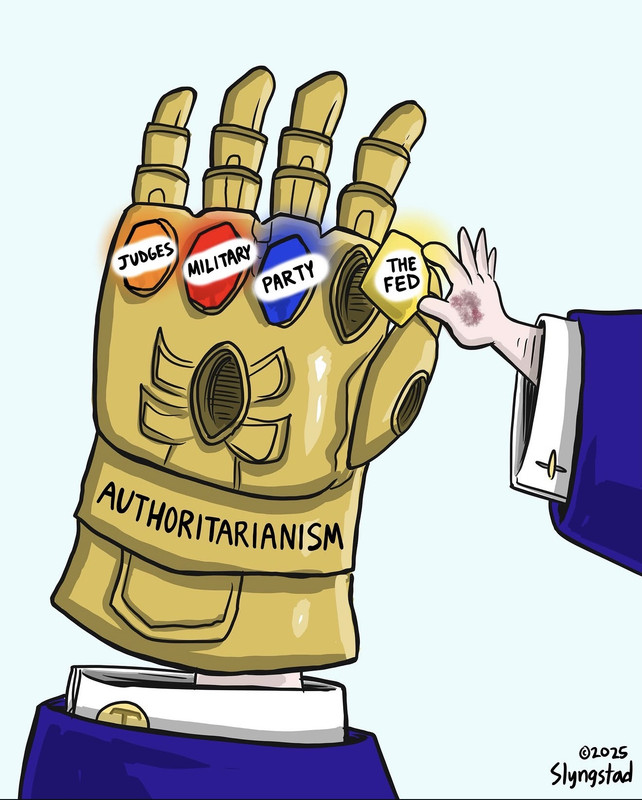
...so what are the other two?

Add the IRS to the glove

President Donald Trump has been feuding with the IRS for many years over audits into whether he and his business empire paid enough taxes
The Justice Department agreement with President Donald Trump over his leaked tax returns includes a guarantee that the tax agency will no longer pursue any claims over tax liabilities it may have against Trump, his family members and his companies.
The nine-page settlement agreement made public by the Justice Department May 18, set up a $1.776 billion fund for "victims of lawfare and weaponization," did not include any mention of the government's efforts to go after Trump, his family and his companies over longstanding tax disputes.
On May 19, DOJ posted a separate one-page document on its website – signed by acting Attorney General Todd Blanche – with the new details. It includes what appears to be an all-inclusive release in which the Internal Revenue Service is “FOREVER BARRED and PRECLUDED” from “prosecuting or pursuing” any and all efforts to determine if Trump and the other parties are liable for non- or under-payment of taxes, interest, attorney’s fees or expenses incurred by the government.
Trump sued the IRS in January for $10 billion, alleging the agency failed to prevent a contractor leaking his returns. Trump had said as early as 2014 that he would release the returns to the public if he ran for president, sometimes adding stipulations or changing explanations.
Some tax experts questioned the propriety and legality of the agreement, which did not include the signature of anyone from the Department of Treasury or IRS.
“This won’t stand up in court; this is corruption with a capital C and ultimately, the American people won't tolerate this,” Paul Pelletier, a former senior Justice Department tax and white-collar crime prosecutor who represented the IRS told USA TODAY. “And the next administration can easily reverse it.”
In September 2020, as Trump was campaigning for reelection, The New York Times published a bombshell report that he had paid only $750 in federal income taxes each in 2016 and 2017.
"He had paid no income taxes at all in 10 of the previous 15 years − largely because he reported losing much more money than he made," the Times reported, citing Trump tax-return data and tax returns filed with the IRS that he had long sought to keep private.
Also hanging over Trump at the time, the Times reported, was a decade-long audit battle with the IRS over the legitimacy of a $72.9 million tax refund that he claimed, and received, after declaring huge losses.
"An adverse ruling," the newspaper wrote, "could cost him more than $100 million."
Democrats blast payout at Blanche hearing
Blanche was sharply criticized by Senate Democrats, who said the fund is geared toward benefiting Trump's political allies with taxpayer dollars, during his appearance at a hearing of the Senate Appropriations Subcommittee on Senate Appropriations Subcommittee on Commerce, Justice, Science, and Related Agencies on May 19.
Sen. Chris Van Hollen of Maryland, the ranking Democrat on the subcommittee, told Blanche he considers the fund “an outrageous, unprecedented slush fund that you set up” to settle Trump’s lawsuit.
Like other Democrats, Van Hollen noted that Blanche had been Trump’s personal defense lawyer in several of his criminal cases.
Blanche argued the fund is nonpartisan.
“It's not limited to Republicans," Blanche told members of the subcommittee, which oversees spending for the Justice Department. "There's no limitation on the claims."
Blanche said that “anybody” can apply for a payout, including those convicted of attacking police during the Jan. 6, 2021, Capitol riot.
“Simple question, will individuals who assaulted Capitol Hill police officers be eligible for this fund?” Van Hollen asked at one point."Anybody in this country is eligible to apply if they believe they're a victim of weaponization,” Blanche replied.
“Are there going to be rules that say that if you've assaulted a Capitol Hill police officer or committed a violent crime, you will not be eligible? Why not make that a rule?” Van Hollen asked Blanche.
“Because I’m not one of the five commissioners setting up the rules,” Blanche replied.
“You’re appointing four of the five members, aren’t you, Mr. Attorney General?” Van Hollen said.
“I am appointing all five members,” Blanche replied.
But Blanche would not commit, under repeated questioning by Democrats, to providing his appointees with guidance about whether to bar anyone connected to Jan. 6 from applying, including those convicted of using violence against police officers defending the Capitol.
“I don't think it's the attorney general's job to encourage commissioners to do or not do anything,” Blanche said.
Later, Blanche said anyone, even President Biden’s son Hunter, could apply for compensation under the new fund. He also said anyone brought before the various grand juries in Trump’s criminal cases – including his Mar-a-Lago gardeners and Secret Service agents – were good candidates for compensation because of the “weaponization” they endured.
https://www.usatoday.com/story/news...new-deal-bars-trump-irs-auditing/90163637007/


This eau de toilet is wonderful. Everyone knows I smell wonderful. Now everyone can smell like me, your favorite president, Donald J. Trump. I know I spelled toilet the American way. It smells better that way.


Thry need the same "sentences" as Saddam Hussain and his sons
Jeff Bezos gets paid $1 a year.
They’re gonna be bets on the civil war. Ain’t God good?Homie just missed the whole ass Kalshi ticker at the bottom!
Kalshi is Polymarket. Kalshi Politics is like having your Gamblers Anonymous meetings in Cesar's Palace. NOTHING good is coming out of this.


Thst cracka seized venesuslan oil areest d maduro and now hes endicting raul castro. Hes just doing this to cury the vote of venesuaoasbwnd cubans. Hes dont rrally care abouttheir freedom. Anybody can see this play from a mile away
One positive from last night


Republicans better look into this because Trump is going to fuck up everything during the midterms

Easy being ridiculous again.Republicans better look into this because Trump is going to fuck up everything during the midterms

I told you all this would happen.


Back when America was great
MAGA
See this is the shit I'm talking about!
Mfkrs were halfway across the globe in a whole different country and still found time to be overtly racist.
And to all the cacs talking about, "we'd love for blacks to have their own thriving neighborhoods."
The dozens of historical atrocities aside (Rosewood, Tulsa, Raleigh, Oscarville,......etc)..... all the way across the globe in Vietnam. They had a couple huts to themselves.
"At first, they didn't seem to have any problems.
Then later on there were instances of cross burnings and they even tried to burn down the hut once."
Mfkrs were there to fight the Vietnamese...... but still couldn't let the negroes have anything to themselves.
Unless they do some type of massive genocide, there is nothing they could do about this
Similar threads

- Replies
- 22
- Views
- 274


- Replies
- 4
- Views
- 392


- Replies
- 55
- Views
- 2K
