

You are using an out of date browser. It may not display this or other websites correctly.
You should upgrade or use an alternative browser.
This is why it's impossible to tax billionaires
- Thread starter Database Error
- Start date

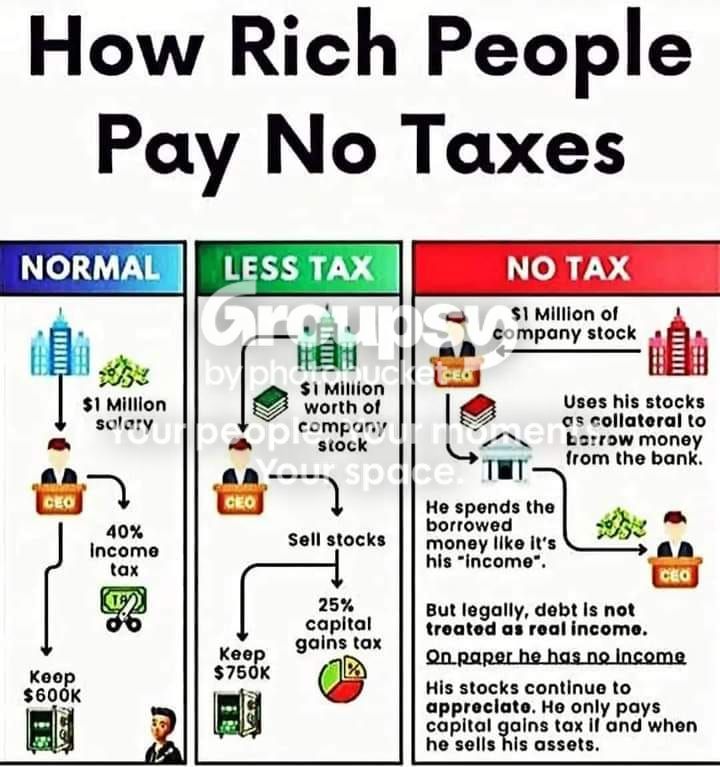

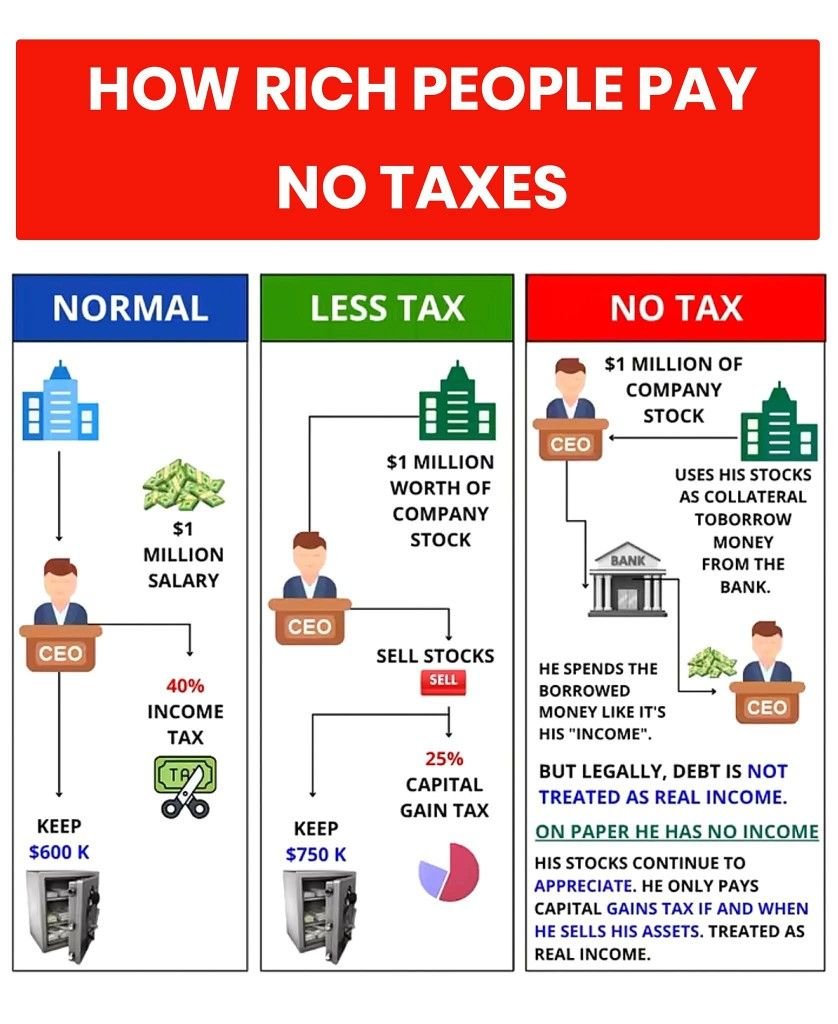

What i have never understood with the no tax transaction is how the banks are making money in that no tax scenario???

What you mean? They collect on the interest rate to borrow. They can give them lower rates because the amount is so high. Rich person borrows 2 million to live on at a 1-5% rate . The bank is making more than when they lend lower amounts to regular people at higher rates . They know that rich person won’t default but just in case they come up even bigger.What i have never understood with the no tax transaction is how the banks are making money in that no tax scenario???


Yeah, I guess they assume the "rich person" won't default.What you mean? They collect on the interest rate to borrow. They can give them lower rates because the amount is so high. Rich person borrows 2 million to live on at a 1-5% rate . The bank is making more than when they lend lower amounts to regular people at higher rates . They know that rich person won’t default but just in case they come up even bigger.

New York Times: President Trump had $270M in debt forgiven after failing to repay lenders for Trump Tower Chicago, tax records show
He's had debt forgiven since 2010 after he didn't repay his lenders for a Chicago skyscraper development, the NY Times reported.
Last edited:

It's funny that when regular folks get tax breaks they will turn around and spend that money. When corporations/rich people get tax breaks, they find more ways to horde it.The main question is this: Should the tax system mainly encourage investment and stimulate economic growth?
Money collection is a game . They are scum for the most part. Trading places showed how these worthless people behave , they think money makes them better than everyone .It's funny that when regular folks get tax breaks they will turn around and spend that money. When corporations/rich people get tax breaks, they find more ways to horde it.
also the tax preparation industry goes through extremes to make it harder and more expensive to file taxes.News Flash: u.s. tax code was/is written by lawyers/lawmakers who rep. the elite...not us..


Inside TurboTax’s 20-Year Fight to Stop Americans From Filing Their Taxes for Free
Using lobbying, the revolving door and “dark pattern” customer tricks, Intuit fended off the government’s attempts to make tax filing free and easy, and created its multi-billion-dollar franchise.
 www.propublica.org

Exactly...they run the system so they set it up to benefit them and their class...they dont have any special tax smartsNews Flash: u.s. tax code was/is written by lawyers/lawmakers who rep. the elite...not us..
So are they paying the interest with the money they just borrowed?What you mean? They collect on the interest rate to borrow. They can give them lower rates because the amount is so high. Rich person borrows 2 million to live on at a 1-5% rate . The bank is making more than when they lend lower amounts to regular people at higher rates . They know that rich person won’t default but just in case they come up even bigger.
I think he means how then does the person get liquid to spend. I think it's like this: The loan is not personal but business, it's repaid through the companies profits but you can also buy stuff through said company and it become a business liability (depreciable, deductible on that business' taxes).What you mean? They collect on the interest rate to borrow. They can give them lower rates because the amount is so high. Rich person borrows 2 million to live on at a 1-5% rate . The bank is making more than when they lend lower amounts to regular people at higher rates . They know that rich person won’t default but just in case they come up even bigger.
Income tax is the example, goes to the feds. Property and sales tax goes local: state, city, etc. They work out ways to get that down too. Property taxes are getting paid but they also influencing how much you also have to spend bc values and zoning.I never understood the unrealized gains argument since homeowners have to pay property taxes.

So how do they pay back the loans.....?
Does he just keep getting loans borrowed against his projected net worth?
Actual money has to come into play at some point.
I think he means how then does the person get liquid to spend. I think it's like this: The loan is not personal but business, it's repaid through the companies profits but you can also buy stuff through said company and it become a business liability (depreciable, deductible on that business' taxes).
Interesting

So how do they pay back the loans.....?
Does he just keep getting loans borrowed against his projected net worth?
Actual money has to come into play at some point.
- Their wealth is mostly not cash
Someone like Elon Musk or Jeff Bezos may be “worth” billions because they own stock, not because they have billions sitting in a checking account. - They borrow against those assets
A bank sees someone with billions in stock as extremely low risk. So the bank may lend them $50 million using stock shares as collateral. - They use the loan for living expenses
Loans are not considered income, so they generally are not taxed like salary or capital gains. - How do they repay the loan?
This is the key part: eventually, real money does have to come in somewhere.
selling some stock
dividends
business income
refinancing with new loans
asset appreciation
A common pattern is:
assets go up in value
the person takes a new, larger loan
part of the new loan pays off the old one
they still keep most of their assets
So in practice, some ultra-wealthy people can roll debt forward for decades as long as their assets keep growing faster than the debt.

Wow
Ok,Usually it happens through:
selling some stock
dividends
business income
refinancing with new loans
asset appreciation
A common pattern is:
assets go up in value
the person takes a new, larger loan
part of the new loan pays off the old one
they still keep most of their assets
So in practice, some ultra-wealthy people can roll debt forward for decades as long as their assets keep growing faster than the debt.
So for the average person, when you take out a loan a payment is needed every 30 days.... so how much do you pay back on $50M?
Since I like to see real world numbers and examples
So I asked Claud about it,
Basically they aren't repaying anything towards the principal amount. They only repay the interest on the loan and the repayment period is usually 3 -5 years, but can be indefinite if they choose to refinance or borrow more against a growing portfolio.
I.e. if my portfolio is worth $100 M, i borrow a safe $25 M against it. At that point i may be paying back around $160K/month. ($160K X 36 months = $5.76 M. $5.76M is less than 25% of the total $25M, the business barrowed!!!)...But lets say after 3 years my portfolio is now worth $250M ai can then go back and borrow an additional $100 M if I wanted, for a total of now $125 M against $250 M......
I'm still only paying back the interest. I can use the new money to grow more wealth and reinvest in my companies....... there's no income tax or capital gains tax. Essentially, "I" pay no taxes. And anything I buy with the money becomes the business's liability.......
Man, this shit is wild. John Hope Bryant is right, WE NEED TO BE DOING THIS!!
You can even borrow against a life insurance policy. Spend your 20's building up a policy and then borrow against it to make some big purchases or start businesses and then have the business take out loans to grow it even faster.....lord, rinse and repeat.
Similar threads

- Replies
- 5
- Views
- 108

- Replies
- 4
- Views
- 121


- Replies
- 3
- Views
- 124


- Replies
- 61
- Views
- 1K

