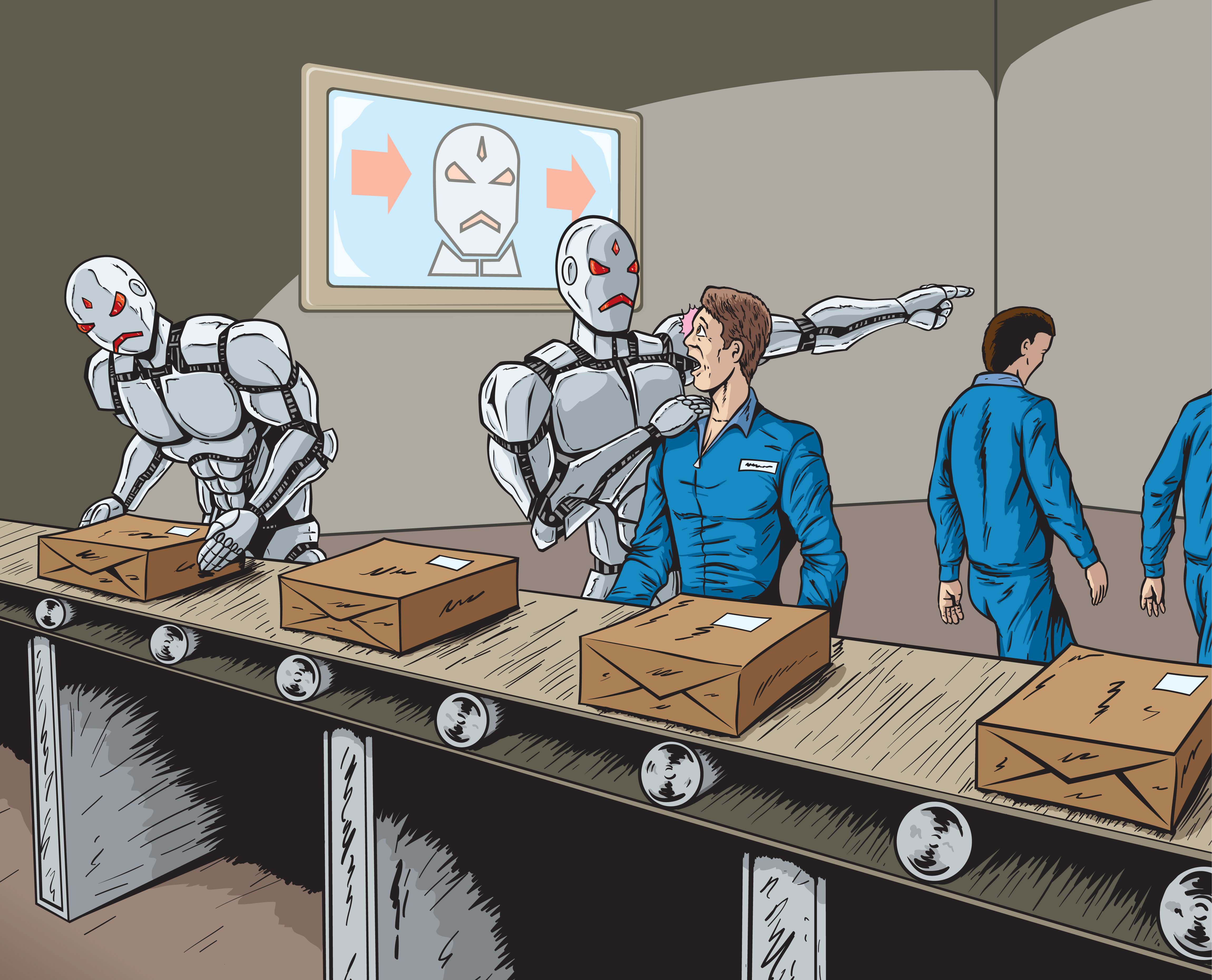
The US is headed for mass unemployment, and no one is prepared
BY JOHN MAC GHLIONN
OPINION CONTRIBUTOR
01/30/26
Universal Basic Income (UBI) is no longer a liberal fantasy, but a necessity to prevent social fracture and buy time as AI continues to replace jobs faster than institutions can adapt.
thehill.com
For years, I opposed Universal Basic Income, firmly and reflexively. I treated it as a liberal fantasy — an invitation to idleness, a subsidy for stagnation, a sedative administered by a bloated state. Work, I believed, wasn’t merely how societies functioned but how men and women found meaning. Pay people for nothing, and you dissolve discipline. That was the story. I told it often.
That position no longer survives contact with reality.
Something fundamental has shifted, and pretending otherwise is nothing short of denial. The AI revolution is here, and it’s gutting entire sectors with hurricane force. This isn’t an industrial transition, nor a replay of mechanization or globalization. It is a technological rupture of a different magnitude. Machines replacing not only muscle but cognition itself: judgment, pattern recognition, reasoning. And it’s advancing at a pace that outstrips legislation, labor markets, and political capacity, moving faster than most in government are willing to admit.
The most sobering warning comes from Geoffrey Hinton, one of the architects of modern AI. Hinton hasn’t joined the hype merchants. Instead, he has joined the alarmists. His claim is troubling: AI capability is effectively doubling every seven months. Not every decade. Not every few years. Every seven months.
At that pace, change doesn’t arrive gradually but in overwhelming waves. First, it replaces what we dismiss as “menial” cognitive work — call centers, customer service, scheduling, transcription. That phase is already underway. Then it moves into clerical roles, basic accounting, paralegal research, routine journalism, marketing copy, and compliance work. Those jobs are next. After that, no profession is spared, not even software engineering itself.
Hinton insists that within a few years, AI systems will complete monthlong programming projects in hours. When that happens, junior developers will be removed rather than retrained. Teams will shrink. Entire layers will vanish. If the people who build the systems can be replaced by the systems, then no white-collar profession should feel insulated.
Lay out the timeline honestly, and it becomes terrifying. In 2026, AI replaces support roles. In 2027, it consumes administrative and clerical work. By 2028, it’s performing serious professional tasks at scale. By the early 2030s, much of white-collar America may no longer be necessary to the current economic structure.
This brings us to the politically radioactive part: The United States has no plan. None. No labor transition strategy. No reskilling conveyor belt capable of operating at this speed. No serious public conversation about income decoupled from employment. Just vague chatter about “innovation,” paired with the familiar promise that new jobs will somehow appear, as they always have.
We must dispense with the dangerous fiction and start facing the brutal reality.
A society where tens of millions are unemployable is not a sign of free-market success but a powder keg. You can’t preach personal responsibility to a population for whom responsibility has been rendered economically irrelevant. You can’t defend social order while ignoring the conditions that make order possible.
Universal basic income, viewed through this lens, stops looking like a left-wing indulgence and starts looking like a stability mechanism.
That doesn’t mean unconditional generosity or bureaucratic bloat. The conservative case for universal basic income is about preventing social fracture while preserving incentives to contribute, where contribution is still possible. It is about replacing a maze of failing welfare programs with something simple, transparent and limited.
Most importantly, it’s about buying time.
Universal basic income is not an end state but a bridge. A way to prevent mass dislocation while society renegotiates the relationship between work, dignity and income as the 9-to-5 day fades away.
I say this reluctantly, but honestly. Before AI, my opposition to universal basic income was rooted in a world that no longer exists. I assumed work would always be available for those willing to do it. That assumption is now obsolete. Not because people are lazy, but because machines are becoming capable faster than institutions can adapt.
The most dangerous response is to pretend this is a liberal argument, detached from objective reality. It is not. The social consequences of mass displacement — crime, despair, radicalization, resentment — spread. They destabilize everything conservatives claim to want to conserve.
We are approaching a moment where the question is no longer whether AI will replace jobs, but how a democratic society survives when it does. That conversation needs to begin now, while there is still time to shape policy deliberately rather than in panic. The country is already near a breaking point, marked by diminishing trust in institutions, the presidency and even one another. Some will argue that things could improve. They might, but it’s increasingly unlikely. For that reason, waiting is a luxury the country no longer has.
British-Canadian computer scientist and cognitive psychologist, Geoffrey Hinton




 carboncredits.com