The Story Behind Bucky’s Groundbreaking Comic-Book Reinvention As the Winter Soldier
Superheroes are generally a static bunch. A character gets introduced, a little bit of tweaking might occur in early stories, and once it’s a hit, it gets frozen in amber. Spider-Man is always wise-cracking and angst-filled Peter Parker, Wolverine is always a grizzled brawler with a tragic past, and so on. Superman may have “died” in 1992, but he soared up from the grave within a few months. Bruce Wayne was replaced as Batman in 2008, only to take up the cape and cowl again in a few years. There’s an old saying in the comics industry, often attributed to former Marvel chief Stan Lee:Readers don’t want change; they only want the illusion of change.
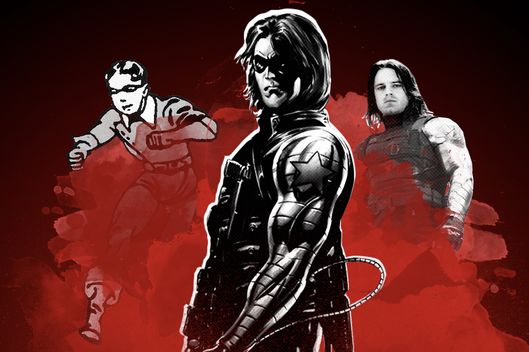
But one character, by his very existence, reveals the folly of that mind-set. Bucky Barnes, now known in print and onscreen as the Winter Soldier, was first introduced in 1941 as Captain America’s plucky teen sidekick. Since that time he's undergone not one but two enormous changes, both of which fundamentally altered the Marvel universe’s status quo. First, he was killed off in 1964 and actually stayed dead — for four decades, at least. Then, in 2004, he was brought back in a thrilling comics story line and given the nom de guerre “Winter Soldier.” The resurrected version of the character abandoned his boyish roots, instead taking on a tragic narrative cooked up by a tiny cabal of nervous creators and editors. The story was a surprise hit, and this new vision of Bucky became the one seen in 2014’sCaptain America: The Winter Soldier and now Captain America: Civil War. In a world where film has usurped comics as the medium of record for superhero fiction, Bucky's reinterpretation has not only succeeded — it has become gospel.
Given that Civil War’s other stars are all characters that ossified soon after their own births, Bucky’s reinvention is no small feat. The Winter Soldier has resonated with people because his archetype is a heady brew of mental-health struggles, classic espionage tropes, America’s poor treatment of veterans, an attempt to reckon with the violence of superhero comics, and male bonding so powerful that it’s regularly read as homoerotic. The tale of Bucky and the comics story that changed him is one that shows superhero fiction’s unique power to play around with characters created far in the past, and demonstrates how gratifying — and profitable — it can be to come up with one little idea that takes a hard left turn away from orthodoxy.
***
Ironically, Bucky’s creation three-quarters of a century ago was all about orthodoxy. In 1941, three years after the first superhero comic was published, two pioneers of the nascent medium, Joe Simon and Jack Kirby, were cooking up a new crime-fighter: Captain America. He was intended to be an expression of national wish-fulfillment: In a time of American dread about the possibility of entering the morass in Europe, he would leap into the fray and clobber Hitler before the madman could threaten our shores. But triumph in war was one thing; triumph in the marketplace was another. To make it big, Cap would need something that was all the rage: a kid sidekick.
Such characters were a useful invention for an array of reasons. “Superhero comics were seen as having an audience of kids,” says Peter Sanderson, comics historian and former Marvel writer. “So the idea was,Let’s give the kids someone to identify with.” The first hit sidekick was Robin, the young ward of Batman, who leapt into action in 1940. The boy wonder sparked an immediate craze. “It helps humanize the adult superhero due to the fact that he gets along with a kid,” Sanderson adds. “And you have a story device that means you don’t need captions to explain what the hero is doing. He can explain it all to his sidekick.”
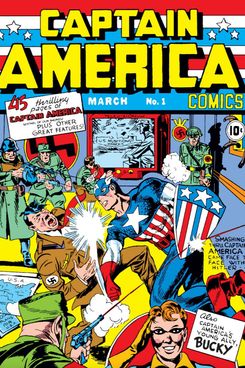 fifth columnists. Bucky was relentlessly optimistic, only pushing back against his older-brother figure when he felt condescended to. “Think you can handle a man’s job … Bucky, m’lad?” Steve asks in one story. “Sure I can — what do you think I am — a baby?” is the kid’s reply. The comics were runaway hits for their publisher, Timely. But the first superhero bubble popped after the end of the war. Other genres usurped it: crime fiction, Westerns, and horror. Sales of Captain America’s series declined. As a triage measure in the late '40s, the publisher experimented with targeting young women and, as such, sidelined Bucky in favor of new Cap sidekick Golden Girl. Even she couldn’t get the job done. Captain America Comicsceased publication in 1949.
There was an extremely short-lived attempt to revive Cap and Bucky as anti-communist crusaders in 1954, but it, too, failed to find an audience. Bucky and his beloved mentor were unceremoniously tossed on the trash heap of pulp history. Then, a decade later, something remarkable happened: In the early 1960s, writer/editor Stan Lee and writer/artist Jack Kirby (back at the company after an exile) relaunched Timely as Marvel Comics, with the goal of completely reimagining what superheroes could be. As part of that process, they eventually turned their focus toward Captain America — and Lee didn't like what he saw by Cap's side.
“One of my many pet peeves has always been the young teenage sidekick of the average superhero,” Lee wrote in his 1974 book Origins of Marvel Comics. “Once again, if yours truly were a superhero there’s no way I’d pal around with some freckle-faced teenager. At the very least, people would start to talk.” In Lee’s mind, the only teens worth writing were ones who were powerful in their own right, with loner hero Spider-Man being the best example. When it came to Bucky, that philosophy had major consequences.
In 1963 Lee and Kirby launched The Avengers, a series that would bring together some of Marvel’s biggest characters to tackle the world’s most serious threats. Issue four featured a startling cover image: Captain America leaping into battle alongside the previously introduced Avengers. The first page read, “BRINGING YOU THE GREAT SUPER HERO WHICH YOUR WONDERFUL AVALANCHE OF FAN MAIL DEMANDED.”
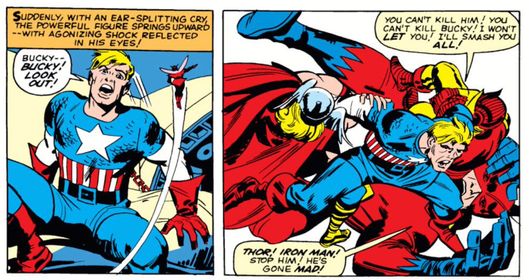
Sure enough, the book revealed that Cap was back — and, improbably, just as youthful as he’d always been. In the story he's found trapped in ice in the North Atlantic, and, upon thawing out and waking up in front of the heroes, he jolts up and screams, “Bucky — Bucky! Look out!” But there’s no Bucky to be found. As we learn in a flashback, tragedy struck during the war: Bucky was blown up while trying to stop a booby-trapped plane in midair, and Cap — attempting to save him — fell into the frigid water, where he froze in suspended animation, only to later wake up in a world where his best chum was long gone.
 first installment in a series of pamphlets called The American Crisis. In it, he decried the “summer soldier” who “will, in this crisis, shrink from the service of their country.” Two centuries later, Vietnam Veterans Against the War referenced Paine when they staged a 1971 event called the Winter Soldier Investigation, during which they drew attention to the immorality of America’s actions in Southeast Asia. A young John Kerry spoke there, giving an incendiary testimony about what America was doing to its drafted men. “The country doesn't know it yet, but it has created a monster,” he said. “A monster in the form of millions of men who have been taught to deal and to trade in violence … men who have returned with a sense of anger and a sense of betrayal which no one has yet grasped.”
This sentiment would lie at the core of what Brubaker was going to try to talk about with Bucky. “It's just one of those names that, the second I wrote it down, I didn't have any alternates,” Brubaker recalls.
The resulting story, launched on November 17, 2004, was a cracking espionage yarn. In the first few issues of Brubaker and Epting’s run onCaptain America, a string of mysterious murders and attacks start occurring, all tied in one way or another to Cap. A government agent theorizes they might all be coming from a Cold War–era Russian assassin only known as the Winter Soldier. Meanwhile, Cap reminisces about World War II, and his reveries include a shocking revelation about Bucky: Although the boy was held up to the public as a symbol of youthful pride in America, he was secretly sent out to viciously execute enemy soldiers as an advance scout during attacks. He was a weapon as much as he was a mascot.
Brubaker — the son of a soldier — made that storytelling choice as a corrective to the sanitized version of the war that so often appears in superhero comics. “I wanted to take World War II seriously,” he says. “If this guy fought in World War II, what good would he have been if he wouldn't actually do the same things that any other soldier had to do?”
Then came May 25, 2005, the day when issue No. 6 would reveal the Winter Soldier's identity. “I was terrified that that was going to be the end of my career,” Brubaker recalls. “My fear was that people would think we'd jumped the shark or something.” It wasn’t an unreasonable fear. Previous status-quo-shaking comics events had marred sales and reputations — for example, there was a widely mocked '90s tale about Spider-Man being revealed as a clone, and none of its creators emerged with their names unsullied.
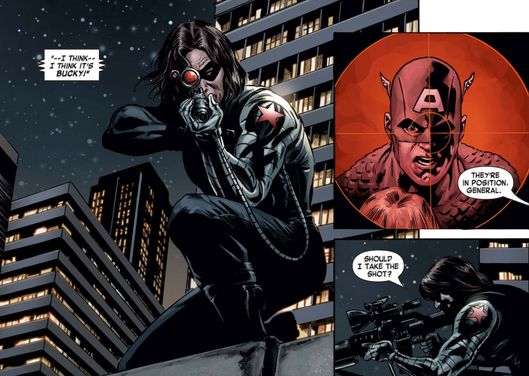
No. 6 hit stands, and, on page 17, readers got their first clear view of the Winter Soldier, his rifle trained at Captain America’s head. A friend of Cap’s who’d been captured by this mysterious figure tells our hero, “I think — I think it’s Bucky!” The man had long, brown hair — a request Brubaker says came from Quesada, who wanted to make it clear that Bucky wasn’t a kid anymore. He had a bionic arm with a Communist red star on it — Brubaker and Epting were tapping into the tradition of comic-book pseudoscience. And, lest we forget that he was still Bucky at his core, he had that classic little domino mask on. A reinvented icon had arrived.
 YouTube channel that remix footage of Bucky and Steve with emotional music behind them. “He seemed like a sharp, precise killer machine with no concept of mercy, so the reveal who he really is was a great moment. What really got to me, though, was the way Sebastian played him as scared, confused, and vulnerable after he encounters Steve.” (Enthusiasts have also built up a considerable bank of material dedicated to depicting a romance between Steve and Bucky, or “Stucky,” as the pair is known.)
The fandom will find a lot to enjoy in Civil War. Even though his name isn’t in the title, the Winter Soldier is a much more prominent character than in the previous Captain America outing. We see him on the run from the world’s governments, we see Cap turn against his colleagues in the Avengers in order to protect him, and we see him struggle with his past. Stan gives a performance that is by turns lethal and heartbreakingly tender. “I can’t trust my own mind,” he says at one point with a sad half-smile. If you’ve suffered a trauma and had to contend with the mental-health issues that follow, you’ll likely feel a pang of melancholic recognition.
But for historians of superhero fiction, the movie’s depiction of the Cap-Bucky relationship is perhaps most interesting on a metafictional level. This Captain America, played with Chris Evans’s usual charm and earnestness, is more or less the same Captain America who leapt into battle against the Third Reich 75 years ago. This Bucky, however, is wildly different from the one who leapt beside him all those decades ago. And yet, as you can see in Stan’s performance, that optimistic scrapper is somehow still a part of the character. Steve remembers his pal’s more innocent days and wants him to remember that he hasn’t lost all of his virtue. A lesser story would show them as rivals; this one shows them trying to rebuild a friendship, piece by piece.
That dynamic was baked into this new Bucky way back in 2004. Brubaker doesn’t work for Marvel anymore, opting instead to do acclaimed independent comics like The Fade Out and Velvet. But he looks back at those consequential comics with pride, as much for what they didn’t do as for what they did. “I didn't want to play it like a 'You never came looking for me, so I hate you' kind of thing,” he says. “I wanted it to feel more tragic than it being that they were two trains racing at each other. It wasn't a revenge story. It was a redemption story.” And it remains a story unlike any other that comics have told.
http://www.vulture.com/2016/05/bucky-winter-soldier-history.html
Superheroes are generally a static bunch. A character gets introduced, a little bit of tweaking might occur in early stories, and once it’s a hit, it gets frozen in amber. Spider-Man is always wise-cracking and angst-filled Peter Parker, Wolverine is always a grizzled brawler with a tragic past, and so on. Superman may have “died” in 1992, but he soared up from the grave within a few months. Bruce Wayne was replaced as Batman in 2008, only to take up the cape and cowl again in a few years. There’s an old saying in the comics industry, often attributed to former Marvel chief Stan Lee:Readers don’t want change; they only want the illusion of change.
But one character, by his very existence, reveals the folly of that mind-set. Bucky Barnes, now known in print and onscreen as the Winter Soldier, was first introduced in 1941 as Captain America’s plucky teen sidekick. Since that time he's undergone not one but two enormous changes, both of which fundamentally altered the Marvel universe’s status quo. First, he was killed off in 1964 and actually stayed dead — for four decades, at least. Then, in 2004, he was brought back in a thrilling comics story line and given the nom de guerre “Winter Soldier.” The resurrected version of the character abandoned his boyish roots, instead taking on a tragic narrative cooked up by a tiny cabal of nervous creators and editors. The story was a surprise hit, and this new vision of Bucky became the one seen in 2014’sCaptain America: The Winter Soldier and now Captain America: Civil War. In a world where film has usurped comics as the medium of record for superhero fiction, Bucky's reinterpretation has not only succeeded — it has become gospel.
Given that Civil War’s other stars are all characters that ossified soon after their own births, Bucky’s reinvention is no small feat. The Winter Soldier has resonated with people because his archetype is a heady brew of mental-health struggles, classic espionage tropes, America’s poor treatment of veterans, an attempt to reckon with the violence of superhero comics, and male bonding so powerful that it’s regularly read as homoerotic. The tale of Bucky and the comics story that changed him is one that shows superhero fiction’s unique power to play around with characters created far in the past, and demonstrates how gratifying — and profitable — it can be to come up with one little idea that takes a hard left turn away from orthodoxy.
***
Ironically, Bucky’s creation three-quarters of a century ago was all about orthodoxy. In 1941, three years after the first superhero comic was published, two pioneers of the nascent medium, Joe Simon and Jack Kirby, were cooking up a new crime-fighter: Captain America. He was intended to be an expression of national wish-fulfillment: In a time of American dread about the possibility of entering the morass in Europe, he would leap into the fray and clobber Hitler before the madman could threaten our shores. But triumph in war was one thing; triumph in the marketplace was another. To make it big, Cap would need something that was all the rage: a kid sidekick.
Such characters were a useful invention for an array of reasons. “Superhero comics were seen as having an audience of kids,” says Peter Sanderson, comics historian and former Marvel writer. “So the idea was,Let’s give the kids someone to identify with.” The first hit sidekick was Robin, the young ward of Batman, who leapt into action in 1940. The boy wonder sparked an immediate craze. “It helps humanize the adult superhero due to the fact that he gets along with a kid,” Sanderson adds. “And you have a story device that means you don’t need captions to explain what the hero is doing. He can explain it all to his sidekick.”
There was an extremely short-lived attempt to revive Cap and Bucky as anti-communist crusaders in 1954, but it, too, failed to find an audience. Bucky and his beloved mentor were unceremoniously tossed on the trash heap of pulp history. Then, a decade later, something remarkable happened: In the early 1960s, writer/editor Stan Lee and writer/artist Jack Kirby (back at the company after an exile) relaunched Timely as Marvel Comics, with the goal of completely reimagining what superheroes could be. As part of that process, they eventually turned their focus toward Captain America — and Lee didn't like what he saw by Cap's side.
“One of my many pet peeves has always been the young teenage sidekick of the average superhero,” Lee wrote in his 1974 book Origins of Marvel Comics. “Once again, if yours truly were a superhero there’s no way I’d pal around with some freckle-faced teenager. At the very least, people would start to talk.” In Lee’s mind, the only teens worth writing were ones who were powerful in their own right, with loner hero Spider-Man being the best example. When it came to Bucky, that philosophy had major consequences.
In 1963 Lee and Kirby launched The Avengers, a series that would bring together some of Marvel’s biggest characters to tackle the world’s most serious threats. Issue four featured a startling cover image: Captain America leaping into battle alongside the previously introduced Avengers. The first page read, “BRINGING YOU THE GREAT SUPER HERO WHICH YOUR WONDERFUL AVALANCHE OF FAN MAIL DEMANDED.”
Sure enough, the book revealed that Cap was back — and, improbably, just as youthful as he’d always been. In the story he's found trapped in ice in the North Atlantic, and, upon thawing out and waking up in front of the heroes, he jolts up and screams, “Bucky — Bucky! Look out!” But there’s no Bucky to be found. As we learn in a flashback, tragedy struck during the war: Bucky was blown up while trying to stop a booby-trapped plane in midair, and Cap — attempting to save him — fell into the frigid water, where he froze in suspended animation, only to later wake up in a world where his best chum was long gone.
This sentiment would lie at the core of what Brubaker was going to try to talk about with Bucky. “It's just one of those names that, the second I wrote it down, I didn't have any alternates,” Brubaker recalls.
The resulting story, launched on November 17, 2004, was a cracking espionage yarn. In the first few issues of Brubaker and Epting’s run onCaptain America, a string of mysterious murders and attacks start occurring, all tied in one way or another to Cap. A government agent theorizes they might all be coming from a Cold War–era Russian assassin only known as the Winter Soldier. Meanwhile, Cap reminisces about World War II, and his reveries include a shocking revelation about Bucky: Although the boy was held up to the public as a symbol of youthful pride in America, he was secretly sent out to viciously execute enemy soldiers as an advance scout during attacks. He was a weapon as much as he was a mascot.
Brubaker — the son of a soldier — made that storytelling choice as a corrective to the sanitized version of the war that so often appears in superhero comics. “I wanted to take World War II seriously,” he says. “If this guy fought in World War II, what good would he have been if he wouldn't actually do the same things that any other soldier had to do?”
Then came May 25, 2005, the day when issue No. 6 would reveal the Winter Soldier's identity. “I was terrified that that was going to be the end of my career,” Brubaker recalls. “My fear was that people would think we'd jumped the shark or something.” It wasn’t an unreasonable fear. Previous status-quo-shaking comics events had marred sales and reputations — for example, there was a widely mocked '90s tale about Spider-Man being revealed as a clone, and none of its creators emerged with their names unsullied.
No. 6 hit stands, and, on page 17, readers got their first clear view of the Winter Soldier, his rifle trained at Captain America’s head. A friend of Cap’s who’d been captured by this mysterious figure tells our hero, “I think — I think it’s Bucky!” The man had long, brown hair — a request Brubaker says came from Quesada, who wanted to make it clear that Bucky wasn’t a kid anymore. He had a bionic arm with a Communist red star on it — Brubaker and Epting were tapping into the tradition of comic-book pseudoscience. And, lest we forget that he was still Bucky at his core, he had that classic little domino mask on. A reinvented icon had arrived.
The fandom will find a lot to enjoy in Civil War. Even though his name isn’t in the title, the Winter Soldier is a much more prominent character than in the previous Captain America outing. We see him on the run from the world’s governments, we see Cap turn against his colleagues in the Avengers in order to protect him, and we see him struggle with his past. Stan gives a performance that is by turns lethal and heartbreakingly tender. “I can’t trust my own mind,” he says at one point with a sad half-smile. If you’ve suffered a trauma and had to contend with the mental-health issues that follow, you’ll likely feel a pang of melancholic recognition.
But for historians of superhero fiction, the movie’s depiction of the Cap-Bucky relationship is perhaps most interesting on a metafictional level. This Captain America, played with Chris Evans’s usual charm and earnestness, is more or less the same Captain America who leapt into battle against the Third Reich 75 years ago. This Bucky, however, is wildly different from the one who leapt beside him all those decades ago. And yet, as you can see in Stan’s performance, that optimistic scrapper is somehow still a part of the character. Steve remembers his pal’s more innocent days and wants him to remember that he hasn’t lost all of his virtue. A lesser story would show them as rivals; this one shows them trying to rebuild a friendship, piece by piece.
That dynamic was baked into this new Bucky way back in 2004. Brubaker doesn’t work for Marvel anymore, opting instead to do acclaimed independent comics like The Fade Out and Velvet. But he looks back at those consequential comics with pride, as much for what they didn’t do as for what they did. “I didn't want to play it like a 'You never came looking for me, so I hate you' kind of thing,” he says. “I wanted it to feel more tragic than it being that they were two trains racing at each other. It wasn't a revenge story. It was a redemption story.” And it remains a story unlike any other that comics have told.
http://www.vulture.com/2016/05/bucky-winter-soldier-history.html