

Trump putting 100% tariffs on $25B of European goods

Spectrum

Elite Poster
BGOL Investor
cnn.com/2019/09/07/politics/trade-war-europe-cheese-wine-trump/index.html

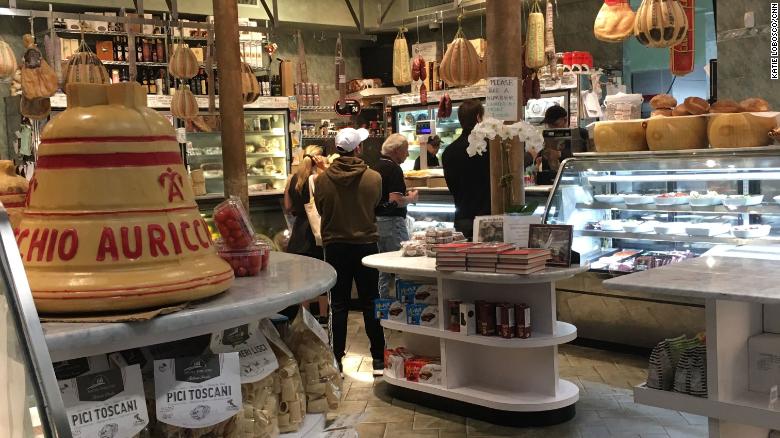
New York (CNN)The steady stream of customers walking into Di Palo's on a recent afternoon were greeted by giant cheese wheels, meat hanging from the ceiling and bottles of olive oil lined up on the shelves -- a century-old array that's at risk because of President Donald Trump's trade wars.

Most of the products sold at the 109-year-old specialty shop in Manhattan's Little Italy neighborhood are from the old country, and attract customers from all over. The store has lasted through two world wars and the Great Depression. But because of a Trump administration fight with the European Union, Di Palo's customers could soon be paying up to double the price, testing their loyalty.
The Trump administration has proposed a tariff of up to 100% on $25 billion in European items. Romano, Parmesan, provolone and Gouda are all on the list. But it's not just cheese. The tariff is proposed to hit a variety of items that pair well with cheese, as well -- like wines and meats, olive oil, olives and pasta.
While Trump's tariffs against China threaten to raise prices on an array of consumer goods, this lesser-known trade dispute has cheese lovers up in arms and cheese sellers like Lou Di Palo worried about how potential new tariffs could hurt sales.


Di Palo says the tariff could hit about 95% of the items his store sells, and he's skeptical that customers will pay double for everything. He plans to take a hit to his profit margins rather than raise prices to cover the cost of the tariff.
190905093133-02-di-palos-exlarge-169.jpg


Di Palo's in New York on September 2.
"Products that we sell are already kind of expensive. For instance, Parmigiano Reggiano and Grana Padano. These are cheeses that sell between $15 and $20 a pound. Could I get $30 and $40 a pound for this cheese? It's going to be very difficult," said Di Palo, who works behind the counter with his brother Sal and sister Marie at the store, which was opened by their great-grandfather.
The kicker for Di Palo and other importers is that the trade dispute has nothing to do with food. Instead, it's part of a 15-year-long issue over subsidies for aircraft makers Boeing and Airbus. Both the US and the EU have been found at fault -- and both are threatening tariffs on a wide range of other goods in retaliation. It's up to the World Trade Organization to determine the scope of allowable duties. A decision is expected sometime this month, and it has importers on the edge of their seats.
Di Palo worries that such high duties could make it difficult for his family business to survive.
"Could this be, excuse the expression, the straw that breaks the camel's back, and my children and my sister's children say it doesn't pay to be here anymore?" he said.
About 14,000 specialty food retailers, along with 20,000 other food retailers across the country, would be affected by the tariffs, according to the Specialty Food Association.
Food importers are worried, too. If sales go down, they'll be doing less business.
"100% duties would be really devastating. We're going to make these items so expensive and so unmarketable we won't import them anymore," said Tom Gellert, principal of the Gellert Global Group, which owns five US-based food importing companies and employs more than 500 workers across dozens of states.
190905104234-01-di-palos-exlarge-169.jpg


Di Palo's in New York on September 2.
If the tariffs are imposed, people like Gellert still don't know when they'll go into effect, and can't be sure what items will be hit or at what rate.
"The uncertainty alone is already frustrating. It's very difficult to budget when we don't know what the cost of our products is going to be," he added.
Supplies of olive oil could get low. The United States produces just about 5% of what Americans consume. A bipartisan group of lawmakers has already pleaded with the US Trade Representative's Office to reconsider imposing a tariff on the oil.
On the other hand, the tariffs may benefit American producers who make domestic versions of cheeses that are thought of as quintessentially Italian, like mozzarella and burrata.
But when it comes to the cheese-obsessed, the region where it's made and the cow's or goat's milk used make all the difference.
If the tariffs go into effect, Di Palo says, he may start selling more American-made cheese as an alternative to what will become a more expensive Italian product.
"I will tell you this," he said. "As long as the door of Di Palo's is open, it's going to maintain the traditions of my great-grandfather and grandparents. We are going to have the authentic products of Italy. The authentic wines of Italy, the authentic cheeses, oil, salumi. This is very important to us."
 
The key to all this is...

FOR CHINA NOT TO AGREE TO A DEAL!

Decoupling -- A term which means could be a Trump-China deal.

Interesting article. Basically - Decoupling - Companies that planned to build in China but now saying BS to the high tariff's coming from there. Are now having their products made somewhere else.

Thus, China looses out. And its a trend China doesn't like.

Tariffs are no longer China’s biggest problem in the trade war
Published Fri, Sep 6 2019 1:13 PM EDTUpdated Sat, Sep 7 2019 11:45 AM EDT

https://www.cnbc.com/2019/09/06/tariffs-are-no-longer-chinas-biggest-problem-in-the-trade-war.html
What a difference two weeks makes.

Two Fridays ago, pundits seemed to be beside themselves over what was the latest flare up in the U.S.-China trade war. President Trump raised tariffs in retaliation for China’s retaliatory tariffs, he called Fed Chairman Jerome Powell an “enemy,” and the Dow plummeted 623 points while the Nasdaq closed 3% lower.


Now it seems like trade deal optimism is back in the air. New formal talks between the U.S. and China have been announced for next month, and there are even high-level Chinese sources suggesting a breakthrough could occur at those meetings.

It doesn’t appear there’s anything the Trump administration has done to improve this sentiment. Right now, it’s the more encouraging news and messaging from China that’s the cause of that optimism.

But what forced this sudden change in the rhetoric from Beijing?

It’s not the new round of tariffs that went into effect; we’ve been playing the tit-for-tat tariff war for more than a year. It’s not the economic reports; they’ve been a little too mixed lately to force any dramatic moves. It’s not even the decision by Hong Kong administrator Carrie Lam to fully withdraw the controversial mainland extradition bill; it’s still not clear that the Hong Kong unrest would be affected in any way by a trade deal.

Given the timing of the change in tone, it seems more likely that what’s making the difference is a realization on both sides that there’s another way this trade war could end – and that possible ending is one the U.S. is very unlikely to lose.


That alternate ending is summed up in one word: decoupling.

The decoupling push is quite different than any U.S. efforts to get China to open up more of its economy to American companies. Instead, it focuses on reducing America’s extremely heavy reliance on China for so much of its manufacturing needs.

Even if China’s economy weren’t so closed off to so many American goods and services, a strong argument has long been made that the U.S. needs to diversify its sources for imports. While finding those new sources wouldn’t necessarily do anything to dent America’s trade imbalances, it would reduce the risks of a major disruption to the U.S. economy based on disputes or other problems connected to a single foreign country.

So what happened between Aug. 23 and this week’s trade optimism-fueled rally?

Thanks to some major news about Google, the world got its clearest notice yet that U.S.-China decoupling has gone from just a theory to something that’s really happening.
Just five days after that trade war flare up, the Nikkei business daily reported on Aug. 28 that Google is shifting its Pixel smartphone production to Vietnam from China starting this year and that the company is also looking to shift some of its smart home speaker assembly to Thailand.

It’s not that Google is the first U.S.-based company to announce some shift away from China; more than 50 other big names have moved out or scaled back. But the timing of Google’s reported plans and how they seem to have affected Beijing can’t be ignored.

It’s important to note that decoupling, even if the trend continues, isn’t necessarily a bullish force for the U.S. economy. It doesn’t mean there will be any increase in American jobs, as the expected Google moves to Vietnam and Thailand make clear. The tariffs on Chinese goodsare also not making America richer or directly growing our economy, no matter what the White House says.

Decoupling is best understood as a national security benefit, as opposed to an economic stimulus.

For China, further decoupling has to be a terrifying scenario. The U.S. remains the world’s number one consumer market, and America is now clearly looking to shop around. Beijing needs to come up with some kind of offer to slow this trend either at the trade negotiating table or in some kind of arrangement with the U.S. manufacturers that are still in China.

Meanwhile, the benefits of American trade diversification and continued U.S. economic strength are giving the Trump administration the gift of time. This is the opposite of the conventional wisdom that China and president-for-life Xi Jingping have the advantage of waiting out President Trump, who supposedly needs a trade deal sometime before next year’s elections. It’s also quite different from the notion that the U.S. needs to “win” the trade war by getting major Chinese protectionist barriers removed.

In the end, simply looking out for U.S. security concerns above immediate economic benefits might have been the point of this trade war all along.
 
cnn.com/2019/09/07/politics/trade-war-europe-cheese-wine-trump/index.html

New York (CNN)The steady stream of customers walking into Di Palo's on a recent afternoon were greeted by giant cheese wheels, meat hanging from the ceiling and bottles of olive oil lined up on the shelves -- a century-old array that's at risk because of President Donald Trump's trade wars.

Most of the products sold at the 109-year-old specialty shop in Manhattan's Little Italy neighborhood are from the old country, and attract customers from all over. The store has lasted through two world wars and the Great Depression. But because of a Trump administration fight with the European Union, Di Palo's customers could soon be paying up to double the price, testing their loyalty.
The Trump administration has proposed a tariff of up to 100% on $25 billion in European items. Romano, Parmesan, provolone and Gouda are all on the list. But it's not just cheese. The tariff is proposed to hit a variety of items that pair well with cheese, as well -- like wines and meats, olive oil, olives and pasta.
While Trump's tariffs against China threaten to raise prices on an array of consumer goods, this lesser-known trade dispute has cheese lovers up in arms and cheese sellers like Lou Di Palo worried about how potential new tariffs could hurt sales.


Di Palo says the tariff could hit about 95% of the items his store sells, and he's skeptical that customers will pay double for everything. He plans to take a hit to his profit margins rather than raise prices to cover the cost of the tariff.
190905093133-02-di-palos-exlarge-169.jpg


Di Palo's in New York on September 2.
"Products that we sell are already kind of expensive. For instance, Parmigiano Reggiano and Grana Padano. These are cheeses that sell between $15 and $20 a pound. Could I get $30 and $40 a pound for this cheese? It's going to be very difficult," said Di Palo, who works behind the counter with his brother Sal and sister Marie at the store, which was opened by their great-grandfather.
The kicker for Di Palo and other importers is that the trade dispute has nothing to do with food. Instead, it's part of a 15-year-long issue over subsidies for aircraft makers Boeing and Airbus. Both the US and the EU have been found at fault -- and both are threatening tariffs on a wide range of other goods in retaliation. It's up to the World Trade Organization to determine the scope of allowable duties. A decision is expected sometime this month, and it has importers on the edge of their seats.
Di Palo worries that such high duties could make it difficult for his family business to survive.
"Could this be, excuse the expression, the straw that breaks the camel's back, and my children and my sister's children say it doesn't pay to be here anymore?" he said.
About 14,000 specialty food retailers, along with 20,000 other food retailers across the country, would be affected by the tariffs, according to the Specialty Food Association.
Food importers are worried, too. If sales go down, they'll be doing less business.
"100% duties would be really devastating. We're going to make these items so expensive and so unmarketable we won't import them anymore," said Tom Gellert, principal of the Gellert Global Group, which owns five US-based food importing companies and employs more than 500 workers across dozens of states.
190905104234-01-di-palos-exlarge-169.jpg


Di Palo's in New York on September 2.
If the tariffs are imposed, people like Gellert still don't know when they'll go into effect, and can't be sure what items will be hit or at what rate.
"The uncertainty alone is already frustrating. It's very difficult to budget when we don't know what the cost of our products is going to be," he added.
Supplies of olive oil could get low. The United States produces just about 5% of what Americans consume. A bipartisan group of lawmakers has already pleaded with the US Trade Representative's Office to reconsider imposing a tariff on the oil.
On the other hand, the tariffs may benefit American producers who make domestic versions of cheeses that are thought of as quintessentially Italian, like mozzarella and burrata.
But when it comes to the cheese-obsessed, the region where it's made and the cow's or goat's milk used make all the difference.
If the tariffs go into effect, Di Palo says, he may start selling more American-made cheese as an alternative to what will become a more expensive Italian product.
"I will tell you this," he said. "As long as the door of Di Palo's is open, it's going to maintain the traditions of my great-grandfather and grandparents. We are going to have the authentic products of Italy. The authentic wines of Italy, the authentic cheeses, oil, salumi. This is very important to us."

The media need to stop saying the word Tariffs and starting saying the word TAX... Trump is putting a tax on the american consumer...
 
I wonder how this will affect pizza and Italian restaurants. Not to mention grocery stores in general.
 
This the party of free trade. :roflmao: This the shit people like Kasich were talking about a few years ago. No one listened.
 
Decoupling -- A term which means could be a Trump-China deal.

Interesting article. Basically - Decoupling - Companies that planned to build in China but now saying BS to the high tariff's coming from there. Are now having their products made somewhere else.

Thus, China looses out. And its a trend China doesn't like.

Tariffs are no longer China’s biggest problem in the trade war
Published Fri, Sep 6 2019 1:13 PM EDTUpdated Sat, Sep 7 2019 11:45 AM EDT

https://www.cnbc.com/2019/09/06/tariffs-are-no-longer-chinas-biggest-problem-in-the-trade-war.html
What a difference two weeks makes.

Two Fridays ago, pundits seemed to be beside themselves over what was the latest flare up in the U.S.-China trade war. President Trump raised tariffs in retaliation for China’s retaliatory tariffs, he called Fed Chairman Jerome Powell an “enemy,” and the Dow plummeted 623 points while the Nasdaq closed 3% lower.


Now it seems like trade deal optimism is back in the air. New formal talks between the U.S. and China have been announced for next month, and there are even high-level Chinese sources suggesting a breakthrough could occur at those meetings.

It doesn’t appear there’s anything the Trump administration has done to improve this sentiment. Right now, it’s the more encouraging news and messaging from China that’s the cause of that optimism.

But what forced this sudden change in the rhetoric from Beijing?

It’s not the new round of tariffs that went into effect; we’ve been playing the tit-for-tat tariff war for more than a year. It’s not the economic reports; they’ve been a little too mixed lately to force any dramatic moves. It’s not even the decision by Hong Kong administrator Carrie Lam to fully withdraw the controversial mainland extradition bill; it’s still not clear that the Hong Kong unrest would be affected in any way by a trade deal.

Given the timing of the change in tone, it seems more likely that what’s making the difference is a realization on both sides that there’s another way this trade war could end – and that possible ending is one the U.S. is very unlikely to lose.


That alternate ending is summed up in one word: decoupling.

The decoupling push is quite different than any U.S. efforts to get China to open up more of its economy to American companies. Instead, it focuses on reducing America’s extremely heavy reliance on China for so much of its manufacturing needs.

Even if China’s economy weren’t so closed off to so many American goods and services, a strong argument has long been made that the U.S. needs to diversify its sources for imports. While finding those new sources wouldn’t necessarily do anything to dent America’s trade imbalances, it would reduce the risks of a major disruption to the U.S. economy based on disputes or other problems connected to a single foreign country.

So what happened between Aug. 23 and this week’s trade optimism-fueled rally?

Thanks to some major news about Google, the world got its clearest notice yet that U.S.-China decoupling has gone from just a theory to something that’s really happening.
Just five days after that trade war flare up, the Nikkei business daily reported on Aug. 28 that Google is shifting its Pixel smartphone production to Vietnam from China starting this year and that the company is also looking to shift some of its smart home speaker assembly to Thailand.

It’s not that Google is the first U.S.-based company to announce some shift away from China; more than 50 other big names have moved out or scaled back. But the timing of Google’s reported plans and how they seem to have affected Beijing can’t be ignored.

It’s important to note that decoupling, even if the trend continues, isn’t necessarily a bullish force for the U.S. economy. It doesn’t mean there will be any increase in American jobs, as the expected Google moves to Vietnam and Thailand make clear. The tariffs on Chinese goodsare also not making America richer or directly growing our economy, no matter what the White House says.

Decoupling is best understood as a national security benefit, as opposed to an economic stimulus.

For China, further decoupling has to be a terrifying scenario. The U.S. remains the world’s number one consumer market, and America is now clearly looking to shop around. Beijing needs to come up with some kind of offer to slow this trend either at the trade negotiating table or in some kind of arrangement with the U.S. manufacturers that are still in China.

Meanwhile, the benefits of American trade diversification and continued U.S. economic strength are giving the Trump administration the gift of time. This is the opposite of the conventional wisdom that China and president-for-life Xi Jingping have the advantage of waiting out President Trump, who supposedly needs a trade deal sometime before next year’s elections. It’s also quite different from the notion that the U.S. needs to “win” the trade war by getting major Chinese protectionist barriers removed.

In the end, simply looking out for U.S. security concerns above immediate economic benefits might have been the point of this trade war all along.


China is selling just as much as they're making!
 
Tariffs on European allies, like they are not going to retaliate??? I'm convinced Trump is Putin's bitch. :hmm:
 
  • Like
Reactions: BDR
Back
Top