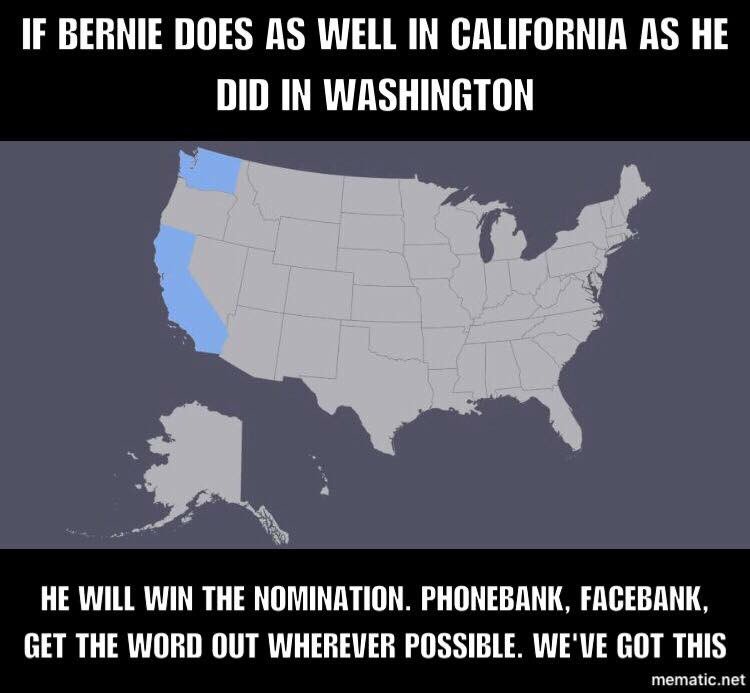
Bernie Sanders Is Currently Winning the Democratic Primary Race, and I’ll Prove It to You

CeokuGQWEAAAnwS.jpg:large
 
2016-03-29-1459283519-5047488-20160313145788902477610053bbc0deb7166da4cthumb.JPG

http://www.huffingtonpost.com/seth-...bernie-sanders-for-a-month-now_b_9567212.html

The Democratic primary race changed fundamentally — indeed, radically — after March 1st, and the national media’s failure to register this and work it into their polling, projections, and punditry is one of the most wide-ranging, public, and ultimately influential journalistic failures of the last decade. In short, it’s the reason supporters of Bernie Sanders have been tearing their hair out reading national media coverage that reports, and glibly, that the Democratic primary race is effectively over.

So let’s expose that radical sea-change with some hard-data analysis, and thereby, for the first time, circumscribe the effects of the media’s failure to catch it.

In the first month of the current, five-and-a-half month Democratic primary season, Hillary Clinton scored 60 percent of the available delegates — 59.8 percent, to be exact.

Since then, Clinton has edged Sanders in the delegate hunt by a mere 2.2 percent — 51.1 percent to 48.9 percent.

For the sake of brevity, let’s say that it’s been a 51 percent to 49 percent race since March 1st.

If the rather conservative projections for the upcoming Wisconsin and Wyoming votes turn out to be correct, that post-March 1st Clinton lead will narrow to 50.5 percent to 49.5 percent — a one percent differential — heading into the big primary in New York on April 19th. If Sanders over-performs in these two pre-New York votes to any degree — keeping in mind that in Alaska, Hawaii, and Washington he out-performed projections by between 40 and 50 points — he will pull ahead in the post-March 1st delegate count.

But let’s stay in the present.

Sanders is presently at 92 percent of his delegate target — the number of delegates he needs to be “on course” to win the pledged delegate battle.

Since March 1st, Sanders has exceeded his delegate targets in Kansas, Nebraska, Maine, Michigan, Illinois, Missouri, Idaho, Utah, Alaska, Hawaii, Washington, and the Democrats Abroad primary.

In five more contests — Louisiana, North Carolina, Arizona, Ohio, and the Northern Marianas — Sanders missed his target by a combined 28 delegates. That’s an average miss of 5.6 delegates in these five contests, all of which were heralded as massive wins for Hillary Clinton.

(As a reminder, 2,026 pledged delegates are needed to win the pledged-delegate battle.)

Only two states have really hurt Sanders over the last month: Florida and Mississippi. Indeed, not just the entirety but far more than the entirety of Clinton’s fractional delegate lead on Sanders since March 1st came from just those two contests. Since March 1st, Clinton has accrued 29 more delegates than Sanders — out of 1,283 total delegates awarded during this month-long span — and Clinton netted 34 delegates on Sanders in Florida and Mississippi alone.

But most of those net gains for Clinton — 25 delegates, or 86 percent of her lead on Sanders since March 1st — came in Florida.

And here’s where things start to get interesting.

Per New York Times exit polling, 67 percent of Floridians decided which Democrat to vote for prior to February 15th — in other words, weeks before the race began to turn in Sanders’ favor, and before Sanders had made a substantial play for the state via live events and in-state ad buys.

Another 15 percent of Florida voters made up their minds sometime between February 15th and March 8th.

Of course, it wasn’t clear that the race had turned in Sanders’ favor until — at the very earliest — March 6th, the morning after Sanders won Kansas and Nebraska and came within a hair of meeting his delegate target in Louisiana.

So what percentage of Florida voters decided who to vote for after it was clear the Democratic primary was shifting dramatically in Sanders’ favor?

18 percent, according to the exit polls.

And how did those 18 percent vote in the Florida Democratic primary?

Well, let’s put it this way:


  1. Clinton won among the 82 percent who made up their minds on March 7th or before by a count of 68 percent to 32 percent — a 36-point edge.
  2. Clinton won the overall Florida primary vote by more than 31 points.
  3. Among those Florida voters who decided who to vote for in the final week before Election Day, Clinton won by just 13.4 points — 56.7 percent to 43.3 percent.


Note that we’re not talking about older voters and younger voters here, or early voters versus Election Day voters, but simply the date on which voters made theirfinal assessment of the Clinton-Sanders race. While it’s true that early voting leads to an earlier final assessment of the candidates — and that for this reason “early voting isn’t good news for candidates [like Bernie Sanders] hoping to make a last-minute splash in the race” — that isn’t what I’m analyzing here. I’ve analyzed itelsewhere, however.

Let’s remember, in any case, that Florida is far and away the worst loss Sanders has suffered since March 1st, as a matter of delegate math.

But surely this is a fluke, you say! What happened in Mississippi, the other state that accounts for Clinton’s narrow (roughly two percent) delegate lead over Sanders since March 1st?

Well, unfortunately we don’t know — largely because Mississippi doesn’t (yet) do early voting, and held its vote just 48 hours after it became clear that the race was starting to go Sanders’ way.

According to CNN exit polls, however, it’s likely that well under 10 percent of Mississippi voters made their decision about who to vote for on March 6th, March 7th, or Election Day. So while we know that Hillary Clinton won Mississippi over Sanders by 66.1 points, and, from CNN exit polling, that that margin was more than 10 points tighter — 56 points — among Mississippians who decided who to vote forin the last week before Election Day, we don’t have a breakout for the 48-hour window before the votes were counted. This means that, while we know Sanders was beginning to close the gap as the final hours ticked away in what turned out to be one of his worst performances of the election season, we don’t know by how much. We know he reduced Clinton’s lead by at least 15 percent (10 of 66 points) among late-deciding voters, but if what happened in Florida also happened in Mississippi, the late-late-deciding voters — the ones who’d seen Sanders’ strong performance on March 5th — may well have been even more favorable to Sanders than that.

Certainly, we know that pre-election polling predicted that Hillary would win North Carolina by 24 points, and on Election Day she only beat Sanders 52 percent to 48 percent. We know that, in Arizona, early voting put Clinton up by more than 25 points, and she then lost Election Day voting 52 percent to 48 percent. We know that she was leading in Illinois by 42 points a week before Election Day there — according to polling — and ended up winning the state by 1.8 percent. We know she was predicted to win Ohio by 31 points, and indeed led in the month-long early voting there by more than 30 points, but won the final vote by only 13.8 percent — meaning that she only won Election Day voting by single-digits, and possibly the low single-digits. We know that Missouri, which looks now like it was a clear “win” for Clinton because it’s colored dark blue on CNN’s “magic wall,” was in fact a tie on Election Day. We know Sanders won Election Day voting in Massachusetts as well.

And so on.

In nearly every state that had it, early voting hurt Sanders in substantial part because it pushed more and more voters to make a final assessment of the Democratic primary campaign before that campaign had turned dramatically in Sanders’ favor.

And this, again, is why the Clinton campaign pushed for as many voters to vote early as possible. All the data they had suggested that the race would turn in Sanders’ favor around March 5th, so they needed to “bank” as many votes as they could in advance of that happening.

The point here is that Hillary Clinton has been losing the primary for a month now in votes cast after the race began to favor Sanders on March 5th. This means that most of the projections the media is making about how Bernie Sanders will do going forward are based on election results, exit polls, and voter surveys compiledbefore that critical March 5th date.

In other words, if you’re a supporter of Bernie Sanders and you feel like you’re stuck in the Twilight Zone every time you turn on cable news or listen to pollsters and professional pundits, you’re absolutely right to feel that way — because the nation’s election “experts” are perpetually reporting “live” from March 1st, 2016.

Fortunately for Sanders and his supporters, today is March 30th.

This also helps explain why Sanders beats Trump by more than does Clinton in every national head-to-head poll and in more than 90 percent of battleground-state polls. He’s faring so well in these polls because most were taken close to or after the end of February. It’s the same reason you can ignore the red-state exit-polling data-dump we’ve been getting from The Washington Post lately — as it focuses exclusively on polls in Alabama, Arkansas, Georgia, Tennessee, Texas, and Virginia, all of which voted before things started to turn for Sanders. The original research done here involving Florida, Mississippi, and North Carolina — which voted well after the “SEC primary” and after the turning point in the nominating season — shows that these much older exit polls have lost their relevance. Likewise, Election Day results in Arizona, Ohio, Missouri, and Illinois reveal that the shift toward Sanders is not just evident in the South, but in the Southwest and the Midwest as well.

In fact, it’s a national trend.

And it’s one the media has missed entirely — largely because they stopped paying much real-time attention to the Democratic primary following the “SEC” voting — which, to them, seemed to seal the deal for Clinton.

Except that it didn’t.

So when you’re reading media predictions about the next twenty-plus nominating contests on the Democratic side — and the awarding of the remaining 40 percent+ of all Democratic delegates — ask yourself, are these projections based on what happened in the first month of the five-and-a-half month Democratic nominating process, or anything that’s happened since?

And for those wondering how much weight to give the predictive powers of thiscolumnist, consider this: FiveThirtyEight.com predicted Sanders would win Alaska by 8, Hawaii by 8, and Washington by 17. I predicted Sanders would win each of these states by “between 35 and 50 points.” Sanders won Alaska by 63.2 points, Hawaii by 39.8, and Washington by 45.6. FiveThirtyEight.com predicted Clinton would win Illinois by 10 and North Carolina by 12; I said that these predictions were missing late polling data suggesting a momentum shift for Sanders — and indeed Illinois was decided by only 1.8 percent and Clinton only beat Sanders on Election day in North Carolina by 52 percent to 48 percent.

The projections I made were based on the fact that something fundamental changed in the Democratic primary race after March 1st. The national media would do well to acknowledge this also and start asking what it means for the next two and a half months of Democratic primaries and caucuses.

Seth Abramson is the Series Editor for Best American Experimental Writing (Wesleyan University) and the author, most recently, of DATA (BlazeVOX, 2016).


Sanders supporters got on Hillary's nerves.... :lol2:

Eva :hmm: "What that fossil fuel money like Hillary?"

What Hillary wanted to say - :D "It's like that private prison and Wall Street money bitch!!" but it came out more like :crymeariver: "They just work for the companies. I'm sick of the Sanders campaign lying about that!"


Bernie Sanders’ campaign is firing back at Hillary Clinton after she said she was “so sick” of them lying about her contributions from the fossil fuel industry.

Jeff Weaver, Sanders’ campaign manager, on Friday called Clinton’s statement “disappointing” and untrue, pointing to research from Greenpeace that shows she’s not just receiving money from “individuals” who happen to work in the oil, coal and gas industry, but from 57 industry lobbyists, including 11 who have bundled more than $1 million to help put her in the White House.

Counting money given to super PACs backing Clinton, the fossil fuel industry has donated more than $4.5 million in support of Clinton’s bid, he said in a statement.

“If the Clinton campaign wants to argue that industry lobbyists giving thousands of dollars to her campaign won’t affect her decisions if she’s elected, that’s fine,” he said. “But to call us liars for pointing out basic facts about the secretary’s fundraising is deeply cynical and very disappointing.”

The statement was the second released by the Sanders campaign on the issue after an angry outburst from Clinton Thursday when Greenpeace activist Eva Resnick-Day confronted her at a campaign event in New York. Resnick-Day thanked Clinton for tackling climate change and asked whether Clinton would reject future fossil fuel money in her campaign.

“I do not have — I have money from people who work for fossil fuel companies,” she said, pointing her finger at Resnick-Day. “I am so sick — I am so sick — of the Sanders campaign lying about me. I’m sick of it.”

Clinton spokesman Nick Merrill said in a statement that the "Sanders campaign is misleading voters with their attacks." Clinton has a proven record on combating climate change and has repeatedly called for eliminating tax breaks for oil and gas companies, he wrote. The campaign hasn’t taken money from oil and gas industry PACs or corporations and the money in question is from individuals who work for the companies, he wrote.

“By the same metric, Bernie Sanders has taken more than $50,000 on this campaign from individuals working for oil and gas companies,” he said. “Assuming they don’t believe their own candidate is bought by the fossil fuel industry, they should stop the false attacks and do what they’ve claimed the campaign is about: debating the issues.”

The exchange follows Clinton’s chief strategist Joel Benenson expressing concern on Monday about Sanders’ negative tone. Benenson suggested that would stand in the way of Clinton debating Sanders in New York, as the Sanders' campaign has requested.

In campaign speeches, Sanders has repeatedly targeted Clinton's campaign or pro-Clinton super PACs for taking what he considers to be questionable contributions and he has called on her to release transcripts of paid speeches she gave to Goldman Sachs and other special interest groups before her presidential bid.

Sanders reacted to the Clinton accusation Monday morning on ABC's Good Morning America.

“I’m not crazy about people disrupting meetings,” he said. “But the fact of the matter is Secretary Clinton has taken significant sums of money from the fossil fuel industry. She raises her money with her super PAC, she gets a lot of money from Wall Street, from the drug companies, from the fossil fuel industry. On the other hand, we have received over 6 million individual campaign contribution averaging 27 dollars apiece.”


Hillary Clinton’s Connections to the Oil and Gas Industry
by Jesse Coleman

Hillary Clinton's campaign and the Super PAC supporting her have received more than $4.5 million from the fossil fuel industry.

hillary-clinton.jpg

Photo by brwn_yd_grl / Flickr. Creative Commons.


For questions or media inquiries about this research, please contact Perry Wheeler, perry.wheeler@greenpeace.org.

Hillary Clinton’s campaign has been backed by the fossil fuel industry in a number of ways.

First, there are the direct contributions from people working for fossil fuel companies to Clinton’s campaign committee. According to the most recent filings, the committee has received $309,107 (as of 3/21/16; source: Center for Responsive Politics) from such donors.

Next are the fossil fuel lobbyists, many of whom have also bundled contributions. These donations also flow to Clinton’s campaign committee. Greenpeace has tracked $1,259,280 in bundled and direct donations from lobbyists currently registered as lobbying for the fossil fuel industry. This number excludes donations from lobbyists who are employed directly by a fossil fuel companies, as those donations would have been included in the previous number.

Last are contributions from fossil fuel interests to Super PACs supporting Hillary Clinton. Greenpeace has found $3,250,000 in donations from large donors connected to the fossil fuel industry to Priorities Action USA, a Super PAC supporting Secretary Clinton’s campaign.

All told, the campaign to elect Hillary Clinton for president in 2016 has received more than $4.5 million from lobbyists, bundlers, and large donors connected the fossil fuel industry.
Number of oil, gas and coal industry lobbyists that have made direct contributions to Hillary Clinton’s 2016 presidential campaign: 57

  • 57 registered oil, coal and gas lobbyists have personally given $126,200 to the Clinton campaign.
  • Of those 57, 11 are bundlers.
  • 11 lobbyists have bundled $1,327,210 in contributions to the Clinton campaign.
  • 43 lobbyists have contributed the maximum allowed ($2700).
This includes:

  • Lobbyists who have reported lobbying for the oil and gas industry – both in-house company lobbyists and hired lobbyists from “K-Street firms.”
This does not include:

  • Industry executives.
  • Other employees of the oil and gas industry.
  • Board members.
  • Corporate PAC contributions.
  • Contributions by major investors.
  • Donations to Super PACS or non-profit groups.
  • Contributions made by trade associations to Super PACs.
Clinton also takes more from lobbyists in general than any other candidate:

https://www.opensecrets.org/pres16/select-industries.php

Total amount bundled from oil and gas lobbyists: $1,140,930

Examples:
  • Ben Klein (Heather Podesta and Associates) lobbied on behalf of Oxbow Carbon on petcoke and other issues. Petcoke is a byproduct of refining. Communities in Detroit and Chicago have complained about piles of petcoke blowing into the community. Bill Koch (the estranged brother of Charles and David) owns controlling interest of Oxbow. Klein also lobbied on restrictions of ivory imports for Oxbow.
  • Fracking company and gas industry trade association lobbyists have also contributed to Clinton’s campaign, including Former Rep. Martin Frost (D-TX), who lobbied for the Domestic Energy Producers Alliance, and Martin Durbin of the American Natural Gas Association (now merged and part of the American Petroleum Institute – API), the nephew of Senator Dick Durbin (D-IL). \Another donor is Elizabeth Gore, a lobbyist for WPX energy (fracking). A lobbyist for FTI Consulting, creator of an industry front group called Energy In Depth, also contributed to Clinton;s campaign. Although Clinton has said she would require FERC to consider climate change before granting any new gas pipeline permits, she recently told activists she would not ban fracking as president, and has a pro-fracking track record which has been well-documented by numerous groups, including pro-Clinton Super PAC Correct the Record.
  • Mary Streett, a lobbyist for BP, gave Clinton’s campaign the maximum allowable amount ($2700). Her sister, Stephanie S. Streett, is the Executive Director of the William J. Clinton Foundation and former executive director of the Bill, Hillary & Chelsea Clinton Foundation (Bill, Hillary & Chelsea Clinton Foundation, 990 report 2013). The Podesta Group (Tony Podesta) also lobbied for BP, on issues including the Gulf of Mexico spill response and recovery.
  • While Secretary of State, Clinton pushed fracking in countries around the world, through the department’s Global Shale Gas Initiative. According to Grist, after the Bulgarian government signed a five-year deal with Chevron, major public protests led the Bulgarian parliament to pass a fracking moratorium. Clinton traveled to Bulgaria and then dispatched her special envoy for energy in Eurasia, Richard Morningstar, to push back against the fracking bans, which were eventually overturned.
  • Clinton’s State Department played a major role in negotiating a bilateral oil agreement with Mexico. Her former special envoy for international energy affairs, David Goldwyn, has donated the maximum allowable amount to the campaign ($2700). Although neither he nor his firm (Goldwyn International Strategies LLC) report lobbying during 2015-2016, since leaving the State Department Goldwyn has consulted for companies wishing to profit from Mexico’s decision to allow private oil services contractors into the country in order to expand PEMEX’s ability to produce shale oil and tap deep offshore reserves.
  • David Leiter (ML Strategies lobbyist for Exxon and a HRC bundler), the former Senate chief of staff to John Kerry, is also a lobbyist for Burisma Holdings, a private Ukrainian natural gas and uranium mining company with many connections to the Democratic Party. Biden’s son Hunter joined Burisma’s board in 2014, right before Leiter was hired to lobby members about the role of the company in Ukraine (arguing for its role in helping Ukraine be independent of Russia). Another board member, Devon Archer, is a HRC donor (2700) and Democratic bundler (though Greenpeace was not able to obtain any record of him bundling for Clinton). FTI’s Lawrence Pacheco does communications for Burisma. Burisma is owned by a Cypriot holding firm, Brociti Investments Ltd, which is controlled by Nikolai Zlochevskyi, a former Ukrainian government minister.
  • Although Clinton has said she supports an investigation into Exxon’s early concealment of what it knew about the risks of climate change and subsequent financing of climate denier front groups, her campaign has taken contributions from at least seven lobbyists working for Exxon, including one in-house lobbyist — Theresa Fariello — who has bundled and additional $21,200 for the campaign.
  • Hess lobbyists from Forbes-Tate (Daniel Tate, Jeffrey Forbes, George Cooper and Rachel Miller) all gave maximum allowable contributions to HRC’s campaign. The firm lobbied on behalf of the Hess Corporation, on crude by rail and crude exports. Hess owns rail cars that came off the tracks and caught fire after a BNSF train derailed in North Dakota in early May 2015. Hess is the third-largest oil producer in North Dakota. Lynn Helms, a former Hess executive served as ND’s top oil and gas regulator at the Department of Mineral Resources between 2005 and 2013. When Clinton came out in opposition to the Keystone XL pipeline, she started talking about how fixing train tracks would create jobs. In December 2015, a couple of months after Clinton announced she opposed Keystone XL, and just over a month after Obama rejected the pipeline down, Warren Buffett — who owns BNSF — endorsed Clinton. Buffett is also a big oil investor (e.g. Phillips 66).
  • Companies invested in LNG projects with lobbyists that have given to HRC’s campaign include Freeport LNG(Elizabeth Gore – Brownstein Hyatt, $500); LNG Allies (Michael Smith – Cornerstone Gov. Affairs – 2700 and a bundler of $59,400); Dominion Resources (Tom Lawler – Lawler Strategies, 2700); Oregon LNG (Robert van Heuvelen VH Strategies – 2700). Exxon also has LNG projects. Cheniere Energy’s Ankit Desai not only gave the maximum allowed, but also bundled $ 139,300 for the campaign. Another donor ($2700) to Clinton’s campaign is Heather Zichal, Obama’s former energy advisor, who joined the board of Cheniere (LNG export company) afterleaving the administration.
  • Former Rep. Richard (“Dick”) Gephardt’s firm lobbies for Peabody Energy (coal), Prairie State (coal-fired power plant and adjacent mine), Ameren Services Co. Gephardt and his wife, son and daughter Chrissy all contributed the maximum allowed to Clinton’s campaign (Dick is the only fossil fuel lobbyist in the family). Gephardt, a Democratic Party super delegate, has pledged to support Clinton. In February, the DNC rolled back its previous commitment to not take any contributions from federally registered lobbyists. Clinton’s campaign has also received contributions from lobbyists representing big mining companies — Westmoreland Coal, Arch Coal and Rio Tinto.
Other points relevant to lobbyist contributions:
During the New Hampshire democratic debate, Clinton said donations are not evidence of favors. But in 2008, she suggested the contributions Obama took from the industry were evidence of a quid pro quo.

In April 2008, Clinton’s campaign aired a television ad portraying Obama’s support for a 2005 energy bill as a quid pro quo for campaign donations. The ad said Obama had “accepted $200,000 from executives and employees of oil companies,” while criticizing him for voting “for the Bush-Cheney energy bill that that put $6 billion in the pocket of big oil.”

The clear message of this ad: Obama backed the bill as a favor to donors.

It’s worth noting that Obama didn’t take any money from lobbyists or PACs in 2008 and pledged to not take contributions from lobbyists in 2012, too, and gave some donations back.

While mostly true, critics did point out after the 2012 campaign that Obama did take some K Street money.

Other oil and gas industry contributions:
Total direct contributions to the Clinton campaign from industry employees and executives: $307,561

For more information:

Fossil Fuel Funding of 2016 Presidential Candidates (research by Jesse Coleman).
 
The momentum is real!

With less than a week to go before the Wisconsin primary, a new poll shows Democratic presidential hopeful Bernie Sanders harnessing his post-weekend momentum into a widening edge over rival Hillary Clinton.

The Marquette Law School poll (pdf) published Wednesday shows Sanders leading Clinton, 49 to 45 percent.

In the February version of the same poll, Sanders led Clinton 44 percent to 43 percent. According to the Wisconsin State Journal, "Clinton has been steadily losing ground to Sanders over the course of several Marquette polls dating back over the past year."

Wisconsin's open primary will be held Tuesday, April 5, and with 96 proportionally allocated delegates at stake, it's "a must-win for Sanders," as The Hill put it.

http://commondreams.org/news/2016/03/30/momentum-real-poll-shows-sanders-widening-lead-wisconsin
 
The Daily 202: 10 reasons Bernie Sanders will probably win Wisconsin
https://www.washingtonpost.com/news...the-margin-of-error/56fd625d981b92a22dc75455/


1. Hillary underperformed in Wisconsin eight years ago. Obama trounced her by a surprising 18 points in 2008. Unlike other Democratic primaries back then, exit polls showed the then-Illinois senator beat her among non-college-educated whites and actually tied her among women.

2. Wisconsin’s demographics favor Sanders. Almost nine in 10 voters will be white. In the 2008 primary, when Obama was on the ballot, African Americans accounted for 8 percent of voters.

3. The rules allow Bernie to expand the electorate. Wisconsin allows same-day voter registration, which makes it easier for Sanders’s organizers to run up the score on huge college campuses like the one in Madison. And unlike New York, which will have a closed primary, Wisconsin’s is open to independents.

4. Hillary is particularly weak among younger women in Wisconsin. Among likely voters, the Marquette poll gave Sanders 83 percent of 18-to-29 year olds, 59 percent among 30-44 year olds, 43 percent among those ages 45-59 and 31 percent among those 60 and over. For Clinton the corresponding percentages are 12 percent among ages 18-29, 37 percent among ages 30-44, 51 percent among ages 45-59 and 63 percent among those 60 and over.

5. Bernie’s core supporters are most engaged: Sanders has accounted for 63 percent of all the social media conversation about the Democratic primary inside Wisconsin this week, per Zignal Labs.

6. The state has a long tradition of embracing radical/revolutionary progressives like Bernie. Milwaukee had an openly socialist mayor, Frank Zeidler, from 1948 to 1960. Wisconsin also gave the country Robert La Follette. “Fighting Bob” was a governor and three-term senator before seeking the presidency in 1924 as the candidate of the Progressive Party. Not only did he carry Wisconsin that year, but he won 17 percent of the national popular vote.

7. Sanders benefits from Scott Walker backlash. Bernie used a Madison speech the other day to frame himself as the anti-Scott Walker. “Wisconsin Democrats feel a lot like national Democrats did at the end of the Bush administration. Walker is their George W. Bush. But they haven't been able to get him out yet, so they have to express their frustration in other ways.”

8. The Sanders campaign is investing more resources and time. Bernie has seven different spots in rotation on Wisconsin television, from his “America” spot featuring Simon & Garfunkel to issue ads on farming and fracking. It’s not clear how many Clinton is running.

9. The left-leaning editorial board of the state’s largest newspaper, the Milwaukee Journal Sentinel, has been harshly critical of Clinton, specifically over her refusal to release the transcripts of her private speeches on Wall Street.

10. Hillary’s support for free trade is a drag. Sanders has been hammering Clinton over NAFTA and TPP, which she now opposes. It’s a winning issue for him. The Marquette poll found that, overall, only 37 percent of Wisconsin voters see free trade as “mostly a good thing for the country” while 46 percent say they are mostly a bad thing. It’s close to an even split among Democrats.
 
Black Bernie supporters crack me up. He's intentionally not trying to talk to and get your vote but y'all still line up to suck his dick like desperate side pieces.
 
Black Bernie supporters crack me up. He's intentionally not trying to talk to and get your vote but y'all still line up to suck his dick like desperate side pieces.

Dude....
I'd openly debate that to be wrong but judging by your fervent post... I'm guessing you are clinging on to your opinion....hmmmph. whomever wins the Democrats.....I'll support.
 
Black Bernie supporters crack me up. He's intentionally not trying to talk to and get your vote but y'all still line up to suck his dick like desperate side pieces.


YOUR REPLY IS WACK!!!!

HOW many lying ass politicians have intentionally pandered the black vote just
to get in office and not give a single fuck.

...but in YOUR logic that's the way it should stay~ :hmm: ..!
 
Black Bernie supporters crack me up. He's intentionally not trying to talk to and get your vote but y'all still line up to suck his dick like desperate side pieces.

Black Hillary supporters crack me up. Supporting a woman whose husband put a million Black men in prison for bullshit. Foh

"Man, both of y'all shut the fuck up!" Both of y'all acting like either one is worth a shit
:)
 
bernie has no path to nomination. some of you are delusional. the math isn't there. Do you need to see it visually?
 
  • Like
Reactions: BKF
Black Hillary supporters crack me up. Supporting a woman whose husband put a million Black men in prison for bullshit. Foh

Actually almost all of those black men were put in state prison by state politicians. So the people that put those black men in prison were the people that voted those local and state politicians into office.

So people need to look in the mirror.

A president can't put a single person in a state or local jail.
 
Actually almost all of those black men were put in state prison by state politicians. So the people that put those black men in prison were the people that voted those local and state politicians into office.

So people need to look in the mirror.

A president can't put a single person in a state or local jail.
That's not necessarily true. A lot of people were prosecuted and sent away under the federal government. In fact more people went to jail under Clinton than they did under Nixon, Reagan, Bush Sr..
There the 3 strikes law and the 60 new crimes he made eligible for the death penalty.
Lets not pretend he had no hand in the mass incarceration of black folk. Yet he was not alone.
He was joined by both white and black politicians (including Bernie Sanders). :ssshhh:
 
Dude....
I'd openly debate that to be wrong but judging by your fervent post... I'm guessing you are clinging on to your opinion....hmmmph. whomever wins the Democrats.....I'll support.


Fervent?? Come on son. Bernie stans have a hard time understanding that I'm not a fanatic just cause I'm not drinking the kool aid.
 
Hilary is LeBron-esque when it comes to closing. I won't believe she'll win anything until she does. The bizarre remarks and the looming email scandal setup the ultimate choke job.
 
According to the Center for Responsive Politics, as of March 21, the Clinton campaign has received nearly $308,000 from individuals in the oil and gas industry. The Sanders campaign has received nearly $54,000.

Bernie has received money too.

As our colleague Philip Bump noted, about 0.15 percent of Clinton’s campaign and outside PAC money is from the “oil and gas industry,” compared to 0.04 percent of Sanders’s contributions. So it’s pretty hard to describe that as “significant,” as Sanders did in his interview.

There’s a further problem with this calculation. Greenpeace counts all of the money raised or contributed by lobbyists as “oil/gas industry” funds, but these lobbyists have many other clients besides the oil industry. Ben Klein, one of the lobbyists highlighted in the Greenpeace report, also lobbies for American Airlines, Cigna, and Hearst, according to the lobbying disclosure database, so in theory his contributions to the Clinton campaign could also be labeled as funds for airline, insurance or media industry.

“When a lobbyist represents a number of different kinds of clients, it’s a little disingenuous to say that the money was bundled by ‘lobbyists for the oil and gas industry’ without a big caveat,” said Viveca Novak, editorial and communications director at the Center for Responsive Politics.


Seems like Bernie is being dishonest in his attacks. Something he said he wouldn't do.


Bernie Sanders’ campaign is firing back at Hillary Clinton after she said she was “so sick” of them lying about her contributions from the fossil fuel industry.

Jeff Weaver, Sanders’ campaign manager, on Friday called Clinton’s statement “disappointing” and untrue, pointing to research from Greenpeace that shows she’s not just receiving money from “individuals” who happen to work in the oil, coal and gas industry, but from 57 industry lobbyists, including 11 who have bundled more than $1 million to help put her in the White House.

Counting money given to super PACs backing Clinton, the fossil fuel industry has donated more than $4.5 million in support of Clinton’s bid, he said in a statement.

“If the Clinton campaign wants to argue that industry lobbyists giving thousands of dollars to her campaign won’t affect her decisions if she’s elected, that’s fine,” he said. “But to call us liars for pointing out basic facts about the secretary’s fundraising is deeply cynical and very disappointing.”

The statement was the second released by the Sanders campaign on the issue after an angry outburst from Clinton Thursday when Greenpeace activist Eva Resnick-Day confronted her at a campaign event in New York. Resnick-Day thanked Clinton for tackling climate change and asked whether Clinton would reject future fossil fuel money in her campaign.

“I do not have — I have money from people who work for fossil fuel companies,” she said, pointing her finger at Resnick-Day. “I am so sick — I am so sick — of the Sanders campaign lying about me. I’m sick of it.”

Clinton spokesman Nick Merrill said in a statement that the "Sanders campaign is misleading voters with their attacks." Clinton has a proven record on combating climate change and has repeatedly called for eliminating tax breaks for oil and gas companies, he wrote. The campaign hasn’t taken money from oil and gas industry PACs or corporations and the money in question is from individuals who work for the companies, he wrote.

“By the same metric, Bernie Sanders has taken more than $50,000 on this campaign from individuals working for oil and gas companies,” he said. “Assuming they don’t believe their own candidate is bought by the fossil fuel industry, they should stop the false attacks and do what they’ve claimed the campaign is about: debating the issues.”

The exchange follows Clinton’s chief strategist Joel Benenson expressing concern on Monday about Sanders’ negative tone. Benenson suggested that would stand in the way of Clinton debating Sanders in New York, as the Sanders' campaign has requested.

In campaign speeches, Sanders has repeatedly targeted Clinton's campaign or pro-Clinton super PACs for taking what he considers to be questionable contributions and he has called on her to release transcripts of paid speeches she gave to Goldman Sachs and other special interest groups before her presidential bid.

Sanders reacted to the Clinton accusation Monday morning on ABC's Good Morning America.

“I’m not crazy about people disrupting meetings,” he said. “But the fact of the matter is Secretary Clinton has taken significant sums of money from the fossil fuel industry. She raises her money with her super PAC, she gets a lot of money from Wall Street, from the drug companies, from the fossil fuel industry. On the other hand, we have received over 6 million individual campaign contribution averaging 27 dollars apiece.”


Hillary Clinton’s Connections to the Oil and Gas Industry
by Jesse Coleman

Hillary Clinton's campaign and the Super PAC supporting her have received more than $4.5 million from the fossil fuel industry.

hillary-clinton.jpg

Photo by brwn_yd_grl / Flickr. Creative Commons.


For questions or media inquiries about this research, please contact Perry Wheeler, perry.wheeler@greenpeace.org.

Hillary Clinton’s campaign has been backed by the fossil fuel industry in a number of ways.

First, there are the direct contributions from people working for fossil fuel companies to Clinton’s campaign committee. According to the most recent filings, the committee has received $309,107 (as of 3/21/16; source: Center for Responsive Politics) from such donors.

Next are the fossil fuel lobbyists, many of whom have also bundled contributions. These donations also flow to Clinton’s campaign committee. Greenpeace has tracked $1,259,280 in bundled and direct donations from lobbyists currently registered as lobbying for the fossil fuel industry. This number excludes donations from lobbyists who are employed directly by a fossil fuel companies, as those donations would have been included in the previous number.

Last are contributions from fossil fuel interests to Super PACs supporting Hillary Clinton. Greenpeace has found $3,250,000 in donations from large donors connected to the fossil fuel industry to Priorities Action USA, a Super PAC supporting Secretary Clinton’s campaign.

All told, the campaign to elect Hillary Clinton for president in 2016 has received more than $4.5 million from lobbyists, bundlers, and large donors connected the fossil fuel industry.
Number of oil, gas and coal industry lobbyists that have made direct contributions to Hillary Clinton’s 2016 presidential campaign: 57

  • 57 registered oil, coal and gas lobbyists have personally given $126,200 to the Clinton campaign.
  • Of those 57, 11 are bundlers.
  • 11 lobbyists have bundled $1,327,210 in contributions to the Clinton campaign.
  • 43 lobbyists have contributed the maximum allowed ($2700).
This includes:

  • Lobbyists who have reported lobbying for the oil and gas industry – both in-house company lobbyists and hired lobbyists from “K-Street firms.”
This does not include:

  • Industry executives.
  • Other employees of the oil and gas industry.
  • Board members.
  • Corporate PAC contributions.
  • Contributions by major investors.
  • Donations to Super PACS or non-profit groups.
  • Contributions made by trade associations to Super PACs.
Clinton also takes more from lobbyists in general than any other candidate:

https://www.opensecrets.org/pres16/select-industries.php

Total amount bundled from oil and gas lobbyists: $1,140,930

Examples:
  • Ben Klein (Heather Podesta and Associates) lobbied on behalf of Oxbow Carbon on petcoke and other issues. Petcoke is a byproduct of refining. Communities in Detroit and Chicago have complained about piles of petcoke blowing into the community. Bill Koch (the estranged brother of Charles and David) owns controlling interest of Oxbow. Klein also lobbied on restrictions of ivory imports for Oxbow.
  • Fracking company and gas industry trade association lobbyists have also contributed to Clinton’s campaign, including Former Rep. Martin Frost (D-TX), who lobbied for the Domestic Energy Producers Alliance, and Martin Durbin of the American Natural Gas Association (now merged and part of the American Petroleum Institute – API), the nephew of Senator Dick Durbin (D-IL). \Another donor is Elizabeth Gore, a lobbyist for WPX energy (fracking). A lobbyist for FTI Consulting, creator of an industry front group called Energy In Depth, also contributed to Clinton;s campaign. Although Clinton has said she would require FERC to consider climate change before granting any new gas pipeline permits, she recently told activists she would not ban fracking as president, and has a pro-fracking track record which has been well-documented by numerous groups, including pro-Clinton Super PAC Correct the Record.
  • Mary Streett, a lobbyist for BP, gave Clinton’s campaign the maximum allowable amount ($2700). Her sister, Stephanie S. Streett, is the Executive Director of the William J. Clinton Foundation and former executive director of the Bill, Hillary & Chelsea Clinton Foundation (Bill, Hillary & Chelsea Clinton Foundation, 990 report 2013). The Podesta Group (Tony Podesta) also lobbied for BP, on issues including the Gulf of Mexico spill response and recovery.
  • While Secretary of State, Clinton pushed fracking in countries around the world, through the department’s Global Shale Gas Initiative. According to Grist, after the Bulgarian government signed a five-year deal with Chevron, major public protests led the Bulgarian parliament to pass a fracking moratorium. Clinton traveled to Bulgaria and then dispatched her special envoy for energy in Eurasia, Richard Morningstar, to push back against the fracking bans, which were eventually overturned.
  • Clinton’s State Department played a major role in negotiating a bilateral oil agreement with Mexico. Her former special envoy for international energy affairs, David Goldwyn, has donated the maximum allowable amount to the campaign ($2700). Although neither he nor his firm (Goldwyn International Strategies LLC) report lobbying during 2015-2016, since leaving the State Department Goldwyn has consulted for companies wishing to profit from Mexico’s decision to allow private oil services contractors into the country in order to expand PEMEX’s ability to produce shale oil and tap deep offshore reserves.
  • David Leiter (ML Strategies lobbyist for Exxon and a HRC bundler), the former Senate chief of staff to John Kerry, is also a lobbyist for Burisma Holdings, a private Ukrainian natural gas and uranium mining company with many connections to the Democratic Party. Biden’s son Hunter joined Burisma’s board in 2014, right before Leiter was hired to lobby members about the role of the company in Ukraine (arguing for its role in helping Ukraine be independent of Russia). Another board member, Devon Archer, is a HRC donor (2700) and Democratic bundler (though Greenpeace was not able to obtain any record of him bundling for Clinton). FTI’s Lawrence Pacheco does communications for Burisma. Burisma is owned by a Cypriot holding firm, Brociti Investments Ltd, which is controlled by Nikolai Zlochevskyi, a former Ukrainian government minister.
  • Although Clinton has said she supports an investigation into Exxon’s early concealment of what it knew about the risks of climate change and subsequent financing of climate denier front groups, her campaign has taken contributions from at least seven lobbyists working for Exxon, including one in-house lobbyist — Theresa Fariello — who has bundled and additional $21,200 for the campaign.
  • Hess lobbyists from Forbes-Tate (Daniel Tate, Jeffrey Forbes, George Cooper and Rachel Miller) all gave maximum allowable contributions to HRC’s campaign. The firm lobbied on behalf of the Hess Corporation, on crude by rail and crude exports. Hess owns rail cars that came off the tracks and caught fire after a BNSF train derailed in North Dakota in early May 2015. Hess is the third-largest oil producer in North Dakota. Lynn Helms, a former Hess executive served as ND’s top oil and gas regulator at the Department of Mineral Resources between 2005 and 2013. When Clinton came out in opposition to the Keystone XL pipeline, she started talking about how fixing train tracks would create jobs. In December 2015, a couple of months after Clinton announced she opposed Keystone XL, and just over a month after Obama rejected the pipeline down, Warren Buffett — who owns BNSF — endorsed Clinton. Buffett is also a big oil investor (e.g. Phillips 66).
  • Companies invested in LNG projects with lobbyists that have given to HRC’s campaign include Freeport LNG(Elizabeth Gore – Brownstein Hyatt, $500); LNG Allies (Michael Smith – Cornerstone Gov. Affairs – 2700 and a bundler of $59,400); Dominion Resources (Tom Lawler – Lawler Strategies, 2700); Oregon LNG (Robert van Heuvelen VH Strategies – 2700). Exxon also has LNG projects. Cheniere Energy’s Ankit Desai not only gave the maximum allowed, but also bundled $ 139,300 for the campaign. Another donor ($2700) to Clinton’s campaign is Heather Zichal, Obama’s former energy advisor, who joined the board of Cheniere (LNG export company) afterleaving the administration.
  • Former Rep. Richard (“Dick”) Gephardt’s firm lobbies for Peabody Energy (coal), Prairie State (coal-fired power plant and adjacent mine), Ameren Services Co. Gephardt and his wife, son and daughter Chrissy all contributed the maximum allowed to Clinton’s campaign (Dick is the only fossil fuel lobbyist in the family). Gephardt, a Democratic Party super delegate, has pledged to support Clinton. In February, the DNC rolled back its previous commitment to not take any contributions from federally registered lobbyists. Clinton’s campaign has also received contributions from lobbyists representing big mining companies — Westmoreland Coal, Arch Coal and Rio Tinto.
Other points relevant to lobbyist contributions:
During the New Hampshire democratic debate, Clinton said donations are not evidence of favors. But in 2008, she suggested the contributions Obama took from the industry were evidence of a quid pro quo.

In April 2008, Clinton’s campaign aired a television ad portraying Obama’s support for a 2005 energy bill as a quid pro quo for campaign donations. The ad said Obama had “accepted $200,000 from executives and employees of oil companies,” while criticizing him for voting “for the Bush-Cheney energy bill that that put $6 billion in the pocket of big oil.”

The clear message of this ad: Obama backed the bill as a favor to donors.

It’s worth noting that Obama didn’t take any money from lobbyists or PACs in 2008 and pledged to not take contributions from lobbyists in 2012, too, and gave some donations back.

While mostly true, critics did point out after the 2012 campaign that Obama did take some K Street money.

Other oil and gas industry contributions:
Total direct contributions to the Clinton campaign from industry employees and executives: $307,561

For more information:

Fossil Fuel Funding of 2016 Presidential Candidates (research by Jesse Coleman).


Watcher is gonna call you a republican:yes:

Hillary is the savior of the people you fool...:angry:
 
So will you support his nomination if he wins or pick up your Legos and go pout in your room?


...sans kool-aid.

First you should stop sounding like my 10 yr when he's moody. The bitch in you is shining through.

I would always support the Democratic candidate because of the Supreme Court. Unlike many progressives I don't take my ball and go home.
 
First you should stop sounding like my 10 yr when he's moody. The bitch in you is shining through.

I would always support the Democratic candidate because of the Supreme Court. Unlike many progressives I don't take my ball and go home.

Pump the breaks son...I was trying to get insight from someone who truly opposes Sanders. You sound uptight and angry for reasons beyond me. Oh well... jeez.
 
Last edited:
Pump the breaks son...I was trying to get insight from someone who truly opposes Sanders. You sound uptight and angry for reasons beyond me. Oh well... jeez.

"Pick up your Lego's and go pout".

You weren't trying to get insight you were trying to talk shit in a passive-aggressive nature. I just called you out on it.
 
"Pick up your Lego's and go pout".

You weren't trying to get insight you were trying to talk shit in a passive-aggressive nature. I just called you out on it.
How is calling another grown man a bitch....you know what never mind.
 
Back
Top