

Texas Lead The Nation In Minimum Wage Jobs

thoughtone

Rising Star
Registered
source: Think Progress

Perry’s Texas Has Highest Percentage Of Minimum Wage Jobs In The Nation


Gov. Rick Perry (R-TX) has been making some noise about potentially entering the 2012 Republican presidential race, and if he chooses to throw his hat into the ring, it’s quite clear that he will point to Texas’ economy as one of his credentials. “In Texas, you don’t have to use your imagination, saying, ‘What’ll happen if we apply this or that conservative principle?’” Perry said earlier this week. “You just need to look around, because they’ve been in play across our state for years, generating real results like unmatched job creation, more exports than any other state and a balanced budget.”

That Perry has a stellar record on job creation is simply not true. As the Austin American-Statesman noted, “while the national unemployment rate is 9.1 percent and the Texas unemployment rate is 8 percent, some 23 states, including New York, have lower unemployment rates.” In addition, “jobs grew at about the same rate during Democrat Ann Richards’ four years as governor” as they have under Perry.

Between 2008 and 2010, jobs actually grew at a faster pace in Massachusetts than they did in Texas, and “Texas has done worse than the rest of the country since the peak of national unemployment in October 2009.” But as it turns out, Texas is leading the nation in one employment metric — the number and percentage of minimum wage jobs:
Additionally, Texas has by far the largest number of employees working at or below the federal minimum wage ($7.25 per hour in 2010) compared to any state, according to a BLS report. In 2010, about 550,000 Texans were working at or below minimum wage, or about 9.5 percent of all workers paid by the hour in the state. Texas tied with Mississippi for the greatest percentage of minimum wage workers…From 2007 to 2010, the number of minimum wage workers in Texas rose from 221,000 to 550,000, an increase of nearly 150 percent.
The Texas Independent added, “the median hourly earnings for all Texas workers was $11.20 per hour in 2010, compared to the national median of $12.50 per hour.”

In addition to these facts that Perry would surely prefer stay under the radar, he relied more on the 2009 Recovery Act than any other governor and faced a $27 billion budget deficit for the 2012-2013 budget, after assuring everyone for months that Texas had its fiscal house in order.
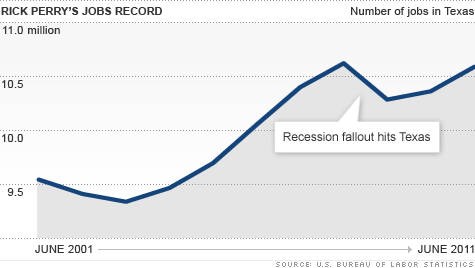
 
source; CNN Money

Rick Perry's Texas jobs boom: The whole story

By Tami Luhby @CNNMoney August 15, 2011: 8:27 AM ET

<!-- KEEP -->
chart-texas-jobs2.top.gif


NEW YORK (CNNMoney) -- Texas has created a lot of jobs over the 10 years that Rick Perry's been governor -- there's no doubt about it.

Perry, who formally launched his presidential candidacy on Saturday, is making his state's economic prowess a centerpiece of his campaign. Already he's been bragging about his state being the "epicenter of job growth."

Texas has gained more than 1 million net new jobs in the decade Perry has led the state. And it's been going strong since the recession ended.

"We are home to fewer than one in 10 Americans ... but four in 10 new American jobs are in our state," he told a conference of state legislators from around the nation this week.

But that doesn't mean that all is well with employment in the Lone Star State. Texas leads the nation in minimum-wage jobs, and many positions don't offer health benefits. Also, steep budget cuts are expected to result in the loss of more than 100,000 jobs.

Perhaps most importantly, Texas can't create jobs fast enough to keep up with its rapidly growing population. Since 2007, the state's number of working-age residents expanded by 6.6%, nearly twice the national average.

Factoring in that population growth means Texas would need to create another 629,000 jobs, or 5.6% more positions, just to reach its pre-recession employment level, according to the Economic Policy Institute.

"They have a long way to go before they get back to a positive place," said Doug Hall, director of the Economic Analysis and Research Network, an institute project.
 
thats some bullshit, of course texas has that extra money because eight years of bush fattend texas up..

no brainer son......
 
thats some bullshit, of course texas has that extra money because eight years of bush fattend texas up..

no brainer son......

Also they benefit from 4.00 a gallon gas.


A funny thing is many of the jobs being created are in the public sector and not the private sector, the complete opposite of the majority of the country.
 
source: Washington Post


Do Texas’s government jobs count as jobs?


Republicans tend to shrug at the fact that private sector job gains have been offset by public sector job losses, viewing government workers as collateral damage in their quest to shrink government. For them, public sector job losses don’t count because those aren’t “real” jobs. This, despite the fact that those job losses have hurt the economy by leading to less consumer demand.

But those government jobs suddenly do seem to count when it comes to Governor Rick Perry of Texas. As former White House adviser Jared Bernstein writes today, part of Perry’s success at dealing with unemployment — a record that’s being widely hailed by conservatives as proof of the success of Perry’s anti-government approach — comes from the fact that Texas is experiencing the opposite dynamic at work in the rest of the country: It’s added public sector jobs, while losing private sector jobs. Bernstein:
Over the last few years, government jobs have been awfully consequential in Texas: 47% of all government jobs added in the US between 2007 and 2010 were added in Texas.​
The chart shows that Texas employment wasn’t down much at all in these years, as the state lost only 53,000 jobs. But looming behind that number are large losses in the private sector (down 178,000) and large gains (up 125,000) in government jobs.​
Good for Perry, and good for Texas. But as Bernstein notes, this hardly matches up with Perry’s anti-government rhetoric, or the national GOP’s indifference to public sector job-loss nationwide. Stemming public sector job losses are one aspect of the economy where the federal government can make a significant impact — if only Republicans Congress were willing to invest in doing that, instead of proclaiming “we’re broke” and then demanding more spending cuts and tax cuts for the wealthy. But when public sector job growth does take place — as in Texas — conservatives are happy to use those numbers as part of their case for their anti-government ideology.
 
I don't know T.O.; I think I'll wait to get the perspective of someone on the ground in Texas -- with unbiased knowledge of the subject.

Hold up, scrolls up; its been since July 21st and no such person has responded.

Perhaps, there is no such person
 
source: Think Progress


Texans Stage Mock Funeral To Mourn The ‘Death Of Good Jobs’ In GOP Congressman’s District


Staffers at the Houston office of GOP Rep. John Culberson (R) must have gotten quite a surprise on Thursday when they looked outside to see more than 100 constituents gathered for a funeral. But this wasn’t a typical funeral — these Texans were gathered to mourn the loss of good, high-wage jobs in their state.

Mourners circled around a mock casket for “Good Jobs,” and Taps played in the background while Rev. Louis Dorsey eulogized. “I used to be middle class!” one woman cried out during the ceremony. Constituents also chanted “Hey, hey, what do you say? How many jobs have you killed today?”
DORSEY: My brothers and my sisters, we are assembled here today to mourn the passing of the jobs in Texas. Jobs died because of a steady influx of minimum wage jobs, tax breaks for corporations and the super-rich, and the policies of politicians like Rep. John Culberson.
Watch it:

<IFRAME height=345 src="http://www.youtube.com/embed/0GkydNrMBI4" frameBorder=0 width=560 allowfullscreen></IFRAME>


Dorsey went on to say, “Good jobs were much loved and appreciated by all here today. This loss is tragic because it is the result of reckless greed on Wall Street and in Congress. While the grief we endure for the loss of Good Jobs is great, we must not let this tragedy continue to happen.” A longer version of the video is available here.

The rally was organized by Good Jobs = Great Houston, and was intended to illustrate “how politicians like Culberson are deliberately pursuing policies that are killing jobs across Texas.” The constituents at Culberson’s office included unemployed workers who want the congressman to start prioritizing their needs over corporate balance sheets.

According to the organization, they seek to hold Culberson accountable “for voting for legislation that could kill 1.8 million jobs nationwide and over 200,000 in Texas.” Texas is currently tied with Mississippi for the highest percentage of minimum wage jobs in the nation, while “the median hourly earnings for all Texas workers was $11.20 per hour in 2010, compared to the national median of $12.50 per hour.”
<!-- (for webtech) Posted in Economy, General, Home Page
--><!-- googleoff: all --><!-- googleon: all -->
 
source: Think Progress

VIDEO: The Mess In Texas — Debunking Rick Perry’s ‘Texas Miracle’


Having only entered the race last week, Texas Gov. Rick Perry (R) has already jumped to the top of the GOP presidential field. Fueling his momentum is the so-called “Texas miracle” — the myth that Perry’s governorship has led Texas to weather the recession better than other states, maintaining a healthy economy and brisk job creation. Unfortunately for Perry, these claims are often built on incomplete analysis, or by cherry picking statistics while overlooking other relevant factors that fill in the full picture, which is a much more mixed and middling economic performance than he and his supporters would like you to believe.

ThinkProgress produced a video report. Watch it:

<IFRAME height=345 src="http://www.youtube.com/embed/Sxv-HZciWJM" frameBorder=0 width=560 allowfullscreen></IFRAME>
 

"One out of 10 minimum-wage workers in the U.S. live in Texas."

rulings%2Ftom-true.gif


logopf_aboutbox.gif

September 18th, 2013


As of July 2012, Texans accounted for nearly one in 10 Americans, according to the U.S. Census Bureau.

On CNN’S Crossfire Sept. 18, 2013, from-the-left co-host Stephanie Cutter prefaced questions of Texas Gov. Rick Perry by saying: "One out of 10 minimum-wage workers in the U.S. live in Texas."

She undershot.

In 2012, according to Cheryl Abbot, a regional economist for the U.S. Bureau of Labor Statistics, Texas workers paid at or below the federal minimum wage of $7.25 an hour accounted for 452,000, or nearly 13 percent, of the nation’s 3,550,000 workers paid minimum wage or less.

"Another way of stating that is that in Texas, 7.5 (percent) of all hourly-paid workers were paid at or below the federal minimum wage," Abbot said by email.

The same year, Abbot said, nearly 12.7 million Texas workers in total amounted to 8 percent of the nation’s 155-million-strong labor force.

Abbot pointed us to a bureau chart showing each state’s share of workers earning minimum wage or less in 2012 — which showed, too, that Texas had far more workers in this dual category than the second-place state in this way, New York, which had 224,000 workers earning the minimum wage or less, equal to 6.3 percent of the nation’s workers in those pay categories.

Nationally, Abbot said, some 75 million hourly workers accounted for 59 percent of all salaried and hourly paid workers. In Texas, the state’s 6 million hourly workers represented 57 percent of all wage and salary workers, she said.

To our inquiry, Austin economist Stuart Greenfield agreed with Abbot’s analysis, though he pointed out by telephone that strictly speaking, according to the bureau chart, nearly two in 10 of the country’s minimum-wage workers lived in Texas. That is, Texans accounted for 282,000 of 1,566,000 U.S. workers paid the minimum wage, according to the chart, with 170,000 Texans paid less than the minimum wage. The Texas share of U.S. minimum-wage-only workers, 18 percent, far outpaced the No. 2 state in this category, Pennsylvania, which was home to nearly 6 percent of such workers, according to the chart.

Also, Texas led other states with its 8.6 percent share of hourly U.S. workers paid below the minimum wage, though Florida landed a close second by having 8.3 percent of such hourly workers, the chart indicates.

Our ruling

Cutter said one of 10 minimum-wage workers in the U.S. lives in Texas.

Actually, 18 percent of U.S. workers paid the minimum wage in 2012 toiled in Texas, according to government figures, while Texas was home to 13 percent of the nation’s hourly employees paid minimum wage or less.

Since Cutter was arguing that Texas is not a land of plenty, the fact that she understated the state’s share of minimum-wage workers doesn’t short the Truth-O-Meter. We rate this claim as True.


http://www.politifact.com/texas/sta...ire-anchor-undershoots-texans-comprising-one/

 
Back
Top