The forgotten black victims of Nazi Germany

BlackWolf

Rising Star
BGOL Investor
What Hitler did to the races he deemed ‘inferior’

National Halocaust Day held earlier this month was largely set up to commemorate the six million million Jewish men, women and children murdered by Hitler’s Nazi regime.


While much has been written about these Jewish victims, the fate of other groups at the hands of the Nazi’s is less well documented. Another 5 million ‘others’ died in Nazi concentration camps and included groups as diverse as communists, gays, Jehovah's Witness, gypsies, and the physical and mentally handicapped.


Only in fairly recent times have academics looked at the fate of black people who were living in Nazi controlled Europe and captured black prisoner of wars. Indeed the fact that there were any black people living in Germany at the time of Adolph Hitler is a surprise to many.


According to the United States Holocaust Memorial Museum, Washington, D.C., “The fate of black people from 1933 to 1945 in Nazi Germany and in German-occupied territories ranged from isolation to persecution, sterilization, medical experimentation, incarceration, brutality, and murder. However, there was no systematic program for their elimination as there was for Jews and other groups.”


After Germany’s defeat in the First World War, the Treaty of Versailles in 1919 stripped the nation of its African colonies and many of the Germans based in Africa returned bringing with them strong racist attitudes.


The Versailles treaty also allowed the Allies to occupy the Rhineland in western Germany where the use of French colonial troops, some of whom were African, encouraged anti-black sentiment in Germany.


The notion of Africans controlling white Germans infuriated many in the country and racist propaganda portrayed the African troops who had relationships with locals as rapists of German women and spreaders of sexual and other diseases.


The children of black soldiers and German women were called ‘Rhineland bastards’ and the Nazis, then a fringe political movement, viewed them as a threat to German racial purity. In his book Mein Kampf (My Struggle), Hitler stated that ‘the Jews had brought the Negroes into the Rhineland with the clear aim of ruining the hated white race by the necessarily-resulting bastardisation’.


When Hitler came to power, many of these mixed-race Germans were rounded up by the German secret police, the Gestapo and forcibly sterilized.


According to academic Terese Pencak Schwartz, who has extensively researched the subject,

“The Nazis set up a secret group, Commission Number 3, to organize the sterilization of these offspring to keep intact the purity of the Aryan race. In 1937, all local authorities in Germany were to submit a list of all the children of African descent. Then, these children were taken from their homes or schools without parental permission and put before the commission.


“Once a child was decided to be of black descent, the child was taken immediately to a hospital and sterilized. About 400 children were medically sterilized -- many times without their parents' knowledge.” says Schwartz.


Hans Hauck, a victim of Hitler's sterilisation program, told decades later in a documentary film ‘Hitler's Forgotten Victims’, that when he was forced to undergo the painful operation as a teenager, he was given no anaesthetic. Once he received his sterilization documentation, he was ‘free to go’, so long as he agreed to have no sexual relations with German women.


There were an estimated 20,000 to 25,000 black people living in Germany at the time of Hitler coming to power. Some were Africans who had come from German colonies, some from the French African troops who had stayed in Germany after the First World War, and others from other parts of the world who were working in Germany often as entertainers.


Prior to Hitler coming to power, black entertainers were popular in Germany, but the Nazi hatred of other ‘inferior’ races led to a ban on Jazz music which was seen as ‘corrupt negro music’.


While not subject to an orgainsed, official policy of ethnic extermination like the Jews, black people did not escape the ideology of German racial purity. Apart from those that were forcibly sterilised, others mysteriously disappeared, or ended being used for medical experiments.


Mixed-race people were not allowed to go to university, prevented from joining the military and kept out of many jobs. It was a terrifying time because no person of black origin felt safe. Not knowing if one day there time may be up.


It was Hitler’s obsession and focus on exterminating the Jews which meant that many black people in Germany didn’t get sent immediately to the concentration camps.


What Hitler thought of black people was clear long before the start of the war in 1939. At the 1936 Berlin Olympic games he was so annoyed that black American sprinter Jesse Owens had beaten German athletes and won three golds, that he refused to take part in the awarding of Owen’s medals.


One of the early black victims of the Nazis was Hilarius (Lari) Gilges, a dancer, who was murdered by the SS in 1933. Gilges' German wife later received compensation from a postwar German government for his killing.


African Americans like female jazz trumpeter Valaida Snow, living in German occupied Europe were imprisoned in Axis internment camps for alien nationals. The artist Josef Nassy, living in Belgium, was arrested as an enemy alien and held for seven months in the Beverloo transit camp in German-occupied Belgium. He was later transferred to Germany, where he spent the rest of the war in the Laufen internment camp.


Other black people whose stories are known include: Lionel Romney, a sailor in the U.S. Merchant Marine, who was imprisoned in the Mauthausen concentration camp. Jean Marcel Nicolas, a Haitian, was imprisoned in the Buchenwald and Dora-Mittelbau concentration camps in Germany. Jean Voste, an African Belgian, was incarcerated in the Dachau concentration camp. Bayume Mohamed Hussein from Tanzania died in the Sachsenhausen camp, near Berlin.


Captured black prisoners of war were often shot on the spot or taken to camps were they were segregated from white prisoners. They were subject to harsher treatment and given the worst prison camp jobs.


African-American pilot Lieutenant Darwin Nichols, was sent to a Gestapo prison in Butzbach. Black soldiers of the American, French, and British armies were worked to death on construction projects or died as a result of mistreatment in concentration or prisoner-of-war camps.


Due to the relatively small number of black people in Germany and occupied Europe there was no official Nazi policy of murder. However there was no recording of the numbers of black people including prisoners of war who did at the hands of the Nazis.


* The Imperial War Museum in London will feature a lecture ‘Black Victims of the Nazis’

on February 22 , 1.00pm - 4.30pm at Museum Conference Room. The lecture will focus on the Black victims of Nazi persecution before and during the Second World War. Films will include Black Victims of the Nazis, about the Black population in Germany during the Second World War.

BBC News
 
History of Blacks in Nazi Germany and the Holocaust


The fate of black people from 1933 to 1945 in Nazi Germany and in German-occupied territories ranged from isolation to persecution, sterilization, medical experimentation, incarceration, brutality, and murder. However, there was no systematic program for their elimination as there was for Jews and other groups.

After World War I, the Allies stripped Germany of its African colonies. The German military stationed in Africa (Schutztruppen), as well as missionaries, colonial bureaucrats, and settlers, returned to Germany and took with them their racist attitudes. Separation of whites and blacks was mandated by the Reichstag (German parliament), which enacted a law against mixed marriages in the African colonies.

Following World War I and the Treaty of Versailles (1919), the victorious Allies occupied the Rhineland in western Germany. The use of French colonial troops, some of whom were black, in these occupation forces exacerbated anti-black racism in Germany. Racist propaganda against black soldiers depicted them as rapists of German women and carriers of venereal and other diseases. The children of black soldiers and German women were called "Rhineland Bastards." The Nazis, at the time a small political movement, viewed them as a threat to the purity of the Germanic race. In Mein Kampf (My Struggle), Adolf Hitler charged that "the Jews had brought the Negroes into the Rhineland with the clear aim of ruining the hated white race by the necessarily-resulting bastardization."

African German mulatto children were marginalized in German society, isolated socially and economically, and not allowed to attend university. Racial discrimination prohibited them from seeking most jobs, including service in the military. With the Nazi rise to power they became a target of racial and population policy. By 1937, the Gestapo (German secret state police) had secretly rounded up and forcibly sterilized many of them. Some were subjected to medical experiments; others mysteriously disappeared.

The racist nature of Adolf Hitler's regime was disguised briefly during the Olympic Games in Berlin in August 1936, when Hitler allowed 18 African American athletes to compete for the U.S. team. However, permission to compete was granted by the International Olympic Committee and not by the host country.

Adult African Germans were also victims. Both before and after World War I, many Africans came to Germany as students, artisans, entertainers, former soldiers, or low-level colonial officials, such as tax collectors, who had worked for the imperial colonial government. Hilarius (Lari) Gilges, a dancer by profession, was murdered by the SS in 1933, probably because he was black. Gilges' German wife later received restitution from a postwar German government for his murder by the Nazis.

Some African Americans, caught in German-occupied Europe during World War II, also became victims of the Nazi regime. Many, like female jazz artist Valaida Snow, were imprisoned in Axis internment camps for alien nationals. The artist Josef Nassy, living in Belgium, was arrested as an enemy alien and held for seven months in the Beverloo transit camp in German-occupied Belgium. He was later transferred to Germany, where he spent the rest of the war in the Laufen internment camp and its subcamp, Tittmoning, both in Upper Bavaria.

European and American blacks were also interned in the Nazi concentration camp system. Lionel Romney, a sailor in the U.S. Merchant Marine, was imprisoned in the Mauthausen concentration camp. Jean Marcel Nicolas, a Haitian national, was incarcerated in the Buchenwald and Dora-Mittelbau concentration camps in Germany. Jean Voste, an African Belgian, was incarcerated in the Dachau concentration camp. Bayume Mohamed Hussein from Tanganyika (today Tanzania) died in the Sachsenhausen camp, near Berlin.

Black prisoners of war faced illegal incarceration and mistreatment at the hands of the Nazis, who did not uphold the regulations imposed by the Geneva Convention. Lieutenant Darwin Nichols, an African American pilot, was incarcerated in a Gestapo prison in Butzbach. Black soldiers of the American, French, and British armies were worked to death on construction projects or died as a result of mistreatment in concentration or prisoner-of-war camps. Others were never even incarcerated, but were instead immediately killed by the SS or Gestapo.

Some African American members of the U.S. Armed forces were liberators and witnesses to Nazi atrocities. The 761st Tank Battalion (an all-African American tank unit), attached to the 71st Infantry Division, U.S. Third Army, under the command of General George Patton, participated in the liberation of Gunskirchen, a subcamp of the Mauthausen concentration camp, in May 1945.

From Wikipedia
 
Blacks in Nazi Germany

by A. Tolbert, III

So much of our history is lost to us because we often don't write the history books, don 't film the documentaries, or don't pass the accounts down from generation to generation. One documentary now touring the film festival circuit telling us to Always Remember is: Black Survivors of the Holocaust (1997). Outside the US the film is entitled Hitler's Forgotten Victims (Afro-Wisdom Productions). It codifies another dimension to the " Never Forget " Holocaust story, our dimension.

Did you know that in the 1920s there were 24,000 blacks living in Germany? Neither did I. Here's how it happened and how many of them were eventually caught unawares by the events of the Holocaust.

Like most West European nations, Germany established colonies in Africa in the late 1800s in what later became Togo, Cameroon, Namibia, and Tanzania. German genetic experiments began there most notably involving prisoners taken from the 1904 Heroro Massacre that left 60,000 Africans dead following a 4 year revolt of German colonization. After the shellacking Germany received in World War I, it was stripped of its African colonies in 1918.

As a spoil of war, the French were allowed to occupy Germany in the Rhineland, a bitter piece of real estate that has gone back and forth between the two nations for centuries. The French willfully deployed their own colonized African soldiers as the occupying force. Germans viewed this as the final insult of World War I. Soon thereafter 92% of them voted in the Nazi party.

Hundreds of these African Rhineland-based soldiers intermarried with German! women and raised their children as Black Germans. In " Mein Kampf " Hitler wrote about his plans for these " Rhineland Bastards ".

When he came to power, one of his first directives was aimed at these mixed children. Underscoring his obsession with racial purity, by 1937, every identified mixed race child in the Rhineland had been forcibly sterilized to prevent further " race polluting " as he termed it.

Hans Hauck, a Black Holocaust survivor and a victim of Hitler's mandatory sterilization program, explained in the film that when he was forced to undergo sterilization as a teenager, he was given no anesthetic. Once he received his sterilization certificate, he was "free to go" so long as he agreed to ha ve no sexual relations whatsoever with Germans.

Although most Black Germans attempted to escape their fatherland, heading for France where people like Josephine Baker were steadily aiding and supporting the French underground, many ran into problems elsewhere. Nations shut its doors to Germans, including the Black ones. Some Black Germans were able to eke out a living during Hitler 's reign of terror by performing in vaudeville shows.

But many Blacks, steadfast in their belief that they were German first, Black second, opted to remain in Germany. Some fought with the Nazis (a few even became Lutwaffe pilots!). Unfortunately, many Black Germans were arrested, charged with treason, and shipped in cattle cars to concentration camps. Often these trains were so charged with people (equipped with no bathroom facilities or food) that after the four day journey, box car doors opened to piles of the dead and dying.

Once in the concentration camps Blacks were given the w orst jobs conceivable. Some Black American soldiers who were captured and held as prisoners of war recounted that while they were starved an forced into dangerous labor (violating the Geneva Convention), they were still better off than Black German concentration camp detainees who were forced to do the unthinkable: man the crematoriums and work in labs where genetic experiments were carried out. As a final sacrifice, these Blacks were killed every three months so that they would never be able to reveal the inner workings of the Final Solution.

In every story of Black oppression, no matter how enslaved, enshackled or beaten, we are, we find a way to survive and rescue others. Case in point, is Johnny Voste, a Belgian Resistance fighter who was arrested in 1942 for sabotage and shipped to Dachau. One of his jobs was stacking vitamin crates. Risking his own life, he distributed hundreds of vitamins to camp detainees which saved the lives of many because they were starving, weak, and ill, conditions exacerbated by extreme vitamin-deficiencies. His motto was: 'No, you can't have my life: I will fight for it.'

According to Essex University's Delroy Constantine-Simms, there were Black Germans who resisted Nazi Germany, such as Lari Gilges, who founded the Northwest Rann--an organization of entertainers that fought the Nazis in his home town of Dusseldorf--and who was murdered by the SS in 1933, the year Hitler came to power.

Little information remains about the numbers of Black Germans held in the camps or killed under the Nazi regime. Some victims of the Nazi sterilization project and Black survivors of the Holocaust are still alive and telling their story in films such as Black Survivors of the Nazi Holocaust.

But they must also speak out for justice, not just history. Unlike Jews (in Israel and in Germany), Black Germans receive no war reparations because their German citizenship was revoked (though they were German-born). The only pension they get is from those of us who are willing to tell the world their stories and continue their battle for recognition and compensation.

After the war, scores of Blacks who had somehow managed to survive the Nazi regime were rounded up and tried as war criminals. Talk about the final insult. There are thousands of Black Holocaust stories from the triangle trade, to slavery in America, to the gas ovens in Germany. We often shy away from hearing about our historical past because so much of it is painful. However, we are in this struggle together for rights, dignity, and yes, reparations for wrongs done to us through the centuries. We need to always remember so that we can take steps to ensure that these things never happen again.

Uncovering the Black German Holocaust
Review by Delroy Constantine-Simms
 
This topic has been covered before on BGOL. Go to the Unsung Heros thread and search "Rhineland Bastards".
 
READ:

http://www.amazon.com/dp/0963129341/?tag=vp314-20

Click Thumbnail Below for larger Pix


http://img250.imagevenue.com/img.php?image=05128_GERMANYS_BLACK_HOLOCAUST_122_216lo.jpg


Black Holocaust Survivors?
mitchellblogmug.JPG

by Mary Mitchell
on October 17, 2006

Written by A. Tolbert, III


http://blogs.suntimes.com/mitchell/2006/10/black_holocaust_survivors.html

So much of our history is lost to us because we often don’t write the history books, don’t film the documentaries, or don’t pass the accounts down from generation to generation.

One documentary now touring the film festival circuit, telling us to “Always Remember” is “Black Survivors of the Holocaust” (1997). Outside the U.S., the film is entitled “Hitler’s Forgotten Victims” (Afro-Wisdom Productions) . It codifies another dimension to the “Never Forget “ Holocaust story—our dimension.

Did you know that in the 1920’s, there were 24,000 Blacks living in Germany?

Neither did I.

Here’s how it happened, and how many of them were eventually caught unawares by the events of the Holocaust.
Like most West European nations, Germany established colonies in Africa in the la te 1800’s in what later became Togo, Cameroon, Namibia, and Tanzania. German genetic experiments began there, most notably involving prisoners taken from the 1904 Heroro Massacre that left 60,000 Africans dead, following a 4-year revolt against German colonization. After the shellacking Germany received in World War I, it was stripped of its African colonies in 1918.

As a spoil of war, the French were allowed to occupy Germany in the Rhineland—a bitter piece of real estate that has gone back and, forth between the two nations for centuries. The French willfully deployed their own colonized African soldiers as the occupying force. Germans viewed this as the final insult of World War I, and, soon thereafter, 92% of them voted in the Nazi party.

Hundreds of the African Rhineland-based soldiers intermarried with German women and raised their children as Black Germans. In Mein Kampf, Hitler wrote about his plans for these “Rhineland Bastards”. When he came to power, one of his first directives was aimed at these mixed-race children. Underscoring Hitler’s obsession with racial purity, by 1937, every identified mixed-race child in the Rhineland had been forcibly sterilized, in order to prevent further “race polluting”, as Hitler termed it.

Hans Hauck, a Black Holocaust survivor and a victim of Hitler’s mandatory sterilization program, explained in the film “Hitler’s Forgotten Victims” that, when he was forced to undergo sterilization as a teenager, he was given no anesthetic. Once he received his sterilization certificate, he was “free to go”, so long as he agreed to have no sexual relations whatsoever with Germans.

Although most Black Germans attempted to escape their fatherland, heading for France where people like Josephine Baker were steadily aiding and supporting the French Underground, many still encountered problems elsewhere. Nations shut their doors to Germans, including the Black ones.

Some Black Germans were able to eke out a living during Hitler’s reign of terror by performing in Vaudeville shows, but many Blacks, steadfast in their belief that they were German first, Black second, opted to remain in Germany. Some fought with the Nazis (a few even became Lutwaffe pilots)! Unfortunately, many Black Germans were arrested, charged with treason, and shipped in cattle cars to concentration camps. Often these trains were so packed with people and (equipped with no bathroom facilities or food), that, after the four-day journey, box car doors were opened to piles of the dead and dying.

Once inside the concentration camps, Blacks were given the worst jobs conceivable. Some Black American soldiers, who were captured and held as prisoners of war, recounted that, while they were being starved and forced into dangerous labor (violating the Geneva Convention), they were still better off than Black German concentration camp detainees, who were forced to do the unthinkable-man the crematoriums and work in labs where genetic experiments were being conducted. As a final sacrifice, these Blacks were killed every three months so that they would never be able to reveal the inner workings of the “Final Solution”.

In every story of Black oppression, no matter how we were enslaved, shackled, or beaten, we always found a way to survive and to rescue others. As a case in point, consider Johnny Voste, a Belgian resistance fighter who was arrested in 1942 for alleged sabotage and then shipped to Dachau. One of his jobs was stacking vitamin crates. Risking his own life, he distributed hundreds of vitamins to camp detainees, which saved the lives of many who were starving, weak, and ill—conditions exacerbated by extreme vitamin deficiencies. His motto was “No, you can’t have my life; I will fight for it.”

According to Essex University’s Delroy Constantine- Simms, there were Black Germans who resisted Nazi Germany, such as Lari Gilges, who founded the Northwest Rann—an organization of entertainers that fought the Nazis in his home town of Dusseldorf—and who was murdered by the SS in 1933, the year that Hitler came into power.

Little information remains about the numbers of Black Germans held in the camps or killed under the Nazi regime. Some victims of the Nazi sterilization project and Black survivors of the Holocaust are still alive and telling their story in films such as “Black Survivors of the Nazi Holocaust”, but they must also speak out for justice, not just history.

Unlike Jews (in Israel and in Germany), Black Germans receive no war reparations because their German citizenship was revoked (even though they were German-born) . The only pension they get is from those of us who are willing to tell the world their stories and continue their battle for recognition and compensation.

After the war, scores of Blacks who had somehow managed to survive the Nazi regime, were rounded up and tried as war criminals. Talk about the final insult! There are thousands of Black Holocaust stories, from the triangle trade, to slavery in America, to the gas ovens in Germany.

We often shy away from hearing about our historical past because so much of it is painful; however, we are in this struggle together for rights, dignity, and, yes, reparations for wrongs done to us through the centuries. We need to always remember so that we can take steps to ensure that these atrocities never happen again.

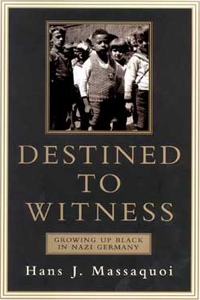
<i>For further information, read: Destined to Witness: Growing Up Black in Nazi Germany, by Hans J. Massaquoi.</x>

 
Last edited:
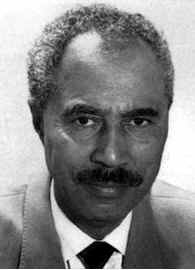
massaquoi.jpg

source: Library of Congress

Growing Up Black in Nazi Germany
The Remarkable Life of Hans Massaquoi


By AUDREY FISCHER

A picture may be worth a thousand words, but the photograph taken in 1933 of a brown-skinned boy wearing a swastika in a schoolyard in Hamburg, Germany, does not begin to tell the story of the remarkable life of Hans J. Massaquoi. Mr. Massaquoi, former managing editor of Ebony magazine, has now told the story himself in his new book, Destined to Witness: Growing Up Black in Nazi Germany.

"When I first heard about the book, I stopped in my tracks," said Yvonne Poser, associate professor of German at Howard University, who interviewed Mr. Massaquoi in the Pickford Theater on Feb. 16 as part of the Library's African American History Month program. "His is a victim's story that had yet to be told."

The question of how Massaquoi came to be raised in Nazi Germany is one he has been asked "millions of times." Grandson of the Liberian consul general to Hamburg, Mr. Massaquoi was born in 1926 to a well-to-do African father and a German mother. His early life was one of privilege, befitting the grandson of a diplomat.

"I associated black skin with superiority, since our servants were white," said Mr. Massaquoi. "My grandfather was 'the man,'" he joked.

His circumstances changed dramatically when his father and grandfather returned to Liberia in 1929. Refusing to expose her sickly son to a tropical climate, Mr. Massaquoi's mother chose instead to raise her son in Germany as best she could on her meager wages as a nurse's aide.

Although he had spent his early years in a villa, Mr. Massaquoi at first found life in a cold-water flat "interesting." What distressed him most was being the "oddity on the block."

"It was a constant problem," he said. "I was always pointed at because of my exotic looks. I just wanted to be like everyone else." Like other boys, he wanted nothing more than to join the Hitlerjugend (Hitler Youth Movement).

"The Nazis put on the best show of all the political parties. There were parades, fireworks and uniforms — these were the devices by which Hitler won over young people to his ideas. Hitler always boasted that despite parents' political persuasion, Germany's youth belonged to him."

Mr. Massaquoi was dealt a crushing blow when he learned that the Hitlerjugend as well as the local playground were not open to "non-Aryans."

Two events that occurred during the summer of 1936 gave him "a genuine pride in my African heritage at a time when such pride was extremely difficult to come by." Two young black American athletes, boxer Joe Louis and Olympic runner Jesse Owens, dominated the news. Mr. Massaquoi initially supported Germany's Max Schmeling, who was scheduled to fight Louis but quickly switched his allegiance to "the Brown Bomber" in the wake of racist remarks attributed to Schmeling. His classmates had taken to calling him "Joe," which gave him welcomed prestige.

"I think I was more crushed than Louis when he lost to Schmeling," joked Mr. Massaquoi. In a rematch several months later, Louis knocked out Schmeling in the first round.

Mr. Massaquoi took similar pride in Jesse Owens's now legendary performance at the 1936 Olympic games in Berlin. He had the good fortune to be included when the father of one of his classmates took a group of boys to the games. The triumph of a "non-Aryan" over German athletes was not what Hitler hoped to capture on film when he commissioned German filmmaker Leni Riefenstahl to make a documentary of the Olympic games.

black_2.jpg
0,,2189257_1,00.jpg

Years later, while working as a journalist, Mr. Massaquoi met Owens and Louis and thanked them "for allowing me to walk a little taller among my peers that summer."

As he grew to adulthood, Mr. Massaquoi was barred from joining the German military, pursuing an education or a preparing for a professional career. Instead he became a machinist's apprentice. After World War II, he immigrated to the United States on a student visa. Although not a citizen, he was ordered to report for military service because of a clerical error and served for two years as a paratrooper in the 82nd Airborn Division during the Korean War. He subsequently took advantage of the GI bill and earned a degree in journalism from the University of Illinois, which paved the way for a nearly 40-year career at Ebony magazine.

Asked how he survived Hitler's reign of terror, Mr. Massaquoi credits two factors. The fact that there were so few blacks in Germany at the time made them a low priority for mass extermination. Additionally, the rapid advance of the allied troops gave Hitler "more to worry about than Hans Massaquoi."

What does he think about Germany today? "I love it. It's my homeland." His opinion of Joerg Haider, the newly elected leader of Austria's right-wing Freedom Party whose views have been likened to the Nazis, is far different: "He must be repudiated. The whole world must show that we won't tolerate this type of ideology." (Mr. Haider has since resigned as his party's chairman.)
 
source: Free Republic

Germany's tribute to its 'black disgrace'
Scotsman.com ^ | 12 Jan 2003 | ALLAN HALL IN BERLIN

UNLIKE the Jewish victims of Hitler’s Third Reich, there is no permanent memorial to mark their terrible fate. While hundreds were murdered in the Nazi death camps because of the colour of their skin, their story has been largely forgotten.

Now, however, a controversial new exhibition is forcing Germans to confront the disturbing truth of what happened to the thousands of black people living in their country during the Führer’s rise to power.

The Nazi Documentation Centre in Cologne is showing the first exhibition on the subject. Called Distinguishing Feature: Negro - Blacks in National Socialist Times, it documents the lives of black people in Germany in the 1930s and 1940s.

At that time, immigrants from European colonies, the Caribbean and Africa called Germany their home. There were also many black Americans who fled to Europe to escape the economic crisis in America, as well as diplomats, business people, students and sailors who began to make their presence felt in Hitler’s narrow, racially-obsessed society.

The driving force behind the exhibition, Dr Peter Martin, of the Hamburg Foundation for the Cultivation of Culture and Science, estimates that some 10,000 black people lived in Germany before the Nazis came to power.

Martin said he was motivated to put on the exhibition by the "lack of awareness" among Germans about the fate of black people during Nazi rule.

He said: "It is important to remember that there were more victims than Jews and that each one was a piece in the mosaic of evil that was Nazism."

Martin added: "Hitler wanted a whiter-than-white society. It had no place for blacks, Asians or anyone else. The one thing that you can say about The Führer is that he was an equal-opportunity hater."

The forgotten chapter in German history has been revealed to the public through a collection of posters, flyers, films, sound recordings and photographs. The venue where they are shown is hauntingly appropriate: The Cologne Nazi Documentation Centre is housed in a building used by the Gestapo for torture and interrogation.

Before Hitler’s accession to power in 1933, there had been widespread tolerance of black people. Black entertainers, in particular jazz musicians, singers and dancers, were wildly popular in Germany and black music was considered hip in the Weimar Republic.

But Josef Goebbels hated it and it was soon demonised then outlawed. He called it "Negroid swamp music" and ordered his brownshirts to the music halls where it was played to beat up and deport listeners to concentration camps.

The Nazis’ 1933 racial law, which applied to black people as well as Jews, institutionalised racism and made it impossible for them to lead normal lives. Propaganda on the streets and in the media labelled blacks as a "dangerous plague" and "bastards". Black men were said to be a danger to German women.

Black Germans who had married white Germans were subjected to additional persecution. Many were forcibly sterilised.

Martin said: "The Nazis liked to demonise blacks in the way that bigots of the deep south in America did. It was all part of the desensitising of the German race in the Nazi effort to convince them they were the chosen people."

Nazi Germany regarded black soldiers as inferior beings and treated them as such. French colonial troops captured after the fall of the country in 1940 were photographed by Goebbels’ propaganda ministry to depict them as "subhuman savages". American troops captured during the Second World War were singled out for particularly brutal treatment in PoW camps.

Historians still don’t know what happened to most blacks in Germany between 1933 and 1945. Many simply disappeared from public life, most of them permanently.

Some were able to leave the country but many others were sent to concentration camps. Hundreds or even thousands may have been killed.

Martin explained: "The Nazis collated names and addresses but there was no separate register for blacks. We honour both those who died and those who survived."

The exhibition also features the great American athlete Jesse Owens whose spectacular performance at the 1936 Olympic Games, which Hitler wanted to be a showcase for ‘Aryan supremacy’, caused the Führer to storm out of the stadium.

In addition, it reveals the spurious pseudo-scientific theories used by the Nazis to justify their perverse ideology. A series of photographs show black men and women having their skulls measured with callipers - supposedly to show that the thickness of black people’s skulls indicated a small brain "unreceptive to intelligence".

Researchers spent months scouring libraries and archives for information and found many letters seized by the Nazis from black prisoners that had been intended for loved ones back home.

One was from a Jamaican sailor called Gilbert Thwaites, who was arrested on 1934. He was sent to the concentration camp of Sachsenhausen on the outskirts of Berlin where thousands died at the hands of the SS.

In the days before his arrest he wrote to his mother in Manderville: " "People started to spit at me in the street and make noises like an ape when I went by. I daren’t speak with a white lady on the streets anymore. There was an article in the Hamburger Morgenpost saying Hitler wants to make us wear a black star like the Jews have to wear a yellow one. The jazz club where I used to hang out in the centre of Hamburg was raided last week. Josef Goebbels said it was a centre of vice and corruption."

Thwaites ultimately managed to escape Germany, after his former boss on the Hamburg waterfront intervened on his behalf and he was able to buy himself freedom.

Also chronicled is the murder of dozens of mixed-race children in 1937. These were children born in the Rhineland to women who cohabited with French colonial occupation troops after the First World War.

Around 800 of the children - referred to as the "Rhineland bastards" and "black disgrace" in Nazi propaganda - were sterilised by a secret group called Commission Number 3.

In Mein Kampf Hitler said he would eliminate all the children born of African-German descent because he considered them an "insult" to the German nation.
 
Valaida Snow was also a forgotten victim of the concentration camps.

2173641855_24ddd957de.jpg

What?

source: WOMEN IN HISTORY

NAME: Valaida Snow

BIRTHDATE: c. June 2, 1903/05/09

BIRTH PLACE: Chattanooga, Tennessee

DATE OF DEATH: May 30, 1956

PLACE OF DEATH: New York, New York

FAMILY BACKGROUND: Valaida Snow was born into a family of musicians: Her mother taught Valaida, her sisters Alvaida and Hattie, and her brother, Arthur Bush, how to play multiple instruments. Valaida and all her siblings became professional musicians. Valaida married twice: first, to dancer Ananias Berry from the Berry Brothers dancing troupe and then to performer and producer Earle Edwards.

EDUCATION:
Valaida Snow was taught by her mother to play cello, bass, violin, banjo, mandolin, harp, accordion, clarinet, saxophone and trumpet.

DESCRIPTION OF ACCOMPLISHMENTS:
It was natural for Valaida Snow to be an entertainer: at the young age of fifteen, she was already a recognized professional singer and trumpet player. While Valaida Snow's beauty attracted audiences, it was her incredible talent as a jazz trumpeter which truly captivated them. She obtained the nickname, "Little Louis" due to her Louis Armstrong-like playing style. Valaida toured and recorded frequently in the United States, Europe and the Far East both with her own bands and other leaders' bands. During the years 1930 through 1950 Alvaida could be seen with various jazz greats: With her sister, Lavaida, a singer, she performed in the Far East with drummer Jack Carter's jazz octet. She took part in a session with Earl Hines in New York in 1933 and also performed with Count Basie, Teddy Weatheford, Willie Lewis and Fletcher Henderson at various places and times.

As an actress, she debuted on Broadway in 1942 as Mandy in Eubie Blake and Noble Sissles's musical Chocolate Dandies. Later, she appeared on Broadway in Ethel Waters' show, Rhapsody in Black in 1934; she appeared in the London production of Blackbirds in 1935 with Johnny Claes and also in its Paris production. She could be seen in Liza across Europe and Russia in the 30's and was also in the Hollywood films Take It from Me in 1937, Irresistible You and L'Alibi and Pieges in 1939 with her husband Ananais Berry.

After headlining at the Apollo Theater in New York, <SPAN style="BACKGROUND-COLOR: #ffff00">Valaida returned to Europe and the Far East to perform. World War II had begun and Valaida was arrested by the Germans for theft and misuse of drugs. She was held for 18 months between 1940 and 1942 at Wester-Faengle, a Nazi concentration camp. She was subsequently released as an exchange prisoner in unstable health.</SPAN> Although this imprisonment greatly affected her physical and psychological health, she resumed performing and appeared at several prestigious engagements. It was at this time that she married producer Earl Edwards.

In the 1930's Valaida Snow's style was characterized by a contagious energy and spark. The 1940's showed a Valaida with a deep blues feeling known and admired for her tremendous breadth and depth of talent. Her rare talent was as much a curiosity as it was admired: as a woman, she was an aberration in a male dominated jazz world. She made her last performance at the Palace Theater in New York in 1956 and died that year on May 30th of a cerebral hemorrhage.

BIBLIOGRAPHY:

Carr, I., D. Fairweather, and B. Priestley. Jazz: The Essential Companion. 1988.Dahl, Linda. Stormy Weather: The Music and Lives of a Century of Jazzwomen. 1984.Handy, D. Antoinette. Black Women in American Bands and Orchestras. 1981
Placksin, Sally. American Women in Jazz, 1900 to the Present: Their Words, Lives and Music. 1982.
Reed, Bill. Hot from Harlem : Profiles in Classic African-American Entertainment. Los Angeles : Cellar Door Books, 1998.
Sampson, Henry T. Blacks in Blackface: A Source Book on Early Black Musical Shows. Metuchen: New Jersey, 1980.
DISCOGRAPHY:
Harlem Comes to London. DRG Records SW 8444 Swing, 1929-38
Hot Snow: Valaida Snow, Queen of the Trumpet, Sings and Swings. Rosetta Records RR 1305 Rosetta Records, 1937-50
I Got Rhythm. Parl F1048, 1937
My Heart Belongs to Daddy. Sonora 3557, 1939
Swing is the Thing, World. EMI SH 354, 1936-37
Valaida: High Hat, Trumpet and Rhythm. World EMI SH 309
 
`

hotair, thanks for introducing me to Valaida Snow; and thoughtone, thanks for providing the education.

QueEx
 
Back
Top