Somalia Pirates & Hijackers

source: Huffington Post

s-RUSH-large.jpg

Shane Murphy, Freed Pirate Hostage, Slams "Disgusting" Rush Limbaugh

Shane Murphy, second-in-command aboard the ship seized by Somali pirates this month, is happy to be home. But he's not happy to be sharing turf with land-lubber Rush Limbaugh, who politicized the pirate affair by referring to the pirates as "black teenagers."

"It feels great to be home," said Murphy in an interview with WCBV in Boston. "It feels like everyone around here has my back, with the exception of Rush Limbaugh, who is trying to make this into a race issue...that's disgusting."

Limbaugh made the remark to suggest why President obama might have appeared preoccupied at church on the day of the operation to rescue the ship's captain, who was taken hostage by the pirates until Navy SEAL snipers shot them in a daring rescue effort.

"He was worried about the order he had given to wipe out three teenagers on the high seas," Limbaugh said. "Black Muslim teenagers."

"You gotta get with us or against us here, Rush," Murphy said. "The president did the right thing...It's a war.... It's about good versus evil. And what you said is evil. It's hate speech. I won't tolerate it."
 
<IFRAME SRC="http://news.bbc.co.uk/2/hi/africa/8066996.stm" WIDTH=780 HEIGHT=1500>
<A HREF="http://news.bbc.co.uk/2/hi/africa/8066996.stm">link</A>

</IFRAME>
 
<IFRAME SRC="http://news.bbc.co.uk/2/hi/africa/8296016.stm" WIDTH=780 HEIGHT=1500>
<A HREF="http://news.bbc.co.uk/2/hi/africa/8296016.stm">link</A>

</IFRAME>
 
<font size="5"><center>
Private guards kill Somali pirate
for first time</font size></center>


Associated Press
By KATHARINE HOURELD (AP)
March 24, 2010


<font size="3">NAIROBI, Kenya — Private security guards shot and killed a Somali pirate during an attack on a merchant ship off the coast of East Africa in what is believed to be the first such killing by armed contractors, the EU Naval Force spokesman said Wednesday.</font size>

The death comes amid fears that increasingly aggressive pirates and the growing use of armed private security contractors onboard vessels could fuel increased violence on the high seas. The handling of the case may have legal implications beyond the individuals involved in Tuesday's shooting.


<font size="3">Private Security; New Concerns</font size>

"This will be scrutinized very closely," said Arvinder Sambei, a legal consultant for the U.N.'s anti-piracy program. "There's always been concern about these (private security) companies. Who are they responsible to?"

The guards were onboard the MV Almezaan when a pirate group approached it twice, said EU Naval Force spokesman Cmdr. John Harbour. During the second approach on the Panamanian-flagged cargo ship, which is United Arab Emirates owned, there was an exchange of fire between the guards and the pirates.

An EU Naval Force frigate was dispatched to the scene and launched a helicopter that located the pirates. Seven pirates were found, including one who had died from small caliber gunshot wounds, indicating he had been shot by the contractors, said Harbour.

A statement by the Spanish Ministry of Defense said the warship Navarra had intercepted two skiffs and a larger vessel believed to be a pirate mothership. Spanish forces arrested the six remaining pirates, took custody of the pirate's body and sunk the larger boat, it said.

The two smaller skiffs had many bullet holes in them, the statement said. Spain was trying to reach the Somali government to hand over the body and get the cargo ship's crew to identify the detained suspects as their attackers. Spain was also trying to reach the ship's owner so formal charge of piracy could be laid and the detainees turned over to the Seychelles or Kenya under an agreement the two countries have with the EU.

Sambei said the case could become legally complicated. Investigators would have to establish who had jurisdiction — the flag the vessel was flying, its owners or the nationality of the contractors — and who was responsible for the security contractors in order to set up an independent inquiry, she said.

"The bottom line is somebody has been killed and someone has to give an accounting of that," she said.


<font size="3">Confrontations on the rise</font size>

Violent confrontations between ships and pirates are on the rise. Crews are becoming increasingly adept at repelling attacks by pirates in the dangerous waters of the Indian Ocean and Gulf of Aden and many ship owners are using private security. But pirates are becoming more aggressive in response, shooting bullets and rocket-propelled grenades at ships to try to intimidate captains into stopping.

Several organizations, including the International Maritime Bureau, have expressed fears that the use of armed security contractors could encourage pirates to be more violent when taking a ship. Sailors have been hurt or killed before but this generally happens by accident or through poor health. There has only been one known execution of a hostage despite dozens of pirate hijackings.

International navies have killed about a dozen pirates over the past year, said Harbour. Hundreds more are believed to have died at sea, either by drowning or through dehydration when their water and fuel runs out, said Alan Cole, who heads the U.N. Office on Drugs and Crime's anti-piracy initiative.

Pirate attacks have not declined despite patrols by dozens of warships off the Somali coast. The amount of ocean to patrol is too vast to protect every ship and pirates have responded to the increased naval presence by moving attacks farther out to sea.

Experts say piracy is just one symptom of the general collapse of law and order in the failed state of Somalia, which has not had a functioning government in 19 years. They say attacks on shipping will continue as long as there is no central government capable of taking on the well-armed and well-paid pirate gangs.

Associated Press Writer Daniel Woolls in Madrid contributed to this report.

Copyright © 2010 The Associated Press. All rights reserved.


http://www.google.com/hostednews/ap/article/ALeqM5gB7YMEDuCwwY9ncDOtPAkEI4-H2wD9EL0E3G0
 
<font size="5"><Center>
Somali rebels move into pirates' den</font size>
<font size="4">

Dozens of Hizbul Islam fighters enter Harardhere,
sending pirates fleeing in luxury cars to nearby town</font size></center>


An-armed-Somali-pirate-on-006.jpg

An armed Somali pirate on the shores of Hobyo. Photograph: Mohamed
Dahir/AFP/Getty Images


guardian.co.uk,
Sunday 2 May 2010


Dozens of fighters from one of Somalia's most powerful rebel groups moved into a northern town where pirates operate today, in a development that could upend the piracy trade.

Hizbul Islam's head of operations, Mohamed Abdi Aros, confirmed that his fighters had entered Harardhere, and claimed that locals had requested their presence to provide security.

Hundreds of pirates could be seen leaving the town hours before the militia moved in, using luxury cars and trucks to carry away TVs, generators and mattresses.

<font size="3">The Islamists may be looking to take over the pirate trade or to take a cut of the millions of dollars in ransom that they take in. Any mixing of the pirate trade and the Islamist insurgency has implications for the 300-plus foreign hostages the pirates now hold, and on international shipping companies' future ability to pay the pirates ransom. If militants take over the piracy trade, such ransom payments would end up in the hands of terror groups.​
</font size>

Aden Jim'ale, a Haradhere resident, said: "Around 200 heavily armed militants with 14 vehicles mounted with guns moved into our town early this morning and took up strategic positions, such as the police station and some former government premises."

Another resident, Suleyman Mumin, said: "Hundreds of the town's well-known pirates in luxury cars fled from the town toward nearby Hobyo."

The rival militants al-Shabab, Somalia's most dangerous rebel group, sent scouts into Harardhere last month. Abdiwali Gadid, a self-proclaimed pirate, said: "Two days ago Hizbul Islam sent agents to the coastal towns saying they wished to move into the area before al-Shabab and demanded a slice of the business, but the pirate leaders ignored the request. That is why they moved in today."

Hizbul Islam lost a major source of revenue when it was kicked out of the southern port town of Kismayo by al-Shabab. Militants levy taxes on the port trade in Kismayo.

Islamist insurgents control much of the capital, Mogadishu, and have been trying to topple the fragile government for three years. Somalia has not had an effective government for nearly 20 years.

Yesterday two bombs exploded in a mosque in Mogadishu, killing at least 46 people and wounding dozens.


http://www.guardian.co.uk/world/2010/may/02/somalia-pirates-hizbul-islam-rebels
 
<font size="5"><center>
US court sentences Somali pirate to 30 years</font size>
<font size="4">

A US court has sentenced a Somali man to
30 years in jail for attacking a US warship
off the coast of Somalia. </font size></center>


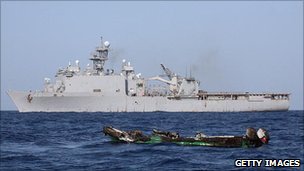
_48901451_98371542(1).jpg

<font size="3">The skiff used by the pirates was
burnt-out after the attack on the
USS Ashland</font size>


BBC
29 November 2010


Jama Idle Ibrahim was caught after an attack on a US naval flotilla which the pirates had apparently mistaken for merchant ships.

He pleaded guilty as part of an agreement which may see him return to court to testify against five other Somalis facing piracy charges.

He still faces other charges connected to an attack in 2008 on a Danish ship.

Monday's sentence was handed down at a federal court in Norfolk, Virginia.

Last week, a Norfolk jury convicted five Somalis of acts of piracy for attacking the USS Nicholas frigate, also in April. They face life in prison at a hearing set for March.

"Today marks the first sentencing in Norfolk for acts of piracy in more than 150 years," US Attorney Neil MacBride said in a statement.

"Piracy is a growing threat throughout the world, and today's sentence, along with last week's convictions, demonstrates that the United States will hold modern-day pirates accountable in US courtrooms."

At a hearing in Norfolk in August, Ibrahim pleaded guilty to attacking to plunder a vessel, engaging in an act of violence against people on a vessel, and using a firearm during a crime of violence. Both Ibrahim and the authorities had agreed to the 30-year jail term.

A judge had earlier dismissed a charge of piracy - which carries a mandatory life sentence - against Ibrahim and his five alleged accomplices because the group had not robbed, boarded or taken control of the US ship.

The gang had chased the USS Ashland in a skiff in the Gulf of Aden on 10 April, opening fire on it.

US Navy personnel returned fire, killing one Somali and wrecking the skiff.

Somalia has been ravaged by internal conflict for two decades, and pirates have flourished amid the US court sentences Somali piratelawlessness.


h[/SIZE][/FONT]ttp://www.bbc.co.uk/news/world-us-canada-11871563
 
Back
Top