Race Exposes Power of Black Athletes

QueEx

Rising Star
Super Moderator
Black Mizzou Football Players Boycott


Black Missouri football players
boycott playing over school chief


<embed src="http://www.cbsnews.com/common/video/cbsnews_video.swf" scale="noscale" salign="lt" type="application/x-shockwave-flash" background="#000000" width="620" height="387" allowFullScreen="true" allowScriptAccess="always" FlashVars="pType=embed&si=254&pid=GEIzx729mIjB&uuid=96a0dc8e-47ae-4218-bc13-35e6f0d7ea29&url=http://www.cbsnews.com/videos/black-missouri-football-players-boycott-playing-over-school-chief/" /><div class='cbs-resources'><span class='cbs-more'>View More: </span><a href='http://www.cbsnews.com/sports/' class='cbs-link'>Sports News</a><span class='cbs-pipe'>|</span><a href='http://www.cbsnews.com/live/' class='cbs-link'>Live News</a><span class='cbs-pipe'>|</span><a href='http://www.cbsnews.com/videos/' class='cbs-link'>More News Videos</a></div><style type='text/css'>.cbs-link {color:#4B5054;text-decoration:none; font: normal 12px Arial;}.cbs-link:hover {color:#A7COFF;text-decoration:none; font: normal 12px Arial;}.cbs-pipe {color:#303435;padding: 0 2px;}.cbs-resources {height:24px; background-color:#000; padding: 0 0 0 8px; width: 612px;}.cbs-more {font: normal 12px Arial; color: #4B5054; padding-right:2px;}</style>​


November 8, 2015, 6:09 PM|At least 30 African-American football players at the University of Missouri say they're on strike and won't play until university president Tim Wolfe steps down. It is the latest in a series of protests against the school's handling of race relations on campus.​


http://www.cbsnews.com/videos/black-missouri-football-players-boycott-playing-over-school-chief/


_____________________________________________________________

Black football players at Missouri:
We'll sit out until system president resigns​


(CNN) Black football players at the University of Missouri have joined calls demanding the ouster of the president of the state's four-campus university system over alleged inaction against racism on campus.

About 30 players made their thoughts known Saturday night in a tweet posted by Missouri's Legion of Black Collegians.

"The athletes of color on the University of Missouri football team truly believe "Injustice Anywhere is a threat to Justice Everywhere," read the tweet. "We will no longer participate in any football related activities until President Tim Wolfe resigns or is removed due to his negligence toward marginalized students' experience."

The players' move is the latest salvo in a spiraling debate over the experiences of African-American students at Missouri, who have complained of inaction on the part of school leaders in dealing with racism on the overwhelmingly white campus.

Black student leaders have complained of students openly using racial slurs and other incidents. In August, someone used feces to draw a swastika, drawing condemnation from black and Jewish student organizations.

One student is on a hunger strike demanding action. Graduate student Jonathan L. Butler started the hunger strike last week, demanding Wolfe's removal.

He wrote Missouri officials that "students are not able to achieve their full academic potential because of the inequalities and obstacles they face," according to the Missourian newspaper in Columbia. "In each of these scenarios, Mr. Wolfe had ample opportunity to create policies and reform that could shift the culture of Mizzou in a positive direction, but in each scenario, he failed to do so."

On Sunday, Butler accused the school's leadership of not caring for the student body.

"I'm in this because it's that serious. We're dealing with humanity here. And at this point, we can't afford to continue to work with individuals who just don't care for their constituents," he told CNN.

"Regardless of what happens with my life, people are really starting these conversations that are necessary and that's what's going to bring about the change in the long term," Butler said.

It's not clear what repercussions, if any, could come to the football players if they refuse to play in Missouri's next football game against Brigham Young University on November 14. Some have called for the students to lose their scholarships.

The school's athletics department said Saturday that it supports the right of student athletes to "tackle these challenging issues."

Head football coach Gary Pinkel seemed to be more direct, tweeting a photo Sunday of dozens of white and black students standing arm in arm with the message, "The Mizzou Family stands as one. We are united. We are behind our players."

The Mizzou Family stands as one. We are united. We are behind our players. #ConcernedStudent1950 GP pic.twitter.com/fMHbPPTTKl
— Coach Gary Pinkel (@GaryPinkel) November 8, 2015​

Missouri Gov. Jay Nixon insisted Friday that the issues must be addressed. Wolfe agreed, but he appeared unwilling to give in to demands that he resign, saying in a statement Sunday that he is "dedicated to ongoing dialogue to address these very complex, societal issues."

"We are tired of dialogue! We want action," the student group behind much of the protest, Concerned Student 1950, tweeted Friday.

We are tired of dialogue! We want action! @UMPrez
— ConcernedStudent1950 (@CS_1950) November 8, 2015​

The group's name refers to the date African-American students were first admitted to the university.

The long-simmering discussion began to boil over this fall, when the African-American student body president spoke out about racism on campus, according to media reports.

Later, a group of African-American students complained that a school safety officer didn't more aggressively pursue an apparently drunken white student who disrupted their gathering and used a racial slur in addressing them.

African-American students then disrupted the school's homecoming parade on October 10, blocking Wolfe's car in a protest calling for greater action on the part of administrators.

They accused Wolfe of looking on impassively and said his car struck one of the protesters. No one was injured, but protesters accused police of using excessive force to disperse protesters.

The top official at the Missouri campus, Chancellor R. Bowen Loftin, ordered mandatory sensitivity training for faculty and students, and Wolfe later apologized.

"Racism does exist at our university, and it is unacceptable," he said.

African-American students said the gestures were insufficient and issued a set of demands calling for school officials to implement broader cultural sensitivity training, increase minority staffing and take other steps.

In his response Sunday, Wolfe said many of the student group's demands are already under consideration.

"It is clear to all of us that change is needed, and we appreciate the thoughtfulness and passion which have gone into the sharing of concerns," his statement said. "My administration has been meeting around the clock and has been doing a tremendous amount of reflection on how to address these complex matters."


Athletes allege abuse and racism at University of Illinois​


The University of Missouri-Columbia has a population of 35,000 students, 17% of whom are minorities, the school says on its website.

Two graduate student groups are calling for walkouts at the university on Monday and Tuesday in solidarity with protesters.

Also Monday, the University of Missouri board of curators will hold an executive session on the Columbia campus.

CNN's Polo Sandoval contributed to this report.​


http://www.cnn.com/2015/11/08/us/missouri-football-players-protest/index.html

 
Re: Black Mizzou Football Players Boycott


Missouri coach Gary Pinkel supports player strike;
team reportedly cancels Sunday practice​


19150736-mmmain.jpg

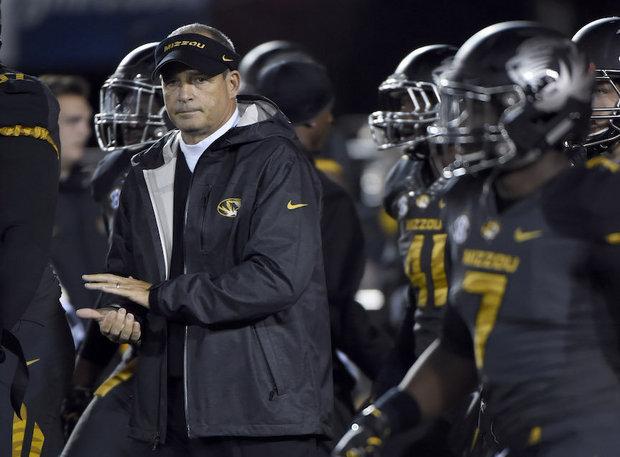
Missouri head coach Gary Pinkel with his team before the start of an NCAA college football game between
Mississippi State and Missouri on Thursday, Nov. 5, 2015, in Columbia, Mo. (AP Photo/L.G Patterson)​


A strike by Missouri football players went to another level Sunday, with head coach Gary Pinkel joining his players in protests against recent racial strife on campus.

On Saturday, several African-American players on the Missouri football team joined campus groups the Legion of Black Collegians and Concerned Students 1950 in calling for the removal of university president Tim Wolfe. The players pledged not to participate in any football activities until Wolfe is fired or steps down.

On Sunday, a photo of all the team's players and coaches standing together arm-in-arm was posted to Pinkel's official Twitter account. It included the caption "The Mizzou Family stands as one. We are united. We are behind our players."


The Mizzou Family stands as one. We are united. We are behind our players. #ConcernedStudent1950 GP pic.twitter.com/fMHbPPTTKl

— Coach Gary Pinkel (@GaryPinkel) November 8, 2015


http://www.al.com/sports/index.ssf/2015/11/missouri_coach_gary_pinkel_joi.html#incart_most-comments

 
Re: Black Mizzou Football Players Boycott


<iframe width="635" height="500" src="http://player.theplatform.com/p/2E2eJC/nbcNewsOffsite?guid=f_mizzou_protest_151108" scrolling="no" frameborder="0"></iframe>​


The University of Missouri's Graduate Professional Council quickly backed the walkout, urging students to participate in protests and solidarity events.

The University of Missouri's history department also expressed support, saying that students who walk out won't be sanctioned. "The department of history understands the way in which institutionalized racism and other forms of social oppression have shaped and affected our society," it said in a statement. "We therefore support our students' efforts to address these problems."

Democratic U.S. Sen. Claire McCaskill, an alumna of the school, said she thinks "it is essential" that the Board of Curators sends a "clear message" to students underscoring an "unqualified commitment to address racism on campus."

Missouri's Attorney General encouraged the "immediate formation" of a task force to address issues raised by "Concerned Student 1950" — the activist group leading protests whose name pays homage to the year Missouri first admitted black students.​


http://www.nbcnews.com/news/us-news...otest-university-missouri-picks-steam-n459671

 
Re: Black Mizzou Football Players Boycott

University of Missouri president steps down amid race row​


151109121742-01-wolfe-missouri-resigns-1109-exlarge-169.jpg


(CNN)—Several University of Missouri organizations, including the football team and the student association, saw their demand met Monday when university system President Tim Wolfe announced he was stepping down amid a controversy over race relations at the school's main campus.

Saying he takes "full responsibility for the inaction that has occurred," he asked that the university community listen to each other's problems and "stop intimidating each other."

"This is not -- I repeat, not -- the way change should come about. Change comes from listening, learning, caring and conversation," he said. "Use my resignation to heal and start talking again."

A timeline of the University of Missouri protests

His decision, he said, "came out of love, not hate," and he urged the university to "focus on what we can change" in the future, not what's happened in the past.

Wolfe's resignation came after black football players at the University of Missouri -- with their coach's support -- threatened not to practice or play again until graduate student Jonathan Butler ended his hunger strike.

Butler said he stopped eating last week and demanded the removal of Wolfe, who until Monday presided over the university system, which includes the main University of Missouri campus, along with the University of Missouri-St. Louis, University of Missouri and Missouri University of Science and Technology.

He tweeted after Wolfe's news conference that he had ended his hunger strike and said, "More change is to come!! #TheStruggleContinues."

He told CNN his reaction to Wolfe's resignation was "just wow," and he was crying because the moment meant so much to him. His fight was not solely against racism, but against sexism and homophobia as well. He fought, he said, because so many others fought for equality before him.

"I was just so overwhelmed about what this truly means ... that students who want to go to college and get an education can now have a fighting chance at having a fair education on a campus that is safe and inclusive," he said. "I wish you guys could be on campus to see the love that is permeating among the students, staff and faculty."​


http://www.cnn.com/2015/11/09/us/missouri-football-players-protest-president-resigns/index.html


Re: Black Mizzou Football Players Boycott


We Shall Overcome' Missouri Students React to Wolfe Resignation​

<iframe width="560" height="315" src="https://www.youtube.com/embed/bPT_l15qGxE" frameborder="0" allowfullscreen></iframe>​


Mizzou student group reacts to president's resignation​

<iframe width="560" height="315" src="https://www.youtube.com/embed/haMcbO9R8KE" frameborder="0" allowfullscreen></iframe>​
 
Re: Black Mizzou Football Players Boycott

Way to go Mizzou! Especially proud of the athletes putting in on the line!
 
Re: Black Mizzou Football Players Boycott

How racial tensions at the University of Missouri
have exposed the power of black athletes​
Especially in contrast to the power of black students more generally.


imrs.php

Jonathan Butler, center, addresses a crowd following the announcement that University of
Missouri System President Tim Wolfe would resign Monday, Nov. 9, 2015, at the university in
Columbia, Mo. Butler has ended his hunger strike as a result of the resignation. (AP Photo/Jeff Roberson)​


By Darla Cameron and
Lydia DePillis
Washington Post
November 10, 2015

After weeks of protests over what students at the University of Missouri saw as racial insensitivity by the administration, it just took one threat — that the school’s football team might go on strike — to bring down the university system president.

That wasn’t just a demonstration of the leverage that student athletics hold in university finances, though it’s certainly considerable. It also was a vivid illustration of the potential power of black athletes in universities where black students represent a tiny proportion of the student body.

"If you look at black undergraduate men, they could do very little in defense of themselves, given their small numbers,” says Shaun R. Harper, director of the Center for the Study of Race and Equity in Education at the University of Pennsylvania. "Given the large number of black men on the football team there, they can do something and they did something.”


imrs.php

In 2013, Harper produced a report showing that between 2007 and 2010, black men made up 2.8 percent of full-time, degree-seeking undergraduates at the 76 schools in the six big athletic conferences, but 57.1 percent of football teams and 64.3 percent of basketball teams. At the University of Missouri, black men now make up 65.3 percent of its football team, according to the most recently released data from the NCAA.

The young men of Missouri's football team not only showed how they could amplify the short-term public relations hit facing the school when graduate student Jonathan Butler went on a hunger strike. They also threatened the school with a financial loss from an unplayed game and a longterm stigma as a place that's hostile to minorities.

“I do not think they knew until this most recent situation just how much collective impact and influence they could have,” Harper says. “Without the black players, you have no football team.”

Well, they’ve been trying to use that power on their own behalf, intermittently, for a couple of decades. But until recently, they hadn’t made the leap to action in the interest of a broader group with which they identified.

Ramogi Huma has been trying to spur college athletes to collective action since 2001, when the former UCLA linebacker founded the National College Players Association to advocate for better healthcare, expanded scholarships and more time to spend on education. Over the years, there have been a few protests, like a boycott by football players at Grambling State in Louisiana in 2013 over poor facilities and grueling bus rides. Now, he thinks the energy is starting to pick up.

“The comments are the same in the locker room. There’s a lot of feelings of injustice among the players, and that hasn’t changed,” Huma says. The difference is that "players are now more informed. You’re seeing players speaking out spontaneously.”

Take the University of Arkansas running back who made the “Hands up, Don’t Shoot” gesture — a reference to the killing of Michael Brown in Ferguson, Mo. — after a touchdown last year. Or in March, the University of Oklahoma football team that mounted a silent protest of a racist video made by one of the school’s white students.


imrs.php


Huma hasn’t lost sight, however, of the thing he thinks would give college athletes even greater power: A union. Earlier this year, the National Labor Relations Board declined to assert jurisdiction in a case at Northwestern University, where football players had taken a vote on whether to join the United Steelworkers, letting stand the lower court’s decision that they weren’t employees. At some point, a union could try again.


imrs.php


If college athletes were deemed employees, they’d enjoy benefits like disability insurance and workers compensation, as well as the power to negotiate contracts with their universities, rather than accepting vague concessions.

“Although I mentioned some of these positive changes that players have won, these are policies that can be rolled back at any minute,” Huma says. “They’re really just promises.”

That additional level of security might also give athletes more power to act on the behalf of other students, as well — although as the Mizzou episode illustrates, they currently have a lot more than they’ve realized in the past.

“There’s a real opportunity here for black male student athletes to step up in other places in support of other black students, and in support of themselves,” Harper says.

* * *​

Here's a look at a few more charts describing the representation of black men in other athletic conferences.


imrs.php


imrs.php


imrs.php


Darla Cameron makes graphics that tell stories at the intersection of business and politics (especially when there are maps involved). Before joining the Post, she worked at the Tampa Bay Times and graduated from the Missouri School of Journalism.

Lydia DePillis is a reporter focusing on labor, business, and housing. She previously worked at The New Republic and the Washington City Paper. She's from Seattle.


https://www.washingtonpost.com/news...ower-of-black-athletes/?tid=pm_business_pop_b


Re: Black Mizzou Football Players Boycott

Especially in contrast to the power of black students more generally.

How racial tensions at the University of Missouri
have exposed the power of black athletes​


<iframe width="560" height="315" src="https://www.youtube.com/embed/FEpNCha5CPk" frameborder="0" allowfullscreen></iframe>
 

The corporate television media of mass deception & distraction (CNN, NBC/MSNBC, CBS, ABC, <s>FOX</s> FAKE) — (90% of the American sheeple rely on corporate television as their ONLY source of “news”??) —. completely mis-characterized, in fact, they lied to their clueless viewers about what this "incident" at the University of Missouri was about.

What just transpired at the University of Missouri was one of the few successful implementations of a 'Black Power' economic boycott since the Martin Luther King led Montgomery Bus Boycott of 1955.

The coach of the University of Missouri's football team Gary Pinkel earns 1000% percent more than the POTUS; in fact he is the highest paid 'State' employee in the State of Missouri. Coach Pinkel earns $4,020,000.00

When the predominately Black Mizzou football team banded together in solidarity in opposition to the patently anti-Black racist campus culture that pervaded University of Missouri,— and they refused to practice and more importantly refused to play in a upcoming football game which would of cost Mizzou $1,000,000 in forfeiture payments — only then did the racist targeted school officials quickly resign. Money talks!


<hr noshade color="#FF0000" size="8"></hr>


d-logo-header.png


3 Lessons From University of Missouri
President Tim Wolfe’s Resignation

The administrators created a world in which universities revolve socially, politically, and economically around the exploited labor of football. Now let them reap what they sow


by Dave Zirin | November 9, 2015 | http://www.thenation.com/article/3-...of-missouri-president-tim-wolfes-resignation/

In shocking news that comes in utter contradiction to a statement released just yesterday, University of Missouri President Tim Wolfe has announced his resignation.

The move comes after incidents of bigotry and racial vandalism that scarred the Columbia campus, followed by weeks of protest, a hunger strike by grad student Jonathan Butler, as well as the announcement that faculty members would not be showing up for work.

Yet the tipping point for Wolfe’s departure was the announcement Saturday night that the black football players at Mizzou would be refusing to practice or play until the school president was gone. Their announcement was followed the next day by a widely circulated photo of most of the team, including many white players, sitting with head coach Gary Pinkel, and the statement that the players had full support of the coaching staff in their efforts. Tim Wolfe makes $459,000 a year and the school would have to forfeit $1 million just for missing this weekend’s game against BYU. In other words, math was not on Tim Wolfe’s side and he was as good as gone.

There are some immediate lessons from this that should be absolutely glaring.

1) Don’t be Tim Wolfe. In 2015, you cannot run a school while being blasé in the face of acts of racist harassment. You cannot, as Wolfe’s supporters bragged when he was brought on in 2012, “run the university like a tech company.” You can’t raise tuition and slash funding for things like health-insurance subsidies while pushing a $72 million expansion of the school’s football stadium. When asked about “systematic oppression,” you can’t say “Systematic oppression is when you don’t believe that you have the equal opportunity for success,” as if marginalized students are just making up the slurs, the vandalism, and the general feeling of being unsafe on their own campus. Don’t be Tim Wolfe, unless you want to be unemployed.


2) Athletes—so often scripted as powerless—have tremendous social power on campus. Too often, those sympathetic with college athletes define them by their hardships instead of by their dazzling, inescapable strengths. We rightfully look at their absence of due process, their lack of access to an income, their hellacious practice and travel schedules, their inability to take the classes of their choosing, and their year-to-year scholarships that consign them to being more “athlete students” than “student athletes.”


Yet they also have a power that if exercised can bring the powerful to their knees. So much of the political and social economy of state universities is tied to football, especially in big-money conferences like Southeastern Conference, where Mizzou plays. The multibillion-dollar college football playoff contracts, the multimillion-dollar coaching salaries, and the small fortunes that pour into small towns on game day don’t happen without a group of young men willing to take the field. The system is entirely based on their acceptance of their own powerlessness as the gears of this machine. If they choose to exercise their power, the machine not only stops moving: It becomes dramatically reshaped.

The emergence of the Black Lives Matter movement threatens the operating of this machinery like nothing since the black athletic revolt of the 1960s and 1970s. These conferences, particularly the Southeastern Conference, field teams that, in the words of sports sociologist Harry Edwards, “look like Ghana on the field and Sweden in the stands.” In other words, black football players in particular have a social power often unseen and not commented upon. It’s there all the same.

These athletes are a sleeping giant. At a school like Mizzou, where just 7 percent of the students are black but a whopping 69 percent of the football players are, one can see how their entry in the struggle had a ripple effect that tore through Columbia and into the college football–crazed national consciousness.

3) Don’t erase the mass struggle of students and faculty members that preceded the football strike. Yes, what the football players did was critical, perhaps even a tipping point in the battle to remove Wolfe from power. But if the football players had acted in a vacuum, then Wolfe would still be in charge. It is also difficult to imagine the football players acting at all without the broader struggle on campus. The protests of students and faculty members whose names the public does not know is what laid the groundwork for the players to showcase their courage. It’s like a stool: students, faculty, and athletes. When one leg on that stool isn’t there, this falls apart.

If there is a lesson here for student activists around the country, it should be to try to connect with so-called “student athletes.” Don’t treat them like they exist in their own space. Don’t accede to the way schools already attempt, with separate dorms and cafeterias, to create an environment where they are segregated from normal campus life. Fight that. Talk to them, listen to their grievances, and make clear to your administration that the athletes, students, and faculty united will never be defeated. The administrators created this world where our universities revolve socially, politically and economically around the exploited labor of big time football. Now let them reap what they sow.

 
Some guy just fled to Canada and claimed political asylum because of racist police. The more things change the more they stay the same.

It looks like there was an environment where people were allowed to terrorize and those in power looked the other way. The college was de facto segregated. Yes you can enter the school or restaurant but you will face a hostile environment that will keep most minorities away.

I have been in worse environments of surveillance and gang stalking. I guess it get more refined and sophisticated as you get older. Unfortunately, our political leadership who control law enforcement look the other way.

I think the tactics used to deal with the problem were brilliant.
 

University of Mo.’s New Diversity Chancellor
Vows to Listen


Chuck Henson says that his job is “to make sure
the idea of inclusion stays front and center.”


hensonchuckenlarged.jpg.CROP.rtstoryvar-medium.jpg

A former assistant attorney general in the Missouri Attorney General’s
Office, Henson earned his bachelor’s degree from Yale and a law degree
from Georgetown University. He began his tenure at the University of
Missouri in 2009, where he’s served as an adjunct professor, a visiting
professor and a trial-practice professor of law. Henson’s academic
scholarship focuses on Title VII of the 1964 Civil Rights Act, which
prohibits employment discrimination based on race, color, religion,
sex or national origin.​


There’s a rumbling going on at college campuses across this nation. Racial tensions are high. For years, students have complained about racism and the lack of diversity in both the student body and faculty at the nation’s institutions of higher learning, only to have their concerns fall on deaf ears. So they have taken to the streets. There have been protests at Yale, Ithaca College and Claremont McKenna, where the dean of students recently resigned.

Their voices are finally being heard, or so it seems.

At Yale, for example, the university has pledged $50 million to increase the diversity of its faculty.

The world is watching the tense situation at the University of Missouri, which recently appointed an African-American former administrator, Michael Middleton, as interim president of the university system. But for years, minority students had complained of racial incidents. When a swastika drawn with feces was found on a campus wall, the students said enough was enough. A group of protesters calling themselves Concerned Student 1950, in reference to the first year African-American students were admitted to the university, finally decided to stand their ground.​

Graduate student Jonathan Butler went on a hunger strike, and Mizzou’s mostly black football team threatened to boycott games until the school’s president resigned. Indeed, on Nov. 9, University of Missouri President Timothy Wolfe stepped down. A day later, Chuck Henson, associate dean for academic affairs and trial practice at the University of Missouri School of Law, was appointed interim vice chancellor for inclusion, diversity and equity—a newly created position—at the school.

“Everyone who is in this community is working very hard to move our relationship with each other forward,” said Henson in a teleconference with a group of reporters.


Henson says that his first step in the new role is just to listen.


“The concerns aren’t limited to the student body,” Henson noted. “These are concerns of everybody in the community, and there are concerns about everyone’s voice being heard; there are concerns about everyone having a fair opportunity in their education.”

“The message I received as part of the student movement was a message of inclusion for everyone,” Henson said. “It’s my job to make sure the idea of inclusion stays front and center.”

Henson said that he understands the students’ pain and passion. He’s aware of their frustration over the pace of change. Henson also acknowledged, however, that in his interim position, he had little power to make any substantive immediate changes. Instead, he said, he will continue to try to move things forward, just as Middleton did years before his retirement last summer as deputy chancellor.

“I will keep things moving forward and focus on the process — by which I mean regular engagement, conversation, listening, developing these conversations into issues that need to be addressed, going from there to action items and then executing on those action items,” said Henson.

But it’s going to be a long road. Henson has already noted the massive “expenditure of fiscal and emotional energy” that he’s experienced in the short time since his appointment. But continued incidents, including recent social media threats to African-American students and vandalism at the university’s Gaines-Oldham Black Culture Center, has Henson committed to the cause. He choked up as he thought about the “suffering that everyone in our community is going through.”

“My plan is to spend myself completely in building relationships and seeing that we move forward together,” Henson said.

Lottie L. Joiner is a Washington, D.C.-based freelance writer.​


http://www.theroot.com/articles/cul...at_university_of_missouri_vows_to_listen.html


what the racist people who control the media are afraid of,

is black unity...?

it puts the fear of Jesus, Mary and the mule in them!!!


trust me, they started the spark...

a fire could pop off at anytime now..

thats what made trump respond the way he did..

and if trump was the college president and did that

donkey ass move, all he wouldve dont is caused the fire

much sooner than expected....

and that fire will work in the favor of all the good people not

just the melanin rich ones.
 
Back
Top