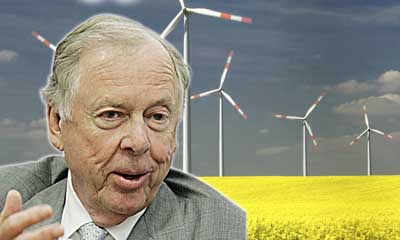
Our Energy Crisis - The Pickens Plan

QueEx

Rising Star
Super Moderator
<embed src="http://services.brightcove.com/services/viewer/federated_f8/1632654798" bgcolor="#FFFFFF" flashVars="videoId=1653634930&playerId=1632654798&viewerSecureGatewayURL=https://console.brightcove.com/services/amfgateway&servicesURL=http://services.brightcove.com/services&cdnURL=http://admin.brightcove.com&domain=embed&autoStart=false&" base="http://admin.brightcove.com" name="flashObj" width="486" height="412" seamlesstabbing="false" type="application/x-shockwave-flash" swLiveConnect="true" pluginspage="http://www.macromedia.com/shockwave/download/index.cgi?P1_Prod_Version=ShockwaveFlash"></embed>
 
<IFRAME SRC="http://www.pickensplan.com/theplan/" WIDTH=780 HEIGHT=1500>
<A HREF="http://www.pickensplan.com/theplan/">link</A>

</IFRAME>
 
Thanks for this. I've seen Pickens TV spots and wondered what his plan entailed. Unusual for an oil man to tout any other energy source. :yes:
 
<IFRAME SRC="http://www.politico.com/news/stories/0708/11922.html" WIDTH=780 HEIGHT=1500>
<A HREF="http://www.politico.com/news/stories/0708/11922.html">link</A>

</IFRAME>
 
<font size="5"><center>Wind energy faces daunting challenges</font size></center>

McClatchy Newspapers
By Dave Montgomery
Friday, July 25, 2008


WASHINGTON — Led by billionaire Texas oilman T. Boone Pickens, pioneers in the emerging wind-power industry are touting their product as The Next Big Thing as they chart a course to produce at least 20 percent of the nation's electricity in just over two decades.

But reaching that goal won't be easy. The most daunting challenge centers on the fundamental question of how to get the product to customers. That will require building thousands of miles of transmission lines to carry electricity from turbines clustered on wind-swept prairies in America's heartland to distant cities and towns.

Industry leaders are calling for a national commitment to wind power on the same scale as the Eisenhower administration's commitment to constructing the Interstate Highway System. Erecting a transmission grid for wind-generated electricity, they say, would require up to 20,000 miles of new lines at a minimum cost of $60 billion — and possibly much more.

The undertaking faces "all kinds of problems," from right-of-way issues to resistance by "not-in-my-backyard" groups opposed to the aesthetic intrusion of giant wind turbines, says Steven P. Lindenberg, with the office of wind and hydropower technologies in the Department of Energy.

"It's huge," Mike Sloan, president of Austin, Texas-based Vitrus Energy, says in describing the challenge. "If you don't have a transmission system to get it there, it becomes useless."

With the price of gasoline shooting past $4 a gallon, wind power has emerged as a promising source of clean, renewable energy. Pickens, who amassed a fortune in the oil business, is now touting wind power with a $58 million multimedia campaign denouncing the nation's dependence on foreign oil.

The 80-year-old chairman of BP Capital Management, who is building the world's biggest wind farm in the Texas Panhandle, urged Congress this week to fully commit to wind energy during a series of recent appearances on Capitol Hill. Pickens says Americans can reduce foreign oil dependence by more than a third by ramping up wind power for electricity generation, thus freeing up the country's abundant natural gas resources to power environmentally friendly cars, trucks and buses.

More than 25,000 wind turbines are operating nationwide, and industry leaders envision a potential boom in coming years. The American Wind Energy Association has declared a goal of 20 percent wind energy by 2030, buoyed by an Energy Department study concluding that the goal was feasible.

"This is a technology that has been fully vetted," said AWEA President James A. Walker of the California-based enXco, which builds wind energy projects nationwide. "This is ready for prime time."

The U.S. wind industry started in California in the 1970s when an oil shortage increased the cost of oil-based electricity. After a series of ups and downs, wind power has surged with concern over global warming and latter-day oil spikes. It grew by 45 percent in 2007, accounting for 30 percent of all new power generating capacity added in the United States that year.

Most of the nation's turbine farms are located in the "wind corridor" stretching through the center of the country from Texas to the Canadian border. Texas, with more than 4,000 turbines, is the biggest wind producer, surpassing California for that title in 2006.

But wind power is also what experts call a "location-constrained resource," meaning that it can't be transported like coal or oil and is thus dependent on a network of lines and towers to reach a market often hundreds of miles away. It is thus burdened by a "chicken-and-egg problem" — wind farms don't want to locate in a site without transmission lines, and utilities don't want to erect lines where there are no wind farms.

Additionally, Pickens told a Senate committee, "long-distance transmission is only economic if it is built to high capacity, which means that there must be a large amount of generation capacity in one place."

Lindenberg, who participated in a briefing on wind energy for congressional aides, said existing lines are capable of carrying only a small amount of projected wind power, thus requiring an ambitious plan to construct new lines and towers. Walker pegged the cost at $60 billion but Pickens projects a cost of about $200 billion.


McClatchy Newspapers 2008

http://www.mcclatchydc.com/226/story/45638.html
 
the only problem I have with wind energy is the fact that wind speeds die down during the summer months *the time most of the energy is used*.

I think we do need this, and clean coal energy *because we know we have a large coal supply*.

Not to mention, Pickens just invested a large amount of money for wind energy. There's no secret on why he is promoting this all of a sudden. BTW, this isn't a bad plan if you decide to drill off shore, and use clean coal with it.
 
the only problem I have with wind energy is the fact that wind speeds die down during the summer months *the time most of the energy is used*.

I think we do need this, and clean coal energy *because we know we have a large coal supply*.

Not to mention, Pickens just invested a large amount of money for wind energy. There's no secret on why he is promoting this all of a sudden.
Do you have a problem with T. Boone; T. Boone's "Plan" or are you saying that the government should be the lead investor in alternative sources of fuel???


actinanass said:
BTW, this isn't a bad plan if you decide to drill off shore, and use clean coal with it.
Isn't "clean coal" an oxymoron ???

We know that there is no such thing as clean coal in its natural state. It can be treated (at a cost) so that it has fewer environmental effects; but, does the cost - benefit justify our reliance that it will play a major role in our energy independence ???

QueEx
 
Do you have a problem with T. Boone; T. Boone's "Plan" or are you saying that the government should be the lead investor in alternative sources of fuel???


Isn't "clean coal" an oxymoron ???

We know that there is no such thing as clean coal in its natural state. It can be treated (at a cost) so that it has fewer environmental effects; but, does the cost - benefit justify our reliance that it will play a major role in our energy independence ???

QueEx


<font size="5"><center>
Clean Coal Projects:
Cleaning Out the Pockets of Taxpayers</font size></center>


Taxpayers for Common Sense
September 09, 2008

Since the late 1970’s, the federal government has funneled billions of dollars into “Clean Coal” technology and programs designed to make the mining and burning of coal less polluting. Unfortunately, funding for clean coal technology has done little more than increase the profits of coal companies. Poorly run and over-funded, clean coal has largely been a waste of taxpayer dollars. Consider the following:

  • Since 1978, the federal government has invested $2.5 billion on clean coal technology.[1] The Energy Policy Act of 2005 included more than $8 billion in subsidies for the coal industry.[2] In 2007 alone, the federal government spent $61 million on its Clean Coal Power Initiative, and an additional $54 million on the FutureGen initiative to develop the technology for zero-emissions coal-fired power plants.[3]

  • The Bush Administration’s Clean Coal Power Initiative, began in 2002, provides $2 billion over 10 years to projects that implement clean coal technologies. The government funds up to fifty percent of the cost of each project.[4]

  • The Energy Policy Act of 2005 included more than $8 billion in subsidies for the coal industry. This includes the following $4.1 billion in subsidies specifically for clean coal:[6,7]

  • $1.8 billion for the Clean Coal Power Initiative, described above

  • Up to $80 million in loans for the Healy Power Plant, a clean coal plant in Alaska

  • $425 million for coal-to-liquids demonstration projects at Southern Illinois University, University of Kentucky, and Purdue University

  • $90 million for carbon capture research and development, a ten-year project to develop carbon capture technologies for new and existing coal power plants

  • $1.68 billion in tax credits for clean coal facilities

The bill also includes an additional $1.1 billion for the Coal and Related Technologies Program, which, among other things, funds research on clean coal technologies and carbon capture and sequestration.​

  • Coal companies shouldn’t need the billions of dollars in support they’re getting from the federal government. Peabody Energy, the largest private-sector coal company, posted record revenue in the second quarter of 2008, more than doubling its profits from the same quarter last year.[8]


  • Private companies can develop these technologies at a lower cost. After spending millions of dollars on Coal Preparation and Environmental Control projects, the government found that these technologies could not compete with other, more efficient techniques developed in private industry. [9]


  • Successful clean coal projects were supposed to generate income, and repay the Department of Energy for the original costs. But of the $1.6 Billion invested in clean coal, only $2 million, around a tenth of one percent, has been repaid. [10]


  • The Government Accountability Office (GAO) has condemned the Clean Coal program as inefficient and a waste of taxpayer dollars. In 2001, the GAO stated: “From a management perspective, we found that many [Clean coal] projects had experienced delays, cost overruns, bankruptcies, and performance problems.” [11]


  • Of the 13 Clean Coal projects that the GAO examined, six projects were behind schedule by as much as seven years, and two projects were completely bankrupt. Furthermore, of the 50 projects funded under the Clean Coal Technology program, 12 were never finished. [12]


  • In a 2005 review of the Department of Energy’s clean coal research, the Office of Management and Budget gave them a score of only 33% on “program results/accountability” and noted the Department of Energy’s “lack of evaluation of whether research and development (R&D) programs have been effective in achieving relevant and beneficial outcomes that otherwise would not have occurred without the program intervention.” [13]

  • Clean coal technologies don’t need taxpayer subsidies. The GAO found that many of the Department of Energy’s clean coal projects could have been developed without millions of dollars in federal assistance. [14]

Congress must stop throwing billions of taxpayer dollars at a program that has been plagued with inefficiencies and mismanagement. Continued funding for the bloated clean coal program will do little to help our nation’s energy future and leave taxpayers paying a hefty price.


_____________________________________

1. EIA: Federal Financial Interventions and Subsidies in Energy Markets 2008


2. Energy Policy Act of 2005 http://thomas.loc.gov


3. EIA: Federal Financial Interventions and Subsidies in Energy Markets 2008.


4. NETL, “Clean Coal Demonstrations”, http://www.netl.doe.gov/technologies/coalpower/cctc/ccpi/index.html, 2008.


5. Public Law 109-58, “Energy Policy Act of 2005”, August 2005.


6. Ibid.


7. TCS Analysis of Energy Policy Act of 2005


8. UPI Energy, “Peabody posts record profits”, July 2008.


9. CRS Report: The Clean Coal Technology Program: Current Prospects (4/6/01)


10. U.S. Department of Energy, Fiscal Year 2003 Budget, February 4, 2002, http://www.whitehouse.gov/omb/budget/fy2003/pdf/bud14.pdf Page: 12


11. GAO: “Lessons Learned in the Clean Coal Technology Program.” (6/12/01)


12. U.S. Department of Energy, Fiscal Year 2003 Budget, February 4, 2002, http://www.whitehouse.gov/omb/budget/fy2003/pdf/bud14.pdf. Page: 12


13. ExpectMore.gov, “Detailed Information on the Coal Energy Technology Assessment”, http://www.whitehouse.gov/omb/expectmore/detail/10000086.2005.html, 2005.


14. GAO: “Lessons Learned in the Clean Coal Technology Program.” (6/12/01)​


<center>For more information, please visit www.taxpayer.net
Or contact Autumn Hanna at (202) 546-8500 or info@taxpayer.net
September 2008</center>


http://www.taxpayer.net/resources.php?category=&type=Project&proj_id=1302&action=Headlines By TCS
 
<font size="6">
<center>
CNG</FONT SIZE><FONT SIZE="5">

Compressed Natural Gas (CNG)

As a Transportation Fuel

</font size>


</center>


<IFRAME SRC="http://www.consumerenergycenter.org/transportation/afvs/cng.html" WIDTH=780 HEIGHT=1500>
<A HREF="http://www.consumerenergycenter.org/transportation/afvs/cng.html">link</A>

</IFRAME>
 
<IFRAME SRC="http://www.cngmotors.com/" WIDTH=780 HEIGHT=1500>
<A HREF="http://www.cngmotors.com/">link</A>

</IFRAME>
 
<IFRAME SRC="http://www.mcclatchydc.com/226/story/53653.html" WIDTH=780 HEIGHT=1500>
<A HREF="http://www.mcclatchydc.com/226/story/53653.html">link</A>

</IFRAME>
 
<font size="5"><center>
Pickens' wind plan hits a snag</font size>
<font size="4">

Credit crunch and falling natural gas prices
delay plans for giant Texas farm. </font size></center>


CNN Money
By Steve Hargreaves,
CNNMoney.com staff writer
November 12, 2008


NEW YORK (CNNMoney.com) -- Billionaire oilman T. Boone Pickens is delaying his massive Texas wind project, citing a drop in natural gas prices and the tightening credit market.

"With natural gas prices where they are, you can't kick off a wind project, you're not economical." Pickens said Tuesday at a news conference in Arizona.

But Pickens, who has spent millions over the last few months promoting his "Pickens Plan" to wean the United States off foreign oil by switching to wind and natural gas, said natural gas and oil prices will rise again in less than a year, and characterized the setback as temporary.

A spokesman for Mesa Power, Pickens' company that is building the Texas wind farm, laid the blame more on the credit markets.

"The capital markets are problematic for everyone and...may lead us to scale back a bit," Jay Rosser, a spokesman for Mesa, said in a statement. "But we are still going forward with our wind business."

Pickens' wind farm in Texas, known as the Pampa Wind Project, was slated to be the largest wind farm in the world, generating 4,000 megawatts of electricity, enough to power 1.3 million homes.

A spokesman for Pickens said turbines for the first phase of the project, 1,000 megawatts of power, are still being purchased. The first phase was slated to come online in 2011. Although now it is no longer clear when it will come on line.

The Pickens Plan, which the billionaire has been pushing in TV commercials, media appearances and lobbying efforts since last summer, calls for the country to use wind to generate 20% of its electricity, displacing some of the natural gas that's currently used to generate power. The natural gas, an abundant domestic resource, could then be used to power vehicles, thus reducing oil imports.

But natural gas prices have fallen from over $12 per million British thermal units last summer to current levels of around $6.

The fall in natural gas prices makes switching to wind power a less certain bet, as utilities would be reluctant to replace natural gas with wind now that natural gas prices are so low.

Pickens said Tuesday that natural gas prices need to be about $9/Btu in order for wind power to be competitive.

He remained confident the dip in prices would not effect his overall Pickens Plan.

"We will get the plan," he said.

Pickens, who made his money in oil production and trading, has been saying for years that the United States is too dependent on foreign oil, and that oil prices will continue to rise over the long term as demand outstrips supply.

http://money.cnn.com/2008/11/12/news/economy/pickens/?postversion=2008111213
 
<font size="5"><center>
T. Boone Pickens Alters His Energy Plan</font size>
<font size="4">

Oil man says "the national romance with the automobile
was beyond his reckoning. “America is nuts about cars,”
he said. “I don’t quite understand this thing about horse-
power; NOW, he is refocusing his plan, de-emphasizing
wind energy - - turning his natural gas focus from cars
and pickup trucks to big commercial vehicles
, including
buses and the 18-wheelers that move American freight.</font size></center>


t_boone_pickens.jpg

“We have to target heavy-duty vehicles,” Mr. Pickens said
during a meeting at The New York Times.


The New York Times
By JIM MOTAVALLI
January 20, 2010


T. Boone Pickens, the Texas billionaire, got his first car, a 1942 Ford, in 1946. But in an interview today at The New York Times, he made it plain that the national romance with the automobile was beyond his reckoning. “America is nuts about cars,” he said. “I don’t quite understand this thing about horsepower. Cars are not a big deal to me, but they are a big deal to a lot of people.”

Nevertheless, the Pickens plan he began in 2008 seeks to transform the way Americans drive by powering vehicles with what he calls our “abundance of clean, cheap, domestic natural gas.” But, in New York, Mr. Pickens said he was refocusing the plan, not only de-emphasizing wind energy, but also turning his natural gas focus from cars and pickup trucks to big commercial vehicles, including buses and the 18-wheelers that move American freight.


<font size="4">Oil Man Moves From Wind to Gas</font size>

“We have to target the heavy-duty vehicles, which is where you can get the volume,” Mr. Pickens said. He said he had been meeting with large trucking companies, hoping to persuade them to switch at least part of their fleets to natural gas. Mr. Pickens said he once explained to Al Gore that battery propulsion was not likely to work well for large trucks. “Natural gas is 130-octane fuel, and it is 25 percent cleaner than diesel,” he said.

T. Boone Pickens, the Texas billionaire, got his first car, a 1942 Ford, in 1946. But in an interview today at The New York Times, he made it plain that the national romance with the automobile was beyond his reckoning. “America is nuts about cars,” he said. “I don’t quite understand this thing about horsepower. Cars are not a big deal to me, but they are a big deal to a lot of people.”

Nevertheless, the Pickens plan he began in 2008 seeks to transform the way Americans drive by powering vehicles with what he calls our “abundance of clean, cheap, domestic natural gas.” But, in New York, Mr. Pickens said he was refocusing the plan, not only de-emphasizing wind energy, but also turning his natural gas focus from cars and pickup trucks to big commercial vehicles, including buses and the 18-wheelers that move American freight.

“We have to target the heavy-duty vehicles, which is where you can get the volume,” Mr. Pickens said. He said he had been meeting with large trucking companies, hoping to persuade them to switch at least part of their fleets to natural gas. Mr. Pickens said he once explained to Al Gore that battery propulsion was not likely to work well for large trucks. “Natural gas is 130-octane fuel, and it is 25 percent cleaner than diesel,” he said.


Mr. Pickens drives a natural gas-burning Honda Civic GX, he said, but he appears to be backing away from trying to put its equivalent in American driveways. Mr. Pickens, who has met with President Obama about his plan, likes the idea of <u>requiring</u> large freight haulers to run on domestic fuel. And he’s not talking about ethanol. “Ethanol is a stupid fuel,” he said.

<font size="4">Natural Gas Legislation</font size>

Mr. Pickens is a supporter of legislation introduced last April that, among other provisions, offers new and stronger tax credits for purchasers of natural gas cars and the companies that produce them. The legislation, H.R. 1835, would also require 50 percent of new federal government vehicles bought before the end of 2014 to be capable of operating on either compressed or liquefied natural gas. “It has 127 co-sponsors,” he said.


http://greeninc.blogs.nytimes.com/2010/01/20/t-boone-pickens-tweaks-his-energy-plan/
 
<font size="5"><center>
After 10-year battle,
first U.S. offshore wind farm approved</font size></center>


20100428_CAPE_WIND.wide_photo.prod_affiliate.91.jpg


McClatchy Newspapers
By Renee Schoof
Wednesday, April 28, 2010


WASHINGTON — Interior Secretary Ken Salazar on Wednesday approved the nation's first offshore wind farm, the 130-turbine Cape Wind project off Cape Cod, Mass., and said that the power of strong winds over the Atlantic Ocean would be an important part of the U.S. drive to reduce dependence on fossil fuels.

European countries have been building offshore wind farms for 20 years, and China is building its first, off Shanghai. Other U.S. states along the Atlantic Coast and the Great Lakes also are looking into building wind farms to produce large amounts of electricity.


The Cape Wind project, however, has been hung up for nine years as opponents — landowners, two Native American tribes and the Advisory Council on Historic Preservation — objected to its cost and its impact on views.

Although Cape Wind's fate is not related to other proposed U.S. offshore wind farms, many wind energy supporters hailed the decision as a good sign for the future of renewable energy development. The Interior Department set new rules for offshore wind last year and said it was working to streamline the permit process.

The decision on Cape Wind comes a month after the Obama administration approved more offshore oil and gas drilling. At a press conference, Salazar was asked about an oil spill in the Gulf of Mexico from a deepwater rig that exploded last week.

Salazar said the Interior Department was watching the spill carefully. He added that "my own view" is that the country needed to move away from fossil fuels.

"Our overdependence on fossil fuels has created a problem we have in this country which has endangered our national security and at the same time has created the challenge we have with responding to the warming of the planet," Salazar said.

"We will continue to use fossil fuels, yes, in an appropriate way, but we need to transition to a clean energy future," he said.

Salazar also said that the United States is no longer leading in renewable energy technology. "We don't want to be second," he said, and so the government also would support efforts to get other offshore wind projects built.

Offshore wind farms have been proposed in proposed off Rehoboth Beach, Del.; Boston; Atlantic Beach, Atlantic City and Avalon in New Jersey, in North Carolina's Eastern Pamlico Sound; in Lake Erie off Cleveland; off Block Island and Sakonnet in Rhode Island, and off Galveston, Texas.

The Alliance to Protect Nantucket Sound said opponents would attempt to stop the wind farm in court.

"We will not stand by and allow our treasured public lands to be marred forever by a corporate giveaway to private industrial energy developers," the group's president and CEO, Audra Parker, said in a statement.

Plans for Cape Wind call for construction to begin within a year. Its 130 turbines would be placed in a grid pattern over a 25-square-mile area of Nantucket Sound. The closest turbine to land will be about five miles from Cape Cod. The turbines will supply a maximum of 468 megawatts of electricity, about the output of a medium-sized coal-fired electricity plant, or enough for about 200,000 homes in Massachusetts.

The Interior Department said it would reduce carbon dioxide emissions by the equivalent of taking 175,000 cars off the road.

The developer, Energy Management Inc., said that the wind turbines would appear a half-inch above the horizon from the nearest beach.

Salazar said the developer was required to reduce the number of turbines from an original plan for 170, reconfigure their arrangement and paint them off-white to reduce their visibility.

Massachusetts Gov. Deval Patrick and governors of five other Atlantic states wrote to Salazar arguing that if he blocked Cape Wind on the grounds of historic preservation, it would be difficult to get an offshore wind permit approved anywhere on the East Coast.

Patrick said the cost of conventional electricity has gone up in recent years, and the wind project would benefit consumers because the costs wouldn't fluctuate.

Cape Wind has not yet signed a power purchase agreement, and so it's not known how much its electricity will cost.

"We hope that today's decision on Cape Wind will help set in motion a series of actions leading to additional American offshore wind projects," Michael Hirshfield, senior vice president of the conservation group Oceana, said in a statement. "It sends a clear signal to turbine manufacturers and supporting companies that the U.S. means business on clean energy and climate change."

Michael Fry, director of conservation advocacy for the American Bird Conservancy and chair of an Interior Department advisory committee, criticized the decision.

Fry said that not enough was known about the potential for bird collisions and that the site is a prime foraging area for sea ducks and near a breeding ground for endangered roseate terns.

Rep. William Delahunt, a Democrat who represents Cape Cod, and Sen. Scott Brown, R-Mass., said they were in favor of wind power as an energy source, but opposed Cape Wind. Brown said that Nantucket Sound was a national treasure that should not be used for wind power, and that the wind farm would harm Cape Cod's tourism and fishing.

Sen. John Kerry, D-Mass., a longtime leader in the Senate for measures to reduce the threat of climate change, said Salazar made his decision after weighing all concerns. Kerry said he supported it.


http://www.mcclatchydc.com/2010/04/28/93081/obama-administration-oks-first.html


 

Obama, T. Boone Pickens
push natural gas as energy fix


McClatchy Newspapers
By Maria Recio
Friday, April 1, 2011


WASHINGTON — The centerpiece of President Barack Obama's new
energy policy mirrors the plan trumpeted for more than two years by
a onetime GOP juggernaut: Dallas oilman T. Boone Pickens.

Pickens wants the U.S. to turn to natural gas, beginning with fleets of
18-wheelers that run on the abundant domestic resource. How long would
it take to reduce our dependence on foreign oil? In seven years, said
Pickens, "we could cut our dependence on OPEC in half, to 2.5 million
barrels a day."

The billionaire told reporters last week that he's spent $80 million of his
own money touting the plan. He's supremely confident that a bill being
introduced Wednesday in the House of Representatives by two
Democrats and two Republicans — which would give natural gas
producers, engine makers and truck operators tax incentives — will
move quickly as gasoline prices continue to spike and the Middle East
ignites.

"In the House, I'm confident you'll have over 300 votes on this," Pickens
said. And the timetable to get it passed by the House and Senate and
signed into law? "I predict, this year."

Supporters of the bill say that's pretty much on the mark, especially
since transportation and energy got a big boost from the president twice
this week — on Wednesday, in a speech about energy at Georgetown
University, and on Friday, in an appearance at a United Parcel Service
facility in Landover, Md., promoting a "Clean Fleet Partnership" between
the government and companies with truck fleets.

In his Georgetown speech, Obama singled out domestically produced natural
gas and called for the U.S. to reduce dependence on foreign oil by one-
third in a decade, saying that when it comes to finding a secure
alternative, "the potential for natural gas is enormous."

Full Story


Back
Top