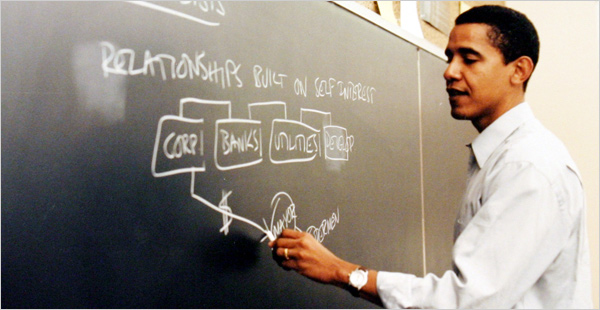
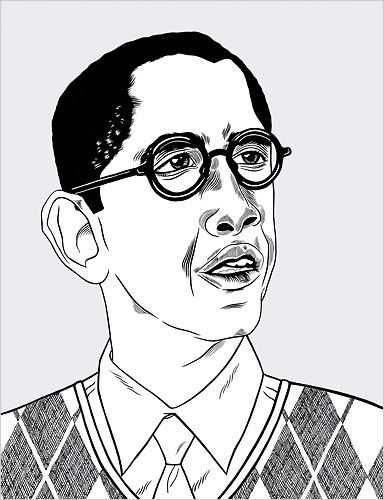
Inside Professor Obama’s Classroom

keysersoze

Star
Registered
Inside Professor Obama’s Classroom

By Jodi Kantor

Examining the Documents

We’ve asked four legal experts to take a look at then-Professor Obama’s course materials and offer some insight into what they say about Mr. Obama’s teaching methods, priorities and approach to the Constitution. First up, is John C. Eastman , the Henry Salvatori Professor of Law & Community Service at Chapman University School of Law, specializing in Constitutional Law and Legal History.

Please use the comment section with this post to ask questions about Mr. Obama’s course materials and therelated article.

John C. Eastman: Although Senator Obama’s teaching position at the University of Chicago Law School overlapped my own time there as a student, I did not have occasion to take one of his classes—I tended to register for the classes of the full-time tenured faculty rather than those taught by adjuncts such as Mr. Obama—but I am not surprised to see the intellectual diversity for which Chicago is famous reflected in then-Professor Obama’s course syllabi and examinations. The syllabus from the 1994 “Current Issues in Racism and the Law” course is particularly instructive. While at many law schools, such courses are frequently taught by critical race theorists who focus largely on one side of a complex legal and policy debate, then-Professor Obama’s course included, quite appropriately in my view, readings from across the ideological spectrum, from Derrick Bell and Malcolm X to Chuck Cooper and Lino Graglia. I was particularly pleased to see a reading from the classic work by Vattel, The Law of Nations. What is more, it is evident from the sampling of proposed topics for group presentations contained in the syllabus that this spectrum of authors was included for more than mere exposure. Rather, it appears that then-Professor Obama was leading his students in an honest assessment of competing views regarding some of the most difficult legal and policy issues our nation has ever faced—a refreshing change from what passes for debate about contested questions in our political classes these days. My one criticism of the course is his recommendation that students read Derrick Bell’s summary of some landmark (if notorious) Supreme Court decisions. Cases such as Dred Scott v. Sanford, The Slaughterhouse Cases, and Plessy v. Ferguson, and in particular the strong dissenting opinions in those cases, cry out for careful study of the original materials, not a secondary summary.

Only occasionally do then-Professor Obama’s decidedly personal views come across. He refers to Justice Scalia’s approach to assessing fundamental rights as “cramped,” for example. But on the whole, this is a body of course materials that is as would be expected of Chicago Law Professors.

Original Post | July 17:
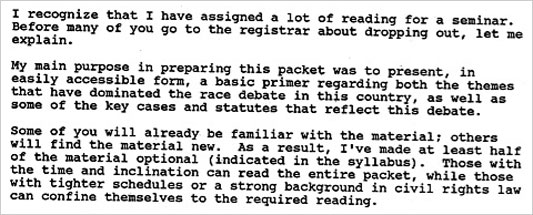
obamalaw533.jpg

An excerpt from the syllabus for Barack Obama’s 1994 Current Issues in Racism and the Law seminar.​

In the course of reporting an article on the 12 years that Barack Obama spent teaching law at the University of Chicago, we unearthed some of Mr. Obama’s old class materials: the syllabus and assignments for his “Racism and the Law” seminar, as well as a set of his constitutional law exams and a partial set of memos he wrote about the answers.

The documents let us hear his voice as a professor, asking students to wrestle with hot-button topics like cloning and reparations. He tells students what he wants and interrogates them on what they have learned. In his little asides about gym visits and his wife, Michelle, we hear hints of his professorial style.

But the documents also offer clues about his thinking. They show us whose writings he wanted students to explore, from Malcolm X to Robert Bork. He framed complex legal, moral and political issues for his students, and in the case of post-exam memos, answered a few problems for them. Those memos also contain a few references to still-sitting Supreme Court justices.

We’re posting the documents here, and inviting you to offer your insights. Since the exam questions in particular involve hard-to-parse issues of constitutional law, we have asked four legal experts, of diverse ideological backgrounds, to lead our inquiry. John Eastman, Randy Barnett, Pamela S. Karlan and Akhil Reed Amar have already looked through the documents, at our request, and on Wednesday we will post their assessments here.

Some of the questions we’ve asked them to consider: Based on what you see here, how does Mr. Obama’s teaching measure up? What do the courses he taught, and the way he taught them, tell us about his interests, beliefs and priorities, including his approach to the Constitution?

We will be integrating reader questions and comments into the discussion, so please post yours below. Everyone is welcome: readers, constitutional law professors, former students and colleagues of Mr. Obama’s. (As for the documents, if you’re not a lawyer, you will probably find the “Racism and the Law” syllabus a more satisfying read than the constitutional law exams.)

Link to rest of article & his exams -
http://thecaucus.blogs.nytimes.com/2008/07/29/inside-professor-obamas-classroom/
 

30law_600.jpg

NOT AFRAID TO PROVOKE Barack Obama taught at the University of Chicago Law School for 12 years.
Former students say he tested many of the ideas of his presidential campaign in the classroom.​

CHICAGO — The young law professor stood apart in too many ways to count. At a school where economic analysis was all the rage, he taught rights, race and gender. Other faculty members dreamed of tenured positions; he turned them down. While most colleagues published by the pound, he never completed a single work of legal scholarship.

At a formal institution, Barack Obama was a loose presence, joking with students about their romantic prospects, using first names, referring to case law one moment and “The Godfather” the next. He was also an enigmatic one, often leaving fellow faculty members guessing about his precise views.

Mr. Obama, now the junior senator from Illinois and the presumptive Democratic presidential nominee, spent 12 years at the University of Chicago Law School. Most aspiring politicians do not dwell in the halls of academia, and few promising young legal thinkers toil in state legislatures. Mr. Obama planted a foot in each, splitting his weeks between an elite law school and the far less rarefied atmosphere of the Illinois Senate.

Before he outraised every other presidential primary candidate in American history, Mr. Obama marched students through the thickets of campaign finance law. Before he helped redraw his own State Senate district, making it whiter and wealthier, he taught districting as a racially fraught study in how power is secured. And before he posed what may be the ultimate test of racial equality — whether Americans will elect a black president — he led students through African-Americans’ long fight for equal status.

Standing in his favorite classroom in the austere main building, sharp-witted students looming above him, Mr. Obama refined his public speaking style, his debating abilities, his beliefs.

“He tested his ideas in classrooms,” said Dennis Hutchinson, a colleague. Every seminar hour brought a new round of, “Is affirmative action justified? Under what circumstances?” as Mr. Hutchinson put it.


But Mr. Obama’s years at the law school are also another chapter — see United States Senate, c. 2006 — in which he seemed as intently focused on his own political rise as on the institution itself. Mr. Obama, who declined to be interviewed for this article, was well liked at the law school, yet he was always slightly apart from it, leaving some colleagues feeling a little cheated that he did not fully engage. The Chicago faculty is more rightward-leaning than that of other top law schools, but if teaching alongside some of the most formidable conservative minds in the country had any impact on Mr. Obama, no one can quite point to it.

“I don’t think anything that went on in these chambers affected him,” said Richard Epstein, a libertarian colleague who says he longed for Mr. Obama to venture beyond his ideological and topical comfort zones. “His entire life, as best I can tell, is one in which he’s always been a thoughtful listener and questioner, but he’s never stepped up to the plate and taken full swings.”

Mr. Obama had other business on his mind, embarking on five political races during his 12 years at the school. Teaching gave him satisfaction, along with a perch and a paycheck, but he was impatient with academic debates over “whether to drop a footnote or not drop a footnote,” said Abner J. Mikva, a mentor whose own career has spanned Congress, the federal bench and the same law school.

Douglas Baird, another colleague, remembers once asking Mr. Obama to assess potential candidates for governor.

“First of all, I’m not running for governor, “ Mr. Obama told him. “But if I did, I would expect you to support me.”

He was a third-year state senator at the time.

Popular and Enigmatic

Mr. Obama arrived at the law school in 1991 thanks to Michael W. McConnell, a conservative scholar who is now a federal appellate judge. As president of The Harvard Law Review, Mr. Obama had impressed Mr. McConnell with editing suggestions on an article; on little more than that, the law school gave him a fellowship, which amounted to an office and a computer, which he used to write his memoir, “Dreams From My Father.”

The school had almost no black faculty members, a special embarrassment given its location on the South Side. Its sleek halls bordered a neighborhood crumbling with poverty and neglect. In his 2000 Congressional primary race, Representative Bobby L. Rush, a former Black Panther running for re-election, used Mr. Obama’s ties to the school to label him an egghead and an elitist.

At the school, Mr. Obama taught three courses, ascending to senior lecturer, a title otherwise carried only by a few federal judges. His most traditional course was in the due process and equal protection areas of constitutional law. His voting rights class traced the evolution of election law, from the disenfranchisement of blacks to contemporary debates over districting and campaign finance. Mr. Obama was so interested in the subject that he helped Richard Pildes, a professor at New York University, develop a leading casebook in the field.

His most original course, a historical and political seminar as much as a legal one, was on racism and law. Mr. Obama improvised his own textbook, including classic cases like Brown v. Board of Education, and essays by Frederick Douglass, W. E. B. Dubois, the Rev. Dr. Martin Luther King Jr. and Malcolm X, as well as conservative thinkers like Robert H. Bork.

Mr. Obama was especially eager for his charges to understand the horrors of the past, students say. He assigned a 1919 catalog of lynching victims, including some who were first raped or stripped of their ears and fingers, others who were pregnant or lynched with their children, and some whose charred bodies were sold off, bone fragment by bone fragment, to gawkers.

“Are there legal remedies that alleviate not just existing racism, but racism from the past?” Adam Gross, now a public interest lawyer in Chicago, wrote in his class notes in April 1994.

For all the weighty material, Mr. Obama had a disarming touch. He did not belittle students; instead he drew them out, restating and polishing halting answers, students recall. In one class on race, he imitated the way clueless white people talked. “Why are your friends at the housing projects shooting each other?” he asked in a mock-innocent voice.

A favorite theme, said Salil Mehra, now a law professor at Temple University, were the values and cultural touchstones that Americans share. Mr. Obama’s case in point: his wife, Michelle, a black woman, loved “The Brady Bunch” so much that she could identify every episode by its opening shots.

As his reputation for frank, exciting discussion spread, enrollment in his classes swelled. Most scores on his teaching evaluations were positive to superlative. Some students started referring to themselves as his groupies. (Mr. Obama, in turn, could play the star. In what even some fans saw as self-absorption, Mr. Obama’s hypothetical cases occasionally featured himself. “Take Barack Obama, there’s a good-looking guy,” he would introduce a twisty legal case.)


Challenging Assumptions

Liberals flocked to his classes, seeking refuge. After all, the professor was a progressive politician who backed child care subsidies and laws against racial profiling, and in a 1996 interview with the school newspaper sounded skeptical of President Bill Clinton’s efforts to reach across the aisle.

“On the national level, bipartisanship usually means Democrats ignore the needs of the poor and abandon the idea that government can play a role in issues of poverty, race discrimination, sex discrimination or environmental protection,” Mr. Obama said.

But the liberal students did not necessarily find reassurance. “For people who thought they were getting a doctrinal, rah-rah experience, it wasn’t that kind of class,” said D. Daniel Sokol, a former student who now teaches law at the University of Florida at Gainesville.

For one thing, Mr. Obama’s courses chronicled the failure of liberal policies and court-led efforts at social change: the Reconstruction-era amendments that were rendered meaningless by a century of resistance, the way the triumph of Brown gave way to fights over busing, the voting rights laws that crowded blacks into as few districts as possible. He was wary of noble theories, students say; instead, they call Mr. Obama a contextualist, willing to look past legal niceties to get results.

For another, Mr. Obama liked to provoke. He wanted his charges to try arguing that life was better under segregation, that black people were better athletes than white ones.


“I remember thinking, ‘You’re offending my liberal instincts,’ ” Mary Ellen Callahan, now a privacy lawyer in Washington, recalled.

In his voting rights course, Mr. Obama taught Lani Guinier’s proposals for structuring elections differently to increase minority representation. Opponents attacked those suggestions when Ms. Guinier was nominated as assistant attorney general for civil rights in 1993, costing her the post.

“I think he thought they were good and worth trying,” said David Franklin, who now teaches law at DePaul University in Chicago.

But whether out of professorial reserve or budding political caution, Mr. Obama would not say so directly. “He surfaced all the competing points of view on Guinier’s proposals with total neutrality and equanimity,” Mr. Franklin said. “He just let the class debate the merits of them back and forth.”

While students appreciated Mr. Obama’s evenhandedness, colleagues sometimes wanted him to take a stand. When two fellow faculty members asked him to support a controversial antigang measure, allowing the Chicago police to disperse and eventually arrest loiterers who had no clear reason to gather, Mr. Obama discussed the issue with unusual thoughtfulness, they say, but gave little sign of who should prevail — the American Civil Liberties Union, which opposed the measure, or the community groups that supported it out of concern about crime.

“He just observed it with a kind of interest,” said Daniel Kahan, now a professor at Yale.

Nor could his views be gleaned from scholarship; Mr. Obama has never published any. He was too busy, but also, Mr. Epstein believes, he was unwilling to put his name to anything that could haunt him politically, as Ms. Guinier’s writings had hurt her. “He figured out, you lay low,” Mr. Epstein said.

The Chicago law faculty is full of intellectually fiery friendships that burn across ideological lines. Three times a week, professors do combat over lunch at a special round table in the university’s faculty club, and they share and defend their research in workshop discussions. Mr. Obama rarely attended, even when he was in town.

“I’m not sure he was close to anyone,” Mr. Hutchinson said, except for a few liberal constitutional law professors, like Cass Sunstein, now an occasional adviser to his campaign. Mr. Obama was working two other jobs, after all, in the State Senate and at a civil rights law firm.

Several colleagues say Mr. Obama was surely influenced by the ideas swirling around the law school campus: the prevailing market-friendliness, or economic analysis of the impact of laws. But none could say how. “I’m not sure we changed him,” Mr. Baird said.

Because he never fully engaged, Mr. Obama “doesn’t have the slightest sense of where folks like me are coming from,” Mr. Epstein said. “He was a successful teacher and an absentee tenant on the other issues.”

Leaving the Classroom

As Mr. Obama built his political career, his so-called groupies became an early core of supporters, handing out leaflets and hosting fund-raisers in their modest apartments.

“Maybe we charged an audacious $20?” said Jesse Ruiz, now a corporate lawyer in Chicago. Mr. Obama was sheepish asking for even that, Mr. Ruiz recalls. With no staff, Mr. Obama would come by the day after a fund-raiser to stuff the proceeds into a backpack.

Mr. Obama never mentioned his humiliating, hopeless campaign against Mr. Rush in class (he lost by a two-to-one margin), though colleagues noticed that he seemed exhausted and was smoking more than usual.

Soon after, the faculty saw an opening and made him its best offer yet: Tenure upon hiring. A handsome salary, more than the $60,000 he was making in the State Senate or the $60,000 he earned teaching part time. A job for Michelle Obama directing the legal clinic.

Your political career is dead, Daniel Fischel, then the dean, said he told Mr. Obama, gently. Mr. Obama turned the offer down. Two years later, he decided to run for the Senate. He canceled his course load and has not taught since.

Now, watching the news, it is dawning on Mr. Obama’s former students that he was mining material for his political future even as he taught them.

Byron Rodriguez, a real estate lawyer in San Francisco, recalls his professor’s admiration for the soaring but plainspoken speeches of Frederick Douglass.

“No one speaks this way anymore,” Mr. Obama told his class, wondering aloud what had happened to the art of political oratory. In particular, Mr. Obama admired Douglass’s use of a collective voice that embraced black and white concerns, one that Mr. Obama has now adopted himself.


In class, Mr. Obama sounded many of the same themes he does on the campaign trail, Ms. Callahan said, ticking them off: “self-determinism as opposed to paternalism, strength in numbers, his concept of community development.”

But as a professor, students say, Mr. Obama was in the business of complication, showing that even the best-reasoned rules have unintended consequences, that competing legal interests cannot always be resolved, that a rule that promotes justice in one case can be unfair in the next.

So even some former students who are thrilled at Mr. Obama’s success wince when they hear him speaking like the politician he has so fully become.

“When you hear him talking about issues, it’s at a level so much simpler than the one he’s capable of,” Mr. Rodriguez said. “He was a lot more fun to listen to back then.”
 
Interesting that he sought inspiration from Douglass - I would have thought DuBois instead with him being more intellectual.

However, it makes sense - Douglass was intelligent enough to know how to convey his intellect across to the mass through his oratory skills - DuBois was perhaps the more eloquent writer.
 
Probably Douglass over DuBois because he didn't want to be lumped in with a commie. Smart politician.
 
21obama.2-500.jpg
THE COLLEGE ISSUE
Case Study

September 21, 2008
By ALEXANDRA STARR
When Jaime Escuder, a University of Chicago law student, was searching for a professor to supervise an independent project on prisoners’ rights, he turned to Barack Obama, but not for his politics. As a student in Obama’s constitutional law class in 2001, Escuder was impressed by his teacher’s ability to see both sides of an argument. “I figured Obama would respect the stance I took in the paper, whether or not he agreed with it,” Escuder, now a public defender in Illinois, told me. In the project, Escuder forcefully advocated for prisoners’ having the freedom to procreate. Obama gave him guidance on honing his argument — but never told him if he agreed. When he did venture an opinion, it was to prod Escuder to consider real-world implications. On running into Escuder at the Hyde Park Co-op one weekend morning, Obama said: “I don’t think that you’re giving adequate consideration to how difficult it will be for prison officials to care for pregnant women. I’ve been dealing with this recently, and believe me, it isn’t easy.” Escuder assumed Obama was talking about being a father.

Obama taught at the University of Chicago Law School for a decade before he left in 2003 to run for the United States Senate. He emerged as one of the Senate’s most liberal members, and his voting record is often invoked in the current campaign, especially by his opponents. But the men and women who studied with him at Chicago echo Escuder’s observation that Obama was much more pragmatic than ideological. Even as his political career advanced, Obama’s teaching stuck to the law-school norm of dispassionately evaluating competing arguments with the tools of forensic logic. But Obama apparently was not attached to legal argumentation for its own sake. “It was drilled into us from Day 1 that you examined your biases and inclinations,” Richard Hess, now an attorney at Susman Godfrey in Houston, told me. “And then, when you made decisions, they were based on sound empirical reasons.” Escuder saw his professor as “a street smart academic”: “He wanted his students to consider the impact laws and judicial opinions had on real people.” According to Marcus Fruchter, who took constitutional law with Obama and now practices at the law firm of Schopf & Weiss in Chicago, “You never would have known he was going to be a liberal senator based on what he said in his courses.”

Obama’s rootedness in the real world shaped every aspect of his teaching. He laced his lectures with basketball analogies. When a student observed the death of Jam Master Jay of the hip-hop group Run-DMC by wearing the group’s trademark tracksuit to the racism seminar, Obama acknowledged the gesture with a nod and a smile. :) (“I can assure you, that would not have been a common response among the faculty at the University of Chicago,” Joshua Pemstein told me. He was in class that day and now practices at Foley Hoag in Boston.) Obama’s style resonated with students, who packed his classes despite the fact that his obligations as a state senator meant that when the Legislature was in session his courses were held early on Monday morning and on Friday afternoon. If his students begrudged the early risings and missed three-day-weekends, they didn’t take it out on Obama in their course evaluations: they routinely rated him as one of the best teachers at the law school.

I recently spoke to many of Obama’s former students and asked them to speculate about how the teacher they saw manage a classroom might try to manage a country. Some students thought Obama’s teaching offers a more accurate glimpse of his potential presidency than the oft-cited statistic that he holds the most liberal voting record in the Senate. “I don’t think that there is a ‘teacher Obama’ and ‘politician Obama,’ ” said David Bird, who works at Reed Smith in Pittsburgh. “He came across as very practical and down to earth. I think that reflects who he is as a person and his experience organizing and in the legislature.” Dan Johnson-Weinberger, who lobbies for progressive causes in Illinois, agreed that his former professor isn’t likely to emerge as an ideological liberal if he indeed makes it to the White House. “Based on what I saw in the classroom, my guess is an Obama administration could be summarized in two words,” he said. “Ruthless pragmatism.”

Obama’s status as senior lecturer in law was a rarefied one. At that time, two federal judges — Richard Posner and Frank Easterbrook, both of the Seventh Circuit — held that position, and both men had been full-time, distinguished members of the Chicago faculty before joining the bench and reducing their course loads at the law school. So when the 34-year-old Obama told the law school’s dean, Douglas Baird, that he wanted the same post, Baird was somewhat taken aback. “He’s not a man possessed by self-doubt,” Baird told me with a smile.

It wasn’t that he didn’t think highly of Obama. Baird had recruited him from Harvard Law School, where Obama was the first African-American president of the law review. Baird arranged for the promising graduating student to become a law and government fellow at Chicago, providing Obama with a stipend and office so he could complete his first book, “Dreams From My Father.” In 1996, after winning election to the state senate, Obama decided he needed to supplement the salary he would draw as a legislator. And so over dinner at the Park Avenue Café in Chicago one evening, he and Baird hammered out an agreement whereby Obama would become a senior lecturer and teach three classes a year.

The dean reiterated a long-standing offer for Obama to take a tenure-track position, mentioning that it would require him to publish legal scholarship. “Douglas,” he replied, according to Baird, “that’s just not me.” Baird points out that Obama could have fudged the issue; it wasn’t as if they were inking a publication schedule. In any event, Baird pushed hard to get Obama the senior lecturer position. The newly minted state senator would have added diversity to the law school: at the time, there was only one person of color on the full-time Chicago academic teaching staff. And Obama had proved to be a skilled teacher. “You could tell from the course evaluations and enrollments that students had really taken to him,” Baird told me.

When Obama was promoted to the senior lecturer position, he had only taught his seminar on racism and the law. While his teaching schedule expanded to include constitutional law and voting rights, it was his original seminar that left the greatest impression on his students. In the class, Obama emphasized how people’s experiences and backgrounds could influence their perceptions of prejudice and the possible need for government action to curb its effects. “He wanted us to be aware of our biases so we could better avoid the pitfalls they can bring,” a former student, Bethany Lampland, who now practices in New York, told me.

He did that in part by sharing personal stories that revealed preconceptions he himself harbored. In the fall of 2003, for example, he related an uncomfortable encounter he had one evening on Lake Shore Drive. An Asian driver in a souped-up Honda cut him off; when the two men reached a stoplight, Obama shot him a dirty look. The driver’s response was to roll down his window and yell “******” at Obama before speeding off.

The professor described himself as initially shocked. But as he reflected on the episode, he told the class, he realized that the other driver wasn’t the only one harboring stereotypes. “I was thinking, Here’s some Asian kid on his way to a club,” Obama said, according to Richard Hess, who was enrolled in the course. Obama had stereotyped the driver as the kind of person who would never call him “******.”

Hess, who worked in Democratic politics before attending law school, told me he was impressed by his professor’s ability to coolly analyze such an unpleasant confrontation. “I thought it displayed a thoughtfulness,” he said. “He would talk about race in a way that I doubt anyone had heard from their professor before, or I had heard from a politician before.”

Tom Hynes, who took racism and the law in 1996, agrees that Obama’s openness and the seminar discussions he encouraged were highly unusual. “That class was a catalyst to examine biases you might have developed throughout your own life,” said Hynes, who now works in finance. “Obama had a way of getting you to think and talk about issues people generally don’t like to think and talk about.”

The class led Hynes to take a hard look at his experiences growing up in an Irish Catholic neighborhood in racially balkanized Chicago. Under Obama’s supervision, he wrote an independent paper on the history of tensions between Irish immigrants and African-Americans. He was struck, he said, by Obama’s pragmatic take on race relations. “In his mind, the real problem wasn’t racist attitudes some people may hold, but the fact that some minorities were starting at such a huge disadvantage,” Hynes recounted. “Issues like poor public education and the lack of access to credit seemed more glaring to him.” When Hynes studied with Obama, his professor was starting a political career, a profession Hynes had seen up close: his father was president of the Illinois State Senate in the late 1970s, and his brother, Dan Hynes, currently serves as Illinois state comptroller. Four years ago, Dan Hynes campaigned for the Democratic nomination for U.S. Senate — and was beaten by Obama.

Dennis Hutchinson, who also teaches courses on race and the law at Chicago, pointed out that Obama’s racial background gave him a certain advantage. “Let’s be frank,” Hutchinson, who is white, said. “If you’re black, and you are teaching a group of mostly white students about sensitive topics touching on race, then you’re controlling the class.” But like any good law professor, Obama seems not to have used his position to produce a preconceived political result. When he lectured on a pivotal affirmative-action Supreme Court case, for instance, he emphasized that white contractors who lost out to minority businesses because of racial set-asides had a legitimate grievance. Similarly, Obama allowed that there was an argument to be made for paying out reparations for slavery. The class reading — including authors like Frederick Douglass and Booker T. Washington — certainly bolstered the idea that some kind of atonement was warranted. But after making the theoretical case, Obama pushed his students to think about the implications of actually cutting checks to the descendants of slaves. It was possible, he pointed out, that the move would merely create resentment.

Obama kept his own thoughts on the topics he was teaching mostly to himself. Michael Turbes, a lawyer who now practices in Atlanta, learned within the first few weeks of his voting rights seminar just how inscrutable Obama could be. Turbes, who is African-American, knew Obama from outside the classroom: the two met while lifting weights in the gym and occasionally played one-on-one basketball. Despite the friendliness, Turbes is not sure exactly what transpired in early 1997, when Obama announced he wanted to change the time the voting rights class was meeting. Turbes was enrolled in another course at the suggested hour, and the window when students could make changes to their schedule had passed. He mentioned this to Obama, who said he would put the matter to a vote.

“I told him, ‘There are some things you don’t vote on,’ ” Turbes recalled.

Obama then invited the rest of the class to debate Turbes’s point and eventually asked for a show of hands. Turbes speculated that Obama regarded the impasse as a teaching moment and allowed the back-and-forth to go on because it was generating a spirited discussion. Since a majority of his classmates voted to keep the same time slot, he can’t be sure if his hunch is correct. “I’ve read that he’s good at poker, and that doesn’t surprise me,” Turbes said. “He is good at not wearing his opinions on his sleeve.”

Dan Johnson-Weinberger studied voting rights with Obama two years after Turbes did. He remembers Obama as an able observer of the allocation of power in the American democratic system. As Obama shepherded students through the evolution of how Americans elect their representatives, Johnson-Weinberger told me, he emphasized how important the rules of the game were in determining who won elections.

That background in voting law, the former student said, played a factor in Obama’s primary triumph over Senator Hillary Rodham Clinton. “He understood how important the caucus states would be, and he grasped that voters in African-American Congressional districts would have a disproportionate impact in selecting the nominee,” he said. “I think one of the reasons he said yes to this race is that he grasped the structural path to victory.”

Johnson-Weinberger, who has championed alternative electoral systems like proportional voting in Illinois, found Obama’s practical approach to be a welcome respite from traditional law-school fare. His former professor, he speculates, would bring a similar mind-set to the White House. “I don’t think he’s wedded to any particular ideology,” Johnson-Weinberger told me. “If he has an impatience about anything, it’s the idea that some proposals aren’t worthy of consideration.”

Johnson-Weinberger has long been an Obama fan. He volunteered for Obama’s losing 2000 primary challenge to Representative Bobby Rush and his triumphant Senate run four years later. But even he is a little stunned by how rapid Obama’s rise has been. “If I had told him then that he was going to be the Democratic presidential nominee in 2008, he would have laughed,” Johnson-Weinberger said.

Or maybe not. Obama offered many hypotheticals in his courses to help explain cases. In a constitutional law lecture more than a decade ago, he tossed out one asking his students to imagine him as president of the United States, according to one who was present. Some giggles ensued.

What, he asked, is so funny about that?


Alexandra Starr has written about politics and culture for The New York Times, Slate, The New Republic and The American Scholar.
 
21obama.2-500.jpg
THE COLLEGE ISSUE
Case Study

September 21, 2008
By ALEXANDRA STARR
When Jaime Escuder, a University of Chicago law student, was searching for a professor to supervise an independent project on prisoners’ rights, he turned to Barack Obama, but not for his politics. As a student in Obama’s constitutional law class in 2001, Escuder was impressed by his teacher’s ability to see both sides of an argument. “I figured Obama would respect the stance I took in the paper, whether or not he agreed with it,” Escuder, now a public defender in Illinois, told me. In the project, Escuder forcefully advocated for prisoners’ having the freedom to procreate. Obama gave him guidance on honing his argument — but never told him if he agreed. When he did venture an opinion, it was to prod Escuder to consider real-world implications. On running into Escuder at the Hyde Park Co-op one weekend morning, Obama said: “I don’t think that you’re giving adequate consideration to how difficult it will be for prison officials to care for pregnant women. I’ve been dealing with this recently, and believe me, it isn’t easy.” Escuder assumed Obama was talking about being a father.

Obama taught at the University of Chicago Law School for a decade before he left in 2003 to run for the United States Senate. He emerged as one of the Senate’s most liberal members, and his voting record is often invoked in the current campaign, especially by his opponents. But the men and women who studied with him at Chicago echo Escuder’s observation that Obama was much more pragmatic than ideological. Even as his political career advanced, Obama’s teaching stuck to the law-school norm of dispassionately evaluating competing arguments with the tools of forensic logic. But Obama apparently was not attached to legal argumentation for its own sake. “It was drilled into us from Day 1 that you examined your biases and inclinations,” Richard Hess, now an attorney at Susman Godfrey in Houston, told me. “And then, when you made decisions, they were based on sound empirical reasons.” Escuder saw his professor as “a street smart academic”: “He wanted his students to consider the impact laws and judicial opinions had on real people.” According to Marcus Fruchter, who took constitutional law with Obama and now practices at the law firm of Schopf & Weiss in Chicago, “You never would have known he was going to be a liberal senator based on what he said in his courses.”

Obama’s rootedness in the real world shaped every aspect of his teaching. He laced his lectures with basketball analogies. When a student observed the death of Jam Master Jay of the hip-hop group Run-DMC by wearing the group’s trademark tracksuit to the racism seminar, Obama acknowledged the gesture with a nod and a smile. :) (“I can assure you, that would not have been a common response among the faculty at the University of Chicago,” Joshua Pemstein told me. He was in class that day and now practices at Foley Hoag in Boston.) Obama’s style resonated with students, who packed his classes despite the fact that his obligations as a state senator meant that when the Legislature was in session his courses were held early on Monday morning and on Friday afternoon. If his students begrudged the early risings and missed three-day-weekends, they didn’t take it out on Obama in their course evaluations: they routinely rated him as one of the best teachers at the law school.

I recently spoke to many of Obama’s former students and asked them to speculate about how the teacher they saw manage a classroom might try to manage a country. Some students thought Obama’s teaching offers a more accurate glimpse of his potential presidency than the oft-cited statistic that he holds the most liberal voting record in the Senate. “I don’t think that there is a ‘teacher Obama’ and ‘politician Obama,’ ” said David Bird, who works at Reed Smith in Pittsburgh. “He came across as very practical and down to earth. I think that reflects who he is as a person and his experience organizing and in the legislature.” Dan Johnson-Weinberger, who lobbies for progressive causes in Illinois, agreed that his former professor isn’t likely to emerge as an ideological liberal if he indeed makes it to the White House. “Based on what I saw in the classroom, my guess is an Obama administration could be summarized in two words,” he said. “Ruthless pragmatism.”

Obama’s status as senior lecturer in law was a rarefied one. At that time, two federal judges — Richard Posner and Frank Easterbrook, both of the Seventh Circuit — held that position, and both men had been full-time, distinguished members of the Chicago faculty before joining the bench and reducing their course loads at the law school. So when the 34-year-old Obama told the law school’s dean, Douglas Baird, that he wanted the same post, Baird was somewhat taken aback. “He’s not a man possessed by self-doubt,” Baird told me with a smile.

It wasn’t that he didn’t think highly of Obama. Baird had recruited him from Harvard Law School, where Obama was the first African-American president of the law review. Baird arranged for the promising graduating student to become a law and government fellow at Chicago, providing Obama with a stipend and office so he could complete his first book, “Dreams From My Father.” In 1996, after winning election to the state senate, Obama decided he needed to supplement the salary he would draw as a legislator. And so over dinner at the Park Avenue Café in Chicago one evening, he and Baird hammered out an agreement whereby Obama would become a senior lecturer and teach three classes a year.

The dean reiterated a long-standing offer for Obama to take a tenure-track position, mentioning that it would require him to publish legal scholarship. “Douglas,” he replied, according to Baird, “that’s just not me.” Baird points out that Obama could have fudged the issue; it wasn’t as if they were inking a publication schedule. In any event, Baird pushed hard to get Obama the senior lecturer position. The newly minted state senator would have added diversity to the law school: at the time, there was only one person of color on the full-time Chicago academic teaching staff. And Obama had proved to be a skilled teacher. “You could tell from the course evaluations and enrollments that students had really taken to him,” Baird told me.

When Obama was promoted to the senior lecturer position, he had only taught his seminar on racism and the law. While his teaching schedule expanded to include constitutional law and voting rights, it was his original seminar that left the greatest impression on his students. In the class, Obama emphasized how people’s experiences and backgrounds could influence their perceptions of prejudice and the possible need for government action to curb its effects. “He wanted us to be aware of our biases so we could better avoid the pitfalls they can bring,” a former student, Bethany Lampland, who now practices in New York, told me.

He did that in part by sharing personal stories that revealed preconceptions he himself harbored. In the fall of 2003, for example, he related an uncomfortable encounter he had one evening on Lake Shore Drive. An Asian driver in a souped-up Honda cut him off; when the two men reached a stoplight, Obama shot him a dirty look. The driver’s response was to roll down his window and yell “******” at Obama before speeding off.

The professor described himself as initially shocked. But as he reflected on the episode, he told the class, he realized that the other driver wasn’t the only one harboring stereotypes. “I was thinking, Here’s some Asian kid on his way to a club,” Obama said, according to Richard Hess, who was enrolled in the course. Obama had stereotyped the driver as the kind of person who would never call him “******.”

Hess, who worked in Democratic politics before attending law school, told me he was impressed by his professor’s ability to coolly analyze such an unpleasant confrontation. “I thought it displayed a thoughtfulness,” he said. “He would talk about race in a way that I doubt anyone had heard from their professor before, or I had heard from a politician before.”

Tom Hynes, who took racism and the law in 1996, agrees that Obama’s openness and the seminar discussions he encouraged were highly unusual. “That class was a catalyst to examine biases you might have developed throughout your own life,” said Hynes, who now works in finance. “Obama had a way of getting you to think and talk about issues people generally don’t like to think and talk about.”

The class led Hynes to take a hard look at his experiences growing up in an Irish Catholic neighborhood in racially balkanized Chicago. Under Obama’s supervision, he wrote an independent paper on the history of tensions between Irish immigrants and African-Americans. He was struck, he said, by Obama’s pragmatic take on race relations. “In his mind, the real problem wasn’t racist attitudes some people may hold, but the fact that some minorities were starting at such a huge disadvantage,” Hynes recounted. “Issues like poor public education and the lack of access to credit seemed more glaring to him.” When Hynes studied with Obama, his professor was starting a political career, a profession Hynes had seen up close: his father was president of the Illinois State Senate in the late 1970s, and his brother, Dan Hynes, currently serves as Illinois state comptroller. Four years ago, Dan Hynes campaigned for the Democratic nomination for U.S. Senate — and was beaten by Obama.

Dennis Hutchinson, who also teaches courses on race and the law at Chicago, pointed out that Obama’s racial background gave him a certain advantage. “Let’s be frank,” Hutchinson, who is white, said. “If you’re black, and you are teaching a group of mostly white students about sensitive topics touching on race, then you’re controlling the class.” But like any good law professor, Obama seems not to have used his position to produce a preconceived political result. When he lectured on a pivotal affirmative-action Supreme Court case, for instance, he emphasized that white contractors who lost out to minority businesses because of racial set-asides had a legitimate grievance. Similarly, Obama allowed that there was an argument to be made for paying out reparations for slavery. The class reading — including authors like Frederick Douglass and Booker T. Washington — certainly bolstered the idea that some kind of atonement was warranted. But after making the theoretical case, Obama pushed his students to think about the implications of actually cutting checks to the descendants of slaves. It was possible, he pointed out, that the move would merely create resentment.

Obama kept his own thoughts on the topics he was teaching mostly to himself. Michael Turbes, a lawyer who now practices in Atlanta, learned within the first few weeks of his voting rights seminar just how inscrutable Obama could be. Turbes, who is African-American, knew Obama from outside the classroom: the two met while lifting weights in the gym and occasionally played one-on-one basketball. Despite the friendliness, Turbes is not sure exactly what transpired in early 1997, when Obama announced he wanted to change the time the voting rights class was meeting. Turbes was enrolled in another course at the suggested hour, and the window when students could make changes to their schedule had passed. He mentioned this to Obama, who said he would put the matter to a vote.

“I told him, ‘There are some things you don’t vote on,’ ” Turbes recalled.

Obama then invited the rest of the class to debate Turbes’s point and eventually asked for a show of hands. Turbes speculated that Obama regarded the impasse as a teaching moment and allowed the back-and-forth to go on because it was generating a spirited discussion. Since a majority of his classmates voted to keep the same time slot, he can’t be sure if his hunch is correct. “I’ve read that he’s good at poker, and that doesn’t surprise me,” Turbes said. “He is good at not wearing his opinions on his sleeve.”

Dan Johnson-Weinberger studied voting rights with Obama two years after Turbes did. He remembers Obama as an able observer of the allocation of power in the American democratic system. As Obama shepherded students through the evolution of how Americans elect their representatives, Johnson-Weinberger told me, he emphasized how important the rules of the game were in determining who won elections.

That background in voting law, the former student said, played a factor in Obama’s primary triumph over Senator Hillary Rodham Clinton. “He understood how important the caucus states would be, and he grasped that voters in African-American Congressional districts would have a disproportionate impact in selecting the nominee,” he said. “I think one of the reasons he said yes to this race is that he grasped the structural path to victory.”

Johnson-Weinberger, who has championed alternative electoral systems like proportional voting in Illinois, found Obama’s practical approach to be a welcome respite from traditional law-school fare. His former professor, he speculates, would bring a similar mind-set to the White House. “I don’t think he’s wedded to any particular ideology,” Johnson-Weinberger told me. “If he has an impatience about anything, it’s the idea that some proposals aren’t worthy of consideration.”

Johnson-Weinberger has long been an Obama fan. He volunteered for Obama’s losing 2000 primary challenge to Representative Bobby Rush and his triumphant Senate run four years later. But even he is a little stunned by how rapid Obama’s rise has been. “If I had told him then that he was going to be the Democratic presidential nominee in 2008, he would have laughed,” Johnson-Weinberger said.

Or maybe not. Obama offered many hypotheticals in his courses to help explain cases. In a constitutional law lecture more than a decade ago, he tossed out one asking his students to imagine him as president of the United States, according to one who was present. Some giggles ensued.

What, he asked, is so funny about that?


Alexandra Starr has written about politics and culture for The New York Times, Slate, The New Republic and The American Scholar.


Excellent read. Thanks for that.
 
This is some real good stuff. As a UCLA Law grad I can really appreciate some of this discussion.

Great post.
 
Thanks for these articles. It was a joy to read and also see that my cousin was mentioned as one of his lecture talking points...he should, being his former professor and all! ;):cool::yes:

It definitely helped shed more light on his scholarly as well as humanly exposed side, one we don't often see as in main stream media.
 
Thanks for these articles. It was a joy to read and also see that my cousin was mentioned as one of his lecture talking points...he should, being his former professor and all! ;):cool::yes:

Who is your cousin?

Another interesting bit that provides an insiders' view on Obama.

26kantor.xlarge1.jpg

A FACE IN THE CROWD A supporter, dressed in a T-shirt perfect for the occasion, listened to Senator Barack Obama speak in New Hampshire this month at Mack’s Apples in Londonderry.​
ELECTION SPECIAL ISSUE
Barack Obama, Forever Sizing Up

By JODI KANTOR

From his days leading The Harvard Law Review to his presidential campaign, Barack Obama has always run meetings by a particular set of rules.

Everyone contributes; silent lurkers will be interrogated. (He wants to “suck the room of every idea,” said Valerie Jarrett, a close adviser.) Mention a theory and Mr. Obama asks how it translates on the ground. He orchestrates debate, playing participants off each other — and then highlights their areas of agreement. He constantly restates others’ contributions in his own invariably more eloquent words. But when the session ends, his view can remain a mystery, and his ultimate call is sometimes a surprise to everyone who was present.

Those meetings, along with the career they span, provide hints about what sort of president Mr. Obama might be if elected. They suggest a cool deliberator, a fluent communicator, a professor with a hunger for academic expertise but little interest in abstraction. He may be uncomfortable making decisions quickly or abandoning a careful plan. A President Obama would prize consensus, except when he would disregard it. And his lifelong penchant for control would likely translate into a disciplined White House.

Winning the presidency would be the latest in a lifetime of dramatic, self-induced transformations: from a child reared in Indonesia and Hawaii to a member of Chicago’s African-American community; from an atheist to a Christian; from a wonkish academic to the smoothest of politicians; and now, just possibly, from an upstart who eight years ago was crushed in a Congressional race to the first black commander in chief of the only superpower on earth.

Turning deficits into assets — a skill Mr. Obama learned in his 20s as a community organizer — could well be called the motto of his rise. With his literary gifts, he transformed a fatherless childhood into a stirring coming-of-age tale. He used a glamourless state senator’s post as the foundation of his political career. He mobilized young people — never an ideal base, because of thin wallets and historically poor turnout — into an energetic army who in turn enlisted parents and grandparents. And even though his exotic name, Barack Hussein Obama, has spurred false rumors and insinuations about his background and beliefs, he has made it a symbol of his singularity and of America’s possibility.

But in the Oval Office, Mr. Obama would have a new set of deficits. Just 47 years old and only four years into a national political career, he has never run anything larger than his campaign. He began his run for president while he was still getting lost in Washington, a city he does not yet know well. His promises are as vast as his résumé is short, and some of his pledges are competing ones: progressive rule and centrist red-blue fusion; wholesale transformation and down-to-earth pragmatism.

Mr. Obama’s ambition and confidence have long confounded critics and annoyed rivals. In 2006, the still-new United States senator appeared before Washington’s elite at the spring dinner of the storied Gridiron Club, and as tradition dictated, roasted himself. He ticked off the evidence of his popularity: the Democratic convention speech that had won him national celebrity, the best-selling books, the magazine covers.

“Really, what else is there to do?” he said in mock innocence. “Well, I guess I could pass a law or something.”

He passed a few. By the end of the year, he was running for president.

A Disciplined Life

Barack Obama’s lowest moment as a community organizer in the 1980s came when he brought the executive director of the Chicago Housing Authority to Altgeld Gardens, a decrepit housing project, to hear complaints about asbestos. Seven-hundred residents grew restless waiting for the tardy director. When he finally appeared, the meeting grew so raucous that the director fled after 15 minutes, to chants of “No more rent!”

The young organizer was humiliated and angry, at himself. “It was embarrassing to him to have the residents out of control,” said Johnnie Owens, whom Mr. Obama would hire as a community organizer.

Mr. Obama has always prized order. Even at Occidental College, during what he has called his dissolute phase, students remember him as a model of moderation: not the pot-smoking, booze-swilling Barry of “Dreams From My Father,” his first book, but a morning jogger who studied hard and might allow himself a puff of a joint here, an extra beer there. “He was not even close to being a party animal,” said Vinai Thummalapally, a friend from those years.

When he applied for jobs, prospective employers often found that they were the ones being interviewed. In fact, when Michelle Obama was interviewing for a position in the Chicago mayor’s office, her new husband accompanied her to dinner with her prospective boss to make sure the job would not compromise Michelle’s values.

There is little Mr. Obama has controlled more tightly than his own story and message. Just as he was planning his entry into politics, he used “Dreams From My Father” to cast his peripatetic, confusing childhood into a lyrical journey. When he was elected to the United States Senate in 2004, Mr. Obama wrote his second book, “The Audacity of Hope,” laying out his political philosophy. It meant getting only three or four hours of sleep at night, his editor said, but he insisted on writing the entire thing himself’. (He not only read policy books to prepare, but also some of the articles cited in their footnotes.) For his presidential campaign speechwriter, he chose a 26-year-old who describes his job as channeling the thoughts of a boss who already knows what he wants to say.

The senator has the discipline to avoid flaunting his oratorical gifts. Periodically during the campaign, rivals accused him of offering more style than substance; Mr. Obama responded with such sober speeches that supporters started to worry he was dull.

When it comes to making decisions, Mr. Obama’s impulse for control translates into a kind of deliberative restraint. He has always required time to mull: As a community organizer, he spent his evenings filling journals, trying to sort out the day’s confusion. During his seven years as a state senator, he used the time driving between Springfield and Chicago for contemplation; when staffers suggested that a candidate for the United States Senate should have a driver, Mr. Obama resisted, saying the driver might intrude. Hence Mr. Obama’s fluster when he misses his daily gym time. “That’s when he can get his mind straight,” said Jim Cauley, his campaign manager in the United States Senate race.

Mr. Obama resists making quick judgments or responding to day-to-day fluctuations, aides say. Instead he follows a familiar set of steps: Perform copious research. Solicit expertise. (What delighted Mr. Obama most about becoming a United States senator, he told an old boss, was his access to top scholars: he was a kid in the Princeton and Stanford candy shops.) Project all likely scenarios. Devise a plan. Anticipate objections. Adjust the plan, and once it’s in place, stick with it. In part, this approach explains how Mr. Obama won in the primaries: he exploited the electoral calendar and arcane differences in voting methods, and while Senator Hillary Rodham Clinton continually tried out new messages, Mr. Obama modified his only slightly, even when some supporters urged more dramatic change.

Like all other campaigns, Mr. Obama’s is imbued with its leader’s personality: it is a tight, centralized structure, run by a tiny group that permits no leaks. On the trail, Mr. Obama has struggled with the unpredictable questions and irritating time limits of presidential debates. He does not always react swiftly to unexpected shifts. This summer, Mr. Obama had just finished a perfectly planned tour of Europe when Russia blitzed into neighboring Georgia; he took several days to settle on a position. After Mr. McCain’s surprise selection of Gov. Sarah Palin as his running mate, the Obama campaign seemed to struggle to react.

The only time Mr. Obama slips from “his normal cool self,” said Marty Nesbitt, a close friend, is “when something surprises him.”

In 2004, Mr. Obama gained sudden fame and fortune: his convention speech drew a nationwide standing ovation, he won a Senate seat, and he signed a multimillion-dollar book contract. Flush with cash for the first time, he made two financial decisions that cast doubt on his reputation as an anti-corruption crusader. He set up a blind trust for his investments, but sloppily so, managing to put thousands of dollars into a biotech company that was developing a drug to treat avian flu just as he pushed for federal financing to battle the disease.

And he allowed Antoin Rezko, a developer and longtime donor, to acquire and sell him land next to the dream house Mr. Obama was buying in Chicago, even though Mr. Rezko’s name was already cropping up in newspaper articles about corruption.

Wielding a Scalpel

Mr. Obama’s message of change can be hard to pin down, and he has spent his entire career searching for the right way to fulfill his desire for broad social renewal. First he became a community organizer, thinking change would flow from citizens upward; then he tried the law, which, as he learned from teaching legal history, was a highly imperfect instrument. Since then he has set his sights on changing government institutions, one higher than the next. Even in the Senate, he told a reporter, it was possible to have a career that was “not particularly useful.”

Critics have used the Rezko incident to question Mr. Obama’s reputation as a reformer, to argue he has few core beliefs. They cite a proposal he made in the Senate for stringent reporting requirements concerning nuclear plant leaks, which he then softened after Republican colleagues and energy executives complained. The bill died in committee. Or the time he joined a bipartisan coalition on immigration reform but backed away when labor groups protested. That legislation collapsed, too.

“He folded like a cheap suit,” said Senator Lindsey Graham, a Republican from South Carolina and a close ally of Senator John McCain, Mr. Obama’s Republican rival.

Most of all, his critics point to his “present” votes in the Illinois Legislature, in which he did not choose sides, avoiding difficult matters like trying juveniles as adults. At least 36 times (out of thousands of votes) Mr. Obama was the only senator to vote “present,” or one of just a few.

Even some of Mr. Obama’s friends call him unusually opaque. After hashing out a question with him, “you may come away thinking, ‘Wow, he agrees with me,’ ” said Rashid Khalidi, a professor of Middle Eastern studies at Columbia and a former adviser to Palestinian diplomatic delegations. “But later, when you get home and think about it, you are not sure.”

But defenders say that Mr. Obama’s reticence is as intellectual as it is tactical. He is a contextualist by nature, they say, suspicious of generalizations. He lived in enough places, at an early enough age, to realize that the same solutions do not work everywhere. Unlike his mother, an idealistic dreamer who moved to Indonesia without realizing a brutal coup had just taken place there, Mr. Obama seems more wary of venturing too far than not far enough. And his years teaching law — particularly chronicling the failure of broad, court-led efforts at social change — gave him a distrust of one-size-fits-all policies.

Countless times on the campaign trail, Mr. Obama has cited the forceful speech he delivered in 2002 against the impending Iraq invasion. It had an unusual mantra for an antiwar rally: “I’m not opposed to all wars,” Mr. Obama repeated again and again, making his point as narrowly as possible.

Similarly, in the recent presidential debates, the candidates twice wrangled over the same question: how should the government cut spending? Mr. McCain called for an across-the-board freeze, but Mr. Obama resisted. “That’s using a hatchet,” he said. “I want to use a scalpel,” he continued, once again bypassing broad principle for a case-by-case approach.

A Commitment to Dialogue

As a law professor at the University of Chicago, Mr. Obama taught a young woman named Uzma Sattar, who was unpopular in class, students said, because of comments she made that others frequently found abrasive. But in a recent interview Ms. Sattar said that Mr. Obama, whom she visited during office hours, was kinder to her than any other faculty member — the only one, she said, who seemed to understand the loneliness of being the sole woman to wear a headscarf.

Barack Obama prides himself on trying to see the world through others’ eyes. In his books, he slips into the heads of his Kenyan relatives, teenage mothers in Chicago, Reagan Democrats, bean farmers in Southern Illinois, and evangelical Christian voters.

He won the presidency of the Harvard Law Review in part because, weeks before voting, he made a speech in favor of affirmative action that so eloquently summarized the objections to it that the Review’s conservatives decided he felt their concerns deeply.

That very first presidential election, carried out in the law school’s stately, leaf-strewn quadrangle, would prove typical of Mr. Obama’s lifelong quest to mediate conflict, and of the way that goal has merged with his own quest for advancement. He wants those on each side of the most toxic conflicts in American life — over race, faith, abortion — to resolve their differences, and in resolving them, to join his cause as well. He has a deep philosophical commitment to dialogue, suggesting that more of it will heal America’s bruised standing in the world, and he has expressed far more willingness to meet with enemies than his primary or general election opponents.

But Mr. Obama’s efforts to relate to everyone can get him in trouble. He initially placed the Rev. Jeremiah A. Wright Jr., his pastor and an incendiary speaker, at the center of his candidacy, titling a book after one of his sermons and originally asking him to speak at the announcement that he would run for president. (Mr. Obama eventually canceled.) “Reverend Wright is a child of the ’60s, and he often expresses himself in that language of concern with institutional racism and the struggles the African-American community has gone through,” he explained in an interview. It took another year and a potentially mortal threat to his campaign for him to sever ties with the minister.

Mr. Obama’s tendency to see things from the perspectives of others, aides say, meant that during the primaries, he could not work up much antipathy for his rivals.

“He’s not consumed by hatred for his opponents,” said David Axelrod, his chief strategist.

In fact, Mr. Obama can be overly familiar with them. When Mr. Obama draped a hand across Cindy McCain’s back after the second presidential debate, she stiffened visibly. He has done the same to President Bush and Mrs. Clinton. In 2004, he approached Alan Keyes, his opponent in the Senate race, at a parade and the situation grew so tense that aides had to diffuse it.

“It’s an uninvited embrace,” said Stanley Renshon, a psychologist who studies presidents, of a habit that Mr. Obama has called unconscious. “Bridging has to be an invitation, not a hand in the back pushing you towards something.”

Bridging the Divide

As a teenager, Mr. Obama, son of a white woman from Kansas and a black father from Kenya, wanted little more than to feel like an African-American. Training his eyes on a grainy television in his grandparents’ Hawaii apartment, he imitated the dance steps on “Soul Train” and Richard Pryor’s outrageous jokes. He locked himself in his bedroom to read James Baldwin and Malcolm X.

Decades later, Mr. Obama is a proud son of the African-American community, and at campaign events with black voters, the connection is visceral. He can seem both more relaxed and more animated than usual, stretching out his stump speech into something more like a sermon, luxuriating in the call-and-response with the crowd.

Most of the time, Mr. Obama speaks lightly of the historic nature of his candidacy, and he is something of a postracial figure, with too many varied influences and constituencies to count. But a few times during the campaign — on the night of his Iowa caucus victory; in Philadelphia when he spoke of America’s failure to grapple with the original sin of slavery — Mr. Obama allowed voters to see just how heavily the country’s divided past sits on his slender shoulders. That weight seems like part of the answer to a central Obama mystery: where all of that burning ambition comes from, what possesses him to push so hard and so fast.

Nearly two decades ago at Harvard, Mr. Obama had his first taste of a barrier-smashing presidential victory, one that made other students weep with jubilation.

Gordon Whitman, one of the classmates who decided that long-ago election, recalled: “We all understood there was a chance to make history.”
 
It seems like Obama's governing style is similar to that of a law school professor at Chicago: encourage debate on all different possible outcomes and then calculating the one that makes the most rational sense, embrace it.


Check this article below. Am I the only one who gets the feeling that while teaching at the economically conservative law school, Obama was influenced more by his conservative peers than he was able to influence them.


The Analytic Mode

By DAVID BROOKS
Many Democrats are nostalgic for Barack Obama’s 2008 presidential campaign — for the passion, the clarity, the bliss-to-be-alive fervor. They argue that these things are missing in a cautious and emotionless White House.

But, of course, the Obama campaign, like all presidential campaigns, was built on a series of fictions. The first fiction was that government is a contest between truth and error. In reality, government is usually a contest between competing, unequal truths.

The second fiction was that to support a policy is to make it happen. In fact, in government power is exercised through other people. It is only by coaxing, prodding and compromise that presidents actually get anything done.

The third fiction was that we can begin the world anew. In fact, all problems and policies have already been worked by a thousand hands and the clay is mostly dry. Presidents are compelled to work with the material they have before them.

The fourth fiction was that leaders know the path ahead. In fact, they have general goals, but the way ahead is pathless and everything is shrouded by uncertainty.

All presidents have to adjust to these realities when they move to the White House. The only surprise with President Obama is how enthusiastically he has made the transition. He’s political, like any president, but he seems to vastly prefer the grays of governing to the simplicities of the campaign.

The election revolved around passionate rallies. The Obama White House revolves around a culture of debate. He leads long, analytic discussions, which bring competing arguments to the fore. He sometimes seems to preside over the arguments like a judge settling a lawsuit.

His policies are often a balance as he tries to accommodate different points of view. He doesn’t generally issue edicts. In matters foreign and domestic, he seems to spend a lot of time coaxing people along. His governing style, in short, is biased toward complexity.


This style has never been more evident than in his decision to expand the war in Afghanistan. America traditionally fights its wars in a spirit of moral fervor. Most war presidents cast themselves as heroes on a white charger, believing that no one heeds an uncertain trumpet.

Obama, on the other hand, cloaked himself in what you might call Niebuhrian modesty. His decision to expand the war is the most morally consequential one of his presidency so far, yet as the moral stakes rose, Obama’s emotional temperature cooled to just above freezing. He spoke Tuesday night in the manner of an unwilling volunteer, balancing the arguments within his administration by leading the country deeper in while pointing the way out.

Despite the ambivalence, he did act. This is not mishmash. With his two surges, Obama will more than double the number of American troops in Afghanistan. As Andrew Ferguson of The Weekly Standard pointed out, he is the first Democratic president in 40 years to deploy a significant number of troops into a war zone.

Those new troops are not themselves a strategy; they are enablers of an evolving strategy. Over the next year, there will be disasters, errors and surprises — as in all wars. But the generals will have more resources with which to cope and respond.

If the generals continue to find that stationing troops in the villages of Helmand Province leads to the revival of Afghan society, they will have the troops to do more of that. If they continue to find that order can be maintained only if social development accompanies military action, they will have more troops for that. We have no way of knowing now how those troops will end up being used. And we have no clue if it will be wise to withdraw them in July 2011.

The advantage of the Obama governing style is that his argument-based organization is a learning organization. Amid the torrent of memos and evidence and dispute, the Obama administration is able to adjust and respond more quickly than, say, the Bush administration ever did.

The disadvantage is the tendency to bureaucratize the war. Armed conflict is about morale, motivation, honor, fear and breaking the enemy’s will. The danger is that Obama’s analytic mode will neglect the intangibles that are the essence of the fight. It will fail to inspire and comfort. Soldiers and Marines don’t have the luxury of adopting President Obama’s calibrated stance since they are being asked to potentially sacrifice everything.

Barring a scientific breakthrough, we can’t merge Obama’s analysis with George Bush’s passion. But we should still be glad that he is governing the way he is. I loved covering the Obama campaign. But amid problems like Afghanistan and health care, it simply wouldn’t do to give gauzy speeches about the meaning of the word hope. It is in Obama’s nature to lead a government by symposium. Embrace the complexity. Learn to live with the dispassion.
 
Back
Top