Freed

muckraker10021

Superstar *****
BGOL Investor
Re: NC Racial Justice Trial: Victory for Justice

inzAf98jMbrjV.gif


When Innocence Isn’t Enough


<img src="http://graphics8.nytimes.com/images/2012/03/18/books/review/18BOYLE/18BOYLE-popup.jpg" width="250"><img src="http://graphics8.nytimes.com/images/2012/03/04/sunday-review/04BONNER/04BONNER-popup.jpg" width="250">
Edward Lee Elmore was in prison for 30 years, convicted of a crime that the evidence strongly suggests he did not commit

by Raymond Bonner

March 2, 2012


http://www.nytimes.com/2012/03/04/opinion/sunday/when-innocence-isnt-enough.html?ref=raymondbonner

EDWARD LEE ELMORE turned 53 in January. For more than half his life, the soft-spoken African-American who doesn’t understand the concept of north, south, east and west, or of summer, fall, winter and spring, was in a South Carolina prison, most of it on death row.

On Friday, Mr. Elmore walked out of the courthouse in Greenwood, S.C., a free man, as part of an agreement with the state whereby he denied any involvement in the crime but pleaded guilty in exchange for his freedom. This was his 11,000th day in jail.

Mr. Elmore was convicted in 1982 for the sexual assault and murder of an elderly white widow in Greenwood. His trial lasted only eight days, including two spent picking the jury. The state concealed evidence that strongly pointed to Mr. Elmore’s innocence and introduced damning evidence that appears to have been planted by the police. For three decades lawyers for Mr. Elmore, who were convinced of his innocence, sought to get him a fair trial.

Headlines and news stories about men being released from death row based on DNA testing suggest that this happens often. But it doesn’t. Once a person has been convicted, even on unimaginably shaky grounds, an almost inexorable process — one that can end in execution — is set in motion. On appeal, gone is the presumption of innocence; the presumption is that the defendant had a fair trial. Not even overwhelming evidence that the defendant is innocent is necessarily enough to get a new trial. “Due process does not require that every conceivable step be taken, at whatever cost, to eliminate the possibility of convicting an innocent person,” Justice Byron R. White wrote for the majority in a 1977 case, Patterson v. New York.

In other words, innocence is not enough.

I came to the Elmore case indirectly during the 2000 presidential campaign. On “Meet the Press,” George W. Bush, who as governor of Texas had presided over more executions than anyone in history at the time (Rick Perry has surpassed him), told Tim Russert that he was confident that every person who had been executed or placed on death row in Texas under his watch was guilty and had had a fair trial. This led to a reporting assignment in which a New York Times colleague, Sara Rimer, and I wrote about capital punishment, starting in Texas and then ranging from coast to coast.

It was an eye-opening experience. But no case grabbed me like Mr. Elmore’s. It stands out because it raises nearly all the issues that shape debate about capital punishment: race, mental retardation, a jailhouse informant, DNA testing, bad defense lawyers, prosecutorial misconduct and a strong claim of innocence.

Few men on death row are without any connection to the crime for which they are condemned to die. Their conviction might be reversed after an appellate court finds they were denied due process or didn’t receive a fair trial. Other death row inmates may not be guilty of murder, because they didn’t pull the trigger though they were present during the crime. But in the case of Mr. Elmore, I am convinced beyond a scintilla of a doubt that he had nothing to do with the Greenwood woman’s death. His conviction resulted primarily from a rush to judgment — and flagrant prosecutorial misconduct.

Mr. Elmore, who grew up in abject poverty as the 8th of 11 children born to a tenant farmer’s daughter, was arrested 36 hours after the body of 76-year-old Dorothy Ely Edwards was found in her bedroom closet. Mr. Elmore had occasionally washed windows and cleaned gutters at the woman’s house, the last time two weeks before the murder. Less than 90 days after the body was found, his trial began.

During his opening statement, the prosecutor, William Townes Jones III, a courtroom legend, said that 53 hairs had been gathered from the victim’s bed, where the sexual assault supposedly took place, and that most were the defendant’s pubic hairs. It was the only physical evidence that put Mr. Elmore inside the house at the time of the crime. “That’s what convicted him,” said a juror.

But contradictions appeared at the outset. When Mr. Jones called an agent from the South Carolina Law Enforcement Division, or SLED, as a witness, he handed him a plastic bag marked State Exhibit 58 and asked him if it contained “53 hairs gathered from the bed of the deceased.”

“The total count on the hairs is 49,” answered the agent, Earl Wells, and he added that there were only 42 in the bag, because he had taken seven out for examination.

Mr. Elmore’s lawyers made nothing of this discrepancy during their cross-examination of Mr. Wells, or in their closing argument.

The state’s own inability to agree on how many hairs were found wasn’t the only suggestion of foul play. State Exhibit 58, the baggie with the hairs, wasn’t sealed. Which means that the hairs could have been put in by anyone at any time, and could have included those yanked from Mr. Elmore’s groin at the police station after he was arrested.

Further, the bed barely featured in the police investigation. Investigators from SLED took nearly a hundred pictures at the house. They took pictures in the guest bedroom, where nothing had happened — even the small figurines on the bureau had not been knocked over — and of the bed in the guest bedroom, which looked as if it was ready for the next guest. But the investigators took no photos of the bed where they claimed to have found hairs.

Nor did the investigators take the sheets from the bed. Why not? “There were no obvious blood or other stains present,” one of the agents, Ira Parnell, explained during Mr. Elmore’s post-conviction relief hearing in the case. The hearing, which is much like a civil trial before a judge, is an opportunity for the defendant’s lawyers to present new evidence and to examine and cross-examine witnesses. He was categorical: “We did not see any stains of any kind.”

The state argued that while the police might have made some mistakes, none served to deny Mr. Elmore any of his constitutional rights. The hearing judge adopted the state’s arguments verbatim and declined to grant Mr. Elmore a new trial.

Perhaps Mr. Elmore’s only good fortune was that on appeal he had on his side two determined appellate lawyers, Diana Holt, who had first begun working on the case as a law school intern, and J. Christopher Jensen, an accomplished New York litigator who was representing Mr. Elmore pro bono. Two years later, they turned up new evidence that the state had sought to hide and that pointed to Mr. Elmore’s innocence.

At Mr. Elmore’s trial, the prosecutor, Mr. Jones, said he had authorized the arrest after being told that during the autopsy, the doctor had found a “Negroid” hair on the victim’s abdomen. The doctor sent the hairs and fibers found on the body to SLED, where the agent, Mr. Wells, examined them under a microscope, then put the slides in a padded envelope and labeled it “Item T.”

In the 1963 landmark case Brady v. Maryland, the Supreme Court ruled that the state must turn over all potentially exonerating evidence to the defendant. But Mr. Jones did not give Item T to Mr. Elmore’s trial lawyers. More shocking still, Item T disappeared.

When Mr. Elmore’s lawyers began searching for it, state officials repeatedly said they couldn’t find it. The lawyers persisted and, 16 years after the trial, found Item T — in Earl Wells’s filing cabinet, where the state attorney general’s office conceded it had been all along. (Mr. Wells said he found it while moving offices.)

The retired F.B.I. agent retained by the state to examine the hair said it was not “Negroid,” but Caucasian. Mr. Elmore’s lawyers had the hair DNA-tested. It wasn’t Mrs. Edwards’s, which suggested it was from an unknown man, likely the killer. Armed with this development, Mr. Elmore’s lawyers went back to court. There was a hearing, a few days before Christmas 2000, in the same courtroom where Mr. Elmore had been convicted 18 years earlier. It was widely expected that he would get a new trial.

The judge ruled against him. “One hair is not enough,” he said. Spectators gasped. But the South Carolina Supreme Court agreed.

Mr. Elmore’s lawyers did not give up. Remarkably, in November, the Fourth Circuit Court of Appeals — historically one of the most conservative — ordered a new trial. In a 163-page opinion, the majority was searing in its criticism of the SLED agents and the police.

There was “persuasive evidence that the agents were outright dishonest,” and there was “further evidence of police ineptitude and deceit,” Judge Robert Bruce King wrote.

Even though he walked out of court on Friday, none can call it justice.

A man has served 30 years for a crime he did not commit, many of those under the threat of imminent execution. Surely, there are grounds for a Justice Department investigation into whether his civil rights were violated.

Raymond Bonner is a lawyer and former New York Times reporter and the author of “Anatomy of Injustice: A Murder Case Gone Wrong.”


<hr noshade color="#FF0000" size="6"></hr>

When this article was first published on March 2012, I emailed the author asking him how he could write this sobering article but never mention the word 'racism'? He didn't reply.


<hr noshade color="#FF0000" size="6"></hr>
 
Re: NC Racial Justice Trial: Victory for Justice


The cases posted above are emblematic of our American Apartheid system’s endurance. ‘White Supremacy’ persist in the United States today, despite the US Civil War where more than 620,000 men died, in a war initiated by the South, wanting to break from the Union to preserve the chattel slavery of Blacks.

In 1987 the Supreme Court tacitly acknowledged institutional racism and the systemic apartheid evident in the criminal justice system; but then ruled 5-4 that if you as a Black American got convicted by a demonstrably biased and racist justice system — too bad!

In 1987 in McCleskey v. Kemp the United States Supreme Court ruled in a majority 5-4 opinion, authored by Justice Powell, acknowledged that racial bias was "an inevitable part of our criminal justice system," but cynically concluded that if sentences stemming from such bias were tossed out it would call the entire system into question.


<hr noshade color="#0000ff" size="6"></hr>


25 Years After McCleskey, Racial Bias Remains "An Inevitable Part Of Our Criminal Justice System"


i6dSeGVnaNcoU.jpg


April 18, 2012

http://fairandunbalancedblog.blogsp...-bias.html?utm_source=dlvr.it&utm_medium=feed

Twenty-five years ago, the United States Supreme Court issued McCleskey v. Kemp, one of its more shameful decisions. Despite overwhelming statistical evidence of systemic racial bias in Georgia's imposition of capital punishment, the Court upheld Warren McCleskey's death sentence. It held that statistics proving a discriminatory effect were insufficient and that a showing of deliberate, purposeful discrimination -- a nearly impossible burden -- was required to establish a constitutional violation on equal protection grounds. The majority 5-4 opinion, authored by Justice Powell, acknowledged that racial bias was "an inevitable part of our criminal justice system," but cynically concluded that if sentences stemming from such bias were tossed out it would call the entire system into question.

I am not a fan of analogies to Nazi Germany, which in many ways was an incomparable horror. But in the piece written below by my dear friend, the remarkable Denny LeBoeuf, the thought experiment she proposes is quite apt. -- Lovechilde

If Germany Had The Death Penalty: A Thought Experiment
<blockquote>
Imagine it's 1976. A high crime rate afflicts German cities, and the government reinstates the death penalty. "We'll have the strongest possible protections for people accused of capital crimes, providing them with free lawyers, right to experts, investigators, appeals to higher courts, and trial by a jury of their peers. This is not the Germany of the Nazi Party. We will never repeat those terrible errors."

Now imagine that 30 years later, statistical evidence shows that Jewish citizens disproportionately get the death penalty; crimes by Jews against Christians are more likely to be selected for a capital prosecution; Jews are routinely excluded from jury service. Further imagine that prosecutors defend all this by saying that Jews shouldn't sit on capital juries because they are mistrustful of German authorities, and that the German high court has ruled that statistical evidence of discrimination against Jews is inadmissible in a death penalty case.
</blockquote>

You see where we're headed. My guess is that most people can't get past the second sentence of this thought experiment, let alone past the discrimination against Jews.

Bryan Stevenson, whose idea this is, asks this of America: "Do we deserve to have a death penalty?" If Germany does not — and they emphatically believe they do not — then why do we? Think the parallels are forced? Not accurate? Really?

Consider this: before the Civil War, crimes against Black people in the South were considered only as property crimes against their owners. The Supreme Court issued its Dred Scott decision in 1857, finding that Blacks have "no rights which the white man is bound to respect." Within a few years after the Civil War, the criminal justice system became an engine to produce bodies — Black bodies — to work in the same agricultural fields they had tended as slaves, and in the burgeoning industries of the post-Reconstruction South.

Doug Blackmon's Pulitzer-winning book, Slavery by Another Name, carefully documents the re-enslavement of Black Americans after the Civil War — by a re-tooled criminal justice system that charged, convicted and sentenced freed slaves and their children, grandchildren and great-grandchildren based on the need for free convict labor — not on guilt, innocence, culpability or fair procedures.

Meanwhile, as Black people were being targeted by the criminal justice system for undeserved punishment, the very same system was protecting the vigilante members of white supremacist domestic terrorist groups like the KKK and the Knights of the White Camellia, who were allowed to commit murder, arson and property theft in the open, without fear of arrest or prosecution.

So if a criminal justice system functions to protect white criminals (the Klan) and convict Black workers (for convict labor) with little or no regard for innocence or guilt, what is the one thing that system cannot accommodate? The equal participation in the system of Black people. That means no Black people on juries — by law for many years and by unlawful and unconstitutional discrimination after that. It also means shutting out statistical evidence of discrimination, no matter how explosive, careful and well-documented, that would prove the system — up to and including the sentencing of a person to death — is tainted by race discrimination. That's according to McCleskey, decided by the U.S. Supreme Court 25 years ago.

As a part of a coalition of capital defense attorneys, earlier this year ACLU Capital Punishment Project attorney Cassandra Stubbs participated in the first-ever hearing under North Carolina's Racial Justice Act, which aims to reverse the harm of McCleskey by allowing capital defendants to introduce statistical evidence showing race is a factor in the administration of the death penalty.
The lawyers are challenging the death sentence of Marcus Robinson, a Black defendant convicted for the death of a white person, who was sentenced to death by a jury tainted by a racially biased jury selection process.

Faced with overwhelming proof that Black people are continually excluded from death penalty juries in North Carolina, the prosecutors in Robinson's case argued, essentially, that Black people tend not to trust the criminal justice system, and don't believe in the death penalty as much.

Now back to the thought experiment. Prosecutors in North Carolina argue that Black people, who have been deliberately excluded from and discriminated against by America's criminal justice system since the Civil War, are less likely to trust that system, and therefore it's okay to continue to exclude them from participating in it. Now let's answer Bryan Stevenson's question: Does the United States deserve to have the death penalty?


<hr noshade color="#ff0000" size="8"></hr>
inzAf98jMbrjV.gif


Bowing To Racism

by Anthony Lewis

April 28, 1987


http://www.nytimes.com/1987/04/28/opinion/abroad-at-home-bowing-to-racism.html

The great achievement of American society since World War II has been to turn away from the racism that marked our history. Unfairness of all kinds remains. But we have made extraordinary progress in ending official racism: the expression in law of racial hatred and fear.

That record is what makes the Supreme Court's recent decision on race and capital punishment so distressing. Confronted with powerful evidence that racial feelings play a large part in determining who will live and who will die, the Court chose to close its eyes. It effectively condoned the expression of racism in a profound aspect of our law.

The evidence was a study of 2,484 murder cases in Georgia: an unusually large and sophisticated study. Prof. David Baldus and others weighed hundreds of factors that might influence sentencing decisions, but one factor made the great difference. Killers of white people were four times as likely as killers of blacks to be sentenced to death.

''The correlation that the Baldus study shows between race and death sentencing in Georgia is two-and-a-half times greater than the proven correlation between cigarette smoking and heart disease.'' A South Carolina lawyer who works on capital cases, David Bruck, wrote that last fall, when the Supreme Court started to consider the case that raised the issue - the case of Warren McCleskey.

''If this case involved race discrimination in the way Georgia hires prison guards or assigns first graders to public schools,'' Mr. Bruck said, ''Georgia would almost certainly lose. Ordinary civil rights lawsuits rarely involve evidence of race discrimination as detailed and as powerful as the data on which McCleskey's case is based.''

But Warren McCleskey lost. A 5-to-4 majority of the Supreme Court, assuming the validity of the Baldus study and its findings, nevertheless held that there was no violation of Mr. McCleskey's constitutional rights.

Justice Powell, writing for the majority, said Mr. McCleskey had not proved that racial prejudice played a part in his particular case. And only that, not statistical proof of general and massive sentencing disparities based on race, could show a violation of the Constitution.

''At most,'' Justice Powell said, ''the Baldus study indicates a discrepancy that appears to correlate with race. Apparent discrepancies in sentencing are an inevitable part of our criminal justice system.''

The reasoning was so unrelated to the facts, so unconvincing, that the opinion sometimes seemed cynical. For an individual defendant to prove that racial feelings figured in his sentence would be almost impossible.

But Justice Powell is the opposite of cynical. He searches achingly for constitutional justice. So one must find another explanation, and he really provided it.

''McCleskey challenges decisions at the heart of the state's criminal justice system,'' he wrote. In other words, to confront the reality of racial influence on death sentences would risk disturbing the system too much.

When the Supreme Court decides for the state in such a case, it passes on only the constitutionality of the challenged practice, not its rightness or wrongness. But the Court inescapably gives it an aura of legitimacy. That is why the implications of the McCleskey decision are so disturbing.

But perhaps here, as in so many other instances, the last word will prove to be the dissenters'. There was a kind of serenity in their opinions, an appeal to history without shrillness. Justice Brennan's opinion especially: I found it the most impressive literary document to come from this Court in a long time.

Over the last three decades, Justice Brennan said, this country has taken ''honorable steps'' against racism. ''But we cannot pretend that we have completely escaped the grip of an historical legacy spanning centuries.

''Warren McCleskey's evidence confronts us with the subtle and persistent influence of the past. His message is a disturbing one to a society that has formally repudiated racism, and a frustrating one to a nation accustomed to regarding its destiny as the product of its own will. Nonetheless, we ignore him at our peril, for we remain imprisoned by the past as long as we deny its influence in the present.

''It is tempting to pretend that minorities on death row share a fate in no way connected to our own, that our treatment of them sounds no echoes beyond the chambers in which they die. Such an illusion is ultimately corrosive, for the reverberations of injustice are not so easily confined. . . . The way in which we choose those who will die reveals the depth of moral commitment among the living.''

 
Re: NC Racial Justice Trial: Victory for Justice


Exonerated Ex-Convicts Band Together In Texas

The Dallas District Attorney's office says it's reviewing 200
cases of inmates who could be innocent


<img src="http://i.dailymail.co.uk/i/pix/2012/05/01/article-2137892-12DCDEEE000005DC-83_634x496.jpg" width="400"><img src="http://i.dailymail.co.uk/i/pix/2012/05/01/article-2137892-12DCDEEA000005DC-187_634x413.jpg" width="400">
Innocent: Judge Susan Hawk apologised to James Curtis Williams and Raymond Jackson and declared them formally innocent of aggravated sexual assault. Dallas County has now cleared 32 convicts in the past decade

<embed src="http://cnettv.cnet.com/av/video/cbsnews/atlantis2/cbsnews_player_embed.swf" scale="noscale" salign="lt" type="application/x-shockwave-flash" background="#333333" width="425" height="279" allowFullScreen="true" allowScriptAccess="always" FlashVars="si=254&&contentValue=50124000&shareUrl=http://www.cbsnews.com/video/watch/?id=7407084n&tag=contentMain;contentBody" />


by Mark Strassmann

April 30, 2012


http://www.cbsnews.com/8301-18563_162-57424510/exonerated-ex-convicts-band-together-in-texas/

(CBS News) It is an all-too-familiar story in this country: in Dallas, two men who spent more than a quarter of a century in prison for a rape they didn't commit were formally exonerated Monday after DNA testing implicated two other men.

With James Curtis Williams and Raymond Jackson, Dallas County has now cleared 32 convicts in the past decade.

CBS News correspondent Mark Strassman reports this is such a common occurrence, the wrongly convicted in Texas have joined forces to help one another.

At one parade in Lancaster, Texas, six convicted felons were hailed as heroes. All had spent years behind bars for crimes they did not commit.

"We're just blessed to have this opportunity here riding around and enjoying our freedom again," said Christopher Scott.

Scott was arrested in 1997 for murdering a man in his neighborhood. A witness identified him as the gunman, but Scott insisted he was innocent. He said he knew he was in trouble "when they found me guilty."

He was sentenced to 40 years in prison.

"I thought everyone who went to prison was guilty, and when you see the tables turned on you and you be put in a position like that and you're in prison for something you didn't do, it changes your whole way of thinking," Scott said.

Thirteen years passed before the real killer confessed. Scott was cleared and released in 2009.

Once out, he got help from other men wrongfully imprisoned in Dallas County. They call themselves the Texas Exoneree Project.

"We have a lot of people say: 'Man we know how you feel.' Man, you don't know how I feel. The only person that know how I feel is the guy that has been in position like me. He know how that feel,'" Scott said.

It's a growing fraternity. In the last ten years, more than 30 men in Dallas County have been freed or cleared of wrongful convictions for murder and rape - more than any other place in the country.

The Exonerees help newly released men rebuild their lives by finding them a place to live or helping them get a drivers license.

They have also become a voice for other Texans they say are still wrongfully imprisoned.

"You wish you can help get everybody get out of prison that don't supposed to be there, but you know you are not going to be able to do it," Scott said.

The Dallas District Attorney's office says it's reviewing 200 cases of inmates who could be innocent.

"You obligated to try, to at least help somebody that's in your position, that they say they are crying out for help. Because many days I cried out for help and wasn't nobody out there for me," Scott said.

Texas paid Scott more than $1 million to compensate him for false imprisonment. He used some of that money to open a men's clothing store.

"Sometime when I get up I still pinch myself to see if it's really true or not," Scott said. "No kidding."

Scott once dreamed of freedom, but now he wants justice.

 
Re: NC Racial Justice Trial: Victory for Justice

logo.png


Registry Tallies Over 2,000 Wrongful
Convictions Since 1989

The national database, the largest of its kind, covers
the period since DNA testing came into common use


<img src="http://i.minus.com/jmW5hnvrZ63xL.jpg" width="400">
Bennie Starks of Chicago spent 20 years in prison after being convicted of rape.
DNA evidence pointed to another man, and charges against Starks were finally dropped May 2012


May 20, 2012 | by David G. Savage


http://articles.latimes.com/2012/may/20/nation/la-na-dna-revolution-20120521

WASHINGTON — More than 2,000 people have been freed from prison since 1989 after they were found to have been wrongly convicted of serious crimes, according to a new National Registry of Exonerations compiled by University of Michigan Law School and Northwestern University.

Its sponsors say it is by far the largest database of such cases, and they hope it will help reveal why the criminal justice system sometimes misfires, prosecuting and convicting the innocent.

"The more we learn about false convictions, the better we'll be at preventing them," said Samuel Gross, a University of Michigan law professor.

The registry covers the period since DNA came into common use and revealed, to the surprise of many prosecutors and judges, that a significant number of convicted rapists and murderers were innocent. The Innocence Project in New York says DNA alone has freed 289 prisoners since 1989.

Criminal law experts have been studying the growing number of exonerations. Some cases have involved police corruption or witnesses who recanted. Experts have also pointed to faulty eyewitness testimony and lying witnesses as common problems.

Beyond that, a surprising number of cases involved suspects who confessed to crimes they didn't commit.

"Nobody had an inkling of the serious problem of false confessions until we had this data," said Rob Warden, executive director of the Center on Wrongful Convictions at Northwestern University. Under persistent and prolonged questioning by investigators, some suspects confessed to crimes such as rape, even though DNA later revealed they were not the perpetrators.

Among the states, Illinois has the most exonerations listed in the new registry, and among counties, Cook County and Chicago led the way, followed by Dallas and Los Angeles. However, the sponsors of the new registry do not contend that their data permits strong comparisons across counties or states because only about 900 of the cases were examined in detail by jurisdiction.

"It's clear that the exonerations we found are the tip of the iceberg," Gross said.

For example, several counties in California with more than 1 million residents, including San Bernardino and Alameda, listed no exonerations. By contrast, Cook County had 78 and Dallas County 36.

"Obviously there are false convictions in those [other] counties. We just don't know about them," he said.

The figures are also constantly changing. Last week, shortly after a report on the registry was completed, prosecutors in Lake County, Ill., dropped sexual assault charges against Bennie Starks. He had been convicted of the 1986 rape of an elderly woman and had served 20 years in prison. DNA evidence taken from the victim pointed to a different man.

Updating the registry, Warden said Illinois now had 103 exonerations.


<hr noshade color="#ff0000" size="8"></hr>
 
Re: NC Racial Justice Trial: Victory for Justice


2,000; when even one is too many.

 
Re: NC Racial Justice Trial: Victory for Justice

i3xtFI29JwrUi.PNG


Anthony Graves Becomes 12th Death Row Inmate Exonerated in Texas

©2012 Death Penalty Information Center<div align="right"><!-- MSTableType="layout" -->
<img src="http://ww1.hdnux.com/photos/04/51/10/1217072/3/628x471.jpg" width="300" align="right"></div>


Anthony Graves (pictured) was released from a Texas prison on October 27 after Washington-Burleson County District Attorney Bill Parham filed a motion to dismiss all charges that had resulted in Graves being sent to death row 16 years ago.

Graves was convicted in 1994 of assisting Robert Carter in multiple murders in 1992. There was no physical evidence linking Graves to the crime, and his conviction relied primarily on Carter’s testimony that Graves was his accomplice.

Two weeks before Carter was scheduled to be executed in 2000, he provided a statement saying he lied about Graves’s involvement in the crime. He repeated that statement minutes before his execution.
<span style="background-color:yellow;"><b>
In 2006, the U.S. Court of Appeals for the Fifth Circuit overturned Graves’s conviction and ordered a new trial after finding that prosecutors elicited false statements and withheld testimony that could have influenced the jurors. </b></span>

After D.A. Parham began to reassemble the case and review the evidence, he hired former Harris County assistant district attorney Kelly Siegler as a special prosecutor. Siegler soon realized that making a case against Graves would be impossible: "After months of investigation and talking to every witness who's ever been involved in this case, and people who've never been talked to before, after looking under every rock we could find, we found not one piece of credible evidence that links Anthony Graves to the commission of this capital murder. This is not a case where the evidence went south with time or witnesses passed away or we just couldn't make the case anymore. He is an innocent man," Siegler said.


<hr noshade color="#333333" size="4"></hr>

iolUMdQpoQrTs.jpg


GRAVE INJUSTICE

Students Help Free Innocent Man Who Spent 16 Years On Death Row


http://www.cbsnews.com/video/watch/?id=7363660n

Watch the full 41 minute story of the innocent Mr. Graves 18 year imprisonment; — 16 years on death row, and finally his exoneration before receiving the lethal injection

Code:
https://www.rapidshare.com/files/4014224687/GraveInj.rar

Anthony Graves Finally Receives $1,400,000 From Texas For Wrongful Conviction


<object id="otvPlayer" width="400" height="268"><param name="movie" value="http://cdn.abclocal.go.com/static/flash/embeddedPlayer/swf/otvEmLoader.swf?version=fw1000&station=ktrk&section=&mediaId=8215674&parentId=8215647&cdnRoot=http://cdn.abclocal.go.com&webRoot=http://abclocal.go.com&configPath=/util/&site=" ></param><param name="allowScriptAccess" value="always"></param><param name="allowNetworking" value="all"></param><param name="allowFullScreen" value="true"></param><embed id="otvPlayer" width="400" height="268" type="application/x-shockwave-flash" allowscriptaccess="always" allownetworking="all" allowfullscreen="true" src="http://cdn.abclocal.go.com/static/flash/embeddedPlayer/swf/otvEmLoader.swf?version=fw1000&station=ktrk&section=&mediaId=8215674&parentId=8215647&cdnRoot=http://cdn.abclocal.go.com&webRoot=http://abclocal.go.com&configPath=/util/&site="></embed></object>
 
Re: NC Racial Justice Trial: Victory for Justice

logo.png


John Edward Smith Released After
&nbsp;&nbsp;19 Years In Prison For Murder

&nbsp;&nbsp;&nbsp;&nbsp;Lone Eyewitness Lied At Trial, LAPD Detectives
&nbsp;&nbsp;&nbsp; Pressured Him To Identify Smith As Gunman


iGMDT5MfL68rk.jpg


September 25, 2012 | LOS ANGELES (AP)

A Los Angeles man serving a life sentence for murder was released Monday after prosecutors conceded that their star witness had perjured himself.

During 19 years behind bars, John Edward Smith, a 37-year-old former gang member, adamantly maintained his innocence in the drive-by shooting, insisting that he was miles away at his grandmother's house at the time of the crime.

His claims went unheard until three years ago, when a fledgling wrongful convictions group, Innocence Matters, took his case and identified problems with the testimony of the lone witness to identify him as the killer. The man subsequently recanted and at a brief and raucous hearing Monday afternoon, a Los Angeles County Superior Court judge vacated his conviction.

Smith's relatives and friends erupted in cheers as Judge Patricia Schnegg, the supervising criminal judge, said she was setting aside the 1995 verdict because Smith's conviction rested almost entirely on perjured testimony.

"Thank you for your enthusiasm," Schnegg told the audience as Smith, dressed in a blue jumpsuit, gave a slight smile.

Smith was released around 8:30 Monday evening from a jail in downtown L.A., and was greeted by a phalanx of camera crews and microphones.

"I had days when I was really frustrated, but I knew I couldn't stop," Smith said of his bid for release in a phone interview minutes after he walked out a free man. He said he was most dazed by the lights of downtown Los Angeles and Staples Center, and was looking forward to going home and hugging his grandmother.

Smith said he was putting the details of his case out of his mind and focusing on the small steps to rebuild a life on the outside, like getting a driver's license.

"I'm not looking in the rear-view mirror," he said. "I'm here now."

The judge's ruling came after the district attorney's office completed its own yearlong investigation and determined that the witness, a high school student injured in the shooting, had lied on the stand.

That teenager, Landu Mvuemba, told Smith's lawyers that LAPD detectives had pressured him into the identification and that he had tried on a number of occasions over the years to alert authorities about his false statements.

The killing was a skirmish in a bloody war between gangs associated with the Crips and Bloods in the Mid-City neighborhood. On the morning of Sept. 9, 1993, two neighborhood teenagers went to look at the scene where a gang shooting had occurred the previous night. As they neared, a car approached and opened fire on them, killing one and injuring Mvuemba, then 16 years old.

Mvuemba became the key to the police case against Smith, a Bloods associate who lived nearby. He said he had seen the gunman's face for a split second from a distance of 18 feet and was questioned repeatedly by police. At the trial, Mvuemba identified Smith as the gunman.

Smith offered the jury an alibi: He was with a girlfriend and two others at his grandmother's house nearly three miles away. But the jury believed Mvuemba, convicting Smith of murder and attempted murder after three hours of deliberations. He was given two life sentences.

Smith's family, including his grandmother Laura Neal, firmly believed in his innocence. At one point, his grandparents mortgaged their house to pay an appellate law firm $65,000. They tried to persuade the Innocence Project to take his case and later took to cold-calling lawyers and investigators. Every effort failed until Smith heard about Innocence Matters from a relative.

When he phoned a few days after Christmas in 2009, the founder, veteran criminal defense attorney Deirdre O'Connor, told him that he was too early. The organization hadn't even filed its incorporation papers yet. But something about Smith's manner grabbed O'Connor. Guilty clients were often vague and hesitant, perhaps trying to sort out lies, but Smith was straightforward and precise.

"It was effortless for him to answer all of my questions," she recalled. She took his case.

O'Connor, a former Los Angeles deputy public defender, and a team of legal interns spent thousands of hours investigating his case. The most important thing they did was track down Mvuemba, according to court filings detailing their work. He was in prison for sexual assault and wanted to talk. Minutes into the first meeting, he blurted out, "I didn't see anything."

He said the police had come to his school two months after the shooting, handcuffed him and brought him to a police station, where they told him Smith had already been identified as the gunman. They wanted him to do the same.

"I felt a lot of pressure to go along with it," he said.

Mvuemba said he soon regretted it and reported his concerns to LAPD internal affairs twice. He even told the courtroom bailiff as he prepared to take the witness stand, he said. No one did anything, he said.

He and Smith later took polygraph tests. Both passed.

In court papers, Smith's lawyers have suggested that another neighborhood man, Roy Clarke, was the gunman. Clarke, an immigrant from Belize, has been a fugitive for two decades in connection with another gang shooting.

Outside the courthouse, Smith's grandmother, a frail women who uses a walker, said she had willed herself to stay alive until he was free.

"There was a part of me that was in there too," she said of his prison stay. "I am free now."

In an only-in-L.A. twist, Smith's exoneration occurred moments before a long-scheduled probation hearing for R&B singer Chris Brown. Brown, who was 4 years old when Smith was arrested, sat about five feet away as the judge recounted the wrongful conviction. When the judge announced that she was freeing Smith, Brown applauded along with Smith's relatives.

Smith's sister, Tiana Goodman, 25, said he would be meeting nieces and nephews who were born while he was in prison.

"This is a big day for our family," she said, tears running down her cheeks. "He kept his faith and never gave up."


http://www.latimes.com/news/local/la-me-conviction-overturned-20120921,0,7713838.story

 
Re: NC Racial Justice Trial: Victory for Justice

democracy_now_logo.png


Freed by DNA, Angola Prisoner Henry James
30 Years Behind Bars for Crime He Didn’t Commit


<iframe width="400" height="225" src="http://www.democracynow.org/embed/story/2013/9/30/freed_by_dna_angola_prisoner_henry" frameborder="0"></iframe>

Monday, September 30, 2013

http://www.democracynow.org/2013/9/30/freed_by_dna_angola_prisoner_henry

We broadcast from New Orleans, Louisiana, the heart of the world’s prison capital, where more people are behind bars any other state per capita — an incarceration rate 13 times that of China.

Louisiana also ranks among the highest in the country in terms of the number of people per capita who are exonerated after serving years in prison for crimes they did not commit. We are joined by Henry James, the longest-serving prisoner to be exonerated in Louisiana. James spent 30 years in the notorious Louisiana State Penitentiary, known as Angola prison, on a life sentence without parole for rape.

At trial, the prosecution never told the jury that serology testing from the rape kit excluded James as the perpetrator.

In 2011, DNA evidence found by accident proved James’ innocence, winning him his release. We also speak with Emily Maw, director of Innocence Project New Orleans, which helped win his exoneration. "Henry James’ case is unfortunately atypical. Everybody in Louisiana who is convicted of murder or rape gets sentenced to life without parole. There is no other sentence for those two crimes. What is atypical about Henry’s case is that they found the evidence," Maw says. "In Louisiana, as in many places, evidence storage and preservation practices are atrocious. People lose evidence all the time in cases where DNA testing could prove their innocence."


<hr noshade color="#ff0000" size="6"></hr>

democracy_now_logo.png


Cancer-Stricken Angola 3 Prisoner Herman Wallace Given Just Days to Live After 42 Years in Solitary


<iframe width="400" height="225" src="http://www.democracynow.org/embed/story/2013/9/30/cancer_stricken_angola_3_prisoner_herman" frameborder="0"></iframe>


Monday, September 30, 2013

http://www.democracynow.org/2013/9/30/cancer_stricken_angola_3_prisoner_herman

Angola prisoner Herman Wallace is dying of liver cancer after 42 years in solitary confinement. A member of the so-called Angola Three, Wallace and two others were in jail for armed robbery, then accused in 1972 of murdering a prison guard at the Louisiana State Penitentiary, known as Angola prison. The men say they were framed because of their political activism as members one of the first prison chapters of the Black Panther Party. Wallace’s supporters say he has just days to live, but his requests for compassionate release has so far gone unanswered.
 
Black Panther dies 3 days after release from 42-year solitary stint

Black Panther dies 3 days after release from 42-year solitary stint
3-shot-herman.jpg

Herman Wallace as he entered prison, during his stay in solitary confinement and in an ambulance after his release from prison.


NEW ORLEANS — A 71-year-old man who spent more than four decades in solitary confinement in Louisiana died Friday, less than a week after a judge freed him and granted him a new trial.

Herman Wallace’s attorneys said he died at a supporter’s home in New Orleans. Wallace had been diagnosed with terminal liver cancer and stopped receiving treatment. Wallace was held for years at the Louisiana State Penitentiary at Angola. In 2009, Wallace was moved from Angola to “closed-cell restriction” at Hunt Correctional in St. Gabriel, where he recently was taken to the prison’s hospital unit.

Jackie Sumell, a longtime supporter of Wallace, said he was surrounded by friends and family when he died. Wallace at one point told them, “I love you all,” according to Sumell.

“He was in and out of consciousness,” she said.

U.S. District Judge Brian Jackson in Baton Rouge had ordered Wallace released from prison on Tuesday after granting him a new trial. Jackson ruled women were unconstitutionally excluded from the grand jury that indicted Wallace in the stabbing death of the 23-year-old guard, Brent Miller.

A West Feliciana Parish grand jury re-indicted Wallace on charges connected to Miller’s death on Thursday. District Attorney Sam D’Aquilla told The Advocate newspaper that Jackson ordered a new trial because he “perceived a flaw in the indictment — not his murder conviction.”

Wallace and two other inmates held in solitary confinement for years came to be known as the “Angola 3.”

Wallace’s attorneys said in a statement Friday that it was an honor to represent him.

“Herman endured what very few of us can imagine, and he did it with grace, dignity, and empathy to the end,” they said. “Although his freedom was much too brief, it meant the world to Herman to spend these last three days surrounded by the love of his family and friends. One of the final things that Herman said to us was, ‘I am free. I am free.’”

Wallace, of New Orleans, was serving a 50-year armed robbery sentence when Miller was stabbed to death.

Wallace and fellow “Angola 3″ member Albert Woodfox denied involvement in Miller’s killing, claiming they were targeted because they helped establish a prison chapter of the Black Panther Party at the Angola prison in 1971, set up demonstrations and organized strikes for better conditions.

In 2010, Woodfox was moved to the David Wade Correctional Center in Homer, where he remains in custody.

The third “Angola 3″ member, Robert King, who was convicted of killing a fellow inmate in 1973, was released in 2001 after his conviction was reversed.
 
Re: Black Panther dies 3 days after release from 42-year solitary stint


Man who spent decades on La. death row is freed


<iframe width="480" height="360" src="http://www.washingtonpost.com/posttv/c/embed/ee577158-3fb4-4f7d-97f1-5d0ddc55efbc" frameborder="0" allowfullscreen=""></iframe>
Glenn Ford of Louisiana has gone free, after spending nearly
26 years on death row. His murder conviction was vacated.


ANGOLA, La. — A man who spent nearly 26 years on death row in Louisiana walked free of prison Tuesday, hours after a judge approved the state’s motion to vacate the man’s murder conviction in the 1983 killing of a jeweler.

Glenn Ford, 64, had been on death row since August 1988 in connection with the death of 56-year-old Isadore Rozeman, a Shreveport jeweler and watchmaker for whom Ford had done occasional yard work. Ford had always denied killing Rozeman.

Ford walked out the maximum security prison at Angola on Tuesday afternoon, said Pam Laborde, a spokeswoman for Louisiana’s Department of Public Safety and Corrections.

Asked as he walked away from the prison gates about his release, Ford told WAFB-TV, “It feels good; my mind is going in all kind of directions. It feels good.”

Ford told the broadcast outlet he does harbor some resentment at being wrongly jailed: “Yeah, cause, I’ve been locked up almot 30 years for something I didn’t do.”

“I can’t go back and do anything I should have been doing when I was 35, 38, 40 stuff like that,” he added.

State District Judge Ramona Emanuel on Monday took the step of voiding Ford’s conviction and sentence based on new information that corroborated his claim that he was not present or involved in Rozeman’s death, Ford’s attorneys said. Ford was tried and convicted of first-degree murder in 1984 and sentenced to death.

“We are very pleased to see Glenn Ford finally exonerated, and we are particularly grateful that the prosecution and the court moved ahead so decisively to set Mr. Ford free,” said a statement from Gary Clements and Aaron Novod, the attorneys for Ford from the Capital Post Conviction Project of Louisiana.

They said Ford’s trial had been “profoundly compromised by inexperienced counsel and by the unconstitutional suppression of evidence, including information from an informant.” They also cited what they said was a suppressed police report related to the time of the crime and evidence involving the murder weapon.

Currently, there are 83 men and two women serving death sentences in Louisiana, according to Laborde.

A Louisiana law entitles those who have served time but are later exonerated to receive compensation. It calls for payments of $25,000 per year of wrongful incarceration up to a maximum of $250,000, plus up to $80,000 for loss of “life opportunities.”

Copyright 2014 The Associated Press. All rights reserved. This material may not be published, broadcast, rewritten or redistributed.


http://www.washingtonpost.com/natio...ccb2e4-a97f-11e3-8a7b-c1c684e2671f_story.html


Freed; DNA evidence overturns 30-year convictions

<iframe width="780" height="1500" src="http://www.bbc.com/news/world-us-canada-29039964" frameborder="0" allowfullscreen></iframe>
 
Re: Freed; DNA evidence overturns 30-year convictions


Alabama tried to kill a man
who never should have been on death row


-a22ebc657af05d76.JPG

Anthony Ray Hinton, who spent nearly 30 years on Alabama's death row, was freed this morning after prosecutors
told a judge they won't re-try him for the 1985 slayings of two fast-food managers. He was released from the
Jefferson County Jail in Birmingham around 9:30 a.m.. Hinton hugs his sister Elizabeth Hinton. (Joe Songer/jsonger@al.com).


If you want to understand why we should abolish the death penalty, consider the case of Anthony Ray Hinton.

If you don't want to understand, consider it anyway.

Authorities arrested Hinton in 1985, after a string of robberies at restaurants in Birmingham. In the first two robberies, the managers were killed and there were no witnesses or physical evidence to identify a suspect. After a third similar robbery at a Quincy's in Bessemer, the manager survived the shooting and later picked Hinton from a photo lineup.

Here's the thing, at the time of the robbery, Hinton had an air-tight alibi. He had been working in a warehouse 15 miles away. The warehouse was even locked, so Hinton couldn't have slipped out on his shift while no one was looking.

Prosecutors never charged Hinton with the Quincy's robbery, but they still used the manager there as a witness against Hinton in the other murders.

The proof they had to tie them all together - the supposed murder weapon, a Smith and Wesson .38 that had belonged to Hinton's mother.

A ballistics "expert" for the prosecution testified that the bullets from all three robberies matched that weapon. I put "expert" in quotation marks because of what we know now after analysis by multiple other experts - that the bullets from those three robberies couldn't be matched to each other, much less to Hinton's mother's gun.

Hinton didn't have the money for a qualified ballistics expert during his trial.

I'm going to take a moment now to rant before we get to the horrifying parts. All my life in Alabama, I've heard the arguments, not just in favor of the death penalty, but arguments that the death penalty we have isn't good enough.


  • That the appeals take too long, and we should set a time limit of (insert your number here: 10 years, five years, a week, string 'em up behind the courthouse that day).

  • That victims' families shouldn't have to go through all this.


  • That we might have made mistakes in the past, but most of those exonerations have come because of advances in DNA evidence. Our science has improved our accuracy and cured the process of its problems.

That last one deserves particular attention, because it has given many of us a false sense of security. People are involved in this process, and because of that, the system will always be messy, imperfect, and sometimes downright malicious.

To see why, you have to consider what happened next to Hinton.

Hinton has been on death row for almost 30 years. During much of that time, appellate attorneys have fought to have the ballistics on the supposed murder weapon retested. The Equal Justice Initiative has been fighting for those tests since they took up the case in 1998.

Thankfully, the United States Supreme Court ruled in favor of the defendant last year, and last month, three experts from the Alabama Department of Forensic Sciences tested the gun and reexamined the evidence. They found the bullets from the three robberies didn't match each other, much less the supposed murder weapon.

Let's be clear here. For decades, Alabama prosecutors have fought like hell to prevent a second look at that evidence, and by doing so, they fought against justice, not for it.

Just so we know who's responsible, let's name a few of them.

•Former Jefferson County District Attorney David Barber.

•Former Alabama Attorney General Troy King.

•Current Alabama Attorney General Luther Strange.​

None of these men should be able to sleep tonight.

And neither should we the voters who put them in office.

Had they been successful, the State of Alabama likely would have put an innocent man to death. Had they been successful, they would have been more guilty of murder as the man who went free on Good Friday.

"I shouldn't have sat on death row 30 years," Hinton said after his release Friday. "All they had to do was test the gun. But when you think you are high and mighty and you're above the law, you don't have to answer to nobody. But I've got news for you. Everybody who played a part in sending me to death row you will answer to God."

Don't think for a second that just because Hinton is free today, that the system worked. Hinton lost 30 years of his life. Justice will never be served.

We shouldn't abolish the death penalty because it's inhumane. There are people in the world who deserve to die - folks who have done unspeakable things.

Rather, we should abolish the death penalty because government can't be trusted to tell the difference between the folks who have it coming and those who don't.


http://www.al.com/opinion/index.ssf/2015/04/alabama_tried_to_kill_a_man_wh.html


Exoneration rate at 25% but Florida passes law to execute inmates quicker

By Emily Bazelon
Jun 14, 2013

On Wednesday[Jun 12, 2013], Florida executed a death row inmate named William Van Poyck. His execution came the same week that Florida’s governor signed a new law designed to speed up executions in the state. Emily Bazelon, legal affairs editor at Slate, explains that of all the states in the country, Florida is probably the last one where you’d want executions to move faster. (8 minutes)

http://www.thisamericanlife.org/radio-archives/episode/497/this-week?act=6#play
 
Ohio man cleared of murder after 39 years in jail to get $1 million payment

Ohio man cleared of murder after 39 years in jail to get $1 million payment
Reuters
March 20, 2015 3:02 AM

(Reuters) - An Ohio man freed last year after spending 39 years in jail for a murder he did not commit will receive more than $1 million from the state for his wrongful imprisonment, court records show.

An Ohio Court of Claims judge on Thursday ordered that just over $1 million be paid to Ricky Jackson, the longest-held U.S. prisoner to be cleared of a crime.

"Wow, I didn't know that," Jackson told the Cleveland Plain Dealer, which said he learnt of the payment from a journalist.

"Wow, wow, wow, that's fantastic, man. I don't even know what to say. This is going to mean so much," he said.

Jackson was convicted along with Wiley Bridgeman and Bridgeman's brother, Kwame Ajamu, for the 1975 murder of Harold Franks, a money order salesman in the Cleveland area, after a 12-year-old boy testified he saw the attack, court papers show.

The boy, Eddie Vernon, recanted his testimony years later, and told authorities he had never actually witnessed the crime. There was no other evidence linking Jackson to the killing.

Other witnesses confirmed the then-teenaged Jackson was on a school bus at the time of the killing. He had originally been sentenced to death but escaped because of a paperwork error.

Bridgeman was freed soon after Jackson, after the charges were dismissed last November. Although Bridgeman had first been freed in 2002, he was imprisoned again for a probation violation, defense attorneys said.

A Cleveland judge in December dropped all charges against Ajamu, who spent 27 years in jail before having his death sentence commuted and being freed in 2003.

The 39 years Jackson spent in jail was the longest time a prisoner had been held before being exonerated, the Ohio Innocence Project, which provided legal counsel to Jackson, and the National Registry of Exonerations said.

http://news.yahoo.com/ohio-man-cleared-murder-39-years-jail-1-063803465.html
 
Re: Ohio man cleared of murder after 39 years in jail to get $1 million payment

(Reuters) - An Ohio man freed last year after spending 39 years in jail for a murder he did not commit will receive more than $1 million from the state for his wrongful imprisonment, court records show.

About $70.00 a day. A paltry sum for the some 14,240 days the state deprived him of his liberty.


Why few of Ohio's exonerated prisoners are compensated like Ricky Jackson

Why few of Ohio's exonerated prisoners are compensated like Ricky Jackson
By Rachel Dissell, The Plain Dealer
March 25, 2015 at 10:30 AM, updated March 30, 2015 at 7:07 AM

CLEVELAND, Ohio - Multi-million dollar payouts to compensate exonerated prisoners like Cleveland's Ricky Jackson, are a relative rarity.

A state court last week awarded Jackson about half of the $2 million he is owed for serving almost 39 years in prison for a crime he didn't commit.

Two other men, brothers Wiley Bridgeman and Kwame Ajamu, also should soon be compensated for the time they spent in prison based on the now-recanted testimony of a 12-year-old boy who said the men were involved in the 1975 robbery and murder of money order salesman Harold Franks.

The initial payments were ushered through the system in mere months because the Cuyahoga County Prosecutor's office agreed that the men should be considered innocent and would not be re-tried for the murder.

That type of agreement appears to be uncommon.

In the past five years, 30 people who have had their criminal convictions overturned, reversed, vacated or dismissed have filed civil claims asking Cuyahoga County judges to declare them wrongfully imprisoned or innocent of the crimes for which they served prison time.

That declaration is essential to file for compensation with the state Court of Claims.
Besides Jackson, Bridgeman and Ajamu, only one other person in that time has cleared that hurdle.

In 2012, a judge declared Darrell Houston was wrongfully imprisoned for 16 years after a jury convicted him in the 1992 murder of deli store owner Said Ali.

Prosecutors fought that ruling. They argued that he didn't deserve to be paid solely because a witness recanted his testimony. But Houston ultimately prevailed and was awarded more than $700,000 to compensate him for the time he spent behind bars and pay his attorneys.

Houston's fight took two years.

For others, it takes far longer, if they get compensated at all, according to attorneys who handle the cases.

Many see prosecutors as their main barrier.

In Jackson's case, attorneys scrambled to gain support for the needed judicial declaration before the case faded from the spotlight and Judge Richard McMonagle, who heard the evidence that helped exonerate him retired from the bench.

But they also needed a promise from prosecutors that Jackson wouldn't be charged again with the murder in the future.

Otherwise, under Ohio law, it would have been "almost impossible" for him to get compensation, said Mark Godsey, of the Ohio Innocence Project, who worked to free Jackson.

"It frequently doesn't go as smoothly or as swiftly as it did for Ricky Jackson," said Chip Cooper, an attorney with Columbus-based Cooper & Elliot LLC said.

"It's very prosecutor driven," said "There are times that a prosecutor fights really very hard. I don't know whether it is personal or whether they are treating the (compensation) money as if it is their own," he said.

Prosecutors decide

Prosecutors often say it is their legal right to leave their options open on whether to re-file charges, especially if the exoneration is not based on DNA or if they think new evidence might turn up.

Each case is examined individually, according to Joe Frolik, a spokesman for the Cuyahoga County Prosecutor's office.

"The key factor is whether the defendant was actually innocent - under Ohio law, that's generally what someone seeking compensation has to prove," he said in an email.

In the case involving Jackson and the others, the office knew there was no longer any evidence, Frolik said.

In other cases, some overturned for technical or legal reasons, the prosecutors remain convinced of a person's guilt or that they committed other crimes at the time they were convicted.

"In every case, our guiding principle is the search for justice. We understand that sometimes, despite the best efforts of everyone, the system makes a mistake."

Frolik said that's also why the office created a Conviction Integrity Unit to examine cases where people say they were unjustly convicted.

That near-absolute power to is viewed a unfair by some, specifically in cases where police or prosecutor decisions or actions may have played into a wrongful conviction.

Cooper represents a Licking County woman named Virginia LeFever who was released from prison after her conviction in the 1988 murder of her husband was reversed based on the testimony of a toxicologist who was later jailed for lying about his credentials. Prosecutors contended, and still believe, she poisoned her husband. LeFever said he overdosed while upset over their impending divorce.

A prosecutor there dismissed charges against LeFever but said she could, at some point, be charged again for the murder. Because of that, she is unable to apply to be compensated for the 20 years she spent in prison, Cooper said.

Ayers still fighting

Cleveland man David Ayers is in the same position, despite the fact that DNA helped exonerate him after he served 11 years in prison for the death of elderly Cuyahoga Metropolitan Housing Authority resident Dorothy Brown.

Ayers, a former security guard in Brown's complex, was serving life in prison when DNA testing in 2011 proved a single pubic hair found in Brown's mouth after the murder didn't belong to him.

A federal jury in 2013 also found that Cleveland detectives who handled the case fabricated or withheld evidence and awarded Ayers $13.2 million.

But the city refuses to pay and prosecutors will not officially agree that Ayers is innocent so he has not received a dime, Russell Ainsworth, his attorney told The Plain Dealer.

"He's out of luck in both regards," Ainsworth said.

Ayers was a 40-year-old man who had never been arrested in his life when he was charged, Ainsworth said. He is also gay, which made him an unlikely suspect in what appeared to be a sexually-motivated murder.

Since being released from prison Ayers took out student loans and went back to school. He remains stuck in a "legal limbo" though with no compensation to repay the loans and the constant threat of a new murder charge hanging over his head, Ainsworth said.

Furthermore, he said, law enforcement has made no effort to find out who did kill Brown, who was 76.

Frolik said the prosecutor's office is currently reviewing Ayers' case.

Lots of hurdles

In Ohio, a person must meet five criteria before they can file with the state for compensation.

That includes having their conviction reversed, dismissed or vacated; no further appeals available; no plea of guilt to a lesser charge; no future chance of charges stemming from the same case; and a declaration of wrongful imprisonment or actual innocence from a judge. That declaration can come by way of an agreement, like with Jackson, or an adversarial process in which the exoneree has to prove by a "preponderance of the evidence" that they were wrongly sent to prison.

State pays relatively few

In the past decade, 25 people statewide have met those standards and filed for compensation with the Court of Claims, which has doled out just under $17 million dollars, including the recent million- dollar payment approved for Jackson.

See a list of the paid and pending claims in the table below.

Unclear, is how many people were released from Ohio prisons or had convictions overturned but were unable to get a declaration or an agreement from prosecutors not to retry their cases. An Ohio Supreme Court spokesman said statistics on wrongful imprisonment claims were not kept statewide. In Cuyahoga County, prosecutors say eight current civil claims are pending and judges have ruled in their favor in 19 cases in the past five years.

Compensation inconsistent across the country

Before 1986, Ohio had no statutory compensation for those wrongfully imprisoned for crimes they didn't commit. Lawmakers often would introduce bills for the individual benefit of those who were released.

Other states have widely varied methods for compensating exonerees. More than 20 states have no statutes specific to the issue at all.

In Colorado, a wrongfully imprisoned person is entitled to $70,000 per year, plus an additional $50,000 per year if they were sentenced to death. They also are entitled to $25,000 for each year on parole or that they erroneously had to register as a sex offender.

In Wisconsin, a person is entitled to $5,000 per year wrongfully imprisoned and $25,000 for attorney fees.

Ohio, in 2012, legislatively sped up the compensation process for those who make it over the hurdles and are eligible to file a claim. But the debate continues over how the statute that sets out the criteria should be interpreted.

Ohio Supreme Court to hear case in May

The Ohio Supreme Court in May will hear a Cuyahoga County case involving a man who was released from prison after an appeals court overturned his 2010 murder conviction in the shooting death of Andre Coleman.

Carl Kozlosky argued using the "Castle Doctrine" defense that he had the right to shoot Coleman, an intruder in his home.

The jury's verdict was overturned by an appeals court and Kozlosky asked a county judge to declare him wrongly imprisoned, a request that prosecutors fought and won.

An appeals court later found in Kozlosky's favor, saying that ruling was erroneous.

The prosecutor's office then asked the Ohio Supreme Court to review the case.

In court briefs, prosecutors argue they still have the right to pursue the case "should new evidence come to light", and there is no statute of limitations in murder cases.

"If an individual was truly innocent, the prosecution has discretion to determine whether that individual is entitled to compensation," Assistant County Prosecutor Brian Gutkoski wrote. "The only way to determine whether an individual was wrongfully imprisoned is after it is clear no further proceedings can be brought against them."

That position blocks Kozlosky from requesting compensation for his year in prison.

Koslosky's attorneys, in court filings, called the argument that prosecutors should have power over whether wrongfully imprisoned Ohioans are "truly innocent" and should be compensated "absurd." They did not return calls for comment on the case.

"This absurd interpretation naturally leads to absurd results," wrote William Eadie and Nicholas DiCello.

"Ohioans who endured the most wrongful imprisonment - imprisoned for murder, but actually innocent -- are excluded from compensation because murder has not statute of limitations."

Below are wrongful imprisonment claims filed with the Ohio Court of Claims in the past decade.

http://www.cleveland.com/court-justice/index.ssf/2015/03/not_all_ohio_exonerees_compens.html
 
Albert Woodfox Released from Prison After More Than 43 Years in Solitary

February 22, 2016


hdls1-albertwoodfox.jpg

Albert Woodfox, who spent more than 43 years in solitary confinement

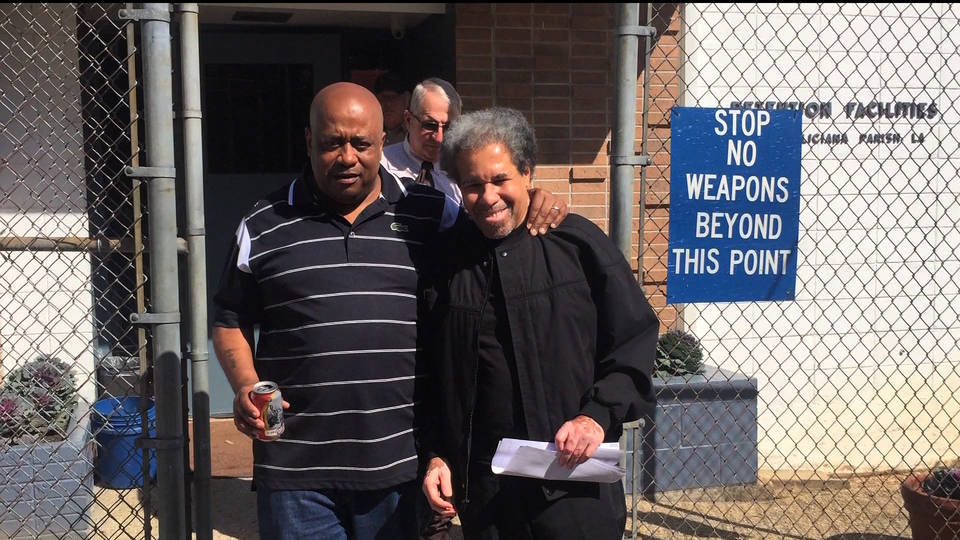
Albert Woodfox, who spent more than 43 years in solitary confinement—more than any one else in the United States—has been released from prison in Louisiana. Woodfox walked free on Friday after he entered a plea of no contest to charges of manslaughter and aggravated burglary of a prison guard more than four decades ago. Prior to Friday’s settlement, his conviction had been overturned three times. Woodfox and the late, fellow Angola Three member Herman Wallace were accused in 1972 of stabbing prison guard Brent Miller. They always maintained their innocence, saying they were targeted because of their attempts to address horrific prison conditions by organizing a chapter of the Black Panther Party. Herman Wallace was freed in 2013, just days before he died from cancer. We’ll be joined by Albert Woodfox in his first broadcast interview after headlines.

 
Back
Top