


Cocaine Incorporated ( colin..blk pple dont read)
An in-depth look at the Sinaloa "cartel"
One afternoon last August, at a hospital on the outskirts of Los Angeles, a former beauty queen named Emma Coronel gave birth to a pair of heiresses. The twins, who were delivered at 3:50 and 3:51, respectively, stand to inherit some share of a fortune that Forbes estimates is worth a billion dollars. Coronel’s husband, who was not present for the birth, is a legendary tycoon who overcame a penurious rural childhood to establish a wildly successful multinational business. If Coronel elected to leave the entry for “Father” on the birth certificates blank, it was not because of any dispute over patrimony. More likely, she was just skittish about the fact that her husband, Joaquín Guzmán, is the C.E.O. of Mexico’s Sinaloa cartel, a man the Treasury Department recently described as the world’s most powerful drug trafficker. Guzmán’s organization is responsible for as much as half of the illegal narcotics imported into the United States from Mexico each year; he may well be the most-wanted criminal in this post-Bin Laden world. But his bride is a U.S. citizen with no charges against her. So authorities could only watch as she bundled up her daughters and slipped back across the border to introduce them to their dad.

Known as El Chapo for his short, stocky frame, Guzmán is 55, which in narco-years is about 150. He is a quasi-mythical figure in Mexico, the subject of countless ballads, who has outlived enemies and accomplices alike, defying the implicit bargain of a life in the drug trade: that careers are glittering but brief and always terminate in prison or the grave. When Pablo Escobar was Chapo’s age, he had been dead for more than a decade. In fact, according to the Drug Enforcement Administration, Chapo sells more drugs today than Escobar did at the height of his career. To some extent, this success is easily explained: as Hillary Clinton acknowledged several years ago, America’s “insatiable demand for illegal drugs” is what drives the clandestine industry. It’s no accident that the world’s biggest supplier of narcotics and the world’s biggest consumer of narcotics just happen to be neighbors. “Poor Mexico,” its former president Porfirio Díaz is said to have remarked. “So far from God and so close to the United States.”

The Sinaloa cartel can buy a kilo of cocaine in the highlands of Colombia or Peru for around $2,000, then watch it accrue value as it makes its way to market. In Mexico, that kilo fetches more than $10,000. Jump the border to the United States, and it could sell wholesale for $30,000. Break it down into grams to distribute retail, and that same kilo sells for upward of $100,000 — more than its weight in gold. And that’s just cocaine. Alone among the Mexican cartels, Sinaloa is both diversified and vertically integrated, producing and exporting marijuana, heroin and methamphetamine as well.

Estimating the precise scale of Chapo’s empire is tricky, however. Statistics on underground economies are inherently speculative: cartels don’t make annual disclosures, and no auditor examines their books. Instead, we’re left with back-of-the-envelope extrapolations based on conjectural data, much of it supplied by government agencies that may have bureaucratic incentives to overplay the problem.

So in a spirit of empirical humility, we shouldn’t accept as gospel the estimate, from the Justice Department, that Colombian and Mexican cartels reap $18 billion to $39 billion from drug sales in the United States each year. (That range alone should give you pause.) Still, even if you take the lowest available numbers, Sinaloa emerges as a titanic player in the global black market. In the sober reckoning of the RAND Corporation, for instance, the gross revenue that all Mexican cartels derive from exporting drugs to the United States amounts to only $6.6 billion. By most estimates, though, Sinaloa has achieved a market share of at least 40 percent and perhaps as much as 60 percent, which means that Chapo Guzmán’s organization would appear to enjoy annual revenues of some $3 billion — comparable in terms of earnings to Netflix or, for that matter, to Facebook.

The drug war in Mexico has claimed more than 50,000 lives since 2006. But what tends to get lost amid coverage of this epic bloodletting is just how effective the drug business has become. A close study of the Sinaloa cartel, based on thousands of pages of trial records and dozens of interviews with convicted drug traffickers and current and former officials in Mexico and the United States, reveals an operation that is global (it is active in more than a dozen countries) yet also very nimble and, above all, staggeringly complex. Sinaloa didn’t merely survive the recession — it has thrived in recent years. And after prevailing in some recent mass-casualty clashes, it now controls more territory along the border than ever.

“Chapo always talks about the drug business, wherever he is,” one erstwhile confidant told a jury several years ago, describing a driven, even obsessive entrepreneur with a proclivity for micromanagement. From the remote mountain redoubt where he is believed to be hiding, surrounded at all times by a battery of gunmen, Chapo oversees a logistical network that is as sophisticated, in some ways, as that of Amazon or U.P.S. — doubly sophisticated, when you think about it, because traffickers must move both their product and their profits in secret, and constantly maneuver to avoid death or arrest. As a mirror image of a legal commodities business, the Sinaloa cartel brings to mind that old line about Ginger Rogers doing all the same moves as Fred Astaire, only backward and in heels. In its longevity, profitability and scope, it might be the most successful criminal enterprise in history.

The state of Sinaloa, from which the cartel derives its name, lies wedged between the Sierra Madre Occidental and Mexico’s west coast. Sun-blasted and remote, Sinaloa is the Sicily of Mexico, both cradle and refuge of violent men, and the ancestral land of many of the country’s most notorious traffickers. Chapo was born in a village called La Tuna, in the foothills of the Sierra, in 1957. His formal education ended in third grade, and as an adult, he has reportedly struggled to read and write, prevailing upon a ghostwriter, at one point, to compose letters to his mistress. Little is known about Chapo’s early years, but by the 1980s, he joined the Guadalajara cartel, which was run by a former policeman known as El Padrino — the Godfather.

For decades, Mexican smugglers had exported homegrown marijuana and heroin to the United States. But as the Colombian cocaine boom gathered momentum in the 1980s and U.S. law enforcement began patrolling the Caribbean, the Colombians went in search of an alternate route to the United States and discovered one in Mexico. Initially, Mexican traffickers, like a pudgy 25-year-old airplane pilot named Miguel Angel Martínez, acted as independent contractors who were paid a fee by the Colombians to move their cargo. In 1986, the Guadalajara cartel dispatched Martínez to the Colombian port of Barranquilla, in the hope that someone might commission him to fly drugs up to Mexico. But Martínez couldn’t find any takers and ended up languishing in Colombia for months, worrying that he had blown his big opportunity with the cartel. Eventually, he caught a commercial flight back to Mexico, and shortly thereafter, he was summoned to a meeting with Chapo, who was by then an underboss in the cartel. “You were very well behaved in Colombia,” Chapo told him, according to subsequent testimony. He seemed impressed by Martínez’s patience in waiting for an assignment.

Having passed this test, Martínez started working for Chapo as a kind of air traffic controller, negotiating directly with the Cali and Medellín cartels, then guiding their cocaine flights from South America to secret runways in barren stretches of Mexico. Martínez knew U.S. agents were monitoring his radio communications, so rather than say a word, he would whistle — a signal to the pilots that they were cleared for takeoff.

With the decline of the Caribbean route, the Colombians started paying Mexican smugglers not in cash but in cocaine. More than any other factor, it was this transition that realigned the power dynamics along the narcotics supply chain in the Americas, because it allowed the Mexicans to stop serving as logistical middlemen and invest in their own drugs instead. In 1986, Martínez couldn’t land a gig as a lowly courier in Barranquilla. Not five years later, he was marshaling hundreds of flights laden with cocaine for Chapo. “Sometimes we would get five planes a night,” he remembered. “Sometimes 16.” Now it was the Colombians who went hat in hand to Chapo, looking not to hire him to move their product but to sell it to him outright. They would tip Martínez $25,000 just to get an audience with the man.

The young pilot became a gatekeeper to the ascendant kingpin, fielding his phone calls and accompanying him on foreign trips. There’s a vaudevillian goofiness to nicknames in Mexico, and the stout Martínez was known in the cartel as El Gordo. He and Chapo — Fatty and Shorty — made quite a pair. “Japan, Hong Kong, India, all of Europe,” Martínez recalled in testimony. Chapo owned a fleet of Learjets, and together, they saw “the whole world.” They both used cocaine as well, a habit that Chapo would eventually give up. When a lawyer inquired, years later, whether he had been Chapo’s right-hand man, Martínez replied that he might have been, but that Guzmán had five left hands and five right hands. “He’s an octopus, Chapo Guzmán,” he said. For his efforts, Martínez was paid a million dollars a year, in a single annual installment: “In cash, in a suitcase, each December.” When Martínez’s son was born, Chapo asked to serve as godfather.
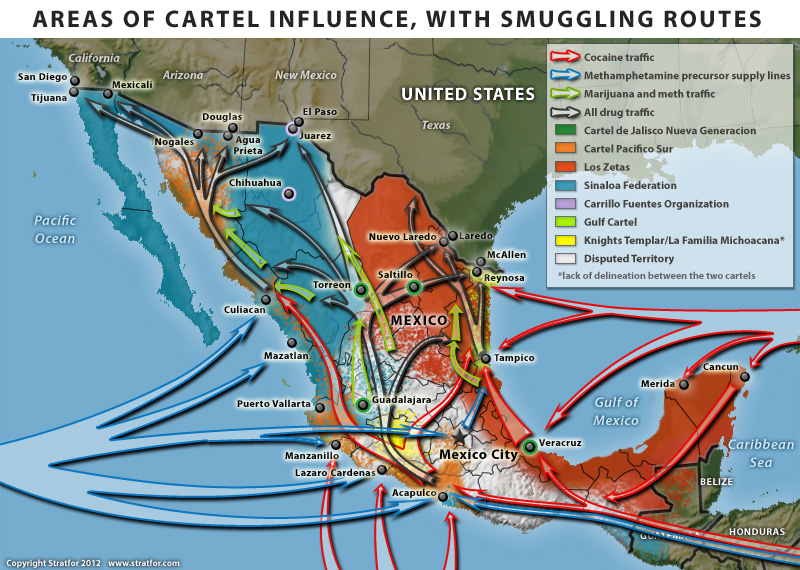
In 1989, Chapo’s mentor, El Padrino, was captured by Mexican authorities, and the remaining members of the Guadalajara cartel assembled in Acapulco to determine which smuggling route each capo would inherit. According to Ioan Grillo’s book, “El Narco,” the meeting was ostensibly a gathering of friends. But the shards of El Padrino’s organization would become the basis for the Tijuana, Juárez and Sinaloa cartels, and these onetime colleagues would soon become antagonists in a cycle of bloody turf wars that continues to this day.

“Drug cartel,” it turns out, is a whopper of a misnomer; neither the Mexicans nor the Colombians ever colluded to fix prices or supply. “I wish they were cartels,” Arturo Sarukhán, Mexico’s ambassador in Washington, told me. “If they were, they wouldn’t be fighting and driving up the violence.”

At first, Chapo’s organization controlled a single smuggling route, through western Mexico into Arizona. But by 1990, it was moving three tons of cocaine each month over the border, and from there, to Los Angeles. The Sinaloa has always distinguished itself by the eclectic means it uses to transport drugs. Working with Colombian suppliers, cartel operatives moved cocaine into Mexico in small private aircraft and in baggage smuggled on commercial flights and eventually on their own 747s, which they could load with as much as 13 tons of cocaine. They used container ships and fishing vessels and go-fast boats and submarines — crude semi-submersibles at first, then fully submersible subs, conceived by engineers and constructed under the canopy of the Amazon, then floated downriver in pieces and assembled at the coastline. These vessels can cost more than a million dollars, but to the smugglers, they are effectively disposable. In the event of an interception by the Coast Guard, someone onboard pulls a lever that floods the interior so that the evidence sinks; only the crew is left bobbing in the water, waiting to be picked up by the authorities.

Moving cocaine is a capital-intensive business, but the cartel subsidizes these investments with a ready source of easy income: marijuana. Cannabis is often described as the “cash crop” of Mexican cartels because it grows abundantly in the Sierras and requires no processing. But it’s bulkier than cocaine, and smellier, which makes it difficult to conceal. So marijuana tends to cross the border far from official ports of entry. The cartel makes sandbag bridges to ford the Colorado River and sends buggies loaded with weed bouncing over the Imperial Sand Dunes into California. Michael Braun, the former chief of operations for the D.E.A., told me a story about the construction of a high-tech fence along a stretch of border in Arizona. “They erect this fence,” he said, “only to go out there a few days later and discover that these guys have a catapult, and they’re flinging hundred-pound bales of marijuana over to the other side.” He paused and looked at me for a second. “A catapult,” he repeated. “We’ve got the best fence money can buy, and they counter us with a 2,500-year-old technology.”

Improvisation is a trafficker’s greatest asset, and in recent years, Sinaloa has devised an even more efficient solution to the perennial challenge of getting marijuana across the border. Grow it here. Several years ago, a hunter was trekking through the remote North Woods of Wisconsin when he stumbled upon a vast irrigated grow site, tended by a dozen Mexican farmers armed with AK-47’s. According to the D.E.A., it was a Sinaloa pot farm, established on U.S. National Forest land to supply the market in Chicago.
Heroin is easier to smuggle but difficult to produce, and as detailed in court documents, Chapo is particularly proud of his organization’s work with the drug. He personally negotiates shipments to the United States and stands by its quality, which is normally 94 percent pure. “The value-to-weight ratio of heroin is better than any other drug,” says Alejandro Hope, who until recently was a senior officer at Cisen, Mexico’s equivalent to the C.I.A.
But the future of the business may be methamphetamine. During the 1990s, when the market for meth exploded in the United States, new regulations made it more difficult to manufacture large quantities of the drug in this country. This presented an opportunity that the Sinaloa quickly exploited. According to Anabel Hernández, author of “Los Señores del Narco,” a book about the cartel, it was one of Chapo’s deputies, a trafficker named Ignacio (Nacho) Coronel, who first spotted the massive potential of methamphetamine. “Nacho was like Steve Jobs,” Hernández told me. “He saw the future.”

Here was a drug that was ragingly addictive and could be produced cheaply and smuggled with relative ease. When they first started manufacturing meth, the Sinaloa would provide free samples to their existing wholesale clients in the Midwest. “They’d send five hundred pounds of marijuana, and secreted in that would be two kilos of meth,” Jack Riley, the D.E.A.’s special agent in charge of the Chicago office, told me. “They’d give it away for free. They wanted the market.” As demand grew, the cartel constructed superlabs, capable of churning out industrial volumes of meth. Container ships from India and China unloaded precursor chemicals — largely ephedrine — in the Pacific ports Lázaro Cárdenas and Manzanillo. To grasp the scale of production, consider the volume of some recent precursor seizures at these ports: 22 tons in October 2009; 88 tons in May 2010; 252 tons last December. When Mexico banned the importation of ephedrine, the cartel adapted, tweaking its recipe to use unregulated precursors. Recently they have started outsourcing production to new labs in Guatemala.
But Chapo’s greatest contribution to the evolving tradecraft of drug trafficking was one of those innovations that seem so logical in hindsight it’s a wonder nobody thought of it before: a tunnel. In the late 1980s, Chapo hired an architect to design an underground passageway from Mexico to the United States. What appeared to be a water faucet outside the home of a cartel attorney in the border town of Agua Prieta was in fact a secret lever that, when twisted, activated a hydraulic system that opened a hidden trapdoor underneath a pool table inside the house. The passage ran more than 200 feet, directly beneath the fortifications along the border, and emerged inside a warehouse the cartel owned in Douglas, Ariz. Chapo pronounced it “cool.”
When this new route was complete, Chapo instructed Martínez to call the Colombians. “Tell them to send all the drugs they can,” he said. As the deliveries multiplied, Sinaloa acquired a reputation for the miraculous speed with which it could push inventory across the border. “Before the planes were arriving back in Colombia on the return, the cocaine was already in Los Angeles,” Martínez marveled.
Eventually the tunnel was discovered, so Chapo shifted tactics once again, this time by going into the chili-pepper business. He opened a cannery in Guadalajara and began producing thousands of cans stamped “Comadre Jalapeños,” stuffing them with cocaine, then vacuum-sealing them and shipping them to Mexican-owned grocery stores in California. He sent drugs in the refrigeration units of tractor-trailers, in custom-made cavities in the bodies of cars and in truckloads of fish (which inspectors at a sweltering checkpoint might not want to detain for long). He sent drugs across the border on freight trains, to cartel warehouses in Los Angeles and Chicago, where rail spurs let the cars roll directly inside to unload. He sent drugs via FedEx.
But that tunnel into Douglas remains Chapo’s masterpiece, an emblem of his creative ingenuity. Twenty years on, the cartels are still burrowing under the border — more than a hundred tunnels have been discovered in the years since Chapo’s first. They are often ventilated and air-conditioned, and some feature trolley lines stretching up to a half-mile to accommodate the tonnage in transit.

You might suppose that a certain recklessness would be a prerequisite for anyone contemplating a career in the drug trade. But in reality, blue-chip traffickers tend to fixate, with neurotic intensity, on the concept of risk. “The goal of these folks is not to sell drugs,” Tony Placido, who was the top intelligence official at the D.E.A. until he retired last year, told me. “It’s to earn a spendable profit and live to enjoy it.” So the smart narcos are preoccupied with what Peter Reuter and Mark Kleiman once referred to, in a classic essay on the drug business, as “the marginal imprisonment risk.” In 2010, Chapo’s old friend Ismael (El Mayo) Zambada, the No. 2 man in the Sinaloa cartel, granted an interview to the Mexican magazine Proceso. Now in his 60s and a grandfather, El Mayo has been in the drug business for nearly half a century and has amassed a fortune. But you can’t buy peace of mind. “I’m terrified they’ll incarcerate me,” he acknowledged. “I’m full of fear. Always.”
There’s a reason coke and heroin cost so much more on the street than at the farm gate: you’re not paying for the drugs; you’re compensating everyone along the distribution chain for the risks they assumed in getting them to you. Smugglers often negotiate, in actuarial detail, about who will be held liable in the event of lost inventory. After a bust, arrested traffickers have been known to demand a receipt from authorities, so that they can prove the loss was not because of their own negligence (which would mean they might have to pay for it) or their own thievery (which would mean they might have to die). Some Colombian cartels have actually offered insurance policies on narcotics, as a safeguard against loss or seizure.
To prevent catastrophic losses, cartels tend to distribute their risk as much as possible. Before sending a 100-kilo shipment across the border, traffickers might disaggregate it into five carloads of 20 kilos each. Chapo and his associates further reduce their personal exposure by going in together on shipments, so each of those smaller carloads might hold 10 kilos belonging to Chapo and 10 belonging to Mayo Zambada. The Sinaloa is occasionally called the Federation because senior figures and their subsidiaries operate semiautonomously while still employing a common smuggling apparatus.
The organizational structure of the cartel also seems fashioned to protect the leadership. No one knows how many people work for Sinaloa, and the range of estimates is comically broad. Malcolm Beith, the author of a recent book about Chapo, posits that at any given moment, the drug lord may have 150,000 people working for him. John Bailey, a Georgetown professor who has studied the cartel, says that the number of actual employees could be as low as 150. The way to account for this disparity is to distinguish between salaried employees and subcontractors. A labor force of thousands may be required to plow all that contraband up the continent, but a lot of the work can be delegated to independent contractors, people the Mexican political scientist and security consultant Eduardo Guerrero describes as working “for the cartel but outside it.”

Even those who do work directly for the cartel are limited to carefully compartmentalized roles. At a recent trial, a regional cartel lieutenant, José Esparza, testified about his experience working for the Sinaloa along the border. On one occasion, he attended a meeting outside Culiacán with many of the cartel’s top leaders. But there was no sign of Chapo. Once the discussion concluded, an emissary left the group and approached a Hummer that was parked in the distance and surrounded by men with bulletproof vests and machine guns, to report on the proceedings. Chapo never stepped out of the vehicle.
It’s not just the federales that the narcos fear; it’s also one another. The brutal opportunism of the underworld economy means that most partnerships are temporary, and treachery abounds. For decades, Chapo worked closely with his childhood friend Arturo Beltrán Leyva, a fearsome trafficker who ran a profitable subsidiary of Sinaloa. But in 2008, the two men split, then went to war, and Beltrán Leyva’s assassins were later blamed for murdering one of Chapo’s sons. To reduce the likelihood of clashes like these, the cartel has revived an unlikely custom: the ancient art of dynastic marriage. Chapo’s organization is occasionally referred to as an alianza de sangre (“alliance of blood”), because so many of its prominent members are cousins by marriage or brothers-in-law. Emma Coronel, who gave birth to Chapo’s twins, is the niece of Nacho Coronel, the Steve Jobs of meth (who died in a shootout with the Mexican Army in 2010). All of this intermarriage, one U.S. official in Mexico suggested to me, functions as “a hedge against distrust.” An associate may be less likely to cheat you, or to murder you, if there’ll be hell to pay with his wife. It’s a cynical strategy, certainly, but in a vocation where one of Chapo’s rivals went by the nickname Mata Amigos, or “Friend Killer,” it may also be quite sound.

The surest way to stay out of trouble in the drug business is to dole out bribes, and promiscuously. Drug cartels don’t pay corporate taxes, but a colossus like Sinaloa makes regular payments to the federal, state and municipal authorities that may well rival the effective tax rate in Mexico. When the D.E.A. conducted an internal survey of its top 50 operatives and informants several years ago and asked them to name the most important factor for running a drug business, they replied, overwhelmingly, corruption. At a trial in 2010, a former police official from Juárez, Jesús Fierro Méndez, acknowledged that he had worked for Sinaloa. “Did the drug cartels have the police on the payroll?” an attorney asked.
“All of it,” Fierro Méndez replied.

The cartel bribes mayors and prosecutors and governors, state police and federal police, the army, the navy and a host of senior officials at the national level. After an arrest for drug trafficking in the 1990s, Chapo was sentenced to 20 years and shipped to Puente Grande, a fortified prison in Jalisco that was Mexico’s answer to a supermax. But during the five years he spent there, Chapo enjoyed prerogatives that make the prison sequence in “Goodfellas” look positively austere. With most of the facility on his payroll, he is said to have ordered his meals from a menu, conducted business by cellphone and orchestrated periodic visits by prostitutes, who would arrive aboard a prison truck driven by a guard. I spoke with one drug producer who negotiated a joint venture deal with Chapo while he was behind bars. Eventually, as the story goes, Chapo was smuggled out in a laundry cart. According to Martínez’s testimony, he paid more than $3 million to secure his release. Today, Chapo is a free man, Puente Grande’s warden only recently completed a jail sentence for letting him go and Mexicans call the prison Puerta Grande — the Big Door.
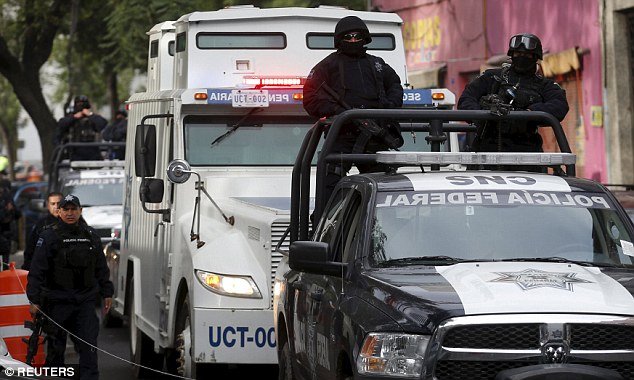
The tacit but unwavering tolerance that Mexican authorities have shown for the drug trade over the years has muddled the boundaries between outlaws and officials. When Miguel Angel Martínez was working for Chapo, he says, “everyone” in the organization had military and police identification. Daylight killings are sometimes carried out by men dressed in police uniforms, and it is not always clear, after the fact, whether the perpetrators were thugs masquerading as policemen or actual policemen providing paid assistance to the thugs. On those occasions when the government scores a big arrest, meanwhile, police and military officials pose for photos at the valedictory news conference brandishing assault weapons, their faces shrouded in ski masks, to shield their identities. In the trippy semiotics of the drug war, the cops dress like bandits, and the bandits dress like cops.
When you tally it all up, bribery may be the single largest line item on a cartel’s balance sheet. In 2008, President Felipe Calderón’s own drug czar, Noe Ramirez, was charged with accepting $450,000 each month. Presumably, such gargantuan bribes to senior officials cascade down, securing the allegiance of their subordinates. “You have to recruit the high commands, so they can issue the information to lower ranks and order whatever they want,” the corrupt cop, Fierro Méndez, testified. But in key jurisdictions, the cartel most likely makes payments up and down the chain of command. In a 2010 speech, Genaro García Luna, Mexico’s secretary of public security, speculated that together, the cartels spend more than a billion dollars each year just to bribe the municipal police.
It’s not only officials who must be bribed, either. There are also the “falcons,” an army of civilian lookouts who might receive $100 a month just to keep their eyes open and make a phone call if they notice an uptick in border inspections or a convoy of police. “There are cities in Mexico where virtually every cabdriver is on the payroll,” Michael Braun, formerly of the D.E.A., said. “They have eyes and ears everywhere.”

And then there are the Americans. Guards at the U.S. border have been known to wave a car through their checkpoints for a few thousand dollars, and since 2004, there have been 138 convictions or indictments in corruption investigations involving members of the United States Customs and Border Protection. Paradoxically, one explanation for this state of affairs is the rapid expansion of border forces following the creation of the Department of Homeland Security. In their hurry to fortify the U.S.-Mexico boundary with uniformed personnel, it seems, officials may have made allowances on background checks and screenings. In some instances, job offers have been extended to the immediate relatives of known traffickers.
When corruption fails, there is always violence. During the 12 years that he worked for the cartel, Martínez claims that he did not carry a gun. But Sinaloa has risen to pre-eminence as much through savagery as through savvy. “In illegal markets, the natural tendency is toward monopoly, so they fight each other,” Antonio Mazzitelli, an official with the United Nations Office on Drugs and Crime in Mexico City, told me. “How do they fight: Go to court? Offer better prices? No. They use violence.” The primal horror of Mexico’s murder epidemic makes it difficult, perhaps even distasteful, to construe the cartel’s butchery as a rational advancement of coherent business aims. But the reality is that in a multibillion-dollar industry in which there is no recourse to legally enforceable contracts, some degree of violence may be inevitable.

“It’s like geopolitics,” Tony Placido said. “You need to use violence frequently enough that the threat is believable. But overuse it, and it’s bad for business.”
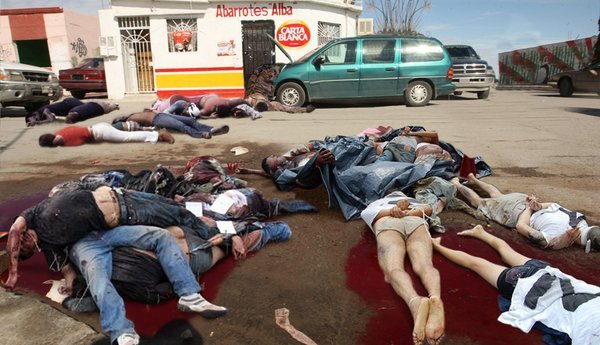
The most gratuitous practitioners of violence right now would be the Zetas, a rampaging league of sociopaths with a notable devotion to physical cruelty. The Zetas are a new kind of cartel, in that they came somewhat late to the actual business of smuggling drugs. They started out as bodyguards for the Gulf Cartel before going into business for themselves, and they specialize in messaging through bloodshed. It’s the Zetas who are charged with dumping 49 mutilated bodies by the side of a highway near Monterrey last month. Sinaloa is responsible for a great deal of carnage as well, but its approach to killing has traditionally been more discreet. Whereas a Sinaloa subsidiary allied with a Tijuana farmer known as the Stewmaker, who dissolved hundreds of bodies in barrels of lye, the Zetas have pioneered a multimedia approach to violence, touting their killings on YouTube. One strategic choice facing any cartel is deciding when to intimidate the civilian population and when to cultivate it. Sinaloa can be exceedingly brutal, but the cartel is more pragmatic than the Zetas in its deployment of violence. It may simply be, as one Obama administration official suggested, that the Sinaloa leadership is “more conscious of their brand.”
It’s a curious rivalry between these two organizations, because their business models are really very different. The Zetas have diversified beyond drugs to extortion, kidnapping and human trafficking, blossoming into what officials call a “polycriminal organization.” Sinaloa, by contrast, has mostly tended to stick to its core competence of trafficking. According to one captured cartel member, Chapo specifically instructed his subordinates not to dabble in protection rackets and insisted that Sinaloa territory remain “calm” and “controlled.”
“Sinaloa does not do extortion directly,” Eduardo Guerrero said. “It’s so risky, and the profits are so small. They want the big business — and the big business is in the United States.”
Just how active the cartel is north of the border is a divisive question. According to the Department of Justice, by 2009, Mexican-based criminal organizations were operating in “more than a thousand U.S. cities.” When you consider the huge jump in the price of narcotics between bulk importation and retail sales, it might seem that Chapo would want to expand into street-level distribution. In 2005, the D.E.A. began intercepting large shipments of cocaine in which each kilo brick was heat-sealed in a distinctive Mylar foil. They spotted the foil in Los Angeles first, then in Oklahoma, Chicago, Atlanta and New Jersey. “This was Sinaloa coke,” Michael Wardrop, who led two of the agency’s most ambitious operations against the domestic networks of the cartel, told me. As the telltale wrapping popped up across the country, Wardrop and his colleagues marveled at the sheer expanse of Sinaloa’s market. “It was like watching a virus in a Petri dish,” he said. “It was constantly growing.”
Wardrop’s investigations netted more than a thousand arrests. But some observers question the extent to which the perpetrators in these cases were actually working for the cartel. “If you’re telling me there’s a straight chain of command back to El Chapo in Sinaloa — come on, that’s absurd,” the Mexican ambassador, Arturo Sarukhán, protested. Often, the gatekeepers and logistics men that the D.E.A. arrested were indeed connected to handlers in Mexico. But this was more true of high-level importers dealing in kilos than run-of-the-mill retailers pushing grams. When The Associated Press tracked down Otis Rich, a Baltimore dealer who was ensnared in one of the operations, he answered the obvious question with a telling reply: “Sina-who?”
“The fully integrated model would indeed maximize profits,” John Bailey observes in a coming book about the cartels, but “it also maximizes risk of exposure.” A big reason for the markup at the retail level is that the sales force is so exposed — out on the corner, a magnet for undercover cops, obliged to negotiate with a needy, unpredictable clientele. When you adjust for all that added risk, the windfall starts to seem less alluring. Like a liquor wholesaler who opts not to open a bar, Chapo appears to have decided that the profits associated with retail sales just aren’t worth the hassle.

What Sinaloa does do inside this country is ferry drugs along highways to regional distribution hubs, where they are turned over to trusted wholesalers, like the Flores twins of Chicago. Pedro and Margarito Flores grew up in a Mexican-American enclave of the city during the 1990s. Their father and an older brother had moved drugs for Sinaloa, and by the time the twins were in their 20s, they had gone into business as distributors, purchasing cocaine and heroin directly from Mexican cartels, then selling to dealers throughout the United States. Chicago, home of the Mercantile Exchange, has always been a hub from which legitimate goods fan out across the country, and it’s no different for black-market commodities. Chapo has used the city as a clearinghouse since the early 1990s; he once described it as his “home port.”
In 2005, the Flores twins were flown to a mountaintop compound in Sinaloa to meet with Chapo Guzmán. The kingpin is an intimidating interlocutor; one criminal who has negotiated with him face to face told me that Chapo tends to dominate a conversation, asking a lot of questions and compensating for his short stature by bouncing on the balls of his feet. But the meeting went well, and before long, the brothers were distributing around two tons of Sinaloa product each month. As preferred customers, they often took Chapo’s drugs without putting any money down, then paid the cartel only after they sold the product. This might seem unlikely, given the pervasive distrust in the underworld, but the narcotics trade is based on a robust and surprisingly reliable system of credit. In a sense, a cartel like Sinaloa has no choice but to offer a financing option, because few wholesale buyers have the liquidity to pay cash upfront for a ton of cocaine. “They have to offer lines of credit,” Wardrop told me, “no different from Walmart or Sears.”
This credit system, known as “fronting,” rests on an ironclad assumption that in the American marketplace, even an idiot salesman should have no trouble selling drugs. One convicted Sinaloa trafficker told me that it often took him more time to count the money he collected from his customers than it did to actually move the product. It may also help that the penalty for defaulting could involve dismemberment.
As wholesale buyers, the Flores brothers occupied a crucial bottleneck between the cartel and its consumers. They grew so indispensable, in fact, that after taking delivery of a shipment of drugs, they could retroactively bargain down the price. One day in 2008, Pedro Flores telephoned Guzmán in Mexico to ask for a discount on heroin.

“What did we agree on?” Chapo asked him, according to a government transcript of the call.
They had negotiated a price of $55,000 per kilo, Flores explained. But if Chapo would consider lowering that to $50,000, the twins could pay immediately.
“That price is fine,” Chapo agreed, without argument. Then he added something significant: “Do you have a way to bring that money over here?”
For the Sinaloa cartel, pushing product north into the United States is only half the logistical equation. The drug trade is a cash business — you can’t buy kilos with your credit card. So while politicians tend to focus on cartels primarily as importers of drugs, the narcos also devote an enormous amount of energy to the export of money. Cash is collected in small denominations from individual buyers and then bundled in great stacks of broken-in bills that are used to pay wholesalers, like the Flores brothers. These bills are counted, hidden in the same vehicle compartments that were used to smuggle drugs in the opposite direction and then sent to stash houses in Los Angeles, San Diego and Phoenix. From there, they move across the border into Mexico.
http://www.csmonitor.com/var/ezflow_site/storage/images/media/images/graphics/maps/map-mexican-drug-wars-claim-us-consulate-lives/7565196-2-
eng-US/Map-Mexican-drug-wars-claim-US-Consulate-lives_full_600.jpg
What happens to the money when it gets there? The cartel employs professional money launderers who specialize in drug proceeds, and according to Robert Mazur, a former D.E.A. agent who infiltrated the Colombian cartels, the fee for fully scrubbing and banking illicit proceeds may run Sinaloa more than 15 cents on the dollar. But a great deal of the cartel’s money remains in cash. In the early 1990s, a Sinaloa accountant sent planeloads of U.S. currency to Mexico City in suitcases holding $1 million each. When Miguel Angel Martínez worked for Chapo, the kingpin would test his loyalty, adding an extra $200,000 to one of the suitcases to see if Martínez would pocket it. “Eight suitcases, compadre, so that is $8 million,” he would say. (Martínez never fell for the trick.) A sizable share of the cash is devoted to paying bribes, and some is sent to Colombia to purchase more product, because drugs offer a strong return on investment. “Where would you put your money?” the former Cisen officer Alejandro Hope asked me with a chuckle. “T-bills? Real estate? I would put a large portion of my portfolio in cocaine.”
Even so, the business generates such volumes of currency that there is only so much you can launder or reinvest, which means that money can start to pile up around the house. The most that Martínez ever saw at one time was $30 million, which just sat there, having accumulated in his living room. In 2007, Mexican authorities raided the home of Zhenli Ye Gon, a Chinese-Mexican businessman who is believed to have supplied meth-precursor chemicals to the cartel, and discovered $206 million, the largest cash seizure in history. And that was the money Zhenli held onto — he was an inveterate gambler, who once blew so much cash in Las Vegas that one of the casinos presented him, in consolation, with a Rolls-Royce. “How much money do you have to lose in the casino for them to give you a Rolls-Royce?” Tony Placido, the D.E.A. intelligence official, asked. (The astonishing answer, in Zhenli’s case, is $72 million at a single casino in a single year.) Placido also pointed out that, as a precursor guy, Zhenli was on the low end of the value chain for meth. It makes you wonder about the net worth of the guy who runs the whole show.
In 2008, the Flores twins were indicted in Chicago and began secretly cooperating with law enforcement. The following year, one of their Sinaloa contacts — a debonair young trafficker named Jesús Vicente Zambada Niebla, or Vicentillo — was arrested in Mexico and later extradited to Chicago. He will be the highest-ranking member of the cartel ever to face trial in the United States, and his favorite wholesale customers will be the star witnesses against him. In a surprise twist, Vicentillo (who is the son of Chapo’s partner, Mayo Zambada) has argued that he can’t be prosecuted — because even as he worked for Sinaloa, he was also a secret informant for the D.E.A.
There has been speculation in Mexico that the Calderón regime favors Sinaloa over the unhinged Zetas and has made a devil’s pact to lay off the cartel. It might be impossible to eradicate all the cartels in Mexico, this theory goes, so the government has picked a favorite in the conflict in the hope that when the smoke clears, a Sinaloa monopoly might usher in a sort of pax narcotica. A 2010 National Public Radio investigation of Mexican arrest statistics found that Sinaloa had suffered conspicuously fewer arrests than had its peers, though this could simply be evidence of triage on the government’s part rather than proof of a conspiracy. Calderón vehemently denies any charges of favoritism, and his administration has arrested or killed several of Chapo’s key deputies in the last few years. (My repeated requests for interviews with relevant officials in Mexico were denied.)
The suggestion that the D.E.A. might have made a deal with a high-ranking Sinaloa figure is new, however. In the past, Chapo has occasionally authorized employees to provide information to American law enforcement. Fierro Méndez, the Juárez cop, described a system in which junior traffickers would walk into U.S. Immigration and Customs Enforcement and announce their willingness to become informers — then feed the Americans intelligence about rival cartels, thereby using law enforcement to eliminate their competitors. U.S. officials allow that there were discussions between the D.E.A. and Vicentillo, but they deny that any quid pro quo was in place.
The trial, which is scheduled for October, should shed significant light on Sinaloa’s logistical apparatus — provided the witnesses can stay alive until then. Recently, a career criminal named Saul Rodriguez testified that Vicentillo solicited his help at the Metropolitan Correctional Center in downtown Chicago, where they were both being held, in an effort to have the Flores twins assassinated. Authorities have expressed concern that the cartel might undertake a daring jailbreak to get Vicentillo out. They have also voiced the opposite worry — that Vicentillo will himself be killed. A request by the trafficker’s attorneys that he be permitted to exercise outdoors raised concerns from prison officials, because the only open space at the prison is a fenced-in recreation area on top of the building, where Vicentillo could be picked off by a sniper. (He has since been moved to a more secure facility.)
It might seem far-fetched that the cartel would try to assassinate one of its own, the son of Mayo Zambada, no less. But Sinaloa guards its secrets ruthlessly. After Chapo’s friend Miguel Angel Martínez was arrested in 1998, four men came to kill him in prison, stabbing him repeatedly. In that assault, and another that followed, he sustained more than a dozen stab wounds, which punctured his lungs, pancreas and intestines. After the second attack, he was moved to another facility and kept in a segregated unit. This time, an assassin managed to get as far as the gate outside Martínez’s cell and chucked two grenades at the bars. Locked in with nowhere to run, Martínez could only cower by the toilet to shield himself from the blast. The roof caved in, and he barely survived. Asked later who it was that tried to have him killed, Martínez said that it was his compadre, Chapo Guzmán. “Because of what I knew,” he explained. (Today he is living in witness protection in the United States.)

Between the coming trial and the increased political drumbeat on both sides of the border for his capture, Chapo may be more embattled today than at any time in his career. In February, he escaped a raid by Mexican authorities in the resort area of Los Cabos. President Calderón’s party is trailing in the polls, and some have theorized that the only way it might manage to retain power after next month’s presidential election would be if Chapo is killed or captured. U.S. authorities, meanwhile, are uncertain about who might succeed Calderón — Vice President Joe Biden met with all of the leading candidates on a visit to Mexico in March — and whether that successor will have any appetite to continue battling the cartels. With so many dead and so little progress, the Mexican populace has grown war-weary. Several U.S. officials told me that the critical window for capturing Chapo is between now and when Calderón leaves office.

In addition to the threat of capture, there is the threat of competition. By some estimates, the Zetas now control more Mexican territory than Chapo does, even if they don’t move nearly as many drugs. Zeta gunmen have made bloody incursions on Chapo’s turf, going so far as to penetrate the previously inviolable stronghold of his own home state, Sinaloa. In 2008, Chapo’s lover, Zulema Hernández, was discovered dead in the trunk of a car, her body carved with the letter “Z.” “It’s like the evolution of the dinosaurs, and the coming of the T. Rex,” Antonio Mazzitelli told me. “The T. Rex is the Zetas.”
Chapo and his colleagues were never peaceful types; in the last few years, they have waged vicious wars of acquisition to seize the lucrative smuggling routes through Juárez and Tijuana. But to fend off the Zetas, Sinaloa is resorting to new levels of barbarism. In March, the cartel dumped a collection of dismembered bodies in Zeta territory and posted a series of open letters on the walls around them, deriding the Zetas as “a bunch of drunks and car-washers.” Each message was signed, “Sincerely, El Chapo.”
One thing Chapo has always done is innovate. Even as he engages in violent brinkmanship along the border, the cartel is expanding to new markets in Europe, where a kilo of cocaine can sell for three times what it does in the U.S., and in Australia, where authorities believe that Chapo is now a major cocaine supplier. There are also indications that the cartel is exploring opportunities in Southeast Asia, China and Japan — places Chapo and Martínez first visited as younger men. And Chapo’s great comparative advantage still lies along that fraught boundary between Mexico and the United States. Even if the kingpin is killed or captured, one of his associates will quite likely take his place, and the smuggling infrastructure that Chapo created will endure, channeling the product, reaping the profits and feeding, with barely a blip in service, the enduring demand on this side of the border — what the historian Héctor Aguilar Camín once referred to as “the insatiable North American nose.”
Patrick Radden Keefe is a staff writer for The New Yorker and a fellow at the Century Foundation. From 2010 to 2011, he was a policy adviser in the Office of the Secretary of Defense.
Editor: Greg Veis
http://www.nytimes.com/2012/06/17/m...l-makes-its-billions.html?_r=1&pagewanted=all
An in-depth look at the Sinaloa "cartel"
How El Chapo Became World's Biggest Drug Lord
Fusion | 12 July 2015
Fusion | 12 July 2015
One afternoon last August, at a hospital on the outskirts of Los Angeles, a former beauty queen named Emma Coronel gave birth to a pair of heiresses. The twins, who were delivered at 3:50 and 3:51, respectively, stand to inherit some share of a fortune that Forbes estimates is worth a billion dollars. Coronel’s husband, who was not present for the birth, is a legendary tycoon who overcame a penurious rural childhood to establish a wildly successful multinational business. If Coronel elected to leave the entry for “Father” on the birth certificates blank, it was not because of any dispute over patrimony. More likely, she was just skittish about the fact that her husband, Joaquín Guzmán, is the C.E.O. of Mexico’s Sinaloa cartel, a man the Treasury Department recently described as the world’s most powerful drug trafficker. Guzmán’s organization is responsible for as much as half of the illegal narcotics imported into the United States from Mexico each year; he may well be the most-wanted criminal in this post-Bin Laden world. But his bride is a U.S. citizen with no charges against her. So authorities could only watch as she bundled up her daughters and slipped back across the border to introduce them to their dad.
Known as El Chapo for his short, stocky frame, Guzmán is 55, which in narco-years is about 150. He is a quasi-mythical figure in Mexico, the subject of countless ballads, who has outlived enemies and accomplices alike, defying the implicit bargain of a life in the drug trade: that careers are glittering but brief and always terminate in prison or the grave. When Pablo Escobar was Chapo’s age, he had been dead for more than a decade. In fact, according to the Drug Enforcement Administration, Chapo sells more drugs today than Escobar did at the height of his career. To some extent, this success is easily explained: as Hillary Clinton acknowledged several years ago, America’s “insatiable demand for illegal drugs” is what drives the clandestine industry. It’s no accident that the world’s biggest supplier of narcotics and the world’s biggest consumer of narcotics just happen to be neighbors. “Poor Mexico,” its former president Porfirio Díaz is said to have remarked. “So far from God and so close to the United States.”
The Sinaloa cartel can buy a kilo of cocaine in the highlands of Colombia or Peru for around $2,000, then watch it accrue value as it makes its way to market. In Mexico, that kilo fetches more than $10,000. Jump the border to the United States, and it could sell wholesale for $30,000. Break it down into grams to distribute retail, and that same kilo sells for upward of $100,000 — more than its weight in gold. And that’s just cocaine. Alone among the Mexican cartels, Sinaloa is both diversified and vertically integrated, producing and exporting marijuana, heroin and methamphetamine as well.
Estimating the precise scale of Chapo’s empire is tricky, however. Statistics on underground economies are inherently speculative: cartels don’t make annual disclosures, and no auditor examines their books. Instead, we’re left with back-of-the-envelope extrapolations based on conjectural data, much of it supplied by government agencies that may have bureaucratic incentives to overplay the problem.
So in a spirit of empirical humility, we shouldn’t accept as gospel the estimate, from the Justice Department, that Colombian and Mexican cartels reap $18 billion to $39 billion from drug sales in the United States each year. (That range alone should give you pause.) Still, even if you take the lowest available numbers, Sinaloa emerges as a titanic player in the global black market. In the sober reckoning of the RAND Corporation, for instance, the gross revenue that all Mexican cartels derive from exporting drugs to the United States amounts to only $6.6 billion. By most estimates, though, Sinaloa has achieved a market share of at least 40 percent and perhaps as much as 60 percent, which means that Chapo Guzmán’s organization would appear to enjoy annual revenues of some $3 billion — comparable in terms of earnings to Netflix or, for that matter, to Facebook.
The drug war in Mexico has claimed more than 50,000 lives since 2006. But what tends to get lost amid coverage of this epic bloodletting is just how effective the drug business has become. A close study of the Sinaloa cartel, based on thousands of pages of trial records and dozens of interviews with convicted drug traffickers and current and former officials in Mexico and the United States, reveals an operation that is global (it is active in more than a dozen countries) yet also very nimble and, above all, staggeringly complex. Sinaloa didn’t merely survive the recession — it has thrived in recent years. And after prevailing in some recent mass-casualty clashes, it now controls more territory along the border than ever.
“Chapo always talks about the drug business, wherever he is,” one erstwhile confidant told a jury several years ago, describing a driven, even obsessive entrepreneur with a proclivity for micromanagement. From the remote mountain redoubt where he is believed to be hiding, surrounded at all times by a battery of gunmen, Chapo oversees a logistical network that is as sophisticated, in some ways, as that of Amazon or U.P.S. — doubly sophisticated, when you think about it, because traffickers must move both their product and their profits in secret, and constantly maneuver to avoid death or arrest. As a mirror image of a legal commodities business, the Sinaloa cartel brings to mind that old line about Ginger Rogers doing all the same moves as Fred Astaire, only backward and in heels. In its longevity, profitability and scope, it might be the most successful criminal enterprise in history.
The state of Sinaloa, from which the cartel derives its name, lies wedged between the Sierra Madre Occidental and Mexico’s west coast. Sun-blasted and remote, Sinaloa is the Sicily of Mexico, both cradle and refuge of violent men, and the ancestral land of many of the country’s most notorious traffickers. Chapo was born in a village called La Tuna, in the foothills of the Sierra, in 1957. His formal education ended in third grade, and as an adult, he has reportedly struggled to read and write, prevailing upon a ghostwriter, at one point, to compose letters to his mistress. Little is known about Chapo’s early years, but by the 1980s, he joined the Guadalajara cartel, which was run by a former policeman known as El Padrino — the Godfather.
For decades, Mexican smugglers had exported homegrown marijuana and heroin to the United States. But as the Colombian cocaine boom gathered momentum in the 1980s and U.S. law enforcement began patrolling the Caribbean, the Colombians went in search of an alternate route to the United States and discovered one in Mexico. Initially, Mexican traffickers, like a pudgy 25-year-old airplane pilot named Miguel Angel Martínez, acted as independent contractors who were paid a fee by the Colombians to move their cargo. In 1986, the Guadalajara cartel dispatched Martínez to the Colombian port of Barranquilla, in the hope that someone might commission him to fly drugs up to Mexico. But Martínez couldn’t find any takers and ended up languishing in Colombia for months, worrying that he had blown his big opportunity with the cartel. Eventually, he caught a commercial flight back to Mexico, and shortly thereafter, he was summoned to a meeting with Chapo, who was by then an underboss in the cartel. “You were very well behaved in Colombia,” Chapo told him, according to subsequent testimony. He seemed impressed by Martínez’s patience in waiting for an assignment.
Having passed this test, Martínez started working for Chapo as a kind of air traffic controller, negotiating directly with the Cali and Medellín cartels, then guiding their cocaine flights from South America to secret runways in barren stretches of Mexico. Martínez knew U.S. agents were monitoring his radio communications, so rather than say a word, he would whistle — a signal to the pilots that they were cleared for takeoff.
With the decline of the Caribbean route, the Colombians started paying Mexican smugglers not in cash but in cocaine. More than any other factor, it was this transition that realigned the power dynamics along the narcotics supply chain in the Americas, because it allowed the Mexicans to stop serving as logistical middlemen and invest in their own drugs instead. In 1986, Martínez couldn’t land a gig as a lowly courier in Barranquilla. Not five years later, he was marshaling hundreds of flights laden with cocaine for Chapo. “Sometimes we would get five planes a night,” he remembered. “Sometimes 16.” Now it was the Colombians who went hat in hand to Chapo, looking not to hire him to move their product but to sell it to him outright. They would tip Martínez $25,000 just to get an audience with the man.
The young pilot became a gatekeeper to the ascendant kingpin, fielding his phone calls and accompanying him on foreign trips. There’s a vaudevillian goofiness to nicknames in Mexico, and the stout Martínez was known in the cartel as El Gordo. He and Chapo — Fatty and Shorty — made quite a pair. “Japan, Hong Kong, India, all of Europe,” Martínez recalled in testimony. Chapo owned a fleet of Learjets, and together, they saw “the whole world.” They both used cocaine as well, a habit that Chapo would eventually give up. When a lawyer inquired, years later, whether he had been Chapo’s right-hand man, Martínez replied that he might have been, but that Guzmán had five left hands and five right hands. “He’s an octopus, Chapo Guzmán,” he said. For his efforts, Martínez was paid a million dollars a year, in a single annual installment: “In cash, in a suitcase, each December.” When Martínez’s son was born, Chapo asked to serve as godfather.
In 1989, Chapo’s mentor, El Padrino, was captured by Mexican authorities, and the remaining members of the Guadalajara cartel assembled in Acapulco to determine which smuggling route each capo would inherit. According to Ioan Grillo’s book, “El Narco,” the meeting was ostensibly a gathering of friends. But the shards of El Padrino’s organization would become the basis for the Tijuana, Juárez and Sinaloa cartels, and these onetime colleagues would soon become antagonists in a cycle of bloody turf wars that continues to this day.
“Drug cartel,” it turns out, is a whopper of a misnomer; neither the Mexicans nor the Colombians ever colluded to fix prices or supply. “I wish they were cartels,” Arturo Sarukhán, Mexico’s ambassador in Washington, told me. “If they were, they wouldn’t be fighting and driving up the violence.”
At first, Chapo’s organization controlled a single smuggling route, through western Mexico into Arizona. But by 1990, it was moving three tons of cocaine each month over the border, and from there, to Los Angeles. The Sinaloa has always distinguished itself by the eclectic means it uses to transport drugs. Working with Colombian suppliers, cartel operatives moved cocaine into Mexico in small private aircraft and in baggage smuggled on commercial flights and eventually on their own 747s, which they could load with as much as 13 tons of cocaine. They used container ships and fishing vessels and go-fast boats and submarines — crude semi-submersibles at first, then fully submersible subs, conceived by engineers and constructed under the canopy of the Amazon, then floated downriver in pieces and assembled at the coastline. These vessels can cost more than a million dollars, but to the smugglers, they are effectively disposable. In the event of an interception by the Coast Guard, someone onboard pulls a lever that floods the interior so that the evidence sinks; only the crew is left bobbing in the water, waiting to be picked up by the authorities.
Moving cocaine is a capital-intensive business, but the cartel subsidizes these investments with a ready source of easy income: marijuana. Cannabis is often described as the “cash crop” of Mexican cartels because it grows abundantly in the Sierras and requires no processing. But it’s bulkier than cocaine, and smellier, which makes it difficult to conceal. So marijuana tends to cross the border far from official ports of entry. The cartel makes sandbag bridges to ford the Colorado River and sends buggies loaded with weed bouncing over the Imperial Sand Dunes into California. Michael Braun, the former chief of operations for the D.E.A., told me a story about the construction of a high-tech fence along a stretch of border in Arizona. “They erect this fence,” he said, “only to go out there a few days later and discover that these guys have a catapult, and they’re flinging hundred-pound bales of marijuana over to the other side.” He paused and looked at me for a second. “A catapult,” he repeated. “We’ve got the best fence money can buy, and they counter us with a 2,500-year-old technology.”
Improvisation is a trafficker’s greatest asset, and in recent years, Sinaloa has devised an even more efficient solution to the perennial challenge of getting marijuana across the border. Grow it here. Several years ago, a hunter was trekking through the remote North Woods of Wisconsin when he stumbled upon a vast irrigated grow site, tended by a dozen Mexican farmers armed with AK-47’s. According to the D.E.A., it was a Sinaloa pot farm, established on U.S. National Forest land to supply the market in Chicago.
Heroin is easier to smuggle but difficult to produce, and as detailed in court documents, Chapo is particularly proud of his organization’s work with the drug. He personally negotiates shipments to the United States and stands by its quality, which is normally 94 percent pure. “The value-to-weight ratio of heroin is better than any other drug,” says Alejandro Hope, who until recently was a senior officer at Cisen, Mexico’s equivalent to the C.I.A.
But the future of the business may be methamphetamine. During the 1990s, when the market for meth exploded in the United States, new regulations made it more difficult to manufacture large quantities of the drug in this country. This presented an opportunity that the Sinaloa quickly exploited. According to Anabel Hernández, author of “Los Señores del Narco,” a book about the cartel, it was one of Chapo’s deputies, a trafficker named Ignacio (Nacho) Coronel, who first spotted the massive potential of methamphetamine. “Nacho was like Steve Jobs,” Hernández told me. “He saw the future.”
Here was a drug that was ragingly addictive and could be produced cheaply and smuggled with relative ease. When they first started manufacturing meth, the Sinaloa would provide free samples to their existing wholesale clients in the Midwest. “They’d send five hundred pounds of marijuana, and secreted in that would be two kilos of meth,” Jack Riley, the D.E.A.’s special agent in charge of the Chicago office, told me. “They’d give it away for free. They wanted the market.” As demand grew, the cartel constructed superlabs, capable of churning out industrial volumes of meth. Container ships from India and China unloaded precursor chemicals — largely ephedrine — in the Pacific ports Lázaro Cárdenas and Manzanillo. To grasp the scale of production, consider the volume of some recent precursor seizures at these ports: 22 tons in October 2009; 88 tons in May 2010; 252 tons last December. When Mexico banned the importation of ephedrine, the cartel adapted, tweaking its recipe to use unregulated precursors. Recently they have started outsourcing production to new labs in Guatemala.
But Chapo’s greatest contribution to the evolving tradecraft of drug trafficking was one of those innovations that seem so logical in hindsight it’s a wonder nobody thought of it before: a tunnel. In the late 1980s, Chapo hired an architect to design an underground passageway from Mexico to the United States. What appeared to be a water faucet outside the home of a cartel attorney in the border town of Agua Prieta was in fact a secret lever that, when twisted, activated a hydraulic system that opened a hidden trapdoor underneath a pool table inside the house. The passage ran more than 200 feet, directly beneath the fortifications along the border, and emerged inside a warehouse the cartel owned in Douglas, Ariz. Chapo pronounced it “cool.”
When this new route was complete, Chapo instructed Martínez to call the Colombians. “Tell them to send all the drugs they can,” he said. As the deliveries multiplied, Sinaloa acquired a reputation for the miraculous speed with which it could push inventory across the border. “Before the planes were arriving back in Colombia on the return, the cocaine was already in Los Angeles,” Martínez marveled.
Eventually the tunnel was discovered, so Chapo shifted tactics once again, this time by going into the chili-pepper business. He opened a cannery in Guadalajara and began producing thousands of cans stamped “Comadre Jalapeños,” stuffing them with cocaine, then vacuum-sealing them and shipping them to Mexican-owned grocery stores in California. He sent drugs in the refrigeration units of tractor-trailers, in custom-made cavities in the bodies of cars and in truckloads of fish (which inspectors at a sweltering checkpoint might not want to detain for long). He sent drugs across the border on freight trains, to cartel warehouses in Los Angeles and Chicago, where rail spurs let the cars roll directly inside to unload. He sent drugs via FedEx.
But that tunnel into Douglas remains Chapo’s masterpiece, an emblem of his creative ingenuity. Twenty years on, the cartels are still burrowing under the border — more than a hundred tunnels have been discovered in the years since Chapo’s first. They are often ventilated and air-conditioned, and some feature trolley lines stretching up to a half-mile to accommodate the tonnage in transit.
You might suppose that a certain recklessness would be a prerequisite for anyone contemplating a career in the drug trade. But in reality, blue-chip traffickers tend to fixate, with neurotic intensity, on the concept of risk. “The goal of these folks is not to sell drugs,” Tony Placido, who was the top intelligence official at the D.E.A. until he retired last year, told me. “It’s to earn a spendable profit and live to enjoy it.” So the smart narcos are preoccupied with what Peter Reuter and Mark Kleiman once referred to, in a classic essay on the drug business, as “the marginal imprisonment risk.” In 2010, Chapo’s old friend Ismael (El Mayo) Zambada, the No. 2 man in the Sinaloa cartel, granted an interview to the Mexican magazine Proceso. Now in his 60s and a grandfather, El Mayo has been in the drug business for nearly half a century and has amassed a fortune. But you can’t buy peace of mind. “I’m terrified they’ll incarcerate me,” he acknowledged. “I’m full of fear. Always.”
There’s a reason coke and heroin cost so much more on the street than at the farm gate: you’re not paying for the drugs; you’re compensating everyone along the distribution chain for the risks they assumed in getting them to you. Smugglers often negotiate, in actuarial detail, about who will be held liable in the event of lost inventory. After a bust, arrested traffickers have been known to demand a receipt from authorities, so that they can prove the loss was not because of their own negligence (which would mean they might have to pay for it) or their own thievery (which would mean they might have to die). Some Colombian cartels have actually offered insurance policies on narcotics, as a safeguard against loss or seizure.
To prevent catastrophic losses, cartels tend to distribute their risk as much as possible. Before sending a 100-kilo shipment across the border, traffickers might disaggregate it into five carloads of 20 kilos each. Chapo and his associates further reduce their personal exposure by going in together on shipments, so each of those smaller carloads might hold 10 kilos belonging to Chapo and 10 belonging to Mayo Zambada. The Sinaloa is occasionally called the Federation because senior figures and their subsidiaries operate semiautonomously while still employing a common smuggling apparatus.
The organizational structure of the cartel also seems fashioned to protect the leadership. No one knows how many people work for Sinaloa, and the range of estimates is comically broad. Malcolm Beith, the author of a recent book about Chapo, posits that at any given moment, the drug lord may have 150,000 people working for him. John Bailey, a Georgetown professor who has studied the cartel, says that the number of actual employees could be as low as 150. The way to account for this disparity is to distinguish between salaried employees and subcontractors. A labor force of thousands may be required to plow all that contraband up the continent, but a lot of the work can be delegated to independent contractors, people the Mexican political scientist and security consultant Eduardo Guerrero describes as working “for the cartel but outside it.”
Even those who do work directly for the cartel are limited to carefully compartmentalized roles. At a recent trial, a regional cartel lieutenant, José Esparza, testified about his experience working for the Sinaloa along the border. On one occasion, he attended a meeting outside Culiacán with many of the cartel’s top leaders. But there was no sign of Chapo. Once the discussion concluded, an emissary left the group and approached a Hummer that was parked in the distance and surrounded by men with bulletproof vests and machine guns, to report on the proceedings. Chapo never stepped out of the vehicle.
It’s not just the federales that the narcos fear; it’s also one another. The brutal opportunism of the underworld economy means that most partnerships are temporary, and treachery abounds. For decades, Chapo worked closely with his childhood friend Arturo Beltrán Leyva, a fearsome trafficker who ran a profitable subsidiary of Sinaloa. But in 2008, the two men split, then went to war, and Beltrán Leyva’s assassins were later blamed for murdering one of Chapo’s sons. To reduce the likelihood of clashes like these, the cartel has revived an unlikely custom: the ancient art of dynastic marriage. Chapo’s organization is occasionally referred to as an alianza de sangre (“alliance of blood”), because so many of its prominent members are cousins by marriage or brothers-in-law. Emma Coronel, who gave birth to Chapo’s twins, is the niece of Nacho Coronel, the Steve Jobs of meth (who died in a shootout with the Mexican Army in 2010). All of this intermarriage, one U.S. official in Mexico suggested to me, functions as “a hedge against distrust.” An associate may be less likely to cheat you, or to murder you, if there’ll be hell to pay with his wife. It’s a cynical strategy, certainly, but in a vocation where one of Chapo’s rivals went by the nickname Mata Amigos, or “Friend Killer,” it may also be quite sound.
The surest way to stay out of trouble in the drug business is to dole out bribes, and promiscuously. Drug cartels don’t pay corporate taxes, but a colossus like Sinaloa makes regular payments to the federal, state and municipal authorities that may well rival the effective tax rate in Mexico. When the D.E.A. conducted an internal survey of its top 50 operatives and informants several years ago and asked them to name the most important factor for running a drug business, they replied, overwhelmingly, corruption. At a trial in 2010, a former police official from Juárez, Jesús Fierro Méndez, acknowledged that he had worked for Sinaloa. “Did the drug cartels have the police on the payroll?” an attorney asked.
“All of it,” Fierro Méndez replied.
The cartel bribes mayors and prosecutors and governors, state police and federal police, the army, the navy and a host of senior officials at the national level. After an arrest for drug trafficking in the 1990s, Chapo was sentenced to 20 years and shipped to Puente Grande, a fortified prison in Jalisco that was Mexico’s answer to a supermax. But during the five years he spent there, Chapo enjoyed prerogatives that make the prison sequence in “Goodfellas” look positively austere. With most of the facility on his payroll, he is said to have ordered his meals from a menu, conducted business by cellphone and orchestrated periodic visits by prostitutes, who would arrive aboard a prison truck driven by a guard. I spoke with one drug producer who negotiated a joint venture deal with Chapo while he was behind bars. Eventually, as the story goes, Chapo was smuggled out in a laundry cart. According to Martínez’s testimony, he paid more than $3 million to secure his release. Today, Chapo is a free man, Puente Grande’s warden only recently completed a jail sentence for letting him go and Mexicans call the prison Puerta Grande — the Big Door.
The tacit but unwavering tolerance that Mexican authorities have shown for the drug trade over the years has muddled the boundaries between outlaws and officials. When Miguel Angel Martínez was working for Chapo, he says, “everyone” in the organization had military and police identification. Daylight killings are sometimes carried out by men dressed in police uniforms, and it is not always clear, after the fact, whether the perpetrators were thugs masquerading as policemen or actual policemen providing paid assistance to the thugs. On those occasions when the government scores a big arrest, meanwhile, police and military officials pose for photos at the valedictory news conference brandishing assault weapons, their faces shrouded in ski masks, to shield their identities. In the trippy semiotics of the drug war, the cops dress like bandits, and the bandits dress like cops.
When you tally it all up, bribery may be the single largest line item on a cartel’s balance sheet. In 2008, President Felipe Calderón’s own drug czar, Noe Ramirez, was charged with accepting $450,000 each month. Presumably, such gargantuan bribes to senior officials cascade down, securing the allegiance of their subordinates. “You have to recruit the high commands, so they can issue the information to lower ranks and order whatever they want,” the corrupt cop, Fierro Méndez, testified. But in key jurisdictions, the cartel most likely makes payments up and down the chain of command. In a 2010 speech, Genaro García Luna, Mexico’s secretary of public security, speculated that together, the cartels spend more than a billion dollars each year just to bribe the municipal police.
It’s not only officials who must be bribed, either. There are also the “falcons,” an army of civilian lookouts who might receive $100 a month just to keep their eyes open and make a phone call if they notice an uptick in border inspections or a convoy of police. “There are cities in Mexico where virtually every cabdriver is on the payroll,” Michael Braun, formerly of the D.E.A., said. “They have eyes and ears everywhere.”
And then there are the Americans. Guards at the U.S. border have been known to wave a car through their checkpoints for a few thousand dollars, and since 2004, there have been 138 convictions or indictments in corruption investigations involving members of the United States Customs and Border Protection. Paradoxically, one explanation for this state of affairs is the rapid expansion of border forces following the creation of the Department of Homeland Security. In their hurry to fortify the U.S.-Mexico boundary with uniformed personnel, it seems, officials may have made allowances on background checks and screenings. In some instances, job offers have been extended to the immediate relatives of known traffickers.
When corruption fails, there is always violence. During the 12 years that he worked for the cartel, Martínez claims that he did not carry a gun. But Sinaloa has risen to pre-eminence as much through savagery as through savvy. “In illegal markets, the natural tendency is toward monopoly, so they fight each other,” Antonio Mazzitelli, an official with the United Nations Office on Drugs and Crime in Mexico City, told me. “How do they fight: Go to court? Offer better prices? No. They use violence.” The primal horror of Mexico’s murder epidemic makes it difficult, perhaps even distasteful, to construe the cartel’s butchery as a rational advancement of coherent business aims. But the reality is that in a multibillion-dollar industry in which there is no recourse to legally enforceable contracts, some degree of violence may be inevitable.
“It’s like geopolitics,” Tony Placido said. “You need to use violence frequently enough that the threat is believable. But overuse it, and it’s bad for business.”
The most gratuitous practitioners of violence right now would be the Zetas, a rampaging league of sociopaths with a notable devotion to physical cruelty. The Zetas are a new kind of cartel, in that they came somewhat late to the actual business of smuggling drugs. They started out as bodyguards for the Gulf Cartel before going into business for themselves, and they specialize in messaging through bloodshed. It’s the Zetas who are charged with dumping 49 mutilated bodies by the side of a highway near Monterrey last month. Sinaloa is responsible for a great deal of carnage as well, but its approach to killing has traditionally been more discreet. Whereas a Sinaloa subsidiary allied with a Tijuana farmer known as the Stewmaker, who dissolved hundreds of bodies in barrels of lye, the Zetas have pioneered a multimedia approach to violence, touting their killings on YouTube. One strategic choice facing any cartel is deciding when to intimidate the civilian population and when to cultivate it. Sinaloa can be exceedingly brutal, but the cartel is more pragmatic than the Zetas in its deployment of violence. It may simply be, as one Obama administration official suggested, that the Sinaloa leadership is “more conscious of their brand.”
It’s a curious rivalry between these two organizations, because their business models are really very different. The Zetas have diversified beyond drugs to extortion, kidnapping and human trafficking, blossoming into what officials call a “polycriminal organization.” Sinaloa, by contrast, has mostly tended to stick to its core competence of trafficking. According to one captured cartel member, Chapo specifically instructed his subordinates not to dabble in protection rackets and insisted that Sinaloa territory remain “calm” and “controlled.”
“Sinaloa does not do extortion directly,” Eduardo Guerrero said. “It’s so risky, and the profits are so small. They want the big business — and the big business is in the United States.”
Just how active the cartel is north of the border is a divisive question. According to the Department of Justice, by 2009, Mexican-based criminal organizations were operating in “more than a thousand U.S. cities.” When you consider the huge jump in the price of narcotics between bulk importation and retail sales, it might seem that Chapo would want to expand into street-level distribution. In 2005, the D.E.A. began intercepting large shipments of cocaine in which each kilo brick was heat-sealed in a distinctive Mylar foil. They spotted the foil in Los Angeles first, then in Oklahoma, Chicago, Atlanta and New Jersey. “This was Sinaloa coke,” Michael Wardrop, who led two of the agency’s most ambitious operations against the domestic networks of the cartel, told me. As the telltale wrapping popped up across the country, Wardrop and his colleagues marveled at the sheer expanse of Sinaloa’s market. “It was like watching a virus in a Petri dish,” he said. “It was constantly growing.”
Wardrop’s investigations netted more than a thousand arrests. But some observers question the extent to which the perpetrators in these cases were actually working for the cartel. “If you’re telling me there’s a straight chain of command back to El Chapo in Sinaloa — come on, that’s absurd,” the Mexican ambassador, Arturo Sarukhán, protested. Often, the gatekeepers and logistics men that the D.E.A. arrested were indeed connected to handlers in Mexico. But this was more true of high-level importers dealing in kilos than run-of-the-mill retailers pushing grams. When The Associated Press tracked down Otis Rich, a Baltimore dealer who was ensnared in one of the operations, he answered the obvious question with a telling reply: “Sina-who?”
“The fully integrated model would indeed maximize profits,” John Bailey observes in a coming book about the cartels, but “it also maximizes risk of exposure.” A big reason for the markup at the retail level is that the sales force is so exposed — out on the corner, a magnet for undercover cops, obliged to negotiate with a needy, unpredictable clientele. When you adjust for all that added risk, the windfall starts to seem less alluring. Like a liquor wholesaler who opts not to open a bar, Chapo appears to have decided that the profits associated with retail sales just aren’t worth the hassle.
What Sinaloa does do inside this country is ferry drugs along highways to regional distribution hubs, where they are turned over to trusted wholesalers, like the Flores twins of Chicago. Pedro and Margarito Flores grew up in a Mexican-American enclave of the city during the 1990s. Their father and an older brother had moved drugs for Sinaloa, and by the time the twins were in their 20s, they had gone into business as distributors, purchasing cocaine and heroin directly from Mexican cartels, then selling to dealers throughout the United States. Chicago, home of the Mercantile Exchange, has always been a hub from which legitimate goods fan out across the country, and it’s no different for black-market commodities. Chapo has used the city as a clearinghouse since the early 1990s; he once described it as his “home port.”
In 2005, the Flores twins were flown to a mountaintop compound in Sinaloa to meet with Chapo Guzmán. The kingpin is an intimidating interlocutor; one criminal who has negotiated with him face to face told me that Chapo tends to dominate a conversation, asking a lot of questions and compensating for his short stature by bouncing on the balls of his feet. But the meeting went well, and before long, the brothers were distributing around two tons of Sinaloa product each month. As preferred customers, they often took Chapo’s drugs without putting any money down, then paid the cartel only after they sold the product. This might seem unlikely, given the pervasive distrust in the underworld, but the narcotics trade is based on a robust and surprisingly reliable system of credit. In a sense, a cartel like Sinaloa has no choice but to offer a financing option, because few wholesale buyers have the liquidity to pay cash upfront for a ton of cocaine. “They have to offer lines of credit,” Wardrop told me, “no different from Walmart or Sears.”
This credit system, known as “fronting,” rests on an ironclad assumption that in the American marketplace, even an idiot salesman should have no trouble selling drugs. One convicted Sinaloa trafficker told me that it often took him more time to count the money he collected from his customers than it did to actually move the product. It may also help that the penalty for defaulting could involve dismemberment.
As wholesale buyers, the Flores brothers occupied a crucial bottleneck between the cartel and its consumers. They grew so indispensable, in fact, that after taking delivery of a shipment of drugs, they could retroactively bargain down the price. One day in 2008, Pedro Flores telephoned Guzmán in Mexico to ask for a discount on heroin.
“What did we agree on?” Chapo asked him, according to a government transcript of the call.
They had negotiated a price of $55,000 per kilo, Flores explained. But if Chapo would consider lowering that to $50,000, the twins could pay immediately.
“That price is fine,” Chapo agreed, without argument. Then he added something significant: “Do you have a way to bring that money over here?”
For the Sinaloa cartel, pushing product north into the United States is only half the logistical equation. The drug trade is a cash business — you can’t buy kilos with your credit card. So while politicians tend to focus on cartels primarily as importers of drugs, the narcos also devote an enormous amount of energy to the export of money. Cash is collected in small denominations from individual buyers and then bundled in great stacks of broken-in bills that are used to pay wholesalers, like the Flores brothers. These bills are counted, hidden in the same vehicle compartments that were used to smuggle drugs in the opposite direction and then sent to stash houses in Los Angeles, San Diego and Phoenix. From there, they move across the border into Mexico.
http://www.csmonitor.com/var/ezflow_site/storage/images/media/images/graphics/maps/map-mexican-drug-wars-claim-us-consulate-lives/7565196-2-
eng-US/Map-Mexican-drug-wars-claim-US-Consulate-lives_full_600.jpg
What happens to the money when it gets there? The cartel employs professional money launderers who specialize in drug proceeds, and according to Robert Mazur, a former D.E.A. agent who infiltrated the Colombian cartels, the fee for fully scrubbing and banking illicit proceeds may run Sinaloa more than 15 cents on the dollar. But a great deal of the cartel’s money remains in cash. In the early 1990s, a Sinaloa accountant sent planeloads of U.S. currency to Mexico City in suitcases holding $1 million each. When Miguel Angel Martínez worked for Chapo, the kingpin would test his loyalty, adding an extra $200,000 to one of the suitcases to see if Martínez would pocket it. “Eight suitcases, compadre, so that is $8 million,” he would say. (Martínez never fell for the trick.) A sizable share of the cash is devoted to paying bribes, and some is sent to Colombia to purchase more product, because drugs offer a strong return on investment. “Where would you put your money?” the former Cisen officer Alejandro Hope asked me with a chuckle. “T-bills? Real estate? I would put a large portion of my portfolio in cocaine.”
Even so, the business generates such volumes of currency that there is only so much you can launder or reinvest, which means that money can start to pile up around the house. The most that Martínez ever saw at one time was $30 million, which just sat there, having accumulated in his living room. In 2007, Mexican authorities raided the home of Zhenli Ye Gon, a Chinese-Mexican businessman who is believed to have supplied meth-precursor chemicals to the cartel, and discovered $206 million, the largest cash seizure in history. And that was the money Zhenli held onto — he was an inveterate gambler, who once blew so much cash in Las Vegas that one of the casinos presented him, in consolation, with a Rolls-Royce. “How much money do you have to lose in the casino for them to give you a Rolls-Royce?” Tony Placido, the D.E.A. intelligence official, asked. (The astonishing answer, in Zhenli’s case, is $72 million at a single casino in a single year.) Placido also pointed out that, as a precursor guy, Zhenli was on the low end of the value chain for meth. It makes you wonder about the net worth of the guy who runs the whole show.
In 2008, the Flores twins were indicted in Chicago and began secretly cooperating with law enforcement. The following year, one of their Sinaloa contacts — a debonair young trafficker named Jesús Vicente Zambada Niebla, or Vicentillo — was arrested in Mexico and later extradited to Chicago. He will be the highest-ranking member of the cartel ever to face trial in the United States, and his favorite wholesale customers will be the star witnesses against him. In a surprise twist, Vicentillo (who is the son of Chapo’s partner, Mayo Zambada) has argued that he can’t be prosecuted — because even as he worked for Sinaloa, he was also a secret informant for the D.E.A.
There has been speculation in Mexico that the Calderón regime favors Sinaloa over the unhinged Zetas and has made a devil’s pact to lay off the cartel. It might be impossible to eradicate all the cartels in Mexico, this theory goes, so the government has picked a favorite in the conflict in the hope that when the smoke clears, a Sinaloa monopoly might usher in a sort of pax narcotica. A 2010 National Public Radio investigation of Mexican arrest statistics found that Sinaloa had suffered conspicuously fewer arrests than had its peers, though this could simply be evidence of triage on the government’s part rather than proof of a conspiracy. Calderón vehemently denies any charges of favoritism, and his administration has arrested or killed several of Chapo’s key deputies in the last few years. (My repeated requests for interviews with relevant officials in Mexico were denied.)
The suggestion that the D.E.A. might have made a deal with a high-ranking Sinaloa figure is new, however. In the past, Chapo has occasionally authorized employees to provide information to American law enforcement. Fierro Méndez, the Juárez cop, described a system in which junior traffickers would walk into U.S. Immigration and Customs Enforcement and announce their willingness to become informers — then feed the Americans intelligence about rival cartels, thereby using law enforcement to eliminate their competitors. U.S. officials allow that there were discussions between the D.E.A. and Vicentillo, but they deny that any quid pro quo was in place.
The trial, which is scheduled for October, should shed significant light on Sinaloa’s logistical apparatus — provided the witnesses can stay alive until then. Recently, a career criminal named Saul Rodriguez testified that Vicentillo solicited his help at the Metropolitan Correctional Center in downtown Chicago, where they were both being held, in an effort to have the Flores twins assassinated. Authorities have expressed concern that the cartel might undertake a daring jailbreak to get Vicentillo out. They have also voiced the opposite worry — that Vicentillo will himself be killed. A request by the trafficker’s attorneys that he be permitted to exercise outdoors raised concerns from prison officials, because the only open space at the prison is a fenced-in recreation area on top of the building, where Vicentillo could be picked off by a sniper. (He has since been moved to a more secure facility.)
It might seem far-fetched that the cartel would try to assassinate one of its own, the son of Mayo Zambada, no less. But Sinaloa guards its secrets ruthlessly. After Chapo’s friend Miguel Angel Martínez was arrested in 1998, four men came to kill him in prison, stabbing him repeatedly. In that assault, and another that followed, he sustained more than a dozen stab wounds, which punctured his lungs, pancreas and intestines. After the second attack, he was moved to another facility and kept in a segregated unit. This time, an assassin managed to get as far as the gate outside Martínez’s cell and chucked two grenades at the bars. Locked in with nowhere to run, Martínez could only cower by the toilet to shield himself from the blast. The roof caved in, and he barely survived. Asked later who it was that tried to have him killed, Martínez said that it was his compadre, Chapo Guzmán. “Because of what I knew,” he explained. (Today he is living in witness protection in the United States.)
Between the coming trial and the increased political drumbeat on both sides of the border for his capture, Chapo may be more embattled today than at any time in his career. In February, he escaped a raid by Mexican authorities in the resort area of Los Cabos. President Calderón’s party is trailing in the polls, and some have theorized that the only way it might manage to retain power after next month’s presidential election would be if Chapo is killed or captured. U.S. authorities, meanwhile, are uncertain about who might succeed Calderón — Vice President Joe Biden met with all of the leading candidates on a visit to Mexico in March — and whether that successor will have any appetite to continue battling the cartels. With so many dead and so little progress, the Mexican populace has grown war-weary. Several U.S. officials told me that the critical window for capturing Chapo is between now and when Calderón leaves office.
In addition to the threat of capture, there is the threat of competition. By some estimates, the Zetas now control more Mexican territory than Chapo does, even if they don’t move nearly as many drugs. Zeta gunmen have made bloody incursions on Chapo’s turf, going so far as to penetrate the previously inviolable stronghold of his own home state, Sinaloa. In 2008, Chapo’s lover, Zulema Hernández, was discovered dead in the trunk of a car, her body carved with the letter “Z.” “It’s like the evolution of the dinosaurs, and the coming of the T. Rex,” Antonio Mazzitelli told me. “The T. Rex is the Zetas.”
Chapo and his colleagues were never peaceful types; in the last few years, they have waged vicious wars of acquisition to seize the lucrative smuggling routes through Juárez and Tijuana. But to fend off the Zetas, Sinaloa is resorting to new levels of barbarism. In March, the cartel dumped a collection of dismembered bodies in Zeta territory and posted a series of open letters on the walls around them, deriding the Zetas as “a bunch of drunks and car-washers.” Each message was signed, “Sincerely, El Chapo.”
One thing Chapo has always done is innovate. Even as he engages in violent brinkmanship along the border, the cartel is expanding to new markets in Europe, where a kilo of cocaine can sell for three times what it does in the U.S., and in Australia, where authorities believe that Chapo is now a major cocaine supplier. There are also indications that the cartel is exploring opportunities in Southeast Asia, China and Japan — places Chapo and Martínez first visited as younger men. And Chapo’s great comparative advantage still lies along that fraught boundary between Mexico and the United States. Even if the kingpin is killed or captured, one of his associates will quite likely take his place, and the smuggling infrastructure that Chapo created will endure, channeling the product, reaping the profits and feeding, with barely a blip in service, the enduring demand on this side of the border — what the historian Héctor Aguilar Camín once referred to as “the insatiable North American nose.”
Patrick Radden Keefe is a staff writer for The New Yorker and a fellow at the Century Foundation. From 2010 to 2011, he was a policy adviser in the Office of the Secretary of Defense.
Editor: Greg Veis
http://www.nytimes.com/2012/06/17/m...l-makes-its-billions.html?_r=1&pagewanted=all
Last edited:





 . It might turn off most from a solid post.


 on the butchered bodies


