Chinese hackers pose a clear and present danger

Obadiah Plainman

Potential Star
Registered
Chinese Hackers Reponsible For '03 East Coast & '08 Florida Blackouts

Probably won't hear much more about this faliure.

China’s Cyber-Militia

Chinese hackers pose a clear and present danger to U.S. government and private-sector computer networks and may be responsible for two major U.S. power blackouts.

by Shane Harris

Sat. May 31, 2008

Computer hackers in China, including those working on behalf of the Chinese government and military, have penetrated deeply into the information systems of U.S. companies and government agencies, stolen proprietary information from American executives in advance of their business meetings in China, and, in a few cases, gained access to electric power plants in the United States, possibly triggering two recent and widespread blackouts in Florida and the Northeast, according to U.S. government officials and computer-security experts...............Full National Journal Magazine Article
 
Re: Chinese Hackers Reponsible For '03 East Coast & '08 Florida Blackouts

Sounds plausible... But should I believe, or should I not believe? That is the question...
 
Re: Chinese Hackers Reponsible For '03 East Coast & '08 Florida Blackouts

:rolleyes:
doesn't sound that far fetched.. Look who stands to gain from a struggling America..! China is the next Superpower, waiting to take the lead.. they might not be waiting patiently..!
 
Last edited:
Re: Chinese Hackers Reponsible For '03 East Coast & '08 Florida Blackouts

Sounds plausible... But should I believe, or should I not believe? That is the question...

Yeah, Chinese aren't into this kind of shit . . .


QueEx
 
Re: Chinese Hackers Reponsible For '03 East Coast & '08 Florida Blackouts

<font size="5"><center>
Cyber spy network with global reach raises alarms</font size>
<font size="4">

University of Toronto researchers say that hackers,
using servers in China, infiltrated government
and private systems in 103 countries</font size></center>


Christian Science Monitor
By Tom A. Peter
March 29, 2009


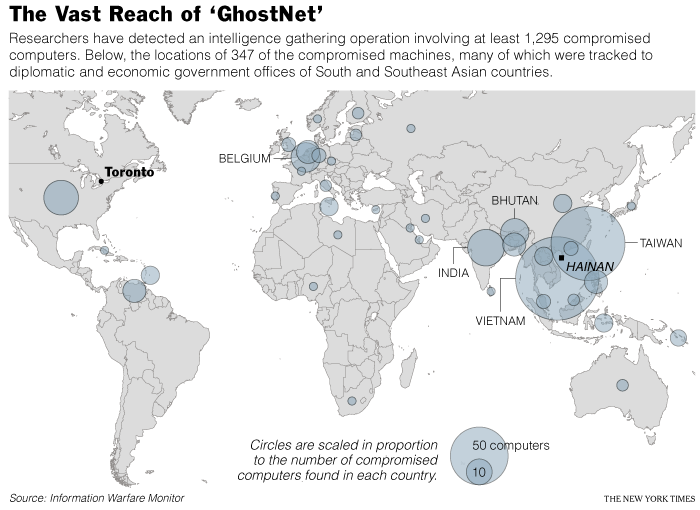
A group of hackers based almost exclusively in China has hacked into 1,295 computers in 103 countries. Canadian researchers at the University of Toronto revealed that cyber spies infiltrated systems in foreign ministries, embassies, international organizations, and the offices of the Dalai Lama. Thirty percent of the targeted computers could be considered "high-value" targets. No US government computers were compromised; however, the cyber spies broke into a NATO computer for half a day.

The Chinese government has denied any connection to the group and it remains unclear who is responsible and whether they worked for an official intelligence agency. In their report (to read it, click here) which was published in the Information Warfare Monitor on Sunday, the researchers said that their investigation "raises more questions than it answers," but their findings should serve as a "wake-up call."

At the very least, a large percentage of high-value targets compromised by this network demonstrate the relative ease with which a technically unsophisticated approach can quickly be harnessed to create a very effective spinet…These are major disruptive capabilities that the professional information security community, as well as policymakers, need to come to terms with rapidly.​

The University of Toronto team began its investigation at the request of the office of the Dalai Lama, but ultimately discovered that, in addition to targeting the exiled Tibetan leader, the spy network was focusing on South Asian and Southeast Asian countries, reports Canada's Globe and Mail. Malware installed by the spy network could activate infected computers' cameras and microphones, allowing cybersleuths to see and hear what was happening in the room.

The researchers were able to monitor the commands given to infected computers and to see the names of documents retrieved by the spies but in most cases the contents of the stolen files have not been determined.

Working with the Tibetans, however, the researchers found specific correspondence had been stolen and the intruders had gained control of the electronic mail server computers of the Dalai Lama's organization.​

A map printed in The New York Times shows where computers were infected. The Times also reports that although reports indicate that most of the computers responsible for the cyberespionage are located in China, investigators have cautioned against drawing conclusions that Chinese authorities were involved.

The spying could be a nonstate, for-profit operation, for example, or one run by private citizens in China known as "patriotic hackers."

"We're a bit more careful about it, knowing the nuance of what happens in the subterranean realms," said Ronald J. Deibert, a member of the research group and an associate professor of political science at [the Munk Center for International Studies at the University of Toronto]. "This could well be the C.I.A. or the Russians. It's a murky realm that we're lifting the lid on."​

Two other researchers at Cambridge University, who also investigated the cyber spy network, have been "less circumspect" than their Canadian counterparts about pointing a finger at China, reports Threat Level, a Wired Magazine blog.

An abstract of the report by the Cambridge researchers, titled "The Snooping Dragon," says that these attacks are particularly significant because of their ability to collect "actionable intelligence for use by the police and security services of a repressive state, with potentially fatal consequences for those exposed." Though the report investigates alleged Chinese hacking, it says that the techniques could be used by individuals and create serious consequences for cyber security in both the public and private sector.

Few organisations outside the defence and intelligence sector could withstand such an attack, and although this particular case involved the agents of a major power, the attack could in fact have been mounted by a capable motivated individual. ... The traditional defence against social malware in government agencies involves expensive and intrusive measures that range from mandatory access controls to tiresome operational security procedures. These will not be sustainable in the economy as a whole. Evolving practical low-cost defences against social-malware attacks will be a real challenge.​

Meanwhile, in the United Kingdom, intelligence chiefs have voiced concerns that China may have gained the ability to stop the delivery of critical services such as electricity water, and food, reports the Times of London. The UK recently signed a multimillion dollar deal with Huawei, a Chinese telecommunications company, to update the nation's telecom network.

According to the sources, the ministerial committee on national security was told at the January meeting that Huawei components that form key parts of BT's new network might already contain malicious elements waiting to be activated by China.

Working through Huawei, China was already equipped to make "covert modifications" or to "compromise equipment in ways that are very hard to detect" and that might later "remotely disrupt or even permanently disable the network", the meeting was told.

This would be likely to have a "significant impact on critical services" such as power and water supplies, food distribution, the financial system and transport, which were dependent on computers to operate.​

http://www.csmonitor.com/2009/0329/p99s01-duts.html
 
Re: Chinese Hackers Reponsible For '03 East Coast & '08 Florida Blackouts

0329-for-X-SPYweb.gif
 
NEW YORK—Hackers believed to be backed by the Chinese communist regime have continuously broken into computers critical to the functioning of the United States' electric grid network and installed control programs that would allow them to catastrophically disrupt service, government officials confirmed Wednesday.

The news about the compromise of mission-critical computers, which is believed to have been happening for at least a few years now, was first broken by the Wall Street Journal on April 7 and then was confirmed through interviews published by several other news media.

Homeland Security Secretary Janet Napolitano confirmed the compromises in a press conference on Wednesday. "The vulnerability is something that the Department of Homeland Security and the energy sector have known about for years," she said at the conference.
Espionage Backed by Chinese Regime
Most of the compromises were made by spies from China and Russia, the Wall Street Journal reported.

"The Chinese have attempted to map our infrastructure, such as the electrical grid," the paper quoted a senior intelligence official as saying.

The level of sophistication in the attacks and the depth of the compromises is reported to be so pervasive that in an interview with the Associated Press, one official said that it was "almost without a doubt" sponsored by the governments and regimes of the countries from where the attacks originated.

"The severity of what we're seeing is off the charts ... most of the critical infrastructure in the U.S. has been penetrated to the root by state actors," the Associated Press quoted Tom Kellermann, who is a member of the Commission on Cyber Security advising U.S. President Barack Obama on cyber-security issues.

All major electricity companies were targeted in the attack, with several of their key systems compromised. The attacks "appeared pervasive across the U.S. and doesn't target a particular company or region," a former Department of Homeland Security official said to the Wall Street Journal.
Vulnerability of U.S. Infrastructure
Intelligence officials are also worried about the vulnerability of several other key components of the United States infrastructure, such as nuclear power plants, financial networks, and water and sewage systems.

CIA analyst Tom Donahue is believed to have impressed the importance of computer security on engineers at utility companies last year. His talk included information about how power grids in regions outside the U.S. had been compromised and held to ransom, with the attackers demanding payment and in one case, turning off the lights of an entire city.

The Edison Electric Institute, an association of public electric companies in the United States, released a statement on Wednesday saying that it was cooperating with government and intelligence officials. "The issue of cyber security has been on our industry’s radar for some time. We are taking aggressive action to ensure that we anticipate, detect and address any present or future potential cyber threats to the system. In this effort we are working closely with the Department of Homeland Security ... and other federal agencies," the statement said.

However, government officials are reported to be flustered at the lack of security initiative taken by power companies, most of which are private. After Idaho National Laboratory released a demonstration video in March 2007 of the damage hackers could do if they seized control of key parts of the electric grid, the government launched an audit investigation of security practices in utility companies, which led to the cyber-espionage findings.

Officials of the Obama administration have been conducting a study of vulnerabilities and security issues that could compromise United States security interests. The report, which will be delivered to the President's desk in a few weeks, is expected to call for increased federal involvement in cyber security of key infrastructure.

http://www.theepochtimes.com/n2/content/view/15058/

http://www.usajobs.gov/
 
Re: Chinese Hackers Penetrate U.S. Electric Power Grid

I don't get how these Russian, Chinese, Latin hackers can do all this damage, and yet...

they can't manage to create a decent PC operating system.

Is hacking that much easier than OS programming and desktop development?

If so, it doesn't say much for the competence of US computer security in the nation's energy/retail/government sector.
 
Re: Chinese Hackers Penetrate U.S. Electric Power Grid

I don't get how these Russian, Chinese, Latin hackers can do all this damage, and yet...

they can't manage to create a decent PC operating system.

Is hacking that much easier than OS programming and desktop development?

If so, it doesn't say much for the competence of US computer security in the nation's energy/retail/government sector.


Yes, especially if it backed by the financially resources of a government.

As for creating OS's Brazil created their own favor of Unix called "Plurix".

Are biggest problem is we have outsourced all of programming to India, and other foreign sources i.e. IBM.
 
Back
Top