Actor Woody Harrelson's father:
The Life and Crimes of Charles Voyde Harrelson: A Notorious Hitman
Texas State Historical Association
By: William V. Scott
Published:
Updated: June 12, 2024
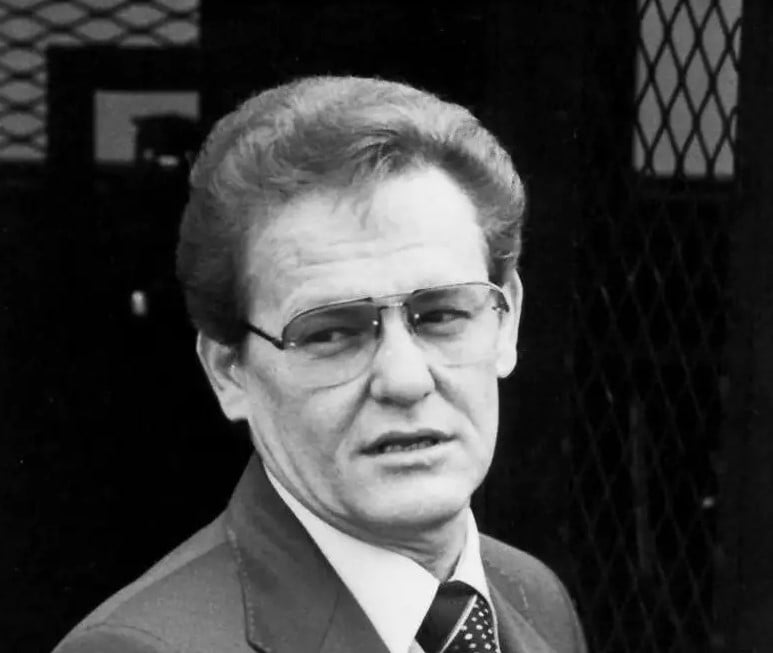
Hit man Charles V. Harrelson was convicted for the contract killing of Judge John H. Wood, Jr. His arrest in 1980 was the result of the FBI's most costly investigation in history to that date. Image available on the
Internet and included in accordance with
Title 17 U.S.C. Section 107.
Harrelson, Charles Voyde (1938–2007).Charles Voyde Harrelson, convicted hit man, was born on July 23, 1938, in Huntsville, Texas, (other sources claim Lovelady in Houston County) to Voyd and Alma Lee (Sparks) Harrelson. His father was a farmer and later guard in the Texas
prison system. Harrelson attended Huntsville High School, where he served as vice president of the poster club and was involved in a cappella and high school choir before dropping out and joining the U.S. Navy, where he served as a sonar man.
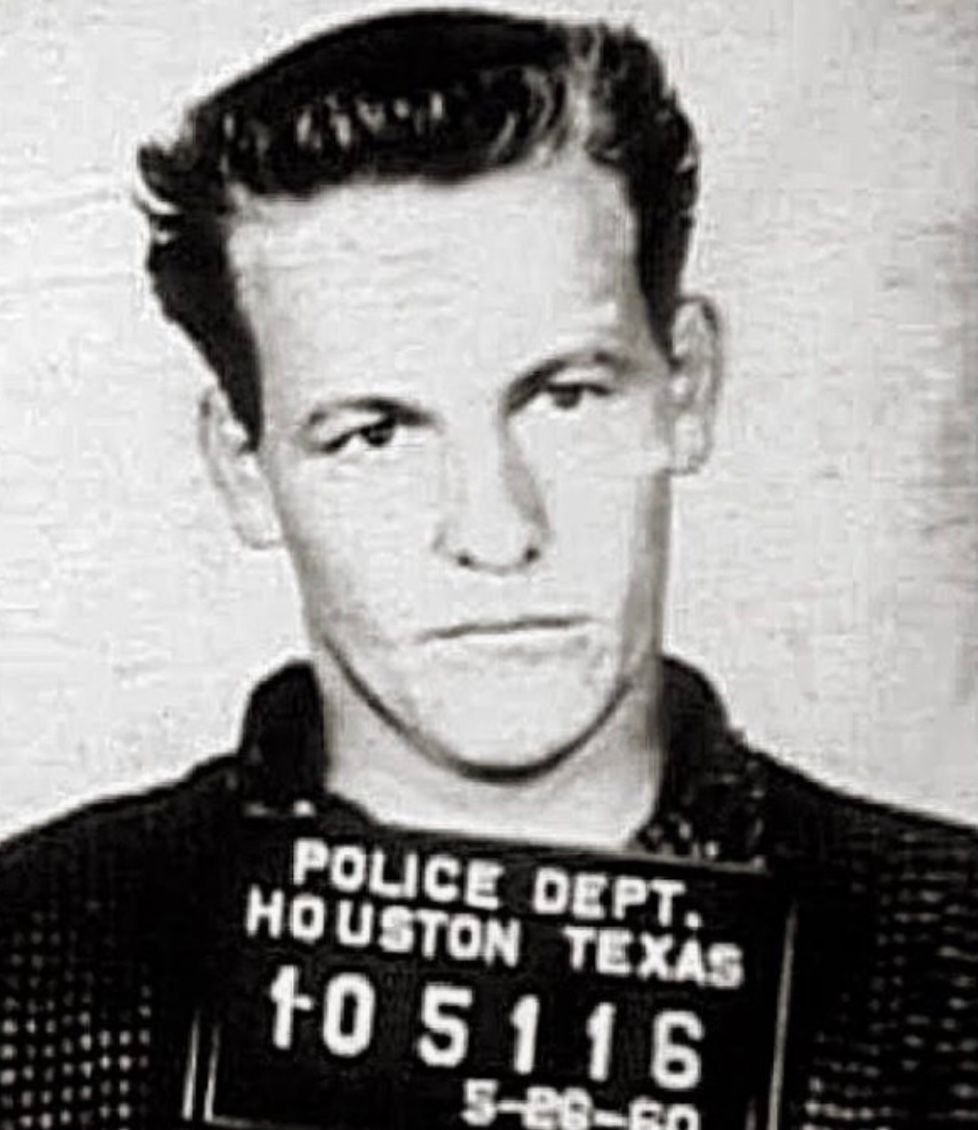
Harrelson was married to Diane Lou Oswald on February 26, 1958, by Baptist Rev. L. D. Morgan in Pasadena, Texas. The couple had three sons, Jordan Kenneth, Woodrow “Woody” Tracy, and Brett V. Harrelson held many odd jobs, including working as a book salesman (where he was presented “Salesman of the Year”) and repairing dental equipment, but he preferred gambling. He was convicted of armed robbery in 1960.
Mugshot of Charles Harrelson, Houston Police Department, 1960. Image available on the
Internet and included in accordance with
Title 17 U.S.C. Section 107.
Harrelson and his wife divorced in 1964, and Diane and their three sons moved to Lebanon, Ohio. Throughout his twenties, Harrelson continued to consort with gamblers and developed a taste for expensive possessions. He spent some time in prison in California. Associates and law enforcement agents described him as having a charming personality that belied ruthless criminal behavior.
In 1968 Harrelson returned to Texas and became a suspect in the murder of gambler Alan Harry Berg. He traveled to Missouri, where he was apprehended by detectives of the Kansas City Police Department on a federal firearms charge. Back in Texas, Harrelson’s acquaintance Sandra Sue Attaway emerged as a principal witness against him. She had witnessed the abduction and hired killing of Alan Berg, who was stuffed in the back of a car in the parking lot of Houston’s Brown Jug Club. Attaway testified that she was with Harrelson at the time of Berg’s abduction and witnessed the murder and disposal of Berg’s body on the Surfside Island waterfront. After Harrelson jumped bail,
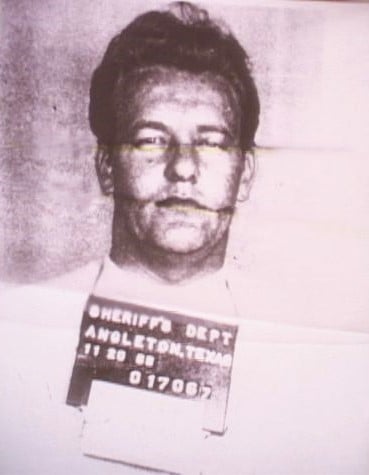
Texas Rangers and agents from the sheriff departments of Brazoria and Harris counties, with the assistance of Atlanta police, arrested Harrelson in Atlanta, Georgia, on November 20, 1968. Harrelson was acquitted of the murder of Berg due to an effective defense by his counsel
Percy Foreman, which resulted in a deadlocked jury.
In 1968 Harrelson was arrested on suspicion of the murder of gambler Alan Harry Berg but was acquitted. Image available on the
Internet and included in accordance with
Title 17 U.S.C. Section 107.
Harrelson remained incarcerated, however, and awaited trial for a second murder-for-hire—the killing of a Hearne-based grain dealer, Sam Carmelo Degelia, Jr., whose remains were found in an irrigation pumphouse in McAllen. The case in Hidalgo County ended in a mistrial, but a second trial rendered a guilty verdict, and Harrelson was sentenced to fifteen years. On August 27, 1973, after his formal sentencing, attorneys Foreman and Dick DeGuerin appealed his time of incarceration. Harrelson had been incarcerated since 1968, and they asked that this time be applied as credit towards his sentence. The Texas Department of Corrections released Harrelson in August 1976, but U.S. marshals took him to the federal facility at Leavenworth, Kansas, to complete a sentence for his previous firearms charge. Harrelson was released again in 1978 and returned to Texas and gambling. On January 7, 1979, he married Jo Ann Starr in Las Vegas, Nevada.
On the morning of May 29, 1979, federal judge
John Howland Wood, Jr., was killed with one shot in the back while he was leaving his home in the Alamo Heights neighborhood of San Antonio. Local, state, and federal law enforcement launched an extensive investigation. During the probe, Texas Ranger
Jack O’Day Dean, captain of Company D in San Antonio, received an anonymous phone call that implicated Harrelson as a possible hit man. Dean was among the law enforcement personnel that had worked on the Degelia case, and his report regarding Harrelson to FBI investigators played a crucial role in the case. In February 1980 Harrelson was arrested on more firearms charges in Houston, but he was released on bail and skipped his court date. Authorities found him outside of Van Horn, Texas, on September 1, and Harrelson, under the influence of injected cocaine, was captured after a six-hour standoff after threatening to kill himself.
After Harrelson’s arrest, he confessed to killing Wood. He also confessed to shooting President John F. Kennedy on November 22, 1963. The Kennedy claim drew media attention for years, as Harrelson exploited his physical similarity to one of three “tramps” who had been questioned by Dallas police after
Kennedy’s assassination. Harrelson, who often bragged about committing various crimes—real or not—was disproven to have been one of the three, as Dallas police later revealed their identities. In the end, the FBI’s extensive investigation of the Wood assassination exceeded the cost of that agency’s inquiry into the assassination of Kennedy and was the most costly investigation in history to that date, totaling more than $11 million.
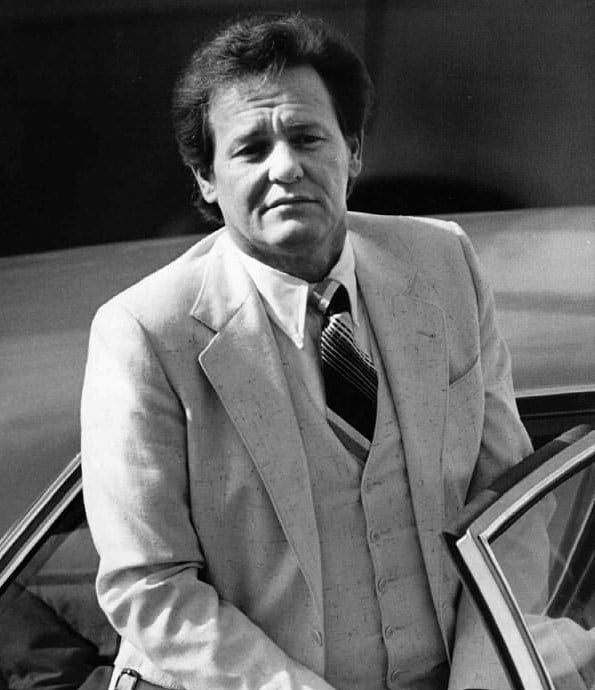
On November 8, 1982, Charles Harrelson arrived at the John H. Wood, Jr. United States Courthouse in San Antonio to stand trial for the assassination of federal judge John H. Wood. Courtesy
Express-News File Photo and included in accordance with
Title 17 U.S.C. Section 107.
Details of the case revealed a contract killing. Harrelson was allegedly paid $250,000 to shoot Wood, who was presiding over the trial and sentencing of drug kingpin Jamiel “Jimmy” Chagra. Wood, nicknamed “Maximum John,” was known for his lengthy prison sentences for felons, especially regarding narcotics. On April 15, 1982, a federal grand jury indicted three defendants in the murder of Wood. The three were Harrelson, accused of the shooting of Wood; Harrelson’s wife Jo Ann, who allegedly bought the murder weapon; and Elizabeth Chagra, wife of Jimmy Chagra, for covering up the crime. Jimmy Chagra, who allegedly hired Harrelson, secured a separate venue and was acquitted in Jacksonville, Florida. He was, however, convicted of drug charges and obstruction of justice. His brother, Joe Chagra, pled guilty to a murder-conspiracy charge and agreed to be a government witness against all the accused, except for his brother. Harrelson’s trial began in the newly-named John H. Wood, Jr. United States Courthouse in San Antonio in September 1982. Judge William S. Sessions presided over the trial, which lasted two and a half months and involved ninety-four witnesses. Harrelson was pronounced guilty and received two life sentences plus five years. He was institutionalized in Marion, Illinois, before being transferred to a facility in Atlanta, Georgia.
Harrelson’s involvement in an ill-fated prison break in Atlanta in 1995 resulted in his transfer to the Supermax facility (USP Florence ADMAX) near Florence, Colorado, where he served the rest of his life. His son, actor Woody Harrelson, funded his unsuccessful appeal in 1997. Charles Voyde Harrelson, at age sixty-eight, was found dead from an apparent heart attack in prison at the Supermax facility at Florence, Colorado, on the morning of March 15, 2007. Upon Harrelson’s death, his sons inherited papers that he had compiled and hoped would be his published memoirs. In these, he admitted that he was involved in dozens of killings beginning in the early 1960s. His involvement was often related to driving the car or other lesser roles, but he claimed to have acted as the assassin in at least six killings.
Bibliography:
Bob Alexander,
Old Riot, New Ranger: Captain Jack Dean, Texas Ranger and U. S. Marshal. (Denton: University of North Texas Press, 2018). Bonham
Daily Favorite, November 20, 1968. Brownsville
Herald, November 20, 1968. Gary Cartwright,
Dirty Dealing: Drug Smuggling on the Mexican Border & the Assassination of a Federal Judge: An American Parable (El Paso: Cinco Punto Press, 1984; second ed., 1998). New York
Times, December 15, 1982. San Antonio
Express-News, March 22, 2007; May 29, 2019; May 27, 2021. San Antonio
Light, May 29, 1979. Vertical files, Texas Ranger Research Center, Waco (Jack O’Day Dean).
The following, adapted from the Chicago Manual of Style, 15th edition, is the preferred citation for this entry.
William V. Scott, “Harrelson, Charles Voyde,”
Handbook of Texas Online, accessed December 24, 2025,
https://www.tshaonline.org/handbook/entries/harrelson-charles-voyde.
Published by the Texas State Historical Association.
TID: FHAR1
All copyrighted materials included within the
Handbook of Texas Online are in accordance with Title 17 U.S.C. Section 107 related to Copyright and “Fair Use” for Non-Profit educational institutions, which permits the Texas State Historical Association (TSHA), to utilize copyrighted materials to further scholarship, education, and inform the public. The TSHA makes every effort to conform to the principles of fair use and to comply with copyright law.
For more information go to:
http://www.law.cornell.edu/uscode/17/107.shtml
If you wish to use copyrighted material from this site for purposes of your own that go beyond fair use, you must obtain permission from the copyright owner.
Original Publication Date: June 12, 2024 Most Recent Revision Date: June 12, 2024