Baucus unveils Senate health care bill

QueEx

Rising Star
Super Moderator
<font size="5"><center>
Baucus Unveils $856 Billion
Health-Care Legislation </font size>
<font size="4">

Bill Has No Public Option,
Would Require People to Purchase Coverage
</font size></center>
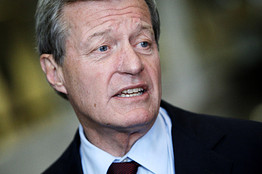

OB-EL670_0916ba_D_20090916093920.jpg

Sen. Max Baucus spoke with the press on
Capitol Hill on Tuesday.


The Wall Street Journal
By GREG HITT
September 16, 2009


WASHINGTON -- Senate Finance Committee Chairman Max Baucus formally unveiled a 10-year $856 billion bill that would extend health insurance to tens of millions of Americans not now covered, moving an important step forward on President Barack Obama's top domestic priority.

The sweeping measure:

  • Is designed to steer a more moderate course on health policy than other major bills moving through Capitol Hill.

  • Does not propose to create a new government insurance plan to compete with private insurers, as proposed in rival House legislation and favored by many liberals.

  • Instead, the Montana Democrat is proposing to expand coverage by creating a network of nonprofit health insurance cooperatives.

More than a year in the making, the bill would overhaul the nation's health-care system and has sparked a sharp battle between Republican leaders and the White House over the size and role of government in the nation's economy. The measure would create a new national insurance exchange, where individuals and small businesses can purchase insurance. Individuals would be required to purchase insurance, but those at the lower end of the income ladder would receive federal tax subsidies to defray the cost.

(Read the full text of the Baucus plan.)

Moreover, insurers would be barred from using a range of practices -- such as denying health coverage to individuals with pre-existing conditions -- that critics say have created economic turmoil and emotional hardship for millions of families.

Senate Majority Leader Harry Reid (D., Nev.) intends to convene a caucus of Senate Democrats Thursday to discuss the legislation. Mr. Baucus is intent on bringing the bill before the influential Finance panel next week. The committee has wide jurisdiction over health policy.

Mr. Baucus has hoped to win over Republican Sens. Olympia Snowe of Maine, Chuck Grassley of Iowa and Mike Enzi of Wyoming, arguing a bipartisan bill has the best chance of ensuring passage on the Senate floor. For now, the senator is pressing forward with his own bill. But he still has hopes of winning bipartisan support, either in committee next week or on the floor next month.

Action in the Finance Committee will affect other versions of the health legislation across Capitol Hill. In the House, moderate Democrats have resisted moving forward, arguing they won't vote to create a public health insurance option if the Senate is not going to support one.

In recent days, House Democratic leaders have signaled flexibility on the issue. And with Mr. Baucus moving forward, the pace of efforts to craft a compromise bill in the House are likely to gain steam.

Write to Greg Hitt at greg.hitt@wsj.com


http://online.wsj.com/article/SB125310546537515699.html?mod=googlenews_wsj
 

The Baucus bill represents FRAUD. It is designed to NOT ONLY preserve the “Health Care Mafia's” obscene profits but Baucus’ bill will actually DRAMATICALLY INCREASE the “Health Care Mafia’s” profits. For Proof of this –in real time- look at the last 3 month stock price history of “Health Care Mafia” stocks.

AETNA - (AET) Up 30%
UNITED HEALTH CARE - (UNH) Up 22%
CIGNA- - (CI) Up 49%


The Baucus bill represents what 1.4 Million Dollars per day in general bribes & payoffs to congress (85% to RepubliKlans) and $4,000,000.00 directly to Max Baucus CAN BUY!!!

MAX BAUCUS “Health Care Mafia” Financial Contributions
The Insurance Industry: $1,170,313
Health Professionals: $1,016,276
Pharmaceuticals/Health Products Industry: $734,605
Hospitals/Nursing Homes: $541,891
Health Services/HMOs: $439,700

That is a grand total of $3,902,785.00

the BAUCUS BRIBERY BILL HIGHLIGHTS

PAGE 4. The bill would allow the “Health Care Mafia” to ‘mandate’ that your employer take money from your paycheck called "salary reduction" whether or NOT you signed up for your company offered health insurance plan. Example: Suppose you & your wife both work for companies that offer health insurance. What currently occurs is that you compare the plans and then choose ONE family plan to cover both of you plus children if you have children. Under Baucus’ plan BOTH of you would have to pay premiums.

PAGE 5. The “Health Care Mafia” CAN CANCELL YOUR coverage AT ANY TIME BY CERTIFYING YOU INELLIGIBLE!

PAGE 12. 52 “Health Care Mafia” CZARS not the US Government will “MONITOR??” the implementation of this new program.

PAGE 12 . BAUCUS provides for THE REPEAL OF HIS BILL following the next Presidential Election via EXECUTIVE ORDER.

Imagine That!!

Imagine such a provision in the bill that created Social Security or Minimum Wage Laws or Medicare. It didn’t and could never happen.

There’s a lot more untenable garbage in Baucus’ fraudulent bill. Now despite this bill being a complete bought & paid for sell out to the “Health Care Mafia”, not one RepubliKlan supports the bill.

The videos below from Olbermann cuts through much of the BullShit propagated about Baucus’ bill, Although the Baucus bill is SO BAD that even the usual corporate shills had great difficulty mustering any enthusiasm pitching this bill on television as being any good.


<div><iframe height="339" width="425" src="http://www.msnbc.msn.com/id/22425001/vp/32885811#32885811" frameborder="0" scrolling="no"></iframe><p style="font-size:11px; font-family:Arial, Helvetica, sans-serif; color: #999; margin-top: 5px; background: transparent; text-align: center; width: 425px;">Visit msnbc.com for <a style="text-decoration:none !important; border-bottom: 1px dotted #999 !important; font-weight:normal !important; height: 13px; color:#5799DB !important;" href="http://www.msnbc.msn.com">Breaking News</a>, <a href="http://www.msnbc.msn.com/id/3032507" style="text-decoration:none !important; border-bottom: 1px dotted #999 !important; font-weight:normal !important; height: 13px; color:#5799DB !important;">World News</a>, and <a href="http://www.msnbc.msn.com/id/3032072" style="text-decoration:none !important; border-bottom: 1px dotted #999 !important; font-weight:normal !important; height: 13px; color:#5799DB !important;">News about the Economy</a></p></div>


<div><iframe height="339" width="425" src="http://www.msnbc.msn.com/id/22425001/vp/32885849#32885849" frameborder="0" scrolling="no"></iframe><p style="font-size:11px; font-family:Arial, Helvetica, sans-serif; color: #999; margin-top: 5px; background: transparent; text-align: center; width: 425px;">Visit msnbc.com for <a style="text-decoration:none !important; border-bottom: 1px dotted #999 !important; font-weight:normal !important; height: 13px; color:#5799DB !important;" href="http://www.msnbc.msn.com">Breaking News</a>, <a href="http://www.msnbc.msn.com/id/3032507" style="text-decoration:none !important; border-bottom: 1px dotted #999 !important; font-weight:normal !important; height: 13px; color:#5799DB !important;">World News</a>, and <a href="http://www.msnbc.msn.com/id/3032072" style="text-decoration:none !important; border-bottom: 1px dotted #999 !important; font-weight:normal !important; height: 13px; color:#5799DB !important;">News about the Economy</a></p></div>


The Absurdity of Preserving Profit in the Health Insurance Industry

September 14, 2009

http://pleasecutthecrap.typepad.com...-profit-in-the-health-insurance-industry.html

You know, one component of the health insurance reform debate that has always puzzled me is this notion that somehow health insurance companies are entitled to make a profit for using your money to pay for your health care. It's truly one of the strangest concepts I've ever heard of, and I think it's time we put that notion to rest, once and for all.

Did you know we're the only industrialized nation on the planet whose health care financing system is controlled by a for-profit health insurance industry? Yeah, that's right; and we're also the only industrialized nation in which health care makes up more than 10% of its GDP (Health care accounts for 17% of our GDP), even though we're also the only country that doesn't cover virtually anyone living within its borders legally. (Fully one-fifth of our population has no coverage, or access to health care.) Coincidence? Not even a little. If you think about what for-profit insurance companies do to maximize their profits, it actually makes perfect sense that our system is screwed. Health insurance, even when it works, doesn't actually provide a marketable service. Essentially, they take money from a bunch of people, who give it to them in good faith to pay for any health problems that might result, but they alone seem to decide what is necessary and what is not. And whatever they don't spend, they get to keep.

How is that fair? More importantly, I'd like for some wingnut to explain to me how that meets any sort of rational "free market" capitalistic model.

The health insurance model we live with now is patently absurd. They actually increase their profits by NOT providing services. In what way does that not stand capitalism on its head?

Think about it this way...

Imagine your brother-in-law came to you and said, "Send me $18,000 per year, and I'll keep it for you. Whenever you need money to spend, just come to me, and I'll pay the bill for you, as long as I approve of the item you plan to buy. Then, at the end of the year, whatever you haven't spent, I get to keep."

Would you take that deal, or would you laugh at him and suggest to your wife that he be committed?

What if you deposited money in your bank, but in return for using the debit card (your money), the bank got to approve your purchases, then zeroed out your balance every December 31, kept the money and made you start over? Would that be a fair capitalist model? What if they approved you for a mortgage this year, then ten years later canceled it because the home's value had dropped slightly or the neighborhood had changed? Wouldn't you consider that unfair and take them to court? Oh, wait; you can't take them to court, because the mortgage contains a mediation clause.

The above examples are almost exactly how health insurance works now. Our current health care financing system is absurd, and it will cripple our economy if we continue with it. By the way, this shouldn't come as a surprise to anyone, but the current for-profit insurance system is actually relatively new, and pretty much a neocon creation.

Yes, that's right. The concept of for-profit health insurance is actually a relatively new concept; borne out of the right wing takeover of the government that actually started right after Goldwater lost the 1964 election by a record margin. Consider the history of health insurance, and you'll see that health insurance worked quite well for most people until it became a profit center.

During the 1920s, because of increased technology and a desire for higher quality care, doctors and hospitals started charging a little more than most individuals could afford to pay. Baylor Hospital in Dallas saw the problem and created a system of insurance, wherein everyone involved could pitch in a few dollars a month, and the system would pay their bills in the event of illness. This concept caught on all over the country, and the Blue Cross system was born.

As conceived, Blue Cross was a system of largely philanthropic organizations. The organizations were led by (then non-profit) hospitals, which were mainly interested in signing up potential patients for their hospital. They charged the same premium to everyone, regardless of age, sex or the state of a person's health. In other words, health insurance came about because hospitals wanted to be paid. It was an economically rational choice, not unlike General Motors setting up its own financing arm, so that more people could afford its cars.

But as is the case with most such ideas, commercial insurers saw a chance to make a buck and bastardized what started as a rational system. The success of Blue Cross convinced those insurers that there was money to be made in health care, so they entered the market by peddling their wares to employers during World War II. Because of wartime wage controls and labor shortages, businesses were looking for a way to compete, so they signed up with these private insurers and offered health insurance as a way to attract new workers. Since they were establishing a market for themselves, they mimicked Blue Cross in every way, including charging everyone the same premium. And they would remain non-profit for quite a while, as they tried to establish themselves.

At the end of the war, you had a strong, non-profit, hospital-run, philanthropic Blue Cross system, and a smattering of fledgling private insurance firms, trying to sell businesses on carrying health insurance to attract workers, and not interested in profits quite yet. Therefore, when Harry Truman proposed a national health insurance system right after World War II, it didn't go over well, as opponents could rightfully point to the non-profits and say they had the situation well in hand, and it wasn't needed. In particular, he was opposed by the American Medical Association, many of whose members were running Blue Cross organizations, and who characterized the proposed national health insurance as "socialized medicine."

Let's just say Harry Truman was a visionary.

At the time Truman proposed a "socialized insurance" scheme, most people had access to health insurance, it was affordable, and everyone paid roughly the same. But, as more private insurance companies entered the market throughout the 1950s, the market began to change, as more of them started evaluating risk and began to avoid the riskiest customers altogether, and raise premiums for those who were just a little risky. At the same time, large companies started to self-insure, which took a lot of potential customers off the market for the still-emerging health insurance companies. But this was the beginning of a trend, whereby those who needed coverage most had the hardest time getting affordable coverage, if they could get it at all.

During the 1950s, a greater number of workers, seniors and the unemployed were not covered, and political pressure grew substantially, at both the national and state levels, to come up with a national health insurance system. Finally, in 1965, Congress passed Medicare and Medicaid, and 20% of the population received coverage.

But the neocon takeover of the government was coming. When the Vietnam War became the most important issue of the late 1960s, it gave Richard Nixon the presidency over Hubert Humphrey. In 1971, Nixon and Ted Kennedy proposed dueling "universal coverage" bills. Teddy's was an actual proposal that would have essentially given everyone access to affordable coverage, while Nixon's was a mix of public and private programs, with an emphasis on the private. A cornerstone of the Nixon plan was a major expansion of the concept of the Health Maintenance Organization, or HMO. Yes, folks, you have Richard Nixon to blame for your HMO. And make no mistake; HMOs are the root of this problem, because HMOs were the conduit by which private insurance brought profit into the system. Keep in mind, by 1971, virtually all health insurance was still non-profit. A lot of people had already been priced or locked out of the health insurance system, but the companies themselves were non-profit.

The HMO idea had been around for years, and in the hands of good people, they can actually be beneficial. I mean, who could argue against a plan that includes coverage for regular trips to the doctor, and creates incentives for doctors to keep you healthy, right? Sounds peachy, doesn't it? But think about how HMOs work, and imagine them in the hands of greedy profiteers.

In an HMO system, you pay premiums to the health insurance company, and choose a primary care physician from a list they give you. Then, that insurance company gives that doctor a portion of the money you've paid in premiums, and that's all the money that doctor will get from the insurance company, so he essentially gets to keep whatever he doesn't use. Now, good doctors, in business for all of the right reasons will see that as an incentive to treat patients efficiently. But others, especially those working for for-profit medical groups, might see an incentive to NOT treat. And remember; doctors only get a portion of the money you pay in to the insurance company; the rest goes to the pool, to pay for hospitalization. But look at the model; by adopting the HMO model, for-profit health insurance companies had the opening they needed. After all, if medical professionals got to keep any portion of your money that was not used by you, why shouldn't health insurance companies, as well?

For the next decade, the move to for-profit insurance was a trickle, mostly because neocons were just gaining a foothold in the government. By 1981, only 12% of the health insurance market was controlled by for-profit insurance companies. But then the neocons hit the fan, and deregulation fever swept the nation. With neocons in charge, and progressives left to sit on the sidelines and whine about how terrible Ronald Reagan was, all of the restraints on for-profit insurance were lifted and the entire system was transformed into the price-gouging, immoral system you see today. And why not? The HMO concept is the only profit model that can work when it comes to health insurance. You pay them money, and whatever you don't use, they get to keep. It's simple, and yet corrupt. That model used to be called a "protection racket," but neocons see this as a good "free market" business model.

But there's nothing "free market," or even "capitalistic" about the current health care financing model. Do you realize health insurance companies don't even have to increase revenues to keep profits increasing and keep their stockholders happy under the current structure? They only have to figure out ways to keep more of what they collect. The problem is, their business model actually works against the needs of the system itself. The actual players in the health care system -- the doctors and patients only -- can only function if everyone is covered and all of the bills are paid. In the health care system we've created, we've been stuck with a "middleman" of sorts, who must necessarily work AGAINST the needs of the system in order to increase profits every year.

For-profit insurance works against any sort of logical model, because it incentivizes the actual non-payment of bills. Opponents of health insurance reform like to bring up "free market" a lot, but it's as if the mere fact that insurance companies make a profit is proof of a "free market" model. That's absurd. That's not saying insurance companies can't make a profit at all. If they'd like to take 3-5% of premiums off the top in a competitive environment, I suppose that might be acceptable. But the current system is simply not a "free market" system any way you look at it.

The next time someone comes to you and tells you that we need to preserve the for-profit aspect of the health insurance system, ask them if they'd take that offer from their brother-in-law or the bank. Then, remind them that health insurance in this country didn’t spin completely out of control until the for-profit model took over. Ask them to explain such coincidence.


[FLASH]http://www.youtube.com/v/jHVwrCzRUX0&hl=en&fs=1&[/FLASH]

<HR NOSHADE COLOR="#D90000" SIZE="14"></HR>

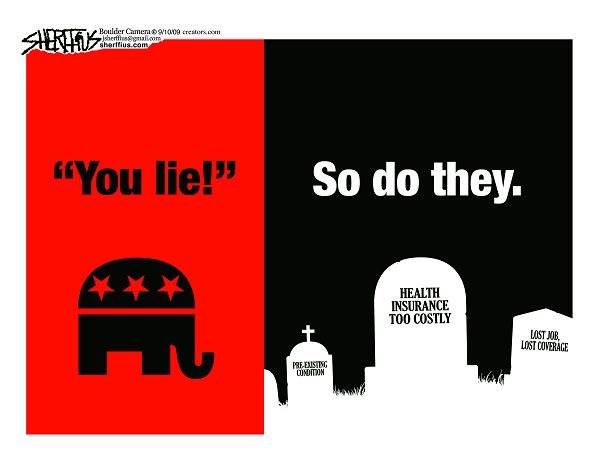
hc-so-do-they.jpg
 
<font size="4">

Senate health care bill would reduce deficit, analysis finds</font size>

The Senate Finance Committee's health care overhaul effort got a boost Wednesday when the nonpartisan Congressional Budget Office estimated that it would cost $829 billion and <SPAN style="BACKGROUND-COLOR: #ffff00">reduce the federal deficit by $81 billion</span> over the next 10 years.

The CBO assumes billions in savings from changes in Medicare and other government health programs. <SPAN style="BACKGROUND-COLOR: #ffff00">The savings and tax revenues, the CBO forecasts, would more than offset anticipated costs for subsidies for those who can't afford coverage and additional spending on Medicaid and the children's health program.</span>

Full Story: http://www.mcclatchydc.com/251/story/76743.html
 
I don't like the mandate w/o the public option. Although, the subsidies should cover my broke ass...
 
<font size="5"><center>
1:19 a.m.: Senate Dems win key
60-40 vote on health care</font size></center>


WEBvicky.wide_photo.prod_affiliate.91.jpg

Victoria Reggie Kennedy, widow of the late Sen. Ted Kennedy, D-Mass.,
congratulates Senate Majority Leader Harry Reid following the 60-40
cloture vote. | Associated Press


McClatchy Newspapers
By David Lightman
December 20, 2009


WASHINGTON — The Senate early Monday voted 60 to 40 to cut off extended debate on the Democratic-authored health care overhaul bill, the first major step toward passing the measure later this week.

The vote, which saw all 58 Democrats and two independents vote to end the latest debate while all 40 Republicans opposed the maneuver, ended at 1:19 a.m. and capped a day of debate that turned partisan and often angry.

“If the people who wrote this bill were proud of it, they wouldn’t be forcing this vote in the dead of night,” Senate Republican Leader Mitch McConnell, R-Ky., said as he made a final post-midnight plea to derail the $871 billion bill. “The final product is a mess _ and so is the process that’s brought us here to vote on a bill that the American people overwhelmingly oppose.”

Senate Majority Leader Harry Reid, D-Nevada, countered: "This is not about politics. It's about people. It's about life and death in America."

The vote, the first of three planned this week aimed at cutting off different debates, found Democrats marching united and determined toward anticipated passage of historic health care legislation late Wednesday or Thursday. If that happens, the Senate bill will have to be reconciled with the version the House of Representatives passed last month.

Most of the talk on Capitol Hill Sunday centered on the difficult clashes ahead over abortion, taxes and the public option.

Resolving those differences will be up to a conference, or negotiating, committee, which is expected to be dominated by senior lawmakers from both Houses close to Senate Majority Leader Harry Reid, D-Nevada, and House Speaker Nancy Pelosi, D-Calif.

White House officials are expected to be close to the talks; Chief of Staff Rahm Emanuel, Health and Human Services Secretary Kathleen Sebelius, Budget Director Peter Orszag and top health care adviser Nancy-Ann DeParle have all been frequent visitors to the Capitol in recent weeks to discuss strategy.

Many major points in both bills are roughly the same. Insurers would be barred from denying coverage because of pre-existing conditions. Nearly everyone would have to obtain coverage in four or five years. New exchanges, or marketplaces, would be created to help consumers shop for policies.

But there are sharp divisions over abortion, taxes and the public option.

Abortion has already come closest to making the legislation implode in both Houses.

Last minute deals with anti-abortion Democrats were needed to keep the bills alive. The Senate bill is moving forward largely because of a painstakingly negotiated weekend agreement with Nebraska Sen. Ben Nelson, the last Democratic holdout on the bill, giving his state substantial new Medicaid aid, and placing strict limits on abortion.

The House version bars federal funding of elective abortions except in cases of rape, incest or where the life of the woman is endangered.

The Senate bill also will ensure that no public funds will be used for abortion, except those now allowed, and require that every state provide an insurance plan option that does not cover abortion. Plans that offer abortion coverage would have to keep an account for private premium dollars and another for federal money, and consumers would have to pay separately for the coverage. The measure also provides each state the right to pass a law barring insurance coverage for abortion within state borders.

Neither side seemed satisfied. “I am disappointed that women's access to full reproductive health care is again paying the price,” said Rep. Lois Capps, D-Calif., a leading House abortion rights supporter.

But anti-abortion lawmakers also were not pleased. Rep. Bart Stupak, D-Mich., who led the House fight to limit abortion funding, said the Senate bill was “a dramatic shift in federal policy that would allow the federal government to subsidize insurance policies with abortion coverage.”

Taxes also loom as a vexing issue. The Senate bill raises money by increasing the Medicare tax, now 1.45 percent, by 0.9 percentage points on individuals with wages of more than $200,000 and couples earning over $250,000. It also would impose a 40 percent excise tax on most high-end expensive insurance policies.

Many House Democrats, as well as some labor union officials, see the excise tax as a burden on the middle class, and prefer a 5.4 percent income tax surcharge, starting in 2011, on individuals with adjusted gross incomes of more than $500,000 and joint filers making more than $1 million.

What once seemed to be the biggest fight, though, the public option, may be cooling.

The House version would create a government-run plan to compete with the private sector, an idea the White House, Democratic leaders and liberals have all sought. And while that idea has strong Senate Democratic support, it lacks the backing of a handful of party moderates _ enough to deny Reid the 60 votes he would need to cut off extended debate.

As a result, the version now before the Senate would allow national, privately run plans, at least one of which must be nonprofit, to be supervised by the federal Office of Personnel Management.

Asked if she could “live without a public option” at a meeting with reporters last week, Pelosi said, “It depends on what else is in the bill.” After the Senate Saturday announced its compromise, Pelosi and House Majority Leader Steny Hoyer, D-Md., issued a joint statement that stayed away from endorsing or opposing anything specific.

“The Democratic Caucus is committed to middle class affordability, security for our seniors, responsibility to our children, and accountability for the insurance industry,” it said, adding, “"On that basis, we look forward to working with the Obama Administration, the Senate, and our Caucus to reconcile our bills and send final legislation to the President's desk as soon as possible."

Sympathetic senators also seemed ready to accept something less than the public option.

“I’m deeply disappointed the public option is not in the bill,” said Sen. Al Franken, D-Minn. But there were other features he liked, and said, “There is a huge victory for those of us interested in keeping costs down.”


http://www.mcclatchydc.com/227/story/81011.html
 
Back
Top