Alternative Fuel Sources

QueEx

Rising Star
Super Moderator
<font size="6"><center>Road trips begin with a deep fryer</font size></center>
<font size><center>Local drivers get up to 50 miles per gallon
using cooking oil to power their diesel engines </font size></center>


front0717bio.jpg


By PATRICK CAIN, Special to the Times Union
First published: Sunday, July 17, 2005

Mark Merrett's 1997 Volkswagen Passat is on a high-fat, high-mileage diet.
His car runs on used vegetable oil, and he gets up to 50 miles per gallon of the stuff. Merrett fuels up for free about twice a week at Manory's, the oldest restaurant in Troy, reducing the number of times he needs to pay the $2.60-per-gallon cost of diesel.

As crude oil prices hover around the $60-a-barrel mark, an increasing number of like-minded drivers are looking for alternative fuels sources that are cheaper and more environmentally friendly.

"We were familiar with veggie cars. I was excited when he came to me. I thought it'd be fun," said Louis Marchese Jr., owner of Manory's. "Every aspect of it seems positive to me, especially the environmental part."

Merrett uses only a small portion of the oil from Manory's Fish Fry Fridays. The rest is stored and Marchese said he'd be happy to help others run their cars on used vegetable oil.

This new use for an old cooking product is attracting attention from municipal transportation departments, the fuel industry and individual drivers -- including some in New York state. Private and public interests are investing in the concept.

All a car needs to get started on grease is a diesel engine.

Merrett, who works for Cogent Technologies and lives in the Rensselaer County village of East Nassau, says he gets 40 to 50 miles from a gallon of filtered vegetable oil. His son, Sam, has made 500-mile trips that, except for a little diesel needed to start and shut down his 1998 Volkswagen Jetta TDI, were fueled by vegetable oil.

The car has made trips of 1,500 miles on one tank of diesel fuel and multiple refillings of vegetable oil, said Sam Merrett, who installed both his and his father's own vegetable oil modifications.

Merrett said his Passat's vegetable-oil-powered diesel engine releases fewer toxins into the environment, and conversions are not complicated. After all, when Rudolf Diesel demonstrated the first working diesel engine in 1893, it ran on peanut oil.

"It's really quite mundane in a way," Merrett said. "Just kind of low-tech."

Merrett collects the used frying oil at Manory's. At home, he heats the vegetable oil to liquefy it, then lets it cool so he can filter out any impurities. After that, he funnels it straight into the vegetable oil tank, located in the Passat's trunk.

A similar alternative fuel, biodiesel, does not require a secondary fuel tank. It, too, is growing in popularity and is made from natural fats and oils.

Biodiesel is created by mixing natural oils -- including vegetable, soybean or animal fats -- with alcohols like methanol or ethanol to create fatty acids. Engines can run solely on biodiesel or with a mixture of biodiesel and diesel fuel.

No alterations are required to operate a vehicle on biodiesel, unlike the waste vegetable oil automobiles that need two fuel tanks: one for diesel fuel, one for vegetable oil.

"It burns a lot cleaner, and it's not as carcinogenic" as diesel, said Chris Reville, a mechanical engineer who has his 1993 Chevy 6.5 turbo liter diesel truck, 1983 Mercedes Benz 240d and 1987 Mercedes Benz 300d running on vegetable oil and biodiesel.

"This way, you just get hungry," said Reville of Greenfield Center in Saratoga County, referring to the smell of egg rolls and fried noodles that seems to linger in his biodiesel vehicles.
Devin Van Zandt, an electrical engineer, says he gets about 85 miles per gallon when he runs his 1980 Mercedes 240d on vegetable oil and biodiesel. That's about twice the mileage he would get from regular diesel fuel. Newer, smaller vehicles like the Volkswagen TDI, with the vegetable-oil-biodiesel combination, would have strong fuel efficiency figures, he added.

Conversion kits, which can be found online from companies such as Frybrid and Greasecar, usually cost from $600 to $1,500 and include the extra tank, heating filter, fuel gauge and other hardware. Van Zandt figures he can operate the vehicle on vegetable oil for about 10 cents per gallon, all costs included. He and Reville are making their own conversion kits that they hope to sell at http://www.roadfry.com.

"With the rising cost of crude oil, some people are saying it'll reach $70 or $75 a barrel," said Christian Fleisher, founder of Saratoga Springs-based Biodiesel Technology Inc., which develops the fuel and sells it wholesale. "Biodiesel is an attractive option."

However, less than 1 percent of the diesel fuel used in the United States is biodiesel.

And even though the United States consumes an unprecedented amount of grease and oil, there is not enough fat in America to fuel every diesel vehicle. If every one of the more than 13 million diesel vehicles nationwide made the switch to running on vegetable oil, only 4 percent of them would have the fatty resources needed.

Producing biodiesel is so simple, you could make it your back yard. But don't try it at home, cautions Fleisher, because it involves the handling of some potentially hazardous chemicals. Lye, the corrosive chemical often used in the production of soap, breaks down the oil into two parts -- glycerin and biodiesel -- once methanol is added.

The process leaves an oxygen molecule ready to be burned off. This molecule, though minuscule compared with the whole biodiesel compound, allows the fuel to burn cleaner than regular or diesel fuel.

"When making the stuff, you don't see smoke stacks; it's a straightforward chemical process," Fleisher said "For all intents and purposes, it's a zero-pollutant process."

The sale of new diesel vehicles is prohibited in New York because of the pollution they produce. However, about 200,000 diesel-powered vehicles are registered in the state.

In addition to greenhouse gases, diesel emissions are often filled with sulfur, a cause of acid rain. Biodiesel contains trace amounts of sulfur, but compared with normal diesel -- or even low-sulfur diesel fuels -- it's negligible, said Leon Schumacher, a biodiesel researcher at University of Missouri.

Across the country, biodiesel is already being used by some city governments. St. Louis; Kansas City, Kan.; and Bloomington, Ind.; for example, operate biodiesel city buses. In Berkeley, Calif., dump trucks are fueled on some of the waste materials they would have otherwise trashed. And U.S. Postal Service trucks in New York City, Miami and San Francisco have also been converted.
"We wanted to reduce pollutants, and it helps lessen our dependence on foreign oil," said Lewis May, general manager of Bloomington's transit system. Biodiesel has been problem-free, he said, and a federal tax credit has made it more cost effective to use.

Here in New York, Gov. George Pataki pushed for renewable energy sources in his 2004 State of the State address. A 2001 executive order mandates that half of the new light-duty state vehicles purchased by this year use alternative-fuel sources. By 2010, all such vehicles must be alternatively fueled.

In June, Pataki earmarked $4 million toward the $157 million cost to convert a former Miller Brewing plant in Oswego County into a biofuel production facility. The plant, scheduled to open next year, will be one of the largest of more than 30 nationwide, and the first in the Northeast to make ethanol. When it opens, 70 to 100 new jobs will be created, and the local farming economy may benefit because corn is used in the production of ethanol.

For many, converting a diesel vehicle into a "veggie car" may be quicker than waiting for a Toyota Prius, a popular gasoline/electric vehicle. "The normal wait is about three months," said Thomas "Red" Skelton, salesman at Lia Toyota in Albany.

Patrick Cain can be reached at 454-5420 or by e-mail at pcain@timesunion.com.

http://timesunion.com/AspStories/st...ry=REGIONOTHER&BCCode=HOME&newsdate=7/17/2005
 
Re: One Alternative -- Must Be More

I saw this on the History Channel's "Modern Marvels" last year.

The original idea for Diesel was for Farmers in remote areas. They could grow and refine their Crops to Oil/Fuel for their Equimpment.

Peace.
 
Re: One Alternative -- Must Be More

ive brought this up in a few threads here

I saw it in use on an auto repair show where the guy put it in his truck and showed the whole process. Its cheap as fuck. Just add methanol and lime. Lime is added to the oil then the clean oil is processed with methanol - the system I saw had the cost at about .29 per gallon
 
Re: One Alternative -- Must Be More

QueEx said:
<font size="6"><center>Road trips begin with a deep fryer</font size></center>
<font size><center>Local drivers get up to 50 miles per gallon
using cooking oil to power their diesel engines </font size></center>


front0717bio.jpg


By PATRICK CAIN, Special to the Times Union
First published: Sunday, July 17, 2005

Mark Merrett's 1997 Volkswagen Passat is on a high-fat, high-mileage diet.
His car runs on used vegetable oil, and he gets up to 50 miles per gallon of the stuff. Merrett fuels up for free about twice a week at Manory's, the oldest restaurant in Troy, reducing the number of times he needs to pay the $2.60-per-gallon cost of diesel.

As crude oil prices hover around the $60-a-barrel mark, an increasing number of like-minded drivers are looking for alternative fuels sources that are cheaper and more environmentally friendly.

"We were familiar with veggie cars. I was excited when he came to me. I thought it'd be fun," said Louis Marchese Jr., owner of Manory's. "Every aspect of it seems positive to me, especially the environmental part."

Merrett uses only a small portion of the oil from Manory's Fish Fry Fridays. The rest is stored and Marchese said he'd be happy to help others run their cars on used vegetable oil.

This new use for an old cooking product is attracting attention from municipal transportation departments, the fuel industry and individual drivers -- including some in New York state. Private and public interests are investing in the concept.

All a car needs to get started on grease is a diesel engine.

Merrett, who works for Cogent Technologies and lives in the Rensselaer County village of East Nassau, says he gets 40 to 50 miles from a gallon of filtered vegetable oil. His son, Sam, has made 500-mile trips that, except for a little diesel needed to start and shut down his 1998 Volkswagen Jetta TDI, were fueled by vegetable oil.

The car has made trips of 1,500 miles on one tank of diesel fuel and multiple refillings of vegetable oil, said Sam Merrett, who installed both his and his father's own vegetable oil modifications.

Merrett said his Passat's vegetable-oil-powered diesel engine releases fewer toxins into the environment, and conversions are not complicated. After all, when Rudolf Diesel demonstrated the first working diesel engine in 1893, it ran on peanut oil.

"It's really quite mundane in a way," Merrett said. "Just kind of low-tech."

Merrett collects the used frying oil at Manory's. At home, he heats the vegetable oil to liquefy it, then lets it cool so he can filter out any impurities. After that, he funnels it straight into the vegetable oil tank, located in the Passat's trunk.

A similar alternative fuel, biodiesel, does not require a secondary fuel tank. It, too, is growing in popularity and is made from natural fats and oils.

Biodiesel is created by mixing natural oils -- including vegetable, soybean or animal fats -- with alcohols like methanol or ethanol to create fatty acids. Engines can run solely on biodiesel or with a mixture of biodiesel and diesel fuel.

No alterations are required to operate a vehicle on biodiesel, unlike the waste vegetable oil automobiles that need two fuel tanks: one for diesel fuel, one for vegetable oil.

"It burns a lot cleaner, and it's not as carcinogenic" as diesel, said Chris Reville, a mechanical engineer who has his 1993 Chevy 6.5 turbo liter diesel truck, 1983 Mercedes Benz 240d and 1987 Mercedes Benz 300d running on vegetable oil and biodiesel.

"This way, you just get hungry," said Reville of Greenfield Center in Saratoga County, referring to the smell of egg rolls and fried noodles that seems to linger in his biodiesel vehicles.
Devin Van Zandt, an electrical engineer, says he gets about 85 miles per gallon when he runs his 1980 Mercedes 240d on vegetable oil and biodiesel. That's about twice the mileage he would get from regular diesel fuel. Newer, smaller vehicles like the Volkswagen TDI, with the vegetable-oil-biodiesel combination, would have strong fuel efficiency figures, he added.

Conversion kits, which can be found online from companies such as Frybrid and Greasecar, usually cost from $600 to $1,500 and include the extra tank, heating filter, fuel gauge and other hardware. Van Zandt figures he can operate the vehicle on vegetable oil for about 10 cents per gallon, all costs included. He and Reville are making their own conversion kits that they hope to sell at http://www.roadfry.com.

"With the rising cost of crude oil, some people are saying it'll reach $70 or $75 a barrel," said Christian Fleisher, founder of Saratoga Springs-based Biodiesel Technology Inc., which develops the fuel and sells it wholesale. "Biodiesel is an attractive option."

However, less than 1 percent of the diesel fuel used in the United States is biodiesel.

And even though the United States consumes an unprecedented amount of grease and oil, there is not enough fat in America to fuel every diesel vehicle. If every one of the more than 13 million diesel vehicles nationwide made the switch to running on vegetable oil, only 4 percent of them would have the fatty resources needed.

Producing biodiesel is so simple, you could make it your back yard. But don't try it at home, cautions Fleisher, because it involves the handling of some potentially hazardous chemicals. Lye, the corrosive chemical often used in the production of soap, breaks down the oil into two parts -- glycerin and biodiesel -- once methanol is added.

The process leaves an oxygen molecule ready to be burned off. This molecule, though minuscule compared with the whole biodiesel compound, allows the fuel to burn cleaner than regular or diesel fuel.

"When making the stuff, you don't see smoke stacks; it's a straightforward chemical process," Fleisher said "For all intents and purposes, it's a zero-pollutant process."

The sale of new diesel vehicles is prohibited in New York because of the pollution they produce. However, about 200,000 diesel-powered vehicles are registered in the state.

In addition to greenhouse gases, diesel emissions are often filled with sulfur, a cause of acid rain. Biodiesel contains trace amounts of sulfur, but compared with normal diesel -- or even low-sulfur diesel fuels -- it's negligible, said Leon Schumacher, a biodiesel researcher at University of Missouri.

Across the country, biodiesel is already being used by some city governments. St. Louis; Kansas City, Kan.; and Bloomington, Ind.; for example, operate biodiesel city buses. In Berkeley, Calif., dump trucks are fueled on some of the waste materials they would have otherwise trashed. And U.S. Postal Service trucks in New York City, Miami and San Francisco have also been converted.
"We wanted to reduce pollutants, and it helps lessen our dependence on foreign oil," said Lewis May, general manager of Bloomington's transit system. Biodiesel has been problem-free, he said, and a federal tax credit has made it more cost effective to use.

Here in New York, Gov. George Pataki pushed for renewable energy sources in his 2004 State of the State address. A 2001 executive order mandates that half of the new light-duty state vehicles purchased by this year use alternative-fuel sources. By 2010, all such vehicles must be alternatively fueled.

In June, Pataki earmarked $4 million toward the $157 million cost to convert a former Miller Brewing plant in Oswego County into a biofuel production facility. The plant, scheduled to open next year, will be one of the largest of more than 30 nationwide, and the first in the Northeast to make ethanol. When it opens, 70 to 100 new jobs will be created, and the local farming economy may benefit because corn is used in the production of ethanol.

For many, converting a diesel vehicle into a "veggie car" may be quicker than waiting for a Toyota Prius, a popular gasoline/electric vehicle. "The normal wait is about three months," said Thomas "Red" Skelton, salesman at Lia Toyota in Albany.

Patrick Cain can be reached at 454-5420 or by e-mail at pcain@timesunion.com.

http://timesunion.com/AspStories/st...ry=REGIONOTHER&BCCode=HOME&newsdate=7/17/2005


There are a lot more and have been around for years. I have routinely posted stke this over the last 4 years. Not many payed attention until the gas prices grabbed their pockets. Here are a lot of experiments that could be advanced with proper funding but the oil industry has most of the Universities on lock.


<iframe src="http://jnaudin.free.fr/index.htm"scrolling="auto" frameborder="no" align="center" height = "950px" width = "800px"></iframe>
 
Re: One Alternative -- Must Be More

just sent the man an e-mail to learn more. I'll let everyone know how things progress from here.
 
Re: One Alternative -- Must Be More

[hide][frame]http://www.grist.org/news/muck/2005/11/22/obama/[/frame][/hide]

<IFRAME SRC="http://www.grist.org/news/muck/2005/11/22/obama/" WIDTH=780 HEIGHT=1500>
<A HREF="http://www.grist.org/news/muck/2005/11/22/obama/">link</A>

</IFRAME>
 
Last edited:
Re: One Alternative -- Must Be More

This is nothing new. Adolph Diesel actually first ran the engine with Hemp Oil and Sunflower oil at the 1903 (I think) Worlds Fair. At the time, there was not a dominant fuel for motor vehicles yet, but Standard Oil was on it's way to seeing that there would be. Good stuff.
 
Re: One Alternative -- Must Be More

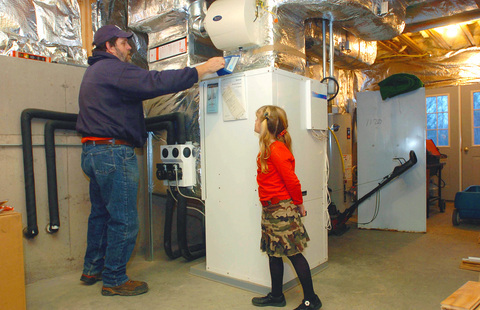
<font size="5"><center>Heat From the Earth to Warm Your Hearth </font size></center>

20051231174413.jpeg

Russ Root checks the geothermal system at his home in Goshen,
Connecticut, with his daughter, Mackenzie, last month. He said
the unit had reduced his energy costs by 20 percent.
PHOTO: NY TIMES NEWS SERVICE

The New York Times
By BARRY REHFELD
Published: January 1, 2006

RUSS ROOT made an efficient move last year - to a new home he had built in Goshen, Conn. While it is considerably bigger than his former house, in Chenango Forks, N.Y., it will cost far less to cool and to heat. That is because he did something he had thought about ever since he built his last house, 15 years earlier: he installed a geothermal system instead of an oil-guzzling boiler.

Now all the heat to warm his house is supplied by the earth beneath him. It's pumped up, through plastic piping, in water circulating in his backyard six feet underground - where the temperature stays at about 45 degrees - and distributed by a fan through the house's ductwork as air warmed to around 95 degrees.

The bill for Mr. Root's geothermal pump, its ground loop of piping and the house's ductwork was just over $21,500. While a geothermal system, including labor, typically costs more than a comparable furnace and air-conditioning system, the price was about the same for Mr. Root, because the extra expense of digging and looping - $1,500 in his case - was more than offset by a $2,000 rebate from Connecticut Light and Power.

"I was in the black from the day I moved in," said Mr. Root, who is a lineman for the utility, which treated him as it would any customer.

The water circulates through the geothermal pump over coils containing refrigerant, which absorbs its heat. The refrigerant is then raised to the higher temperature under pressure by a compressor. In the summer, the method is reversed. His home is cooled by circulating hot air out of the house - a process that is similar to the operation of a refrigerator, an appliance that his basement pump resembles.

The system is quiet, clean and odorless, and uses little electricity. Maintenance consists of cleaning a filter every few months; the pipes are guaranteed to last 50 years. There are virtually no moving parts other than the pump. After living for more than a year in the 2,900-square-foot home, a third bigger than his old house, Mr. Root finds that his energy costs are running about 20 percent less than the $2,700 he used to spend, or about 40 percent less per square foot.

And he is likely to reap added benefits when he sells the house. A 1998 study commissioned by the Environmental Protection Agency found that a home's value rises an average of $20 for each $1 decrease in the annual utility bill.

Although the notion of tapping the earth's heat has been around forever and the basic technology has existed for decades, the many advantages have only recently begun to win widespread attention. The big reasons are concern for the environment and, more to the point, money. Geothermal systems are becoming increasingly competitive, even for homes in which an old furnace and air-conditioning system must first be removed.

After a decade in which installations grew 20 percent a year, a million American homes - both old and new - now have geothermal heat pumps, said Jessica Commins, a spokeswoman for the Geothermal Heat Pump Consortium. And a growing number of celebrity homeowners who use them - like the country music star Toby Keith, the Home Depot co-founder Arthur Blank, the actor Ed Begley Jr. and President Bush - have helped to raise the technology's profile.

Energy legislation last summer increased the financial support for these systems. The law provides for $300 in federal tax incentives and includes a provision allowing for a $2,000 federal incentive for home improvements that reduce energy costs by more than 50 percent. Geothermal systems can trim 30 percent to 75 percent of the cost to heat and cool, so many installations would qualify.

But the biggest driver is the cost of fossil fuel. With the Energy Department predicting huge jumps in residential oil and natural gas costs for winter heating - 27 percent for oil and 41 percent for gas - shipments of geothermal pumps doubled during the last three months, Ms. Commins said.

Now, "the front-end costs are within reach," said Roy Mink, director of the Energy Department's geothermal program. At the same time, he said, "there's more competition for geothermal business, and that's driving down the price of installing them by 10 percent."

The payback period depends on a variety of factors, including the type of system, the installer and the location and size of the house. Typically, it takes 3 to 10 years before fuel savings equal the cost of the pipes and placing them in the ground; indoors, the cost of traditional and geothermal systems is roughly the same. Of course, the greater the heating and cooling needs and the higher the fuel costs, the quicker the payback. A 2,500-square-foot home in New York City with a standard furnace and central air costs $3,200 a year, on average, for heating, cooling and hot water, versus $1,800 for a geothermal system; in Los Angeles, the figures are $1,600 and $800.

Installers generally stick to one brand of pump to get better pricing from the manufacturer, so the installer and pump tend to be a package deal. The standard for installers is certification by the International Ground Source Heat Pump Association; the most desirable pumps carry an Energy Star efficiency rating. Among the brands earning that rating are WaterFurnace, ClimateMaster, Trane, Hydro Delta, McQuay and Econar.

"Water Furnace is the Cadillac," said Steve Brown, co-owner of Carl Franklin Homes in Dallas, a builder of homes with geothermal systems. "But there are a lot of good pumps, and it's more important who puts in the system. You have to shop around to get the best deal."

Installers generally recommend three types of systems: those with horizontal, open vertical and closed vertical loops. A horizontal loop system, typically an E-formation that requires about a half-acre, is recommended when homeowners have the space, as Mr. Root did. It is generally the least expensive, and its costs fall further if it is part of new construction, because its installation can be combined with the laying of the foundation.

The cost of a loop varies greatly, from about $1,000 for a horizontal loop connected to a modest house in the West, where geothermal systems are more common and homeowners have more options, to $50,000 or more for a vertical closed loop attached to a mansion atop New England bedrock.

A vertical loop, generally two or more connected branches extending more than 200 feet into the ground, is the urban choice; it requires less surface area but is likely to cost more because of the drilling expense.

THERE are also open vertical systems, which are drilled in much the same way as a water well and may be used when there is access to an aquifer. These may do double duty in rural areas by providing homes with drinking water.

Steve Toma has an open system in his new 7,000-square-foot home in Mendham, N.J., that taps a well 1,400 feet down. Because of its unusual depth, it was expensive to drill. He also has extras like filtration equipment and a radiant-heat grid, which add significantly to the cost. His system cost more than $135,000, roughly 30 percent more than an equivalent traditional oil or natural gas installation; he expects to earn back the difference in about eight years.

"It's a big investment, but there's the green aspect," he said. "You can't put a dollar on it."

For a relatively few lucky homeowners, there is an option that delivers the best of both green worlds. It's the pond loop, for homes near a body of water that is at least eight feet deep year-round. There are no digging or drilling costs, just the cost of a Slinky-like tubing coil and the labor of placing it at the bottom of the pond or lake.

"It's generally the cheapest," said Kirk Bellanca, a co-owner of Enviro-Tech, an installer in Staatsburg, N.Y. "You should get permission from the town, but they're almost always very supportive. The fish like it, too. It becomes part of their habitat."

In a sense, two comfortable homes for the price of one.

http://www.nytimes.com/2006/01/01/b...l=0&adxnnlx=1136130591-3lJaxhf8CRRezHCgeuDWJQ
 
Re: One Alternative -- Must Be More

<font size="5"><center>Saudi Minister Slams Calls for Alternative Fuels</font size></center>

Bloomberg
February 8, 2006
By Jim Efstathiou

Washington - Energy consuming nations that planned to cut back on oil use in favour of alternative fuels would make it hard for oil producers to justify the investments needed to assure adequate supplies, Saudi Arabian oil minister Ali al- Naimi said yesterday.

Crude oil would remain the fuel of choice to meet the world's transport demands "for decades", he said in remarks prepared for an address at a Cambridge Energy Research Associates conference in Houston.

Oil reserves were enough to meet growing demand, said al-Naimi, whose country pumps about 11 percent of the world's crude.

"Consuming governments' policies aimed at reducing oil demand create another element of uncertainty for producers," al-Naimi said.

"This added risk is detrimental to timely investment decisions."

US President George W Bush said in his state of the union address last week that the US was "addicted" to oil. He proposed a target of replacing 75 percent of the oil the US imported from the Middle East by 2025.

Reaching that target meant raising investment in alternative energy sources, Bush said. Al-Naimi declined to say what oil price would be best for producers and consumers. The ability to predict prices was "extremely limited and inconsistent".


Saudi Arabia was investing an "unprecedented" amount to keep oil prices in a range that spurred economic growth while giving producers sufficient returns, said al-Naimi, who advised against cutting back on oil "for some less efficient and more costly alternative".

Shifting environmental mandates "undermine industry efforts to provide products that are the most economical and environmentally beneficial", he said.

Efforts to cope with global warming by capturing carbon dioxide before it entered the atmosphere were preferable to "a radical non-market-based approach like moving away from the use of hydrocarbons".

The challenge for the oil industry was to avoid excess supplies that would drive prices so low that investment in new fields or refineries dried up, said al-Naimi.

The minister offered a "road map to our energy future", in which growth in supply roughly matched demand growth and enough spare capacity would exist to manage demand surges or supply disruptions without a surge in prices.

- Bloomberg

http://www.busrep.co.za/index.php?fSectionId=565&fArticleId=3101344
 
Re: One Alternative -- Must Be More

<font size="5"><center>Running our cars on corn</font size></center>


03/03/2006

The Illinois state Senate did the nation a favor Tuesday by voting to require gasoline sold in the state to contain 10 percent ethanol by 2008 and 15 percent in 2012.

Ethanol has two good things going for it. First, it's not oil. Our supply can't fall prey to the whims of fickle dictators or religious fanatics. The more ethanol we use, the less the chance an oil crisis could drag us into recession or war.

Second, ethanol is usually derived from corn. Missouri and Illinois grow lots of it. Turning more corn into more ethanol means more new jobs in both states.

A decision to boost ethanol use provides a win all around. Even drivers win, thanks to a 51-cent-a-gallon federal subsidy for ethanol.

At about 95 cents a gallon, it costs about as much to make ethanol as it does to make gasoline from crude oil. And ethanol should get cheaper as production technology improves and production capacity expands.

The idea of running cars on corn is often pooh-poohed -- by oil companies, of course -- but also by those who say it is inefficient. For a decade, scientist David Pimentel at Cornell University has argued that ethanol is a net energy loser, that it takes more energy to create it than it yields when it's used to power vehicles. Other studies show the opposite.

Scientists Alexander Farrell and Richard Plevin at the University of California at Berkeley recrunched the numbers used in all such studies and concluded that ethanol is a clear energy winner. Their work appeared in the prestigious journal Science in January. Studies by the U.S. Department of Agriculture also show energy gains.

If one of our goals is to reduce our dependence on foreign oil, ethanol wins the daily double. Most of the energy used to produce ethanol comes from natural gas and electricity made from coal. Coal, of course, is a dirty non-renewable fossil fuel that produces lots of greenhouse gas emissions. But America, as Jimmy Carter noted, is the Saudi Arabia of coal. We import little natural gas except from Canada.

The Berkeley scientists estimate that "corn ethanol reduces petroleum use by about 95 percent on an energetic basis." In other words, the more ethanol we use, the less oil we need.

Compared to gasoline, ethanol produces 13 percent less greenhouse gas blamed for global warming.

Brazil recently achieved energy independence largely by encouraging the design and production of cars that run on ethanol made cheaply from Brazilian sugar.

That won't happen here: too many vested interests to fight in the energy and automobile industries. But the smart policy for the United States would be to encourage ethanol use and require higher fuel economy standards for all cars, SUVs and light trucks. Through ethanol and new gas-sipping auto technology we can reduce our dependence on foreign oil and spare the planet the worst effects of our profligate consumption of energy of all kinds.

The Illinois House has yet to take up the ethanol bill, which also would provide money for the Corn to Ethanol Research Center at Southern Illinois University Edwardsville. In Missouri, Gov. Matt Blunt has proposed a 10 percent ethanol requirement. That, too, is a good idea the Legislature should support.

If one of our goals is to reduce our dependence on foreign oil, ethanol wins the daily double.

http://www.stltoday.com/stltoday/ne...611277C2AD53DFC2862571260019BC09?OpenDocument
 
Re: One Alternative -- Must Be More

I Want To Get Somthing For The Gas Guzzling 84 Eldo I Got Any One Know Of Anything?
 
Re: One Alternative -- Must Be More

<font size="5"><center>Solar energy 'revolution' brings green power closer</font size>
<font size="4">Panels start solar power 'revolution'</font size></center>

The Guardian
John Vidal, environment editor
Saturday December 29 2007

The holy grail of renewable energy came a step closer yesterday as thousands of mass-produced wafer-thin solar cells printed on aluminium film rolled off a production line in California, heralding what British scientists called "a revolution" in generating electricity.

The solar panels produced by a Silicon Valley start-up company, Nanosolar, are radically different from the kind that European consumers are increasingly buying to generate power from their own roofs. Printed like a newspaper directly on to aluminium foil, they are flexible, light and, if you believe the company, expected to make it as cheap to produce electricity from sunlight as from coal.

Yesterday Nanosolar said its order books were full until mid-2009 and that a second factory would soon open in Germany where demand for solar power has rocketed. Britain was unlikely to benefit from the technology for some years because other countries paid better money for renewable electricity, it added.

"Our first solar panels will be used in a solar power station in Germany," said Erik Oldekop, Nanosolar's manager in Switzerland. "We aim to produce the panels for 99 cents [50p] a watt, which is comparable to the price of electricity generated from coal. We cannot disclose our exact figures yet as we are a private company but we can bring it down to that level. That is the vision we are aiming at."

He added that the first panels the company was producing were aimed for large- scale power plants rather than for homeowners, and that the cost benefits would be in the speed that the technology could be deployed. "We are aiming to make solar power stations up to 10MW in size. They can be up and running in six to nine months compared to 10 years or more for coal-powered stations and 15 years for nuclear plants. Solar can be deployed very quickly," said Oldekop.

Nanosolar is one of several companies in Japan, Europe, China and the US racing to develop different versions of "thin film" solar technology. It is owned by internet entrepreneur Martin Roscheisen who sold his company to Yahoo for $450m and, with the help of the founders of Google, the US government and other entrepreneurs in Silicon Valley, has invested nearly $300m in commercialising the technology.

At the moment solar electricity costs nearly three times as much as conventional electricity to generate, but Nanosolar's developments are thought to have halved the price of producing conventional solar cells at a stroke.

"This is the world's lowest-cost solar panel, which we believe will make us the first solar manufacturer capable of profitably selling solar panels at as little as 99 cents a watt," said Roscheisen yesterday.

However, the company, which claims to lead the "third wave" of solar electricity, is notoriously secretive and has not answered questions about its panels' efficiency or their durability. It is quite open about wanting to restrict access to the technology to give it a market advantage.

Jeremy Leggett, chief executive of Britain's leading solar energy company, Solar Century, said that it would be "breathtaking" if the technology proved as efficient as projected by the company. "This is a revolution. But people are going to be amazed at other developments taking place in solar technologies. We will be thrilled if this technology is as efficient as the company says. It will not change the direction of solar power in itself. Spectacular improvements are also being made in other parts of the industry," he said.

Figures released yesterday by the Earth Policy Institute in Washington showed that solar electricity generation was now the fastest-growing electricity source, doubling its output every two years. It is now attracting government and venture capital money on an unprecedented scale.

The technology is particularly exciting because it can be used nearly everywhere. "You are talking about printing rolls of the stuff, printing it on garages, anywhere you want it. It really is a big deal in terms of altering the way we think about solar," said Dan Kamman, director of the Renewable and Appropriate Energy Laboratory at the University of California at Berkeley.

"The next industrial revolution will be based on these clean green technologies," said Tony Juniper, director of Friends of the Earth. "If the UK wants to be part of it, as Gordon Brown says it does, then it needs to rethink its strategies. Ministers have so far shown a distinct lack of vision."

Power from light

Photovoltaic (PV) devices convert light into electrical energy. PV cells are made of semiconductor materials such as silicon. When light shines on a PV cell, the energy is transferred to electrons in the atoms of the PV cell. These electrons become part of the electrical flow, or current, in an electrical circuit. First wave photovoltaic cell used thick silicon-wafer cells but were cumbersome and costly. The second generation of photovoltaic materials were developed about 10 years ago and use very thin silicon layers. These brought the price down dramatically but still need expensive vacuum processes in their construction. The third wave of PV, now being developed by firms such as Nanosolar, can print directly on to other materials and does not use silicon

http://www.guardian.co.uk/environment/2007/dec/29/solarpower.renewableenergy
 
Re: One Alternative -- Must Be More

<font size="5"><center>Brazil's sugar cane mills race
to keep up with ethanol boom</font size></center>


542-19web-BRAZIL-ETHANOL.major_story_img.prod_affiliate.91.jpg

The Moema sugar mill in Orindiuva, about 330 miles north-
west of Sao Paulo, Brazil.

By Jack Chang | McClatchy Newspapers
Posted on Monday, May 19, 2008

ORINDIUVA, Brazil — Just a decade ago, the giant Moema ethanol and sugar mill in this corner of southeastern Brazil covered less than half of its current 173,000 acres. It produced mainly sugar.

That was before world petroleum prices skyrocketed and millions of Brazilians turned to cheaper sugar cane-based ethanol to fuel their vehicles. Now, fuels made from sugar cane have become Brazil's second most-used energy source, only behind fossil fuels.

That boom has transformed Moema into one of Brazil's biggest sugar-cane mills and turned much of Sao Paulo state, where Moema is located, into the world capital of sugar cane ethanol.

More than 5,000 workers now help Moema churn out about 880,000 tons of sugar and 185 million gallons of ethanol every year, working day and night, rain or shine. Nationwide, sugar-cane mills produced nearly 6 billion gallons of ethanol last year, with output projected to jump by 160 percent through 2016.

"Things have completely changed here since this all started," said Roberto Santos, who supervises mechanized sugar cane cutting at Moema. "We've become much more efficient and quicker, and we're producing more. We're a different mill now."

Some 320 mills all over this nation of 185 million people are locked in the same race to keep up with rising domestic ethanol demand. Another 150 mills are scheduled to come on line over the next decade, mostly in the country's southeast.

Exploding demand has pushed mills here to plant on more farmland, harvest the crop more quickly and grow better-quality cane. Such innovations have drawn a steady stream of international visitors eager to learn the country's biofuel secrets and attracted global investors hoping to take part in the ethanol rush.

The country now ranks a close second in ethanol production to the United States, where farmers make the biofuel from corn, a far more expensive, less efficient and less environmentally friendly method. Brazil is by far the world's biggest producer of sugar cane.

"Brazil's industry has really been cost effective because they've had time to develop their methods," said Amani Elobeid, a leading biofuels expert at Iowa State University. "They've built an industry that is good at what it does."

Brazilian officials said part of their secret is nonstop research into sugar cane and ethanol, which started more than three decades ago when Brazil's government first subsidized ethanol production to counter rising world petroleum prices.

The resulting know-how has been put to use at Moema, where planters work with some 60 strains of sugar cane designed for every imaginable variety of weather conditions and terrains. That's allowed the mill to plant cane in previously unsuitable soils and extract more sucrose, the key ingredient in both sugar and ethanol.

The results have been dramatic in the cane fields.

Producers plant different strains of sugar cane for ethanol and other strains for sugar production and can use up to six generations of the same plant before the sucrose level deteriorates.

"There are some soils around here where you can use 12 generations," Santos said. "Now, we're growing cane in places it's never been."

Moema also has changed what it does with its sugar cane, now using half of it for sugar and half of it for ethanol. The mill's towering factory runs two sets of production lines, one for each product, and can change the sugar-ethanol balance instantly.

The mill has even found uses for bagasse — a fibrous material that's left over after the juice is pressed out of sugar cane — by burning it to generate all the electricity the factory needs, as well as to power three surrounding towns.

"We're using nearly every part of the sugar cane now," said Renato Junqueira Santos Pereira, whose family co-owns the Moema mill. "Nothing is wasted here. Everything goes into the process."

While U.S. sugar producers say their growth has been limited by concerns about pollution caused by the refining process, Brazilian growers insist they've solved what's been a longtime sugar-industry headache: What to do with vinasse, a potentially toxic, molasses-like sugar byproduct that can pollute groundwater and nearby rivers.

The Brazilians mix vinasse and water in carefully calculated proportions, which when spread over the right kind of soil, act as fertilizer.

"I can't say what's good for Brazil is good for Louisiana, but we've found a solution to this problem," said Carlos Rossel, a researcher and chemical engineer at the State University of Campinas in Sao Paulo state. "We've taken our own unique Brazilian circumstances and found a way to make this all function."

Not everything about Brazil's sugar-cane mills, however, has changed with the boom. Much of the cane is still cut by workers stooping and hacking with machetes, although at Moema, such work is being replaced by machine harvesters.

Cutting cane by hand also requires first setting controlled fires in the fields to clear out razor-sharp leaves, snakes and other dangers, a practice that diminishes one of ethanol's main selling points — its reduction of greenhouse-gas emissions. Sao Paulo state requires growers to stop burning fields by 2014.

On top of that, the industry's best practices may not always work in far-flung regions where many new mills are being built. Such areas have different soil and weather conditions than what's found in the country's traditional ethanol belt. Land disputes, deforestation and slave labor are also more pervasive.

"As you move into new territory, closer to the Amazon, the soils are not as rich and are more easily degraded, and the enforcement of labor laws is much weaker," said Andrea Bolzon, Brazilian coordinator of the United Nations' anti-slavery project. "Problems the ethanol industry has so far controlled could grow."

Despite such fears, Brazil's ethanol leaders say they've built an unstoppable ethanol machine that could fuel the world if other countries, including the United States, lowered protective ethanol tariffs blocking the biofuel's entry.

Ethanol producers also say they haven't stopped improving their methods. Next on the horizon are new generations of biofuels made from castor oil plants and leaves, grass and other cellulosic material.

And while the Moema mill already appears to be working at full capacity, people here say they're ready for more.

"We won't be able to double our production overnight," Santos Pereira said. "But with the right planning and given the right conditions, growth is inevitable."

McClatchy Newspapers 2008

http://www.mcclatchydc.com/226/story/37660.html
 
Re: One Alternative -- Must Be More

433-4web-AUTO-HYBRID-major.major_story_img.prod_affiliate.91.jpg

Lithium ion batteries revolutionized consumer electronics
and now they are being developed for larger uses like
battery pack that will power Nissan's electric car that is
slated to reach consumers by 2012


<IFRAME SRC="http://www.mcclatchydc.com/226/story/39869.html" WIDTH=780 HEIGHT=1500>
<A HREF="http://www.mcclatchydc.com/226/story/39869.html">link</A>

</IFRAME>
 
Re: One Alternative -- Must Be More

<font size="5"><center>Garbage takes its place
as alternative fuel of the future</font size>
<font size="4">
Fuel of the future looks more promising</font size></center>

879-DeLorean061_ME_6-22-08_JFS.embedded.prod_affiliate.81.jpg


The Kansas City Star
By JAMES A. FUSSELL
June 24, 2008

In the “Back to the Future” movies 20 years ago, Marty McFly drove a sports car equipped with a “Flux Capacitor” that ran on garbage.

Pure fantasy in the 1980s. Not quite so crazy now.

As gas prices have increased, so has research into futuristic fuels and vehicles that may help break our dependence on pricey planet-polluting gasoline.

Today companies are learning to make biofuels from everything from household waste and crop residue to old tires and cow manure. The first batch of biofuels may be on the market by 2010, helping to offset growing energy demand, and, perhaps, providing a creative use for the nation’s swelling landfills.

And you want a flux capacitor? We might be close.

Toronto’s Zenn Motor Co. announced last month that it would make a car powered by a breakthrough version of an electrical storage device called an “ultracapacitor.” While the new car won’t travel through time, the CityZenn could be the answer to a more practical prayer. Set for manufacture in 2009, it reportedly will have no battery, no emissions, a range of 250 miles, reach 80 mph on the freeway and be capable of recharging in five minutes (with a special charging infrastructure in place).

Skeptics, who say it sounds too good to be true, call it today’s equivalent of cold fusion, a still-theoretical energy source announced in 1989 that delivered more hype than hope. Wait and see, said company founder and CEO Ian Clifford. He told The Christian Science Monitor in April that the revolutionary technology would bring an end to petroleum’s “100-year run.”

It remains to be seen whether the new ultracapacitor lives up to its astonishing claims. Even if it doesn’t, there are scads of other alternate-fuel technologies that offer drivers hope down the road. Here’s an update on a few of them.


Plug-in hybrid electric vehicles

Plug-in hybrids offer the most realistic help for consumers in the near future. They’re essentially regular hybrids with an extension cord, and much better mileage.

Depending on how you drive, some experts say you could get the equivalent of 100 miles per gallon or more. (Other experts are dubious of such claims.) One such car is the Chevy Volt, a car that’s being developed “with a strong sense of urgency.” Chevy, which hopes to begin production by late 2010, is actively encouraging customers to dream.

“Imagine a daily commute without using a drop of gas,” it says on the company Web site. “For someone who drives less than 40 miles a day, Chevy Volt will use zero gasoline and produce zero emissions.”

For longer trips, the car’s gasoline engine kicks in and helps charge the battery while you drive. Expect a range of 640 miles.

For General Motors, it’s the second try at an electric car. The company pulled the plug on its first effort — the EV1 — in 1996, sparking controversy and conspiracy theories. Seeking to head off more controversy, the company included an article on its Web site headlined “Aren’t You The Guys Who Killed the Electric Car?” It’s a clear reference to the 2006 documentary “Who Killed the Electric Car?”

GM’s explanation? It wasn’t the right time.

“When GM launched the EV1 gas was cheap, there wasn’t a war in Iraq, and there was less discussion about global warming,” the article explained. “We didn’t kill the electric car; electric vehicle technology is far from dead.”


Pure battery electric cars

Many fringe automakers have developed all-electric cars. The problem? There’s always a trade-off. If they’re affordable, they’re typically puny, weird-looking or have a severely limited range. If they’re roomy with a long range and a short charging time, they’ll often cost more than your house.

But soon the next generation of all-electric cars will hit the market, and there’s reason to believe things may change.

Nissan and Mitsubishi have announced they will begin marketing pure battery electric cars by 2010 that are utilitarian, attractive and affordable. The Nissan will have a range from 100 to 150 miles and will take less than five hours for a full recharge. No word yet on the cost. More offerings are in the works from many other major manufacturers.

But there are unresolved problems with electric vehicles that could short-circuit consumer enthusiasm.

“I think it’s unlikely that the batteries, which are going to be expensive, will last the life of the car,” said Steven Plotkin, a Washington-based transportation energy analyst at the Argonne National Laboratory. “Imagine having to spend $4,000 to replace your batteries just four years in. And it may be more than that. Even the plug-ins will have this issue.”

But given enough time, he said, those and other problems can be overcome.


Hydrogen fuel cell cars

Once just a dream, fuel cell cars are now a reality. Yes, they work, and testers seem to love them. No wonder. They’re smooth and powerful, don’t pollute and are powered by the most plentiful element in the universe.

So why aren’t we all driving one?

There are two main problems, said Joan Ogden, director of the Sustainable Transportation Energy Pathways program at the University of California at Davis:

  • Cost. Current prototypes can cost a million dollars each. Mass production will bring down the costs. The questions are, how far, and how fast?

  • Infrastructure. Even if you could buy an affordable fuel cell car, where would you refuel it? Retrofitting filling stations around the country to dispense hydrogen is possible, but it’s not easy, cheap or fast.

Still, companies are making hydrogen headway. On Monday, Honda celebrated the beginning of the production of its FCX Clarity, the world’s first hydrogen-powered fuel cell vehicle intended for mass production. The rollout will be modest, with only 200 of the futuristic vehicles slated to be made in the next three years. The company will increase production as hydrogen filling stations become more common.

Jonathan Wenzel, a post-doctoral fellow at Missouri University of Science and Technology in Rolla, said the school is working on a way to do just that.

Its solution would enable filling stations to make hydrogen on the premises using an ethanol and water reaction. Given time, he said, he’s confident we have the technology to create the hydrogen infrastructure we need.

“If I had a million dollars, that’s what I would put it in,” he said.

The school is seeking commercial or government partners to continue to develop its technology.

Consumers would not have to wait until fuel cell cars were affordable to take advantage of hydrogen’s clean-burning technology (although that would give the best combination of power and efficiency). As more filling stations begin to offer hydrogen as an alternative, customers could convert their current internal combustion cars to run on the new fuel.

To contact James A. Fussell, call 816-234-4460 or send e-mail to jfussell@kcstar.com.


http://www.kansascity.com/703/story/676127.html
 
<font size="5"><center>
Go green: Algae could be next hot biofuel</font size></center>


635-5web-ALGAE-major.major_story_img.prod_affiliate.91.jpg

Beakers of algae at the Biosystems & Agricultural
Engineering Dept. at the University of Kentucky.


McClatchy Newspapers
By Les Blumenthal
Sunday, December 7, 2008


WASHINGTON — A 75-gallon tank of goo that in the course of a week or so changed color from lime green to almost black was one of the stars of last summer's Farnborough International Air Show in England.

As airlines ordered hundreds of planes worth billions of dollars at the world's largest air show, the tank, or bioreactor, was a near-perfect breeding ground for what could become the fuel of the future: the lowly algae.

Aerospace companies and airlines are betting that algae — simple organisms that come in some 30,000 species, many of which can be genetically modified — will prove to be a green fuel that can power jet planes. Algae also could be blended into diesel and gasoline, and perhaps could even replace petroleum-based diesel and gasoline one day.

As the infant industry organizes, algae must make their case for the kinds of tax breaks, market incentives, loans, and research and development backing that other biofuel sectors have. Though corn and soybean growers long have lobbied in Washington, the Algal Biomass Organization is a new kid on the block.

On Monday, the organization will meet in the nation's capital to discuss how to convince Congress and the incoming Obama administration that algae are much more than the film inside your fish tank, the scum blooming in the neighborhood pond or, in one of their most complex forms, seaweed.

"We are up against formidable opposition from competing interests," Jason Pyle, the chief executive of Sapphire Energy, said of resistance from ethanol and biodiesel groups during an algae industry meeting in Seattle earlier this fall.

Sapphire, a San Diego company, already has made a type of gasoline using algae that meets fuel quality standards, is compatible with current gasoline-manufacturing infrastructure and achieved a 91 octane rating.

Pyle said that current policy favored such alternative fuels as corn for ethanol or soybeans for biodiesel and provided only limited assistance to algae-related products. He said that one of the top priorities for the new Congress and the Obama administration in their first 100 days would be to write a comprehensive energy bill. Pyle said it was crucial that the algae industry make its presence known.

"The train is moving . . . it hasn't left the station yet," Pyle said in urging the algae industry to make a concerted lobbying effort. "But we are approaching the final opportunity . . . to grab a seat on the energy train."

In addition to algae, biofuel researchers have looked at jatropha — a bush that grows in arid environments, needs little water and yields more oil than corn — and halophytes, salt-tolerant plants such as seashore mallow.

First-generation biofuels made from corn, soybeans, sunflower seeds and rapeseed were rejected because they use valuable agriculture land and water, can result in deforestation in developing countries and the demand for them has driven up food prices and caused scattered food shortages.

Virgin Atlantic — which is a member of the Seattle-based Algal Biomass Organization along with Boeing, Air New Zealand and Continental Airlines — successfully tested a green aviation fuel based on jatropha on a 747 flight from London to Amsterdam. Air New Zealand plans a similar test.

Though jatropha has attracted a lot of attention, Darrin Morgan, who heads Boeing's effort to develop biofuels and is one of the Algal Biomass Organization's chairmen, said algae might be the best bet in the long run.

If algae-based fuel can be certified for commercial use and large enough quantities can be produced, Morgan said, it's realistic that it would be used in commercial aviation in three to five years.

"It would be possible to fly on 100 percent (algae), but most likely it will be a blend," he said.

The Department of Energy studied algae as a fuel source as far back as the 1970s but abandoned the research in 1996 to focus on ethanol. Last year's energy bill required the department to report to Congress on the feasibility of algae as a biofuel.

NASA has been looking at algae as a jet fuel and for other uses in outer space.

"It's hard not to get excited about algae's potential," said Paul Dickerson, the chief operating officer of the Energy Department's Office of Energy Efficiency and Renewable Energy.

While most of the interest in developing algae farms has focused on southern California and Arizona, where it's sunny, or near coal-fired generating plants, where carbon dioxide emissions could be used as plant food, it's possible to grow algae anywhere. They can flourish in salt water, fresh water, brackish water or wastewater.

Last year's energy bill requires the production of 36 billion gallons of renewable fuel by 2022. Ethanol and biodiesel manufacturers think that provides more than enough room for the algae industry.

"We don't necessarily see them as competitors," said Matt Hartwig, a spokesman for the Renewable Fuels Association, an ethanol trade group.

Michael Prolich of the National Biodiesel Board said, "We would welcome their work to grow the biodiesel industry."

Lawmakers don't see it necessarily as a zero-sum game.

"We shouldn't be picking winners and losers," said Sen. Maria Cantwell, D-Wash., a member of the Senate Energy and Natural Resources Committee and a leader on energy issues for the Democrats. "We need to create a level playing field with incentives."

The Algal Biomass Organization is composed of companies such as Boeing, the airlines and Sapphire, along with researchers, entrepreneurs, harvesters, processors and end users of algae. There's been some disagreement over how quickly to move on the lobbying front.

"Everyone has an opinion; everyone is strong-willed," said Tom Byrne, the group's secretary and a renewable fuel consultant from Minnesota. "This is still in its early stages."

Boeing's Morgan agrees, but he added that it's important for the industry to have a voice in Washington.

Boeing's decision to put up an algae exhibit at the Farnborough air show generated a lot of interest within the aerospace industry, Morgan said. The issue no longer is whether jets can use fuels based on such plants as algae but how quickly production facilities can scale up, he said.

"There are no algae farmers," Morgan said. "There are lots of corn farmers, but no algae farmers. We are finding a receptive audience when it comes to policymakers and the general public, but we need a collective voice."


http://www.mcclatchydc.com/226/story/57207.html
 
<IFRAME SRC="http://www.algalbiomass.org/" WIDTH=780 HEIGHT=1500>
<A HREF="http://www.algalbiomass.org/">link</A>

</IFRAME>
 
Update: Tally of Reports on Ethanol Scam Hits 15, Vilsack Wants More Ethanol

from energy tribune.com

Update: Tally of Reports on Ethanol Scam Hits 15, Vilsack Wants More Ethanol

A couple days ago, I published a piece listing 14 studies that have exposed the high costs of the ethanol scam. I overlooked three points: A new study by Cornell University’s David Pimentel, the latest numbers showing the amount of corn ethanol distilling capacity that has been idled due to negative margins, and finally, a story by Bloomberg News which says that Agriculture Secretary Tom Vilsack is talking with the Environmental Protection Agency about raising the amount of ethanol blended into the US gasoline supply.
On January 29, Pimentel, a professor of ecology at Cornell University who has been researching the corn ethanol issue for more than two decades, published another report on the costs of producing motor fuel from grain. His article, which has seven co-authors, appeared in the journal Human Ecology. In the article, “Food Versus Biofuels: Environmental and Economic Costs,” Pimentel and his fellow researchers found that “using food and feed crops for ethanol production has brought increases in the prices of US beef, chicken, pork, eggs, breads, cereals, and milk of 10 percent to 20 percent.” It concludes “Using food crops to produce ethanol raises major nutritional and ethical concerns. Nearly 60 percent of humans in the world are currently malnourished, so the need for grains and other basic foods is critical….Growing crops for biofuel not only ignores the need to reduce natural resource consumption, but exacerbates the problem of malnourishment worldwide by turning food grain into biofuel.”

While it’s true that other factors have helped inflate food prices, including rising energy prices and increased grain demand in other countries, it’s also abundantly obvious that the corn ethanol industry has had an effect on food prices. The reason is obvious: in 2008, some 4.1 billion bushels of corn – fully one-third of the US crop – was used to make motor fuel. And the results are being seen in the supermarket.

In mid-January, the Bureau of Labor Statistics reported that in 2008, food prices jumped by nearly 6 percent. That comes on the heels of food price increases of 4.8 percent in 2007. Some agricultural economists are now predicting that food prices could increase by as much as 10 percent in 2009. Worse still, those increases are coming at the same time that the global economy is foundering and U.S. unemployment rates are soaring.

Pimentel’s report provides yet more ammunition for ethanol critics. And while the criticism is important, Tom Elam, an Indiana-based agricultural economist and a long-time critic of the ethanol industry, reminded me that data is easily obtainable that shows the level of distress in the industry. Ethanol Producer Magazine tracks the number of ethanol plants that have quit producing fuel. Its latest numbers show that 32 ethanol distilleries are now idled. The capacity of those plants is 2 billion gallons per year. According to the Renewable Fuels Association, the US now has 12.3 billion gallons of ethanol production capacity. Thus, about 16.1 percent of all the ethanol capacity in the US has been idled due to high corn costs – which are, in part, a reflection of the ethanol industry’s own demand for grain – and relatively low gasoline prices.

During a brief telephone interview on Thursday, Pimentel told me that he continues to be amazed that Congress still supports the idea of corn ethanol. He is equally dismissive of the concept of cellulosic ethanol, a substance which, in theory, can profitably produce motor fuel from switchgrass, corn stubble, or other biomass. Although promoters have been pushing cellulosic ethanol for decades – and it is now being pushed hard by the Democrats -- Pimentel’s latest report estimates that the energy return on energy invested in cellulosic ethanol is minus 68 percent. (Pimentel puts the EROEI on corn ethanol at a negative 46 percent. Some of the most-widely cited reports on corn ethanol, particularly those done by the US Department of Agriculture show that corn ethanol has a slightly positive EROEI.) “It’s absolutely ridiculous,” says Pimentel. Congress and others who are promoting the idea “haven’t even done the most basic calculations about what it would mean to make cellulosic ethanol.”

When it comes to making fuel from biomass, he told me, “I wish that it did work. But I’m a scientist first and an agriculturalist second.”

Finally, Vilsack. Bloomberg reports that the former Iowa governor is talking with the EPA about increasing the blend levels above the 10 percent now allowed. In November, the EPA said it would require gasoline to contain 10.2 percent ethanol this year. But it appears that Vilsack wants to increase that amount even further regardless of the fact that the overwhelming majority of the vehicles on the road today are only emissions-certified to run on a 10 percent blend.

Neither the EPA nor Vilsack appear interested in thinking about how increased ethanol volumes in gasoline will affect air quality. Last year, William Becker, executive director of the National Association of Clean Air Agencies, which represents air pollution control authorities from 49 states and several territories, as well as local agencies from 165 metro areas around the country, told me that ethanol has had a negative effect on air quality and yet the EPA has chosen to ignore it. As Becker explains it, the issue is clear: “More ethanol means more air pollution. Period.”

And yet, more ethanol in gasoline is on the way.
 
Re: Update: Tally of Reports on Ethanol Scam Hits 15, Vilsack Wants More Ethanol

<font size="5"><center>
Miracle light:
Can lasers solve the energy crisis?</font size></center>


9web_SCI-LASER_major.major_story_img.prod_affiliate.91.jpg

An artist's rendering of laser beams entering both ends of
a capsule containing a pea-sized pellet of deuterium and
tritium at the Energy Department's National Ignitition
Facility in Livermore, Calif.


McClatchy Newspapers
By Robert S. Boyd
Wednesday, December 9, 2009


WASHINGTON — Next year will mark the 50th birthday of the laser, one of the most productive and widely used mega-inventions of the last century. Scientists hope that 2010 also will see the launch of laser technology's greatest challenge: creating an inexhaustible supply of clean, carbon-free energy.

In the five decades since lasers were developed, they've found a host of applications — from the everyday to the exotic — in industry, science, medicine, entertainment and national security.

Lasers read bar codes at checkout counters, write and read DVDs, operate laser printers, perform surgery, diagnose and treat cancers, spot military targets and measure the distance to the moon. They even remove unwanted body hair.

Next year, scientists will take lasers to a new level, trying to produce energy by imitating the way the sun creates the light and heat that support life on Earth.

"Creating star power in the laboratory,'' is how Edward Moses, the director of the Department of Energy's National Ignition Facility in Livermore, Calif., describes the system.

As the facility's name suggests, the project's scientists are attempting to marry lasers to nuclear fusion, the process that fuels the sun, stars and hydrogen bombs.

<SPAN style="BACKGROUND-COLOR: #ffff00">They hope to use a combination of 192 powerful lasers to generate the extreme heat and pressure that are needed to force hydrogen atoms to fuse, or combine. The combination loses a tiny bit of mass, which turns into a huge quantity of energy. It's Einstein's formula, E = mc2, in action.</span>

In contrast, nuclear power plants today work by fission, splitting apart heavy atoms such as uranium and plutonium to generate energy.

<SPAN style="BACKGROUND-COLOR: #ffff00">If it works, fusion eventually could power a new class of atomic energy plants. The trick is to build a system that produces more energy than it consumes, a goal that researchers admit is still many years away.</span>

A rival fusion system, using powerful magnets instead of lasers, is being developed, but it hasn't yet proved to be successful. France also has a large laser-fusion research program.

According to the National Ignition Facility, a laser-fusion energy plant would emit no greenhouse gases, would produce few radioactive byproducts and would present no danger of a meltdown. Unlike wind or solar power, it would operate continuously to meet demand. Unlike oil, gas or uranium, its fuel source, mainly hydrogen, is virtually limitless.

To achieve nuclear fusion, the facility's operators hope to focus an array of intense laser beams on a pea-sized pellet of deuterium and tritium — heavy forms of hydrogen — in their $3.5 billion plant at Lawrence Livermore National Laboratory near San Francisco.

The beams, which would be transformed into powerful X-rays, would heat and compress the target so that, researchers hope, the fuel would ignite. Ignition would take place in 2 billionths of a second at temperatures of 100 million degrees Celsius and pressures 100 billion times greater than the Earth's atmosphere.

If successful, it would be "analogous to achievement of the first spark ever in an internal combustion engine,'' Edmund Synakowski, an Energy Department fusion expert, told a congressional panel on Oct. 29. "The pursuit is one of the most challenging programs of scientific research and development that has ever been undertaken.''

Moses said the National Ignition Facility hoped to achieve ignition next year, but outside experts think it will take another two or three years to reach that goal, if ever. Many technical problems remain, such as simultaneously and precisely focusing all 192 laser beams on a miniature target without wrecking the whole machine.

"The laser has to go miraculously well" for ignition to occur, said David Hammer, a nuclear engineer at Cornell University in Ithaca, N.Y.

Stephen Bodner, a former director of laser fusion at the Naval Research Laboratory in Washington, accused National Ignition Facility managers in an e-mail of being "unscientifically optimistic. ...There is no way to use the NIF for ignition attempts.''

Even the facility's managers say laser fusion won't begin providing electricity to consumers for another 20 years.

"Major technological and engineering challenges will still remain even after the demonstration of ignition,'' said Riccardo Betti, a physicist at the University of Rochester.

A laser is a device that creates an intense beam of light and focuses it tightly in one direction. The difference between regular light and laser light is like the difference between a water sprinkler and a fire hose.

The story of the laser is a remarkable tale of scientific and technological ingenuity, marred by the usual quarrels and patent fights.

Although the laser concept had been worked out in theory for a century, the first working device was demonstrated on May 16, 1960, by Theodore Maiman, a graduate student at Hughes Research Laboratory in Malibu, Calif.

"The laser era burst open,'' Anthony Siegman, a retired physics professor at Stanford University in Stanford, Calif., wrote in a book-length history of the invention.

The breakthrough was reproduced immediately by numerous laboratories, and practical applications blossomed.

The first medical use was laser surgery to destroy a retinal tumor at Columbia-Presbyterian Hospital in New York in December 1961. Nowadays lasik surgery — changing the shape of the cornea to improve eyesight — is a common procedure. Laser tools remove skin blemishes and tattoos. Dentists drill teeth with them. Factories use them to cut steel or glass. College professors use laser pointers to illustrate their lectures

The first laser was ruby-red, but they now come in multiple colors and strengths. Prices range from a few dollars to millions. A laser can be as small as a microscopic computer chip or as big as the National Ignition Facility, three football fields long.

Scientists use lasers to manipulate electrons, photons and other atomic particles in order to understand fundamental physics.

Just last week, NASA researchers reported using lasers to make extremely tough yarn that could be used for body armor or to shield space ships from radiation.


http://www.mcclatchydc.com/226/story/80351.html
 
Re: Update: Tally of Reports on Ethanol Scam Hits 15, Vilsack Wants More Ethanol

<IFRAME SRC="https://lasers.llnl.gov/" WIDTH=780 HEIGHT=1500>
<A HREF="https://lasers.llnl.gov/">link</A>

</IFRAME>
 
Re: Update: Tally of Reports on Ethanol Scam Hits 15, Vilsack Wants More Ethanol

<IFRAME SRC="http://www.npr.org/templates/story/story.php?storyId=121531373" WIDTH=780 HEIGHT=1500>
<A HREF="http://www.npr.org/templates/story/story.php?storyId=121531373">link</A>

</IFRAME>
 
Back
Top