

20bn barrel oil discovery puts Cuba in the big league

thoughtone

Rising Star
Registered
source: The Guardian


• Self-reliance beckons for communist state
• Estimate means reserves are on a par with US
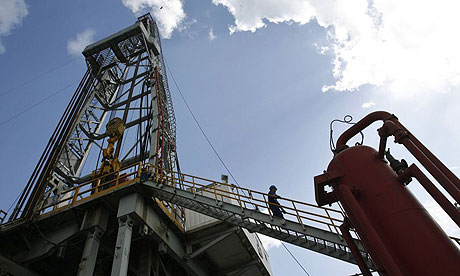
cuba.jpg

A worker walks at an oil rig in Havana, Cuba. Photograph: Enrique De La Osa/Reuters


Friends and foes have called Cuba many things - a progressive beacon, a quixotic underdog, an oppressive tyranny - but no one has called it lucky, until now .

Mother nature, it emerged this week, appears to have blessed the island with enough oil reserves to vault it into the ranks of energy powers. The government announced there may be more than 20bn barrels of recoverable oil in offshore fields in Cuba's share of the Gulf of Mexico, more than twice the previous estimate.

If confirmed, it puts Cuba's reserves on par with those of the US and into the world's top 20. Drilling is expected to start next year by Cuba's state oil company Cubapetroleo, or Cupet.

"It would change their whole equation. The government would have more money and no longer be dependent on foreign oil," said Kirby Jones, founder of the Washington-based US-Cuba Trade Association. "It could join the club of oil exporting nations."

"We have more data. I'm almost certain that if they ask for all the data we have, (their estimate) is going to grow considerably," said Cupet's exploration manager, Rafael Tenreyro Perez.

Havana based its dramatically higher estimate mainly on comparisons with oil output from similar geological structures off the coasts of Mexico and the US. Cuba's undersea geology was "very similar" to Mexico's giant Cantarell oil field in the Bay of Campeche, said Tenreyro.

A consortium of companies led by Spain's Repsol had tested wells and were expected to begin drilling the first production well in mid-2009, and possibly several more later in the year, he said.

Cuba currently produces about 60,000 barrels of oil daily, covering almost half of its needs, and imports the rest from Venezuela in return for Cuban doctors and sports instructors. Even that barter system puts a strain on an impoverished economy in which Cubans earn an average monthly salary of $20.

Subsidised grocery staples, health care and education help make ends meet but an old joke - that the three biggest failings of the revolution are breakfast, lunch and dinner - still does the rounds. Last month hardships were compounded by tropical storms that shredded crops and devastated coastal towns.

"This news about the oil reserves could not have come at a better time for the regime," said Jonathan Benjamin-Alvarado, a Cuba energy specialist at the University of Nebraska.

However there is little prospect of Cuba becoming a communist version of Kuwait. Its oil is more than a mile deep under the ocean and difficult and expensive to extract. The four-decade-old US economic embargo prevents several of Cuba's potential oil partners - notably Brazil, Norway and Spain - from using valuable first-generation technology.

"You're looking at three to five years minimum before any meaningful returns," said Benjamin-Alvarado.

Even so, Cuba is a master at stretching resources. President Raul Castro, who took over from brother Fidel, has promised to deliver improvements to daily life to shore up the legitimacy of the revolution as it approaches its 50th anniversary.

Cuba's unexpected arrival into the big oil league could increase pressure on the next administration to loosen the embargo to let US oil companies participate in the bonanza and reduce US dependency on the middle east, said Jones. "Up until now the embargo did not really impact on us in a substantive, strategic way. Oil is different. It's something we need and want."
 
Is this in response to your Conservatives/Republicans hate Cuba and love China?

Was Obama president then and had a majority democratic congress at any time between then and now to act on the embargo? This would be a good reason to start the doing something about it.

After reading the article I started thinking BP disaster and how the hell would they affort the cleanup and that it might also have devasting effects on US side of the Gulf of Mexico.
 
Is this in response to your Conservatives/Republicans hate Cuba and love China?

Was Obama president then and had a majority democratic congress at any time between then and now to act on the embargo? This would be a good reason to start the doing something about it.

After reading the article I started thinking BP disaster and how the hell would they affort the cleanup and that it might also have devasting effects on US side of the Gulf of Mexico.

Interesting response. I'm going to let T.O., answer your first question. I wouldn't presume to know WHY he started a new thread or WHETHER the article above was INTENDED to be in response to the Cuba/China thread.

Regarding the remainder of this post, did you ask then and do you know now what, if any, damage the BP spill has had upon the Cuban side of the Gulf ???

I don't remember your question back then.


QueEx
 
source: Vindy.com


What will oil find mean for Cuba?


Los Angeles Times

Cuba and its foreign partners will begin exploring for oil this year in the Gulf of Mexico. Drilling will take place as close as 50 miles from Florida and in sites deeper than BP’s Macondo well, the source of last year’s disaster. About 5 billion barrels of oil and 10 trillion cubic feet of natural gas lie beneath the gulf in land belonging to Cuba, according to the U.S. Geological Survey.

If Cuba finds oil in commercially viable amounts, this would be transformative. Revenue from natural resources has the potential to provide long-sought stability for its economy and is likely to significantly alter Cuba’s relations with Venezuela, Asia and other leading energy-producing and consuming nations. Discoveries of commercially viable resources would also have an enormous effect on the gulf environment shared by Cuba and the United States.

Thanks to the U.S. embargo against Cuba — a remnant of the Cold War — the risks to the United States begin the moment the first drill bit pierces the seabed. And we are utterly unprepared.

Embargo fallout

Not only does the embargo prohibit U.S. firms from joining Cuba in any efforts to extract its offshore resources, thus giving the competitive advantage to foreign firms, but it also denies Cuba access to U.S. equipment for drilling and environmental protection — an especially troubling policy considering the potential for a spill. The embargo also compels Cuba’s foreign partners to go through contortions, such as ordering a drilling rig built in China and shipping it nearly 10,000 miles to Cuban waters, to avoid violating U.S. law.

Most important, the failed policy of isolating Cuba has the U.S. paralyzed: It stops us from engaging Cuba in meaningful environmental cooperation and prevents us from addressing in advance the threat of potential spills caused by hurricanes or technological failures, which could put our waters, fisheries and beaches at peril.

As Cuba gets ready to drill, the Obama administration has limited options. It could do nothing. It could try to stop Cuba from developing its oil and natural gas, an alternative most likely to fail in an energy-hungry world. Or it could use its executive authority to cooperate with Cuba, despite the embargo, to ensure that drilling in the gulf protects our mutual interests.

Since the 1990s, Cuba has showed a serious commitment to the environment, building an array of environmental policies, many based on U.S. and Spanish law. But it has no experience responding to major spills. And, like the U.S., Cuba has to balance its economic and environmental interests, and the environmental side will not always prevail.

Against this backdrop, cooperation and engagement is the right approach, and there is already precedent for it. During the BP spill, Cuba permitted a vessel from the National Oceanic and Atmospheric Administration to look for damage in Cuban waters. The Obama administration also provided visas for Cuban scientists to attend an important environmental conference in Florida. But these modest measures are not sufficient.

Sanctions

Members of Congress from Florida have introduced bills to impose sanctions on foreign oil companies and U.S. firms that help Cuba drill for oil, and to punish those foreign firms by denying them the right to drill in U.S. waters. These proposals will not stop Cuba from drilling; if enacted, Cuba’s partners will disregard them, and they will make cooperation to protect our mutual coastal environment even more difficult.

The Treasury Department, which enforces Cuba sanctions, should make clear to the private sector that efforts to protect drilling safety will not be met with adverse regulatory actions. The U.S. government should open direct negotiations with the Cuban government for environmental agreements modeled on cooperation that exists with our Canadian and Mexican neighbors.

Sarah Stephens is executive director of the Center for Democracy in the Americas, an independent organization focused on U.S. relations with Cuba and Latin America. She wrote this for the Los Angeles Times. Distributed by McClatchy-Tribune Information Services.
 
source: Huffington Post


Changes in Cuba Challenge Obama's Will to Respond and Change Course


<!-- /sidebarHeader --><!-- entry_body_text -->In today's Washington Post, George Will reaches the conclusion that many of us have held as an abiding faith for some time -- America's Cuba policy doesn't work and its counterproductive. His column (available in full here) concludes as follows:

Today, the U.S. policy of isolating Cuba by means of economic embargoes and travel restrictions serves two Castro goals: It provides an alibi for Cuba's social conditions, and it insulates Cuba from some of the political and cultural forces that brought down communism in Eastern Europe. Barack Obama, who was born more than two years after Castro seized power, might want to rethink this policy, now that even Castro is having second thoughts about fundamentals.

Will's last comment frames the right question. Why, in the face of really big changes taking place in Cuba is the President so utterly failing to capitalize on these developments, even to help realize the goals of his own policy?

For some U.S. political figures in both parties, there is nothing that Cuba could do -- short of dissolving its government and economic system unilaterally to curry favor with the United States - that would satisfy their definitions of progress. But President Barack Obama was not supposed to be from that school of thought - not because we imagined him or wanted him to be different, but because he declared himself to be.

Let us not forget in the 2008 presidential campaign that he expressed his willingness to meet with President Raúl Castro, with an agenda and with pre-planning, if there were something real to discuss. He said on one occasion "I would never, ever, rule out a course of action that could advance the cause of liberty." He promised he would not substitute posturing for serious policy -- "we have seen too much of that in other areas over the past six years.

He said before the Cuban American National Foundation and in an early op-ed column in the Miami Herald that political prisoners in Cuba required justice, that a goal of U.S. policy was to make Cuban families less dependent on the Castro regime, and that efforts by Cuba's government to liberalize its system would be met by steps to help solidify openings into lasting change.

As recently as Friday, Cuba's Catholic Church revealed the names of four more political prisoners to be released, under the agreement it made with the government this spring, which will bring to 36 the number of dissidents freed. The agreement calls for all 52 of the remaining prisoners from Cuba's 2003 round up to be let go. This agreement is not uncontroversial among hardliners in the government or the Cuban communist party, but it is being honored nonetheless.

This past week, Cuba's government also announced that it would lay off 500,000 Cuban citizens on state payrolls, and take steps to help the private sector economy absorb them, which sounds an awful lot like they will be less dependent on the government.

These changes, along with others already made, are redefining, as many analysts have written, Cuba's social contract with its own people, and represent extraordinarily difficult decisions taken even in the context of a one-party state.

In other words, the conditions that President Obama articulated as core to his policy toward Cuba are beginning to be realized. While Cuba rejects the notion that actions it takes can or should be linked to gestures that liberalize U.S. policy -- that is Obama's policy. By failing to act in response to what Cuba is doing, the President is undermining the credibility of his Cuba program.

In the weeks following the announced prisoner deal, Administration officials repeatedly promised action. Obama, they said, would use his executive authority to ease limits on travel short of tourism (academic, religious, cultural, sports, and the like) not expressly to reward the prisoner release, but doing exactly that in practice.

But as summer rapidly turns to fall, the prospects for positive action are appearing to dim.

Given a chance to reflect on reforms in Cuba resulting in layoffs for ten percent of the nation's workforce, P.J. Crowley, the State Department spokesman said, "I mean, we're looking for action by Cuba, but I don't have a particular comment on about what they've announced."

Democratic leaders are being advised that action on travel -- by the White House or Congress -- would be politically inconvenient before November. According to Congressional Quarterly, Rep. Albio Sires said "this is not something you want to do now," but changing Cuba policy is something he -- a Cuban-American hardliner from New Jersey opposes all the time.

Others -- like Assistant Secretary of State Arturo Valenzuela - blame Cuba for continuing to detain Alan Gross, saying action on liberalizing policy is not possible while he remains in prison. Gross, a USAID contractor, has been behind bars since December 2009 after illegally entering Cuba (on multiple occasions), funded by a "regime change" program, with the goal of handing out high tech equipment to Cubans, activities illegal under Cuban (and, frankly, US law) without government authorization. My organization has repeatedly called on Cuba to release Mr. Gross, but by making progress on ideas like the freedom to travel hostage to a resolution of his case is not going to spring Mr. Gross any time soon.

Blaming Gross, blaming politics, blaming Fidel Castro, no, these are excuses for inaction, posturing instead of policy making, what the president promised -- as a candidate -- we would not be getting from him.

Failing to act has real consequences. It says to the Cubans that Obama, despite his words to the contrary, and some very positive but smaller steps, is not the sharp departure from the past that he said he would be. Inaction sends a message to Cuban hardliners that the U.S. is simply unreachable and unreasonable not matter how many reforms the government undertakes. Inaction will also send them a message about the reforms that Obama is undertaking of the now discredited and dangerous USAID program that landed Mr. Gross in prison in the first place.

The National Security Program of the Third Way recently argued that refusing to engage Cuba or to help the reforms move forward puts the U.S. in weak position to criticize the Cuban government. By opting for silence over action we ignore the history of transitions, as Tomas Bilbao wrote recently, which teaches us to encourage even incremental steps when they happen.

What we're asking Obama and the Congress to do isn't politically difficult. After all, we are asking them to restore the constitutional rights of Americans to travel, to create jobs and profits here in America by opening up the Cuban market to travel and trade, to put money in the pockets of Cuban families by creating more tourism jobs on the island when their economy needs more private sector activity, and to honor the pleas of the Cuban people that we end the ban on travel as a sign of solidarity to Cuba's civil society.

It's all easy in comparison to what Cubans are experiencing. We should be on their side and acting -- strongly and promptly -- as the President led us to believe that he would do
 
Back
Top