
You are using an out of date browser. It may not display this or other websites correctly.
You should upgrade or use an alternative browser.
You should upgrade or use an alternative browser.
UPDATE: Donald Trump Takes Office as the 47th US President
- Thread starter DC_Dude
- Start date


...yeah, don't lump Cormier in with us! He's a company man and will toe that lineCormier just kept on talking. We are fucking SOFT as baby shit. It's not that hard to fucking walk out.

Gavin Newsom

·
Follow
Today, my wife & I joined Donald Trump’s hit list. He has directed his Department of Justice to investigate us. They have not found a crime - they are simply trying to find one.
He isn't coming after me because of mean tweets, but because I am considering running for President.
He hates that I consistently call him out. He is simply the most corrupt President in American history.
We have nothing to hide.
Mr. President, come after me. I am not going anywhere.
The country is watching.
Talking with my mother the other day and I mentioned how the "joke" about Michelle Obama is racist. And she mentioned that that her sisters-in-laws (my "liberal" father as they call him. His sisters) also say and laugh at that joke. Finding out in real time that I have a family tree infested with raCOONs.
Over here with a bunch of Auntie Ruckus'. A gaggle of Rucku if you will



correction...She is SlovenianThe amount of antipsychotics they have him on to keep him from killing people must be insane. He has to have 4 or 5 murders under his belt already. The son of a pedo trust fund baby and a ukrainian prostitute.
but all the rest of that stuff is true...or very likely....ALLEGEDLY!!!


The whole fucking country is going to be sick
Yeah he looks like he got about 25 "grapes" under his belt.


A good number of conservative media is being very quiet about what happened at the White House. Everyone seen that you can’t hide it.
this?


Trump’s Cage Fight Genius
How ‘bout a cage rematch? Don “The Bovine” Trump v. Sen. Jon Ossoff?
Greg PalastJun 15, 2026
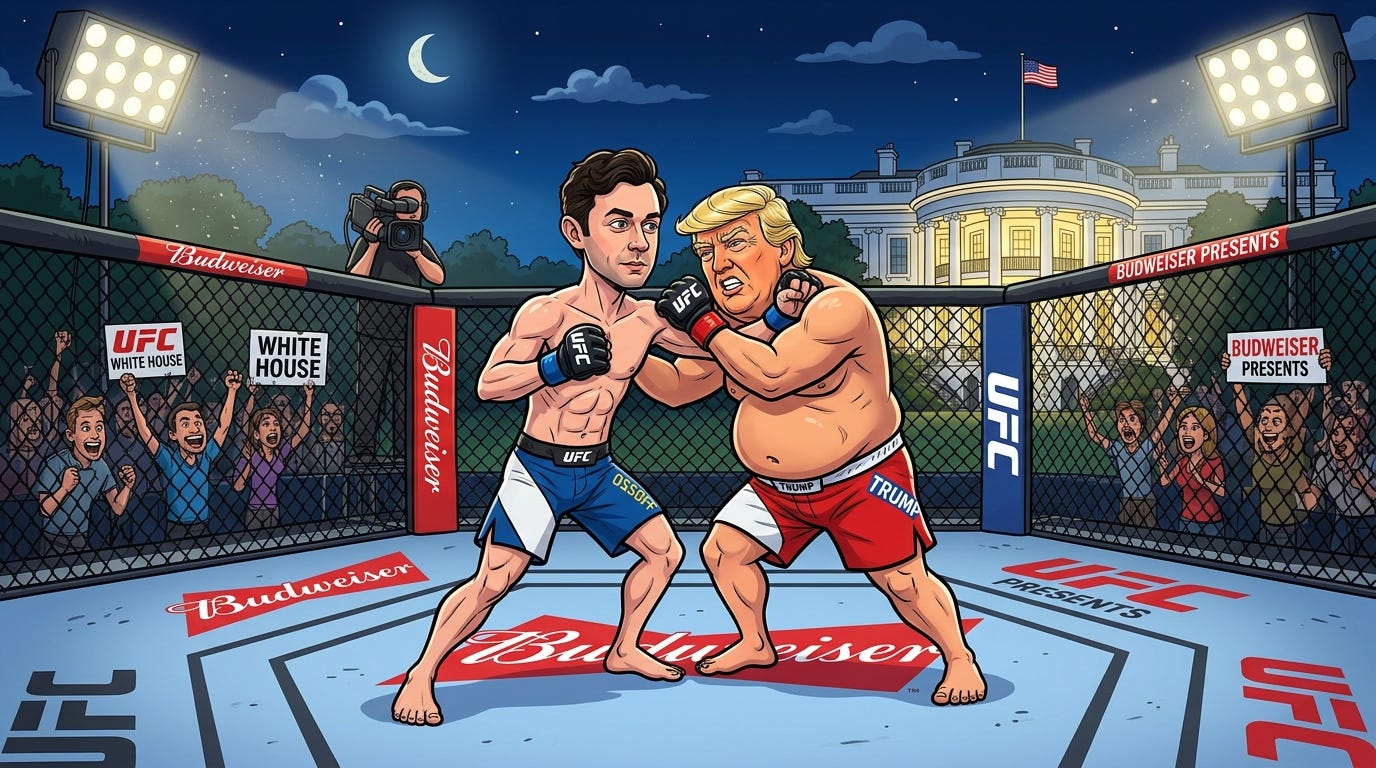
Just when the Democrats thought they had it clinched because of high gas prices from the “little excursion” in Iran, Trump pulls off one of the most brilliant political moves of the last 60 years: a UFC match on the White House Lawn.
It’s a double genius move, like a 1/6 in Wordle. (I’m translating UFC into Manhattan-ese.)
Think about it. First, on Agent Orange’s 80th birthday, instead of everyone talking about a guy who makes Joe Biden sound like Diogenes, we are distracted that our President is a walking coronary wrapped in a babbling Baconator, with ankles the size of the FIFA Peace Prize, who bumbles the names of the countries he wants to bomb or tariff. Instead, we are spending our time bitching about the bong-hitting masses who think Trump is cool as sh*t because he’s hosting that most patriotic of American sports: the UFC.
Coastal metrosexuals and other sissy elites hate the UFC because it stars big macho guys kicking the crap out of each other. It’s the lovechild of martial arts and threepenny opera.
And most American just eat it up! They love it, because YOU hate it, you Coastal prigs who don’t like the sight of blood unless it’s Palestinian or Israeli blood (your pick).
Up to one billion people tuned in to watch the UFC SmackDown, including Lord knows how many ‘Muricans, versus only about eight million of us who watched the World Cup game between Tunisia and Sweden.
Galoots in a Cage
The match in DC isn’t really about 14 galoots in a cage, and it’s not about Tunisia versus IKEA. It’s about Them and Us.Trump, admittedly a bloviating belly-fish who couldn’t hoist himself into a fight cage without J.D. Vance pushing up his rear, got to show that, like most Americans, he’s no pussy, but a Real Guy who’d rather see some big dude punched in the face by a bigger dude than watch some foreigners in little shorts collect little yellow cards.
It’s a total two-fer for The Donald. Up until Trump decided to reduce prices at the pump by blowing up an oil exporting nation, he was the fave of young people, especially young men, of all races, who’ve had it with being put down because they don’t say, “gestating person.”
So, Trump gets to play himself off as a Man’s Man, and at the same time provokes the Progressive pearl-clutching blue-noses into bleating, “For shame! For shame!”
I’m old enough to remember that the last guy to pull this stunt was JFK. Jack Kennedy made a big media sensation out of playing touch football on the White House lawn. Like Trump, Kennedy wanted to show he was a strong young man, not like that old fogie Eisenhower. JFK’s catchword was “Vigor” — though his staff knew that he was usually immobilized, in deep, deep pain from World War II back injuries. (Marlene Dietrich said she had to unwrap the gauze around the President — he was wound up like a mummy — before Kennedy could bang her on the Oval Office desk.)
Not only does Trump prove his unparalleled showmanship, his UFC party taunts the NPR snobs into turning up their noses at this for-profit bacchanalia. In fact, I just heard a commentator on NPR tsk-tsk about “despoiling the Peoples’ House” because of the giant LED billboard hawking Ram Trucks, Bud Light and Trump Coins.
But dear Democrats, there is nothing more patriotic than a UFC gladiator performance that celebrates the guys in Dodge pick-ups running red lights with an open brewski between their knees. The UFC fans know damn well you’ll never see an American-made pick-up in Beverly Hills unless it’s filled with brown-skinned gardeners.
In other words, the UFC match is a vengeance battle: the Real Americans versus the bigshots who sneer at them.
Listen, I come from White Trashville. So, let me give you some no bullshit advice on how to disrupt this looming MAGA resurgence: Let’s set up a GoFundMe to pay for a cage fight between Trump, who claims to be the healthiest president in history — and Sen. John Ossoff!
And whoever loses, stays in the cage until the end of this Administration.
Who’s in with me?
Greg Palast is a once-respected journalist who’s simply goes off into eccentric tangents in his declining years. Nevertheless, he is begging like a dog for funds to create a six-part investigative series on the latest, most devious tools that the Epstein Class employs to steal, disqualify and otherwise play like Satan with your ballot. So, please, make a tax-deductible donation for this pre-Midterm crusade. Or you can save the money for a very large tombstone for democracy.
Trump is giving $300 billion to Iran. This could pay for:
— Student debt elimination for 7.6M Americans
— An end to homelessness in America
— Healthcare subsidies for 22M Americans for nearly a decade
— Medicaid coverage for 3.2M Americans for a decade
— Food assistance for 41M Americans for 3 years
— Federal cancer research for 40+ years
— Free school lunch for every kid in America for over 4 years
— Replacing every lead pipe in America
— Free pre-K for every child in America for over 7 years
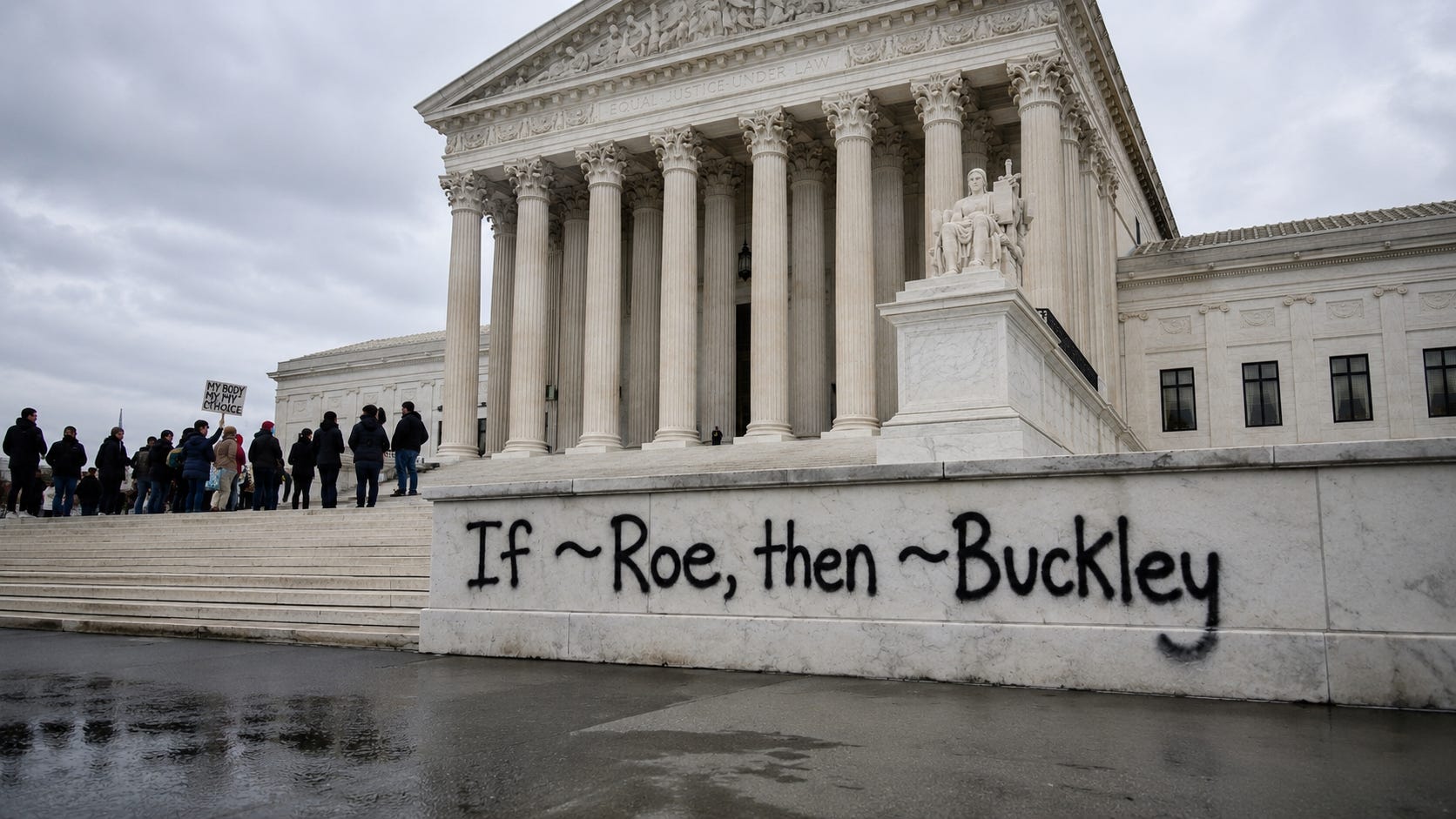
If ~Roe, then ~Buckley
Reaping what originalism has sown.
Lawrence LessigJun 15, 2026
Almost exactly 20 years ago, a brilliant young social activist and technologist convinced me to give up my work on the Internet and copyright and to take up a fight against corruption. Aaron Swartz, who at the age of 13 helped craft RSS, and by the time he was persuading me, had co-founded Reddit and would go on to co-found at least two progressive reform organizations, asked me why I thought I could achieve the policy reform I sought “so long as we had this corrupt institution of Congress.” “It’s not my field, Aaron,” I told him. “You mean as an academic?” “Yes, as an academic,” I replied, “it’s not my field. I study copyright and internet policy.” “What about as a citizen?” he asked. “Is it your field as a citizen?”
He had trapped me. I had tenure. I could work on whatever I thought was important. And I knew he was right. That night, I resolved to give up on copyright and the internet. That summer, I announced the change. And for the last twenty years, I have done everything I could to push this issue to the center of America’s political imagination, writing books, starting at least three reform organizations focused on the issue, starting a SuperPAC to end SuperPACs, and trying to enter the 2016 Democratic primary for President focused exclusively on this issue.
Twenty years later, because of the work of many activists and reform organizations, as well as the sins of many politicians, America has caught up to where Aaron was twenty years ago.
In a study conducted by the Brennan Center for Justice released just last week, overwhelming majorities of Americans from all political perspectives identify corruption as a core political issue. 92% of Americans are either somewhat or very concerned “about corruption influencing U.S. elected officials.” Two-thirds see corruption as “deeply embedded in the institutions of the U.S. government.” A strong majority (55%) believe service in government makes elected officials corrupt. And 88% believe what Aaron had said to me: that this corruption is responsible for the problems our government has failed to solve.
Yet what’s striking about the public’s view of corruption is how far removed it is from the Supreme Court’s conception of corruption. 94% of those surveyed viewed the government’s prioritizing the interests of billionaires as “corrupt.” 89% view billionaires and big corporations having “an easier time having their voices heard” as “corrupt.” But from the Supreme Court’s perspective, neither is “corruption.” From the Supreme Court’s perspective, the only “corruption” Congress has the power to address — at least through means that limit the role of money in politics — is “quid pro quo,” or “this for that” corruption. Bribery is corruption. But the overwhelming influence of the superwealthy is just the way democracy is meant to work.
The Supreme Court grounds its limited view of “corruption” in its interpretation of the First Amendment. That amendment forbids Congress from “abridging the freedom of speech.” If Congress limits money in elections, the Court first said in Buckley v. Valeo (1976), that is an “abridgment” of “the freedom of speech” — unless that money creates a risk of quid pro quo corruption.
Yet it was never clear in Buckley from where the Court derived this view. The Court never explained the original meaning of the First Amendment; it never accounted for its decision to limit Congress’ ability to police the integrity of the political system to the regulation of its narrow view of “corruption.” Instead, the Court simply asserted that this would be the meaning of the framers’ First Amendment, even though, as Justice Thomas has acknowledged while essaying to overturn New York Times v. Sullivan, the framers of the First Amendment meant for Congress to craft the contours of the “freedom of speech,” and certainly never meant for the Court to second guess Congress’ crafting.
This gap between the original meaning of the First Amendment and the Supreme Court’s rendering of that meaning was not surprising in 1976. The Burger Court was not much concerned with the original meaning of the Constitution. That was part of what motivated the current Court to reverse another Burger Court decision, Roe v. Wade. And so it’s surprising that this Court — even the originalists on this Court — continue to block the ability of the people’s representatives to address the problem of corruption where the people’s conception of corruption does not accord with Buckley’s narrow definition. By what right? If we the people in fact never did enact a constitution or an amendment to that constitution that embraced the Supreme Court’s conception, by what authority does the Supreme Court interfere with the people’s view?
The answer — at least for an originalist — is by no right. And while not every justice on the Supreme Court declares themselves to be an originalist, a clear majority of the Court does, and the three who don’t would affirm a conception of “corruption” closer to the view of 92% of Americans than the conception in Buckley.
For the cynical, none of this is surprising. Many view the Supreme Court in partisan terms. By the time we lost him to suicide, that was Aaron’s view as well. For the cynical, to follow originalism to uphold Evangelical Christian values (Dobbs) while ignoring originalism when it comes to the power of the rich (Buckley, Citizens United) is no real surprise.
I don’t believe the Court is a partisan institution. I instead believe that it has simply not yet worked out what a consistent position for its newfound originalist majority should be. And when it finally gets around to considering that question in the context of campaign finance, it will recognize its inconsistency. The question then will be what it will do.
James Madison, the author of the First Amendment, promised us a Congress “dependent on the people alone,” where by the people, he meant, “not the rich more than the poor.” That his words have been read to produce a government plainly “dependent on” the rich more than the poor is not on him. It is the product of a Court unconstrained by the original meaning of his First Amendment. Whether this Court will remain so unconstrained — whether it will continue to impose its values on the Constitution’s text regardless of the meaning the framers gave to that text—is the most urgent constitutional question on the Supreme Court’s docket.
Share
Analysis
June 2, 2026
Money in Politics
Share
The key findings include:
Poll: Voters Want Solutions for Government Corruption
Overwhelming majorities across parties see corruption as a major problem and back measures to limit self-dealing by officials and the influence of money in politics.June 2, 2026


Money in Politics
Share
Greggory DiSalvo/Getty
A new Brennan Center survey finds that large majorities of Republicans, Democrats, and independents share deep-seated concerns about government corruption, which most voters define broadly and blame for many of the country’s biggest problems going unaddressed. The survey, fielded to 2,000 registered voters across the country between April 28 and May 6, also finds widespread support for key anticorruption reforms, such as new limits on money in elections and stronger protections against self-dealing by high-ranking government officials.The key findings include:
- Voters see corruption as a big problem that permeates every government institution. More than 9 in 10 voters (92 percent) — including supermajorities of Republicans (90 percent), Democrats (93 percent), and independents (93 percent) — believe corruption is a big problem in politics and government. Large majorities of voters also view the last two presidents, Congress, and the Supreme Court as corrupt.
- Voters define corruption broadly. Most voters say corruption covers a range of conduct, including officials using their position for personal gain (97 percent) and prioritizing the interests of billionaires and big corporations over those of the public (94 percent), waste of taxpayer dollars (90 percent), and officials who are unresponsive to their constituents (76 percent).
- Voters identify several causes of corruption in elected officials. Voters point to a lack of consequences for corrupt behavior (79 percent), officials prioritizing personal financial gain (79 percent), and campaign contributions from billionaires (64 percent) and big corporations (62 percent) as top causes of corruption.
- Voters blame corruption for kitchen-table issues going unaddressed. Overwhelming majorities believe corruption is responsible for big problems that government has failed to solve (88 percent) and for dysfunctional public services (83 percent).
- Voters want significant reforms. Major anticorruption policy proposals command widespread support across self-identified partisanship, including a constitutional amendment to restore limits on money in elections (79 percent), mandatory disclosure for all federal campaign contributions and spending (85 percent), the creation of a new federal ethics enforcer (81 percent), and a constitutional amendment limiting the president’s pardon power (69 percent).
Analysis
Poll: Voters Want Solutions for Government Corruption
Overwhelming majorities across parties see corruption as a major problem and back measures to limit self-dealing by officials and the influence of money in politics.
June 2, 2026
Money in Politics
Share
Greggory DiSalvo/GettyA new Brennan Center survey finds that large majorities of Republicans, Democrats, and independents share deep-seated concerns about government corruption, which most voters define broadly and blame for many of the country’s biggest problems going unaddressed. The survey, fielded to 2,000 registered voters across the country between April 28 and May 6, also finds widespread support for key anticorruption reforms, such as new limits on money in elections and stronger protections against self-dealing by high-ranking government officials.
The key findings include:
- Voters see corruption as a big problem that permeates every government institution. More than 9 in 10 voters (92 percent) — including supermajorities of Republicans (90 percent), Democrats (93 percent), and independents (93 percent) — believe corruption is a big problem in politics and government. Large majorities of voters also view the last two presidents, Congress, and the Supreme Court as corrupt.
- Voters define corruption broadly. Most voters say corruption covers a range of conduct, including officials using their position for personal gain (97 percent) and prioritizing the interests of billionaires and big corporations over those of the public (94 percent), waste of taxpayer dollars (90 percent), and officials who are unresponsive to their constituents (76 percent).
- Voters identify several causes of corruption in elected officials. Voters point to a lack of consequences for corrupt behavior (79 percent), officials prioritizing personal financial gain (79 percent), and campaign contributions from billionaires (64 percent) and big corporations (62 percent) as top causes of corruption.
- Voters blame corruption for kitchen-table issues going unaddressed. Overwhelming majorities believe corruption is responsible for big problems that government has failed to solve (88 percent) and for dysfunctional public services (83 percent).
- Voters want significant reforms. Major anticorruption policy proposals command widespread support across self-identified partisanship, including a constitutional amendment to restore limits on money in elections (79 percent), mandatory disclosure for all federal campaign contributions and spending (85 percent), the creation of a new federal ethics enforcer (81 percent), and a constitutional amendment limiting the president’s pardon power (69 percent).
Voters See Corruption as a Major Systemic Problem
Voters across the political spectrum identify corruption as a widespread, systemic problem. The poll finds that 92 percent of voters say corruption is a big problem in U.S. politics and government, with 62 percent — including 71 percent Democrats, 64 percent independents, and 53 percent Republicans — calling it a very big problem. Ninety-three percent of voters are somewhat or very concerned about corruption influencing elected officials.
Voters see corruption as endemic to U.S. government. When asked whether corruption is driven by individual choices or is instead an embedded structural problem, nearly two-thirds of voters said the latter. More than half of respondents (55 percent) say the process of running for office and serving in government makes officials corrupt, compared with 45 percent who say people who run for or serve in office tend to be corrupt.
Voters identify the major institutions of the federal government as corrupt, including Congress (85 percent), the president (68 percent), the cabinet (81 percent), and the Supreme Court (62 percent). With respect to Congress, these findings are broadly consistent across every demographic tested: political party, race, education, income, age, urban/suburban/rural, and geographic region.
Voters Define Corruption Expansively
As for what qualifies as corruption, voters across party lines are in agreement. They understand corruption broadly, centered in part on the perception that government primarily works for the ultrawealthy and well-connected and doesn’t prioritize the interests of most voters. The poll finds that while 97 percent of voters say that a government official using their office for personal gain is corrupt, almost as many (89 percent) say the same about billionaires and big corporations having an easier time being heard than the general public.
Large swaths of the electorate across party lines also associate corruption with government inefficiency and inaccessibility. Ninety percent say that taxpayer dollars spent on programs that do not seem to benefit the public constitutes corruption, and 79 percent point to Congress not focusing on the problems faced by the public as another example.
Please indicate if the following are examples of corruption.
Total Yes — very and somewhat corrupt
0%20%40%60%80%100%
A government official who uses their position for personal gain
98%
96%
96%
A government official who prioritizes the interests of billionaires and big corporations over those of the public
97%
94%
91%
A government official who bends the rule of law
96%
95%
94%
A government official who lies to the public
94%
94%
94%
Billionaires and big corporations having an easier time having their voices heard by the government than the general public
94%
90%
83%
Taxpayer dollars spent on programs that do not seem to benefit the public
90%
88%
94%
Congress not focusing on solving the problems faced by the public
82%
77%
80%
A government official who is unresponsive to their constituents
78%
75%
76%
Democrat
Independent
Republican
Source: Brennan Center poll of 2,000 registered voters conducted between April 28 and May 6, 2026
Voters Agree Corruption Has Many Causes
Voters across the political spectrum most often say corruption is caused by a lack of consequences for corrupt behavior (79 percent) and elected officials prioritizing personal gain (79 percent). Not far behind, and again with large bipartisan majorities, were campaign contributions from big corporations and billionaires, with 62 and 64 percent.
Voters Believe Corruption Has Serious Consequences for Their Daily Lives
Voters link corruption directly to kitchen-table issues and the problems with government they experience daily. Eighty-eight percent blame corruption for the persistence of today’s biggest problems that government has failed to solve, and 83 percent say corruption is responsible for public services not working properly.
Eighty-nine percent of voters — overwhelming majorities of Democrats, Republicans, and independents — say corruption is responsible for policies that benefit billionaires and big corporations at the expense of the American people.
Demand for Change Across Party Lines
Voters’ perception of widespread corruption and its consequences for their daily lives translates into a mandate for solutions. Every reform tested in this survey polled nearly at or above 70 percent — with majority support across party lines. In fact, most proposals commanded supermajority support from each party and independents. They also garnered widespread support across other demographics, including race, income, age, gender, education, and geographic region. Even among the small minority of voters (8 percent) who do not view corruption as a big problem, nearly every anticorruption proposal received majority support.
An overwhelming majority of voters across party lines support campaign finance reforms. These include legislation to end “dark money,” or funds from groups that do not disclose their donors (85 percent overall, with 88 percent support among Democrats, 84 percent among independents, and 85 percent support among Republicans) and a constitutional amendment to overturn Supreme Court rulings that have struck down limits on money in elections (79 percent overall, including 84 percent support among Democrats, 81 percent support among independents, and 75 percent support among Republicans).
Supermajorities in regions across the country support amending the Constitution to restore campaign finance limits, with backing from more than three-quarters of voters in the West (82 percent), South (78 percent), Northeast (81 percent), and Midwest (76 percent). The same is true across the urban (81 percent), suburban (79 percent), and rural (76 percent) divide.
Voters also support major reforms to curb self-dealing at the highest levels of government. Voters of all political affiliations, for example, are aligned in wanting to strengthen federal ethics laws for all three branches of the federal government. That includes banning presidential conflicts of interest (83 percent), requiring the Supreme Court to adopt a binding code of ethics (84 percent), banning congressional stock trading (81 percent), creating a new federal agency to enforce anticorruption laws (81 percent), and passing a constitutional amendment to limit the president’s unilateral power to issue pardons (69 percent).
At least 70 percent of young voters (ages 18 to 34) back the reforms aimed at addressing the misuse of government power for graft. These solutions also have large majority support across all other age groups, with voters 65 or older often showing the highest levels of support.
The Brennan Center’s survey shows that the public believes corruption is serious and exists in all corners of government. It also offers some hope: Americans across party lines overwhelmingly support solutions that address the role of concentrated wealth in politics and unchecked self-enrichment by those in power in order to restore the government’s ability to serve the public and confidence in government.
Research Analyst Emily Gill made substantial contributions to the survey instrument and underlying research for this analysis.


Similar threads

- Replies
- 0
- Views
- 22
- Replies
- 12
- Views
- 115


